Chapter 22
Earthʼs Interior
   Section 22.1
 Earthʼs Structure
Objectives

Describe the science of geology
Describe the main layers of Earthʼs
 Interior.
How have scientists learned about
Earthʼs Interior?
Indirect measurements
   Wave energy


Direct measurements
   Drilling
      Deepest hole drilled was 12 km
The Science of Geology

 Geology - the study of Earthʼs composition
  and structure
   Composition - what itʼs made of
   Structure - how itʼs put together
 Geologists
   Geo - Earth
   Ology - the study of
   Ists - people who
The Science of Geology (cont.)

 Geologists categorize forces that change the
  Earth into:
   Destructive forces - break down/destroy
   Constructive forces - build/contruct
 Modern Geology
   Began 1700ʼs
   James Hutton, scottish physican and farmer
The Science of Geology (cont.)

Hutton formed the principle of
 Uniformitarianism
   the forces acting on the Earth now are the
    same ones that have existed I the past
A Cross Section of Earth

 Like these “Scotch
  Eggs”:
  Breading - crust
  White - mantle
  Yellow - core
The Crust

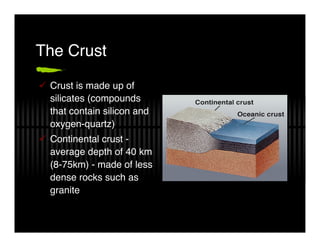
 Crust is made up of
  silicates (compounds
  that contain silicon and
  oxygen-quartz)
 Continental crust -
  average depth of 40 km
  (8-75km) - made of less
  dense rocks such as
  granite
The Crust (cont.)

 Oceanic crust -
  composed of more
  dense rocks such as
  basalt
 Average thickness of 7
  km
The Mantle

 Hot but solid rock
 Temper and
  pressure increase
  the deeper you get
  into the mantle
 Rich in iron and
  magnesium
 Denser than crust
The Mantle (cont.)

 3 layers
  Lithosphere - cool,
  rigid rock (top layer)
  Aesthenosphere -
  softer, weaker rock with
  the ability to flow (like
  taffy)
  Mesosphere -
  stronger lower part of
  the mantle
The core
 Composed of iron
  and nickel
 Temp. estimated to
  be 5500 degrees
  Celsius
 Outer core - liquid
  Rotation creates an
  electric current that in
  turn creates the
  magnetic field

Earth 22.1

  • 1.
    Chapter 22 Earthʼs Interior Section 22.1 Earthʼs Structure
  • 2.
    Objectives Describe the scienceof geology Describe the main layers of Earthʼs Interior.
  • 3.
    How have scientistslearned about Earthʼs Interior? Indirect measurements  Wave energy Direct measurements  Drilling  Deepest hole drilled was 12 km
  • 4.
    The Science ofGeology  Geology - the study of Earthʼs composition and structure  Composition - what itʼs made of  Structure - how itʼs put together  Geologists  Geo - Earth  Ology - the study of  Ists - people who
  • 5.
    The Science ofGeology (cont.)  Geologists categorize forces that change the Earth into:  Destructive forces - break down/destroy  Constructive forces - build/contruct  Modern Geology  Began 1700ʼs  James Hutton, scottish physican and farmer
  • 6.
    The Science ofGeology (cont.) Hutton formed the principle of Uniformitarianism  the forces acting on the Earth now are the same ones that have existed I the past
  • 7.
    A Cross Sectionof Earth  Like these “Scotch Eggs”: Breading - crust White - mantle Yellow - core
  • 8.
    The Crust  Crustis made up of silicates (compounds that contain silicon and oxygen-quartz)  Continental crust - average depth of 40 km (8-75km) - made of less dense rocks such as granite
  • 9.
    The Crust (cont.) Oceanic crust - composed of more dense rocks such as basalt  Average thickness of 7 km
  • 10.
    The Mantle  Hotbut solid rock  Temper and pressure increase the deeper you get into the mantle  Rich in iron and magnesium  Denser than crust
  • 11.
    The Mantle (cont.) 3 layers Lithosphere - cool, rigid rock (top layer) Aesthenosphere - softer, weaker rock with the ability to flow (like taffy) Mesosphere - stronger lower part of the mantle
  • 12.
    The core  Composedof iron and nickel  Temp. estimated to be 5500 degrees Celsius  Outer core - liquid Rotation creates an electric current that in turn creates the magnetic field