PERCEPTION AND MEMORY DISORDERS. DELUSIONS
AND HALLUCINATIONS KORSAKOFF SYNDROME.
PSYCHOPATHOLOGY OF EMOTIONS. THE SYMPTOMS
OF EMOTIONAL DISORDERS. DEPRESSIVE AND MANIC
SYNDROMES
● Perception is a process of becoming aware of what is presented through the sense
organs
● Imagery means an experience within the mind, usually without the sense of reality that
is part of reality
● Pseudoillusions – distorted perception of objects which may occur when the general
level of sensory stimulation is reduced
● Illusions are psychopathological phenomena; they appear mainly in conditions of
qualitative disturbances of consciousness (missing insight)
● Hallucinations are percepts without any obvious stimulus to the sense organs; the
patient is unable to distinguish them from reality. These sensory impressions are
generated by the mind rather than by any external stimuli, and may be seen, heard, felt,
and even smelled or tasted. They can appear in the form of visions, voices or sounds,
tactile feelings (known as haptic hallucinations), smells, or tastes.
Hallucinations
● auditory (acousma, voices)
● visual
● olfactory
● gustatory
● tactile (or deep somatic)
● extracampine, inadequate
● intrapsychic (belong rather to disturbances of thinking)
● hypnagogic and hypnopompic (hypnexagogic) Pseudohallucinations –
patient can distinguish them from reality
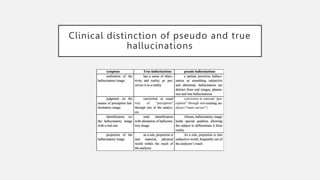
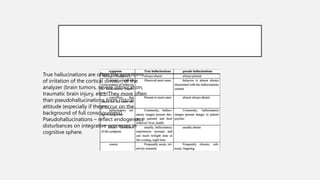
Clinical distinction of pseudo and true
hallucinations
True hallucinations are often the symptoms
of irritation of the cortical division of the
analyzer (brain tumors, severe intoxication,
traumatic brain injury, etc.). They more often
than pseudohallucinations form critical
attitude (especially if they occur on the
background of full consciousness).
Pseudohallucinations – reflect endogenous
disturbances on integrative processes in
cognitive sphere.
Memory disorders. Korsakoff syndrome
• Memory is a process of storing information and experiences. It is a main mechanism of adaptation
which makes us able to hold psychological phenomena like, obtaining feelings, emotions, doing
something, some actions for a long time in the brain. The work of memory is connected with the
main elements of process of perception and thought, like representation and understanding. It is the
basic ground of work of intellect.
• Memory can be of two types: 1. Short term memory (memory of recent events up to 3 – 5 months) .
2. Long term memory (memory of past events, from childhood).
• ● Short term memory in most of the cases is the first to be affected. As a rule, in case of memory
loss patient tends to forget the most recent memories first. Like an old man can remember his
acquired knowledge from university but can‘t remember if he ate his breakfast. In the next step, he
may forget his knowledge that he obtained in university or at work, but remembers events in his
childhood. In the end the childhood memory may also be lost but he knows his name, surname,
street address (where he lived at his childhood). At the last stage he even can‘t remember his name.
But in practice we seldom see this step. (even patients suffering from Alzheimer s, could tell their
names). Disorder of memory in most of the cases is related to organic defect of brain. But sometimes
it may also be secondary to other psychological disorder
. Therefore it is important to include the attention, consciousness of the patient during grading his memory.
● Short – term memory (working memory) – for verbal and visual information, retained for 15 – 20 sec., low capacity
● Long-term memory – wide capacity and more permanent storage
● declarative (explicit) memory – episodic (for events) or semantic (for language and knowledge)
● procedural memory – for motor arts
● priming – unconscious memory
● conditioning – classic or emotional Disorders of memory:
● Amnesia – inability to recall past events ● Jamais vu, déja vu
● Confabulation, amnesic disorientation, Korsakoff syndrome
● Hypomnesia
● Hypermnesia
Disorders of memory: Disorder of memory conditionally may be divided in
dismnesia and paramnesia.
● Dismnesia contains hypermnesia, hypomnesia, and different types of
amnesia.
● Hypermnesia is a nonproductive, some unfairly actualization of past
experiences. A flood of memory about accidentally occurred situations
which had negligible effect on life, doesn‘t improve productivity of
thinking, but merely distracts the patient and disturbs him to obtain new
information. Hypermnesia is seen in mania episodes or sometimes is seen
in disorders of consciousness. It is also observed in case of intake of
psychotropic drugs (marijuana, LSD, opioids, amphetamines etc.), or
accompanied by epileptic paroxysm
● Hypomnesia is general weakening of memory. In this case the patient
remembers new names, dates, with difficulty and forgets details about
events. The patients have to write the important information to remember
them, without these notes they cannot remember. During reading a book,
he has to return at previous pages to remember and connect what he is
reading now. Hypomnesia is often accompanied by a symptom:
anecphoria (greek word) i.e. when the patient cannot remember names,
words, unless he is given a clue or hint.
Hypomnesia is related to broad spectrum organic diseases of brain
(basically vascular), sometimes it is seen in functional disorders of
psychology e.g. in condition of fatigue (asthenic syndrome).
● Amnesia is a row of diseases characterized by loss of part of memory.
● Retrograde amnesia is loss of memory till the beginning of the disease
(in most of the cases it is connected with acute brain catastrophe with loss
of consciousness). A part of memory of the past is lost in this case.

psychology.pptx

  • 1.
    PERCEPTION AND MEMORYDISORDERS. DELUSIONS AND HALLUCINATIONS KORSAKOFF SYNDROME. PSYCHOPATHOLOGY OF EMOTIONS. THE SYMPTOMS OF EMOTIONAL DISORDERS. DEPRESSIVE AND MANIC SYNDROMES
  • 2.
    ● Perception isa process of becoming aware of what is presented through the sense organs ● Imagery means an experience within the mind, usually without the sense of reality that is part of reality ● Pseudoillusions – distorted perception of objects which may occur when the general level of sensory stimulation is reduced ● Illusions are psychopathological phenomena; they appear mainly in conditions of qualitative disturbances of consciousness (missing insight) ● Hallucinations are percepts without any obvious stimulus to the sense organs; the patient is unable to distinguish them from reality. These sensory impressions are generated by the mind rather than by any external stimuli, and may be seen, heard, felt, and even smelled or tasted. They can appear in the form of visions, voices or sounds, tactile feelings (known as haptic hallucinations), smells, or tastes.
  • 3.
    Hallucinations ● auditory (acousma,voices) ● visual ● olfactory ● gustatory ● tactile (or deep somatic) ● extracampine, inadequate ● intrapsychic (belong rather to disturbances of thinking) ● hypnagogic and hypnopompic (hypnexagogic) Pseudohallucinations – patient can distinguish them from reality
  • 4.
    Clinical distinction ofpseudo and true hallucinations
  • 5.
    True hallucinations areoften the symptoms of irritation of the cortical division of the analyzer (brain tumors, severe intoxication, traumatic brain injury, etc.). They more often than pseudohallucinations form critical attitude (especially if they occur on the background of full consciousness). Pseudohallucinations – reflect endogenous disturbances on integrative processes in cognitive sphere.
  • 6.
    Memory disorders. Korsakoffsyndrome • Memory is a process of storing information and experiences. It is a main mechanism of adaptation which makes us able to hold psychological phenomena like, obtaining feelings, emotions, doing something, some actions for a long time in the brain. The work of memory is connected with the main elements of process of perception and thought, like representation and understanding. It is the basic ground of work of intellect. • Memory can be of two types: 1. Short term memory (memory of recent events up to 3 – 5 months) . 2. Long term memory (memory of past events, from childhood). • ● Short term memory in most of the cases is the first to be affected. As a rule, in case of memory loss patient tends to forget the most recent memories first. Like an old man can remember his acquired knowledge from university but can‘t remember if he ate his breakfast. In the next step, he may forget his knowledge that he obtained in university or at work, but remembers events in his childhood. In the end the childhood memory may also be lost but he knows his name, surname, street address (where he lived at his childhood). At the last stage he even can‘t remember his name. But in practice we seldom see this step. (even patients suffering from Alzheimer s, could tell their names). Disorder of memory in most of the cases is related to organic defect of brain. But sometimes it may also be secondary to other psychological disorder
  • 7.
    . Therefore itis important to include the attention, consciousness of the patient during grading his memory. ● Short – term memory (working memory) – for verbal and visual information, retained for 15 – 20 sec., low capacity ● Long-term memory – wide capacity and more permanent storage ● declarative (explicit) memory – episodic (for events) or semantic (for language and knowledge) ● procedural memory – for motor arts ● priming – unconscious memory ● conditioning – classic or emotional Disorders of memory: ● Amnesia – inability to recall past events ● Jamais vu, déja vu ● Confabulation, amnesic disorientation, Korsakoff syndrome ● Hypomnesia ● Hypermnesia
  • 8.
    Disorders of memory:Disorder of memory conditionally may be divided in dismnesia and paramnesia. ● Dismnesia contains hypermnesia, hypomnesia, and different types of amnesia. ● Hypermnesia is a nonproductive, some unfairly actualization of past experiences. A flood of memory about accidentally occurred situations which had negligible effect on life, doesn‘t improve productivity of thinking, but merely distracts the patient and disturbs him to obtain new information. Hypermnesia is seen in mania episodes or sometimes is seen in disorders of consciousness. It is also observed in case of intake of psychotropic drugs (marijuana, LSD, opioids, amphetamines etc.), or accompanied by epileptic paroxysm
  • 9.
    ● Hypomnesia isgeneral weakening of memory. In this case the patient remembers new names, dates, with difficulty and forgets details about events. The patients have to write the important information to remember them, without these notes they cannot remember. During reading a book, he has to return at previous pages to remember and connect what he is reading now. Hypomnesia is often accompanied by a symptom: anecphoria (greek word) i.e. when the patient cannot remember names, words, unless he is given a clue or hint.
  • 10.
    Hypomnesia is relatedto broad spectrum organic diseases of brain (basically vascular), sometimes it is seen in functional disorders of psychology e.g. in condition of fatigue (asthenic syndrome). ● Amnesia is a row of diseases characterized by loss of part of memory. ● Retrograde amnesia is loss of memory till the beginning of the disease (in most of the cases it is connected with acute brain catastrophe with loss of consciousness). A part of memory of the past is lost in this case.