Membrane transport
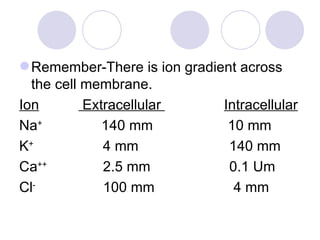
Remember-There is ion gradient across the cell membrane. Ion   Extracellular  Intracellular Na +   140 mm  10 mm K +  4 mm  140 mm Ca ++  2.5 mm  0.1 Um Cl -  100 mm  4 mm
Cell membranes maintain their gradients by: Preventing ion flux Active transport of ions from one side to the other side of P.M. The movement of materials into and out of the cells influences the internal concentration of molecules. The ability of cells to move materials in and out can determine whether they will live or die
Transport is either  passive   or   active PASSIVE TRANSPORT No energy expenditure Passive or inactive because the force moving these molecules or ions is  NOT  external to them. It comes from  KINETIC ENERGY  the particles already have.
- They have this motion because they have  heat. All molecules are in constant motion above a very cold temperature called  absolute zero   ( -273 C ) Amount of molecular movement depends on; 1. Temperature 2. Physical properties
Less heat = Less kinetic energy = Less motion I )  Diffusion (  simple diffusion ) It is the movement of a substance from an area of its greater concentration to an area of its lesser concentration. This is called  down the concentration gradient . When we have difference in concentration between 2 regions =  Concentration gradient The diffusion is driven by   the kinetic energy the molecules posses.
Diffusion occurs when molecules move randomly away from each other in liquid or gas The rate of diffusion depends on; 1. Temperature- The higher….the greater 2. Size- Smaller the greater 3. Type of diffusing molecules - Most short distance transport of materials into and out of cells occur by diffusion.
When molecules are dispersed evenly, there is no longer any diffusion because there is no further concentration gradient =  State of equilibrium II )  Osmosis - It is the diffusion of water across a semipermeable membrane( from an area of high concentration of water to a region of low concentration )
Therefore, osmosis occurs in response to the concentration of solutes dissolved in water. In hypertonic solution, water diffuses out of the cell till equilibrium is established. If cells lose too much water … Shrivel & shrink On the reverse, in hypotonic solution, water will move to the inside… cell swelling
- Many cells function in hypotonic environment such as unicellular  fish water organisms . Water diffuses constantly into these organisms - Since they require lower concentrations of water in the cytosol to function normally, these unicellular organisms must rid themselves of the excess of water that enters by osmosis.
An example;  paramecia . They do this through  contractile vacuoles . Such vacuoles collect the excess of water and then contract pumping the water out of the cell.  Unlike diffusion and osmosis, the pumping action requires energy and thus it is a form of active transport
III ) Facilitated diffusion (mediated transport)   Most  molecules cannot cross the membrane by simple diffusion. This type of diffusion utilizes membrane protein channels to allow molecules to freely diffuse in and out of the cell These channels come into greatest use with small ions ( K + , Na + , Cl -  ) =  Ion channels.
The speed of transport is limited by the number of the protein channels available, whereas the speed of diffusion is dependent only on  concentration gradient These proteins are called; 1. Carrier proteins  OR 2. Porters  OR 3.Porting system  OR 4. Transport system  OR
5. Pumps  OR 6. Translocases Carrier proteins change shape when molecules attach to them and this change of proteins enables the molecule to cross the membrane The facilitated diffusion can help substances move either into or out of the cell depending on  concentration gradient
An example; facilitated diffusion of glucose transport into the cell. Some ion channels are  always open .  Others have  gates  that open to allow ions to pass or close to stop their passage. This happens in response to conditions in the environment and the cell and these conditions are;
Stretching of the cell membrane Electrical signals Chemicals in cytosol or external environment Steps of transport : 1. Recognition of the substance to be  transported 2. Translocation: Movement of the  substance from one side of the  membrane to another
3. Release: to the other side of the  membrane 4. Recovery: Return of the carrier to the  original site. The carrier proteins are enzyme-like in the following ways;
1 .  They are specific 2. Transport can be inhibited by specific  inhibitors. 3. They exhibit saturation Diffusion is not saturable and its rate increases with increased concentration.
CHARACTERISTICS OF CARRIERS Change conformation during transport Sometimes, carriers move more than one molecule simultaneously They do not catalyse the reaction
Terminology Uniport = Single molecule moving in one direction Symport = Two molecules move in the same direction simultaneously Antiport = Two molecules move in opposite directions simultaneously
ACTIVE TRANSPORT Energy expenditure Take molecules up and down their concentration ( against concentration gradient ) Active transport is limited by the number of protein transporter molecules present
Types: Primary Secondary - Primary: Using energy through ATP hydrolysis at the cell membrane itself to cause a conformation change that results in the transport of molecules through the protein. The best known is;
NA + -K +  pump The structure of Na + -K +  pump is a tetramer  ( of 2 types  α 2 β 2 ). The  β  subunit is a glycoprotein with the carbohydrate on the external surface of membrane
The Na + -K +  pump or Na + -K +  ATPase is an antiport This pump is specific for Na +  and can substitute for K + Stoichiometry: 3 Na +  getting out and 2 K +  in for every ATP hydrolysis The proposed activity of Na + -K +  ATPase  (pump )shows the role of ATP in effecting the conformational change of the carrier
STEPS 1. Na +  attaches on the inside of the membrane 2. Protein conformation changes which are due to; a. Phosphorylation of protein by ATP b. Affinity of protein to Na decreases 3. Na +  leaves
4. K +  from outside binds 5. K +  de-phosphorylates the protein 6. The protein now goes to its original state 7. K +  now dissociates Secondary : Using energy to establish a gradient across the cell membrane.
Then utilizing the gradient to transport  the molecule of interest. E. coli establishes a proton ( H +  ) gradient across the cell membrane using energy to pump protons out of the cell.  These protons are coupled to lactose at the  lactose permease transmembrane protein
The lactose permease uses energy of the proton moving down its concentration gradient to transport lactose into the cell This coupled transport in the same direction across the membrane is called  symport E. coli uses similar proton to transport ribose, arabinose and several amino acids
Another example is Na + -glucose secondary transport In this, using Na + -K +  ATPase as the first step generating a strong Na gradient across the cell membrane Then, Na + -glucose symport protein uses Na +  gradient to transport glucose into the cell
- This system is used in a novel way in human gut epithelium. These cells take in glucose and Na +  from the intestine and transport them through the blood stream using the concentration action of Na + -glucose symport, glucose permease ( a glucose facilitated diffusion protein and Na + -K +  pumps)
Another example is Na-amino acid symport There are at least 6 proteins of different specificity that employ the mechanism Active transport-Movement in vesicles-Bulk transport-Endocytosis & exocytosis
Some molecules as complex proteins are  TOO LARGE  to cross the cell membrane Large molecules, food and others are packed in membrane bound sacs= vesicles and move across the membrane Types 1. Endocytosis ( pinocytosis &  phagocytosis )  2. Exocytosis
1.Endocytosis: Begings when a particle contacts the plasma membrane. An invagination of the membrane occurs until the particle is completely wrapped in membrane 2.The wrapped particle is now inside the cell 3.The vesicle can fuse with lysosomes or they release their content inside the cell
A/ Phagocytosis B/ Pinocytosis The difference between the 2 has to do with the size of the molecule. Phagocytosis ( cell eating ): Solid material is involved Pinocytosis ( cell drinking ) occurs when small particles are in solution are ingested
-  Exocytosis: Reverse of endocytosis. Plasma membrane is also involved.These products are packaged in Golgi apparatus which then fuse with the cell membrane and then to the outside. E.g. waste products, mucus

4. membrane transport 1

  • 1.
  • 2.
    Remember-There is iongradient across the cell membrane. Ion Extracellular Intracellular Na + 140 mm 10 mm K + 4 mm 140 mm Ca ++ 2.5 mm 0.1 Um Cl - 100 mm 4 mm
  • 3.
    Cell membranes maintaintheir gradients by: Preventing ion flux Active transport of ions from one side to the other side of P.M. The movement of materials into and out of the cells influences the internal concentration of molecules. The ability of cells to move materials in and out can determine whether they will live or die
  • 4.
    Transport is either passive or active PASSIVE TRANSPORT No energy expenditure Passive or inactive because the force moving these molecules or ions is NOT external to them. It comes from KINETIC ENERGY the particles already have.
  • 5.
    - They havethis motion because they have heat. All molecules are in constant motion above a very cold temperature called absolute zero ( -273 C ) Amount of molecular movement depends on; 1. Temperature 2. Physical properties
  • 6.
    Less heat =Less kinetic energy = Less motion I ) Diffusion ( simple diffusion ) It is the movement of a substance from an area of its greater concentration to an area of its lesser concentration. This is called down the concentration gradient . When we have difference in concentration between 2 regions = Concentration gradient The diffusion is driven by the kinetic energy the molecules posses.
  • 7.
    Diffusion occurs whenmolecules move randomly away from each other in liquid or gas The rate of diffusion depends on; 1. Temperature- The higher….the greater 2. Size- Smaller the greater 3. Type of diffusing molecules - Most short distance transport of materials into and out of cells occur by diffusion.
  • 8.
    When molecules aredispersed evenly, there is no longer any diffusion because there is no further concentration gradient = State of equilibrium II ) Osmosis - It is the diffusion of water across a semipermeable membrane( from an area of high concentration of water to a region of low concentration )
  • 9.
    Therefore, osmosis occursin response to the concentration of solutes dissolved in water. In hypertonic solution, water diffuses out of the cell till equilibrium is established. If cells lose too much water … Shrivel & shrink On the reverse, in hypotonic solution, water will move to the inside… cell swelling
  • 10.
    - Many cellsfunction in hypotonic environment such as unicellular fish water organisms . Water diffuses constantly into these organisms - Since they require lower concentrations of water in the cytosol to function normally, these unicellular organisms must rid themselves of the excess of water that enters by osmosis.
  • 11.
    An example; paramecia . They do this through contractile vacuoles . Such vacuoles collect the excess of water and then contract pumping the water out of the cell. Unlike diffusion and osmosis, the pumping action requires energy and thus it is a form of active transport
  • 12.
    III ) Facilitateddiffusion (mediated transport) Most molecules cannot cross the membrane by simple diffusion. This type of diffusion utilizes membrane protein channels to allow molecules to freely diffuse in and out of the cell These channels come into greatest use with small ions ( K + , Na + , Cl - ) = Ion channels.
  • 13.
    The speed oftransport is limited by the number of the protein channels available, whereas the speed of diffusion is dependent only on concentration gradient These proteins are called; 1. Carrier proteins OR 2. Porters OR 3.Porting system OR 4. Transport system OR
  • 14.
    5. Pumps OR 6. Translocases Carrier proteins change shape when molecules attach to them and this change of proteins enables the molecule to cross the membrane The facilitated diffusion can help substances move either into or out of the cell depending on concentration gradient
  • 15.
    An example; facilitateddiffusion of glucose transport into the cell. Some ion channels are always open . Others have gates that open to allow ions to pass or close to stop their passage. This happens in response to conditions in the environment and the cell and these conditions are;
  • 16.
    Stretching of thecell membrane Electrical signals Chemicals in cytosol or external environment Steps of transport : 1. Recognition of the substance to be transported 2. Translocation: Movement of the substance from one side of the membrane to another
  • 17.
    3. Release: tothe other side of the membrane 4. Recovery: Return of the carrier to the original site. The carrier proteins are enzyme-like in the following ways;
  • 18.
    1 . They are specific 2. Transport can be inhibited by specific inhibitors. 3. They exhibit saturation Diffusion is not saturable and its rate increases with increased concentration.
  • 19.
    CHARACTERISTICS OF CARRIERSChange conformation during transport Sometimes, carriers move more than one molecule simultaneously They do not catalyse the reaction
  • 20.
    Terminology Uniport =Single molecule moving in one direction Symport = Two molecules move in the same direction simultaneously Antiport = Two molecules move in opposite directions simultaneously
  • 21.
    ACTIVE TRANSPORT Energyexpenditure Take molecules up and down their concentration ( against concentration gradient ) Active transport is limited by the number of protein transporter molecules present
  • 22.
    Types: Primary Secondary- Primary: Using energy through ATP hydrolysis at the cell membrane itself to cause a conformation change that results in the transport of molecules through the protein. The best known is;
  • 23.
    NA + -K+ pump The structure of Na + -K + pump is a tetramer ( of 2 types α 2 β 2 ). The β subunit is a glycoprotein with the carbohydrate on the external surface of membrane
  • 24.
    The Na +-K + pump or Na + -K + ATPase is an antiport This pump is specific for Na + and can substitute for K + Stoichiometry: 3 Na + getting out and 2 K + in for every ATP hydrolysis The proposed activity of Na + -K + ATPase (pump )shows the role of ATP in effecting the conformational change of the carrier
  • 25.
    STEPS 1. Na+ attaches on the inside of the membrane 2. Protein conformation changes which are due to; a. Phosphorylation of protein by ATP b. Affinity of protein to Na decreases 3. Na + leaves
  • 26.
    4. K + from outside binds 5. K + de-phosphorylates the protein 6. The protein now goes to its original state 7. K + now dissociates Secondary : Using energy to establish a gradient across the cell membrane.
  • 27.
    Then utilizing thegradient to transport the molecule of interest. E. coli establishes a proton ( H + ) gradient across the cell membrane using energy to pump protons out of the cell. These protons are coupled to lactose at the lactose permease transmembrane protein
  • 28.
    The lactose permeaseuses energy of the proton moving down its concentration gradient to transport lactose into the cell This coupled transport in the same direction across the membrane is called symport E. coli uses similar proton to transport ribose, arabinose and several amino acids
  • 29.
    Another example isNa + -glucose secondary transport In this, using Na + -K + ATPase as the first step generating a strong Na gradient across the cell membrane Then, Na + -glucose symport protein uses Na + gradient to transport glucose into the cell
  • 30.
    - This systemis used in a novel way in human gut epithelium. These cells take in glucose and Na + from the intestine and transport them through the blood stream using the concentration action of Na + -glucose symport, glucose permease ( a glucose facilitated diffusion protein and Na + -K + pumps)
  • 31.
    Another example isNa-amino acid symport There are at least 6 proteins of different specificity that employ the mechanism Active transport-Movement in vesicles-Bulk transport-Endocytosis & exocytosis
  • 32.
    Some molecules ascomplex proteins are TOO LARGE to cross the cell membrane Large molecules, food and others are packed in membrane bound sacs= vesicles and move across the membrane Types 1. Endocytosis ( pinocytosis & phagocytosis ) 2. Exocytosis
  • 33.
    1.Endocytosis: Begings whena particle contacts the plasma membrane. An invagination of the membrane occurs until the particle is completely wrapped in membrane 2.The wrapped particle is now inside the cell 3.The vesicle can fuse with lysosomes or they release their content inside the cell
  • 34.
    A/ Phagocytosis B/Pinocytosis The difference between the 2 has to do with the size of the molecule. Phagocytosis ( cell eating ): Solid material is involved Pinocytosis ( cell drinking ) occurs when small particles are in solution are ingested
  • 35.
    - Exocytosis:Reverse of endocytosis. Plasma membrane is also involved.These products are packaged in Golgi apparatus which then fuse with the cell membrane and then to the outside. E.g. waste products, mucus