CELL MEMBRANE
TRANSPORT
PRESENTED BY
MD FAHIM SHAHRIAR
TEACHER, SINDH BIOTECHNOLOGISTS ASSOCIATION
Factors Affecting the Direction of Transport
(passive transport): Energy, Concentration
(active transport):
*Driving Forces Acting on Molecules:
Chemical Driving Forces: Concentration gradient
Electrical Driving Forces: Membrane potential
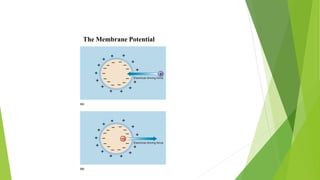
The Membrane Potential
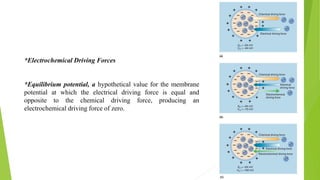
*Electrochemical Driving Forces
*Equilibrium potential, a hypothetical value for the membrane
potential at which the electrical driving force is equal and
opposite to the chemical driving force, producing an
electrochemical driving force of zero.
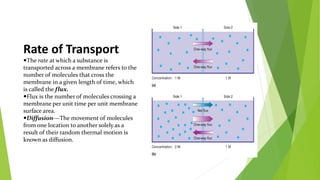
Rate of Transport
The rate at which a substance is
transported across a membrane refers to the
number of molecules that cross the
membrane in a given length of time, which
is called the flux.
Flux is the number of molecules crossing a
membrane per unit time per unit membrane
surface area.
Diffusion---The movement of molecules
from one location to another solely as a
result of their random thermal motion is
known as diffusion.
Passive Transport
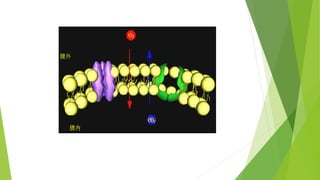
*Simple Diffusion--- Biological membrane’s lipid bilayer.
*Although the movement of individual molecules is random, the net flux
always proceeds from regions of higher concentration to regions of
lower concentration.
*At last, the system reached diffusion equilibrium No further change in
the molecular concentration of the two compartments will occur, since
equal numbers of molecules will continue to diffuse in both directions
between the two compartments.
The magnitude of the net flux depends on several factors:
the magnitude of the driving force, the membrane surface area, and the
permeability of the membrane.
(1) Concentration difference
(2) Temperature
(3) Mass of the molecule
(4) Surface area
(5) Lipid solubility of the molecule
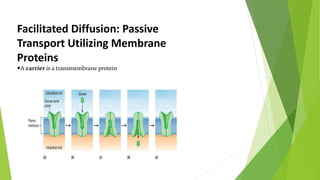
Facilitated Diffusion: Passive
Transport Utilizing Membrane
Proteins
A carrier is a transmembrane protein
Facilitated Diffusion
*Neither diffusion nor facilitated diffusion is coupled to
energy derived from metabolism, and thus they are
incapable of moving solute from a lower to a higher
concentration across a membrane.
*The energy source for facilitated diffusion is the
transmembrane concentration gradient of transported
substance.
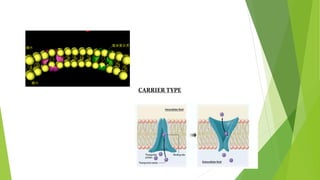
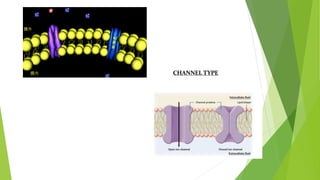
*TWO TYPE CARRIER AND CHANNEL
CARRIER TYPE
CHANNEL TYPE
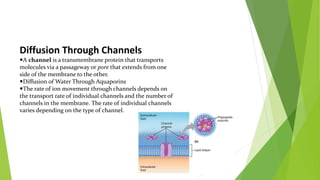
Diffusion Through Channels
A channel is a transmembrane protein that transports
molecules via a passageway or pore that extends from one
side of the membrane to the other.
Diffusion of Water Through Aquaporins
The rate of ion movement through channels depends on
the transport rate of individual channels and the number of
channels in the membrane. The rate of individual channels
varies depending on the type of channel.
Protein-mediated transport
Facilitated diffusion and Active transport.
Facilitated diffusion uses a transporter to move solute
downhill from a higher to a lower concentration across a
membrane.
whereas active transport uses a transporter that is coupled
to an energy source to move solute uphill across a
membrane—that is, against it electrochemical gradient.
Active transport
*Active transport differs from facilitated diffusion in that it uses
energy to move a substance uphill across a membrane that is,
against the substance’s electrochemical gradient
*Pump
*specificity and saturation
*Two means of coupling an energy flow to transporters are known 1
the direct use of ATP in primary active transport and 2 the use of
an ion concentration difference across a membrane to drive the
process in secondary active transport
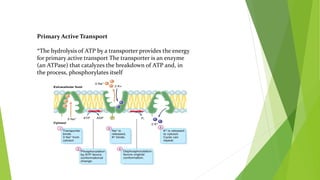
Primary Active Transport
*The hydrolysis of ATP by a transporter provides the energy
for primary active transport The transporter is an enzyme
(an ATPase) that catalyzes the breakdown of ATP and, in
the process, phosphorylates itself
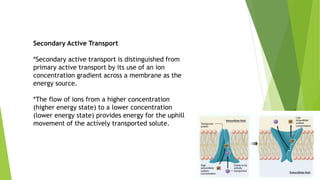
Secondary Active Transport
*Secondary active transport is distinguished from
primary active transport by its use of an ion
concentration gradient across a membrane as the
energy source.
*The flow of ions from a higher concentration
(higher energy state) to a lower concentration
(lower energy state) provides energy for the uphill
movement of the actively transported solute.
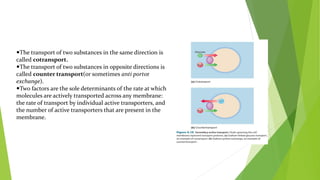
The transport of two substances in the same direction is
called cotransport.
The transport of two substances in opposite directions is
called counter transport(or sometimes anti portor
exchange).
Two factors are the sole determinants of the rate at which
molecules are actively transported across any membrane:
the rate of transport by individual active transporters, and
the number of active transporters that are present in the
membrane.
CELL MEMBRANE TEANSPORT IN
BIOTECHNOLOGY
REFERENCES
1. www.baidu.com
2. www.mhhe.com/widmaier13
3. 大学化学 书 or University Chemistry by
Yubin Zhang
Thanks

Lecture on cell membrane transport

  • 1.
    CELL MEMBRANE TRANSPORT PRESENTED BY MDFAHIM SHAHRIAR TEACHER, SINDH BIOTECHNOLOGISTS ASSOCIATION
  • 2.
    Factors Affecting theDirection of Transport (passive transport): Energy, Concentration (active transport): *Driving Forces Acting on Molecules: Chemical Driving Forces: Concentration gradient Electrical Driving Forces: Membrane potential
  • 3.
  • 4.
    *Electrochemical Driving Forces *Equilibriumpotential, a hypothetical value for the membrane potential at which the electrical driving force is equal and opposite to the chemical driving force, producing an electrochemical driving force of zero.
  • 5.
    Rate of Transport Therate at which a substance is transported across a membrane refers to the number of molecules that cross the membrane in a given length of time, which is called the flux. Flux is the number of molecules crossing a membrane per unit time per unit membrane surface area. Diffusion---The movement of molecules from one location to another solely as a result of their random thermal motion is known as diffusion.
  • 6.
    Passive Transport *Simple Diffusion---Biological membrane’s lipid bilayer. *Although the movement of individual molecules is random, the net flux always proceeds from regions of higher concentration to regions of lower concentration. *At last, the system reached diffusion equilibrium No further change in the molecular concentration of the two compartments will occur, since equal numbers of molecules will continue to diffuse in both directions between the two compartments.
  • 8.
    The magnitude ofthe net flux depends on several factors: the magnitude of the driving force, the membrane surface area, and the permeability of the membrane. (1) Concentration difference (2) Temperature (3) Mass of the molecule (4) Surface area (5) Lipid solubility of the molecule
  • 9.
    Facilitated Diffusion: Passive TransportUtilizing Membrane Proteins A carrier is a transmembrane protein
  • 10.
    Facilitated Diffusion *Neither diffusionnor facilitated diffusion is coupled to energy derived from metabolism, and thus they are incapable of moving solute from a lower to a higher concentration across a membrane. *The energy source for facilitated diffusion is the transmembrane concentration gradient of transported substance. *TWO TYPE CARRIER AND CHANNEL
  • 11.
  • 12.
  • 13.
    Diffusion Through Channels Achannel is a transmembrane protein that transports molecules via a passageway or pore that extends from one side of the membrane to the other. Diffusion of Water Through Aquaporins The rate of ion movement through channels depends on the transport rate of individual channels and the number of channels in the membrane. The rate of individual channels varies depending on the type of channel.
  • 14.
    Protein-mediated transport Facilitated diffusionand Active transport. Facilitated diffusion uses a transporter to move solute downhill from a higher to a lower concentration across a membrane. whereas active transport uses a transporter that is coupled to an energy source to move solute uphill across a membrane—that is, against it electrochemical gradient.
  • 15.
    Active transport *Active transportdiffers from facilitated diffusion in that it uses energy to move a substance uphill across a membrane that is, against the substance’s electrochemical gradient *Pump *specificity and saturation *Two means of coupling an energy flow to transporters are known 1 the direct use of ATP in primary active transport and 2 the use of an ion concentration difference across a membrane to drive the process in secondary active transport
  • 16.
    Primary Active Transport *Thehydrolysis of ATP by a transporter provides the energy for primary active transport The transporter is an enzyme (an ATPase) that catalyzes the breakdown of ATP and, in the process, phosphorylates itself
  • 17.
    Secondary Active Transport *Secondaryactive transport is distinguished from primary active transport by its use of an ion concentration gradient across a membrane as the energy source. *The flow of ions from a higher concentration (higher energy state) to a lower concentration (lower energy state) provides energy for the uphill movement of the actively transported solute.
  • 18.
    The transport oftwo substances in the same direction is called cotransport. The transport of two substances in opposite directions is called counter transport(or sometimes anti portor exchange). Two factors are the sole determinants of the rate at which molecules are actively transported across any membrane: the rate of transport by individual active transporters, and the number of active transporters that are present in the membrane.
  • 19.
    CELL MEMBRANE TEANSPORTIN BIOTECHNOLOGY
  • 20.
    REFERENCES 1. www.baidu.com 2. www.mhhe.com/widmaier13 3.大学化学 书 or University Chemistry by Yubin Zhang
  • 21.