psm.edu
• Use Fick’sLaw of diffusion to explain how changes in the concentration gradient will
influence the diffusional movement of a compound.
• Based on the principle of ionic attraction, explain how a potential difference across a
membrane will influence the distribution of a cation and an anion.
• Write the Nernst equation, and explain the effects of altering the intracellular or
extracellular Na+, K+, Cl-, or Ca2+ concentration on the equilibrium potential for that
ion.
• List the values for membrane potential, ENa, EK, ECl, and ECa in a typical mammalian cell.
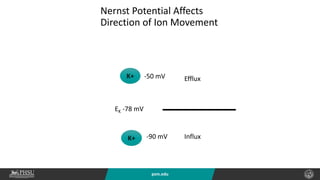
• Explain the direction that an ion will move when the membrane potential is at its
equilibrium potential, is higher than its equilibrium potential, or is less than its
equilibrium potential.
Objectives
4.
psm.edu
Objectives
• Describe thenormal distribution of Na+, K+, and Cl- across the cell membrane, and use the
Goldman equation to explain how the relative permeabilities of these ions create a resting
membrane potential.
• Define gating, activation, and inactivation of ion channels.
• Explain how driving force and conductance affect current flow across a membrane.
• Contrast the gating of ion channels by extracellular ligands, intracellular ligands, stretch, and
voltage.
• Describe the effects of hyperkalemia, hypokalemia, and hypoxia on resting membrane
potential.
• Explain how changes in membrane resistance, axial resistance, and capacitance affect the
propagation of membrane potentials and action potentials.
psm.edu
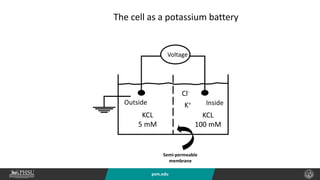
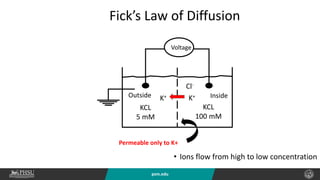
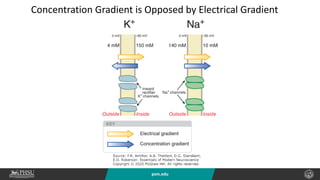
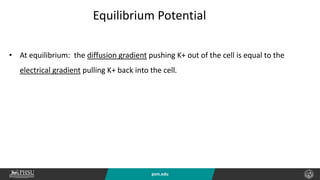
Equilibrium Potential
• Atequilibrium: the diffusion gradient pushing K+ out of the cell is equal to the
electrical gradient pulling K+ back into the cell.
10.
psm.edu
Ex = RT* ln [ X ]o
[ X ]i
___
zF
Ex = 60 * log
[ X ]o
[ X ]i
EK = 60 * log
[ 5 ]o
[ 100 ]i
At 37 °C and a
valence = +1
= -78 mV
The Nernst Equation
• The Nernst potential for a single ion is
its equilibrium potential.
z = valence of ion
psm.edu
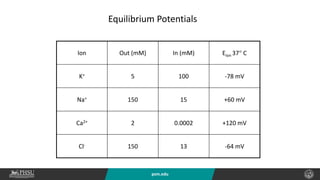
Ion Out (mM)In (mM) Eion 37 C
K+ 5 100 -78 mV
Na+ 150 15 +60 mV
Ca2+ 2 0.0002 +120 mV
Cl- 150 13 -64 mV
Equilibrium Potentials
13.
psm.edu
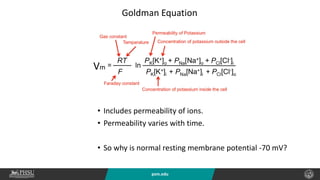
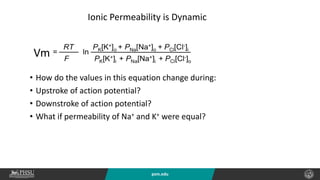
• Includes permeabilityof ions.
• Permeability varies with time.
• So why is normal resting membrane potential -70 mV?
Goldman Equation
Vm
14.
psm.edu
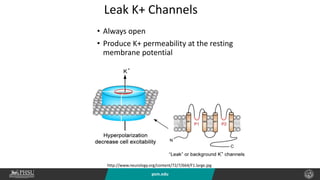
Leak K+ Channels
•Always open
• Produce K+ permeability at the resting
membrane potential
http://www.neurology.org/content/72/7/664/F1.large.jpg
15.
psm.edu
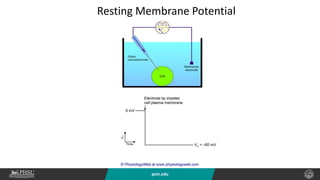
To Establish theResting Membrane Potential
- Only need a concentration difference and diffusion through a semipermeable
membrane
- No ATP is required
- No pump is required
16.
psm.edu
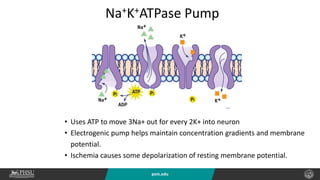
Na+K+ATPase Pump
• UsesATP to move 3Na+ out for every 2K+ into neuron
• Electrogenic pump helps maintain concentration gradients and membrane
potential.
• Ischemia causes some depolarization of resting membrane potential.
17.
psm.edu
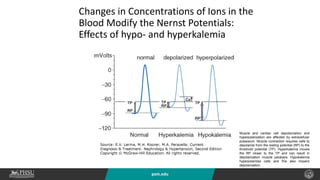
Changes in Concentrationsof Ions in the
Blood Modify the Nernst Potentials:
Effects of hypo- and hyperkalemia
Muscle and cardiac cell depolarization and
hyperpolarization are affected by extracellular
potassium. Muscle contraction requires cells to
depolarize from the resting potential (RP) to the
threshold potential (TP). Hyperkalemia moves
the RP closer to the TP and can result in
depolarization muscle paralysis. Hypokalemia
hyperpolarizes cells and this also impairs
depolarization.
18.
psm.edu
• How dothe values in this equation change during:
• Upstroke of action potential?
• Downstroke of action potential?
• What if permeability of Na+ and K+ were equal?
Ionic Permeability is Dynamic
Vm
19.
psm.edu
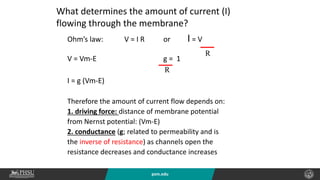
Ohm’s law: V= I R or I = V
V = Vm-E g = 1
I = g (Vm-E)
Therefore the amount of current flow depends on:
1. driving force: distance of membrane potential
from Nernst potential: (Vm-E)
2. conductance (g; related to permeability and is
the inverse of resistance) as channels open the
resistance decreases and conductance increases
What determines the amount of current (I)
flowing through the membrane?
R
R
20.
psm.edu
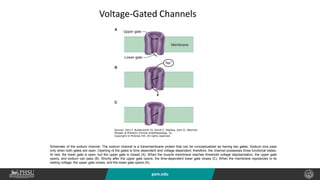
Schematic of thesodium channel. The sodium channel is a transmembrane protein that can be conceptualized as having two gates. Sodium ions pass
only when both gates are open. Opening of the gates is time dependent and voltage dependent; therefore, the channel possesses three functional states.
At rest, the lower gate is open, but the upper gate is closed (A). When the muscle membrane reaches threshold voltage depolarization, the upper gate
opens, and sodium can pass (B). Shortly after the upper gate opens, the time-dependent lower gate closes (C). When the membrane repolarizes to its
resting voltage, the upper gate closes, and the lower gate opens (A).
Voltage-Gated Channels
21.
psm.edu
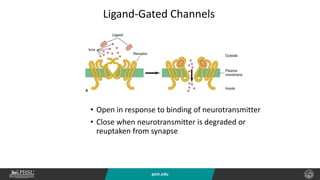
Ligand-Gated Channels
• Openin response to binding of neurotransmitter
• Close when neurotransmitter is degraded or
reuptaken from synapse
22.
psm.edu
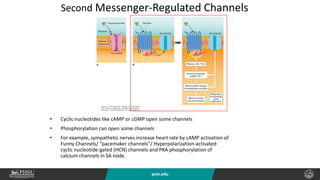
Second Messenger-Regulated Channels
•Cyclic nucleotides like cAMP or cGMP open some channels
• Phosphorylation can open some channels
• For example, sympathetic nerves increase heart rate by cAMP activation of
Funny Channels/ “pacemaker channels”/ Hyperpolarization-activated
cyclic nucleotide-gated (HCN) channels and PKA phosphorylation of
calcium channels in SA node.
23.
psm.edu
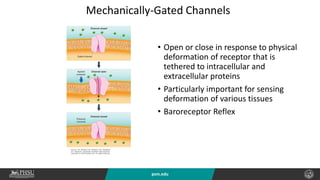
Mechanically-Gated Channels
• Openor close in response to physical
deformation of receptor that is
tethered to intracellular and
extracellular proteins
• Particularly important for sensing
deformation of various tissues
• Baroreceptor Reflex
24.
psm.edu
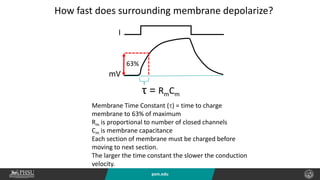
How fast doessurrounding membrane depolarize?
I
Membrane Time Constant () = time to charge
membrane to 63% of maximum
Rm is proportional to number of closed channels
Cm is membrane capacitance
Each section of membrane must be charged before
moving to next section.
The larger the time constant the slower the conduction
velocity.
63%
τ = RmCm
mV
25.
psm.edu
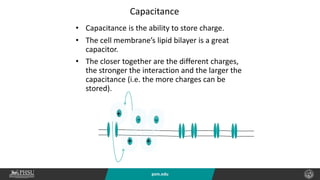
• Capacitance isthe ability to store charge.
• The cell membrane’s lipid bilayer is a great
capacitor.
• The closer together are the different charges,
the stronger the interaction and the larger the
capacitance (i.e. the more charges can be
stored).
Capacitance
+
-
+
-
+
26.
psm.edu
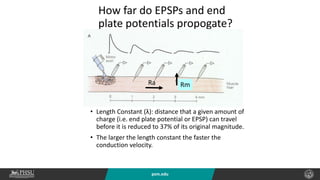
How far doEPSPs and end
plate potentials propogate?
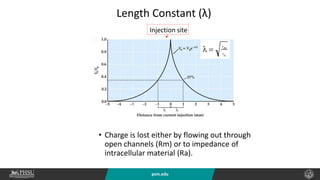
• Length Constant (λ): distance that a given amount of
charge (i.e. end plate potential or EPSP) can travel
before it is reduced to 37% of its original magnitude.
• The larger the length constant the faster the
conduction velocity.
Ra Rm
27.
psm.edu
Length Constant (λ)
•Charge is lost either by flowing out through
open channels (Rm) or to impedance of
intracellular material (Ra).
Injection site


![psm.edu
Ex = RT * ln [ X ]o
[ X ]i
___
zF
Ex = 60 * log
[ X ]o
[ X ]i
EK = 60 * log
[ 5 ]o
[ 100 ]i
At 37 °C and a
valence = +1
= -78 mV
The Nernst Equation
• The Nernst potential for a single ion is
its equilibrium potential.
z = valence of ion](https://image.slidesharecdn.com/membranepotentials1-260123035659-13da5f65/85/Membrane-Potentials-for-SCU-MSMS-Program-10-320.jpg)


![ONFH[AVN HIP] -TRIPLE REGIME -A NOVAL SURGICAL CONCEPT .pptx](https://cdn.slidesharecdn.com/ss_thumbnails/onfhavnhip2026koaconcalicutdrgokuldevdrmashraf-260210064517-213ec005-thumbnail.jpg?width=640&height=640&fit=bounds)


![PERI-PROSTHETIC FRACTURE NAIL-PLATE CONSTRUCT [NPC].pptx](https://cdn.slidesharecdn.com/ss_thumbnails/drarunkumardrmohamedashrafperiprostheticfrasturenail-plateconstructnpc-260209164459-7e9d15a1-thumbnail.jpg?width=640&height=640&fit=bounds)


