Meenakshi
temple
Pandyan dynasty
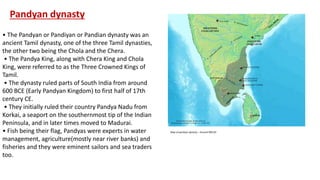
• The Pandyan or Pandiyan or Pandian dynasty was an
ancient Tamil dynasty, one of the three Tamil dynasties,
the other two being the Chola and the Chera.
• The Pandya King, along with Chera King and Chola
King, were referred to as the Three Crowned Kings of
Tamil.
• The dynasty ruled parts of South India from around
600 BCE (Early Pandyan Kingdom) to first half of 17th
century CE.
• They initially ruled their country Pandya Nadu from
Korkai, a seaport on the southernmost tip of the Indian
Peninsula, and in later times moved to Madurai.
• Fish being their flag, Pandyas were experts in water
management, agriculture(mostly near river banks) and
fisheries and they were eminent sailors and sea traders
too.
Map of pandyan dynasty – Around 900 AD
Pandyan Dynasty — Art and Culture
• The Pandyan Kings were of Dravidian descent, and were proficient in
art, culture, trade and literature. Being located in a coastal area, the
Pandyan Rulers wielded control over the fisheries and the related trade
activities between Sri Lanka and India.
• This period also saw some of the finest pearls ever produced. The
Pandyans were also great patrons of architecture, and the famous
Meenakshi Temple in Madurai is a testimony to this.
• Meenakshi Temple - Built by Pandya Rulers — This Structure has been
Constructed in Madurai in Early 17th Century - 1623 AD
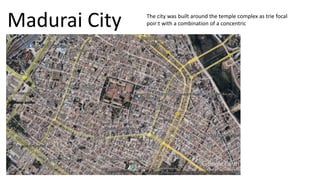
Madurai City The city was built around the temple complex as trie focal
poir:t with a combination of a concentric
INTRODUCTION
• MADURAI , popularly known as the Temple city,
also called as ATHENS OF THE EAST, City of
Junction, City of Jasmine, CITY THAT NEVER
SLEEPS and City of four junctions. Madurai is
third major economic, industrial, commercial,
political centre and a major transportation hub
for the southern Tamilnadu.
• The city is renowned for tourism, festivals and
vibrant cultural life in general and is considered
to be the states cultural capital.
•The rich and vibrant natural and cultural landscape with different linguistic and cultural groups
coexisting together in its UNIQUE CUSTOMS, TRADITIONS, AND ART FORMS make it a classical example
of an urban environment wherein diversity becomes the source of strength rather than conflicts.
• In 1801 the British East India
Company took direct control
of Madurai and brought it
under the Madras Presidency.
• In 1837, the city was expanded
to accommodate the growing
population by demolishing the
fortifications around the
temple. This was done on the
orders of the then collector
John Blackburn.
• The moat was drained and the debris was used to construct the
new streets - Veli, Marat and Perumaal Mesthiri streets. The city
was constituted as a municipality in 1866.
• The old city of Madurai is considered to be
designed according to the Rajdhani plan, described
in Manasara, one of the Shilpasastra, and has the
fivefold concentric rectangular formation with
Meenakshi- Sundareshwara Temple at a very
centre point.
• The city was a well planned one with bazaars and
many broad streets with high and luxurious
mansions on both sides.
• The city was built around the temple complex as
the focal point with a combination of a concentric
street pattern.
• TRADITIONAL PLANNING
STRATEGIES
• The settlement pattern of Madurai is
planned according to the ancient system
of town planning which is based on caste
and occupational hierarchies.
• The map shows the present settlement
pattern and its relevance with the ancient
town planning system.
• Ancient south Indian temple towns are
designed by placing the temple complex
at the centre with concentric rectangle
pattern of streets around.
• This can be seen in another southern
temple town Srirangam also.
• In Madurai, Meenakshi Amman Temple
is at the Palaces, Royal center. Brahmins
and Priests at the first concentric
rectangle.
• Traders, Kishatriyas and Vaishnavaites on
the second rectangle. The lower caste
Sudras and immigrants in the
third rectangle.
• Meenakshi Amma Temple is a historic
Tamil Hindu temple located on the
southern bank of the Vaigai River in the
temple city of Madurai, Tamil Nadu.
• It is dedicated to Parvati, known as
Meenakshi, and her consort, Shiva, here
named Sundareswarar.
• The temple forms the heart and
lifeline of the 2,500-year-old city of
Madurai and is a significant symbol for
the Tamil people, mentioned since
antiquity in Tamil literature.
GUARDIAN:-
Fierce monster images, with protruding ryes and
borns, mark the arched ends of the vaulted roofs,
and serve as guardian deities.
STUCCO WORK:-
The figures of deities on the tower are repaired,
repinted and ntually reconsecrated every 12 years.
• Meenakshi amma temple is located on the southern bank of the Vaigai river in the temple city
of Madurai, Tamil nadu, India.
• Its an Dravidian style Hindu temple.
• It is dedicated to Parvathi, known as Meenakshi, and her consort, Shiva, here named
sundareswarar.
• Surrounding an area of the temple is about 45 acres
• The temple was 1st constructed somewhere around the time by kulashekara pandyan.
• A large part of the temple was destroyed during the muslim invasion during the 14th century
and then was restored to its former glory in the early 17th century.
• The temple was rebuilt by vishwanatha nayak accordance to shilpa shastra.
INTRODUCTION
GOPURAMS
• The temple has huge Gopurams which can be seen from a far distance. •
There are 14 Gopurams ranging from 45—50m in height. • The outer 4 towers
are the landmarks of Madurai, which are tall when compared to other
gopurams.
Thev are:
• East tower height 161'3" & has 1011 sudhai figures. (its the oldest gopuram
built by maravarman sundara pandyan during 1216-1238)
• South tower height 170'6"(, 51.9 metres) & has 1511 sudhai figures. ( tallest
of all)
• West tower height 163'3" has 1124 sudhai figures.
• North tower height 160'6" & has lesser figures of sudhai than other outer
towers.
• These 4 gopuram's are nine storeys & is ornamented with elaborate
sculptures.
• And the other towers are inside the twin temples and are smaller compared
to the outer gopurams. and aslso these inner gopuram serves as the entrance
to the inner enclosure shrines
MADURA STYLE
• The temple is high walled &
enclosure on the boundaries
around the temples, intervening
courtyards called prakarams
which contain pillared halls, store
rooms, other smaller shrines and
square water tanks for ritual
baths.
• The temple is square shaped.
• The tank is surrounded by a
pillared cloister and has steps
leading down to the water.
meenakshi munder.pptx

meenakshi munder.pptx

  • 1.
  • 2.
    Pandyan dynasty • ThePandyan or Pandiyan or Pandian dynasty was an ancient Tamil dynasty, one of the three Tamil dynasties, the other two being the Chola and the Chera. • The Pandya King, along with Chera King and Chola King, were referred to as the Three Crowned Kings of Tamil. • The dynasty ruled parts of South India from around 600 BCE (Early Pandyan Kingdom) to first half of 17th century CE. • They initially ruled their country Pandya Nadu from Korkai, a seaport on the southernmost tip of the Indian Peninsula, and in later times moved to Madurai. • Fish being their flag, Pandyas were experts in water management, agriculture(mostly near river banks) and fisheries and they were eminent sailors and sea traders too. Map of pandyan dynasty – Around 900 AD
  • 3.
    Pandyan Dynasty —Art and Culture • The Pandyan Kings were of Dravidian descent, and were proficient in art, culture, trade and literature. Being located in a coastal area, the Pandyan Rulers wielded control over the fisheries and the related trade activities between Sri Lanka and India. • This period also saw some of the finest pearls ever produced. The Pandyans were also great patrons of architecture, and the famous Meenakshi Temple in Madurai is a testimony to this. • Meenakshi Temple - Built by Pandya Rulers — This Structure has been Constructed in Madurai in Early 17th Century - 1623 AD
  • 4.
    Madurai City Thecity was built around the temple complex as trie focal poir:t with a combination of a concentric
  • 5.
    INTRODUCTION • MADURAI ,popularly known as the Temple city, also called as ATHENS OF THE EAST, City of Junction, City of Jasmine, CITY THAT NEVER SLEEPS and City of four junctions. Madurai is third major economic, industrial, commercial, political centre and a major transportation hub for the southern Tamilnadu. • The city is renowned for tourism, festivals and vibrant cultural life in general and is considered to be the states cultural capital. •The rich and vibrant natural and cultural landscape with different linguistic and cultural groups coexisting together in its UNIQUE CUSTOMS, TRADITIONS, AND ART FORMS make it a classical example of an urban environment wherein diversity becomes the source of strength rather than conflicts.
  • 6.
    • In 1801the British East India Company took direct control of Madurai and brought it under the Madras Presidency. • In 1837, the city was expanded to accommodate the growing population by demolishing the fortifications around the temple. This was done on the orders of the then collector John Blackburn. • The moat was drained and the debris was used to construct the new streets - Veli, Marat and Perumaal Mesthiri streets. The city was constituted as a municipality in 1866.
  • 7.
    • The oldcity of Madurai is considered to be designed according to the Rajdhani plan, described in Manasara, one of the Shilpasastra, and has the fivefold concentric rectangular formation with Meenakshi- Sundareshwara Temple at a very centre point. • The city was a well planned one with bazaars and many broad streets with high and luxurious mansions on both sides. • The city was built around the temple complex as the focal point with a combination of a concentric street pattern. • TRADITIONAL PLANNING STRATEGIES
  • 8.
    • The settlementpattern of Madurai is planned according to the ancient system of town planning which is based on caste and occupational hierarchies. • The map shows the present settlement pattern and its relevance with the ancient town planning system. • Ancient south Indian temple towns are designed by placing the temple complex at the centre with concentric rectangle pattern of streets around. • This can be seen in another southern temple town Srirangam also.
  • 9.
    • In Madurai,Meenakshi Amman Temple is at the Palaces, Royal center. Brahmins and Priests at the first concentric rectangle. • Traders, Kishatriyas and Vaishnavaites on the second rectangle. The lower caste Sudras and immigrants in the third rectangle.
  • 10.
    • Meenakshi AmmaTemple is a historic Tamil Hindu temple located on the southern bank of the Vaigai River in the temple city of Madurai, Tamil Nadu. • It is dedicated to Parvati, known as Meenakshi, and her consort, Shiva, here named Sundareswarar. • The temple forms the heart and lifeline of the 2,500-year-old city of Madurai and is a significant symbol for the Tamil people, mentioned since antiquity in Tamil literature.
  • 12.
    GUARDIAN:- Fierce monster images,with protruding ryes and borns, mark the arched ends of the vaulted roofs, and serve as guardian deities. STUCCO WORK:- The figures of deities on the tower are repaired, repinted and ntually reconsecrated every 12 years.
  • 15.
    • Meenakshi ammatemple is located on the southern bank of the Vaigai river in the temple city of Madurai, Tamil nadu, India. • Its an Dravidian style Hindu temple. • It is dedicated to Parvathi, known as Meenakshi, and her consort, Shiva, here named sundareswarar. • Surrounding an area of the temple is about 45 acres • The temple was 1st constructed somewhere around the time by kulashekara pandyan. • A large part of the temple was destroyed during the muslim invasion during the 14th century and then was restored to its former glory in the early 17th century. • The temple was rebuilt by vishwanatha nayak accordance to shilpa shastra. INTRODUCTION
  • 16.
    GOPURAMS • The templehas huge Gopurams which can be seen from a far distance. • There are 14 Gopurams ranging from 45—50m in height. • The outer 4 towers are the landmarks of Madurai, which are tall when compared to other gopurams. Thev are: • East tower height 161'3" & has 1011 sudhai figures. (its the oldest gopuram built by maravarman sundara pandyan during 1216-1238) • South tower height 170'6"(, 51.9 metres) & has 1511 sudhai figures. ( tallest of all) • West tower height 163'3" has 1124 sudhai figures. • North tower height 160'6" & has lesser figures of sudhai than other outer towers. • These 4 gopuram's are nine storeys & is ornamented with elaborate sculptures. • And the other towers are inside the twin temples and are smaller compared to the outer gopurams. and aslso these inner gopuram serves as the entrance to the inner enclosure shrines
  • 17.
    MADURA STYLE • Thetemple is high walled & enclosure on the boundaries around the temples, intervening courtyards called prakarams which contain pillared halls, store rooms, other smaller shrines and square water tanks for ritual baths. • The temple is square shaped. • The tank is surrounded by a pillared cloister and has steps leading down to the water.