Preview: Medieval China
Take notes and make educated
guesses and observations from the
images and sources provided
Geography
Physical Geography
Neighboring Countries
Change in Dynasties Over Time
http://www.youtube.com/watch?v=vs34AJqmB
5I
Chinese Geography
• China's natural barriers to the west, south,
and east helped to protect these early people
from invasion.
• China's natural barriers include seas - the
China Sea and the Yellow Sea, both located in
the Pacific Ocean. These seas provide a huge
coastline, which provided trade routes and
easy access to food.
Confucius
Confucius
Confucius “The Teacher”
Confucius lived from 551- 479
BC and he studied hard and
became one of the best-
educated Chinese of his time.
His ideas influenced Chinese
society after almost 2,500
years! A central idea of his
teachings is ren, which means
harmony among humanity.
Zeng He
Zeng He
Fifty years before Europeans
began searching for a sea
route to the East, Chinese
ambassador Zeng He explored
the West. His emperor sent
him to collect presents to
display the splendor and
power of China. He sailed to
SE Asia, India, Arabia and
Africa in 1400s.
Video
http://www.youtube.com/wat
ch?v=cjWscQolTK4&feature=re
sults_main&playnext=1&list=P
L15F19D4B3D52991A
Trade and Travel
“Junks”
Junks or Chinese sailing
boats carried goods along
the coast.
“Merchants from southern
and central provinces come
to this town in seagoing
junks to sell such dutiable
(taxable) goods as spices.
Merchants come bringing
copper cash, silk thread, silk
floss, silk gauze and thin silk
and do an extremely thriving
trade with them.”
c. 1088
Chinese Inventions
The sailors are sure of
their bearings. At night
they judge by the stars. In
daytime they tell by the
sun. When it is cloudy,
they rely on the south
pointing needle.
(description of ancient
Chinese compass)
http://www.youtube.com/
watch?v=cx-x7BrgjSA
Inventions con’t
• Printing press c. 700
CE(cultural diffusion)
• Movable-type printing
press c. 1045 CE
• Gunpowder c. 600s CE
• Compass “fish”
Mongols in China
“Kublai Khan staged many
attacks on the Song
Dynasty in Southern
China. His forces finally
overpowered the last
group of Song defenders
in 1279. Kublai thus
became the first ruler to
control all of China in over
300 years.”
Ming
Although merchants
prospered, most Chinese
were eager to expel the
foreigners (Mongols) who
did not share their
appreciation of cultural
customs and traditions;
they founded a new
dynasty in 1368 known as
the “Ming.”
The Forbidden City
The Forbidden City was
the imperial palace under
the Ming and Qing
Dynasties. It’s located in
present-day Bejiing and it
served a ceremonial and
political center for the
Chinese government.
http://videos.howstuffwor
ks.com/discovery/7248-
china-chinese-
architecture-of-the-
forbidden-city-video.htm
Qing Dynasty
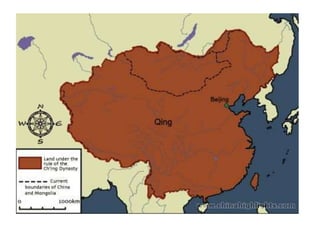
Invasions from the north
continued under the Qing
Dyansty as Manchus
attempted to invade and
conquer China. In 1644, the
Manchus successfully
invaded and ruled until
1912. Qing rulers wanted to
preserve their own culture
but adopted some Chinese
(Ming) traditions like their
civil service system.
Medieval china preview

Medieval china preview

  • 1.
    Preview: Medieval China Takenotes and make educated guesses and observations from the images and sources provided
  • 2.
  • 3.
  • 4.
  • 5.
    Change in DynastiesOver Time http://www.youtube.com/watch?v=vs34AJqmB 5I
  • 6.
    Chinese Geography • China'snatural barriers to the west, south, and east helped to protect these early people from invasion. • China's natural barriers include seas - the China Sea and the Yellow Sea, both located in the Pacific Ocean. These seas provide a huge coastline, which provided trade routes and easy access to food.
  • 7.
    Confucius Confucius Confucius “The Teacher” Confuciuslived from 551- 479 BC and he studied hard and became one of the best- educated Chinese of his time. His ideas influenced Chinese society after almost 2,500 years! A central idea of his teachings is ren, which means harmony among humanity.
  • 8.
    Zeng He Zeng He Fiftyyears before Europeans began searching for a sea route to the East, Chinese ambassador Zeng He explored the West. His emperor sent him to collect presents to display the splendor and power of China. He sailed to SE Asia, India, Arabia and Africa in 1400s. Video http://www.youtube.com/wat ch?v=cjWscQolTK4&feature=re sults_main&playnext=1&list=P L15F19D4B3D52991A
  • 10.
    Trade and Travel “Junks” Junksor Chinese sailing boats carried goods along the coast. “Merchants from southern and central provinces come to this town in seagoing junks to sell such dutiable (taxable) goods as spices. Merchants come bringing copper cash, silk thread, silk floss, silk gauze and thin silk and do an extremely thriving trade with them.” c. 1088
  • 11.
    Chinese Inventions The sailorsare sure of their bearings. At night they judge by the stars. In daytime they tell by the sun. When it is cloudy, they rely on the south pointing needle. (description of ancient Chinese compass) http://www.youtube.com/ watch?v=cx-x7BrgjSA
  • 12.
    Inventions con’t • Printingpress c. 700 CE(cultural diffusion) • Movable-type printing press c. 1045 CE • Gunpowder c. 600s CE • Compass “fish”
  • 13.
    Mongols in China “KublaiKhan staged many attacks on the Song Dynasty in Southern China. His forces finally overpowered the last group of Song defenders in 1279. Kublai thus became the first ruler to control all of China in over 300 years.”
  • 14.
    Ming Although merchants prospered, mostChinese were eager to expel the foreigners (Mongols) who did not share their appreciation of cultural customs and traditions; they founded a new dynasty in 1368 known as the “Ming.”
  • 16.
    The Forbidden City TheForbidden City was the imperial palace under the Ming and Qing Dynasties. It’s located in present-day Bejiing and it served a ceremonial and political center for the Chinese government. http://videos.howstuffwor ks.com/discovery/7248- china-chinese- architecture-of-the- forbidden-city-video.htm
  • 17.
    Qing Dynasty Invasions fromthe north continued under the Qing Dyansty as Manchus attempted to invade and conquer China. In 1644, the Manchus successfully invaded and ruled until 1912. Qing rulers wanted to preserve their own culture but adopted some Chinese (Ming) traditions like their civil service system.