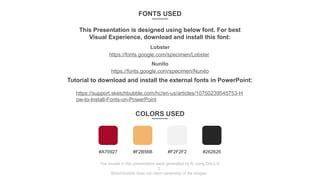
COLORS USED
#A70927 #F2B56B#F2F2F2 #262626
The visuals in this presentation were generated by AI using DALL-E
3.
Sketchbubble does not claim ownership of the images.
Tutorial to download and install the external fonts in PowerPoint:
https://support.sketchbubble.com/hc/en-us/articles/10750239545753-H
ow-to-Install-Fonts-on-PowerPoint
This Presentation is designed using below font. For best
Visual Experience, download and install this font:
Nunito
https://fonts.google.com/specimen/Nunito
FONTS USED
Lobster
https://fonts.google.com/specimen/Lobster
2.
ANIMATION – ONCLICK
Note - In Slideshow mode, each graphic element with text will appear/animate on mouse click OR press
space bar/enter key/arrow key (right or down ) to trigger the remaining animation.
► ▼
Table
of
Content
05
.
Slide Headline
Lorem ipsumdolor sit amet consecteur adipiscing elit quisque
faucib.
04
.
Slide Headline
Lorem ipsum dolor sit amet consecteur adipiscing elit quisque
faucib.
03
.
Slide Headline
Lorem ipsum dolor sit amet consecteur adipiscing elit quisque
faucib.
02
.
Slide Headline
Lorem ipsum dolor sit amet consecteur adipiscing elit quisque
faucib.
01
.
Slide Headline
Lorem ipsum dolor sit amet consecteur adipiscing elit quisque
faucib.
5.
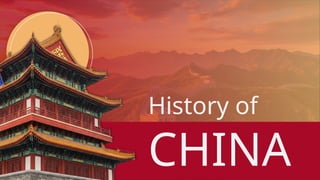
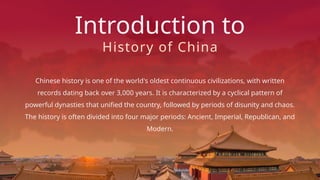
Introduction to
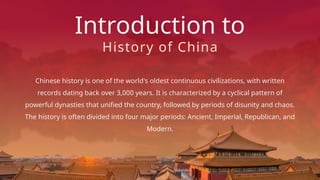
Chinese historyis one of the world's oldest continuous civilizations, with written
records dating back over 3,000 years. It is characterized by a cyclical pattern of
powerful dynasties that unified the country, followed by periods of disunity and chaos.
The history is often divided into four major periods: Ancient, Imperial, Republican, and
Modern.
History of China
6.
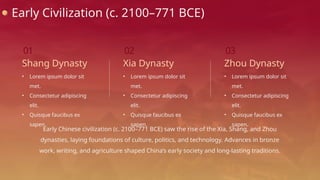
Early Civilization (c.2100–771 BCE)
01
.
Shang Dynasty
• Lorem ipsum dolor sit
met.
• Consectetur adipiscing
elit.
• Quisque faucibus ex
sapen.
02
.
Xia Dynasty
• Lorem ipsum dolor sit
met.
• Consectetur adipiscing
elit.
• Quisque faucibus ex
sapen.
03
.
Zhou Dynasty
• Lorem ipsum dolor sit
met.
• Consectetur adipiscing
elit.
• Quisque faucibus ex
sapen.
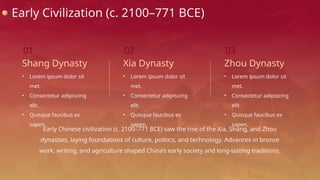
Early Chinese civilization (c. 2100–771 BCE) saw the rise of the Xia, Shang, and Zhou
dynasties, laying foundations of culture, politics, and technology. Advances in bronze
work, writing, and agriculture shaped China’s early society and long-lasting traditions.
7.
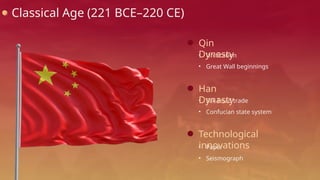
Classical Age (221BCE–220 CE)
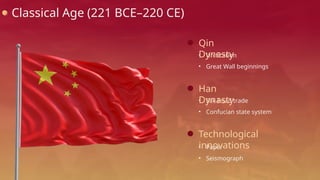
• Unification
• Great Wall beginnings
Qin
Dynasty
• Silk Road trade
• Confucian state system
Han
Dynasty
• Paper
• Seismograph
Technological
innovations
8.
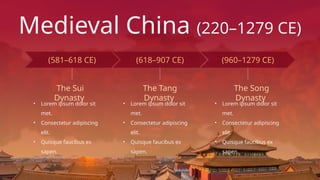
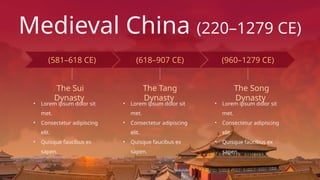
Medieval China (220–1279CE)
(581–618 CE)
The Sui
Dynasty
(618–907 CE)
The Tang
Dynasty
(960–1279 CE)
The Song
Dynasty
• Lorem ipsum dolor sit
met.
• Consectetur adipiscing
elit.
• Quisque faucibus ex
sapen.
• Lorem ipsum dolor sit
met.
• Consectetur adipiscing
elit.
• Quisque faucibus ex
sapen.
• Lorem ipsum dolor sit
met.
• Consectetur adipiscing
elit.
• Quisque faucibus ex
sapen.
9.
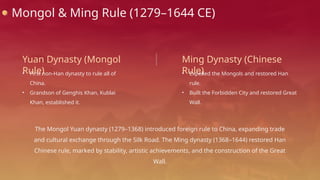
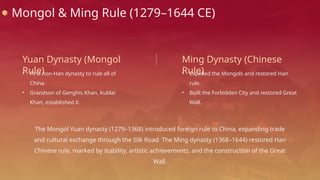
Mongol & MingRule (1279–1644 CE)
Yuan Dynasty (Mongol
Rule)
• First non-Han dynasty to rule all of
China.
• Grandson of Genghis Khan, Kublai
Khan, established it.
Ming Dynasty (Chinese
Rule)
• Expelled the Mongols and restored Han
rule.
• Built the Forbidden City and restored Great
Wall.
The Mongol Yuan dynasty (1279–1368) introduced foreign rule to China, expanding trade
and cultural exchange through the Silk Road. The Ming dynasty (1368–1644) restored Han
Chinese rule, marked by stability, artistic achievements, and the construction of the Great
Wall.
10.
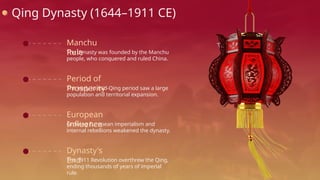
Qing Dynasty (1644–1911CE)
Manchu
Rule
The dynasty was founded by the Manchu
people, who conquered and ruled China.
Period of
Prosperity
The early to mid-Qing period saw a large
population and territorial expansion.
European
Influence
Growing European imperialism and
internal rebellions weakened the dynasty.
Dynasty's
End
The 1911 Revolution overthrew the Qing,
ending thousands of years of imperial
rule.
11.
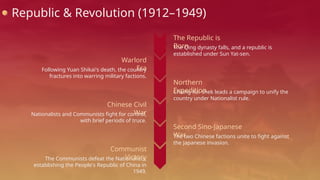
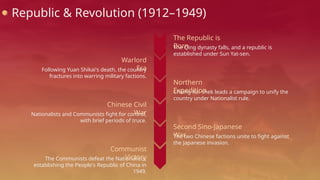
Republic & Revolution(1912–1949)
The Qing dynasty falls, and a republic is
established under Sun Yat-sen.
The Republic is
Born
Following Yuan Shikai's death, the country
fractures into warring military factions.
Warlord
Era
Chiang Kai-shek leads a campaign to unify the
country under Nationalist rule.
Northern
Expedition
Nationalists and Communists fight for control,
with brief periods of truce.
Chinese Civil
War
The two Chinese factions unite to fight against
the Japanese invasion.
Second Sino-Japanese
War
The Communists defeat the Nationalists,
establishing the People's Republic of China in
1949.
Communist
Victory
12.
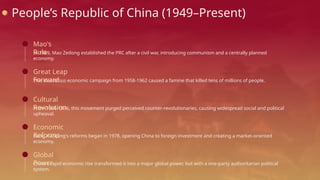
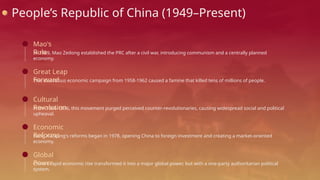
People’s Republic ofChina (1949–Present)
In 1949, Mao Zedong established the PRC after a civil war, introducing communism and a centrally planned
economy.
Mao's
Rule
This disastrous economic campaign from 1958-1962 caused a famine that killed tens of millions of people.
Great Leap
Forward
From 1966-1976, this movement purged perceived counter-revolutionaries, causing widespread social and political
upheaval.
Cultural
Revolution
Deng Xiaoping's reforms began in 1978, opening China to foreign investment and creating a market-oriented
economy.
Economic
Reforms
China's rapid economic rise transformed it into a major global power, but with a one-party authoritarian political
system.
Global
Power
13.
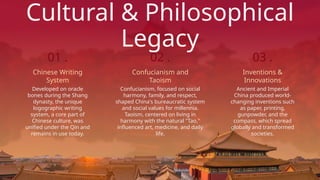
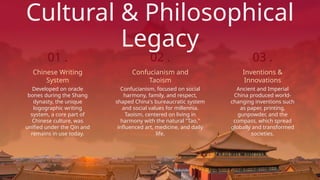
Cultural & Philosophical
Legacy
Confucianism,focused on social
harmony, family, and respect,
shaped China's bureaucratic system
and social values for millennia.
Taoism, centered on living in
harmony with the natural "Tao,"
influenced art, medicine, and daily
life.
Confucianism and
Taoism
02 .
Developed on oracle
bones during the Shang
dynasty, the unique
logographic writing
system, a core part of
Chinese culture, was
unified under the Qin and
remains in use today.
Chinese Writing
System
01 .
Ancient and Imperial
China produced world-
changing inventions such
as paper, printing,
gunpowder, and the
compass, which spread
globally and transformed
societies.
Inventions &
Innovations
03 .
ANIMATION - AUTOMATED
Note- In Slideshow mode, each graphic element with text will appear/animate automatically. You just
need to click your mouse OR press space bar/enter key/arrow key (right or down ) once to start the
► ▼
animation on each slide.
Table
of
Content
05
.
Slide Headline
Lorem ipsumdolor sit amet consecteur adipiscing elit quisque
faucib.
04
.
Slide Headline
Lorem ipsum dolor sit amet consecteur adipiscing elit quisque
faucib.
03
.
Slide Headline
Lorem ipsum dolor sit amet consecteur adipiscing elit quisque
faucib.
02
.
Slide Headline
Lorem ipsum dolor sit amet consecteur adipiscing elit quisque
faucib.
01
.
Slide Headline
Lorem ipsum dolor sit amet consecteur adipiscing elit quisque
faucib.
18.
Introduction to
Chinese historyis one of the world's oldest continuous civilizations, with written
records dating back over 3,000 years. It is characterized by a cyclical pattern of
powerful dynasties that unified the country, followed by periods of disunity and chaos.
The history is often divided into four major periods: Ancient, Imperial, Republican, and
Modern.
History of China
19.
Early Civilization (c.2100–771 BCE)
01
.
Shang Dynasty
• Lorem ipsum dolor sit
met.
• Consectetur adipiscing
elit.
• Quisque faucibus ex
sapen.
02
.
Xia Dynasty
• Lorem ipsum dolor sit
met.
• Consectetur adipiscing
elit.
• Quisque faucibus ex
sapen.
03
.
Zhou Dynasty
• Lorem ipsum dolor sit
met.
• Consectetur adipiscing
elit.
• Quisque faucibus ex
sapen.
Early Chinese civilization (c. 2100–771 BCE) saw the rise of the Xia, Shang, and Zhou
dynasties, laying foundations of culture, politics, and technology. Advances in bronze
work, writing, and agriculture shaped China’s early society and long-lasting traditions.
20.
Classical Age (221BCE–220 CE)
• Unification
• Great Wall beginnings
Qin
Dynasty
• Silk Road trade
• Confucian state system
Han
Dynasty
• Paper
• Seismograph
Technological
innovations
21.
Medieval China (220–1279CE)
(581–618 CE)
The Sui
Dynasty
(618–907 CE)
The Tang
Dynasty
(960–1279 CE)
The Song
Dynasty
• Lorem ipsum dolor sit
met.
• Consectetur adipiscing
elit.
• Quisque faucibus ex
sapen.
• Lorem ipsum dolor sit
met.
• Consectetur adipiscing
elit.
• Quisque faucibus ex
sapen.
• Lorem ipsum dolor sit
met.
• Consectetur adipiscing
elit.
• Quisque faucibus ex
sapen.
22.
Mongol & MingRule (1279–1644 CE)
Yuan Dynasty (Mongol
Rule)
• First non-Han dynasty to rule all of
China.
• Grandson of Genghis Khan, Kublai
Khan, established it.
Ming Dynasty (Chinese
Rule)
• Expelled the Mongols and restored Han
rule.
• Built the Forbidden City and restored Great
Wall.
The Mongol Yuan dynasty (1279–1368) introduced foreign rule to China, expanding trade
and cultural exchange through the Silk Road. The Ming dynasty (1368–1644) restored Han
Chinese rule, marked by stability, artistic achievements, and the construction of the Great
Wall.
23.
Qing Dynasty (1644–1911CE)
Manchu
Rule
The dynasty was founded by the Manchu
people, who conquered and ruled China.
Period of
Prosperity
The early to mid-Qing period saw a large
population and territorial expansion.
European
Influence
Growing European imperialism and
internal rebellions weakened the dynasty.
Dynasty's
End
The 1911 Revolution overthrew the Qing,
ending thousands of years of imperial
rule.
24.
Republic & Revolution(1912–1949)
The Qing dynasty falls, and a republic is
established under Sun Yat-sen.
The Republic is
Born
Following Yuan Shikai's death, the country
fractures into warring military factions.
Warlord
Era
Chiang Kai-shek leads a campaign to unify the
country under Nationalist rule.
Northern
Expedition
Nationalists and Communists fight for control,
with brief periods of truce.
Chinese Civil
War
The two Chinese factions unite to fight against
the Japanese invasion.
Second Sino-Japanese
War
The Communists defeat the Nationalists,
establishing the People's Republic of China in
1949.
Communist
Victory
25.
People’s Republic ofChina (1949–Present)
In 1949, Mao Zedong established the PRC after a civil war, introducing communism and a centrally planned
economy.
Mao's
Rule
This disastrous economic campaign from 1958-1962 caused a famine that killed tens of millions of people.
Great Leap
Forward
From 1966-1976, this movement purged perceived counter-revolutionaries, causing widespread social and political
upheaval.
Cultural
Revolution
Deng Xiaoping's reforms began in 1978, opening China to foreign investment and creating a market-oriented
economy.
Economic
Reforms
China's rapid economic rise transformed it into a major global power, but with a one-party authoritarian political
system.
Global
Power
26.
Cultural & Philosophical
Legacy
Confucianism,focused on social
harmony, family, and respect,
shaped China's bureaucratic system
and social values for millennia.
Taoism, centered on living in
harmony with the natural "Tao,"
influenced art, medicine, and daily
life.
Confucianism and
Taoism
02 .
Developed on oracle
bones during the Shang
dynasty, the unique
logographic writing
system, a core part of
Chinese culture, was
unified under the Qin and
remains in use today.
Chinese Writing
System
01 .
Ancient and Imperial
China produced world-
changing inventions such
as paper, printing,
gunpowder, and the
compass, which spread
globally and transformed
societies.
Inventions &
Innovations
03 .
IMPORTANT INSTRUCTIONS
• Note- It is essential to acknowledge SketchBubble's contribution by retaining the Thanks
slide.
• Feel free to customize this template to suit your needs, whether it be for personal or
commercial use.
Please refrain from engaging in the following actions:
• Sublicensing, selling, or renting any SketchBubble’s Content (including modified
versions).
• Distributing this SketchBubble Template (including modified versions) or incorporating
it into a bundle for distribution or resale.
• Removing the "Thanks" or ”Attribution" slide.
For more information about allowed and restricted usage, please refer below links:
https://www.sketchbubble.com/en/eula
https://www.sketchbubble.com/en/terms-of-use
29.
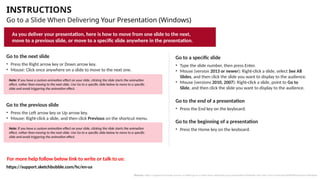
INSTRUCTIONS
Go to aSlide When Delivering Your Presentation (Windows)
Go to the next slide
• Press the Right arrow key or Down arrow key.
• Mouse: Click once anywhere on a slide to move to the next one.
Go to the previous slide
• Press the Left arrow key or Up arrow key.
• Mouse: Right-click a slide, and then click Previous on the shortcut menu.
Go to a specific slide
• Type the slide number, then press Enter.
• Mouse (version 2013 or newer): Right-click a slide, select See All
Slides, and then click the slide you want to display to the audience.
• Mouse (versions 2010, 2007): Right-click a slide, point to Go to
Slide, and then click the slide you want to display to the audience.
Go to the beginning of a presentation
• Press the Home key on the keyboard.
Go to the end of a presentation
• Press the End key on the keyboard.
For more help follow below link to write or talk to us:
As you deliver your presentation, here is how to move from one slide to the next,
move to a previous slide, or move to a specific slide anywhere in the presentation.
Note: If you have a custom animation effect on your slide, clicking the slide starts the animation
effect, rather than moving to the next slide. Use Go to a specific slide below to move to a specific
slide and avoid triggering the animation effect.
Note: If you have a custom animation effect on your slide, clicking the slide starts the animation
effect, rather than moving to the next slide. Use Go to a specific slide below to move to a specific
slide and avoid triggering the animation effect.
Source: https://support.microsoft.com/en-us/office/go-to-a-slide-when-delivering-your-presentation-ff9d6d4e-7bec-49c1-95e3-95a416be26f4#OfficeVersion=Windows
https://support.sketchbubble.com/hc/en-us
30.
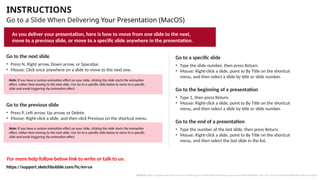
INSTRUCTIONS
Go to aSlide When Delivering Your Presentation (MacOS)
Go to the next slide
• Press N, Right arrow, Down arrow, or Spacebar.
• Mouse: Click once anywhere on a slide to move to the next one.
Go to the previous slide
• Press P, Left arrow, Up arrow, or Delete.
• Mouse: Right-click a slide, and then click Previous on the shortcut menu.
Go to a specific slide
• Type the slide number, then press Return.
• Mouse: Right-click a slide, point to By Title on the shortcut
menu, and then select a slide by title or slide number.
Go to the end of a presentation
• Type the number of the last slide, then press Return.
• Mouse: Right-click a slide, point to By Title on the shortcut
menu, and then select the last slide in the list.
Go to the beginning of a presentation
• Type 1, then press Return.
• Mouse: Right-click a slide, point to By Title on the shortcut
menu, and then select a slide by title or slide number.
For more help follow below link to write or talk to us:
As you deliver your presentation, here is how to move from one slide to the next,
move to a previous slide, or move to a specific slide anywhere in the presentation.
Note: If you have a custom animation effect on your slide, clicking the slide starts the animation
effect, rather than moving to the next slide. Use Go to a specific slide below to move to a specific
slide and avoid triggering the animation effect.
Note: If you have a custom animation effect on your slide, clicking the slide starts the animation
effect, rather than moving to the next slide. Use Go to a specific slide below to move to a specific
slide and avoid triggering the animation effect.
Source: https://support.microsoft.com/en-us/office/go-to-a-slide-when-delivering-your-presentation-ff9d6d4e-7bec-49c1-95e3-95a416be26f4#OfficeVersion=macOS
https://support.sketchbubble.com/hc/en-us