Ancient China
  By: Hanson Han
   (Archeologist)
Introduction
In ancient times, China was a very different civilization. Ancient China was a
very strong civilization. Ancient china lasted over 5000 years. It was the
longest civilization of all the great civilizations. Ancient China was the area
that is now the western half of china. The ancient Chinese were a very
interesting and creative people. Their lifestyle and legacies have influenced
our world today. This report will tell you about architecture, food, structure of
society and legacies in ancient China.
Architecture
One of the most important pieces of ancient Chinese architecture was the Great
wall. Do you know that the Great wall was begun in the time of the first emperor? It
stretched along the northern edge of the Chinese empire. The connected walls
were then built in different dynasties. The Great wall was built to defend China
from invaders. It’s called “the longest grave yard in the world” because so many
many people died while building it. The Great Wall was mostly made by the army,
as well as poor farmers and criminals. The Great Wall is more than 2,100
miles(3,400kilometers) long. Chinese people believed the world was square so
their architecture often had square or rectangular designs, which can be seen on
roofs and bricks across the land.
Food
Ancient Chinese people ate many different kinds of food. The food people ate
depend on how wealthy they were. Poor people didn’t eat meat meat every
day. Sometimes they ate chickens if they were not laying eggs any more.
Poor people also hunted for wild animals to eat, too. On the other hand,
wealthy people ate many kinds of meat such as goose, chicken and pork. On
special occasions, they ate special foods such as dogs, snake, snail and
small birds. Also, everybody ate vegetables and fruit. In the south, people ate
rice and in the north, people ate noodle because of differences in farming.
People drank rice wine and Chinese tea, too. Most people ate with with
chopsticks or with their hands.
Legacies
There are four great inventions which became legacies of Ancient China.
The Compass was invented In 200 B.C., the Chinese found that a
magnetic rock floating in water or hanging from a string will point north. They
first used this invention to to make sure houses faced the right way. Later, the
compass became very important for navigation. Gun powder was invented
by by a scientist who was trying to make a drink that will let you live for ever
and it exploded. It was made from salt, pepper, sulphur and carbon.
First, Chinese people used them to make fire works for scaring their enemies.
Then they used it for weapons such as bombs and rockets. It is still used in
many weapons today. Paper was invented around 100B.C. It came from the
fiber of a plant called hemp which was soaked(put in water ) until it was a
mushy pulp. Then, people used a wooden frame with a fine mesh to lift a layer
of pulp. When it was dry it was good for writing. Printing was used
in1600B.C.. They began by carving the wooden block with characters.
Then, they put ink on the wooden blocks. At last, paper was put on the block.
This was a very fast way to make a book. Moveable type was invented in 1040
B.C. This made an important difference to how quickly writing could be
produced.
Structure of Society
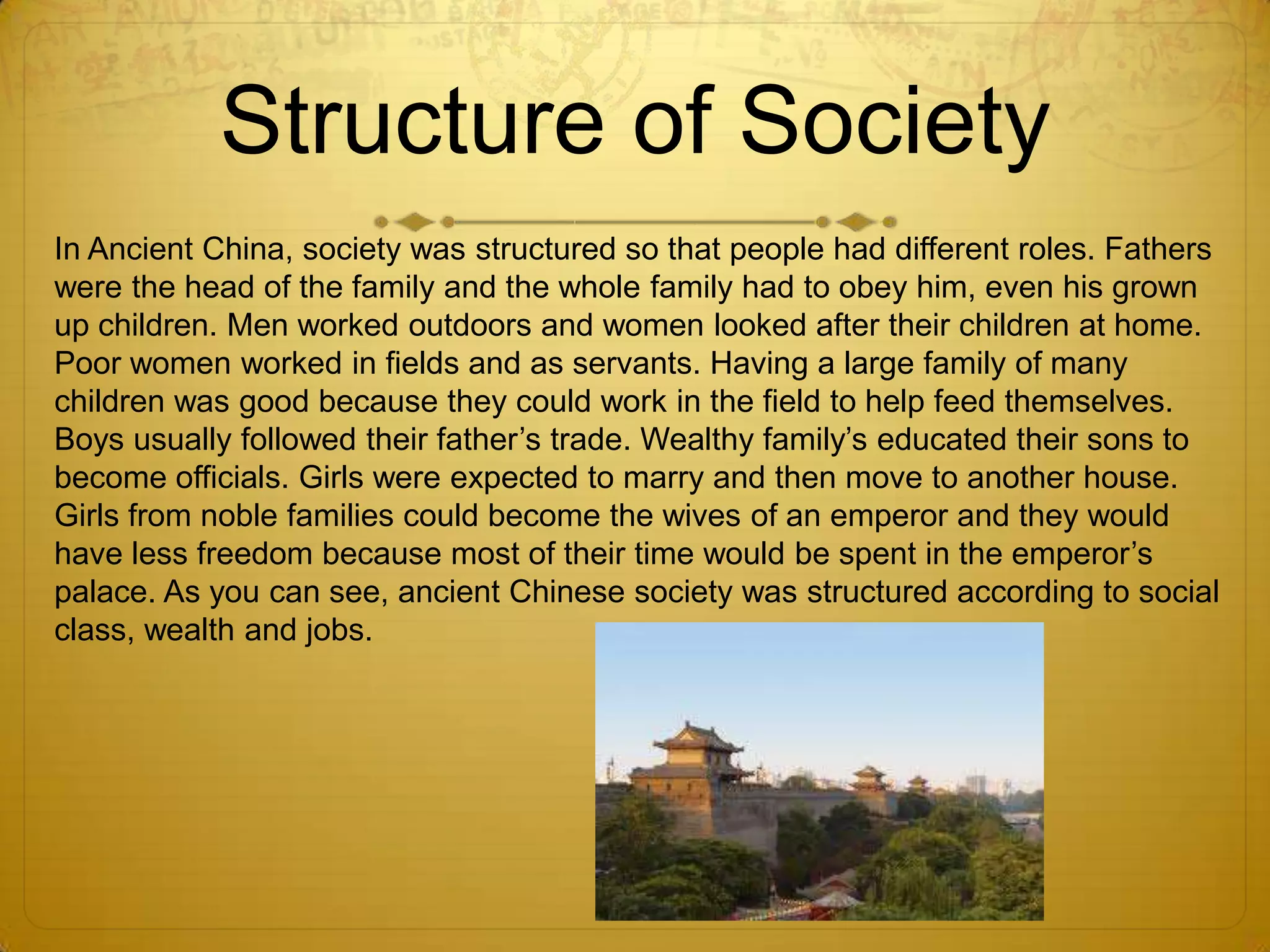
In Ancient China, society was structured so that people had different roles. Fathers
were the head of the family and the whole family had to obey him, even his grown
up children. Men worked outdoors and women looked after their children at home.
Poor women worked in fields and as servants. Having a large family of many
children was good because they could work in the field to help feed themselves.
Boys usually followed their father’s trade. Wealthy family’s educated their sons to
become officials. Girls were expected to marry and then move to another house.
Girls from noble families could become the wives of an emperor and they would
have less freedom because most of their time would be spent in the emperor’s
palace. As you can see, ancient Chinese society was structured according to social
class, wealth and jobs.
Conclusion
In conclusion, ancient China was very different from how
it is today. I hope you enjoyed learning about the
architecture, food, structure of society and inventions
from ancient China. We can learn a lot studying ancient
China. Ancient Chinese civilization gave the world many
new ideas and ways of doing things.
REFERENCE LIST
Author           Date       Title

Joanna Cole       2005    Ms.Frizzles Adventures
Imperial China

Paul Challen     2005    Life in Ancient China

Philp Steel      1998    Step Into The Chinese
Empire

Ivan Minnis      2005    You Are In Ancient China

Date accessed              Website

25/10/2012               www.Brainpop.com

Ancient china

  • 1.
    Ancient China By: Hanson Han (Archeologist)
  • 2.
    Introduction In ancient times,China was a very different civilization. Ancient China was a very strong civilization. Ancient china lasted over 5000 years. It was the longest civilization of all the great civilizations. Ancient China was the area that is now the western half of china. The ancient Chinese were a very interesting and creative people. Their lifestyle and legacies have influenced our world today. This report will tell you about architecture, food, structure of society and legacies in ancient China.
  • 3.
    Architecture One of themost important pieces of ancient Chinese architecture was the Great wall. Do you know that the Great wall was begun in the time of the first emperor? It stretched along the northern edge of the Chinese empire. The connected walls were then built in different dynasties. The Great wall was built to defend China from invaders. It’s called “the longest grave yard in the world” because so many many people died while building it. The Great Wall was mostly made by the army, as well as poor farmers and criminals. The Great Wall is more than 2,100 miles(3,400kilometers) long. Chinese people believed the world was square so their architecture often had square or rectangular designs, which can be seen on roofs and bricks across the land.
  • 4.
    Food Ancient Chinese peopleate many different kinds of food. The food people ate depend on how wealthy they were. Poor people didn’t eat meat meat every day. Sometimes they ate chickens if they were not laying eggs any more. Poor people also hunted for wild animals to eat, too. On the other hand, wealthy people ate many kinds of meat such as goose, chicken and pork. On special occasions, they ate special foods such as dogs, snake, snail and small birds. Also, everybody ate vegetables and fruit. In the south, people ate rice and in the north, people ate noodle because of differences in farming. People drank rice wine and Chinese tea, too. Most people ate with with chopsticks or with their hands.
  • 5.
    Legacies There are fourgreat inventions which became legacies of Ancient China. The Compass was invented In 200 B.C., the Chinese found that a magnetic rock floating in water or hanging from a string will point north. They first used this invention to to make sure houses faced the right way. Later, the compass became very important for navigation. Gun powder was invented by by a scientist who was trying to make a drink that will let you live for ever and it exploded. It was made from salt, pepper, sulphur and carbon. First, Chinese people used them to make fire works for scaring their enemies. Then they used it for weapons such as bombs and rockets. It is still used in many weapons today. Paper was invented around 100B.C. It came from the fiber of a plant called hemp which was soaked(put in water ) until it was a mushy pulp. Then, people used a wooden frame with a fine mesh to lift a layer of pulp. When it was dry it was good for writing. Printing was used in1600B.C.. They began by carving the wooden block with characters. Then, they put ink on the wooden blocks. At last, paper was put on the block. This was a very fast way to make a book. Moveable type was invented in 1040 B.C. This made an important difference to how quickly writing could be produced.
  • 6.
    Structure of Society InAncient China, society was structured so that people had different roles. Fathers were the head of the family and the whole family had to obey him, even his grown up children. Men worked outdoors and women looked after their children at home. Poor women worked in fields and as servants. Having a large family of many children was good because they could work in the field to help feed themselves. Boys usually followed their father’s trade. Wealthy family’s educated their sons to become officials. Girls were expected to marry and then move to another house. Girls from noble families could become the wives of an emperor and they would have less freedom because most of their time would be spent in the emperor’s palace. As you can see, ancient Chinese society was structured according to social class, wealth and jobs.
  • 7.
    Conclusion In conclusion, ancientChina was very different from how it is today. I hope you enjoyed learning about the architecture, food, structure of society and inventions from ancient China. We can learn a lot studying ancient China. Ancient Chinese civilization gave the world many new ideas and ways of doing things.
  • 8.
    REFERENCE LIST Author Date Title Joanna Cole 2005 Ms.Frizzles Adventures Imperial China Paul Challen 2005 Life in Ancient China Philp Steel 1998 Step Into The Chinese Empire Ivan Minnis 2005 You Are In Ancient China Date accessed Website 25/10/2012 www.Brainpop.com