Academic Support at Home 
Park View University Course 
Presented by: Christine Parry 
and Katy Reihsmann 
Park View Instructional Coaches
Introductions 
Christine Parry 
cparry@mgsd70.org 
Katy Reihsmann 
kreihsmann@mgsd70.org
Park View and the CCSS 
As we work to integrate the Common Core State Standards into 
classroom instruction, you may notice shifts in your student’s 
academic experience. 
★ Increased rigor 
★ Increased volume of writing across the 
content areas 
★ Increased student ownership of 
learning
Family Literacy- Research 
● Encompasses the ways 
families, children, and 
extended family 
members use literacy at 
home and in their 
community 
● Examples-o 
drawings/writing to share 
ideas 
o composing notes/letters to 
communicate messages 
o keeping records 
o making lists 
o following written directions 
o sharing stories and ideas 
through conversation, 
reading, and writing
Family Literacy- 
Why is it important? 
● You are your child’s FIRST and LONGEST 
teacher! 
● Success of school’s academic program 
frequently depends on the literacy 
environment at home
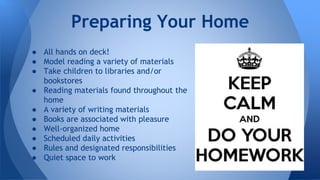
Preparing Your Home 
● All hands on deck! 
● Model reading a variety of materials 
● Take children to libraries and/or 
bookstores 
● Reading materials found throughout the 
home 
● A variety of writing materials 
● Books are associated with pleasure 
● Well-organized home 
● Scheduled daily activities 
● Rules and designated responsibilities 
● Quiet space to work
Managing Tech Use at Home 
● Promote devices as robust tools, not 
just toys or distractions 
● Keep technology use in public 
spaces 
● Set clear boundaries
Homework Help - Tips and Tricks 
● Provide choice within structure 
● Let a teacher or an online resource settle 
an argument. 
● Encourage students to communicate 
directly with their teacher via email. 
● Point out places students should look back 
to check work, but don’t reveal errors.
What do we have in our 
toolkit? 
● Online resources: 
o BrainPOP 
o LearnZillion 
o Khan Academy 
o PV Library website 
o MGPL website 
o YouTube
Bridging Home and School 
When do I communicate with my child’s teacher? 
● volunteer/help in any way 
● concerns in any subject or content area 
● concerns about child’s vision, hearing, etc. 
● language help 
● find out more about helping at home 
● find out more about what your child is learning 
Where can I look for information about what my 
student is learning? 
● Teacher Websites, twitter feeds 
● Examine their Google Drive, Schoology courses, etc. 
● Grades 6-8 - Parent Portal
Additional Resources 
● handouts 
● links to further online resources

PVU - Academic Support at Home

  • 1.
    Academic Support atHome Park View University Course Presented by: Christine Parry and Katy Reihsmann Park View Instructional Coaches
  • 2.
    Introductions Christine Parry cparry@mgsd70.org Katy Reihsmann kreihsmann@mgsd70.org
  • 3.
    Park View andthe CCSS As we work to integrate the Common Core State Standards into classroom instruction, you may notice shifts in your student’s academic experience. ★ Increased rigor ★ Increased volume of writing across the content areas ★ Increased student ownership of learning
  • 4.
    Family Literacy- Research ● Encompasses the ways families, children, and extended family members use literacy at home and in their community ● Examples-o drawings/writing to share ideas o composing notes/letters to communicate messages o keeping records o making lists o following written directions o sharing stories and ideas through conversation, reading, and writing
  • 5.
    Family Literacy- Whyis it important? ● You are your child’s FIRST and LONGEST teacher! ● Success of school’s academic program frequently depends on the literacy environment at home
  • 6.
    Preparing Your Home ● All hands on deck! ● Model reading a variety of materials ● Take children to libraries and/or bookstores ● Reading materials found throughout the home ● A variety of writing materials ● Books are associated with pleasure ● Well-organized home ● Scheduled daily activities ● Rules and designated responsibilities ● Quiet space to work
  • 7.
    Managing Tech Useat Home ● Promote devices as robust tools, not just toys or distractions ● Keep technology use in public spaces ● Set clear boundaries
  • 8.
    Homework Help -Tips and Tricks ● Provide choice within structure ● Let a teacher or an online resource settle an argument. ● Encourage students to communicate directly with their teacher via email. ● Point out places students should look back to check work, but don’t reveal errors.
  • 9.
    What do wehave in our toolkit? ● Online resources: o BrainPOP o LearnZillion o Khan Academy o PV Library website o MGPL website o YouTube
  • 10.
    Bridging Home andSchool When do I communicate with my child’s teacher? ● volunteer/help in any way ● concerns in any subject or content area ● concerns about child’s vision, hearing, etc. ● language help ● find out more about helping at home ● find out more about what your child is learning Where can I look for information about what my student is learning? ● Teacher Websites, twitter feeds ● Examine their Google Drive, Schoology courses, etc. ● Grades 6-8 - Parent Portal
  • 11.
    Additional Resources ●handouts ● links to further online resources

Editor's Notes

  • #4 One of the biggest changes in education today has been the adoption of the CCSS. Common Core, this year especially, is being rolled out at Park View as teachers are more fully understanding what the standards call for and how to put them into daily practice. As the year progresses, you may notice some of these shifts. First, increased rigor. You might notice younger children working on skills that your older children may have done in older grades or just generally doing work that seems beyond what you might expect. With standards that call for increased rigor, children at all grade levels are expected to be able to explain their thinking and reasoning. Generally, increased rigor also means that learning will be “deeper” not “wider”. So for example, a 3rd grade student today at PV will spend a longer amount of time learning multiplication and division than in the past, but they will be asked to know more about these concepts beyond just fact fluency and be able to apply them to a range of real-world contexts. You might also notice an increase of your students’ nonfiction reading, as research shows that students need to read and comprehend a wide range of literature in order to be college and career ready. The second shift is an increased volume of writing. Writing is no longer only instructed during a language arts period. All content areas, including social studies, science, and math, call for students to be able to process their learning through written response. The increases of both rigor and writing means that students necessarily must increase ownership of their learning. The shifts in teaching and learning that CC brings about require higher levels of engagement for students to meet higher expectations and increased challenges in the classroom. In light of these changes, we will share some recommendations tonight for what to focus on at home to best support your child’s academic success this year and in the future.
  • #5 One of the most important things parents can do, no matter the age of your children, is to create a literate home environment. Family literacy encompasses the ways families, children, and extended family members use literacy at home and in their community. Some examples of what a literate home looks like are listed here. Although some purposeful initiation is required to build a literate home, you might notice that many of these things occur naturally and spontaneously during the routines of daily living and are activities that help adults and children “get things done.” Some family literacy activities, such as keeping records and sharing stories, may reflect and reinforce the ethnic or cultural heritage of your family. Occasionally, some home activities may be initiated by the teachers or school with the intention to support the acquisition and development of school literacy for children and families. These could include storybook reading, writing, and helping with homework assignments. Family Literacy also includes your attendance at events such as Curriculum Night, conferences, and any extra programs (sport, band, orchestra) your children participate in. Volunteering in your child’s classrooms for and participating in workshops like tonight’s all contribute to your family literacy.
  • #6 Family Literacy is important to consider, because research shows that about 75% of families include both parents at work. This means that we, as parents, have little time to think about literacy. But family literacy is critical because you are your child’s first and longest teacher.
  • #7 So, how do you get your home ready to support your child’s academic success? Various researchers have established that certain characteristics are common to homes that promote literacy development. Early readers have family members who read to them and help them with writing and reading. Any older people in the household- siblings, cousins, grandparents, etc. can build early literacy skills for any of you with young children by doing these things. Children of all ages need to see adults model reading a variety of material- novels, magazines, newspapers, internet, work-related information. Parents should own or borrow books for both yourself and your child, subscribe to magazines for kids, and provide students of all ages with materials to create their own stories (puppets, dolls, iPad apps). Generally, more parents remind their children to read that write. Don’t forget about writing! There are many authentic reasons for your child to write at home- grocery lists for younger kids, thank you notes and other notes for older kids. Creating a well-organized home provides a setting where interactions between adults and children are socially, emotionally, and intellectually conducive to academic growth. As teachers, we learn to streamline classroom procedures in order to allow maximum time for instruction and for kids to engage in work. The same principle applies at home. It’s important to talk to each other often, ask specific questions about what your child did in school. As you have probably observed, kids don’t usually give a response you are looking for when you simply ask “What did you do in school today?” so ask more pointed questions like “What book did you discuss in reading class today?” or “Tell me about the piece you’re currently working on in writing” or “Was there anything particularly challenging during science today?” in order to elicit better feedback from your child. Students need a quiet place to work, not necessarily a bedroom, and parents should enforce rules for screen time.
  • #8 Technology has so much to offer when it comes to extending and enriching learning at home! Try to promote resourcefulness with tech - learn new things, answer your own questions, solve problems Technology is so much more than games! Kids can exercise creativity - make a movie, learn to code, illustrate your own story, etc. To keep kids safe, we suggest keeping tech use in public spaces in the home We do filter devices purchased by the district at school and at home, but they don’t catch everything By providing supervision, students will be more apt to ask for help if they encounter something bad. Set clear boundaries about where kids can go on the internet and when they are allowed to use tech at home.
  • #9 Homework is sent home both as practice and as work continued from class Encourage students to complete independently in case it’s used as a measure of proficiency Teachers want to be able to use homework as a measure of what students know and are able to do There are sometimes challenges associated with homework completion Kids are tired, especially with the increased rigor of CCSS Kids don’t always buy that their parents know what they’re doing To prevent a power struggle, provide choice within structure choices make kids feel empowered Always give choices that result in your desired outcome “Do you want to watch 20 minutes of TV and then start your homework, or would you rather play outside for 20 minutes and then start your homework?” If you’re not sure how to answer a homework question, or if your student challenges your explanation Access resources from class - teacher website, class notes, digital textbook Access other online resources such as video tutorials If you can’t come to an agreement, or if your student doesn’t have what s/he needs to complete homework, email teacher directly Requires student to take responsibility when homework is not completed Lets the teacher know that they should check in with the student the next day We do encourage you to look over your student’s homework Point out that students should go back and look at sections of work for errors Don’t be too specific. Reinforce what we teach in school about looking for your own errors. Keep the thinking in it for kids.
  • #10 These websites provide great information, tutorial videos, databases of information, and practice for a variety of educational topics.
  • #11 Our teachers are connected and eager to keep the lines of communication open. When in doubt, email! Whether you’re emailing to keep us in the loop, to inquire about something, or learn about your child’s progress, we want to hear from you. To locate information about what your child is learning: Check the MGSD70 website for pictures and information about curriculum Look at your child’s teacher website Ask your child to open their Google Drive, Schoology Courses, or apps on their iPad if they are in 1:1 Middle School Students - Google Drive is used constantly, and you can check the parent portal (MGSD70 website)