The Voyages of Zheng He
600 years ago, in the early 1400s,
at the beginning of the Ming
dynasty, the Chinese emperor
sent Admiral Zheng He on a series
of expeditions to the South China
Sea and the Indian Ocean.
On seven trips spread over almost 30
years, Zheng He and his huge fleets of
ships visited 30 kingdoms between
China and the east coast of Africa.
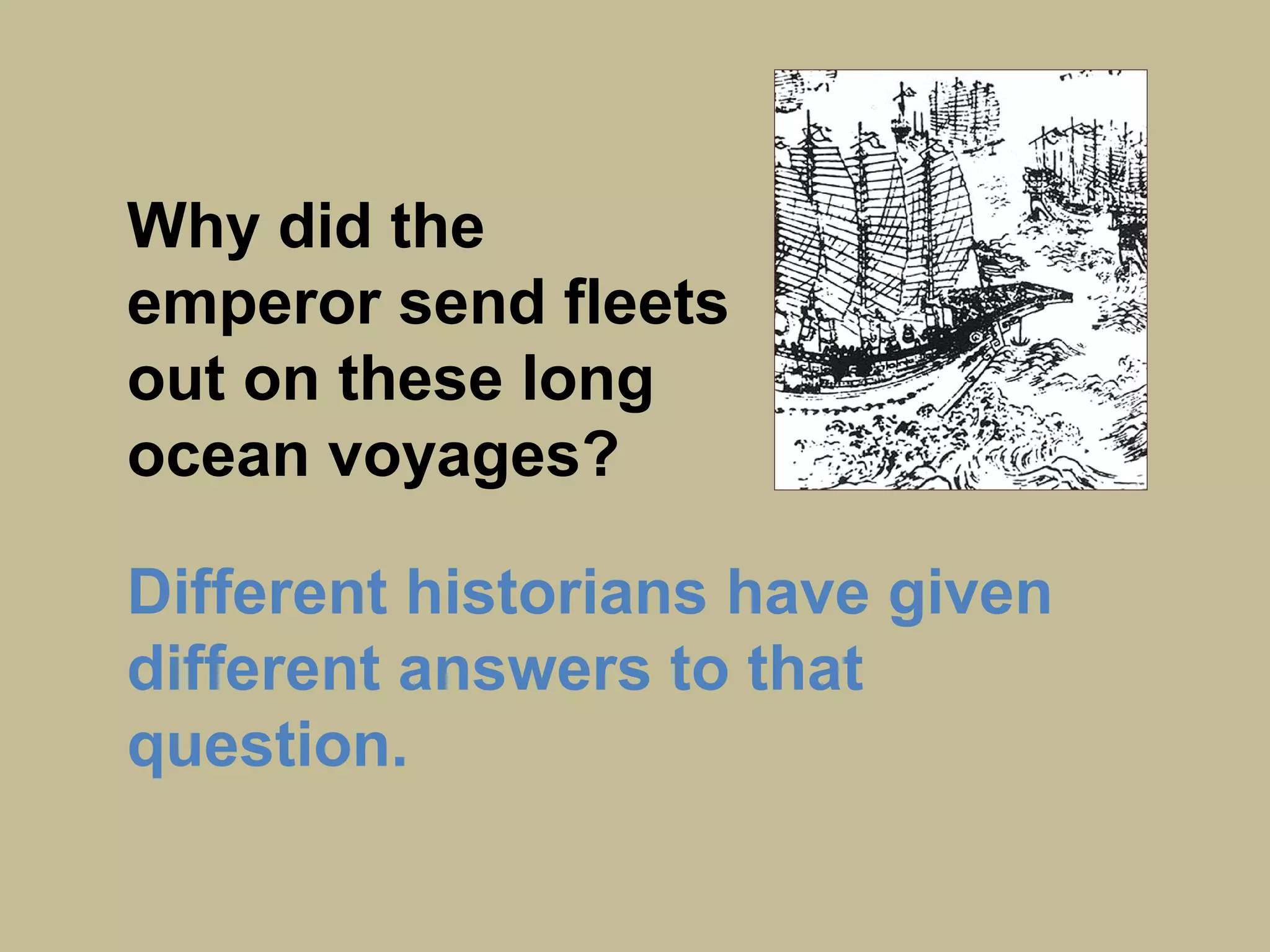
Why did the
emperor send fleets
out on these long
ocean voyages?
Different historians have given
different answers to that
question.
Why did the emperor send fleets out on
these long ocean voyages?
1. To establish tributary relations with
foreign kingdoms.
China considered itself stronger than
all the foreign kingdoms. China
demonstrated its strength by
inviting rulers of other kingdoms to
China, by giving them presents,
and by receiving their presents in
return.
Why did the emperor send fleets out on
these long ocean voyages?
2. To gain the respect of the Chinese
people.
The emperor became emperor by
defeating the previous emperor, his
nephew, in a war. To show that he
deserved to be emperor, he did lots of
spectacular things, like building the
Imperial City in Beijing and bringing
foreign rulers to China.
Why did the emperor send fleets out on
these long ocean voyages?
3. To develop trade with other
kingdoms.
In addition to tribute, which is a form
of trade, Zheng He’s voyages
promoted trade among private
merchants throughout Southeast Asia
and South Asia by making the trade
routes safe from pirates.
Who was Zheng He?
(Pronounce it “Jung Huh”)
As with many
famous people, we
know more legend
than history. People
have been making up
stories about Zheng
He for 600 years!
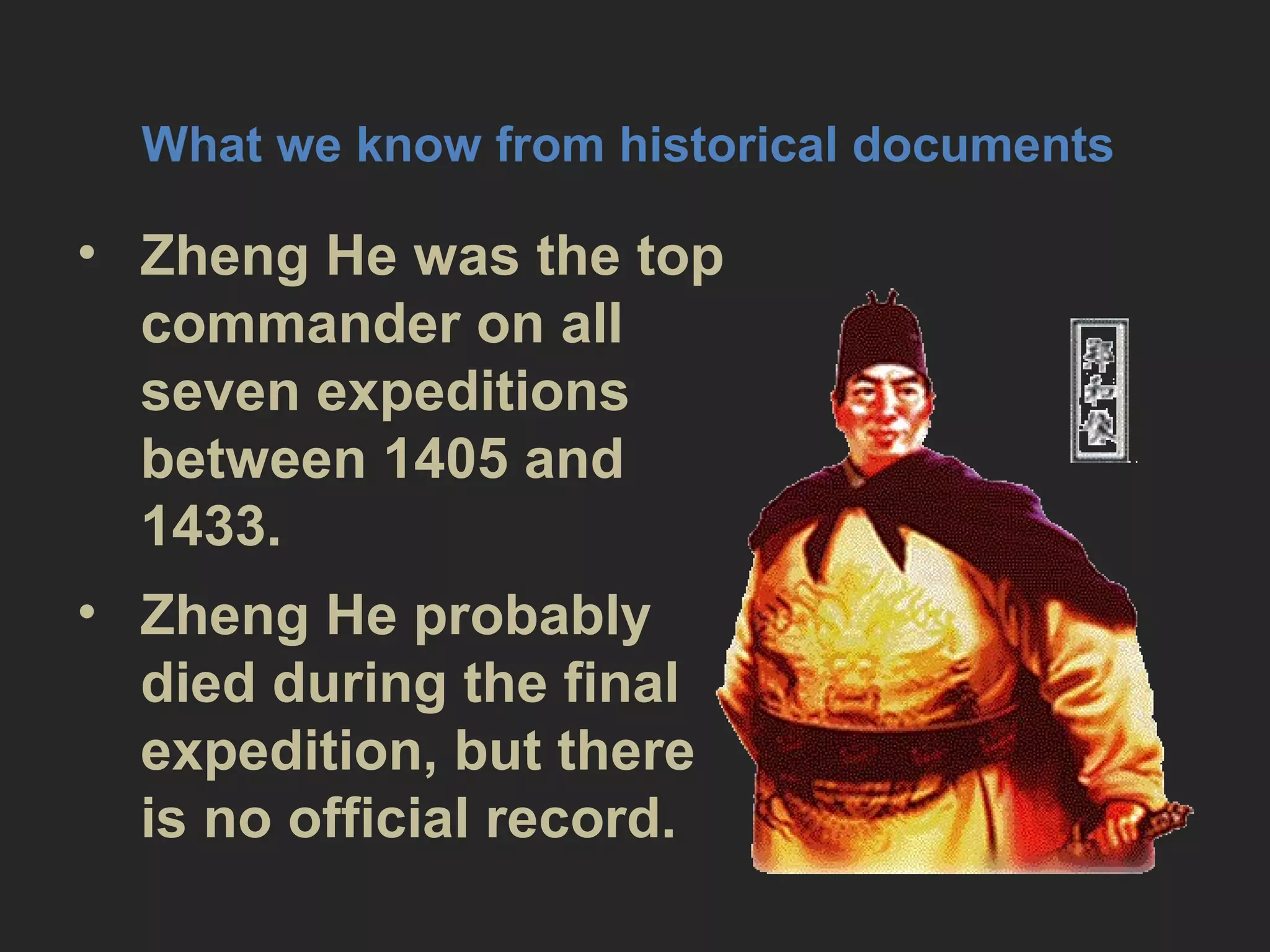
What we know from historical
documents
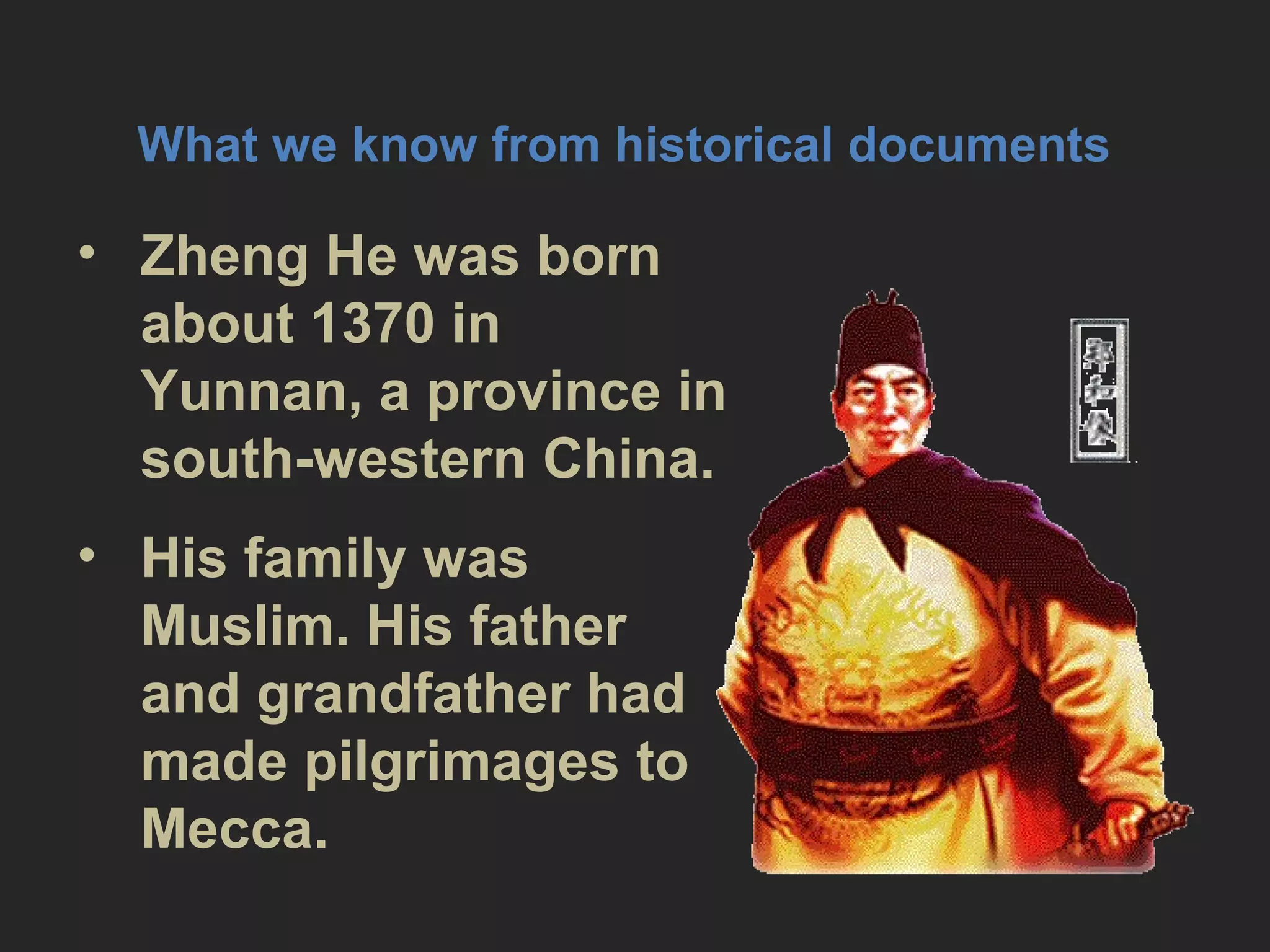
• Zheng He was born about 1370 in
Yunnan, a province in south-
western China.
• His family was Muslim. His father
and grandfather had made
pilgrimages to Mecca.
What we know from historical
documents
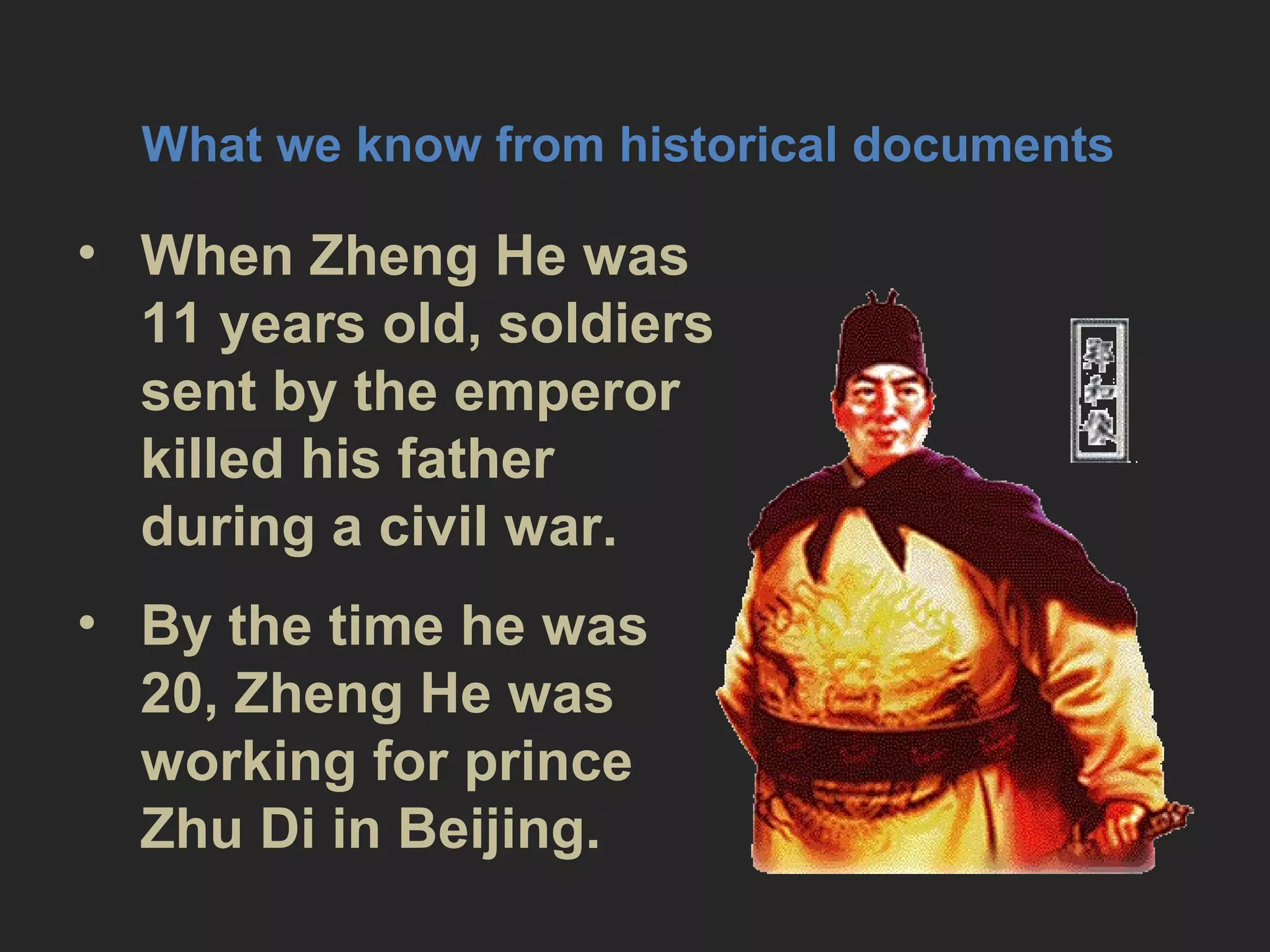
• When Zheng He was 11 years old,
soldiers sent by the emperor
killed his father during a civil war.
• By the time he was 20, Zheng He
was working for prince Zhu Di in
Beijing.
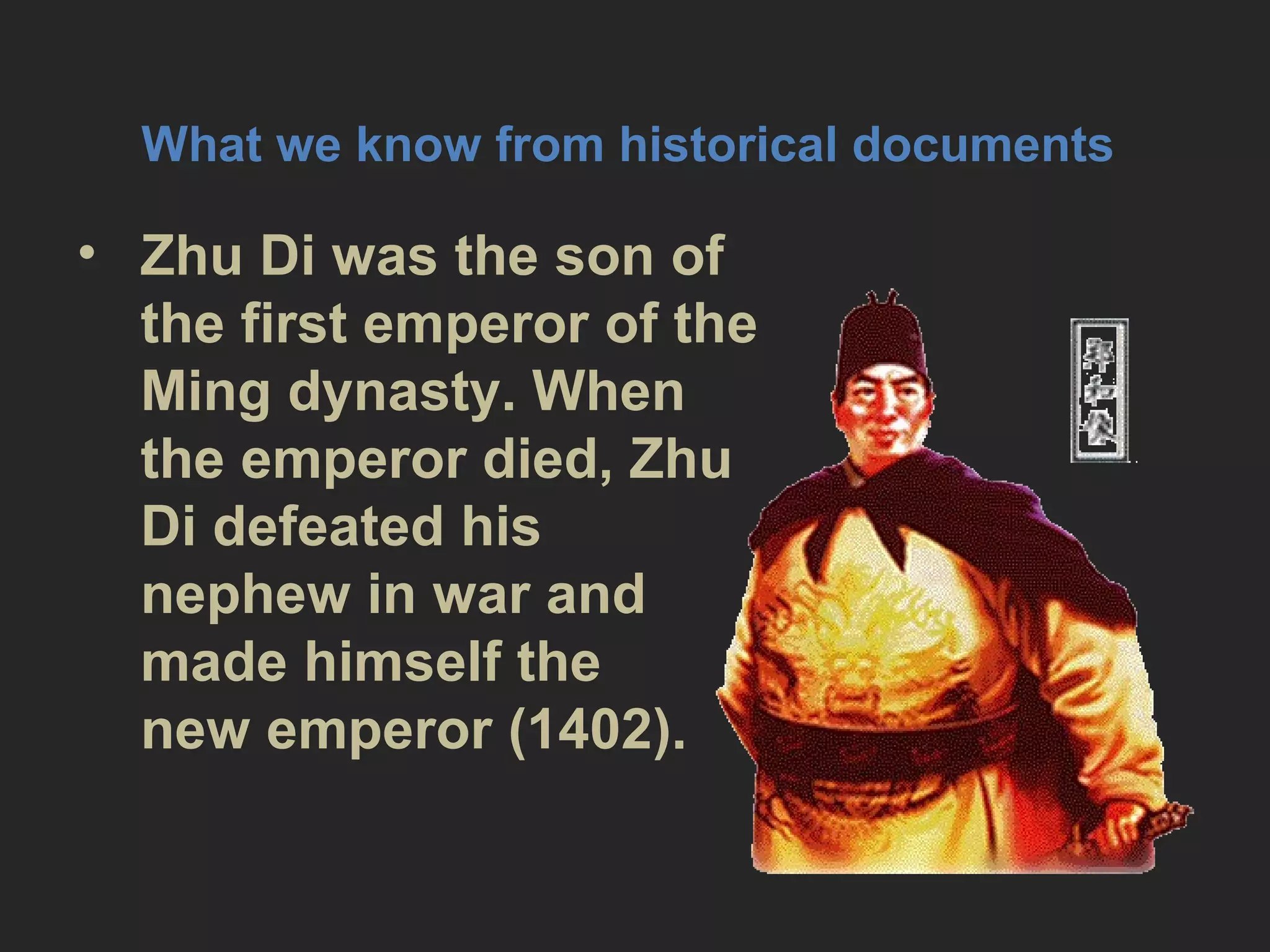
• Zhu Di was the son of
the first emperor of the
Ming dynasty. When
the emperor died, Zhu
Di defeated his
nephew in war and
made himself the
new emperor (1402).
What we know from historical
documents
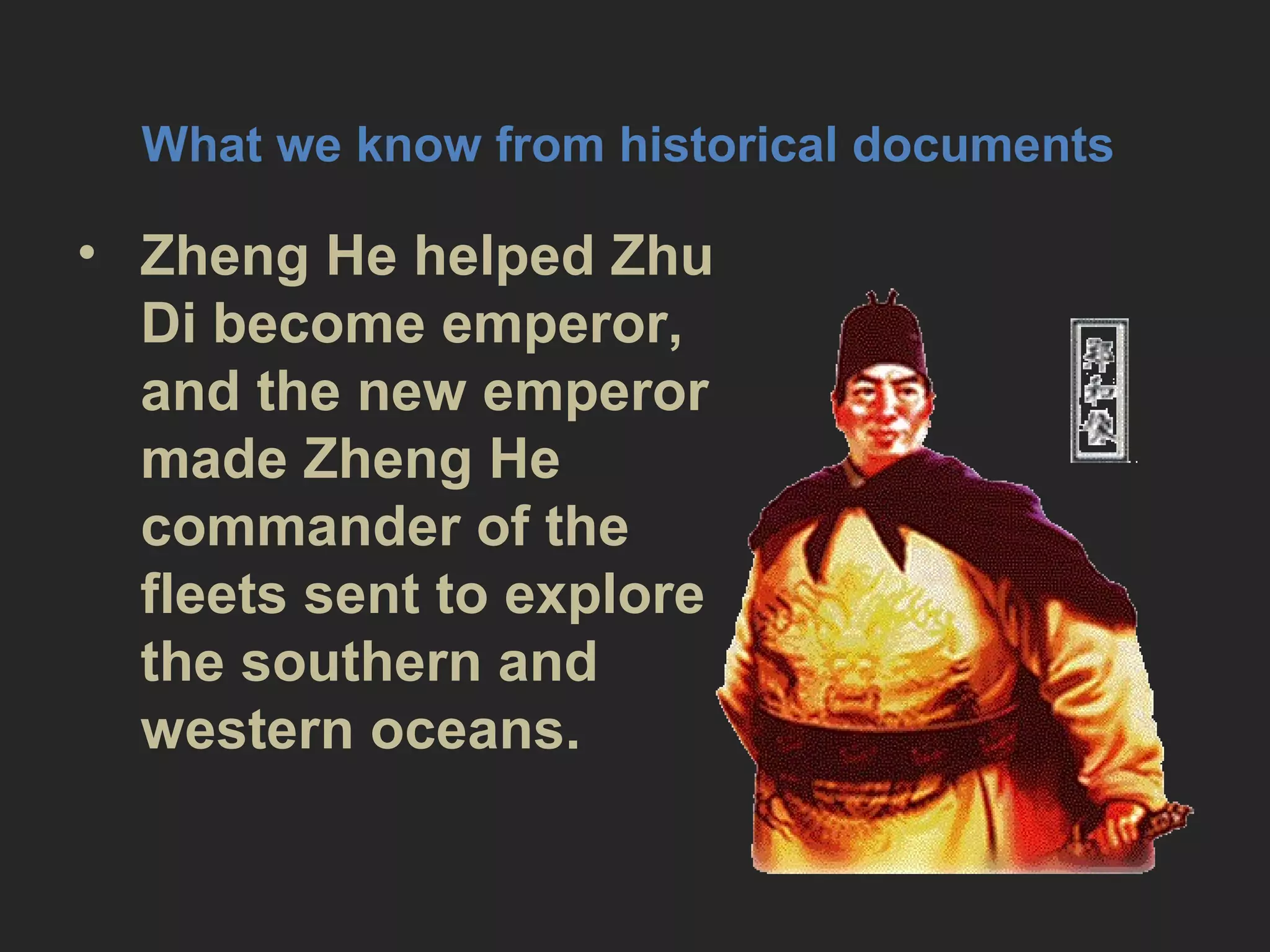
• Zheng He helped Zhu
Di become emperor,
and the new emperor
made Zheng He
commander of the
fleets sent to explore
the southern and
western oceans.
What we know from historical documents
• Zheng He was the top
commander on all
seven expeditions
between 1405 and
1433.
• Zheng He probably
died during the final
expedition, but there
is no official record.
What we know from historical
documents
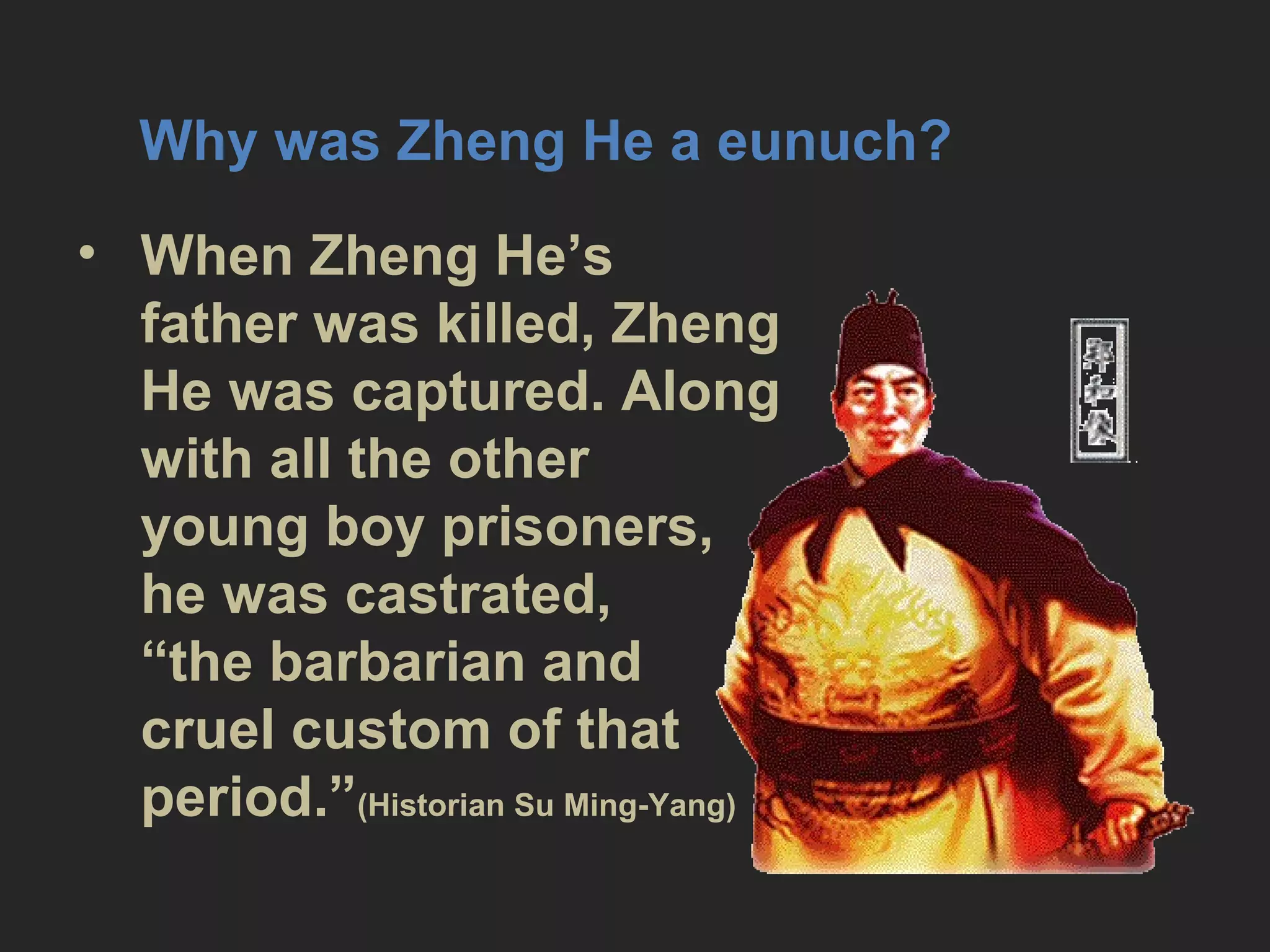
Why was Zheng He a eunuch?
• When Zheng He’s
father was killed, Zheng
He was captured. Along
with all the other
young boy prisoners,
he was castrated,
“the barbarian and
cruel custom of that
period.”(Historian Su Ming-Yang)
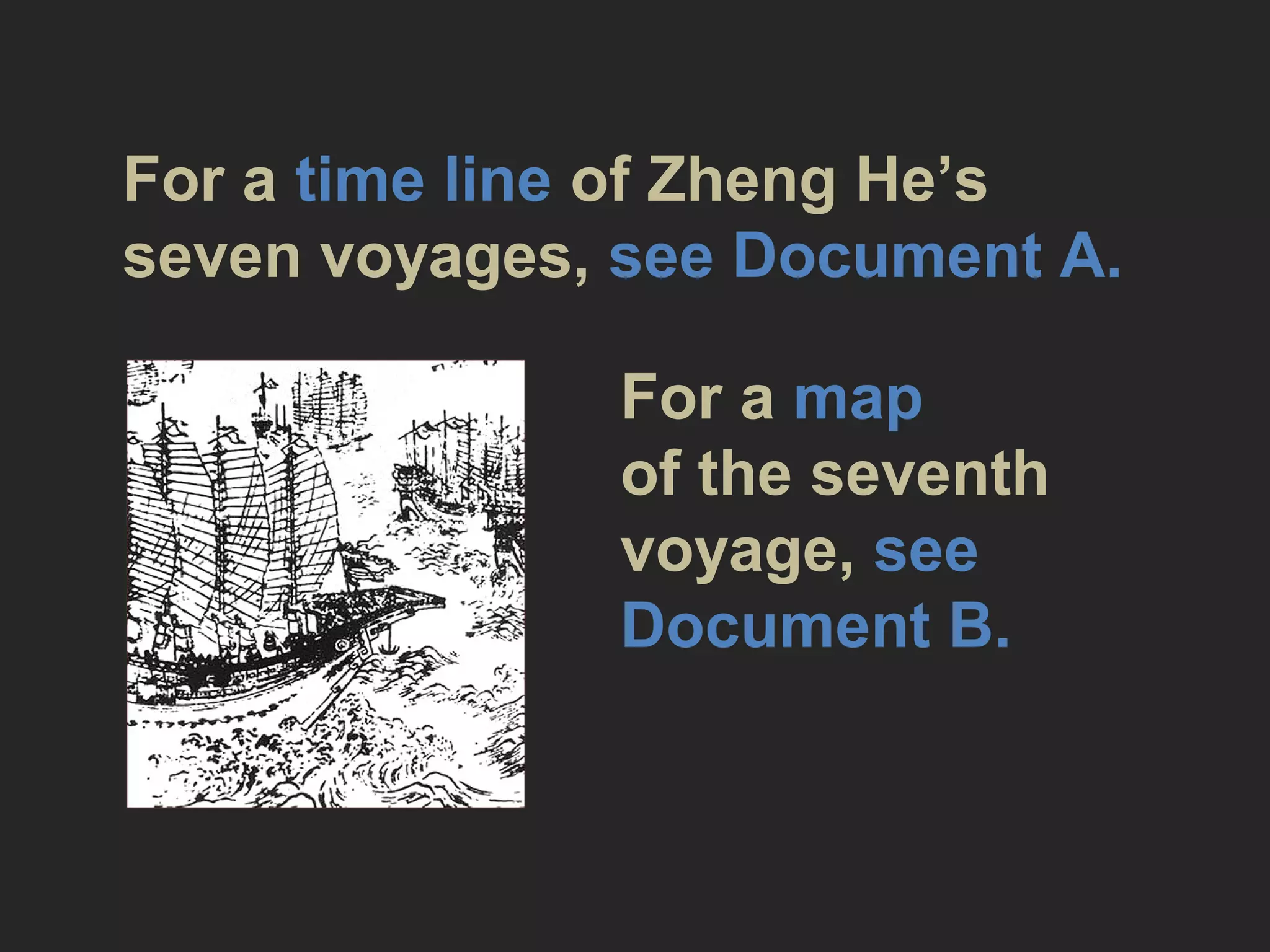
For a time line of Zheng He’s
seven voyages, see Document A.
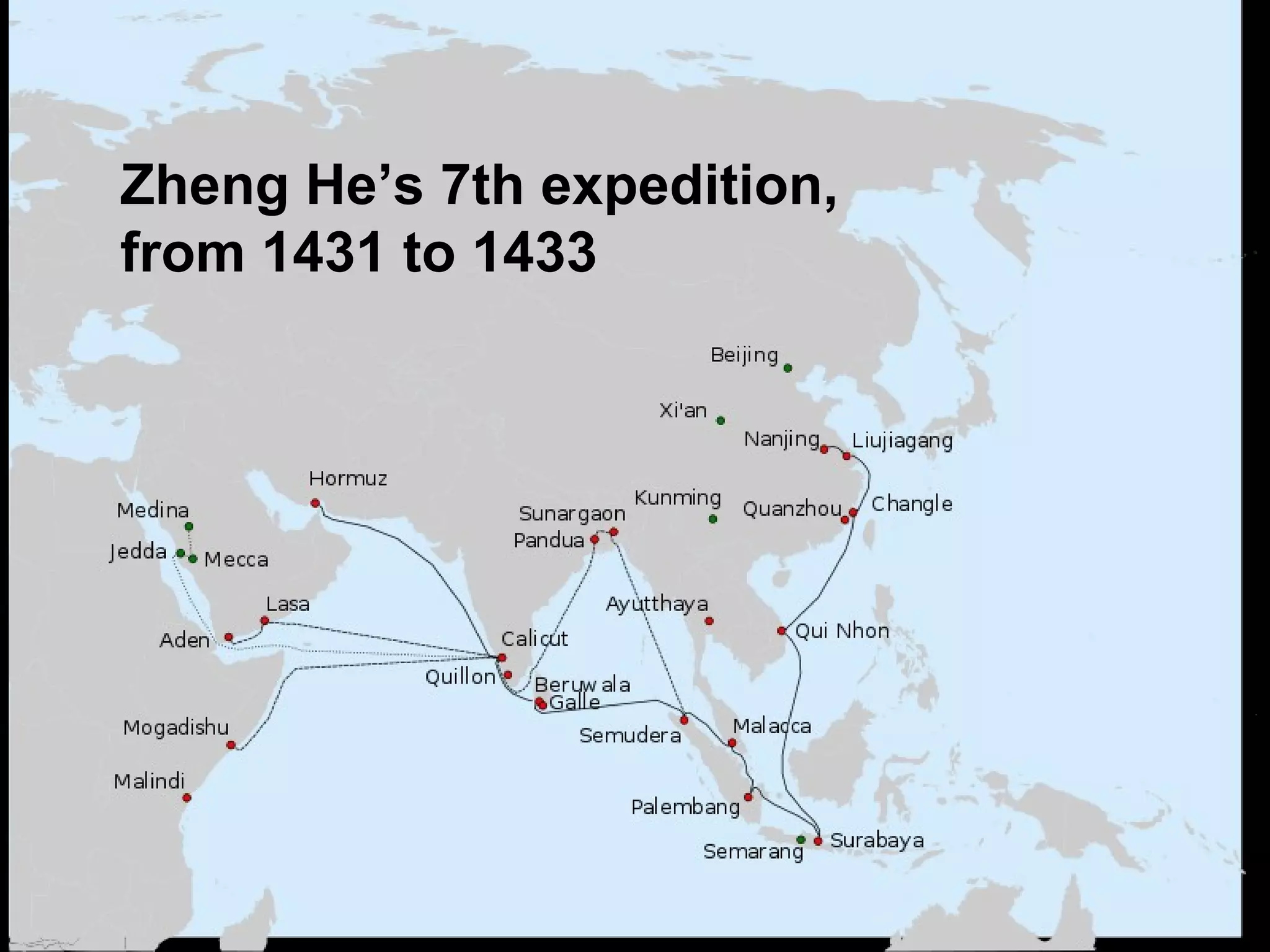
For a map
of the seventh
voyage, see
Document B.
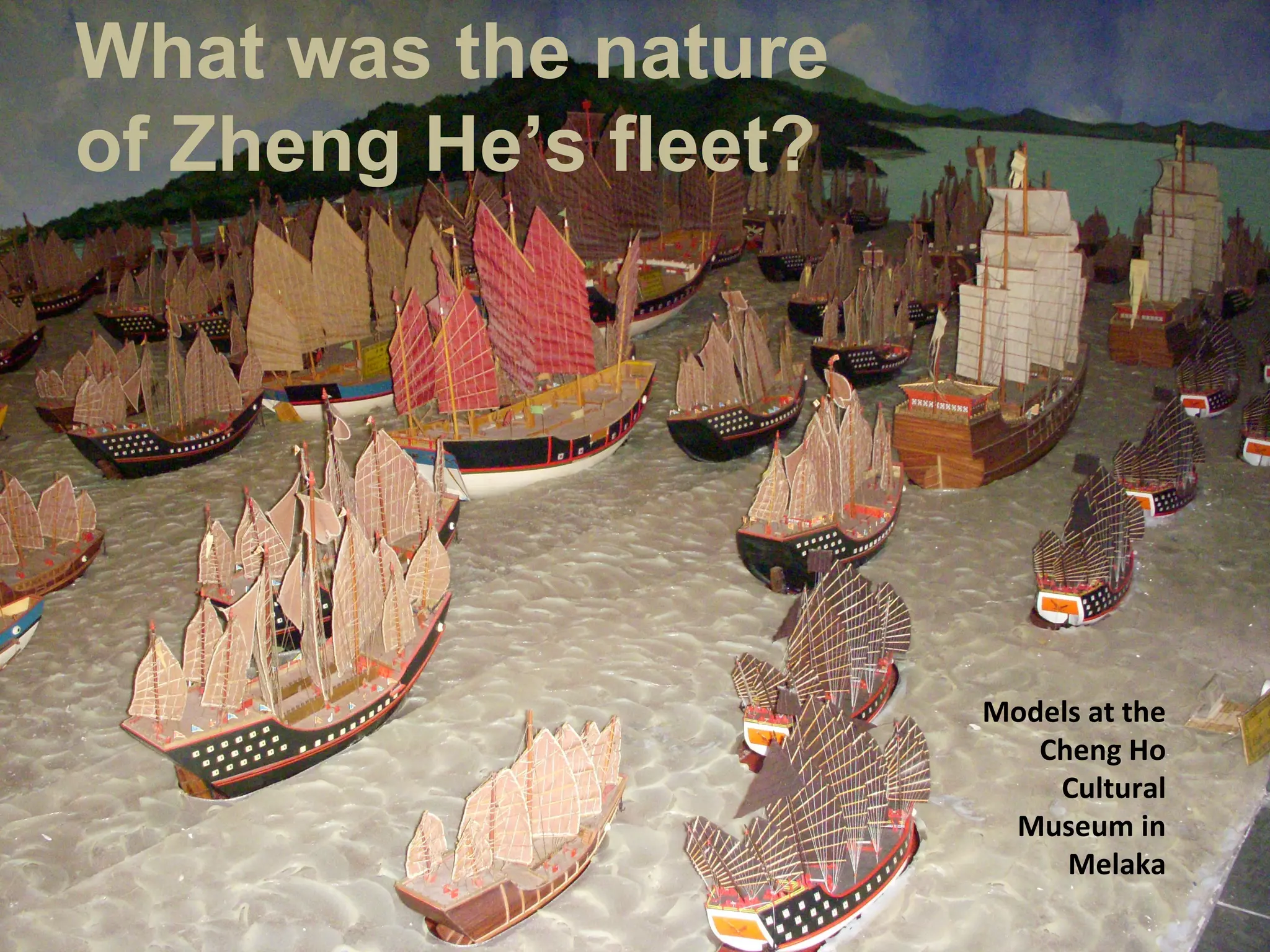
What was the nature of Zheng
He’s fleet?
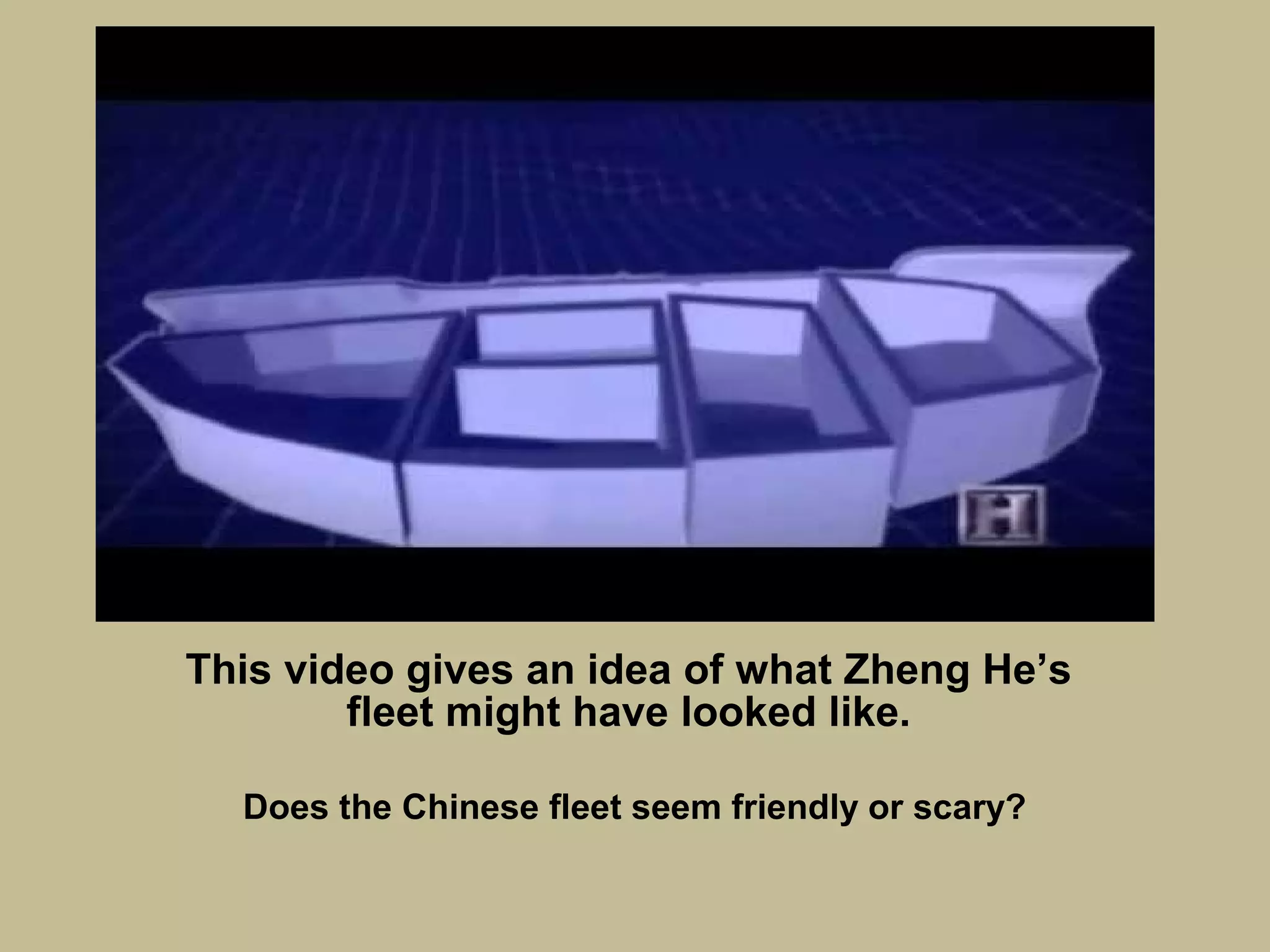
This video gives an idea of what Zheng He’s
fleet might have looked like.
Does the Chinese fleet seem friendly or scary?
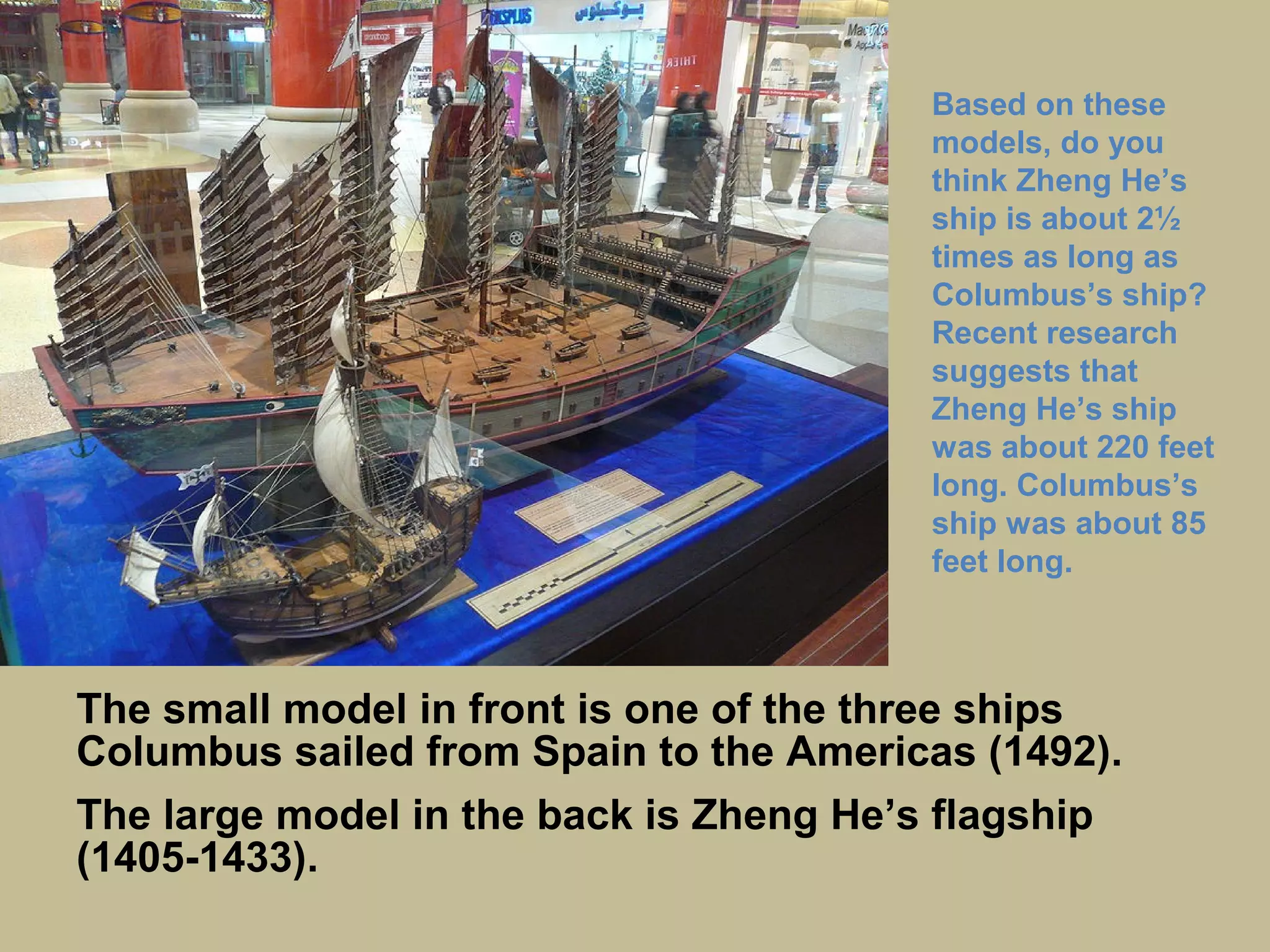
The ship in front is one of the three ships Columbus
sailed from Spain to the Americas (1492).
The large ship in the back is Zheng He’s flagship (1405-
1433).
Based on these
models, do you
think Zheng He’s
ship is about 2½
times as long as
Columbus’s ship?
Recent research
suggests that
Zheng He’s ship
was about 220 feet
long. Columbus’s
ship was about 85
feet long.
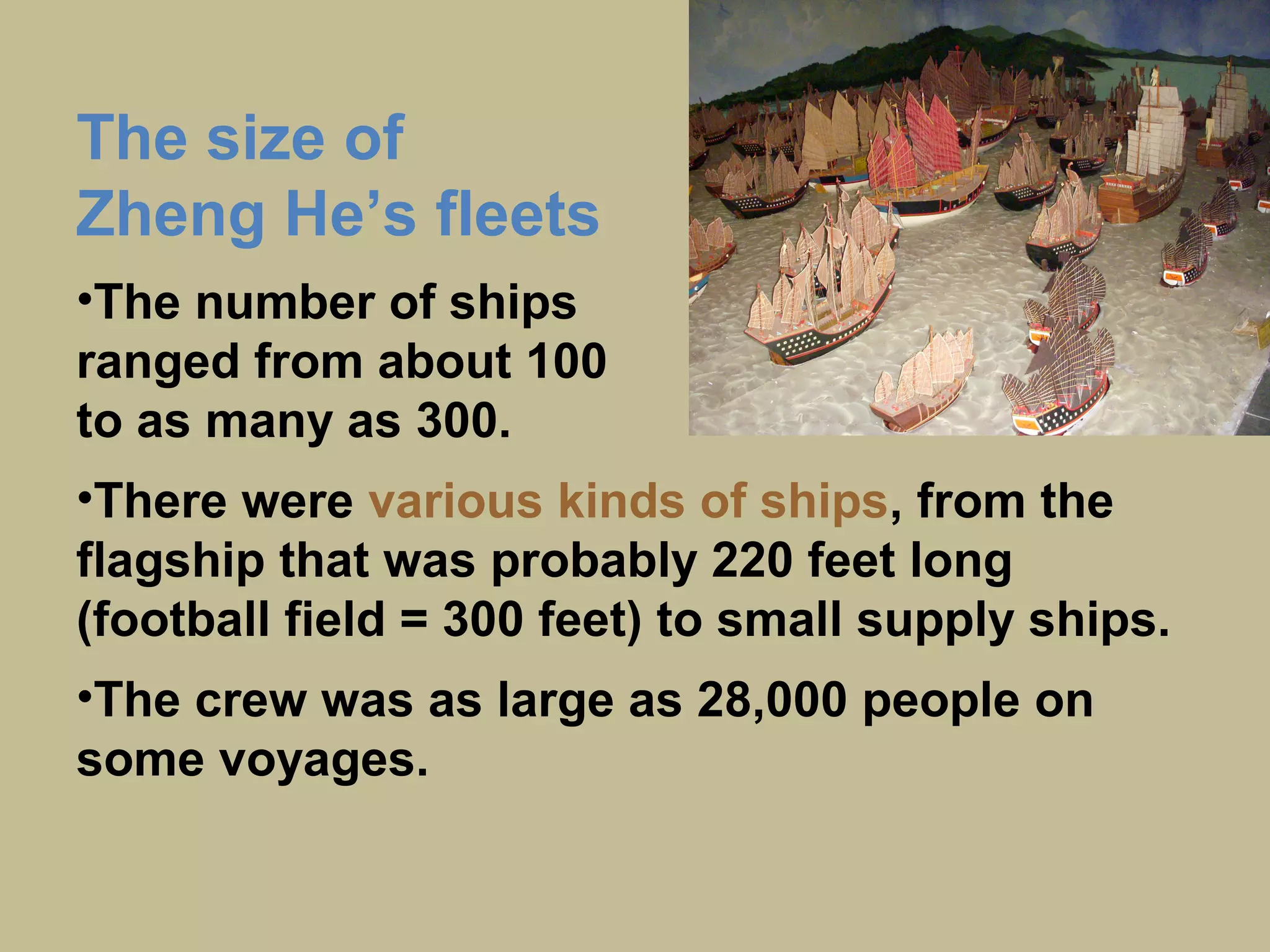
The size of
Zheng He’s fleets
•The number of ships
ranged from about 100
to as many as 300.
•There were
various kinds of ships,
from the flagship that was
probably 220 feet long
(football field = 300 feet)
to small supply ships.
•The crew was as large as
28,000 people on some
voyages.
How far did Zheng
He’s exploration go?
In 2002, retired submariner Gavin
Menzies published a new theory
about Zheng He and his voyages.
Menzies claims that Zheng He's
sailors
•explored the islands of the Atlantic
•established Colonies in Australia,
New Zealand and America
•Introduced horses to the Americas,
rice to California, chickens to South
America, coffee to Puerto Rico, Sloths
to Australia, sea otters to New
Zealand and maize to the Philippines.
What evidence does he use?
•Only China had advanced seafaring
skills at the time
•Chinese maps of the world
•European maps of the world that
show areas not discovered yet
•Chinese style artefacts, sculpture,
inscriptions, shipwrecks
•Chinese DNA in Native American
populations
Other historians have been very critical of Menzies'
ideas. Robert Finlay says:
•The 1421-1423 voyages Menzies describes could not
have taken place
•Conti played no role in transmitting knowledge of
Chinese exploration to European map-makers
•all Menzies' evidence for the presence of Chinese
fleets in America and Australia is baseless
•There were no 'missing years' for the Ming fleets
•It is odd that Zheng He's captains completed a voyage
of 17 000 miles in unknown seas in seven months while
Zheng He took to the same amount of time to journey 3
500 miles from Sumatra to Nanjing.
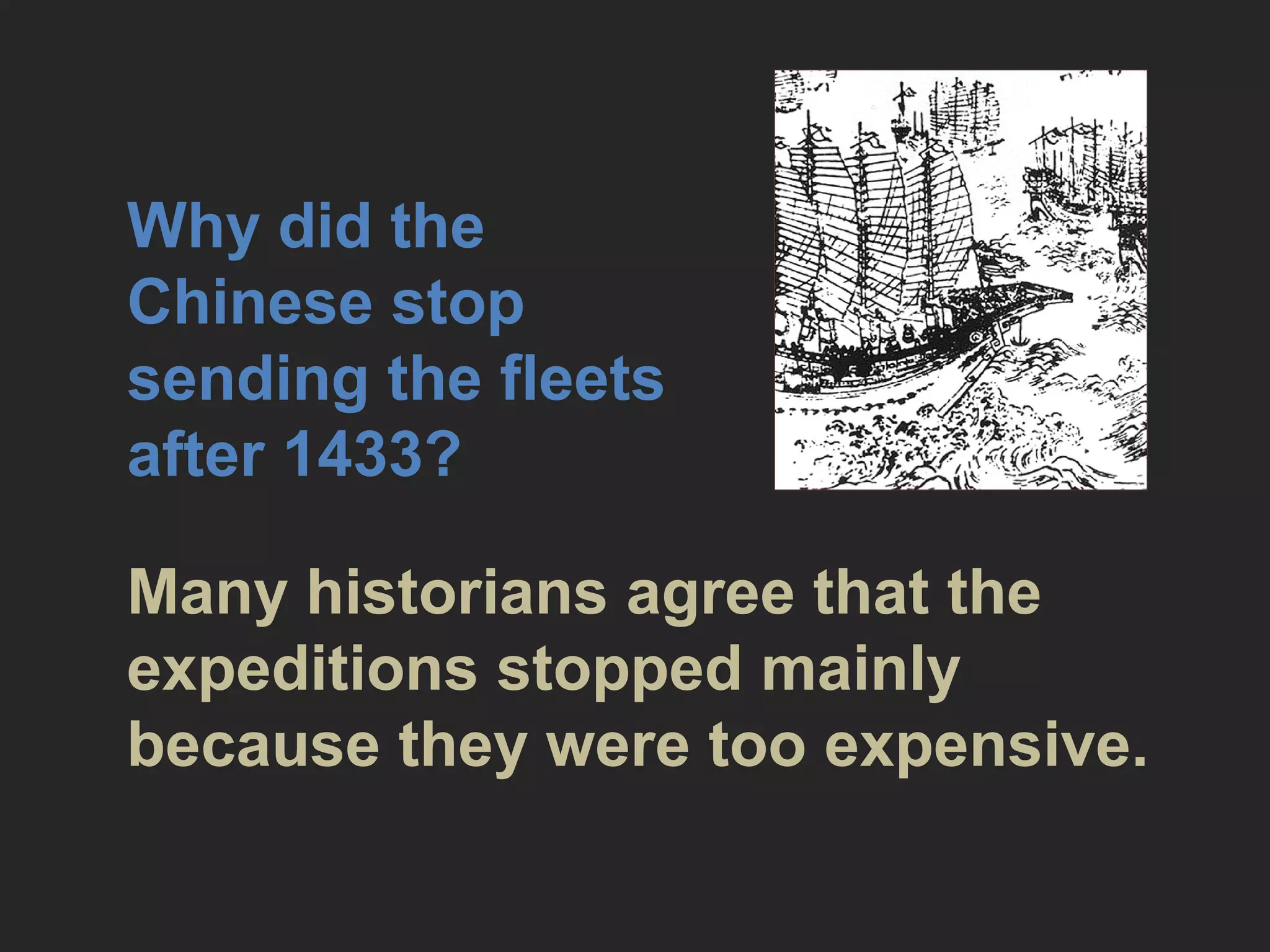
Why did the
Chinese stop
sending the fleets
after 1433?
Many historians agree that the
expeditions stopped mainly
because they were too expensive.
The emperor who first sent Zheng He
out was also spending lots of money
• Building a new capital in Beijing.
• Conducting military campaigns
against the nomads in the north.
• Rebuilding the Great Wall.
• Rebuilding the Grand Canal.
• Waging war against Vietnam for 20
years.
When the emperor died in 1424, the new
emperor decided it was time to reduce
spending.
After all, the expeditions had accomplished
their original goals of establishing tributary
relationships, establishing the prestige of
the emperor, and developing trade.
As people recently observed the 600th
anniversary of Zheng He’s voyages, a
debate among historians emerged:
Was Zheng He a peaceful ambassador
or an imperial aggressor?
Historian Geoff Wade says:
“Zheng He’s expeditions were
intended to achieve the recognition of
Ming dominance over all the states and
kingdoms in the regions visited. To
achieve this they used force, or the
threat of force.”
Historian Tan Ta Sen says:
“Zheng He acted as a peacekeeper and
guardian of native states to maintain
law and order and the safety of trade
routes. Throughout his seven voyages
Zheng He did not occupy or colonize
an inch of foreign land.”
What do you think?
To help you decide, we are going to
conduct an investigation just like
historians do. We’re going to study
some documents from Zheng He’s
time to see what really happened.

Introductory slide show zheng he

  • 1.
  • 2.
    600 years ago,in the early 1400s, at the beginning of the Ming dynasty, the Chinese emperor sent Admiral Zheng He on a series of expeditions to the South China Sea and the Indian Ocean.
  • 3.
    On seven tripsspread over almost 30 years, Zheng He and his huge fleets of ships visited 30 kingdoms between China and the east coast of Africa.
  • 5.
    Why did the emperorsend fleets out on these long ocean voyages? Different historians have given different answers to that question.
  • 6.
    Why did theemperor send fleets out on these long ocean voyages? 1. To establish tributary relations with foreign kingdoms. China considered itself stronger than all the foreign kingdoms. China demonstrated its strength by inviting rulers of other kingdoms to China, by giving them presents, and by receiving their presents in return.
  • 7.
    Why did theemperor send fleets out on these long ocean voyages? 2. To gain the respect of the Chinese people. The emperor became emperor by defeating the previous emperor, his nephew, in a war. To show that he deserved to be emperor, he did lots of spectacular things, like building the Imperial City in Beijing and bringing foreign rulers to China.
  • 8.
    Why did theemperor send fleets out on these long ocean voyages? 3. To develop trade with other kingdoms. In addition to tribute, which is a form of trade, Zheng He’s voyages promoted trade among private merchants throughout Southeast Asia and South Asia by making the trade routes safe from pirates.
  • 9.
    Who was ZhengHe? (Pronounce it “Jung Huh”) As with many famous people, we know more legend than history. People have been making up stories about Zheng He for 600 years!
  • 10.
    What we knowfrom historical documents • Zheng He was born about 1370 in Yunnan, a province in south- western China. • His family was Muslim. His father and grandfather had made pilgrimages to Mecca.
  • 11.
    What we knowfrom historical documents • When Zheng He was 11 years old, soldiers sent by the emperor killed his father during a civil war. • By the time he was 20, Zheng He was working for prince Zhu Di in Beijing.
  • 12.
    • Zhu Diwas the son of the first emperor of the Ming dynasty. When the emperor died, Zhu Di defeated his nephew in war and made himself the new emperor (1402). What we know from historical documents
  • 13.
    • Zheng Hehelped Zhu Di become emperor, and the new emperor made Zheng He commander of the fleets sent to explore the southern and western oceans. What we know from historical documents
  • 14.
    • Zheng Hewas the top commander on all seven expeditions between 1405 and 1433. • Zheng He probably died during the final expedition, but there is no official record. What we know from historical documents
  • 15.
    Why was ZhengHe a eunuch? • When Zheng He’s father was killed, Zheng He was captured. Along with all the other young boy prisoners, he was castrated, “the barbarian and cruel custom of that period.”(Historian Su Ming-Yang)
  • 16.
    For a timeline of Zheng He’s seven voyages, see Document A. For a map of the seventh voyage, see Document B.
  • 17.
    What was thenature of Zheng He’s fleet?
  • 18.
    This video givesan idea of what Zheng He’s fleet might have looked like. Does the Chinese fleet seem friendly or scary?
  • 19.
    The ship infront is one of the three ships Columbus sailed from Spain to the Americas (1492). The large ship in the back is Zheng He’s flagship (1405- 1433). Based on these models, do you think Zheng He’s ship is about 2½ times as long as Columbus’s ship? Recent research suggests that Zheng He’s ship was about 220 feet long. Columbus’s ship was about 85 feet long.
  • 20.
    The size of ZhengHe’s fleets •The number of ships ranged from about 100 to as many as 300. •There were various kinds of ships, from the flagship that was probably 220 feet long (football field = 300 feet) to small supply ships. •The crew was as large as 28,000 people on some voyages.
  • 23.
    How far didZheng He’s exploration go? In 2002, retired submariner Gavin Menzies published a new theory about Zheng He and his voyages.
  • 25.
    Menzies claims thatZheng He's sailors •explored the islands of the Atlantic •established Colonies in Australia, New Zealand and America •Introduced horses to the Americas, rice to California, chickens to South America, coffee to Puerto Rico, Sloths to Australia, sea otters to New Zealand and maize to the Philippines.
  • 27.
    What evidence doeshe use? •Only China had advanced seafaring skills at the time •Chinese maps of the world •European maps of the world that show areas not discovered yet •Chinese style artefacts, sculpture, inscriptions, shipwrecks •Chinese DNA in Native American populations
  • 28.
    Other historians havebeen very critical of Menzies' ideas. Robert Finlay says: •The 1421-1423 voyages Menzies describes could not have taken place •Conti played no role in transmitting knowledge of Chinese exploration to European map-makers •all Menzies' evidence for the presence of Chinese fleets in America and Australia is baseless •There were no 'missing years' for the Ming fleets •It is odd that Zheng He's captains completed a voyage of 17 000 miles in unknown seas in seven months while Zheng He took to the same amount of time to journey 3 500 miles from Sumatra to Nanjing.
  • 29.
    Why did the Chinesestop sending the fleets after 1433? Many historians agree that the expeditions stopped mainly because they were too expensive.
  • 30.
    The emperor whofirst sent Zheng He out was also spending lots of money • Building a new capital in Beijing. • Conducting military campaigns against the nomads in the north. • Rebuilding the Great Wall. • Rebuilding the Grand Canal. • Waging war against Vietnam for 20 years.
  • 31.
    When the emperordied in 1424, the new emperor decided it was time to reduce spending. After all, the expeditions had accomplished their original goals of establishing tributary relationships, establishing the prestige of the emperor, and developing trade.
  • 32.
    As people recentlyobserved the 600th anniversary of Zheng He’s voyages, a debate among historians emerged: Was Zheng He a peaceful ambassador or an imperial aggressor?
  • 33.
    Historian Geoff Wadesays: “Zheng He’s expeditions were intended to achieve the recognition of Ming dominance over all the states and kingdoms in the regions visited. To achieve this they used force, or the threat of force.”
  • 34.
    Historian Tan TaSen says: “Zheng He acted as a peacekeeper and guardian of native states to maintain law and order and the safety of trade routes. Throughout his seven voyages Zheng He did not occupy or colonize an inch of foreign land.”
  • 35.
    What do youthink? To help you decide, we are going to conduct an investigation just like historians do. We’re going to study some documents from Zheng He’s time to see what really happened.