A Classroom Field Trip
1. Confucianism
                   
  If asked about Confucianism, an advisor would
  say, “Lead by example.”
  The goal of Confucianism was a fair and peaceful society.
  Values such as respect for elders, proper behavior, and
  love of
 scholarship (learning) became deeply woven into
  Chinese society.
2. Daoism
                       
If asked about Daoism, an advisor would say, “If you must
rule, rule as little as possible.”
The Dao De Jing preached a return to a simple & natural way of
living.
To the Daoists, nature is full of opposites. Examples are:
o Life and death
o Light and darkness
True harmony comes from balancing the opposite forces of
nature, called yin & yang.
3. China’s First Emperor
            
China’s first emperor, Qin Shihuangdi, was both a
strong and a cruel ruler.
He unified Chinese government and culture.
To protect his empire from invaders, the Emperor of
Qin ordered a long wall to be built along China’s
northern border.
Later it became known as the Great Wall.
4. China’s Foreign
Contacts- Ming Dynasty
                            
Under the Ming dynasty, many other countries were China’s
tributaries
o This means they had to acknowledge the supreme power &
   authority of China and pay tribute to (honor) its leader.
Once a country paid tribute, the Chinese emperors did the
following:
o Acknowledged (accepted) these countries’ rulers
o Provided military help
o Allowed them to trade with China
5. China’s Foreign
Contacts- Mongol Dynasty
                               
Travel along the Silk Road became very safe.
Kublai Khan appointed many visiting foreigners to official
positions in his government.
 o   Marco Polo was hired to go on       inspection tours. His travels
     gave Europeans firsthand knowledge of China and further encouraged
     interest in trade.
Life was more pleasant for foreigners (like Marco Polo) than it was
for the native Chinese.
The resentment that built up under Mongol rule made the Chinese
suspicious of foreigners.
6. China’s Foreign Contacts- Tang
             Dynasty
                       
China both welcomed and rejected contact with
foreigners.
The religion of Buddhism became very popular.
Three items the Chinese traded were:
silk, porcelain, paper, iron, & jade (choose 2)
In return, three things they received were
ivory, cotton, perfumes, spices, & horses (choose 3).
7. Government
               
Officials were sometimes selected for a job because of
their family or wealth.
Meritocracy: Rule by officials chosen for their quality
(rather than their wealth/economic status).
The Mongol leader, Kublai Khan, took the title of
Emperor of China.
He did not trust the Chinese people to run his
government.
8. Chinese Discoveries and
Inventions – Everyday Objects
                         
 Playing cards were invented in China
 Paper money was invented by the Chinese in the late 8th
 or early 9th century.
 The Chinese developed the first mechanical clock in about
 the 8th century.
 Modern-day mechanical clocks are based on the same
 fundamental principles as early Chinese clocks.
9. Chinese Discoveries and
Inventions – Exploration and Travel
                             
 Chinese inventions made exploration and travel safer
 and faster.
 The First Compass:
 o Compasses made long sea voyages possible because sailors
    could figure out directions       even without a landmark or
    a point in the sky to steer by.
 The Chinese discovered how to build ships with
 watertight compartments.
10. Chinese Discoveries and
         Inventions-Industries
                             
For more than 500 years, only the Chinese knew the secret of
making paper.
Woodblock Printing: First type of printing
Movable Type: Printers carved characters out of clay and baked
them. To print, they selected the characters they needed and placed
them in an iron frame in the order they would appear on the page.
When the printing job was done, the type could be removed from
the frame and used again.
The Chinese first made steel, a very useful metal, before 200 B.C.E.
11. Chinese Discoveries and
        Inventions – Military
                         
The Chinese who first made gunpowder were alchemists.
An alchemist is a person who practiced a blend of science
& magic
o While experimenting with saltpeter, Chinese Alchemists
   accidentally discovered an explosive powder.
Rocket technology was developed in China during the
Song dynasty.
12. Legalism
                 
If asked about Legalism, an advisor would say, “Set clear
laws and harshly punish those who disobey them.”
Legalism was based on the idea that most people are
naturally   selfish.
It was not enough for rulers to set a good example.
Instead, they should establish strict laws and enforce
them with rewards for good behavior and harsh
punishments for bad behavior.
13. Silk Road
                          
    The Silk Road was network of smaller trade routes that stretched
    more than 4,000 miles across Asia to the Middle East and Europe.
    Several dangers faced traders while traveling the Silk Road.
    For traders to make a profit, goods had to be valuable and easy to
    carry.
    o   Silk was the perfect trading good, because it was both light and
        valuable.
    The Silk Road also helped to spread the religion of
         Buddhism.

14. Zhou Dynasty
                  
To justify their conquest, the Zhou Dynasty claimed they had been given
the Mandate of Heaven, the right to rule China granted by a god.
As long as the king governed his people well, Heaven gave him the right
to rule.
The Feudalism system started breaking down & causing conflict. There
were 250 years of disorder in China. This time is often called the Warring
States period.
So much instability led the Chinese to ask important questions about
human nature and the best way for rulers to govern.
o   The three most influential ideas about how to govern were
    Confucianism, Daoism, and Legalism.
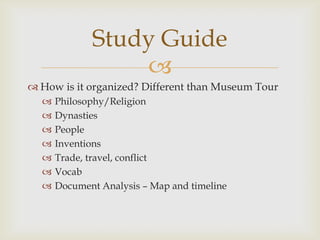
Study Guide
                 
 How is it organized? Different than Museum Tour
     Philosophy/Religion
     Dynasties
     People
     Inventions
     Trade, travel, conflict
     Vocab
     Document Analysis – Map and timeline
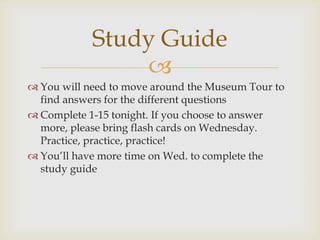
Study Guide
                
 You will need to move around the Museum Tour to
  find answers for the different questions
 Complete 1-15 tonight. If you choose to answer
  more, please bring flash cards on Wednesday.
  Practice, practice, practice!
 You’ll have more time on Wed. to complete the
  study guide
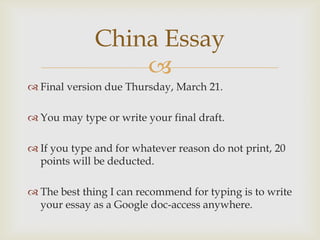
China Essay
                  
 Final version due Thursday, March 21.

 You may type or write your final draft.

 If you type and for whatever reason do not print, 20
  points will be deducted.

 The best thing I can recommend for typing is to write
  your essay as a Google doc-access anywhere.

China Museum Tour

  • 1.
  • 2.
    1. Confucianism  If asked about Confucianism, an advisor would say, “Lead by example.” The goal of Confucianism was a fair and peaceful society. Values such as respect for elders, proper behavior, and love of  scholarship (learning) became deeply woven into Chinese society.
  • 3.
    2. Daoism  If asked about Daoism, an advisor would say, “If you must rule, rule as little as possible.” The Dao De Jing preached a return to a simple & natural way of living. To the Daoists, nature is full of opposites. Examples are: o Life and death o Light and darkness True harmony comes from balancing the opposite forces of nature, called yin & yang.
  • 4.
    3. China’s FirstEmperor  China’s first emperor, Qin Shihuangdi, was both a strong and a cruel ruler. He unified Chinese government and culture. To protect his empire from invaders, the Emperor of Qin ordered a long wall to be built along China’s northern border. Later it became known as the Great Wall.
  • 5.
    4. China’s Foreign Contacts-Ming Dynasty  Under the Ming dynasty, many other countries were China’s tributaries o This means they had to acknowledge the supreme power & authority of China and pay tribute to (honor) its leader. Once a country paid tribute, the Chinese emperors did the following: o Acknowledged (accepted) these countries’ rulers o Provided military help o Allowed them to trade with China
  • 6.
    5. China’s Foreign Contacts-Mongol Dynasty  Travel along the Silk Road became very safe. Kublai Khan appointed many visiting foreigners to official positions in his government. o Marco Polo was hired to go on inspection tours. His travels gave Europeans firsthand knowledge of China and further encouraged interest in trade. Life was more pleasant for foreigners (like Marco Polo) than it was for the native Chinese. The resentment that built up under Mongol rule made the Chinese suspicious of foreigners.
  • 7.
    6. China’s ForeignContacts- Tang Dynasty  China both welcomed and rejected contact with foreigners. The religion of Buddhism became very popular. Three items the Chinese traded were: silk, porcelain, paper, iron, & jade (choose 2) In return, three things they received were ivory, cotton, perfumes, spices, & horses (choose 3).
  • 8.
    7. Government  Officials were sometimes selected for a job because of their family or wealth. Meritocracy: Rule by officials chosen for their quality (rather than their wealth/economic status). The Mongol leader, Kublai Khan, took the title of Emperor of China. He did not trust the Chinese people to run his government.
  • 9.
    8. Chinese Discoveriesand Inventions – Everyday Objects  Playing cards were invented in China Paper money was invented by the Chinese in the late 8th or early 9th century. The Chinese developed the first mechanical clock in about the 8th century. Modern-day mechanical clocks are based on the same fundamental principles as early Chinese clocks.
  • 10.
    9. Chinese Discoveriesand Inventions – Exploration and Travel  Chinese inventions made exploration and travel safer and faster. The First Compass: o Compasses made long sea voyages possible because sailors could figure out directions even without a landmark or a point in the sky to steer by. The Chinese discovered how to build ships with watertight compartments.
  • 11.
    10. Chinese Discoveriesand Inventions-Industries  For more than 500 years, only the Chinese knew the secret of making paper. Woodblock Printing: First type of printing Movable Type: Printers carved characters out of clay and baked them. To print, they selected the characters they needed and placed them in an iron frame in the order they would appear on the page. When the printing job was done, the type could be removed from the frame and used again. The Chinese first made steel, a very useful metal, before 200 B.C.E.
  • 12.
    11. Chinese Discoveriesand Inventions – Military  The Chinese who first made gunpowder were alchemists. An alchemist is a person who practiced a blend of science & magic o While experimenting with saltpeter, Chinese Alchemists accidentally discovered an explosive powder. Rocket technology was developed in China during the Song dynasty.
  • 13.
    12. Legalism  If asked about Legalism, an advisor would say, “Set clear laws and harshly punish those who disobey them.” Legalism was based on the idea that most people are naturally selfish. It was not enough for rulers to set a good example. Instead, they should establish strict laws and enforce them with rewards for good behavior and harsh punishments for bad behavior.
  • 14.
    13. Silk Road  The Silk Road was network of smaller trade routes that stretched more than 4,000 miles across Asia to the Middle East and Europe. Several dangers faced traders while traveling the Silk Road. For traders to make a profit, goods had to be valuable and easy to carry. o Silk was the perfect trading good, because it was both light and valuable. The Silk Road also helped to spread the religion of Buddhism. 
  • 15.
    14. Zhou Dynasty  To justify their conquest, the Zhou Dynasty claimed they had been given the Mandate of Heaven, the right to rule China granted by a god. As long as the king governed his people well, Heaven gave him the right to rule. The Feudalism system started breaking down & causing conflict. There were 250 years of disorder in China. This time is often called the Warring States period. So much instability led the Chinese to ask important questions about human nature and the best way for rulers to govern. o The three most influential ideas about how to govern were Confucianism, Daoism, and Legalism.
  • 16.
    Study Guide   How is it organized? Different than Museum Tour  Philosophy/Religion  Dynasties  People  Inventions  Trade, travel, conflict  Vocab  Document Analysis – Map and timeline
  • 17.
    Study Guide   You will need to move around the Museum Tour to find answers for the different questions  Complete 1-15 tonight. If you choose to answer more, please bring flash cards on Wednesday. Practice, practice, practice!  You’ll have more time on Wed. to complete the study guide
  • 18.
    China Essay   Final version due Thursday, March 21.  You may type or write your final draft.  If you type and for whatever reason do not print, 20 points will be deducted.  The best thing I can recommend for typing is to write your essay as a Google doc-access anywhere.