MEDICATION ERRORS
Dr . UPPU JHANSI RANI
Pharmacovigilance Associate
Overview
• Definition
• Types of Medication Errors
• Barriers that contribute to Medication Error
• Medication Error Detection
• Reporting process
• How to Prevent Medication Errors?
Definition
Medication Error: is any preventable event that may
cause or lead to inappropriate medication use or patient
harm while the medication is in the control of the
healthcare professional, patient, or consumer according
to the National Coordinating Council for Medication
Error Reporting and Prevention.
Near Miss (Medication Error): The Medication error
that took place but captured before reaching the patient,
such events are termed as Near Miss errors.
Medication Errors
• Medication Errors cause at least one death
every day and injure approximately 1.3 million
people annually in the United States.
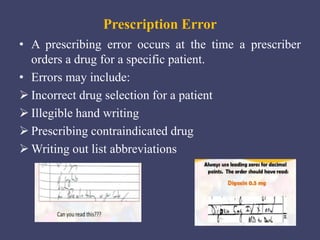
Prescription Error
• A prescribing error occurs at the time a prescriber
orders a drug for a specific patient.
• Errors may include:
 Incorrect drug selection for a patient
 Illegible hand writing
 Prescribing contraindicated drug
 Writing out list abbreviations
Dispensing Error
• Dispensing errors occur at any stage of the dispensing
process, from the receipt of the prescription in the
pharmacy to the supply of a dispensed medicine to a
patient.
• Incorrect drug, Incorrect strength, Incorrect dosage
form, miscalculation of doses.
Example: Dispensed Chlorpramazine instead of
Chlorpromide.
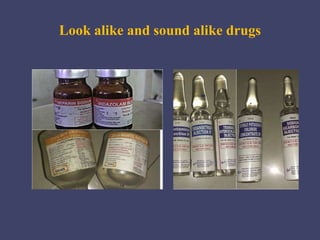
Look alike and sound alike drugs
 Administration Error A drug administration error may be
defined as the discrepancy between the drug therapy received
by the patient and the drug therapy intended by prescriber.
• It involves wrong patient, wrong route of administration,
wrong time, wrong dose
• Example: Administered Diclofenac in IV Route instead of
IM
 Transcription Error: Transcription is the process of making
an identical copy of prescription in the medical records. Errors
that occur during this process called Transcription error.
 Indenting Error: Errors that occur during the process of
indenting.
Sub-types of Medication Errors
• Wrong Patient
• Wrong Drug
• Wrong time Error
• Improper Dose Error
• Wrong drug preparation Error
• Wrong Administration technique Error
Factors that Contribute to Medication Errors
• Excessive task demand
• Inadequate medication history taking
• Inappropriate use of decimal points
• Use of unlisted abbreviations (AZT)
• Lack of communication
• Lack of patient counseling
• Environmental factors
• Look alike/sound alike drugs
• Lack of unit dose system
• Lack of independent check before dispensing or
administering the medications
• Incomplete Knowledge of medicines
• Lack of drug availability
Factors that Contribute to Medication Errors
Barriers to effective Error Reporting
• Culture of Blame ǃǃ
Right Drug
Right Route
Right Time
Right Dose
Right Patient
Right Dosage Form
Medication Error Detection
• Attending medical rounds
• Directly observing medication administration
• Reviewing patient’s charts
• Analyzing dose returned to the pharmacy
• Comparing medication administration records
with physician’s orders
Reporting Process
Whether paper or Electronic, a successful reporting
system should possess the following characteristics:
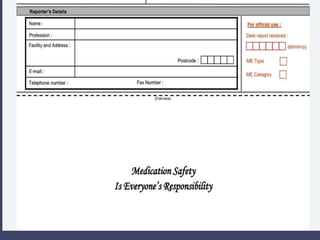
• Confidentiality: Patient, Reporter, Organization
• Easy to understand
• Requires minimal time to report
• Privileged: Allow using the data for quality
improvement while protecting from disclosure in
potential legal proceedings
Reporting Process
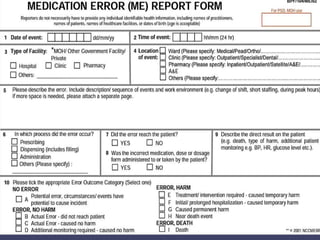
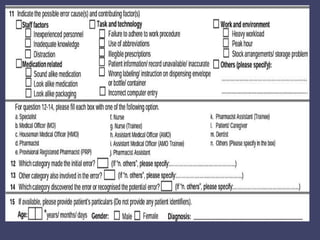
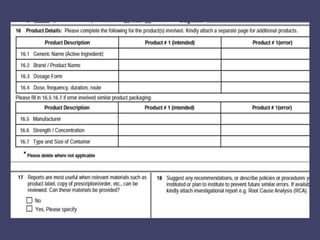
Suggested Minimal fields for Medication Error data collection:
• Patient Information
• Date, time, Ward/dept.
• Name of the medications prescribed
• Name of the medication administered
• Therapeutic classification of medication
• Route of administration
• Description of event
• Type of error
• Patient outcome
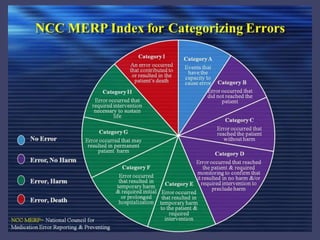
• NCCMERP Categories
Root Cause Analysis
The Goal of RCA Process is to find out:
1. What happened?
2. Why did it happen?
3. What do you do to prevent it from happening again?
Characteristics of an Effective Medication
Error Reporting System
 Organization goal should monitor both actual and potential
errors
 Should investigate the root cause analysis of errors to prevent
it.
 Encourage Voluntary Reporting of errors
 Provide confidentiality of reported information
 Provide confidentiality of reporter information
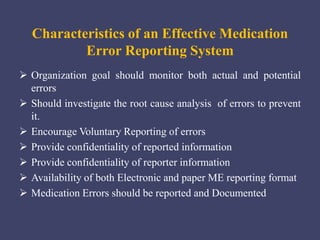
 Availability of both Electronic and paper ME reporting format
 Medication Errors should be reported and Documented
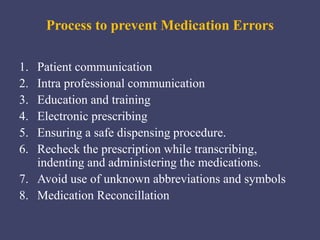
Process to prevent Medication Errors
1. Patient communication
2. Intra professional communication
3. Education and training
4. Electronic prescribing
5. Ensuring a safe dispensing procedure.
6. Recheck the prescription while transcribing,
indenting and administering the medications.
7. Avoid use of unknown abbreviations and symbols
8. Medication Reconcillation
Actions that can be taken in clinic Areas
 Risk Awareness- HIGH RISK DRUG
 Review Floor stock to reduce out of stock
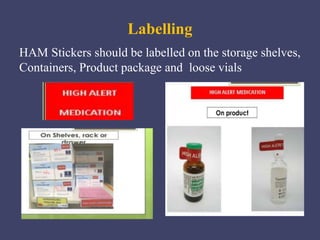
 Use of Proper Labelling (Label HAM stickers on
High alert medication packages/Vials or Ampoules)
 LASA Medicines to be stored separately
 Ensure proper and correct programming of infusion
pump.
 Perform Independent double check
 No verbal orders for High Risk medications.
HAM Stickers should be labelled on the storage shelves,
Containers, Product package and loose vials
Labelling
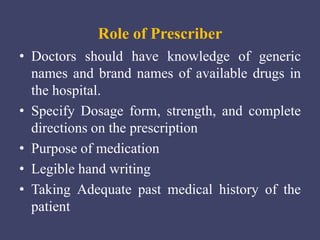
Role of Prescriber
• Doctors should have knowledge of generic
names and brand names of available drugs in
the hospital.
• Specify Dosage form, strength, and complete
directions on the prescription
• Purpose of medication
• Legible hand writing
• Taking Adequate past medical history of the
patient
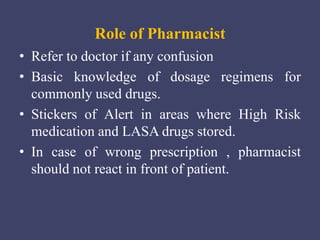
Role of Pharmacist
• Refer to doctor if any confusion
• Basic knowledge of dosage regimens for
commonly used drugs.
• Stickers of Alert in areas where High Risk
medication and LASA drugs stored.
• In case of wrong prescription , pharmacist
should not react in front of patient.
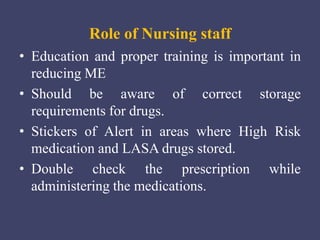
Role of Nursing staff
• Education and proper training is important in
reducing ME
• Should be aware of correct storage
requirements for drugs.
• Stickers of Alert in areas where High Risk
medication and LASA drugs stored.
• Double check the prescription while
administering the medications.
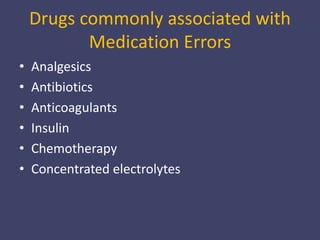
Drugs commonly associated with
Medication Errors
• Analgesics
• Antibiotics
• Anticoagulants
• Insulin
• Chemotherapy
• Concentrated electrolytes
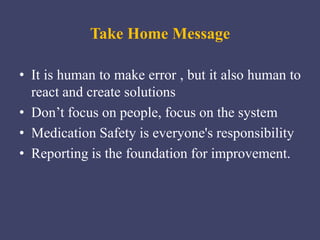
Take Home Message
• It is human to make error , but it also human to
react and create solutions
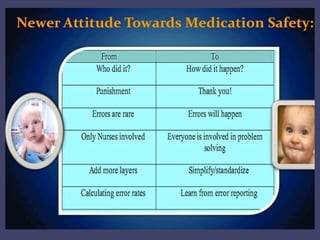
• Don’t focus on people, focus on the system
• Medication Safety is everyone's responsibility
• Reporting is the foundation for improvement.
Medication Error Reporting.pptx

Medication Error Reporting.pptx

  • 1.
    MEDICATION ERRORS Dr .UPPU JHANSI RANI Pharmacovigilance Associate
  • 2.
    Overview • Definition • Typesof Medication Errors • Barriers that contribute to Medication Error • Medication Error Detection • Reporting process • How to Prevent Medication Errors?
  • 3.
    Definition Medication Error: isany preventable event that may cause or lead to inappropriate medication use or patient harm while the medication is in the control of the healthcare professional, patient, or consumer according to the National Coordinating Council for Medication Error Reporting and Prevention. Near Miss (Medication Error): The Medication error that took place but captured before reaching the patient, such events are termed as Near Miss errors.
  • 4.
    Medication Errors • MedicationErrors cause at least one death every day and injure approximately 1.3 million people annually in the United States.
  • 6.
    Prescription Error • Aprescribing error occurs at the time a prescriber orders a drug for a specific patient. • Errors may include:  Incorrect drug selection for a patient  Illegible hand writing  Prescribing contraindicated drug  Writing out list abbreviations
  • 7.
    Dispensing Error • Dispensingerrors occur at any stage of the dispensing process, from the receipt of the prescription in the pharmacy to the supply of a dispensed medicine to a patient. • Incorrect drug, Incorrect strength, Incorrect dosage form, miscalculation of doses. Example: Dispensed Chlorpramazine instead of Chlorpromide.
  • 8.
    Look alike andsound alike drugs
  • 9.
     Administration ErrorA drug administration error may be defined as the discrepancy between the drug therapy received by the patient and the drug therapy intended by prescriber. • It involves wrong patient, wrong route of administration, wrong time, wrong dose • Example: Administered Diclofenac in IV Route instead of IM  Transcription Error: Transcription is the process of making an identical copy of prescription in the medical records. Errors that occur during this process called Transcription error.  Indenting Error: Errors that occur during the process of indenting.
  • 10.
    Sub-types of MedicationErrors • Wrong Patient • Wrong Drug • Wrong time Error • Improper Dose Error • Wrong drug preparation Error • Wrong Administration technique Error
  • 11.
    Factors that Contributeto Medication Errors • Excessive task demand • Inadequate medication history taking • Inappropriate use of decimal points • Use of unlisted abbreviations (AZT) • Lack of communication • Lack of patient counseling
  • 12.
    • Environmental factors •Look alike/sound alike drugs • Lack of unit dose system • Lack of independent check before dispensing or administering the medications • Incomplete Knowledge of medicines • Lack of drug availability Factors that Contribute to Medication Errors
  • 13.
    Barriers to effectiveError Reporting • Culture of Blame ǃǃ
  • 14.
    Right Drug Right Route RightTime Right Dose Right Patient Right Dosage Form
  • 15.
    Medication Error Detection •Attending medical rounds • Directly observing medication administration • Reviewing patient’s charts • Analyzing dose returned to the pharmacy • Comparing medication administration records with physician’s orders
  • 16.
    Reporting Process Whether paperor Electronic, a successful reporting system should possess the following characteristics: • Confidentiality: Patient, Reporter, Organization • Easy to understand • Requires minimal time to report • Privileged: Allow using the data for quality improvement while protecting from disclosure in potential legal proceedings
  • 17.
    Reporting Process Suggested Minimalfields for Medication Error data collection: • Patient Information • Date, time, Ward/dept. • Name of the medications prescribed • Name of the medication administered • Therapeutic classification of medication • Route of administration • Description of event • Type of error • Patient outcome • NCCMERP Categories
  • 23.
    Root Cause Analysis TheGoal of RCA Process is to find out: 1. What happened? 2. Why did it happen? 3. What do you do to prevent it from happening again?
  • 24.
    Characteristics of anEffective Medication Error Reporting System  Organization goal should monitor both actual and potential errors  Should investigate the root cause analysis of errors to prevent it.  Encourage Voluntary Reporting of errors  Provide confidentiality of reported information  Provide confidentiality of reporter information  Availability of both Electronic and paper ME reporting format  Medication Errors should be reported and Documented

  • 25.
    Process to preventMedication Errors 1. Patient communication 2. Intra professional communication 3. Education and training 4. Electronic prescribing 5. Ensuring a safe dispensing procedure. 6. Recheck the prescription while transcribing, indenting and administering the medications. 7. Avoid use of unknown abbreviations and symbols 8. Medication Reconcillation
  • 26.
    Actions that canbe taken in clinic Areas  Risk Awareness- HIGH RISK DRUG  Review Floor stock to reduce out of stock  Use of Proper Labelling (Label HAM stickers on High alert medication packages/Vials or Ampoules)  LASA Medicines to be stored separately  Ensure proper and correct programming of infusion pump.  Perform Independent double check  No verbal orders for High Risk medications.
  • 27.
    HAM Stickers shouldbe labelled on the storage shelves, Containers, Product package and loose vials Labelling
  • 29.
    Role of Prescriber •Doctors should have knowledge of generic names and brand names of available drugs in the hospital. • Specify Dosage form, strength, and complete directions on the prescription • Purpose of medication • Legible hand writing • Taking Adequate past medical history of the patient
  • 30.
    Role of Pharmacist •Refer to doctor if any confusion • Basic knowledge of dosage regimens for commonly used drugs. • Stickers of Alert in areas where High Risk medication and LASA drugs stored. • In case of wrong prescription , pharmacist should not react in front of patient.
  • 31.
    Role of Nursingstaff • Education and proper training is important in reducing ME • Should be aware of correct storage requirements for drugs. • Stickers of Alert in areas where High Risk medication and LASA drugs stored. • Double check the prescription while administering the medications.
  • 32.
    Drugs commonly associatedwith Medication Errors • Analgesics • Antibiotics • Anticoagulants • Insulin • Chemotherapy • Concentrated electrolytes
  • 33.
    Take Home Message •It is human to make error , but it also human to react and create solutions • Don’t focus on people, focus on the system • Medication Safety is everyone's responsibility • Reporting is the foundation for improvement.