Objectives
1. Understand thesignificance of maintaining professional boundaries in nursing.
2. Identify situations that may challenge professional boundaries and learn
strategies to manage them.
3. Implement best practices for maintaining professional boundaries with patients
and colleagues.
3.
Introduction
• “Professional boundariesare the spaces between the nurse’s power and the
patient’s vulnerability.”
• “Crossing professional boundaries or engaging in improper use of social
media are violations of the nurse practice act and can be the cause of
professional discipline and termination of employment.”
• Boundary violations can result when there is confusion between the needs of
the nurse and those of the patient.
5.
Case Scenario
A femalenurse enters a male patient's room just after the healthcare provider
has informed him that he has lung cancer. Noticing that the patient is very
upset, the nurse sits on his bed and holds his hand, saying, “You seem upset.
Would you like to talk about it?” After the patient starts crying, she hugs him.
He stops crying after a few minutes, saying, “I just didn't expect that. I'll be
okay.” She says, “I'm here if you need me,” and then leaves.
• Can the nurse's behavior be considered inappropriate? Or was she just being
compassionate?
6.
Case Scenario
A malenurse has been caring for a female patient who's being discharged.
After completing his assessment and discharge instructions, he asks, “Do you
have any other questions?” The patient replies, “Not about my discharge, but
can I have your phone number?” The nurse says, “I don't see why not.”
• Did the nurse cross a boundary? Or, because the patient is being discharged,
is it now considered acceptable to form a personal relationship?
7.
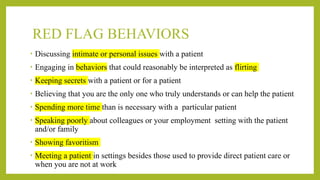
RED FLAG BEHAVIORS
•Discussing intimate or personal issues with a patient
• Engaging in behaviors that could reasonably be interpreted as flirting
• Keeping secrets with a patient or for a patient
• Believing that you are the only one who truly understands or can help the patient
• Spending more time than is necessary with a particular patient
• Speaking poorly about colleagues or your employment setting with the patient
and/or family
• Showing favoritism
• Meeting a patient in settings besides those used to provide direct patient care or
when you are not at work
8.
Maintaining Professional Boundaries
•Understand the Essence of Professional Boundaries
• Embrace Clear Communication
• Set Realistic Expectations from the Onset
• Nurture Empathy Without Over-Identification
• Recognize and Address Transference and Countertransference
• Practice Self-Care Religiously
• Learn to Say No Compassionately
• Seek Support and Supervision
• Maintain Digital Boundaries in Healthcare
Bibliography
1. American NursesAssociation. Code of Ethics for Nurses with Interpretive
Statements. Silver Spring, MD: American Nurses Association; 2015.
2. Benner P. From Novice to Expert: Excellence and Power in Clinical Nursing
Practice. Upper Saddle River, NJ: Prentice Hall; 2001.
3. World Health Organization. Framework on Integrated, People-Centred Health
Services: Executive Summary. Geneva: World Health Organization; 2016.
4. Perry AG, Potter PA, Ostendorf WR. Clinical Nursing Skills and Techniques. 9th ed.
St. Louis, MO: Elsevier; 2019.
5. Yoder-Wise PS. Leading and Managing in Nursing. 7th ed. St. Louis, MO: Elsevier;
2019.
11.
Bibliography
1. International Councilof Nurses. The ICN Code of Ethics for Nurses. Geneva:
International Council of Nurses; 2021.
2. Indian Nursing Council. Indian Nursing Council Act, 1947. New Delhi: Indian
Nursing Council; 2019.
3. Basavanthappa BT. Nursing Administration. 3rd ed. New Delhi: Jaypee
Brothers Medical Publishers; 2009.
4. Surjyakanta A. Essentials of Nursing Management. 1st ed. New Delhi: Jaypee
Brothers Medical Publishers; 2015.
Editor's Notes
#3 The power of the nurse comes from the nurse’s professional position and access to sensitive personal information. The difference in personal information the nurse knows about the patient versus personal information the patient knows about the nurse creates an imbalance in the nurse–patient relationship. Nurses should make every effort to respect the power imbalance and ensure a patient-centered relationship.
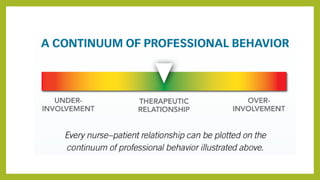
#4 Overinvolvement includes boundary crossings, boundary violations and professional sexual mis conduct.
Under involvement includes patient abandonment, disinterest and neglect, and can be detrimental to the patient and the nurse.
#5 A nurse giving a patient a quick hug that's not seductive can be interpreted as a sign of compassion. Although it may be customary in some cultures to hug a person to show support, this practice may not be viewed positively in all cultures. Also, because sitting on a patient's bed may be perceived as invading the patient's personal space, nurses are discouraged from doing so.
#6 As professionals, nurses have the duty to set and follow their own boundaries. The patient's consent to participate in a romantic or sexual relationship doesn't lessen the healthcare professional's responsibility to maintain boundaries. The nurse must realize that boundaries have been violated.
#8 Transference- when a patient will view the nurse as someone who is similar to an important person in their life.
Countertransference in nursing is whenever the nurse unknowingly transfers their unresolved thoughts, feelings, and emotions onto a client. This can be a problem because it can lead to a nurse potentially pushing a patient into action before they are ready, harshly condemning or judging a patient, desiring a relationship outside of the appropriate boundaries, or even transferring bad moods onto the patient.
https://www.thesocialworkgraduate.com/post/professional-boundaries reference for you Uma