MEDICATION ERRORS
DETECTION AND MANAGEMENT
BY – DR. ANURAG SHARMA
JUNIOR RESIDENT
DEPARTMENT OF PHARMACOLOGY & THERAPEUTICS
DEFINITION
• Any preventable event that may cause or lead to
inappropriate medication use or patient harm while the
medication is in control of the healthcare professional,
patient or consumer.
• May occur at any time from the prescription to
consumption of the medicine.
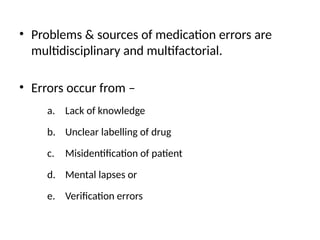
• Problems & sources of medication errors are
multidisciplinary and multifactorial.
• Errors occur from –
a. Lack of knowledge
b. Unclear labelling of drug
c. Misidentification of patient
d. Mental lapses or
e. Verification errors
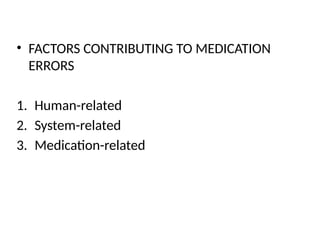
• FACTORS CONTRIBUTING TO MEDICATION
ERRORS
1. Human-related
2. System-related
3. Medication-related
HUMAN RELATED FACTORS
PROVIDERS PATIENTS
1. Over-worked 1. In a hurry
2. Under-trained 2. Health literacy level
3. Competence 3. Donot understand the
medication/use
4. Distracted 4. Trust Providers to not make
mistakes
5. Illness
6. Stressed
SYSTEM RELATED FACTORS
1. Lack of Communication
2. Poor workflow
3. Disorganized workspace
4. Lack of supervision
MEDICATION RELATED FACTORS
1. Look-alike/ Sound-alike medications
2. Multiple dosage forms and strengths
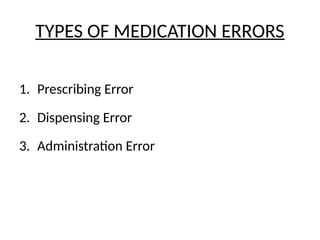
TYPES OF MEDICATION ERRORS
1. Prescribing Error
2. Dispensing Error
3. Administration Error
Prescribing errors
1. Incorrect drug
selection for a patient
2. Errors in quantity
and indication
3. Prescribing
contraindicated
drug
• Factors contributing prescribing errors -
i. Lack of knowledge of the prescribed drug, dose, patient details
ii. Illegible handwriting
iii. Inaccurate medication history taking
iv. Confusion with the drug name
v. Inappropriate use of decimal points
vi. Use of abbreviations
vii. Use of verbal orders
• Reducing Prescribing errors -
1. Electronic prescribing reduces errors due to
illegible handwriting
2. Computerized physician order entry system
eliminates need for transcription orders by
nursing staff
Dispensing Errors
• A dispensing error is a discrepancy between a
prescription and the medicine that the
pharmacy delivers to the patient on the basis
of prescription.
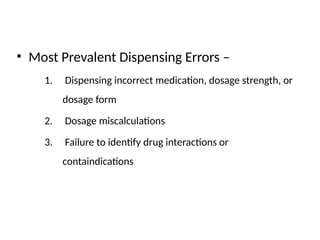
• Most Prevalent Dispensing Errors –
1. Dispensing incorrect medication, dosage strength, or
dosage form
2. Dosage miscalculations
3. Failure to identify drug interactions or
containdications
• Reducing Dispensing errors –
1. Ensuring a safe dispensing procedure
2. Separating drugs with similar name or appearance
3. Automated medication dispensing system
4. Unit dose medication dispensing
• Example of Dispensing Error
A Physician writes an order for primidone for a patient with
seizure disorder. Misreading the physician’s handwriting, the
pharmacist mistakenly dispensed the prednisone. For 4
months, the patient receives prednisone alongwith his other
seizure medications causing steroid-induced diabetes. The
diabetes goes unrecognized, and patient dies from Diabetic
Ketoacidosis because the drug was LASA drug that lead to
Dispensing Error.
LOOK ALIKE SOUND ALIKE (LASA)
• Existence of confusing drug names is one of
the most common causes of medication error
• With thousands of drugs currently in market,
potential for error due to confusing drug
names is significant
Examples of LASA Drugs
BRAND NAME (GENERIC NAME) BRAND NAME (GENERIC NAME)
1. BENZOL (DANAZOL) 1. BENZOLE (ALBENDAZOLE)
2. AMSAT (AMPICILLIN) 2. AMSET (AMLODIPINE)
3. ADCOM (TELMISARTAN) 3. ADCON (FLUCONAZOLE)
4. ALFLOX (NORFLOXACIN) 4. ALFOX (OXCARBAZEPINE)
5. DAZOLIC (ORNIDAZOLE) 5. DAZOLIN (SERTRALINE)
Administration Errors
• Discrepancy between drug received by patient &
drug therapy intended by prescriber
• Errors of omission- the drug is not administered
• Incorrect administration technique &
administration of incorrect or expired preparations
• Contributing factors for administration errors –
1. Failure to check patient’s identity prior to administration
2. Environmental factors such as noise, interruptions, poor
lighting
3. Wrong calculation to determine the correct dose
• Reducing administration errors –
1. Checking patient’s identity
2. Ensuring dosage calculations are cross checked
independently by another healthcare
professional before drug is administered
3. Ensuring medication given at correct time
Drugs commonly associated with Medication
errors
• Analgesics
 Unnecessary use of Opioids (over sedation of patient)
 Failure to monitor clinical parameters (HR,RR & BP), resulted in
major adverse outcomes related to opioid use
• Antibiotics
 Irrational use
• Anticoagulants
 Inadequate therapeutic dosing
 Failure to monitor blood levels
• Cardiovascular agents
 Errors due to overdose
 Failure to identify drug-drug interactions due to polypharmacy
• Diabetic Medications
 Overdose of hypoglycemic drugs (Insulin)
 Overenthusiastic patients trying to keep blood glucose levels within
normal limits
 This group of drugs signifies importance of patient education by
treating physicians
Six step approach by WHO for good
prescribing
1. Evaluate & Clearly define patient’s problem
2. Specify therapeutic objectives
3. Select appropriate drug therapy: P-drug & STEPS approach (Safety,
Tolerability, Effectiveness, Price & Simplicity)
4. Initiate therapy with appropriate details
5. Give information, instructions & warnings
6. Evaluate therapy regularly
Role of Regulatory Authorities
• Important role in preventing medication errors
• Review of drug labels & nomenclature greatly
enhances preventive strategies
• Public education by regulatory agencies improve
medication use
• Potentially confusing names to be rejected
Role of Prescribers/Physicians
1. Doctors should have knowledge of generic names & brand
names of available drugs in their local setting
2. Specify dosage form, drug strength & complete directions
on prescriptions
3. Using both brand name & generic name on prescription
4. Purpose of Medication
5. Legible Handwriting
Role of Pharmacists
• Refer back to Doctor if any confusion
• Basic knowledge of dosing regimens for commonly used
drugs
• Sticker of ‘ALERT’ can be used in areas where LASA drugs
stored
• In case of wrong prescription, Pharmacist should not
react in front of patient
Role of Nursing Staff
• Education & proper training is important in
reducing medication related errors
• Should be aware of correct storage
requirements for drugs
• Independent calculations of paediatric doses by
more than one person
REFERENCES
• Medication Errors: Causes & its prevention,
Singh I, Shafiq N, Malhotra S; Drugs Bulletin
Vol.XXXVI No. 2, April 2011
• British Journal of clinical pharmacology; 67:6,
2009

MEDICATION ERRORS DETECTION AND MANAGEMENT.pptx

  • 1.
    MEDICATION ERRORS DETECTION ANDMANAGEMENT BY – DR. ANURAG SHARMA JUNIOR RESIDENT DEPARTMENT OF PHARMACOLOGY & THERAPEUTICS
  • 2.
    DEFINITION • Any preventableevent that may cause or lead to inappropriate medication use or patient harm while the medication is in control of the healthcare professional, patient or consumer. • May occur at any time from the prescription to consumption of the medicine.
  • 3.
    • Problems &sources of medication errors are multidisciplinary and multifactorial. • Errors occur from – a. Lack of knowledge b. Unclear labelling of drug c. Misidentification of patient d. Mental lapses or e. Verification errors
  • 4.
    • FACTORS CONTRIBUTINGTO MEDICATION ERRORS 1. Human-related 2. System-related 3. Medication-related
  • 5.
    HUMAN RELATED FACTORS PROVIDERSPATIENTS 1. Over-worked 1. In a hurry 2. Under-trained 2. Health literacy level 3. Competence 3. Donot understand the medication/use 4. Distracted 4. Trust Providers to not make mistakes 5. Illness 6. Stressed
  • 6.
    SYSTEM RELATED FACTORS 1.Lack of Communication 2. Poor workflow 3. Disorganized workspace 4. Lack of supervision
  • 7.
    MEDICATION RELATED FACTORS 1.Look-alike/ Sound-alike medications 2. Multiple dosage forms and strengths
  • 8.
    TYPES OF MEDICATIONERRORS 1. Prescribing Error 2. Dispensing Error 3. Administration Error
  • 9.
    Prescribing errors 1. Incorrectdrug selection for a patient 2. Errors in quantity and indication 3. Prescribing contraindicated drug
  • 10.
    • Factors contributingprescribing errors - i. Lack of knowledge of the prescribed drug, dose, patient details ii. Illegible handwriting iii. Inaccurate medication history taking iv. Confusion with the drug name v. Inappropriate use of decimal points vi. Use of abbreviations vii. Use of verbal orders
  • 11.
    • Reducing Prescribingerrors - 1. Electronic prescribing reduces errors due to illegible handwriting 2. Computerized physician order entry system eliminates need for transcription orders by nursing staff
  • 12.
    Dispensing Errors • Adispensing error is a discrepancy between a prescription and the medicine that the pharmacy delivers to the patient on the basis of prescription.
  • 13.
    • Most PrevalentDispensing Errors – 1. Dispensing incorrect medication, dosage strength, or dosage form 2. Dosage miscalculations 3. Failure to identify drug interactions or containdications
  • 14.
    • Reducing Dispensingerrors – 1. Ensuring a safe dispensing procedure 2. Separating drugs with similar name or appearance 3. Automated medication dispensing system 4. Unit dose medication dispensing
  • 15.
    • Example ofDispensing Error A Physician writes an order for primidone for a patient with seizure disorder. Misreading the physician’s handwriting, the pharmacist mistakenly dispensed the prednisone. For 4 months, the patient receives prednisone alongwith his other seizure medications causing steroid-induced diabetes. The diabetes goes unrecognized, and patient dies from Diabetic Ketoacidosis because the drug was LASA drug that lead to Dispensing Error.
  • 16.
    LOOK ALIKE SOUNDALIKE (LASA) • Existence of confusing drug names is one of the most common causes of medication error • With thousands of drugs currently in market, potential for error due to confusing drug names is significant
  • 17.
    Examples of LASADrugs BRAND NAME (GENERIC NAME) BRAND NAME (GENERIC NAME) 1. BENZOL (DANAZOL) 1. BENZOLE (ALBENDAZOLE) 2. AMSAT (AMPICILLIN) 2. AMSET (AMLODIPINE) 3. ADCOM (TELMISARTAN) 3. ADCON (FLUCONAZOLE) 4. ALFLOX (NORFLOXACIN) 4. ALFOX (OXCARBAZEPINE) 5. DAZOLIC (ORNIDAZOLE) 5. DAZOLIN (SERTRALINE)
  • 18.
    Administration Errors • Discrepancybetween drug received by patient & drug therapy intended by prescriber • Errors of omission- the drug is not administered • Incorrect administration technique & administration of incorrect or expired preparations
  • 19.
    • Contributing factorsfor administration errors – 1. Failure to check patient’s identity prior to administration 2. Environmental factors such as noise, interruptions, poor lighting 3. Wrong calculation to determine the correct dose
  • 20.
    • Reducing administrationerrors – 1. Checking patient’s identity 2. Ensuring dosage calculations are cross checked independently by another healthcare professional before drug is administered 3. Ensuring medication given at correct time
  • 21.
    Drugs commonly associatedwith Medication errors • Analgesics  Unnecessary use of Opioids (over sedation of patient)  Failure to monitor clinical parameters (HR,RR & BP), resulted in major adverse outcomes related to opioid use • Antibiotics  Irrational use
  • 22.
    • Anticoagulants  Inadequatetherapeutic dosing  Failure to monitor blood levels • Cardiovascular agents  Errors due to overdose  Failure to identify drug-drug interactions due to polypharmacy
  • 23.
    • Diabetic Medications Overdose of hypoglycemic drugs (Insulin)  Overenthusiastic patients trying to keep blood glucose levels within normal limits  This group of drugs signifies importance of patient education by treating physicians
  • 24.
    Six step approachby WHO for good prescribing 1. Evaluate & Clearly define patient’s problem 2. Specify therapeutic objectives 3. Select appropriate drug therapy: P-drug & STEPS approach (Safety, Tolerability, Effectiveness, Price & Simplicity) 4. Initiate therapy with appropriate details 5. Give information, instructions & warnings 6. Evaluate therapy regularly
  • 25.
    Role of RegulatoryAuthorities • Important role in preventing medication errors • Review of drug labels & nomenclature greatly enhances preventive strategies • Public education by regulatory agencies improve medication use • Potentially confusing names to be rejected
  • 26.
    Role of Prescribers/Physicians 1.Doctors should have knowledge of generic names & brand names of available drugs in their local setting 2. Specify dosage form, drug strength & complete directions on prescriptions 3. Using both brand name & generic name on prescription 4. Purpose of Medication 5. Legible Handwriting
  • 27.
    Role of Pharmacists •Refer back to Doctor if any confusion • Basic knowledge of dosing regimens for commonly used drugs • Sticker of ‘ALERT’ can be used in areas where LASA drugs stored • In case of wrong prescription, Pharmacist should not react in front of patient
  • 28.
    Role of NursingStaff • Education & proper training is important in reducing medication related errors • Should be aware of correct storage requirements for drugs • Independent calculations of paediatric doses by more than one person
  • 29.
    REFERENCES • Medication Errors:Causes & its prevention, Singh I, Shafiq N, Malhotra S; Drugs Bulletin Vol.XXXVI No. 2, April 2011 • British Journal of clinical pharmacology; 67:6, 2009