Medication Error
Reporting System
Pharmacist: Yasir A. Alowayyidh
Pharmaceutical Care Administration, Medina Region
yalowayyidh@moh.gov.sa
Main Topics
2
How we detect Medication Error ?
Barriers to effective Medication Error reporting
Reporting process
Characteristics of an Effective Medication Error Reporting System
Take home message
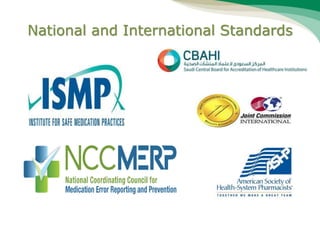
National and International Standards
2015 CBAHI standards contain 41 standards related
to medication management, 3 of them are national
essential safety requirements.
MM 5
MM 6
MM 41
MM 41 The hospital has a process for monitoring, identifying,
and reporting significant medication errors, including near
misses, hazardous conditions, and at-risk behaviors that have
the potential to cause patient harm.
Substandards:MM.41.1  MM.41.12
Medication Error Detection
•Directly observing medication administration.
• Reviewing patients' charts.
• Reviewing incident reports involving medication errors.
• Attending medical rounds.
• Interviewing health care personnel to stimulate self-report.
• Analyzing doses returned to the pharmacy.
Medication Error Detection
• Comparing medication administration record (MAR) with
physicians' orders.
• Performing computerized analysis to identify patients receiving
target drugs that may be used to treat a medication error.
- Flumazenil for Benzodiazepine
- Naloxone for (Opioids)
•Search for Serum drug concentration orders that may indicate an
overdoes.
•Examining death certificates.
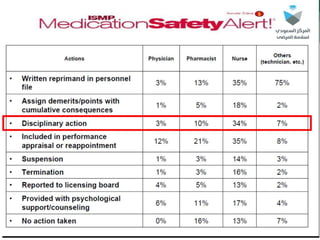
Barriers to Effective Error
Reporting
Culture of blame!!
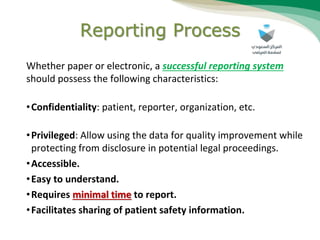
Reporting Process
Whether paper or electronic, a successful reporting system
should possess the following characteristics:
•Confidentiality: patient, reporter, organization, etc.
•Privileged: Allow using the data for quality improvement while
protecting from disclosure in potential legal proceedings.
•Accessible.
•Easy to understand.
•Requires minimal time to report.
•Facilitates sharing of patient safety information.
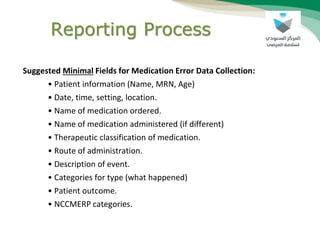
Reporting Process
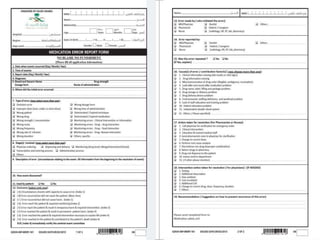
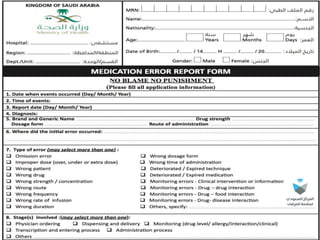
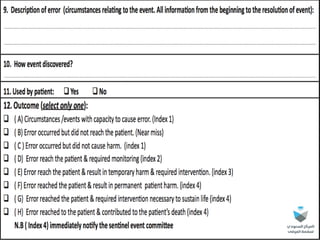
Suggested Minimal Fields for Medication Error Data Collection:
• Patient information (Name, MRN, Age)
• Date, time, setting, location.
• Name of medication ordered.
• Name of medication administered (if different)
• Therapeutic classification of medication.
• Route of administration.
• Description of event.
• Categories for type (what happened)
• Patient outcome.
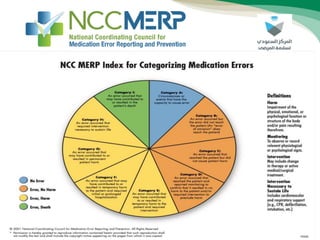
• NCCMERP categories.
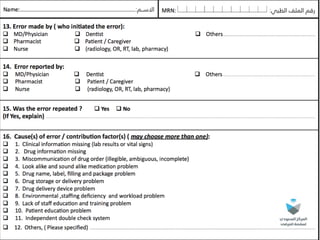
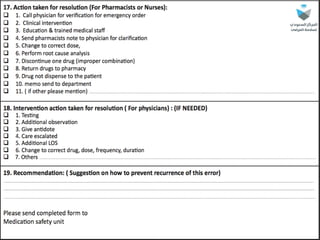
Medication Error Reporting
Form
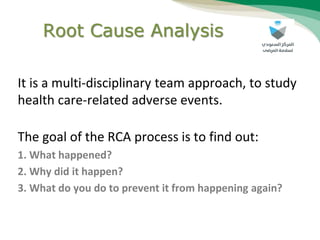
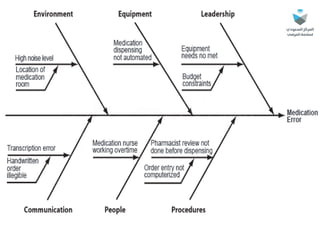
Root Cause Analysis
It is a multi-disciplinary team approach, to study
health care-related adverse events.
The goal of the RCA process is to find out:
1. What happened?
2. Why did it happen?
3. What do you do to prevent it from happening again?
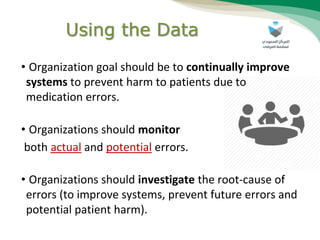
Using the Data
• Organization goal should be to continually improve
systems to prevent harm to patients due to
medication errors.
• Organizations should monitor
both actual and potential errors.
• Organizations should investigate the root-cause of
errors (to improve systems, prevent future errors and
potential patient harm).
Characteristics of an Effective
Medication Error Reporting System
• Voluntary.
•Provide confidentiality of reported information.
• Provide confidentiality of reporter information.
•Encourage reporting of both potential & actual errors.
• Provides feedback of error analysis and timely
recommendations for learning and education purposes.
Characteristics of an Effective
Medication Error Reporting System
• Availability of both electronic and paper format.
•Standard taxonomy.
• Severity of outcome.
• Root cause analysis.
•Ease of use.
Take home message
Medication Safety Is
Everyone’s Responsibility
Thank You...

medication error reporting system

  • 1.
    Medication Error Reporting System Pharmacist:Yasir A. Alowayyidh Pharmaceutical Care Administration, Medina Region yalowayyidh@moh.gov.sa
  • 2.
    Main Topics 2 How wedetect Medication Error ? Barriers to effective Medication Error reporting Reporting process Characteristics of an Effective Medication Error Reporting System Take home message
  • 3.
  • 4.
    2015 CBAHI standardscontain 41 standards related to medication management, 3 of them are national essential safety requirements. MM 5 MM 6 MM 41
  • 5.
    MM 41 Thehospital has a process for monitoring, identifying, and reporting significant medication errors, including near misses, hazardous conditions, and at-risk behaviors that have the potential to cause patient harm. Substandards:MM.41.1  MM.41.12
  • 6.
    Medication Error Detection •Directlyobserving medication administration. • Reviewing patients' charts. • Reviewing incident reports involving medication errors. • Attending medical rounds. • Interviewing health care personnel to stimulate self-report. • Analyzing doses returned to the pharmacy.
  • 7.
    Medication Error Detection •Comparing medication administration record (MAR) with physicians' orders. • Performing computerized analysis to identify patients receiving target drugs that may be used to treat a medication error. - Flumazenil for Benzodiazepine - Naloxone for (Opioids) •Search for Serum drug concentration orders that may indicate an overdoes. •Examining death certificates.
  • 8.
    Barriers to EffectiveError Reporting Culture of blame!!
  • 11.
    Reporting Process Whether paperor electronic, a successful reporting system should possess the following characteristics: •Confidentiality: patient, reporter, organization, etc. •Privileged: Allow using the data for quality improvement while protecting from disclosure in potential legal proceedings. •Accessible. •Easy to understand. •Requires minimal time to report. •Facilitates sharing of patient safety information.
  • 12.
    Reporting Process Suggested MinimalFields for Medication Error Data Collection: • Patient information (Name, MRN, Age) • Date, time, setting, location. • Name of medication ordered. • Name of medication administered (if different) • Therapeutic classification of medication. • Route of administration. • Description of event. • Categories for type (what happened) • Patient outcome. • NCCMERP categories.
  • 14.
  • 20.
    Root Cause Analysis Itis a multi-disciplinary team approach, to study health care-related adverse events. The goal of the RCA process is to find out: 1. What happened? 2. Why did it happen? 3. What do you do to prevent it from happening again?
  • 22.
    Using the Data •Organization goal should be to continually improve systems to prevent harm to patients due to medication errors. • Organizations should monitor both actual and potential errors. • Organizations should investigate the root-cause of errors (to improve systems, prevent future errors and potential patient harm).
  • 23.
    Characteristics of anEffective Medication Error Reporting System • Voluntary. •Provide confidentiality of reported information. • Provide confidentiality of reporter information. •Encourage reporting of both potential & actual errors. • Provides feedback of error analysis and timely recommendations for learning and education purposes.
  • 24.
    Characteristics of anEffective Medication Error Reporting System • Availability of both electronic and paper format. •Standard taxonomy. • Severity of outcome. • Root cause analysis. •Ease of use.
  • 25.
    Take home message MedicationSafety Is Everyone’s Responsibility
  • 26.