What is medical textile??
• Textile materials and products that have
been engineered to meet particular
• needs, are suitable for any medical and
surgical application where a
combination of
• strength, flflexibility, and sometimes
moisture and air permeability are
required.
RAW MATERIALS
• These materials can be categorised into four sepa
• rate and specialised areas of application as follows:
• • Nonimplantable materials – wound dressings,
bandages, plasters, etc.
• • Extracorporeal devices – artifificial kidney, liver, and
lung
• • Implantable materials – sutures, vascular grafts,
artifificial ligaments, artifificial
• joints, etc.
• • Healthcare/hygiene products – bedding, clothing,
surgical gowns, cloths, wipes, etc.
Fibers uses:
• Commodity fibres :
• Fibres used in medicine and surgery
may be classifified depending on
whether
• the materials from which they are made
are natural or synthetic, biodegradable
or
• nonbiodegradable
• Speciality fibres
• A variety of natural polymers such as collagen,
alginate, chitin, chitosan, and so on,
• have been found to be essential materials for
modern wound dressings.9 Collagen,
• which is obtained from bovine skin, is a protein
available either in fifibre or hydro
• gel (gelatin) form. Collagen fifibres, used as
sutures, are as strong as silk and are
• biodegradable. The transparent hydrogel that is
formed when collagen is
• crosslinked in 5–10% aqueous solution, has a
high oxygen permeability and can be
• processed into soft contact lenses
Non-implantable materials
• These materials are used for external
applications on the body and may or may
not make contact with skin
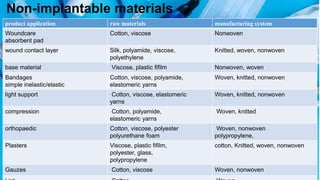
Non-implantable materials
product application raw materials manufacturing system
Woundcare
absorbent pad
Cotton, viscose Nonwoven
wound contact layer Silk, polyamide, viscose,
polyethylene
Knitted, woven, nonwoven
base material Viscose, plastic fifilm Nonwoven, woven
Bandages
simple inelastic/elastic
Cotton, viscose, polyamide,
elastomeric yarns
Woven, knitted, nonwoven
light support Cotton, viscose, elastomeric
yarns
Woven, knitted, nonwoven
compression Cotton, polyamide,
elastomeric yarns
Woven, knitted
orthopaedic Cotton, viscose, polyester
polyurethane foam
Woven, nonwoven
polypropylene,
Plasters Viscose, plastic fifilm,
polyester, glass,
polypropylene
cotton, Knitted, woven, nonwoven
Gauzes Cotton, viscose Woven, nonwoven
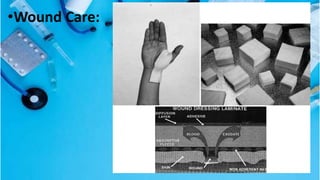
•Wound Care:
Extracorporeal devices
• Extracorporeal devices are
mechanical organs that are
used for blood purifification
• and include the artifificial kidney
(dialyser), the artifificial liver,
and the mechanical
• lung
Extracorporeal devices
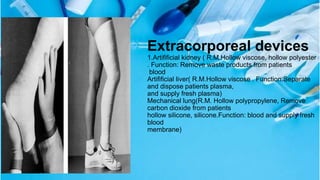
1.Artifificial kidney ( R.M.Hollow viscose, hollow polyester
. Function: Remove waste products from patients
blood
Artifificial liver( R.M.Hollow viscose . Function:Separate
and dispose patients plasma,
and supply fresh plasma)
Mechanical lung(R.M. Hollow polypropylene, Remove
carbon dioxide from patients
hollow silicone, silicone.Function: blood and supply fresh
blood
membrane)
Implantable materials
• These materials are used in effecting repair to the body whether it be
wound closure
• (sutures) or replacement surgery (vascular grafts, artifificial
ligaments, etc.). Table
• 15.3 illustrates the range of specifific products employed within this
category with
• the type of materials and methods of manufacture.
KEY Factors
• importance if the textile material is to be accepted by the body and
four key factors
• will determine how the body reacts to the implant. These are as
follows:
• 1 The most important factor is porosity which determines the rate at
which human
• tissue will grow and encapsulate the implant.
• 2 Small circular fifibres are better encapsulated with human tissue
than larger fifibres
• with irregular cross-sections.
• 3 Toxic substances must not be released by the fifibre polymer, and
the fifibres should
• be free from surface contaminants such as lubricants and sizing
agents
Healthcare/hygiene products
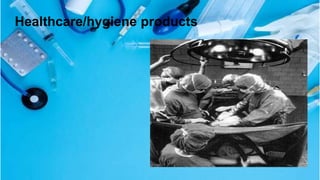
• Healthcare and hygiene products are an important sector in the
field of medicine and surgery.The range of products available is
vast but typically they are used either in the operating theatre
or on the hospital ward for the hygiene, care, and safety of staff
and patients
Healthcare/hygiene products
1.Surgical clothing gowns ( R.M.Cotton,polypropylene, polyester.
Preparation: Nonwoven,woven )
2 .caps (Viscose Nonwoven )
3.masks (Viscose, polyester, glass , prepared:Nonwoven
4.Surgical covers ( Polyester, polyethylene Nonwoven, woven Polyester,
polyethylene prepared: Nonwoven, woven)
Healthcare/hygiene products

A presentation on Medical Textile

  • 3.
    What is medicaltextile?? • Textile materials and products that have been engineered to meet particular • needs, are suitable for any medical and surgical application where a combination of • strength, flflexibility, and sometimes moisture and air permeability are required.
  • 4.
    RAW MATERIALS • Thesematerials can be categorised into four sepa • rate and specialised areas of application as follows: • • Nonimplantable materials – wound dressings, bandages, plasters, etc. • • Extracorporeal devices – artifificial kidney, liver, and lung • • Implantable materials – sutures, vascular grafts, artifificial ligaments, artifificial • joints, etc. • • Healthcare/hygiene products – bedding, clothing, surgical gowns, cloths, wipes, etc.
  • 5.
    Fibers uses: • Commodityfibres : • Fibres used in medicine and surgery may be classifified depending on whether • the materials from which they are made are natural or synthetic, biodegradable or • nonbiodegradable
  • 6.
    • Speciality fibres •A variety of natural polymers such as collagen, alginate, chitin, chitosan, and so on, • have been found to be essential materials for modern wound dressings.9 Collagen, • which is obtained from bovine skin, is a protein available either in fifibre or hydro • gel (gelatin) form. Collagen fifibres, used as sutures, are as strong as silk and are • biodegradable. The transparent hydrogel that is formed when collagen is • crosslinked in 5–10% aqueous solution, has a high oxygen permeability and can be • processed into soft contact lenses
  • 7.
    Non-implantable materials • Thesematerials are used for external applications on the body and may or may not make contact with skin
  • 8.
    Non-implantable materials product applicationraw materials manufacturing system Woundcare absorbent pad Cotton, viscose Nonwoven wound contact layer Silk, polyamide, viscose, polyethylene Knitted, woven, nonwoven base material Viscose, plastic fifilm Nonwoven, woven Bandages simple inelastic/elastic Cotton, viscose, polyamide, elastomeric yarns Woven, knitted, nonwoven light support Cotton, viscose, elastomeric yarns Woven, knitted, nonwoven compression Cotton, polyamide, elastomeric yarns Woven, knitted orthopaedic Cotton, viscose, polyester polyurethane foam Woven, nonwoven polypropylene, Plasters Viscose, plastic fifilm, polyester, glass, polypropylene cotton, Knitted, woven, nonwoven Gauzes Cotton, viscose Woven, nonwoven
  • 9.
  • 10.
    Extracorporeal devices • Extracorporealdevices are mechanical organs that are used for blood purifification • and include the artifificial kidney (dialyser), the artifificial liver, and the mechanical • lung
  • 11.
    Extracorporeal devices 1.Artifificial kidney( R.M.Hollow viscose, hollow polyester . Function: Remove waste products from patients blood Artifificial liver( R.M.Hollow viscose . Function:Separate and dispose patients plasma, and supply fresh plasma) Mechanical lung(R.M. Hollow polypropylene, Remove carbon dioxide from patients hollow silicone, silicone.Function: blood and supply fresh blood membrane)
  • 12.
    Implantable materials • Thesematerials are used in effecting repair to the body whether it be wound closure • (sutures) or replacement surgery (vascular grafts, artifificial ligaments, etc.). Table • 15.3 illustrates the range of specifific products employed within this category with • the type of materials and methods of manufacture.
  • 13.
    KEY Factors • importanceif the textile material is to be accepted by the body and four key factors • will determine how the body reacts to the implant. These are as follows: • 1 The most important factor is porosity which determines the rate at which human • tissue will grow and encapsulate the implant. • 2 Small circular fifibres are better encapsulated with human tissue than larger fifibres • with irregular cross-sections. • 3 Toxic substances must not be released by the fifibre polymer, and the fifibres should • be free from surface contaminants such as lubricants and sizing agents
  • 14.
    Healthcare/hygiene products • Healthcareand hygiene products are an important sector in the field of medicine and surgery.The range of products available is vast but typically they are used either in the operating theatre or on the hospital ward for the hygiene, care, and safety of staff and patients
  • 15.
    Healthcare/hygiene products 1.Surgical clothinggowns ( R.M.Cotton,polypropylene, polyester. Preparation: Nonwoven,woven ) 2 .caps (Viscose Nonwoven ) 3.masks (Viscose, polyester, glass , prepared:Nonwoven 4.Surgical covers ( Polyester, polyethylene Nonwoven, woven Polyester, polyethylene prepared: Nonwoven, woven)
  • 16.