Anesthesia Machine
step by step
Prepared by
The anesthesia team
Al shifa medical complex
Palestine
zoom
 The anesthesia warkestation (machine) divided into 3 main
components :
1- electrical component
2- Pneumatic component
3- scavenging system
 In this lecture we will focus on the pneumatic component
step by step..
introduction
Safety features were incorporated sequentially over this huge time span
of nearly 100 years of evolution of the anaesthesia machine (since 1917),
With more and more safety systems being added as realisation of the
problems and mishaps surfaced.
Various national associations of anaesthesiologists have recommended
the minimum safety features for machines used in their countries or by
their members.
 Many international standards exist for the anaesthesia machines
specifying the safety features that are absolutely required and those
that are relative/desirable.
Anaesthesia machines are covered by the american society for testing
and materials (astm) standard.
introduction
The most popular ones are those from the American Society of Anesthesiologists
(ASA), (CAS),(ANZCA).
Most professional associations e.g., Association of Anaesthetists of Great Britain
and Ireland (AAGBI) and ASA also recommend pre-anaesthesia checkout
procedures that check the proper functioning of all the safety features
incorporated in the machine.
In a review conducted over the years 1962-1991 by ASA, 72 of 3791 (ASA
closed claims Project):
 malpractice claims were related to gas delivery equipment.
 Death and permanent brain damage accounted for a majority of the claims (76%).
Misuse of equipment was 3 times more common than equipment failure, highlighting
the necessity of proper equipment check and training before use
The ultimate responsibility for the safe use of the machine rests with the end
user – the anaesthesia provider.
introduction
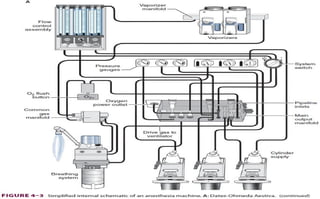
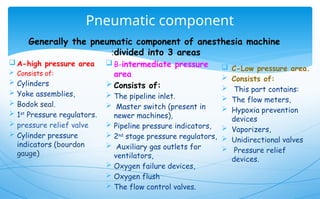
Pneumatic component
Generally the pneumatic component of anesthesia machine
divided into 3 areas
:
 A-high pressure area
 Consists of:
 Cylinders
 Yoke assemblies,
 Bodok seal.
 1st
Pressure regulators.
 pressure relief valve
 Cylinder pressure
indicators (bourdon
gauge)
 C-Low pressure area.
 Consists of:
 This part contains:
 The flow meters,
 Hypoxia prevention
devices
 Vaporizers,
 Unidirectional valves
 Pressure relief
devices.
 B-intermediate pressure
area
 Consists of:
 The pipeline inlet.
 Master switch (present in
newer machines),
 Pipeline pressure indicators,
 2nd
stage pressure regulators,
 Auxiliary gas outlets for
ventilators,
 Oxygen failure devices,
 Oxygen flush
 The flow control valves.
 1-Cylinder supply source
 Anesthesia machines have reserve E cylinders if a
pipeline supply source is not available or if the pipeline
fails.
 O2 tanks are fitted at the factory to a pressure of
approximately 2000 psig =137 bar = 13,700 kPa at
room temperature.
 A full E cylinder of O2 (2000 psig ) will produce
approximately 660 L of gaseous O2 at atmospheric
pressure.
 The cylinder attaches to the machine through the
hanger-yoke assembly.
 The cylinders should be turned off except during the
preoperative machine checking period or when pipeline
source is unavailable, to avoid depletion of the
cylinder
A-high pressure area
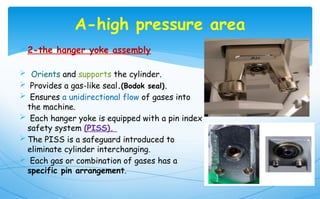
2-the hanger yoke assembly
 Orients and supports the cylinder.
 Provides a gas-like seal.(Bodok seal).
 Ensures a unidirectional flow of gases into
the machine.
 Each hanger yoke is equipped with a pin index
safety system (PISS).
 The PISS is a safeguard introduced to
eliminate cylinder interchanging.
 Each gas or combination of gases has a
specific pin arrangement.
A-high pressure area
 3- Bodok seal
 The yoke contains a Bodok seal.
 Bodok seals (bonded disk).
 These are non-combustible neoprene washers
with aluminium edges placed between the cylinder
head and yoke to provide a gas-tight seal.
 Under no circumstances may oil or grease be used
as a seal;
 the pressurized gases give off heat as they are
released from the cylinder and may cause an
explosion if oil is used.
A-high pressure area
 4- check valve(one way valve)
 Check valves or one-way valves are normally
placed on/after the yoke.
 Has several functions:
1- It minimizes gas transfer from a cylinder at a high
pressure to one with lower pressure.
2- It allows exchanging a cylinder while gas flow
continues from the other cylinder into the machine
with minimal loss of gas.
3- It minimizes leakage from an open cylinder to the
atmospheres if one cylinder is absent.
 The check valves may leak; therefore if a yoke does
not have a tank hanging on it, a yoke plug should be
inserted .
A-high pressure area
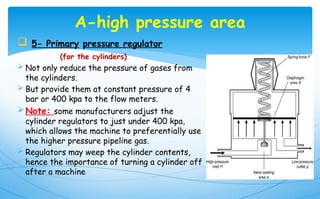
 5- Primary pressure regulator
(for the cylinders)
 Not only reduce the pressure of gases from
the cylinders.
 But provide them at constant pressure of 4
bar or 400 kpa to the flow meters.
Note: some manufacturers adjust the
cylinder regulators to just under 400 kpa,
which allows the machine to preferentially use
the higher pressure pipeline gas.
 Regulators may weep the cylinder contents,
hence the importance of turning a cylinder off
after a machine
A-high pressure area
 6- A pressure relief valve
Cylinders have exploded because of over-pressure in them
either due to over filling or mis-filling.
To prevent explosion, astm standards require all cylinders to
have pressure relief devices,
 It vent over-pressurized contents of the cylinder to the
atmosphere.
 They are of two types:
Rupture disc, where, when a predetermined pressure is reached
a disc guarding an orifice ruptures releasing the contents.
Fusible plug, which is a thermally operated plug providing
protection against high temperatures, but not pressure.
 A combination of these two is sometimes used as well.
A-high pressure area
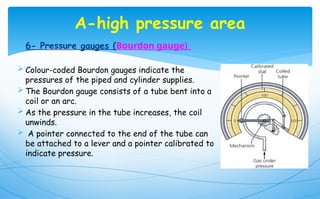
 6- Pressure gauges (Bourdon gauge)
 Colour-coded Bourdon gauges indicate the
pressures of the piped and cylinder supplies.
 The Bourdon gauge consists of a tube bent into a
coil or an arc.
 As the pressure in the tube increases, the coil
unwinds.
 A pointer connected to the end of the tube can
be attached to a lever and a pointer calibrated to
indicate pressure.
A-high pressure area
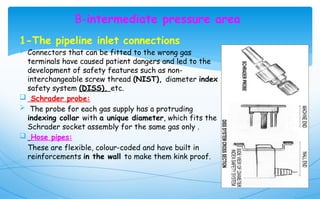
1-The pipeline inlet connections
 Connectors that can be fitted to the wrong gas
terminals have caused patient dangers and led to the
development of safety features such as non-
interchangeable screw thread (NIST), diameter index
safety system (DISS), etc.
 Schrader probe:
 The probe for each gas supply has a protruding
indexing collar with a unique diameter, which fits the
Schrader socket assembly for the same gas only .
 Hose pipes:
 These are flexible, colour-coded and have built in
reinforcements in the wall to make them kink proof.
B-intermediate pressure area
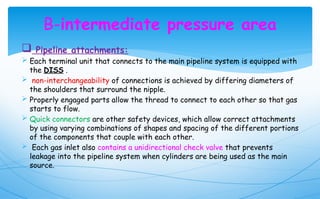
 Pipeline attachments:
 Each terminal unit that connects to the main pipeline system is equipped with
the DISS .
 non-interchangeability of connections is achieved by differing diameters of
the shoulders that surround the nipple.
 Properly engaged parts allow the thread to connect to each other so that gas
starts to flow.
 Quick connectors are other safety devices, which allow correct attachments
by using varying combinations of shapes and spacing of the different portions
of the components that couple with each other.
 Each gas inlet also contains a unidirectional check valve that prevents
leakage into the pipeline system when cylinders are being used as the main
source.
B-intermediate pressure area
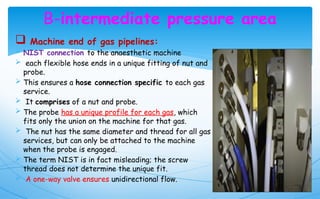
 Machine end of gas pipelines:
 NIST connection to the anaesthetic machine
 each flexible hose ends in a unique fitting of nut and
probe.
 This ensures a hose connection specific to each gas
service.
 It comprises of a nut and probe.
 The probe has a unique profile for each gas, which
fits only the union on the machine for that gas.
 The nut has the same diameter and thread for all gas
services, but can only be attached to the machine
when the probe is engaged.
 The term NIST is in fact misleading; the screw
thread does not determine the unique fit.
 A one-way valve ensures unidirectional flow.
B-intermediate pressure area
 2- Pipeline pressure indicators
 Indicators are required for each gas.
 they usually have a colour-coded dial
 in some indicators satisfactory working pressures zones have a special
colour for easier identification.
B-intermediate pressure area
 3- Second stage pressure regulator
 Most modern machines have a second stage regulator .
 It is located just upstream of the flow meters .
 so that flow is constant at the flow meters even if there are
fluctuations in the pipeline pressure.
 It reduces pipeline pressure (4 bar) down to the machine working
pressure (around 1 bar) .
B-intermediate pressure area
 4- Oxygen failure devices:
The 2000 ASTM F 1850-00 standard states:
“The anesthesia gas supply device shall be designed so that whenever
O2 supply pressure is reduced to below the manufacturer specific
minimum, the delivered O2 concentration shall not decrease below 19%
at the common gas outlet.”
 If the oxygen pressure in the high-pressure system decreases (usually to
<30 psig), an oxygen supply alarm is activated within 5 s.
A- O2 failure alarm
 The O2 failure alarm was originally introduced to prevent the unobserved
emptying of oxygen cylinders before piped gases were in common use. An alarm
must sound for 7 s duration when the pressure in the oxygen supply falls below
200 kPa.
 Originally, this alarm was a mechanical device called a Ritchie whistle but modern
anaesthetic machines employ electronic alarms.
B-intermediate pressure area
 B-Fail-safe valves
1- in datex-ohmeda machines:
 When the oxygen pressure in the
machine’s high pressure system falls
below 20 psig,
 The flow of N2O and all other gases
to their flow-control valves is
interrupted.
 This valve is an all-or-nothing valve;
 It opens at oxygen pressures of 20
psig or more
 And it is closed at pressures less than
20 psig
B-intermediate pressure area
2- Dräger Narkomed machines (Dräger, Lübeck, Germany)
 Is called the oxygen failure protection device (OFPD).
 There is 1 OFPD for each of the gases supplied to the machine.
 As the oxygen supply pressure decreases, the OFPD proportionately reduces the
supply pressure of each of the other gases to their flow-control valves.
 The supply of N2O and other gases is completely interrupted when
o2 supply pressure falls below 12 ± 4 psig
B-intermediate pressure area
 The oxygen failure safety device and the oxygen supply failure
alarm both depend and detect failure based on pressure and
not on flow.
 These mechanisms work on supply connections upstream of the
machine.
 Hence they do not protect against hypoxic gas delivery, which
may occur because of:
 empty cylinders
or misconnected pipelines
or the wrong proportion of gases being dialled on the flow
meters.
B-intermediate pressure area
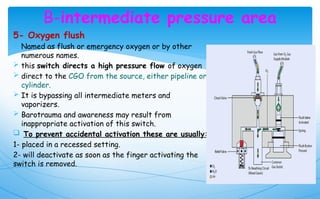
5- Oxygen flush
 Named as flush or emergency oxygen or by other
numerous names.
 this switch directs a high pressure flow of oxygen
 direct to the CGO from the source, either pipeline or
cylinder.
 It is bypassing all intermediate meters and
vaporizers.
 Barotrauma and awareness may result from
inappropriate activation of this switch.
 To prevent accidental activation these are usually:
1- placed in a recessed setting.
2- will deactivate as soon as the finger activating the
switch is removed.
B-intermediate pressure area
C- Low-pressure system
1- Flowmeter:
 Gases pass through an adjustable needle valve
into flowmeters to accurately measure gas flow.
 The conventional form of a flowmeter on an
anaesthetic machine is called a Rotameter.
 Increasingly many modern anaesthetic machines
do not have rotameters.
 They deliver fresh gas of a desired flow rate and
oxygen concentration by the use of electronic
solenoid valves.
 Flowmeters measure consist of:
1. A flow control valve or needle valve
2. A tapered transparent tube
3. A lightweight rotating bobbin or ball
1. Flow control valves
 It allow manual adjustment of the flow through rotameters.
 There is one brass valve situated at the base of each pair of rotameter tubes
 adjusted by means of a labelled, colour-coded knob.
 If knob is turned anticlockwise, it will opens up the valve allowing increased flow
through the rotameter.
 The knob of oxygen is larger than for other gases, with grooves cut into the side.
 This is a safety feature that allows quick identification of the O2 even in the
dark.
 Another means of quick identification is the UK convention that always places the
O2 knob and rotameter to the left of other gases (Boyle’s left-handed influence)
 A minimal basal flow of 100-300mls/min is always flowing if the anaesthetic
machine is on to prevent hypoxia if a patient is connected with no flow.
C- Low-pressure system
 2. A tapered tube
 clear tubes with varying internal diameters.
 The higher the gas flow the further the bobbin or ball
will move up the tube.
 the graduations get closer together higher up the tube
due to it widening towards the top.
 The O2 rotameter and control knob are always on the
left
 O2 is actually the last gas to join the back bar at the
top right- hand side of the rotameter unit.
 This is to preserve the O2 supply in the event a leak or
damage to any of the other rotameter tubes.
 They have an anti-static coating on the inside to
prevent the bobbin sticking and are accurate to
within 2.5%.
C- Low-pressure system
 3. A bobbin or ball
 The bobbin (most common) or ball floats within
the tube as the gas flow passes around giving a
measure of the flow rate.
 The higher the flow, the higher the bobbin
rises.
 It is important to check that the bobbin is
freely rotating and for this purpose each
bobbin is marked with a clearly visible dot.
 Always read the gas flow rate from:
 The TOP of the bobbin (not the dot)
 The MIDDLE of the ball.
C- Low-pressure system
 Proportioning Systems
(Hypoxic link)
Nitrous oxide and oxygen are
interfaced mechanically or
pneumatically or electronic so
that the minimum oxygen
concentration at the common
gas outlet is between 23% and
25%, depending on the
manufacturer.
C- Low-pressure system
 2- Back bar:
 The back bar is a structure that supports and connects the flow meters and the
gas pathways.
 It is where all the gases finally meet.
 Most machines use a system that allows the user to add or remove specific
vaporizers quickly and easily while maintaining a gas-tight system.
 Some machines have space for a single vaporizer;
 others allow the attachment of two or more vaporizers.
 However, only one vaporizer can be turned on at any given time system due to
an interlock.
 This is to prevent the transfer of upstream agents to the downstream vaporiser
and simultaneous delivery of two agents.
 Once a vaporizer is attached and turned on, gas flow is diverted from the back
bar into the vaporizer to provide the required concentration of anaesthetic
vapour.
C- Low-pressure system
 3-Vaporizers
 Vaporizers convert volatile anaesthetic liquid
into measured allow inhalational anaesthesia.
 The vapour is added after the flowmeters.
 All modern vaporizers are precise and agent
specific.
 Colour-coded
 Individual keyed filling systems are used to
ensure the vaporizers cannot be filled with
the wrong agent.
Low-pressure system
Modern vaporizers (e.g. Tec 5, 6 and 7) have several safety
advantages over their predecessors:
1. an interlock to isolate vaporizers not in use;
2. a clear indication of liquid level;
3. a non-spill reservoir with up to 180° of allowable tilt;
4. a keyed-filler or pour-fill systems prevent filling with an
incorrect volatile agent and minimize leaks;
5. an increased wick capacity.
6. accurate to within 2.5%
Low-pressure system
 Aladin cassettes veporiser
 The cassettes are lighter (2–3 kg),
 virtually service-free
 have no restrictions for tilting.
 Integrated real-time electronic fresh gas flow measurement of
gas mixtures enables the unit to dispense more accurately
dialled concentrations, compared with traditional vaporizers.
 DIVA
Draeger has the DIVA (direct injection
of volatile anaesthetics)
 In some of its newer machines that use
injectors.
They inject the volatile directly into
the fresh gas flow allowing rapid
increases in concentration even with
minimal flows, which normal vaporisers
and Aladdin units cannot do.
Low-pressure system
4- Pressure relief devices
 Modern machines have a pressure relief device between the vaporizer and the
CGO
 it vents to the atmosphere in case dangerous pressures develop downstream due
to occlusions,
 thus protecting the machine
5- Alternate oxygen flow meter
 Many newer machines have the facility of a separate, stand-alone mechanical
flow meter.
 which has to be consciously activated in the rare instance of electronics in the
machine failing to provide a gas flow to the CGO.
 This flow usually may or may not pass through the vaporizers.
6- Common Gas output
 This has a standard 15 mm female slip joint fitting with 22 mm coaxial
connector.
C- Low-pressure system
Anesthesia machine step by step presentation.pptx

Anesthesia machine step by step presentation.pptx

  • 1.
    Anesthesia Machine step bystep Prepared by The anesthesia team Al shifa medical complex Palestine zoom
  • 3.
     The anesthesiawarkestation (machine) divided into 3 main components : 1- electrical component 2- Pneumatic component 3- scavenging system  In this lecture we will focus on the pneumatic component step by step.. introduction
  • 4.
    Safety features wereincorporated sequentially over this huge time span of nearly 100 years of evolution of the anaesthesia machine (since 1917), With more and more safety systems being added as realisation of the problems and mishaps surfaced. Various national associations of anaesthesiologists have recommended the minimum safety features for machines used in their countries or by their members.  Many international standards exist for the anaesthesia machines specifying the safety features that are absolutely required and those that are relative/desirable. Anaesthesia machines are covered by the american society for testing and materials (astm) standard. introduction
  • 5.
    The most popularones are those from the American Society of Anesthesiologists (ASA), (CAS),(ANZCA). Most professional associations e.g., Association of Anaesthetists of Great Britain and Ireland (AAGBI) and ASA also recommend pre-anaesthesia checkout procedures that check the proper functioning of all the safety features incorporated in the machine. In a review conducted over the years 1962-1991 by ASA, 72 of 3791 (ASA closed claims Project):  malpractice claims were related to gas delivery equipment.  Death and permanent brain damage accounted for a majority of the claims (76%). Misuse of equipment was 3 times more common than equipment failure, highlighting the necessity of proper equipment check and training before use The ultimate responsibility for the safe use of the machine rests with the end user – the anaesthesia provider. introduction
  • 7.
    Pneumatic component Generally thepneumatic component of anesthesia machine divided into 3 areas :  A-high pressure area  Consists of:  Cylinders  Yoke assemblies,  Bodok seal.  1st Pressure regulators.  pressure relief valve  Cylinder pressure indicators (bourdon gauge)  C-Low pressure area.  Consists of:  This part contains:  The flow meters,  Hypoxia prevention devices  Vaporizers,  Unidirectional valves  Pressure relief devices.  B-intermediate pressure area  Consists of:  The pipeline inlet.  Master switch (present in newer machines),  Pipeline pressure indicators,  2nd stage pressure regulators,  Auxiliary gas outlets for ventilators,  Oxygen failure devices,  Oxygen flush  The flow control valves.
  • 8.
     1-Cylinder supplysource  Anesthesia machines have reserve E cylinders if a pipeline supply source is not available or if the pipeline fails.  O2 tanks are fitted at the factory to a pressure of approximately 2000 psig =137 bar = 13,700 kPa at room temperature.  A full E cylinder of O2 (2000 psig ) will produce approximately 660 L of gaseous O2 at atmospheric pressure.  The cylinder attaches to the machine through the hanger-yoke assembly.  The cylinders should be turned off except during the preoperative machine checking period or when pipeline source is unavailable, to avoid depletion of the cylinder A-high pressure area
  • 9.
    2-the hanger yokeassembly  Orients and supports the cylinder.  Provides a gas-like seal.(Bodok seal).  Ensures a unidirectional flow of gases into the machine.  Each hanger yoke is equipped with a pin index safety system (PISS).  The PISS is a safeguard introduced to eliminate cylinder interchanging.  Each gas or combination of gases has a specific pin arrangement. A-high pressure area
  • 10.
     3- Bodokseal  The yoke contains a Bodok seal.  Bodok seals (bonded disk).  These are non-combustible neoprene washers with aluminium edges placed between the cylinder head and yoke to provide a gas-tight seal.  Under no circumstances may oil or grease be used as a seal;  the pressurized gases give off heat as they are released from the cylinder and may cause an explosion if oil is used. A-high pressure area
  • 11.
     4- checkvalve(one way valve)  Check valves or one-way valves are normally placed on/after the yoke.  Has several functions: 1- It minimizes gas transfer from a cylinder at a high pressure to one with lower pressure. 2- It allows exchanging a cylinder while gas flow continues from the other cylinder into the machine with minimal loss of gas. 3- It minimizes leakage from an open cylinder to the atmospheres if one cylinder is absent.  The check valves may leak; therefore if a yoke does not have a tank hanging on it, a yoke plug should be inserted . A-high pressure area
  • 12.
     5- Primarypressure regulator (for the cylinders)  Not only reduce the pressure of gases from the cylinders.  But provide them at constant pressure of 4 bar or 400 kpa to the flow meters. Note: some manufacturers adjust the cylinder regulators to just under 400 kpa, which allows the machine to preferentially use the higher pressure pipeline gas.  Regulators may weep the cylinder contents, hence the importance of turning a cylinder off after a machine A-high pressure area
  • 13.
     6- Apressure relief valve Cylinders have exploded because of over-pressure in them either due to over filling or mis-filling. To prevent explosion, astm standards require all cylinders to have pressure relief devices,  It vent over-pressurized contents of the cylinder to the atmosphere.  They are of two types: Rupture disc, where, when a predetermined pressure is reached a disc guarding an orifice ruptures releasing the contents. Fusible plug, which is a thermally operated plug providing protection against high temperatures, but not pressure.  A combination of these two is sometimes used as well. A-high pressure area
  • 14.
     6- Pressuregauges (Bourdon gauge)  Colour-coded Bourdon gauges indicate the pressures of the piped and cylinder supplies.  The Bourdon gauge consists of a tube bent into a coil or an arc.  As the pressure in the tube increases, the coil unwinds.  A pointer connected to the end of the tube can be attached to a lever and a pointer calibrated to indicate pressure. A-high pressure area
  • 15.
    1-The pipeline inletconnections  Connectors that can be fitted to the wrong gas terminals have caused patient dangers and led to the development of safety features such as non- interchangeable screw thread (NIST), diameter index safety system (DISS), etc.  Schrader probe:  The probe for each gas supply has a protruding indexing collar with a unique diameter, which fits the Schrader socket assembly for the same gas only .  Hose pipes:  These are flexible, colour-coded and have built in reinforcements in the wall to make them kink proof. B-intermediate pressure area
  • 16.
     Pipeline attachments: Each terminal unit that connects to the main pipeline system is equipped with the DISS .  non-interchangeability of connections is achieved by differing diameters of the shoulders that surround the nipple.  Properly engaged parts allow the thread to connect to each other so that gas starts to flow.  Quick connectors are other safety devices, which allow correct attachments by using varying combinations of shapes and spacing of the different portions of the components that couple with each other.  Each gas inlet also contains a unidirectional check valve that prevents leakage into the pipeline system when cylinders are being used as the main source. B-intermediate pressure area
  • 17.
     Machine endof gas pipelines:  NIST connection to the anaesthetic machine  each flexible hose ends in a unique fitting of nut and probe.  This ensures a hose connection specific to each gas service.  It comprises of a nut and probe.  The probe has a unique profile for each gas, which fits only the union on the machine for that gas.  The nut has the same diameter and thread for all gas services, but can only be attached to the machine when the probe is engaged.  The term NIST is in fact misleading; the screw thread does not determine the unique fit.  A one-way valve ensures unidirectional flow. B-intermediate pressure area
  • 18.
     2- Pipelinepressure indicators  Indicators are required for each gas.  they usually have a colour-coded dial  in some indicators satisfactory working pressures zones have a special colour for easier identification. B-intermediate pressure area
  • 19.
     3- Secondstage pressure regulator  Most modern machines have a second stage regulator .  It is located just upstream of the flow meters .  so that flow is constant at the flow meters even if there are fluctuations in the pipeline pressure.  It reduces pipeline pressure (4 bar) down to the machine working pressure (around 1 bar) . B-intermediate pressure area
  • 20.
     4- Oxygenfailure devices: The 2000 ASTM F 1850-00 standard states: “The anesthesia gas supply device shall be designed so that whenever O2 supply pressure is reduced to below the manufacturer specific minimum, the delivered O2 concentration shall not decrease below 19% at the common gas outlet.”  If the oxygen pressure in the high-pressure system decreases (usually to <30 psig), an oxygen supply alarm is activated within 5 s. A- O2 failure alarm  The O2 failure alarm was originally introduced to prevent the unobserved emptying of oxygen cylinders before piped gases were in common use. An alarm must sound for 7 s duration when the pressure in the oxygen supply falls below 200 kPa.  Originally, this alarm was a mechanical device called a Ritchie whistle but modern anaesthetic machines employ electronic alarms. B-intermediate pressure area
  • 21.
     B-Fail-safe valves 1-in datex-ohmeda machines:  When the oxygen pressure in the machine’s high pressure system falls below 20 psig,  The flow of N2O and all other gases to their flow-control valves is interrupted.  This valve is an all-or-nothing valve;  It opens at oxygen pressures of 20 psig or more  And it is closed at pressures less than 20 psig B-intermediate pressure area
  • 22.
    2- Dräger Narkomedmachines (Dräger, Lübeck, Germany)  Is called the oxygen failure protection device (OFPD).  There is 1 OFPD for each of the gases supplied to the machine.  As the oxygen supply pressure decreases, the OFPD proportionately reduces the supply pressure of each of the other gases to their flow-control valves.  The supply of N2O and other gases is completely interrupted when o2 supply pressure falls below 12 ± 4 psig B-intermediate pressure area
  • 23.
     The oxygenfailure safety device and the oxygen supply failure alarm both depend and detect failure based on pressure and not on flow.  These mechanisms work on supply connections upstream of the machine.  Hence they do not protect against hypoxic gas delivery, which may occur because of:  empty cylinders or misconnected pipelines or the wrong proportion of gases being dialled on the flow meters. B-intermediate pressure area
  • 24.
    5- Oxygen flush Named as flush or emergency oxygen or by other numerous names.  this switch directs a high pressure flow of oxygen  direct to the CGO from the source, either pipeline or cylinder.  It is bypassing all intermediate meters and vaporizers.  Barotrauma and awareness may result from inappropriate activation of this switch.  To prevent accidental activation these are usually: 1- placed in a recessed setting. 2- will deactivate as soon as the finger activating the switch is removed. B-intermediate pressure area
  • 25.
    C- Low-pressure system 1-Flowmeter:  Gases pass through an adjustable needle valve into flowmeters to accurately measure gas flow.  The conventional form of a flowmeter on an anaesthetic machine is called a Rotameter.  Increasingly many modern anaesthetic machines do not have rotameters.  They deliver fresh gas of a desired flow rate and oxygen concentration by the use of electronic solenoid valves.  Flowmeters measure consist of: 1. A flow control valve or needle valve 2. A tapered transparent tube 3. A lightweight rotating bobbin or ball
  • 26.
    1. Flow controlvalves  It allow manual adjustment of the flow through rotameters.  There is one brass valve situated at the base of each pair of rotameter tubes  adjusted by means of a labelled, colour-coded knob.  If knob is turned anticlockwise, it will opens up the valve allowing increased flow through the rotameter.  The knob of oxygen is larger than for other gases, with grooves cut into the side.  This is a safety feature that allows quick identification of the O2 even in the dark.  Another means of quick identification is the UK convention that always places the O2 knob and rotameter to the left of other gases (Boyle’s left-handed influence)  A minimal basal flow of 100-300mls/min is always flowing if the anaesthetic machine is on to prevent hypoxia if a patient is connected with no flow. C- Low-pressure system
  • 27.
     2. Atapered tube  clear tubes with varying internal diameters.  The higher the gas flow the further the bobbin or ball will move up the tube.  the graduations get closer together higher up the tube due to it widening towards the top.  The O2 rotameter and control knob are always on the left  O2 is actually the last gas to join the back bar at the top right- hand side of the rotameter unit.  This is to preserve the O2 supply in the event a leak or damage to any of the other rotameter tubes.  They have an anti-static coating on the inside to prevent the bobbin sticking and are accurate to within 2.5%. C- Low-pressure system
  • 28.
     3. Abobbin or ball  The bobbin (most common) or ball floats within the tube as the gas flow passes around giving a measure of the flow rate.  The higher the flow, the higher the bobbin rises.  It is important to check that the bobbin is freely rotating and for this purpose each bobbin is marked with a clearly visible dot.  Always read the gas flow rate from:  The TOP of the bobbin (not the dot)  The MIDDLE of the ball. C- Low-pressure system
  • 29.
     Proportioning Systems (Hypoxiclink) Nitrous oxide and oxygen are interfaced mechanically or pneumatically or electronic so that the minimum oxygen concentration at the common gas outlet is between 23% and 25%, depending on the manufacturer. C- Low-pressure system
  • 30.
     2- Backbar:  The back bar is a structure that supports and connects the flow meters and the gas pathways.  It is where all the gases finally meet.  Most machines use a system that allows the user to add or remove specific vaporizers quickly and easily while maintaining a gas-tight system.  Some machines have space for a single vaporizer;  others allow the attachment of two or more vaporizers.  However, only one vaporizer can be turned on at any given time system due to an interlock.  This is to prevent the transfer of upstream agents to the downstream vaporiser and simultaneous delivery of two agents.  Once a vaporizer is attached and turned on, gas flow is diverted from the back bar into the vaporizer to provide the required concentration of anaesthetic vapour. C- Low-pressure system
  • 31.
     3-Vaporizers  Vaporizersconvert volatile anaesthetic liquid into measured allow inhalational anaesthesia.  The vapour is added after the flowmeters.  All modern vaporizers are precise and agent specific.  Colour-coded  Individual keyed filling systems are used to ensure the vaporizers cannot be filled with the wrong agent. Low-pressure system
  • 32.
    Modern vaporizers (e.g.Tec 5, 6 and 7) have several safety advantages over their predecessors: 1. an interlock to isolate vaporizers not in use; 2. a clear indication of liquid level; 3. a non-spill reservoir with up to 180° of allowable tilt; 4. a keyed-filler or pour-fill systems prevent filling with an incorrect volatile agent and minimize leaks; 5. an increased wick capacity. 6. accurate to within 2.5% Low-pressure system
  • 33.
     Aladin cassettesveporiser  The cassettes are lighter (2–3 kg),  virtually service-free  have no restrictions for tilting.  Integrated real-time electronic fresh gas flow measurement of gas mixtures enables the unit to dispense more accurately dialled concentrations, compared with traditional vaporizers.
  • 34.
     DIVA Draeger hasthe DIVA (direct injection of volatile anaesthetics)  In some of its newer machines that use injectors. They inject the volatile directly into the fresh gas flow allowing rapid increases in concentration even with minimal flows, which normal vaporisers and Aladdin units cannot do. Low-pressure system
  • 35.
    4- Pressure reliefdevices  Modern machines have a pressure relief device between the vaporizer and the CGO  it vents to the atmosphere in case dangerous pressures develop downstream due to occlusions,  thus protecting the machine 5- Alternate oxygen flow meter  Many newer machines have the facility of a separate, stand-alone mechanical flow meter.  which has to be consciously activated in the rare instance of electronics in the machine failing to provide a gas flow to the CGO.  This flow usually may or may not pass through the vaporizers. 6- Common Gas output  This has a standard 15 mm female slip joint fitting with 22 mm coaxial connector. C- Low-pressure system