Methods in Reducing Medical Errors Introduction Stephen Stripe MD, FAAFP Shirley Cole-Harding PhD Vicki Michels PhD
Historical Prospective Nov. 1999 IOM Report, “To Err is Human” Called for; Research into causes and solutions Enhanced Reporting of Errors Increased Expectations for Performance
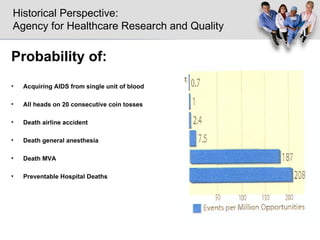
Historical Perspective: Agency for Healthcare Research and Quality Probability of: Acquiring AIDS from single unit of blood  All heads on 20 consecutive coin tosses Death airline accident Death general anesthesia Death MVA Preventable Hospital Deaths
Historical Perspective July 2006 IOM Report 1.5 million medication injuries/year $3.5 Billion in hospital costs/year
DEFINING ERRORS Adverse Error (AE)- “an injury that results from medical error” Preventable AE Potential AE – “near miss” or “close call” Serious error=Preventable + Potential AE
Tracking Errors Brennan et al. (1991) 30,121 charts reviewed, NYS 1984 Results 3.7% with AE 1% negligent care 51.2% of those with AEs died. Risk Factors Age > 64 High risk surgery
Tracking Errors Leape et al. (1991) Types of Error Operative =47.7% Non-operative=52.3% Medication related=19.4% Diagnostic mishap=8.1% Therapeutic mishap=7.5%
Tracking Errors Bates et al., ( 1995) Chart review and self-report on medical and surgical units Results; 6.5% ADE(1.8% preventable) 5.5% with potential ADE Rate highest in ICU 42% of preventable ADEs life threatening or serious 56% ordering 24% administration
Tracking Errors Cognitive errors in malpractice suits  state and federal courts U.S 8 th  Circuit Court of Appeals Region In 59% of the cases cognitive errors could be identified (Stripe et al. 2006)
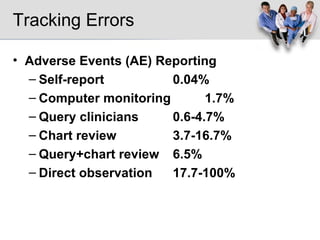
Tracking Errors Adverse Events (AE) Reporting Self-report   0.04% Computer monitoring  1.7% Query clinicians 0.6-4.7% Chart review 3.7-16.7% Query+chart review 6.5% Direct observation  17.7-100%
Methods in Reducing Medical Errors Systems Approaches Stephen Stripe MD, FAAFP Shirley Cole-Harding PhD Vicki Michels PhD
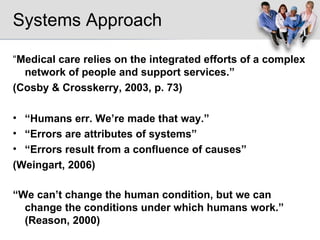
Systems Approach “ Medical care relies on the integrated efforts of a complex network of people and support services.” (Cosby & Crosskerry, 2003, p. 73) “ Humans err. We’re made that way.” “ Errors are attributes of systems” “ Errors result from a confluence of causes” (Weingart, 2006) “ We can’t change the human condition, but we can change the conditions under which humans work.” (Reason, 2000)
Systems Approach “ Recognizing that medical errors are the fault of systems and not of individuals, (QuIC, 2000) the purpose of hearing from this panel was to identify how improving patient safety can be a health care system-wide endeavor. …Some common themes raised by this panel were: confidentiality and protection, human factors, organizational/cultural issues, reporting   systems, use of technology, and training of providers.”
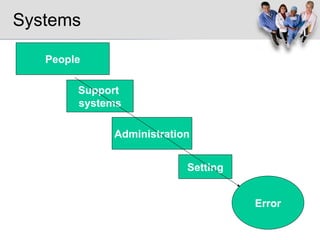
What defines a system? Setting ED, hospital People Physicians Nurses Pharmacists Technicians Administrators Support systems Radiology, laboratory, e.g. Organization (Cosby & Croskerry, 2003)
Systems Error People Support  systems Setting Administration
Overview of Systems Theory Sources of error System problems even if human error is a factor Inadequate infrastructure to support high-tech medical care Teamwork failure Inadequate information networks Equipment failure (Cosby & Croskerry, 2003)
Settings Sources of problems The ED Overloaded, understaffed High-acuity Rapid decision making Need rapid interventions (Cosby & Croskerry, 2003)
Teamwork Sources of problems Segregation of medical personnel during training Hierarchies Lack of cross-checking Lack of communication/information sharing Lack of task sharing Lack of coordination (Cosby & Croskerry, 2003)
Support Systems Design flaws in medication delivery Naming, packaging, labeling Handwriting Matching staffing with demand Delivery systems (Weingart, 2006)
Systems solutions Recognize latent (systems) error is a component of most errors Encourage reporting of error Promote teamwork Prevent medication errors Improve information technology Address equipment problems Consider human factors in equipment design (Cosby & Croskerry, 2003)
Systems solutions Simplify and standardize Reduce handoffs Use constraints and forcing functions Build in appropriate redundancy Improve access to information Adopt best practices Take care of the system ( W eingart, 2006)
A Systems Solution Computerized Physician Order Entry 55% reduction in errors in serious medication errors Specific benefits Streamlines ordering Information needed at hand Dosage guidance available Checks performed (Bates, 2006)
A Systems Solution Problems with this CPOE system Lessons Systems must be modified in response to problems occurring on implementation Software alone is insufficient Rapid introduction may cause problems Must be implemented well Must have proper decision support Must be monitored Changes must be made in response to problems (Bates, 2006)
Methods in Reducing Medical Errors Individual Approaches Stephen Stripe MD, FAAFP Shirley Cole-Harding PhD Vicki Michels PhD
Individual Approaches Introduction Systems made up of individuals Individual decisions create medical error Providing education will reduce medical error
Individual Approach Theory Factors affecting decision making Cognitive processes Situational influences Personality traits
Individual Approach Theory Cognitive Processes  Development of  Schemas Experience Observations Benefits of Schemas  Efficiency Cost of Schemas Biases
Individual Approach Theory Type of Schemas Heuristics Representative  Probability of occurring Availability  Recent exposure to similar case
Individual Approach Theory Biases created by schemas Confirmation bias Fundamental attribution error Recency effect Commission bias Ommission bias Gender biases (Crosskerry, 2002)
Individual Approach Theory Situational Factors Loss of situational awareness Personal situational factors Illness Medications Stress Alcohol or other substance use Fatigue, hunger Emotions External Pressures
Individual Approach Theory Personality Traits  Antiauthority Macho Impulsive Invulnerability Resignation
Individual Solutions Improving meta-cognitive skills Educate about cognitive processes Educate about cognitive errors Develop strategies to prevent cognitive errors (Crosskerry et al., 2000)
Individual Solutions Modified Aviation Prevention Model  Stripe, Cole-Harding, & Michels Increase awareness of situational factors affecting decision making Increase awareness of personality on decision making
Assessment of Models Improving meta-cognitive skills Curriculum for model well laid out (Cosby & Croskerry, 2000;Croskerry, et al., 2000) No systematic research to assess effectiveness Modified Aviation Prevention Model Curriculum well laid out  Pilot study showed a 40% decrease in error  for family medicine residents who received Modified Aviation Prevention Training. Only pre and post test, more research needed
Methods in Reducing Medical Errors Integrated Model Stephen Stripe MD, FAAFP Shirley Cole-Harding PhD Vicki Michels PhD
Integrated Models Commercial Aviation Model Combined Systems and Cognitive Approach Checklists Scheduled maintaince Simulator training on a scheduled calendar  for every flight officer Cognitive reviews on a scheduled calendar for every flight officer
Integrated Models Aviation Model Research Results  Safest industry in the world involving high risk activity 0.232 incidents or accidents/100,000 flight hours Death in airline accident just greater than the odds of 20 consecutive coin tosses coming up all heads
Medical Model Combined Systems and Cognitive Approach Checklists Standard routine orders; (pneumonia, acute coronary syndrome, etc.) Scheduled maintenance training
Medical Model EMR Prepackaged medications Cognitive review on a scheduled calendar for  every physician, nurse, midlevel etc.
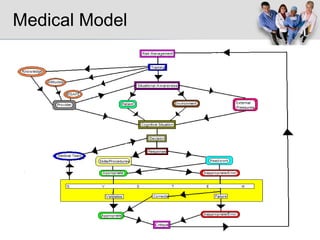
Medical Model Pilot study showed a 40% decrease in error  for family medicine residents who received Modified Aviation Prevention Training. 55% with at least one systems approach What would the decrease in error be with a combined approach?
Medical Model
References Bates, D.W.,  The Patient Safety Imperitive,  2006. Bates et al.,  JAMA  1995: 274;29-34  Brennan et al.  NEJM  1991: 324:370-6 Cosby, K.S. & Croskerry, P.  Acad. Emerg. Med.  2003: 10; 69-78  Croskerry, P. Acad. Emerg. Med. 2000; 7;1223-1231 Croskerry, P., Wears, R., & Binder, L., Acad. Emerg. Med., 2000:7;11194-1200. Leape et. Al.  NEJM  1991: 324:377-84 Stripe, S., et al., JABFM, 2006 Weingart, S.N.  The Patient Safety Imperitive,  2006.

Medical Error

  • 1.
    Methods in ReducingMedical Errors Introduction Stephen Stripe MD, FAAFP Shirley Cole-Harding PhD Vicki Michels PhD
  • 2.
    Historical Prospective Nov.1999 IOM Report, “To Err is Human” Called for; Research into causes and solutions Enhanced Reporting of Errors Increased Expectations for Performance
  • 3.
    Historical Perspective: Agencyfor Healthcare Research and Quality Probability of: Acquiring AIDS from single unit of blood All heads on 20 consecutive coin tosses Death airline accident Death general anesthesia Death MVA Preventable Hospital Deaths
  • 4.
    Historical Perspective July2006 IOM Report 1.5 million medication injuries/year $3.5 Billion in hospital costs/year
  • 5.
    DEFINING ERRORS AdverseError (AE)- “an injury that results from medical error” Preventable AE Potential AE – “near miss” or “close call” Serious error=Preventable + Potential AE
  • 6.
    Tracking Errors Brennanet al. (1991) 30,121 charts reviewed, NYS 1984 Results 3.7% with AE 1% negligent care 51.2% of those with AEs died. Risk Factors Age > 64 High risk surgery
  • 7.
    Tracking Errors Leapeet al. (1991) Types of Error Operative =47.7% Non-operative=52.3% Medication related=19.4% Diagnostic mishap=8.1% Therapeutic mishap=7.5%
  • 8.
    Tracking Errors Bateset al., ( 1995) Chart review and self-report on medical and surgical units Results; 6.5% ADE(1.8% preventable) 5.5% with potential ADE Rate highest in ICU 42% of preventable ADEs life threatening or serious 56% ordering 24% administration
  • 9.
    Tracking Errors Cognitiveerrors in malpractice suits state and federal courts U.S 8 th Circuit Court of Appeals Region In 59% of the cases cognitive errors could be identified (Stripe et al. 2006)
  • 10.
    Tracking Errors AdverseEvents (AE) Reporting Self-report 0.04% Computer monitoring 1.7% Query clinicians 0.6-4.7% Chart review 3.7-16.7% Query+chart review 6.5% Direct observation 17.7-100%
  • 11.
    Methods in ReducingMedical Errors Systems Approaches Stephen Stripe MD, FAAFP Shirley Cole-Harding PhD Vicki Michels PhD
  • 12.
    Systems Approach “Medical care relies on the integrated efforts of a complex network of people and support services.” (Cosby & Crosskerry, 2003, p. 73) “ Humans err. We’re made that way.” “ Errors are attributes of systems” “ Errors result from a confluence of causes” (Weingart, 2006) “ We can’t change the human condition, but we can change the conditions under which humans work.” (Reason, 2000)
  • 13.
    Systems Approach “Recognizing that medical errors are the fault of systems and not of individuals, (QuIC, 2000) the purpose of hearing from this panel was to identify how improving patient safety can be a health care system-wide endeavor. …Some common themes raised by this panel were: confidentiality and protection, human factors, organizational/cultural issues, reporting systems, use of technology, and training of providers.”
  • 14.
    What defines asystem? Setting ED, hospital People Physicians Nurses Pharmacists Technicians Administrators Support systems Radiology, laboratory, e.g. Organization (Cosby & Croskerry, 2003)
  • 15.
    Systems Error PeopleSupport systems Setting Administration
  • 16.
    Overview of SystemsTheory Sources of error System problems even if human error is a factor Inadequate infrastructure to support high-tech medical care Teamwork failure Inadequate information networks Equipment failure (Cosby & Croskerry, 2003)
  • 17.
    Settings Sources ofproblems The ED Overloaded, understaffed High-acuity Rapid decision making Need rapid interventions (Cosby & Croskerry, 2003)
  • 18.
    Teamwork Sources ofproblems Segregation of medical personnel during training Hierarchies Lack of cross-checking Lack of communication/information sharing Lack of task sharing Lack of coordination (Cosby & Croskerry, 2003)
  • 19.
    Support Systems Designflaws in medication delivery Naming, packaging, labeling Handwriting Matching staffing with demand Delivery systems (Weingart, 2006)
  • 20.
    Systems solutions Recognizelatent (systems) error is a component of most errors Encourage reporting of error Promote teamwork Prevent medication errors Improve information technology Address equipment problems Consider human factors in equipment design (Cosby & Croskerry, 2003)
  • 21.
    Systems solutions Simplifyand standardize Reduce handoffs Use constraints and forcing functions Build in appropriate redundancy Improve access to information Adopt best practices Take care of the system ( W eingart, 2006)
  • 22.
    A Systems SolutionComputerized Physician Order Entry 55% reduction in errors in serious medication errors Specific benefits Streamlines ordering Information needed at hand Dosage guidance available Checks performed (Bates, 2006)
  • 23.
    A Systems SolutionProblems with this CPOE system Lessons Systems must be modified in response to problems occurring on implementation Software alone is insufficient Rapid introduction may cause problems Must be implemented well Must have proper decision support Must be monitored Changes must be made in response to problems (Bates, 2006)
  • 24.
    Methods in ReducingMedical Errors Individual Approaches Stephen Stripe MD, FAAFP Shirley Cole-Harding PhD Vicki Michels PhD
  • 25.
    Individual Approaches IntroductionSystems made up of individuals Individual decisions create medical error Providing education will reduce medical error
  • 26.
    Individual Approach TheoryFactors affecting decision making Cognitive processes Situational influences Personality traits
  • 27.
    Individual Approach TheoryCognitive Processes Development of Schemas Experience Observations Benefits of Schemas Efficiency Cost of Schemas Biases
  • 28.
    Individual Approach TheoryType of Schemas Heuristics Representative Probability of occurring Availability Recent exposure to similar case
  • 29.
    Individual Approach TheoryBiases created by schemas Confirmation bias Fundamental attribution error Recency effect Commission bias Ommission bias Gender biases (Crosskerry, 2002)
  • 30.
    Individual Approach TheorySituational Factors Loss of situational awareness Personal situational factors Illness Medications Stress Alcohol or other substance use Fatigue, hunger Emotions External Pressures
  • 31.
    Individual Approach TheoryPersonality Traits Antiauthority Macho Impulsive Invulnerability Resignation
  • 32.
    Individual Solutions Improvingmeta-cognitive skills Educate about cognitive processes Educate about cognitive errors Develop strategies to prevent cognitive errors (Crosskerry et al., 2000)
  • 33.
    Individual Solutions ModifiedAviation Prevention Model Stripe, Cole-Harding, & Michels Increase awareness of situational factors affecting decision making Increase awareness of personality on decision making
  • 34.
    Assessment of ModelsImproving meta-cognitive skills Curriculum for model well laid out (Cosby & Croskerry, 2000;Croskerry, et al., 2000) No systematic research to assess effectiveness Modified Aviation Prevention Model Curriculum well laid out Pilot study showed a 40% decrease in error for family medicine residents who received Modified Aviation Prevention Training. Only pre and post test, more research needed
  • 35.
    Methods in ReducingMedical Errors Integrated Model Stephen Stripe MD, FAAFP Shirley Cole-Harding PhD Vicki Michels PhD
  • 36.
    Integrated Models CommercialAviation Model Combined Systems and Cognitive Approach Checklists Scheduled maintaince Simulator training on a scheduled calendar for every flight officer Cognitive reviews on a scheduled calendar for every flight officer
  • 37.
    Integrated Models AviationModel Research Results Safest industry in the world involving high risk activity 0.232 incidents or accidents/100,000 flight hours Death in airline accident just greater than the odds of 20 consecutive coin tosses coming up all heads
  • 38.
    Medical Model CombinedSystems and Cognitive Approach Checklists Standard routine orders; (pneumonia, acute coronary syndrome, etc.) Scheduled maintenance training
  • 39.
    Medical Model EMRPrepackaged medications Cognitive review on a scheduled calendar for every physician, nurse, midlevel etc.
  • 40.
    Medical Model Pilotstudy showed a 40% decrease in error for family medicine residents who received Modified Aviation Prevention Training. 55% with at least one systems approach What would the decrease in error be with a combined approach?
  • 41.
  • 42.
    References Bates, D.W., The Patient Safety Imperitive, 2006. Bates et al., JAMA 1995: 274;29-34 Brennan et al. NEJM 1991: 324:370-6 Cosby, K.S. & Croskerry, P. Acad. Emerg. Med. 2003: 10; 69-78 Croskerry, P. Acad. Emerg. Med. 2000; 7;1223-1231 Croskerry, P., Wears, R., & Binder, L., Acad. Emerg. Med., 2000:7;11194-1200. Leape et. Al. NEJM 1991: 324:377-84 Stripe, S., et al., JABFM, 2006 Weingart, S.N. The Patient Safety Imperitive, 2006.