Dr.Osama Arafa Abd EL Hameed
Consultant
of
Pediatrics & Neonatology
Head of Pediatrics Department
Port-Fouad Hospital
Common Medical Errors in
NICU
By
To Err Is Human
Kohn LT, Corrigan
JM, Donaldson MS,
Eds. To Err Is Human.
Washington National
Press, Wash, DC.
2000.
Everyone makes mistakes
 
Introduction
The incidence and consequences of medication errors in the
neonatal intensive care unit (NICU) demonstrate the importance
of established safety procedures and guidelines for the
prescribing, dispensing, and administration of medications.
As the professional voice of neonatal nurses, the National
Association of Neonatal Nurses (NANN) recommends that
appropriate measures and education be made available to
everyone who prescribes or administers medications in the NICU
and that members be proactive in participating in the
development and implementation of safe medication practices in
the NICU.
 
Introduction cont.
Three important variables make the medication administration
process in the NICU uniquely and inherently risky:
the vulnerable nature of NICU patients, the complexity of the
medications used, and the challenges of the NICU
environment
• Patients in the NICU are undergoing maturational changes in
drugsensitive areas such as renal, gastrointestinal, and hepatic
systems, resulting in variable responses to drugs and the
disease process.
• Medications are universally weight based, requiring
calculations for each dose. But some of the drugs used also are
based on gestational age, making it even more complex.
.  
Introduction cont.
• NICU patients often have long hospital stays, which increases
exposure to medications and medication errors. In premature
infants, the immaturity of developing body systems affects the
absorption, distribution, metabolism, and excretion of drugs, and
therefore, the risk for medication errors is present.
•NICU patients are nonverbal and unable to actively participate in
the patient identification process, which increases the likelihood of
wrong-patient errors
•The increased incidence of multiple gestation births has also
contributed to the misidentification of NICU patients
"A medication error is any preventable event that
may cause or lead to inappropriate medication
use or patient harm while the medication is in the
control of the health care professional, patient, or
consumer.
Defining medication errors
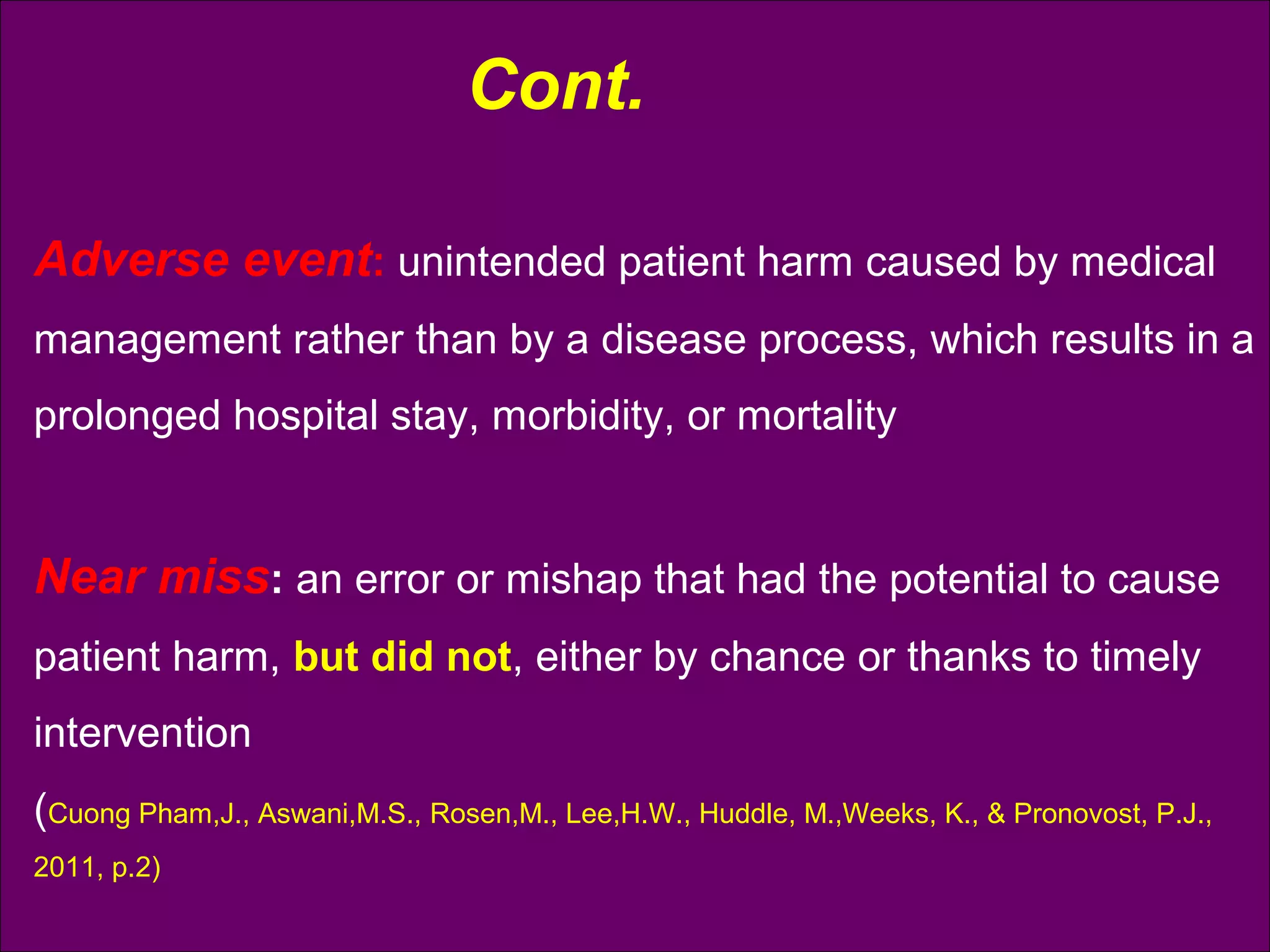
Adverse event: unintended patient harm caused by medical
management rather than by a disease process, which results in a
prolonged hospital stay, morbidity, or mortality
Near miss: an error or mishap that had the potential to cause
patient harm, but did not, either by chance or thanks to timely
intervention
(Cuong Pham,J., Aswani,M.S., Rosen,M., Lee,H.W., Huddle, M.,Weeks, K., & Pronovost, P.J.,
2011, p.2)
Cont.
Effects of medical errors
Increase length of stay
Increased cost
Patient disability
Death
Nurse’s personal and professional status,
confidence, and practice
If you saw this, would you fly ?
Extra Extra
Airlines expect 1-2
jets to crash daily
Over 1000 deaths expected weekly
But what about being a patient in
the health care system
Extra Extra
Airlines expect 1-2 jets to
crash daily
Over 1000 deaths expected
weekly
=
44,000 – 98,000
deaths annually
due to
medical errors
Accidents
123,706
Medical
Errors
~100,000
Alzheimer's
74,632
Diabetes
71,382
How medical errors rank as
cause of mortality
Heart
616,067
Cancer
562,875
Stroke
135,952
Lung
127,924
14
Near Misses in the NICU per 100 orders
2.8
1.3
0.77
0.35
0
0.5
1
1.5
2
2.5
3
NICU PICU Med/Surg Adult
*
*
* P<0.001
JAMA 2014;285;2114-20
*
 Wrong medication, dose, schedule, or infusion rate (including
nutritional agents and blood products (47%)
 Error in administration or method of using a treatment (14%)
 Patient misidentification (12%)
 Other system failure (11%)
 Error or delay in diagnosis (8%); and error in the performance
of an operation, procedure, or test (4%).
 Errors in patient misidentification, for example, were a common
cause of feeding a mother's expressed breast milk to the wrong
baby.
The most frequent errors in NICU
Identification is important to the administration of medications
and blood products, drawing laboratory specimens, performing
diagnostic procedures, and administering treatments including
surgery.
Patients cannot participate in the identification process, and the
methods often used to differentiate individuals (age, size, sex,
and hair color) are not as readily apparent in the neonatal
population.
Caregivers must use the often difficult-to-read or access patient
limb bands to check patient identifiers. Similar-sounding names,
identical names, and similar medical record numbers are so
frequent in the NICU that on some days, more than 70% of
patients can be at risk for misidentification
Misidentification
 Weight based dosing
 Stock medicine dilution
 Ten fold errors
 Decreased communication abilities
 Inability to self-administer medications
 Increased vulnerability of young, critically ill children
 Immature renal and hepatic systems
Why medication errors occur in children
18
Administering
Ordering
Dispensing
Transmitting
Administering
Ordering
Dispensing
Transmitting
Preventable ADEs Near Misses
Stages of medication errors
A circumstances exist for potential errors to occur
B an error occurred but did not reach the patient
C error reached the patient but did not cause harm
D patient monitoring required to determine lack of harm
E error caused temporary harm and some intervention
F temporary harm with initial or prolonged hospitalization
G error resulted in permanent patient harm
H error required intervention to sustain the patient’s life
I error contributed to the patient’s death
• The ability to care for patient – positive or negative
emotion
• Harder to adjust diagnoses to correct ones
• Negative Emotion
– Less time
– Quicker diagnoses
– Sicker patients may be less liked
• Positive Emotion
– Under investigate
– Delay in diagnosis
– Tries to avoid uncomfortable procedures
Emotion and Medical Errors
• Physician writes an order
• Nursing, pharmacist, and clerical staff
mechanisms are in place to carry out
orders
• What occurs in reality?
Why Do Errors Occur?
A true comedy (tragedy) of errors
• Attending MD tells the resident to give the patient
“free water” (meaning let her drink water”)
• Resident assumes he meant an IV and writes for
water to be given IV
• New RN can’t find IV water and calls pharmacy
asking where they get IVs; pharmacy asks no
questions and tells the RN they get them from C.S.
• RN obtains IV from C.S. never questioning RN
why she by-passed pharmacy; water bag says
“water for irrigation”
A true comedy of errors
(continued)
• RN attaches the bag to regular IV tubing;
RN infuses 600 mL of “free water”
• At change of shift, more experienced RN notes
patient is lethargic, sees bag of water, removes
it, and calls MD
A true comedy of errors
Free water has no electrolytes and would
likely have caused burst red blood cells and
death if the second RN hadn’t interceded
• MD #1: used an unfamiliar term “free water”
when he meant let the patient drink water
• MD #2: Intimidated to clarify so he wrote what
he assumed was supposed to be an IV
• RN: well-meaning, wanted to help her patient;
she called pharmacy and talked to whoever
answered the phone; went to obtain the IV
directly from Central Stores Dept
What did staff do wrong ?
Should someone be fired ?
(continued)
• Pharmacy tech: didn’t identify herself as a
tech; didn’t ask why the RN had this unusual
request; didn’t consider having pharmacist
consult with RN
• C.S. staff: never questioned RN why
pharmacy was not involved; provided drug
directly to RN without normal pharmacy
process
What did staff do wrong ?
Should someone be fired ?
An example of a latent condition is a laboratory report
sheet that does not have alternating gray (shaded)
and white rows.
A physician scanning the sheet reads the wrong
value for platelets, and the infant receives an
unnecessary platelet transfusion.
Alternating shaded and white rows are easier to read
and would have likely prevented this error.
Examples from NICUExamples from NICU
The tubing misconnection errors reported recently in
which a piece of tubing used for enteral feedings
can be fitted to an intravenous line, eventually it will
be, with disastrous consequences.
When this error occurs, the problem will not be
prevented from occurring again by blaming the
individual who made the error.
What we must do is make it impossible for such
errors to occur by only using special enteral
tubing for feedings that cannot be attached to an
intravascular line.
Examples from NICU Cont,.Examples from NICU Cont,.
Many NICUs use some form of a "double-check" or "2-nurse
check" system in an attempt to prevent errors, particularly
medication and intravenous pump errors.
The very idea of having to confirm the calculation of a medication
or how much is drawn into the syringe is insulting to many
individuals because it suggests questioning of competence.
The double-check system can suffer from what is known as
the halo effect -- professionals inherently shy away from
questioning the integrity of other professionals. If someone
has the reputation of being a good nurse, other nurses are
unlikely to look closely at or question their medication
calculations or how they have set their intravenous pumps.
Examples from NICU Cont,.Examples from NICU Cont,.
• If Nurse A says to Nurse B, "I'm giving Baby Ahmed 1 mg of
furosemide and it's 10 to 1, so I'm giving point 1 cc," and
Nurse B says, "OK," a true double check has not been
conducted. Nurse A has biased Nurse B's response by telling
her that what she has drawn up is furosemide, what the
concentration is, and how much is in the syringe. The only
effective way to use the double-check system is to perform an
independent double check. In this system, Nurse A would
show Nurse B the order, vial, and syringe, and Nurse B would
independently check to see whether the correct medication,
correct concentration, and correct volume were drawn up for
the correct baby. Obviously, independent double checks
are more time-consuming and must be supported by
providing adequate nurse-to-patient ratios.
Examples from NICU Cont,.Examples from NICU Cont,.
OK – so what can we do ?
Communication and Teamwork
Many principles have been adopted from crew resource
management, a system of training first used in the aerospace
industry. A few good practices:
•Always identify yourself. Another person might be reluctant to
speak up about a patient safety issue if he or she doesn't know
your name. Identification of each team member also helps to
establish role clarity.
•Use 3-way communication to request something you need
during a critical situation. Using the person's name, make a
request.
•They should repeat the request, and you confirm it. This is
known as request-response-confirmation (or challenge-
response-response). It is much more effective than just yelling
"somebody do this" and "somebody do that."
Communication and Teamwork Cont.
Learn to use SBAR, the structured language that can concisely
communicate key information to others (Situation, what is going
on; Background, how the situation developed, the objective
data; Assessment, what you think the problem is;
and Recommendation, what you think needs to be done).
In a critical situation, if you are uncomfortable pointing out a
safety concern, learn and use specific words or phrases that
assertively express your concern.
One example used in crew resource management is, "I need
clarity." Upon hearing this phrase, the team leader should
understand that the team member is trying to raise a concern,
and the team should stop what they are doing until the concern
has been addressed.
• In general:
– a safety culture is pivotal to improving
medication safety (encourage voluntary
reporting)
– senior management must devote adequate
attention to safety
– provide sufficient resources to quality
improvement and safety teams
– authorize resources to invest in technologies,
such as computerized provider order entry
(CPOE) and electronic health records
Reducing medication errors in
long-term care facilities
• Prescribers:
– use sound med reconciliation techniques
– avoid verbal orders except in emergencies
– avoid abbreviations (U for units seen as a 0)
– inform patients of reasons for all medications
– work as a team with consultant pharmacists
and nurses
– use special caution with high-risk medications
– report errors and ADEs
Reducing medication errors in
long-term care facilities
• Pharmacists:
– monitor the medication safety literature
– in conjunction with doctors and nurses,
develop, implement, and follow a medication
error avoidance plan
– verify the accurate entry of data on new
prescriptions (avoid abbreviations; use
TALLman lettering)
e.g. Morphine HYDROmorphone
– report errors and near misses to internal and
external medication error reporting programs
Reducing medication errors in
long-term care facilities
• Nurses:
– foster a commitment to patients’ rights
(YOU are the patient’s advocate)
– be prepared and confident in questioning
medication orders
– participate in, or lead, evaluations of the
efficacy of new safety systems and
technology
– support a culture that values accurate
reporting of medication errors
Reducing medication errors in
long-term care facilities
JUST CULTURE
Managing Errors
The term just culture describes a learning culture that
provides a safe haven in which errors may be reported without
the fear of disciplinary action in events in which there was no
intent to harm.
It is a culture that rewards reporting and places a high value
on communication.
Because it is a culture that thrives on knowledge,
the reporting of near-miss and no-harm errors is just
as important as the errors that result in harm to
Of the 2 chief approaches to error:,
is the Person approach and the other is the systems
approach.
The traditional person approach, also known as the
"naming, shaming, and blaming" approach, will not
help to prevent future errors.
If you focus only on the individual and not on the
system, the error will occur again.
Errors Waiting to Happen
The systems approach recognizes that every
system is perfectly designed to get the results
that it gets, so if you want different results, you
need to change the system.
The focus is on latent errors -- factors in the work
environment that predispose to errors.
Latent conditions are like resident pathogens
lurking in the system, waiting for the right
opportunity to become errors.
Errors Waiting to Happen Cont.,
Conclusion
 Medical errors are common in neonatal intensive care, and
frequently result in harm to patients.
 Reporting and analysis of all errors, and not just those that
result in harm, are essential in learning how to prevent
medical error.
 Develop a working culture in which communication flows
freely regardless of the authority gradient.
 Finally, prevention requires an approach that doesn't blame
individuals for errors, but focuses on a systems approach that
seeks to root out, find, and correct the true causes of errors.
REFERENCES
• 1 Ross LM, Wallace J, Paton JY. Medication errors in a paediatric teaching hospital in the UK: five years
operational experience. Arch Dis Child 2000;83:492–7. 2 Dean B, Schachter M, Vincent C, et al. Causes of
prescribing errors in hospital inpatients: a prospective study. Lancet 2002;359:1373–8. 3 Expert Group on
Learning from Adverse Events in the NHS. An organisation with a memory. London: Department of Health,
2000. 4 Folli HL, Poole RL, Benitz WE, et al. Medication error prevention by clinical pharmacists in two
children’s hospitals. Pediatrics 1987;79:718–22. 5 Koren G, Reich A, Hales B. The role of clinical
pharmacists in preventing potentially fatal ten-fold medication errors in children. J Pharm Technol
1991;7:219–21. 6 Leape LL, Cullen DJ, Clapp MD, et al. Pharmacist participation on physician rounds and
adverse drug events in the intensive care unit. JAMA 1999;282:267–70. 7 Frey B, Buettiker V, Hug MI, et al.
Does critical incident reporting contribute to medication error prevention? Eur J Pediatr 2002;161:594–9. 8
Kaushal R, Shonjania KG, Bates DW. Effects of computerized physician order entry and clinician decision
support systems on medication safety: a systematic review. Arch Intern Med 2003;163:1409–16. 9 King JW,
Paice N, Rangrej J, et al. The effect of computerized physician order entry on medication errors and adverse
drug events in pediatric inpatients. Pediatrics 2003;112:506–9. 10 Kaushal R, Barker KN, Landrigan C, et al.
Medication errors and adverse drug events in pediatric inpatients. JAMA 2001;285:2114–20. 11 Deshpande
SA. How common are violations of good prescribing practice in the neonatal unit? Arch Dis Child
2003;88(suppl 1):A20. 12 Koren G, Barzilay Z, Greenwald M. Tenfold errors in administration of drug doses:
a neglected iatrogenic disease in pediatrics. Pediatrics 1986;77:848–9. 13 Choonara I. How to harm children
in hospital: a guide for junior doctors. Paediatric and Perinatal Drug Therapy 1999;3:34–5. 14 Wilson DG,
McArtney RG, Newcombe RG, et al. Medication errors in paediatric practice: insights from a continuous
quality improvement approach. Eur J Pediatr 1998;157:769–74. 15 Fortescue EB, Kaushal R, Landrigan CP,
et al. Prioritizing strategies for preventing medication errors and adverse drug events in pediatric inpatients.
Pediatrics 2003;111:722–9.
Thank
You

Common medical error in nicu

  • 1.
    Dr.Osama Arafa AbdEL Hameed Consultant of Pediatrics & Neonatology Head of Pediatrics Department Port-Fouad Hospital Common Medical Errors in NICU By
  • 2.
    To Err IsHuman Kohn LT, Corrigan JM, Donaldson MS, Eds. To Err Is Human. Washington National Press, Wash, DC. 2000.
  • 3.
  • 4.
      Introduction The incidence andconsequences of medication errors in the neonatal intensive care unit (NICU) demonstrate the importance of established safety procedures and guidelines for the prescribing, dispensing, and administration of medications. As the professional voice of neonatal nurses, the National Association of Neonatal Nurses (NANN) recommends that appropriate measures and education be made available to everyone who prescribes or administers medications in the NICU and that members be proactive in participating in the development and implementation of safe medication practices in the NICU.
  • 5.
      Introduction cont. Three importantvariables make the medication administration process in the NICU uniquely and inherently risky: the vulnerable nature of NICU patients, the complexity of the medications used, and the challenges of the NICU environment • Patients in the NICU are undergoing maturational changes in drugsensitive areas such as renal, gastrointestinal, and hepatic systems, resulting in variable responses to drugs and the disease process. • Medications are universally weight based, requiring calculations for each dose. But some of the drugs used also are based on gestational age, making it even more complex.
  • 6.
    .   Introduction cont. •NICU patients often have long hospital stays, which increases exposure to medications and medication errors. In premature infants, the immaturity of developing body systems affects the absorption, distribution, metabolism, and excretion of drugs, and therefore, the risk for medication errors is present. •NICU patients are nonverbal and unable to actively participate in the patient identification process, which increases the likelihood of wrong-patient errors •The increased incidence of multiple gestation births has also contributed to the misidentification of NICU patients
  • 7.
    "A medication erroris any preventable event that may cause or lead to inappropriate medication use or patient harm while the medication is in the control of the health care professional, patient, or consumer. Defining medication errors
  • 8.
    Adverse event: unintendedpatient harm caused by medical management rather than by a disease process, which results in a prolonged hospital stay, morbidity, or mortality Near miss: an error or mishap that had the potential to cause patient harm, but did not, either by chance or thanks to timely intervention (Cuong Pham,J., Aswani,M.S., Rosen,M., Lee,H.W., Huddle, M.,Weeks, K., & Pronovost, P.J., 2011, p.2) Cont.
  • 9.
    Effects of medicalerrors Increase length of stay Increased cost Patient disability Death Nurse’s personal and professional status, confidence, and practice
  • 10.
    If you sawthis, would you fly ? Extra Extra Airlines expect 1-2 jets to crash daily Over 1000 deaths expected weekly
  • 11.
    But what aboutbeing a patient in the health care system Extra Extra Airlines expect 1-2 jets to crash daily Over 1000 deaths expected weekly = 44,000 – 98,000 deaths annually due to medical errors
  • 12.
    Accidents 123,706 Medical Errors ~100,000 Alzheimer's 74,632 Diabetes 71,382 How medical errorsrank as cause of mortality Heart 616,067 Cancer 562,875 Stroke 135,952 Lung 127,924
  • 14.
    14 Near Misses inthe NICU per 100 orders 2.8 1.3 0.77 0.35 0 0.5 1 1.5 2 2.5 3 NICU PICU Med/Surg Adult * * * P<0.001 JAMA 2014;285;2114-20 *
  • 15.
     Wrong medication,dose, schedule, or infusion rate (including nutritional agents and blood products (47%)  Error in administration or method of using a treatment (14%)  Patient misidentification (12%)  Other system failure (11%)  Error or delay in diagnosis (8%); and error in the performance of an operation, procedure, or test (4%).  Errors in patient misidentification, for example, were a common cause of feeding a mother's expressed breast milk to the wrong baby. The most frequent errors in NICU
  • 16.
    Identification is importantto the administration of medications and blood products, drawing laboratory specimens, performing diagnostic procedures, and administering treatments including surgery. Patients cannot participate in the identification process, and the methods often used to differentiate individuals (age, size, sex, and hair color) are not as readily apparent in the neonatal population. Caregivers must use the often difficult-to-read or access patient limb bands to check patient identifiers. Similar-sounding names, identical names, and similar medical record numbers are so frequent in the NICU that on some days, more than 70% of patients can be at risk for misidentification Misidentification
  • 17.
     Weight baseddosing  Stock medicine dilution  Ten fold errors  Decreased communication abilities  Inability to self-administer medications  Increased vulnerability of young, critically ill children  Immature renal and hepatic systems Why medication errors occur in children
  • 18.
  • 19.
    Stages of medicationerrors A circumstances exist for potential errors to occur B an error occurred but did not reach the patient C error reached the patient but did not cause harm D patient monitoring required to determine lack of harm E error caused temporary harm and some intervention F temporary harm with initial or prolonged hospitalization G error resulted in permanent patient harm H error required intervention to sustain the patient’s life I error contributed to the patient’s death
  • 20.
    • The abilityto care for patient – positive or negative emotion • Harder to adjust diagnoses to correct ones • Negative Emotion – Less time – Quicker diagnoses – Sicker patients may be less liked • Positive Emotion – Under investigate – Delay in diagnosis – Tries to avoid uncomfortable procedures Emotion and Medical Errors
  • 21.
    • Physician writesan order • Nursing, pharmacist, and clerical staff mechanisms are in place to carry out orders • What occurs in reality? Why Do Errors Occur?
  • 22.
    A true comedy(tragedy) of errors
  • 24.
    • Attending MDtells the resident to give the patient “free water” (meaning let her drink water”) • Resident assumes he meant an IV and writes for water to be given IV • New RN can’t find IV water and calls pharmacy asking where they get IVs; pharmacy asks no questions and tells the RN they get them from C.S. • RN obtains IV from C.S. never questioning RN why she by-passed pharmacy; water bag says “water for irrigation” A true comedy of errors (continued)
  • 25.
    • RN attachesthe bag to regular IV tubing; RN infuses 600 mL of “free water” • At change of shift, more experienced RN notes patient is lethargic, sees bag of water, removes it, and calls MD A true comedy of errors Free water has no electrolytes and would likely have caused burst red blood cells and death if the second RN hadn’t interceded
  • 26.
    • MD #1:used an unfamiliar term “free water” when he meant let the patient drink water • MD #2: Intimidated to clarify so he wrote what he assumed was supposed to be an IV • RN: well-meaning, wanted to help her patient; she called pharmacy and talked to whoever answered the phone; went to obtain the IV directly from Central Stores Dept What did staff do wrong ? Should someone be fired ? (continued)
  • 27.
    • Pharmacy tech:didn’t identify herself as a tech; didn’t ask why the RN had this unusual request; didn’t consider having pharmacist consult with RN • C.S. staff: never questioned RN why pharmacy was not involved; provided drug directly to RN without normal pharmacy process What did staff do wrong ? Should someone be fired ?
  • 28.
    An example ofa latent condition is a laboratory report sheet that does not have alternating gray (shaded) and white rows. A physician scanning the sheet reads the wrong value for platelets, and the infant receives an unnecessary platelet transfusion. Alternating shaded and white rows are easier to read and would have likely prevented this error. Examples from NICUExamples from NICU
  • 29.
    The tubing misconnectionerrors reported recently in which a piece of tubing used for enteral feedings can be fitted to an intravenous line, eventually it will be, with disastrous consequences. When this error occurs, the problem will not be prevented from occurring again by blaming the individual who made the error. What we must do is make it impossible for such errors to occur by only using special enteral tubing for feedings that cannot be attached to an intravascular line. Examples from NICU Cont,.Examples from NICU Cont,.
  • 30.
    Many NICUs usesome form of a "double-check" or "2-nurse check" system in an attempt to prevent errors, particularly medication and intravenous pump errors. The very idea of having to confirm the calculation of a medication or how much is drawn into the syringe is insulting to many individuals because it suggests questioning of competence. The double-check system can suffer from what is known as the halo effect -- professionals inherently shy away from questioning the integrity of other professionals. If someone has the reputation of being a good nurse, other nurses are unlikely to look closely at or question their medication calculations or how they have set their intravenous pumps. Examples from NICU Cont,.Examples from NICU Cont,.
  • 31.
    • If NurseA says to Nurse B, "I'm giving Baby Ahmed 1 mg of furosemide and it's 10 to 1, so I'm giving point 1 cc," and Nurse B says, "OK," a true double check has not been conducted. Nurse A has biased Nurse B's response by telling her that what she has drawn up is furosemide, what the concentration is, and how much is in the syringe. The only effective way to use the double-check system is to perform an independent double check. In this system, Nurse A would show Nurse B the order, vial, and syringe, and Nurse B would independently check to see whether the correct medication, correct concentration, and correct volume were drawn up for the correct baby. Obviously, independent double checks are more time-consuming and must be supported by providing adequate nurse-to-patient ratios. Examples from NICU Cont,.Examples from NICU Cont,.
  • 32.
    OK – sowhat can we do ?
  • 35.
    Communication and Teamwork Manyprinciples have been adopted from crew resource management, a system of training first used in the aerospace industry. A few good practices: •Always identify yourself. Another person might be reluctant to speak up about a patient safety issue if he or she doesn't know your name. Identification of each team member also helps to establish role clarity. •Use 3-way communication to request something you need during a critical situation. Using the person's name, make a request. •They should repeat the request, and you confirm it. This is known as request-response-confirmation (or challenge- response-response). It is much more effective than just yelling "somebody do this" and "somebody do that."
  • 36.
    Communication and TeamworkCont. Learn to use SBAR, the structured language that can concisely communicate key information to others (Situation, what is going on; Background, how the situation developed, the objective data; Assessment, what you think the problem is; and Recommendation, what you think needs to be done). In a critical situation, if you are uncomfortable pointing out a safety concern, learn and use specific words or phrases that assertively express your concern. One example used in crew resource management is, "I need clarity." Upon hearing this phrase, the team leader should understand that the team member is trying to raise a concern, and the team should stop what they are doing until the concern has been addressed.
  • 37.
    • In general: –a safety culture is pivotal to improving medication safety (encourage voluntary reporting) – senior management must devote adequate attention to safety – provide sufficient resources to quality improvement and safety teams – authorize resources to invest in technologies, such as computerized provider order entry (CPOE) and electronic health records Reducing medication errors in long-term care facilities
  • 38.
    • Prescribers: – usesound med reconciliation techniques – avoid verbal orders except in emergencies – avoid abbreviations (U for units seen as a 0) – inform patients of reasons for all medications – work as a team with consultant pharmacists and nurses – use special caution with high-risk medications – report errors and ADEs Reducing medication errors in long-term care facilities
  • 39.
    • Pharmacists: – monitorthe medication safety literature – in conjunction with doctors and nurses, develop, implement, and follow a medication error avoidance plan – verify the accurate entry of data on new prescriptions (avoid abbreviations; use TALLman lettering) e.g. Morphine HYDROmorphone – report errors and near misses to internal and external medication error reporting programs Reducing medication errors in long-term care facilities
  • 40.
    • Nurses: – fostera commitment to patients’ rights (YOU are the patient’s advocate) – be prepared and confident in questioning medication orders – participate in, or lead, evaluations of the efficacy of new safety systems and technology – support a culture that values accurate reporting of medication errors Reducing medication errors in long-term care facilities
  • 41.
    JUST CULTURE Managing Errors Theterm just culture describes a learning culture that provides a safe haven in which errors may be reported without the fear of disciplinary action in events in which there was no intent to harm. It is a culture that rewards reporting and places a high value on communication. Because it is a culture that thrives on knowledge, the reporting of near-miss and no-harm errors is just as important as the errors that result in harm to
  • 42.
    Of the 2chief approaches to error:, is the Person approach and the other is the systems approach. The traditional person approach, also known as the "naming, shaming, and blaming" approach, will not help to prevent future errors. If you focus only on the individual and not on the system, the error will occur again. Errors Waiting to Happen
  • 43.
    The systems approachrecognizes that every system is perfectly designed to get the results that it gets, so if you want different results, you need to change the system. The focus is on latent errors -- factors in the work environment that predispose to errors. Latent conditions are like resident pathogens lurking in the system, waiting for the right opportunity to become errors. Errors Waiting to Happen Cont.,
  • 44.
    Conclusion  Medical errorsare common in neonatal intensive care, and frequently result in harm to patients.  Reporting and analysis of all errors, and not just those that result in harm, are essential in learning how to prevent medical error.  Develop a working culture in which communication flows freely regardless of the authority gradient.  Finally, prevention requires an approach that doesn't blame individuals for errors, but focuses on a systems approach that seeks to root out, find, and correct the true causes of errors.
  • 45.
    REFERENCES • 1 RossLM, Wallace J, Paton JY. Medication errors in a paediatric teaching hospital in the UK: five years operational experience. Arch Dis Child 2000;83:492–7. 2 Dean B, Schachter M, Vincent C, et al. Causes of prescribing errors in hospital inpatients: a prospective study. Lancet 2002;359:1373–8. 3 Expert Group on Learning from Adverse Events in the NHS. An organisation with a memory. London: Department of Health, 2000. 4 Folli HL, Poole RL, Benitz WE, et al. Medication error prevention by clinical pharmacists in two children’s hospitals. Pediatrics 1987;79:718–22. 5 Koren G, Reich A, Hales B. The role of clinical pharmacists in preventing potentially fatal ten-fold medication errors in children. J Pharm Technol 1991;7:219–21. 6 Leape LL, Cullen DJ, Clapp MD, et al. Pharmacist participation on physician rounds and adverse drug events in the intensive care unit. JAMA 1999;282:267–70. 7 Frey B, Buettiker V, Hug MI, et al. Does critical incident reporting contribute to medication error prevention? Eur J Pediatr 2002;161:594–9. 8 Kaushal R, Shonjania KG, Bates DW. Effects of computerized physician order entry and clinician decision support systems on medication safety: a systematic review. Arch Intern Med 2003;163:1409–16. 9 King JW, Paice N, Rangrej J, et al. The effect of computerized physician order entry on medication errors and adverse drug events in pediatric inpatients. Pediatrics 2003;112:506–9. 10 Kaushal R, Barker KN, Landrigan C, et al. Medication errors and adverse drug events in pediatric inpatients. JAMA 2001;285:2114–20. 11 Deshpande SA. How common are violations of good prescribing practice in the neonatal unit? Arch Dis Child 2003;88(suppl 1):A20. 12 Koren G, Barzilay Z, Greenwald M. Tenfold errors in administration of drug doses: a neglected iatrogenic disease in pediatrics. Pediatrics 1986;77:848–9. 13 Choonara I. How to harm children in hospital: a guide for junior doctors. Paediatric and Perinatal Drug Therapy 1999;3:34–5. 14 Wilson DG, McArtney RG, Newcombe RG, et al. Medication errors in paediatric practice: insights from a continuous quality improvement approach. Eur J Pediatr 1998;157:769–74. 15 Fortescue EB, Kaushal R, Landrigan CP, et al. Prioritizing strategies for preventing medication errors and adverse drug events in pediatric inpatients. Pediatrics 2003;111:722–9.
  • 47.