Quality managment and Safety and Risk
managment -Part II
Basic Concepts
Definition Of Safety in
Healthcare
2
Institute of Medicine IOM)
Patient safety is the freedom from Accidental injury caused
by patient care .
 FUNDAMENTAL HEALTHCARE SLOGAN / OATH
PRIMUM NON NOCERE
MUPHY"S LAW
3
The concept of healthcare Safety and proactive Risk
management is motivated by the murphy's law :
4
US HEALTHCARE SYSTEM
Medical Errors lead to 44,000 to 98000 deaths
annually( (To Err is human IOM report1999)
7% of patient suffer from medical errors
On average very patient admitted to the ICU suffers
from adverse event .
Nearly 100,00 dealths from HAIS
Medical errors account for as much as $ 29 billion
annually in lost income , disability and healthcare costs
(To Err is human IOM report1999 )
Medical Errors lead to 44,000 to 98000 deaths
annually( (To Err is human IOM report1999)
7% of patient suffer from medical errors
On average very patient admitted to the ICU suffers
from adverse event .
Nearly 100,00 dealths from HAIS
Medical errors account for as much as $ 29 billion
annually in lost income , disability and healthcare costs
(To Err is human IOM report1999 )
MEDICAL ERRORS
5
Medical Errors are the unintentional , preventable
mistakes in the provision of care that have actual
or potential impact on the patient .
Medical Errors are the unintentional , preventable
mistakes in the provision of care that have actual
or potential impact on the patient .
An act of commision ( doing something wrong) or
Omission ( Failing to do the right that leads to
undesirable outcome
An act of commision ( doing something wrong) or
Omission ( Failing to do the right that leads to
undesirable outcome
ERRORS
CAN BE
ACTIVE: At the
sharp end at point
of contact between
humans ,
machines , patients
LATENT: At the
blunt end means
failure of design,
organization or
layers of healthcare
EXAMPLES
(e.g., The surgeon holding the scalpel performed the
incorrect procedure)/operated wrong site or figuratively
by administering any wrong kind of treatment is an
example of ???
Computer monitors in the operating room had been placed in
such a way that viewing them forced nurses to turn away from
the patient, limiting their ability to monitor the surgery and
perhaps detect the incorrect procedure before it was
completed.???
BASED ON COGNITIVE PSYCHOLOGY AHRQ
(Agency of healthcare research and quality website)
8
Errors at the sharp end can be further classified
into slips and mistakes
SLIP MISTAKE
Slips represent failures of
schematic behaviors, or
lapses in concentration, and
occur in the face of
competing sensory or
emotional distractions,
fatigue, or stress.
Mistakes, by contrast, reflect
incorrect choices, and more
often reflect lack of
experience, insufficient
training, or outright
negligence.
WHAT CAUSES MEDICAL ERRORS
The institute if healthcare improvement (IHI) research estimates
that aproximately 80% of Medical errors are systems driven .
The Factors that can cause patient harm are:
System failures
Human factors
Communication breakdown
Work Place culture
Insufficient procedures
Training deficiencies
Deficits in understanding the level of service provided
Dr Lucian Leape , Harvard school of
Public Health
Incompetent people are
1% of the problem .The
other 99% are good
people trying to do good
job who can make very
simple mistakes and it is
the processes that set
them up to make these
mistakes .
PERSONAL VRS SYSTEM
Approach
Errors are a result of human failures
Humans are generally perform
flawlessly
Perfect performance is expected
Use retraining and punishment to
root out bad apples
Focused on individual performance
and fear of reprisals keeps key
information underground
Partial or incomplete solutions that
do not resolve the root cause leave the
organization vulnerable to
reoccurrence of the event .
Based on the principle of Murphy's
law .
Don't Expect Human perfection
Design System in a proactive way
 Collective preoccupation with the
failure
Focused on improving the system
 Root cause analysis involves all the
stakeholders including frontline staff
for extensive analysis
Safety Culture
Product of individual and group values, attitudes , perceptions ,
competencies and patterns of behaviour that determine the
comimitment , style, proficiency of organization health and safety
managment.
Safety Culture should have
Leaders
Vision
Strategy for change
Error Managment and intervention
Minimization of Individual blame or just but accountable culture
"Moving from blame shame and train to a blame free
enviroment or just culture "
Patient Safety Goals
Swiss Cheese Model of system
analysis
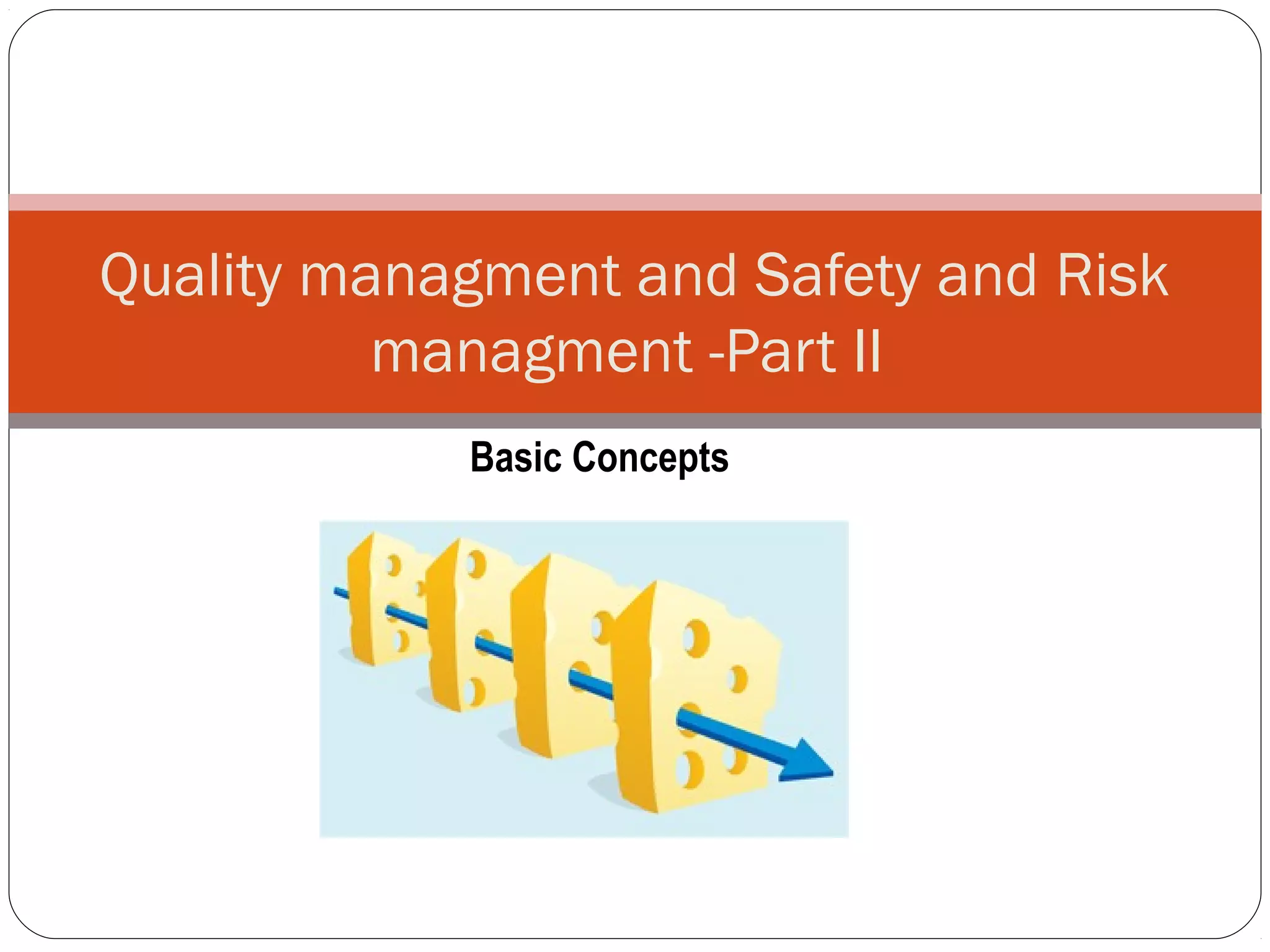
The "Swiss cheese" model illustrates how a particular
hazard penetrates multiple barriers and safeguards in
order to cause harm.
15
Swiss cheese model is a field of system analysis
pioneered by British psychologist James Reason,
 Most accidents result from multiple, smaller
errors in environments with serious underlying
system flaws.
 Errors made by individuals result in disastrous
consequences due to flawed systems—the holes in
the cheese.
This Model helps point the way toward solutions
—encouraging personnel to try to identify the holes
and to both shrink their size and create enough
overlap so that they never line up in the future.
Focus on the root cause not just the sharp end of
the error .
Swiss cheese model is a field of system analysis
pioneered by British psychologist James Reason,
 Most accidents result from multiple, smaller
errors in environments with serious underlying
system flaws.
 Errors made by individuals result in disastrous
consequences due to flawed systems—the holes in
the cheese.
This Model helps point the way toward solutions
—encouraging personnel to try to identify the holes
and to both shrink their size and create enough
overlap so that they never line up in the future.
Focus on the root cause not just the sharp end of
the error .
Human Factors Engineering
In healthcare it is a interdisciplinary field of applying what is
know about the human capabilities and limitations to the
design of products , processes , systems and enviroments
Relation between human skills and technology
Humans factors include how humans interact with the
equipments, enviroments, teams and organization including
both strengths and weaknesses .
Examples of Human factor engineering in healthcare to reduce
errors
 Checklists
CPOE SYSTEM
( Computerized physician
order entry)
Color Coding of Medical
gasses adaptor
Barcode medication
administration system.
Forcing functions : Removal
of concentrated potassium
from general wards
Reactive and Proactive Risk analysis
Root cause analysis
Proactive risk management :Failure mode
effective analySis FMEA
19
Important Definitions and concepts :
Adverse Event : Unintended injury to patient as a
result of medical intervention gnerally with lesser degree
of severity but which may be a precursor for sentinel
event .
SENTINEL EVENT: An unexpected occurence
involving the death or serious physiological injury or the
risk thereoff . The phase risk thereoff includes any process
variation for which reoccurence would carry a significant
chances of a serious adverse outcome .
SENTINEL: ONE THAT KEEPS A GUARD . To
WATCH OVER AS A GUARD and requires intensive
analysis .
NEAR MISS:An error that could have caused the harm
but did not either by chance or because of timely
intervention .
CLINICAL AND NON CLINICAL
INCIDENTS AS PER THE UMC POLICY
Seven steps to patient safety
NHS Guidelines
1.Lead and support the staff
2.Foster a culture of safety
3.Promote reporting
4.Involve patient and public
5.Implement system solutions
to reduce harm
6.Learn and share safe culture
7.Multidisciplinary safety
managment
Summary
26

Safety and risk mgt

  • 1.
    Quality managment andSafety and Risk managment -Part II Basic Concepts
  • 2.
    Definition Of Safetyin Healthcare 2 Institute of Medicine IOM) Patient safety is the freedom from Accidental injury caused by patient care .  FUNDAMENTAL HEALTHCARE SLOGAN / OATH PRIMUM NON NOCERE
  • 3.
    MUPHY"S LAW 3 The conceptof healthcare Safety and proactive Risk management is motivated by the murphy's law :
  • 4.
    4 US HEALTHCARE SYSTEM MedicalErrors lead to 44,000 to 98000 deaths annually( (To Err is human IOM report1999) 7% of patient suffer from medical errors On average very patient admitted to the ICU suffers from adverse event . Nearly 100,00 dealths from HAIS Medical errors account for as much as $ 29 billion annually in lost income , disability and healthcare costs (To Err is human IOM report1999 ) Medical Errors lead to 44,000 to 98000 deaths annually( (To Err is human IOM report1999) 7% of patient suffer from medical errors On average very patient admitted to the ICU suffers from adverse event . Nearly 100,00 dealths from HAIS Medical errors account for as much as $ 29 billion annually in lost income , disability and healthcare costs (To Err is human IOM report1999 )
  • 5.
    MEDICAL ERRORS 5 Medical Errorsare the unintentional , preventable mistakes in the provision of care that have actual or potential impact on the patient . Medical Errors are the unintentional , preventable mistakes in the provision of care that have actual or potential impact on the patient . An act of commision ( doing something wrong) or Omission ( Failing to do the right that leads to undesirable outcome An act of commision ( doing something wrong) or Omission ( Failing to do the right that leads to undesirable outcome
  • 6.
    ERRORS CAN BE ACTIVE: Atthe sharp end at point of contact between humans , machines , patients LATENT: At the blunt end means failure of design, organization or layers of healthcare
  • 7.
    EXAMPLES (e.g., The surgeonholding the scalpel performed the incorrect procedure)/operated wrong site or figuratively by administering any wrong kind of treatment is an example of ??? Computer monitors in the operating room had been placed in such a way that viewing them forced nurses to turn away from the patient, limiting their ability to monitor the surgery and perhaps detect the incorrect procedure before it was completed.???
  • 8.
    BASED ON COGNITIVEPSYCHOLOGY AHRQ (Agency of healthcare research and quality website) 8 Errors at the sharp end can be further classified into slips and mistakes SLIP MISTAKE Slips represent failures of schematic behaviors, or lapses in concentration, and occur in the face of competing sensory or emotional distractions, fatigue, or stress. Mistakes, by contrast, reflect incorrect choices, and more often reflect lack of experience, insufficient training, or outright negligence.
  • 9.
    WHAT CAUSES MEDICALERRORS The institute if healthcare improvement (IHI) research estimates that aproximately 80% of Medical errors are systems driven . The Factors that can cause patient harm are: System failures Human factors Communication breakdown Work Place culture Insufficient procedures Training deficiencies Deficits in understanding the level of service provided
  • 10.
    Dr Lucian Leape, Harvard school of Public Health Incompetent people are 1% of the problem .The other 99% are good people trying to do good job who can make very simple mistakes and it is the processes that set them up to make these mistakes .
  • 11.
    PERSONAL VRS SYSTEM Approach Errorsare a result of human failures Humans are generally perform flawlessly Perfect performance is expected Use retraining and punishment to root out bad apples Focused on individual performance and fear of reprisals keeps key information underground Partial or incomplete solutions that do not resolve the root cause leave the organization vulnerable to reoccurrence of the event . Based on the principle of Murphy's law . Don't Expect Human perfection Design System in a proactive way  Collective preoccupation with the failure Focused on improving the system  Root cause analysis involves all the stakeholders including frontline staff for extensive analysis
  • 12.
    Safety Culture Product ofindividual and group values, attitudes , perceptions , competencies and patterns of behaviour that determine the comimitment , style, proficiency of organization health and safety managment. Safety Culture should have Leaders Vision Strategy for change Error Managment and intervention Minimization of Individual blame or just but accountable culture "Moving from blame shame and train to a blame free enviroment or just culture "
  • 13.
  • 14.
    Swiss Cheese Modelof system analysis The "Swiss cheese" model illustrates how a particular hazard penetrates multiple barriers and safeguards in order to cause harm.
  • 15.
    15 Swiss cheese modelis a field of system analysis pioneered by British psychologist James Reason,  Most accidents result from multiple, smaller errors in environments with serious underlying system flaws.  Errors made by individuals result in disastrous consequences due to flawed systems—the holes in the cheese. This Model helps point the way toward solutions —encouraging personnel to try to identify the holes and to both shrink their size and create enough overlap so that they never line up in the future. Focus on the root cause not just the sharp end of the error . Swiss cheese model is a field of system analysis pioneered by British psychologist James Reason,  Most accidents result from multiple, smaller errors in environments with serious underlying system flaws.  Errors made by individuals result in disastrous consequences due to flawed systems—the holes in the cheese. This Model helps point the way toward solutions —encouraging personnel to try to identify the holes and to both shrink their size and create enough overlap so that they never line up in the future. Focus on the root cause not just the sharp end of the error .
  • 16.
    Human Factors Engineering Inhealthcare it is a interdisciplinary field of applying what is know about the human capabilities and limitations to the design of products , processes , systems and enviroments Relation between human skills and technology Humans factors include how humans interact with the equipments, enviroments, teams and organization including both strengths and weaknesses .
  • 17.
    Examples of Humanfactor engineering in healthcare to reduce errors  Checklists CPOE SYSTEM ( Computerized physician order entry) Color Coding of Medical gasses adaptor Barcode medication administration system. Forcing functions : Removal of concentrated potassium from general wards
  • 18.
    Reactive and ProactiveRisk analysis Root cause analysis Proactive risk management :Failure mode effective analySis FMEA
  • 19.
    19 Important Definitions andconcepts : Adverse Event : Unintended injury to patient as a result of medical intervention gnerally with lesser degree of severity but which may be a precursor for sentinel event . SENTINEL EVENT: An unexpected occurence involving the death or serious physiological injury or the risk thereoff . The phase risk thereoff includes any process variation for which reoccurence would carry a significant chances of a serious adverse outcome . SENTINEL: ONE THAT KEEPS A GUARD . To WATCH OVER AS A GUARD and requires intensive analysis . NEAR MISS:An error that could have caused the harm but did not either by chance or because of timely intervention .
  • 20.
    CLINICAL AND NONCLINICAL INCIDENTS AS PER THE UMC POLICY
  • 25.
    Seven steps topatient safety NHS Guidelines 1.Lead and support the staff 2.Foster a culture of safety 3.Promote reporting 4.Involve patient and public 5.Implement system solutions to reduce harm 6.Learn and share safe culture 7.Multidisciplinary safety managment
  • 26.