LASER INTERACTIONWITH HUMAN TISSUE
When a laser is projected to tissue, five phenomena will occur:
a) Reflection
b) Transmission
c) Scattering
d) Re-emission
e) Absorption
laser transfers energy of photon to the t
Tissue because of absorption occur.
1. Reflection: Laser light bounces off (hits)the tissue surface, reducing its
energy entering the tissue.
2. Transmission: Laser energy passes through the tissue.
3. Scattering: The laser light spreads in multiple directions within the tissue,
reducing precision.
4. Re-emission: Absorbed energy is released by the tissue, often as heat or
light.
5. Absorption: Tissue absorbs the laser energy, this energy is then converted
into heat .
PHOTOCOAGULATION
• A laser heating of tissue above 50 c and below 100 C induces disordering of
proteins and other biomolecules, this process is called photocoagulation
• When lasers are used to photocoagulate tissues during surgery, tissues become
cooked.
• They shrink in mass because water is expelled
• The heat region change color and loses its mechanical integrity
• Cells in this cooked region die and this region is called photocoagulation burn
APPLICATION OF PHOTOCOAGULATION
• Destroy tumors.
• Treating various eye condition like retinal disorder caused by diabetes.
• Ophthalmology
• Dermatology
• Oncology
• Gastroenterology .
HEMOSTATIC LASER SURGERY
• Is a medical procedure that uses laser energy to control bleeding by sealing
(blocking ) blood vessels during or after surgery .
• The laser generates heat that cause b.v to coagulate , seal and reduce blood loss .
• Application
• Ophthalmology treating retinal disorders and reducing intraocular bleeding .
• ENT ( ear , nose and throat )
PHOTOVAPORIZATION
• Is technique that uses laser energy to remove unwanted tissue by converting directly from
solid to Gase .
• The laser light generates high heat that breaks the cellular structure and cause tissue to
disappear , this allow doctors to remove unwanted tissue with out minimal effecting the
healthy surrounding tissue .
• Application
• Benign prostatic hyperplasia
• Removal of warts and e.t.c 4
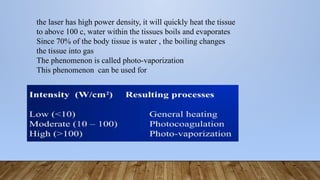
the laser has high power density, it will quickly heat the tissue
to above 100 c, water within the tissues boils and evaporates
Since 70% of the body tissue is water , the boiling changes
the tissue into gas
The phenomenon is called photo-vaporization
This phenomenon can be used for
PHOTOCHEMICAL ABLATION
• Is a medical procedure that uses light energy in combination with photosensitive substances to
treat abnormal conditions .
How it works
 photosensitizing drug is administered to the patient and will accumulate in the abnormal tissue .
 after period time the tissue exposed to light with specific wavelength usually from laser .
 The light activates the photosensitizers causing chemical reaction that destroys target tissue .
some chemical bonds can be broken without causing local heating
This results in clean-cut incision
APPLICATION
 oncology
Cardiovascular medicine
• atherosclerosis removal of plaque from arteries .
 dermatology
• acne treatment
• Psoriasis and vitiligo

Laser interaction with human tissue.pptx

  • 1.
    LASER INTERACTIONWITH HUMANTISSUE When a laser is projected to tissue, five phenomena will occur: a) Reflection b) Transmission c) Scattering d) Re-emission e) Absorption laser transfers energy of photon to the t Tissue because of absorption occur.
  • 2.
    1. Reflection: Laserlight bounces off (hits)the tissue surface, reducing its energy entering the tissue. 2. Transmission: Laser energy passes through the tissue. 3. Scattering: The laser light spreads in multiple directions within the tissue, reducing precision. 4. Re-emission: Absorbed energy is released by the tissue, often as heat or light. 5. Absorption: Tissue absorbs the laser energy, this energy is then converted into heat .
  • 3.
    PHOTOCOAGULATION • A laserheating of tissue above 50 c and below 100 C induces disordering of proteins and other biomolecules, this process is called photocoagulation • When lasers are used to photocoagulate tissues during surgery, tissues become cooked. • They shrink in mass because water is expelled • The heat region change color and loses its mechanical integrity • Cells in this cooked region die and this region is called photocoagulation burn
  • 4.
    APPLICATION OF PHOTOCOAGULATION •Destroy tumors. • Treating various eye condition like retinal disorder caused by diabetes. • Ophthalmology • Dermatology • Oncology • Gastroenterology .
  • 5.
    HEMOSTATIC LASER SURGERY •Is a medical procedure that uses laser energy to control bleeding by sealing (blocking ) blood vessels during or after surgery . • The laser generates heat that cause b.v to coagulate , seal and reduce blood loss . • Application • Ophthalmology treating retinal disorders and reducing intraocular bleeding . • ENT ( ear , nose and throat )
  • 6.
    PHOTOVAPORIZATION • Is techniquethat uses laser energy to remove unwanted tissue by converting directly from solid to Gase . • The laser light generates high heat that breaks the cellular structure and cause tissue to disappear , this allow doctors to remove unwanted tissue with out minimal effecting the healthy surrounding tissue . • Application • Benign prostatic hyperplasia • Removal of warts and e.t.c 4
  • 7.
    the laser hashigh power density, it will quickly heat the tissue to above 100 c, water within the tissues boils and evaporates Since 70% of the body tissue is water , the boiling changes the tissue into gas The phenomenon is called photo-vaporization This phenomenon can be used for
  • 8.
    PHOTOCHEMICAL ABLATION • Isa medical procedure that uses light energy in combination with photosensitive substances to treat abnormal conditions . How it works  photosensitizing drug is administered to the patient and will accumulate in the abnormal tissue .  after period time the tissue exposed to light with specific wavelength usually from laser .  The light activates the photosensitizers causing chemical reaction that destroys target tissue . some chemical bonds can be broken without causing local heating This results in clean-cut incision
  • 9.
    APPLICATION  oncology Cardiovascular medicine •atherosclerosis removal of plaque from arteries .  dermatology • acne treatment • Psoriasis and vitiligo