LASER IN DENTISTRY
• ASHISH RANGHANI
• PG PART 2
• GDCH, AHMEDABAD
UNDER GUIDANCE OF
DR. J.S SHAH
PROFESSOR AND HEAD
ORAL MEDICINE AND
RADIOLOGY
GDCH
DATE- 06/01/2017
CONTENT
• Introduction
• History
• Laser Design
• Laser Tissue Interaction
• Laser Effect on Tissues
• Types of Laser
• Uses of Laser In Dentistry
• Advantages of Lasers
• Disadvantages of Lasers
• Laser Safety
INTRODUCTION1
• Laser is an acronym, which stands
for Light Amplification By
Stimulated Emission Of Radiation
• Laser light is one specific color, a
property called Monochromacity
• Laser light possesses
characteristics: collimation
(constant beam size and shape),
coherency (identical amplitude and
identical frequency)
• The unique property of laser is that
its light waves travel very long
distances with very little
divergence
•Laser photons travel “ in phase ”
LaserPhoton’s
Coherent
Monochromatic
Collimated
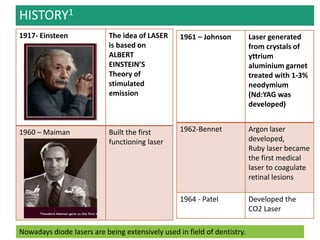
HISTORY1
1917- Einsteen The idea of LASER
is based on
ALBERT
EINSTEIN’S
Theory of
stimulated
emission
1960 – Maiman Built the first
functioning laser
Nowadays diode lasers are being extensively used in field of dentistry.
1961 – Johnson Laser generated
from crystals of
yttrium
aluminium garnet
treated with 1-3%
neodymium
(Nd:YAG was
developed)
1962-Bennet Argon laser
developed,
Ruby laser became
the first medical
laser to coagulate
retinal lesions
1964 - Patel Developed the
CO2 Laser
Laser is an electromagnetic radiation & used for
Metal cutting Communications
Surgery Defense Reading
LASER DESIGN1,4
• The laser consists of
the following
components:
• Housing tube
• Lasing medium
• Power source
• Laser Beam Delivery
Systems
Housing tube or Optical cavity:
• Made up of metal, ceramic or both.
• The structure encapsulates the laser medium and
consists of two mirrors, one fully reflective and the
other partially transmitive, which are located at
either end of the optical cavity.
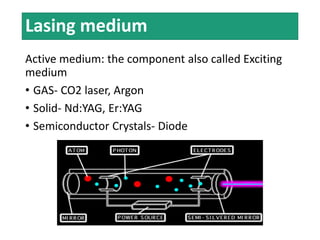
Lasing medium
Active medium: the component also called Exciting
medium
• GAS- CO2 laser, Argon
• Solid- Nd:YAG, Er:YAG
• Semiconductor Crystals- Diode
External power source
• It excites atom in
the laser medium to
their higher energy
levels.
• This causes the
population
inversion.
• Atoms in the excited
state spontaneously
emit photons of
light, which bounce
back and forth
between the two
mirrors in the laser
tube.
• As they bounce within the laser tube, they strike
other atoms, stimulating more spontaneous
emission.
• Photons of energy of the same wavelength and
frequency escape through the transmittive mirror as
the laser beam
Mainly two types:
Laser beam Delivery systems
Hollow tube waveguide
• It is hollow tube lined
with series of well
aligned mirror which
reflect the laser beam
from the unit of the
handpiece- CO2,
Er:YAG
Fibro optic
• Quartz silica fibers
with a handpiece-
Diode, Nd:YAG.
• This come in various
diameters, the
operator can select the
diameter (range from
200 microm to 800
microm) as per the use
USE OF LASER BEAM
Contact mode- The distal
end of the fibro optic is
placed in direct contact of
the target tissue
Noncontact mode- The hand
piece is held away from the
tissue and a guide is provided
to focus the beam at the
desired target tissue
Mode of Laser beam
Continuous mode-
• The laser wave
emits energy in
continuous mode at
average power
• Useful in ablative
procedures or
Coagulation
Pulsed mode-
• It emits the energy
from laser beam in
series of pulses with
burst of peak energy
at each pulse with a
resting time in
between
Spot size
• This is measure of surface area on which laser is
concentrated
• Spot size is directly related to efficiency
• Small laser spot diameters are ideal for incision and
excision.
• Laser with bigger spot size mainly applied in
ablation & hemostatic procedure
LASER-TISSUE INTERACTION1,3
Laser energy can be transmitted or absorbed based on the
composition of the target tissue
ABSORPTION TRANSMISSION
REFLECTION SCATTERING
• Absorption of the laser light by the target tissue is the primary
and beneficial effect of laser energy
• When absorbed, light energy is converted into thermal energy
Absorption
of laser
light
depend
upon:
Water content of the
tissue
Tissue pigmentation
Laser wavelength
Argon has a high affinity for melanin and hemoglobin in
the soft tissue.
Diode and Nd: YAG has a high affinity for melanin and
less interaction with hemoglobin.
The longer wavelengths are more interactive with water
and hydroxyapatite.
Erbium is well absorbed by hydroxyapatite and water
Transmission of light transfers
energy through the tissue without
any interaction and thus does not
cause any effect or injury.
This interaction is also highly
dependent on the wavelength of
laser light.
• Water, for example is relatively transparent to
the Nd: YAG wavelength, whereas tissue fluids
readily absorb erbium family and CO2,so that
there is little energy transmitted to adjacent
tissues.
Nd:YAG laser
would work
better in an
environment
difficult to keep
dry
CO2 laser would
be less effective
because of its
absorption by
the saliva, water
and tissue fluids
REFLECTION
Reflection results
in little or no absorption,
so that there is no thermal
effect on the tissue.
When scattered, light travels in
different directions and energy is
absorbed over a greater surface
area, producing a less intense and
less precise thermal effect
Laser effect on tissues2
The light energy from a laser can have four different
interactions with the target tissue.
•Photo thermal interaction
•Photo chemical interaction.
•Photo mechanical interaction
• Photo electrical interaction
PHOTO THERMAL INTERACTIONS
Photo ablation-, or the removal of tissue by vaporization
and superheating of tissue fluids
Type of thermal reaction depends on the
Spot size
Power density
Optical properties and composition of irradiated tissue
The principle effect of laser energy is photo thermal i.e.
conversion of light energy into heat
Light energy Heat energy
Effects on tissues on certain temperatures
37-50
• Hyperthermia
>60
• Coagulation, protein denaturation
70-90
• Welding of tissues
100-150
• Vaporization
>200
• Carbonization
There are photochemical effects from the
laser light that can stimulate chemical
reactions (e.g. the curing of composite
resin) and breaking of chemical bonds (e.g.
using photosensitized drugs exposed to
laser light to destroy tumor cells, a process
called photodynamic therapy).
PHOTO CHEMICAL INTERACTIONS
•Photo-disruption – shock waves by laser –rupture
the intermolecular and atomic bonds
•Photo-disassociation - which is the breaking apart
of structures
•Photo-acoustic interactions- Removal of the tissue
with Shockwave therapy
PHOTO MECHANICAL INTERACTION
Photo plasmolysis, tissue is removed through the
formation of electrically charged ions
PHOTO ELECTRICAL INTERACTIONS
TYPES OF LASER1
According to the
lasing medium
Gas laser- Argon , CO2 laser
Solid laser- Nd:YAG, Er:YAG
Semiconductor Crystals-
Diode
According to tissue
applicability
Soft tissue laser
Diode, CO2, Argon, and
Nd:YAG
Hard tissue laser
Er:YAG
CARBON DIOXIDE LASER3,4
• The CO2 laser first developed by Patel et al in
1964 is a gas –active medium laser that must be
delivered through a hollow tube-like waveguide
• Because of the water absorption, the CO2 laser
generates a lot of heat, which readily carbonizes
tissues.
• Since this carbonized or charred layer acts as a
biological dressing, it should not be removed.
Type : Molecular gas laser
Active Medium : Mixture of CO2, N2, He or H2O vapour
Active Centre : CO2
Pumping Method : Electric Discharge Method
Optical Resonator : Gold mirror coated with Al
Power Output : 10 kW
Nature of Output : Continuous or pulsed
Wavelength Emitted : 10600 nm
Symmetric 100 C - stationary
O - vibrates
simultaneously
along molecular
axis
Bending 010,
020
C & O vibrate
perpendicular to
molecular axis
Asymmetric
Stretching
001,
002
C & O atoms
vibrate in opposite
directions along
molecular axis
They are highly absorbed in oral mucosa, which
is more than 90% water. High absorption in small
volume, results in a penetration depth as
shallow as 0.2 to 0.3mm.
There is no scattering, reflection, or transmission
in the oral mucosa. Hence, what you see is what
you get
CO2 lasers cannot be delivered fiber optically.
Advances in articulated arms and hollow wave-
guide technologies now provide easy access to
all areas of the mouth
CO2 LASER
• Rapid soft tissue remover
and has a shallow depth of
tissue penetration, which is
important when treating
mucosal lesions.
• Beam can be focused to
create a precised
coagulation of small blood
vessels
• Specially useful for cutting
dense fibrous tissue
• Focused onto the surgical
site in a non-contact fashion
• Loss of tactile sensation is
disadvantageous, but the
tissue ablation can be
precise with careful
technique
Application
of CO2
laser
Mucocele
Fibroma
Epulis
fissuratum
High
frenum
attachment Precancerous
lesions
Aphthous
ulcer
Pregnancy
tumour
Application
of CO2
laser
Tongue tie
Exposure of
partially
erupted
tooth
Lichen
planus
Biopsies –
Incisional/
Excisional
Aesthetic
gingival re-
contouring and
crown
lengthening
Dissection
and
coagulation
• The active medium is ionized
argon gas.
• They are the lasers in the
blue-green visible spectrum
• Two wavelength of 488 nm blue
color and 514nm blue green
• Fibro optic delivery system
• Argon lasers work both in the
contact and non contact mode
• The small diameter flexible
glass fiber is normally used
in contact with the surgical
target tissue
• Absorbed by haemoglobin and
melanin
ARGON LASER1
• Argon lasers have an affinity for darker colored tissues and
also for hemoglobin, making them excellent coagulators.
Thus, an argon laser focused on bleeding vessels stop the
hemorrhage.
• It is not absorbed well by hard tissue and no particular care
is needed to protect the teeth during surgery
• Argon lasers also have the ability to cure composite resins
• The blue wavelength (488nm) is used mainly for composite
curing while the green wavelength (514nm) is mainly used
for soft tissue procedures
 Both the wavelengths can be used as an aid in caries
detection. When the argon laser light illuminates the tooth,
the diseased, carious area appears a dark orange red color
and is easily differentiated from the surrounding healthy
structures
 Acute inflammatory periodontal disease and highly
vascularized lesions such as hemangioma are ideally
suited for treatment by the argon laser.
Nd (Neodymium) – YAG (Yttrium Aluminium Garnet) LASER1
Type : Doped Insulator Laser
Active Medium : Solid active media-Yttrium Aluminium Garnet
Active Centre : Neodymium
Pumping Method : Optical Pumping
Pumping Source : Xenon Flash Pump
Optical Resonator : Ends of rods silver coated
Two mirrors partially and totally reflecting
Power Output : 20 kWatts
Nature of Output : Pulsed
Wavelength Emitted : 1.064 μm
Fiber optic delivery system
CHARACTERISTICS
Nd:YAG laser
• This is mostly used in hair
removal procedures.
• Also used in removing tattoos
and certain pigmented lesions.
• Useful in Intraoral Soft Tissue
Surgery (Ablating, Incising,
Excising, Coagulating)
• Periodontal surgery, sulcular
debridement
• Aphthous Ulcer Treatment
• Root canal sterilization
• Removal of Filling Materials
• Solid active semiconductor
• Lasing media- aluminium gallium
and arsenide
• Wavelength 800-980 nm
• The chief advantage of the diode
laser is one of a smaller size
portable instrument
• Useful in soft tissue surgeries,
ablative procedure & periodontal
treatment
• The power output utilized by the
soft-tissue diode laser is typically
between .1 and 10 watts or joules
per second
DIODE LASER1
• Laser energy is delivered
fiberoptically in continuous-
wave and gated – pulse mode;
used in contact with the tissue.
• Poorly absorbed by tooth
structure so that soft tissue
surgery can be performed safely
in close proximity to enamel,
dentine and cementum
• An excellent soft tissue surgical
laser indicated for cutting and
coagulating gingiva and mucosa
and for soft tissue curettage, or
sulcular debridement.
• Intraoral Soft Tissue Surgery (Ablating, Incising,Excising,
Coagulating)
• Aphthous Ulcer Treatment
• Sulcular Debridement Laser-assisted periodontal
curettage using a diode laser at a setting of 0.6 watts in
continuous wave mode in conjunction with root planing
and scaling procedures were then performed
• Removal of Coronal Pulp
• Tooth Whitening
• Aid in Diagnosis of Dental Caries
• Blood Flow Measurements
Application DIODE laser
Er:YAG laser1
• Yttrium aluminum
garnet doped with
Erbium
• They have a
wavelength of
2.94μm
• Highest absorption
in water
• High affinity for
hydroxyapatite
These lasers are most commonly used for the treatment of
hard tissues, teeth and bones
like Cutting,Shaving, Contouring and Resection of Osseous
Tissue
Apicoectomy
Osteotomy
Crown Lengthening
Caries removal
Soft tissue surgeries
Bone ablation
Tooth preparation
ADVANTAGES OF LASERS1,2,3
Less pain, little bleeding, reduced risk of infection
Minimal damage to surrounding tissues
Haemostatic effect by sealing blood vessels.
Reduction of postoperative inflammation & edema.
Dressing & suturing is not required for wound closer.
Operating time is reduced
Sterilization of wound due to reduction in amount of microorganism exposed
to laser irradiation
Dry surgical field and better visualization
Patient becomes free of fear & anxiety
low recurrence rates
Excellent wound healing
Laser exposure to tooth enamel causes Reduction in caries activity.
Technique is very easy, fast and safe
DISADVANTAGES OF LASERS1,2,3
Laser beam could injure the patient or operator by
direct beam or reflected light, causing retinal burns
Treatment is very expensive
Specially trained person is needed
No tactile sensation with the use of laser
Laser Hazards5
Endangers mainly two organs-
• Eyes and Skin
In case of eyes it damages retina , cornea , & the lens and
slight carelessness can destroy vision permanently.
LASER SAFETY5
Gloves, mask and cap should
be used by surgeons and
assistants.
Clean the area with povidone
iodine 5% solution
Patient's eye should be
protected with the eye shield
Dentist and assistants should
use wavelength-rated
spectacles
Post signs that lasers are
being used
BEFORE PROCEDURE
• Hold the hand piece perpendicular to
the lesion and press the foot pedal to
fire the laser. Vaporize the lesion in
coiled, centrifugal, vertical or
horizontal fashion. Vaporize the flat
lesions from the top
DURING LASER THERAPY
• Pedunculated lesions can be excised
by lasing from the base of the
lesion. Hold the lesion with toothed
forceps on the top, pull it to the side
on the top of the wet gauze (to
prevent charring of the normal skin).
Always use wet gauze as dry gauze
can catch fire.
• Wipe the vaporized lesions with wet
gauze. Always make sure to dry the
area or wipe the water with dry
gauze. Coagulate the bleeding spots
if any by defocusing the laser beam
The treated area does not require any special
postoperative care.
Suturing or dressing is unnecessary in laser surgery.
The wound is kept raw and uncovered, because there is
good hemostasis and minimal or no edema.
Avoid hot and spicy food
POST PROCEDURE CARE
LOW LEVEL
LASER
THERAPY 7
55
03-07-2017
56
Low level laser therapy also known as
soft laser or low intensity level laser
whereas the therapy has been reffered to
as biostimulation & biomodulation
Generally operate in the visible and
infrared spectrum 600-900 nm
wavelength
Suitable therapeutic energies range from
1-10 J per point
03-07-2017
57
58
Increase lymphatic
flow
Leads to reduction
in swelling
Collagen synthesis in
fibroblasts & formation
of capillaries
Important in wound
healing
SECONDARY CLINICAL EFFECTS
59
Reduction of
depolarization C
fibres
Decreases pain
sensation
Stimulation of
osteoblasts and
odontoblasts
Builds bone and
dentin
Decreases histamine,
bradikinins, substance
P, acetylcholine
Decreases
inflammation and pain
60
USING THE APPROPRIATE DOSE
BIO STIMULATION -
For application where
you want to stimulate
(osteoblasts), use lower
doses 4J
BIO INHIBITION - For
applications where you want
to inhibit ( pain management
& reduction of inflammation )
use higher doses 8J
61
INDICATIONS
Herpes
simplex
infection
Musculoskeletal
pathology
Dentinal
hypersensitivity
Wound
healing
MUCOSITIS
Aphthous
ulcer
Herpetic
lesion
• DIODE LASER use
0.6 watt
for 45 sec
0.7 watt
for 45 sec
0.8 watt
for 45 sec
Gingivectomy
procedure
• DIODE LASER used
• 0.8 to 1.2 watt
• Very light depth touch and working
short brush like strock
• Diode fibre place parallel to long axis
of tooth
CLINICAL APPLICATIONS OF LASERS IN DENTISTRY5,6
Pulp vitality
Indirect pulp
capping
Direct pulp
capping
Access
cavity
preparation
and orifice
enlargement
Vital pulp
amputation
Pulpectomy
Root canal
preparation
with lasers
Sterilization
of infected
root canals
Endosurgery
PULP
VITALITY – Laser used - Nd:YAG at 2W, 20
pulses per sec (pps) at
distance of 10mm from the
tooth surface
INDIRECT
PULP
CAPPING
• In cases of deep and
hypersensitive cavities
• A reduction in the permeability of
the dentin- achieved by sealing
the dentinal tubules
• Lasers used
– Nd: YAG – 2W & 20 PPS for
less than one sec with black
ink
– CO2 laser
DIRECT
PULP
CAPPING
laser treatment causes successful
pulp restoration after direct capping
of inflamed pulps with laser
irradiation
• 1 or 2 W laser energy after
alternate irrigation with 5.25%
NaOCl and 3% Hydroen peroxide
• Exposure site closed with Calcium
hydroxide paste
• Nd: YAG, Argon laser, Diode laser,
Er: YAG, CO2 laser
PULPOTOMY
& VITAL
PULP
AMPUTATION
• One of the most anticipated laser
treatment in Endodontics
• Lasers used –
– CO2 laser 1 to 4 W
– Nd:YAG for 2sec,
• Carbanized layer that is formed
on the surface must be removed
with 3%hydrozen peroxide and
5.25% of NaOCl
PULPECTOMY
AND ROOT
CANAL WALL
PREPARATION
• Access cavity preparation
Er:YAG – 8Hz, 2W
• Pulpectomy
• Nd:YAG for 2W at 20 PPs for one sec,
Multiple application with 5 sec
interval
• Cleaning and shaping
– CO2 laser
– Nd:YAG laser
– Argon lasers
– Er:YAG- most effective
• Limitations of lasers in cleaning and
shaping
• The laser energy from the tip is
directed along the root canal and not
necessarily laterally to the root canal
wall.
• Thermal damage to the periapical
tissues
STERILIZATION
OF INFECTED
ROOT CANALS
• Effective tools for killing
micro-organisms by its
bactericidal effect
• Lasers used
• Nd:YAG laser 100mJ for 5
sec, twice
• Diode lasers- 150mJ for 5
sec, twice
• Er:YAG laser- 75mJ for 5
sec, twice
• Argon lasers
• CO2 lasers
OBTURATION
OF ROOT
CANALS
• Obturation with AH –plus and
composite resin activated by
Argon lasers
• Laser initiates photo
polymerization by activation of
composite resin
• Argon laser, CO2 laser, Nd:YAG-
soften the guttapercha – vertical
compaction
• Argon lasers – good apical seal
RETROGRADE
CAVITY
PREPARATION
& ENDODONTIC
SURGERY
Apicosectomy
Er:YAG laser – 200mJ for
root resection
TOOTH
WHITENING
• Nd:YAG & DIODE laser can be use
74
RECONTOURING
OF GINGIVAL
MARGINS FOR
CROWN
LENGHENING
75
WHICH ONE IS BEST???
DIODE LASER CO2 LASER
DIODE LASER
Compact weighing less than 10
Ibs, ease of use & portability
Can be move to the other areas
quickly & easily
Can be used with contact
method the same way that a
metal scalpel is used
Non contact method will not cut
the tissue because the diode
light goes through the skin
surface to treat pain,
inflammation and wound
CO2 laser
Co2 laser weigh over
40 Ibs
Larger and Heavier
Use only a Non
contact method
Using a co2 laser
requires skills to
focus the laser on
specific point
DIODE LASER
Can incise vessels of 1 to
2mm in diameter with
little or no bleeding.
This superior hemostatic
ability reduces the overall
risks of surgery
Diode laser can be used
for endoscopic surgery
Cost: 3.25 lakh/ piece
CO2 laser
CO2 laser tends to be
absorbed by water, This
means that is very difficult
to stop bleeding
It is possible to incise
capillaries without bleeding
but it is difficult to incise
vessels of 1 mm or larger
without bleeding
CO2 laser can not be
used for endoscopic
surgery
1. A Clinical guide on oral laser applications, Anil shah, Naresh thukral,
Mohan vakade
2. Sunil r panat, Gv sowmya,astha durgvanshi,Laser in oral medicine: an
update,Jp-journals-10039-1045
3. Reshma j abraham, arathy s lankupalli, Laser management of intraoral soft
tissue lesions,IOSR journal of dental and medical sciences, Volume 13, PP
59-64( feb 2014)
4. Sanjeev kumar, Sandhya maheshwari, Laser in dentistry: an innovative tool
in modern dental practice,Nati J Maxillofac Suurg.2012 jul-dec
5. Carbon Dioxide Laser Guidelines, DS Krupa Shankar, M Chakravarthi, J
Cutan Aesthet Surg. 2009 Jul-Dec; 2(2): 72–80.
6. Donand j. coluzzi, Portola vally, Fundamentals of laser in dentistry, J laser
Dent 2008,16 (sep issue):4-10
7. Dr resmi, dr Nandakumar, The current status of low level laser in dentistry,
JIDA,2002, vol 73,198-202
REFERENCES

LASER IN DENTISTRY

  • 1.
    LASER IN DENTISTRY •ASHISH RANGHANI • PG PART 2 • GDCH, AHMEDABAD UNDER GUIDANCE OF DR. J.S SHAH PROFESSOR AND HEAD ORAL MEDICINE AND RADIOLOGY GDCH DATE- 06/01/2017
  • 2.
    CONTENT • Introduction • History •Laser Design • Laser Tissue Interaction • Laser Effect on Tissues • Types of Laser • Uses of Laser In Dentistry • Advantages of Lasers • Disadvantages of Lasers • Laser Safety
  • 3.
    INTRODUCTION1 • Laser isan acronym, which stands for Light Amplification By Stimulated Emission Of Radiation • Laser light is one specific color, a property called Monochromacity • Laser light possesses characteristics: collimation (constant beam size and shape), coherency (identical amplitude and identical frequency) • The unique property of laser is that its light waves travel very long distances with very little divergence •Laser photons travel “ in phase ” LaserPhoton’s Coherent Monochromatic Collimated
  • 4.
    HISTORY1 1917- Einsteen Theidea of LASER is based on ALBERT EINSTEIN’S Theory of stimulated emission 1960 – Maiman Built the first functioning laser Nowadays diode lasers are being extensively used in field of dentistry. 1961 – Johnson Laser generated from crystals of yttrium aluminium garnet treated with 1-3% neodymium (Nd:YAG was developed) 1962-Bennet Argon laser developed, Ruby laser became the first medical laser to coagulate retinal lesions 1964 - Patel Developed the CO2 Laser
  • 5.
    Laser is anelectromagnetic radiation & used for Metal cutting Communications Surgery Defense Reading
  • 6.
    LASER DESIGN1,4 • Thelaser consists of the following components: • Housing tube • Lasing medium • Power source • Laser Beam Delivery Systems
  • 7.
    Housing tube orOptical cavity: • Made up of metal, ceramic or both. • The structure encapsulates the laser medium and consists of two mirrors, one fully reflective and the other partially transmitive, which are located at either end of the optical cavity.
  • 8.
    Lasing medium Active medium:the component also called Exciting medium • GAS- CO2 laser, Argon • Solid- Nd:YAG, Er:YAG • Semiconductor Crystals- Diode
  • 9.
    External power source •It excites atom in the laser medium to their higher energy levels. • This causes the population inversion. • Atoms in the excited state spontaneously emit photons of light, which bounce back and forth between the two mirrors in the laser tube.
  • 10.
    • As theybounce within the laser tube, they strike other atoms, stimulating more spontaneous emission. • Photons of energy of the same wavelength and frequency escape through the transmittive mirror as the laser beam
  • 11.
    Mainly two types: Laserbeam Delivery systems Hollow tube waveguide • It is hollow tube lined with series of well aligned mirror which reflect the laser beam from the unit of the handpiece- CO2, Er:YAG Fibro optic • Quartz silica fibers with a handpiece- Diode, Nd:YAG. • This come in various diameters, the operator can select the diameter (range from 200 microm to 800 microm) as per the use
  • 12.
    USE OF LASERBEAM Contact mode- The distal end of the fibro optic is placed in direct contact of the target tissue Noncontact mode- The hand piece is held away from the tissue and a guide is provided to focus the beam at the desired target tissue
  • 13.
    Mode of Laserbeam Continuous mode- • The laser wave emits energy in continuous mode at average power • Useful in ablative procedures or Coagulation Pulsed mode- • It emits the energy from laser beam in series of pulses with burst of peak energy at each pulse with a resting time in between
  • 14.
    Spot size • Thisis measure of surface area on which laser is concentrated • Spot size is directly related to efficiency • Small laser spot diameters are ideal for incision and excision. • Laser with bigger spot size mainly applied in ablation & hemostatic procedure
  • 15.
    LASER-TISSUE INTERACTION1,3 Laser energycan be transmitted or absorbed based on the composition of the target tissue ABSORPTION TRANSMISSION REFLECTION SCATTERING
  • 16.
    • Absorption ofthe laser light by the target tissue is the primary and beneficial effect of laser energy • When absorbed, light energy is converted into thermal energy Absorption of laser light depend upon: Water content of the tissue Tissue pigmentation Laser wavelength
  • 17.
    Argon has ahigh affinity for melanin and hemoglobin in the soft tissue. Diode and Nd: YAG has a high affinity for melanin and less interaction with hemoglobin. The longer wavelengths are more interactive with water and hydroxyapatite. Erbium is well absorbed by hydroxyapatite and water
  • 18.
    Transmission of lighttransfers energy through the tissue without any interaction and thus does not cause any effect or injury. This interaction is also highly dependent on the wavelength of laser light.
  • 19.
    • Water, forexample is relatively transparent to the Nd: YAG wavelength, whereas tissue fluids readily absorb erbium family and CO2,so that there is little energy transmitted to adjacent tissues. Nd:YAG laser would work better in an environment difficult to keep dry CO2 laser would be less effective because of its absorption by the saliva, water and tissue fluids
  • 20.
    REFLECTION Reflection results in littleor no absorption, so that there is no thermal effect on the tissue.
  • 21.
    When scattered, lighttravels in different directions and energy is absorbed over a greater surface area, producing a less intense and less precise thermal effect
  • 22.
    Laser effect ontissues2 The light energy from a laser can have four different interactions with the target tissue. •Photo thermal interaction •Photo chemical interaction. •Photo mechanical interaction • Photo electrical interaction
  • 23.
    PHOTO THERMAL INTERACTIONS Photoablation-, or the removal of tissue by vaporization and superheating of tissue fluids Type of thermal reaction depends on the Spot size Power density Optical properties and composition of irradiated tissue The principle effect of laser energy is photo thermal i.e. conversion of light energy into heat Light energy Heat energy
  • 24.
    Effects on tissueson certain temperatures 37-50 • Hyperthermia >60 • Coagulation, protein denaturation 70-90 • Welding of tissues 100-150 • Vaporization >200 • Carbonization
  • 25.
    There are photochemicaleffects from the laser light that can stimulate chemical reactions (e.g. the curing of composite resin) and breaking of chemical bonds (e.g. using photosensitized drugs exposed to laser light to destroy tumor cells, a process called photodynamic therapy). PHOTO CHEMICAL INTERACTIONS
  • 26.
    •Photo-disruption – shockwaves by laser –rupture the intermolecular and atomic bonds •Photo-disassociation - which is the breaking apart of structures •Photo-acoustic interactions- Removal of the tissue with Shockwave therapy PHOTO MECHANICAL INTERACTION
  • 27.
    Photo plasmolysis, tissueis removed through the formation of electrically charged ions PHOTO ELECTRICAL INTERACTIONS
  • 28.
    TYPES OF LASER1 Accordingto the lasing medium Gas laser- Argon , CO2 laser Solid laser- Nd:YAG, Er:YAG Semiconductor Crystals- Diode According to tissue applicability Soft tissue laser Diode, CO2, Argon, and Nd:YAG Hard tissue laser Er:YAG
  • 29.
    CARBON DIOXIDE LASER3,4 •The CO2 laser first developed by Patel et al in 1964 is a gas –active medium laser that must be delivered through a hollow tube-like waveguide • Because of the water absorption, the CO2 laser generates a lot of heat, which readily carbonizes tissues. • Since this carbonized or charred layer acts as a biological dressing, it should not be removed.
  • 30.
    Type : Moleculargas laser Active Medium : Mixture of CO2, N2, He or H2O vapour Active Centre : CO2 Pumping Method : Electric Discharge Method Optical Resonator : Gold mirror coated with Al Power Output : 10 kW Nature of Output : Continuous or pulsed Wavelength Emitted : 10600 nm
  • 32.
    Symmetric 100 C- stationary O - vibrates simultaneously along molecular axis Bending 010, 020 C & O vibrate perpendicular to molecular axis Asymmetric Stretching 001, 002 C & O atoms vibrate in opposite directions along molecular axis
  • 33.
    They are highlyabsorbed in oral mucosa, which is more than 90% water. High absorption in small volume, results in a penetration depth as shallow as 0.2 to 0.3mm. There is no scattering, reflection, or transmission in the oral mucosa. Hence, what you see is what you get CO2 lasers cannot be delivered fiber optically. Advances in articulated arms and hollow wave- guide technologies now provide easy access to all areas of the mouth CO2 LASER
  • 34.
    • Rapid softtissue remover and has a shallow depth of tissue penetration, which is important when treating mucosal lesions. • Beam can be focused to create a precised coagulation of small blood vessels • Specially useful for cutting dense fibrous tissue • Focused onto the surgical site in a non-contact fashion • Loss of tactile sensation is disadvantageous, but the tissue ablation can be precise with careful technique
  • 35.
  • 36.
    Application of CO2 laser Tongue tie Exposureof partially erupted tooth Lichen planus Biopsies – Incisional/ Excisional Aesthetic gingival re- contouring and crown lengthening Dissection and coagulation
  • 37.
    • The activemedium is ionized argon gas. • They are the lasers in the blue-green visible spectrum • Two wavelength of 488 nm blue color and 514nm blue green • Fibro optic delivery system • Argon lasers work both in the contact and non contact mode • The small diameter flexible glass fiber is normally used in contact with the surgical target tissue • Absorbed by haemoglobin and melanin ARGON LASER1
  • 38.
    • Argon lasershave an affinity for darker colored tissues and also for hemoglobin, making them excellent coagulators. Thus, an argon laser focused on bleeding vessels stop the hemorrhage. • It is not absorbed well by hard tissue and no particular care is needed to protect the teeth during surgery • Argon lasers also have the ability to cure composite resins • The blue wavelength (488nm) is used mainly for composite curing while the green wavelength (514nm) is mainly used for soft tissue procedures
  • 39.
     Both thewavelengths can be used as an aid in caries detection. When the argon laser light illuminates the tooth, the diseased, carious area appears a dark orange red color and is easily differentiated from the surrounding healthy structures  Acute inflammatory periodontal disease and highly vascularized lesions such as hemangioma are ideally suited for treatment by the argon laser.
  • 40.
    Nd (Neodymium) –YAG (Yttrium Aluminium Garnet) LASER1 Type : Doped Insulator Laser Active Medium : Solid active media-Yttrium Aluminium Garnet Active Centre : Neodymium Pumping Method : Optical Pumping Pumping Source : Xenon Flash Pump Optical Resonator : Ends of rods silver coated Two mirrors partially and totally reflecting Power Output : 20 kWatts Nature of Output : Pulsed Wavelength Emitted : 1.064 μm Fiber optic delivery system CHARACTERISTICS
  • 41.
    Nd:YAG laser • Thisis mostly used in hair removal procedures. • Also used in removing tattoos and certain pigmented lesions. • Useful in Intraoral Soft Tissue Surgery (Ablating, Incising, Excising, Coagulating) • Periodontal surgery, sulcular debridement • Aphthous Ulcer Treatment • Root canal sterilization • Removal of Filling Materials
  • 42.
    • Solid activesemiconductor • Lasing media- aluminium gallium and arsenide • Wavelength 800-980 nm • The chief advantage of the diode laser is one of a smaller size portable instrument • Useful in soft tissue surgeries, ablative procedure & periodontal treatment • The power output utilized by the soft-tissue diode laser is typically between .1 and 10 watts or joules per second DIODE LASER1
  • 43.
    • Laser energyis delivered fiberoptically in continuous- wave and gated – pulse mode; used in contact with the tissue. • Poorly absorbed by tooth structure so that soft tissue surgery can be performed safely in close proximity to enamel, dentine and cementum • An excellent soft tissue surgical laser indicated for cutting and coagulating gingiva and mucosa and for soft tissue curettage, or sulcular debridement.
  • 44.
    • Intraoral SoftTissue Surgery (Ablating, Incising,Excising, Coagulating) • Aphthous Ulcer Treatment • Sulcular Debridement Laser-assisted periodontal curettage using a diode laser at a setting of 0.6 watts in continuous wave mode in conjunction with root planing and scaling procedures were then performed • Removal of Coronal Pulp • Tooth Whitening • Aid in Diagnosis of Dental Caries • Blood Flow Measurements Application DIODE laser
  • 45.
    Er:YAG laser1 • Yttriumaluminum garnet doped with Erbium • They have a wavelength of 2.94μm • Highest absorption in water • High affinity for hydroxyapatite
  • 46.
    These lasers aremost commonly used for the treatment of hard tissues, teeth and bones like Cutting,Shaving, Contouring and Resection of Osseous Tissue Apicoectomy Osteotomy Crown Lengthening Caries removal Soft tissue surgeries Bone ablation Tooth preparation
  • 47.
    ADVANTAGES OF LASERS1,2,3 Lesspain, little bleeding, reduced risk of infection Minimal damage to surrounding tissues Haemostatic effect by sealing blood vessels. Reduction of postoperative inflammation & edema. Dressing & suturing is not required for wound closer. Operating time is reduced
  • 48.
    Sterilization of wounddue to reduction in amount of microorganism exposed to laser irradiation Dry surgical field and better visualization Patient becomes free of fear & anxiety low recurrence rates Excellent wound healing Laser exposure to tooth enamel causes Reduction in caries activity. Technique is very easy, fast and safe
  • 49.
    DISADVANTAGES OF LASERS1,2,3 Laserbeam could injure the patient or operator by direct beam or reflected light, causing retinal burns Treatment is very expensive Specially trained person is needed No tactile sensation with the use of laser
  • 50.
    Laser Hazards5 Endangers mainlytwo organs- • Eyes and Skin In case of eyes it damages retina , cornea , & the lens and slight carelessness can destroy vision permanently.
  • 51.
    LASER SAFETY5 Gloves, maskand cap should be used by surgeons and assistants. Clean the area with povidone iodine 5% solution Patient's eye should be protected with the eye shield Dentist and assistants should use wavelength-rated spectacles Post signs that lasers are being used BEFORE PROCEDURE
  • 52.
    • Hold thehand piece perpendicular to the lesion and press the foot pedal to fire the laser. Vaporize the lesion in coiled, centrifugal, vertical or horizontal fashion. Vaporize the flat lesions from the top DURING LASER THERAPY
  • 53.
    • Pedunculated lesionscan be excised by lasing from the base of the lesion. Hold the lesion with toothed forceps on the top, pull it to the side on the top of the wet gauze (to prevent charring of the normal skin). Always use wet gauze as dry gauze can catch fire. • Wipe the vaporized lesions with wet gauze. Always make sure to dry the area or wipe the water with dry gauze. Coagulate the bleeding spots if any by defocusing the laser beam
  • 54.
    The treated areadoes not require any special postoperative care. Suturing or dressing is unnecessary in laser surgery. The wound is kept raw and uncovered, because there is good hemostasis and minimal or no edema. Avoid hot and spicy food POST PROCEDURE CARE
  • 55.
  • 56.
    03-07-2017 56 Low level lasertherapy also known as soft laser or low intensity level laser whereas the therapy has been reffered to as biostimulation & biomodulation Generally operate in the visible and infrared spectrum 600-900 nm wavelength Suitable therapeutic energies range from 1-10 J per point
  • 57.
  • 58.
    58 Increase lymphatic flow Leads toreduction in swelling Collagen synthesis in fibroblasts & formation of capillaries Important in wound healing SECONDARY CLINICAL EFFECTS
  • 59.
    59 Reduction of depolarization C fibres Decreasespain sensation Stimulation of osteoblasts and odontoblasts Builds bone and dentin Decreases histamine, bradikinins, substance P, acetylcholine Decreases inflammation and pain
  • 60.
    60 USING THE APPROPRIATEDOSE BIO STIMULATION - For application where you want to stimulate (osteoblasts), use lower doses 4J BIO INHIBITION - For applications where you want to inhibit ( pain management & reduction of inflammation ) use higher doses 8J
  • 61.
  • 62.
    Herpetic lesion • DIODE LASERuse 0.6 watt for 45 sec 0.7 watt for 45 sec 0.8 watt for 45 sec
  • 63.
    Gingivectomy procedure • DIODE LASERused • 0.8 to 1.2 watt • Very light depth touch and working short brush like strock • Diode fibre place parallel to long axis of tooth
  • 64.
    CLINICAL APPLICATIONS OFLASERS IN DENTISTRY5,6 Pulp vitality Indirect pulp capping Direct pulp capping Access cavity preparation and orifice enlargement
  • 65.
    Vital pulp amputation Pulpectomy Root canal preparation withlasers Sterilization of infected root canals Endosurgery
  • 66.
    PULP VITALITY – Laserused - Nd:YAG at 2W, 20 pulses per sec (pps) at distance of 10mm from the tooth surface
  • 67.
    INDIRECT PULP CAPPING • In casesof deep and hypersensitive cavities • A reduction in the permeability of the dentin- achieved by sealing the dentinal tubules • Lasers used – Nd: YAG – 2W & 20 PPS for less than one sec with black ink – CO2 laser
  • 68.
    DIRECT PULP CAPPING laser treatment causessuccessful pulp restoration after direct capping of inflamed pulps with laser irradiation • 1 or 2 W laser energy after alternate irrigation with 5.25% NaOCl and 3% Hydroen peroxide • Exposure site closed with Calcium hydroxide paste • Nd: YAG, Argon laser, Diode laser, Er: YAG, CO2 laser
  • 69.
    PULPOTOMY & VITAL PULP AMPUTATION • Oneof the most anticipated laser treatment in Endodontics • Lasers used – – CO2 laser 1 to 4 W – Nd:YAG for 2sec, • Carbanized layer that is formed on the surface must be removed with 3%hydrozen peroxide and 5.25% of NaOCl
  • 70.
    PULPECTOMY AND ROOT CANAL WALL PREPARATION •Access cavity preparation Er:YAG – 8Hz, 2W • Pulpectomy • Nd:YAG for 2W at 20 PPs for one sec, Multiple application with 5 sec interval • Cleaning and shaping – CO2 laser – Nd:YAG laser – Argon lasers – Er:YAG- most effective • Limitations of lasers in cleaning and shaping • The laser energy from the tip is directed along the root canal and not necessarily laterally to the root canal wall. • Thermal damage to the periapical tissues
  • 71.
    STERILIZATION OF INFECTED ROOT CANALS •Effective tools for killing micro-organisms by its bactericidal effect • Lasers used • Nd:YAG laser 100mJ for 5 sec, twice • Diode lasers- 150mJ for 5 sec, twice • Er:YAG laser- 75mJ for 5 sec, twice • Argon lasers • CO2 lasers
  • 72.
    OBTURATION OF ROOT CANALS • Obturationwith AH –plus and composite resin activated by Argon lasers • Laser initiates photo polymerization by activation of composite resin • Argon laser, CO2 laser, Nd:YAG- soften the guttapercha – vertical compaction • Argon lasers – good apical seal
  • 73.
  • 74.
    TOOTH WHITENING • Nd:YAG &DIODE laser can be use 74
  • 75.
  • 76.
    WHICH ONE ISBEST??? DIODE LASER CO2 LASER
  • 77.
    DIODE LASER Compact weighingless than 10 Ibs, ease of use & portability Can be move to the other areas quickly & easily Can be used with contact method the same way that a metal scalpel is used Non contact method will not cut the tissue because the diode light goes through the skin surface to treat pain, inflammation and wound CO2 laser Co2 laser weigh over 40 Ibs Larger and Heavier Use only a Non contact method Using a co2 laser requires skills to focus the laser on specific point
  • 78.
    DIODE LASER Can incisevessels of 1 to 2mm in diameter with little or no bleeding. This superior hemostatic ability reduces the overall risks of surgery Diode laser can be used for endoscopic surgery Cost: 3.25 lakh/ piece CO2 laser CO2 laser tends to be absorbed by water, This means that is very difficult to stop bleeding It is possible to incise capillaries without bleeding but it is difficult to incise vessels of 1 mm or larger without bleeding CO2 laser can not be used for endoscopic surgery
  • 79.
    1. A Clinicalguide on oral laser applications, Anil shah, Naresh thukral, Mohan vakade 2. Sunil r panat, Gv sowmya,astha durgvanshi,Laser in oral medicine: an update,Jp-journals-10039-1045 3. Reshma j abraham, arathy s lankupalli, Laser management of intraoral soft tissue lesions,IOSR journal of dental and medical sciences, Volume 13, PP 59-64( feb 2014) 4. Sanjeev kumar, Sandhya maheshwari, Laser in dentistry: an innovative tool in modern dental practice,Nati J Maxillofac Suurg.2012 jul-dec 5. Carbon Dioxide Laser Guidelines, DS Krupa Shankar, M Chakravarthi, J Cutan Aesthet Surg. 2009 Jul-Dec; 2(2): 72–80. 6. Donand j. coluzzi, Portola vally, Fundamentals of laser in dentistry, J laser Dent 2008,16 (sep issue):4-10 7. Dr resmi, dr Nandakumar, The current status of low level laser in dentistry, JIDA,2002, vol 73,198-202 REFERENCES