Mediation Training
Programme
By Adv. (Dr.) Santosh A. Shah
Advocate, Lecturer in Law &
Mediator, Kolhapur
Session 1
Introduction
ADR Mechanism and other modes
of settlement.
A) Scope and contents of S. 89 of C.P.C &
Mediation Rules, 2006
B) Difference between Mediation and other
ADR mechanism
 People are abandoning the justice
system
 Criminal has more rights than the
victim, Defendants can defeat
legitimate claims of the Plaintiff
 Business transactions are
frustrated due to costs and delays
 Should we accept the status quo or
Try to make a change ?
 There once was a smoker so
disturbed by reading stories about
the harmful effect of smoking that
he decided to do something about
the problem- He stopped reading !
 Adversarial Legal System, too much
emphasis on litigation.
 21st Century India needs effective and
multi door Dispute Resolution System.
 Voltaire : I was ruined twice in my life,
once when I lost the law suit and once
when I won a law suit !
 India for 1 lakh people – 1 Judge ,
In the U.S for 1 lakh people – 10 Judges.
 A dispute is a problem to be solved,
together, rather than a combat to be won.
 Litigant not a mere recipient of the Court
verdicts but consumer of justice delivery
system: C.J Mohit Shah, Bombay High
Court.
 Different litigants want different methods
of dispute resolution
 - Prof. Frank Sander of Harvard Law
School- “Please re-imagine the Civil
Courts as a collection of dispute
Resolution Procedures tailored to fit the
variety of disputes .”
 Awareness Building of ADR a must.
 ADR Values
 Much Compromise
 Help from the
mediator in
communication, in
mood and tone, in
reality checks, etc.
 Adjudication Values
 Very Little
Compromise
 Adjudicator decides
rules.
 ADR Values
 Party-to-party
communications.
 Party Control,
nothing happens
without party
consent.
 Adjudication Values
 Lawyer to tribunal
communication.
 All control given
away to a stranger; a
stranger rules.
 ADR Values
 Inquiry into and
preservation of
relationships.
 Broadened relevance
to include focus on
interests, values, goals,
aspirations, as well as
relationships
 Adjudication Values
 Inquiry to
relationships is
irrelevant.
 Narrow relevance,
essentially limited to
issues defined by the
pleadings.
 ADR Values
 Focus on future and
future relationships
 Cultural factors are
important.
 Adjudication Values
 Focus backward, on
application of the rule
of law only to past
acts.
 Cultural factors tend
to receive de minimis
attention. The law
written in another
factual context is
applied.
 ADR Values
 Value
misunderstandings
are massaged out.
 Process Flexibility
 Adjudication Values
 Stranger determines
value.
 "One size" of rules
tends to be force-fit
upon all disputes.
 ADR Values
 The law is determined,
applied or disregarded
by the parties.
 The facts are
determined
compromised or
disregarded by the
parties. .
 Adjudication Values
 The law is determined
and applied by the
stranger.
 The facts are found on
sometimes irresponsible
evidence, by
stranger(s).
 MEANING OF MEDIATION
 Mediation is the process by which the
participants together with the assistance of
a neutral person or persons, systematically
isolate disputed issues in order to develop
options, consider alternatives and aim to
reach a consensual agreement that will
accommodate their needs.
 It is not an adjudicative process, where a
neutral third party decides the outcome of
the case.
‘Mediation’ means the process by which a
mediator appointed by parties or by the
Court, as the case may be, mediates the
dispute between the parties to the suit by the
application of the provisions of the
Mediation Rules in Part II, and in
particular, by facilitating discussion between
parties directly or by communicating with
each other through the mediator, by
assisting parties in identifying issues,
reducing misunderstandings, clarifying
priorities, exploring areas of compromise,
generating options in an attempt to solve the
dispute and emphasizing that it is the
parties’ own responsibility for making
decisions which affect them.
MEANING OF CONCILIATION
 Conciliation is a consensus based dispute
resolution process in which the parties to a
dispute meet with a conciliator to discuss
mutually acceptable options for resolution of
the dispute. The conciliator has some input
into the resolution of the dispute reached by
the parties in the sense that the conciliator
encourages the parties to consider options
for settlement, which are fair in all the
circumstances, including the precedents for
resolution of similar complaints within the
formal justice system.
‘Conciliation’ means the process by which a
conciliator who is appointed by parties or by
the Court, as the case may be, conciliates the
disputes between the parties to the suit by the
application of the provisions of the
Arbitration and Conciliation Act, 1996 (26 of
1996) in so far as they relate to conciliation,
and in particular, in exercise of his powers
under sections 67 and 73 of that Act, by
making proposals for a settlement of the
dispute and by formulating or reformulating
the terms of a possible settlement; and has a
greater role than a mediator.
Various ADR Mechanisms
Afcons Infrastructure Ltd & Anr.Vs.
Cherian Varkey Construction Co (P)
Ltd.& Ors.
Supreme Court
Judgment given on 26 July 2010 by R.V. Raveendran J. & J.M. Panchal J.
 Arbitration: In the event of referral by the court to
Arbitration due to arbitration agreement between
the parties, the case will go outside the stream of
court permanently and will not come back to the
court.
 Conciliation : As contrasted from arbitration, when
a matter is refereed to conciliation, the matter does
not go out of the stream of court permanently. If
there is no settlement, the matter is returned to the
court for framing of issues and proceeding with the
trial.
 Mediation : If the suit is complicated or lengthy,
mediation will be recognized choice.
 Lok Adalat: If the suit is not complicated and
disputes are easily sortable or and be settled by
applying clear legal principles Lok Adalat will be
preferred choice.
 Judicial Settlement : If the court feels that
suggestion and guidance by a judge will be
appropriate, it can refer it to another judge for
dispute resolution.
Client’s Expectations :
Reliefs
Speed
Solution
Fair Hearing
Peace of Mind
Tell their story in detail
Cost
Discovery
Participation
Execution
What A D R offers to Advocates
 Stable Fees
 Client’s Satisfaction
 Speedy Solutions
 Avoid Adjudicatory Processes
 Options open on failure
 Less Hassle
 Restoration of client’s faith in system
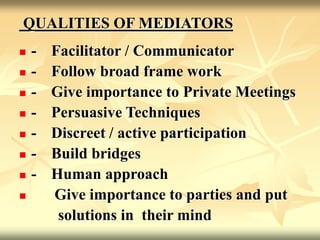
QUALITIES OF MEDIATORS
 - Facilitator / Communicator
 - Follow broad frame work
 - Give importance to Private Meetings
 - Persuasive Techniques
 - Discreet / active participation
 - Build bridges
 - Human approach
 Give importance to parties and put
solutions in their mind
Parties problem are minor,
pleadings make a wide gap
Take help of Advocates
Impartial and independent
Make required Amendments
Liberty to mould procedures
Congratulate parties and Advocates -
whatever is the result
Tips for a Mediator
Courtsey / respect
Confidentiality
Impartiality
Empathy ; Compassion
Integrity ; trustworthiness
Speed
Without Excessive Cost
Active Listening
Questioning
Reframing
Option Generation
Breaking Impasses
Reality Testing
Non an Advocate of the Party
Patience and Perseverance
Interpersonal skills
Good Human Being
 Following words are commonly
used in Mediation
 BATANA : Best Alternative To A
Negotiated Agreement
 WATNA : Worst Alternative To A
Negotiated Agreement
 MLATNA : Most I likely Alternative
To A Negotiated Agreement.
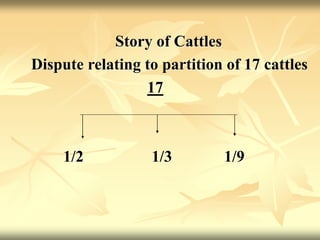
Story of Cattles
Dispute relating to partition of 17 cattles
17
1/2 1/3 1/9
Mediator to add one cattle
17 +1
1/2 1/3 1/9
9 6 2
Two children fighting for a larger
piece of a cake.
Both demand, they be allowed to
cut and have the cake first.
Mediator – One cuts and the
other gets the choice for picking
up the piece first.
 Two brothers fighting over an
orange
 Ad-judication – cut into 2 and give
each ½ share
 – Mediation -One Brother may
want the orange, the other may
want the cover.
 Fight between a Husband and Wife
(universal )
 They start sleeping separately –
child one night sleeps with Father other
night sleeps with mother-
First night tells the father,
“ Daddy, Mom yesterday told me that she
too goes wrong and feels bad about it”, -
Next night he tells the mother, “Mom,
Daddy tells me that he too is wrong and
feels bad about it”. – Third night the
husband & wife came together.
 SALEM ADVOCATES BAR ASSOCIATION V/S.
UNION OF INDIA ( II)
 2005(5) All MR. (SC) 876
 1. There should be a panel of well
trained conciliators / mediators to
which it may be possible for the Court
to make a reference
 2. Respective High Courts to take
appropriate steps for making rules.
 3. Draft rules accepted by the
Supreme Court.
RULES SUGGESTED BY LAW
COMMISSION
Framed by Bombay High Court.
Civil Procedure Alternative Dispute
Resolution And Mediation Rules, 2006.
PART II
CIVIL PROCEDURE MEDIATION RULES
Rule 2 : Appointment of Mediator
A] Parties to a suit may all agree on the
name of the sole mediator for mediating
between them.
B] Where, there are two sets of parties
and are unable to agree on a sole
mediator, each set of parties shall
nominate a mediator.
C] parties agree on a sole mediator
under clause (a) or where parties
nominate more than one mediator
under clause (b), the mediator need
not necessarily be from the panel of
mediators referred to in Rule 4 but
should not be a person who suffers
from the disqualifications referred to
in Rule 5.
D] Where there are more than two sets
of parties having diverse interests,
each set shall nominate a person on
its behalf and the said nominees shall
select the sole mediator and failing
unanimity in that behalf, the Court
shall appoint sole mediator.
 Rule 3 : Panel of medaitors
The High Court, the Courts of the
Principal District and sessions Judge in
each District or the Courts of the
Principal Judge of the City Civil Court
or Courts of equal status and Family
Courts shall, prepare a panel of
mediators after obtaining the approval
of the High Court.
 Rule 4 : Qualifications of persons to be
empanelled under Rule 3
The following shall be treated as qualified
and eligible for being enlisted in the panel of
mediators under Rule 3, namely :-
(a) (i) Retired Judges of the Supreme Court of
India ;
(ii) Retired Judges of the High Court;
(iii) Retired District and Sessions Judges or
retired Judges of the City Civil Court or
Courts of equivalent status
 (b) Legal practitioners with at least
15 years standing at the Bar at the
level of the Supreme Court or High
Court; or the District Courts or
Courts of equivalent status.
 ( c) Experts or other professionals
with at least 15 years standing or
retired senior bureaucrats or retired
senior executives .
 (d) Institutions which are themselves
experts in mediation and have been
recognized as such by the High
Court, provided the names of its
members are approved by the High
Court initially or whenever there is
change in membership.
 Rule 5: Disqualifications of Persons:
 The following persons shall be
deemed to be disqualified for being
empanelled as mediators:
 (i) Any person who has been
adjudged as insolvent or is declared
of unsound mind.
 (ii) Or any person against whom
criminal charges involving moral
turpitude are framed by a criminal
court and are pending, or
 (iii) Persons who have been
convicted by a criminal court for any
offence involving moral turpitude;
(iv) Any person against whom
disciplinary proceedings have
been initiated by the appropriate
disciplinary authority which are
pending or have resulted in a
punishment.
(v) Any person who is
interested or connected with the
subject-matter of dispute or is
related to any one of the parties
or to those who represent them,
unless such objection is waived
by all the parties in writing.
(vi) Any legal practitioner who
has or is appearing for any of the
parties in the suit or in any other
suit or proceedings.
(vii) Such other categories of
persons as may be notified by the
High Court.
 Rule 11: Procedure of mediation
(a) The parties may agree on the
procedure to be followed by the
mediator in the conduct of the
mediation proceedings.
(b) Where the parties do not agree on any
particular procedure to be followed by
the mediator , the mediator shall
follow the procedure hereinafter
mentioned, namely:
 (i) he shall fix, in consultation with
parties, a time schedule the dates and the
time of each mediation session, where all
parties have to be present ;
 (ii) he shall hold the mediation conference
in accordance with the provisions of Rule
6;
 (iii) he may conduct joint or separate
meetings with the parties;
 (iv) each party shall , ten days before a
sessions, provide to the mediator a
brief memorandum setting forth the
issues, which according to it, need to be
resolved, and its position in respect to
these issues and all information
reasonably required for the mediator to
understand the issue; such memoranda
shall also be mutually exchanged
between the parties;
 (v) each party shall furnish to the mediator, copies
of pleadings or documents or such information as
may be required by him in connection with the
issues to be resolved. Provided that where the
mediator is of the opinion that he should look into
any original document , the Court may permit
him to look into the original document before
such officer of the Court and on such date or time
as the Court may fix.
 (vi) each party shall furnish to the mediator such
other information as may be required by him in
connection with the issues to be resolved.
 Rule 12: Mediator not bound by
Evidence Act, 1872 or Code of Civil
Procedure, 1908:
 The mediator shall not be bound by the
Code of Civil Procedure, 1908 or the
Evidence Act, 1872, but shall be guided
by principles of fairness and justice, have
regard to the rights and obligations of the
parties, usages of trade, if any, and the
circumstances of the dispute.
 Rule 16: Role of Mediator:
 The mediator shall attempt to facilitate
voluntary resolution of the dispute by the
parties, and communicate the view of each
party to the other, assist them in identifying
issues, reducing misunderstandings,
clarifying priorities, exploring areas of
compromise and generating options in an
attempt to solve the dispute, emphasizing
that it is the responsibility of the parties to
take decision which effect them; he shall not
impose any terms of settlement on the
parties.
 Rule 17: Parties alone responsible for
taking decision:
 The parties must understand that the
mediator only facilitates in arriving
at a decision to resolve disputes and
that he will not and cannot impose
any settlement nor does the mediator
give any warranty that the mediation
will result in a settlement. The
mediator shall not impose any
decision on the parties.
 Rule 18:
Time limit for completion of
mediation :
Sixty days extendable by thirty
days
 Rule 26 : Fee of mediator and costs :
 (1) At the time of referring the
disputes to mediation, the Court
shall, after consulting the mediator
and the parties, fix the fee of the
mediator.
 (2) As far as possible a consolidated
sum may be fixed rather than for
each session or meeting.
 (3) Where there are two mediators
as in clause (b) of Rule 2, the Court
shall fix the fee payable to the
mediators which shall be shared
equally by the two sets of parties.
 (4) The expense of the mediation
including the fee of the mediator, costs
of administrative assistance, and other
ancillary expenses concerned, shall be
borne equally by the various contesting
parties or as may be otherwise directed
by the Court.
 (5) Each party shall bear the costs for
production of witnesses on his side
including experts, or for production of
documents.
 (6) The mediator may, before the
commencement of mediation, direct the
parties to deposit equal sums, tentatively,
to the extent of 40 % of the probable costs
of the mediation, as referred to in clauses
(1), (3) and (4). The remaining 60% shall
be deposited with the mediator, after the
conclusion of mediation. For the amount
of cost paid to the mediator, he shall issue
the necessary receipt and a statement of
account shall be filed, by the mediator in
the Court.
 (7) The expense of mediation
including fees, if not paid by the
parties, the Court shall on the
application of the mediator or
parties, direct the concerned parties
to pay, and if they do not pay, the
Mediator or the parties, as the case
may be, shall recover the said
amount as if there was a decree.
 (8) Where a party is entitled to
legal aid under section 12 of the
Legal Services Authority Act,
1987, the amount of fee payable
to the mediator and costs shall be
paid by the concerned Legal
Services Authority under that
Act.
 Rule 27: Ethics to be followed by
Mediator:
 The mediator shall:
 (1) Follow and observe these Rules
strictly and with due diligence;
 (2) Not carry on any activity or conduct
which could reasonably be considered as
conduct unbecoming of a mediator;
 (3) Up hold the integrity and fairness of
the mediation process;
(4) Ensure that the parties
involved in the mediation and
fairly informed and have an
adequate understanding of the
procedural aspects of the process;
(5) Satisfy himself/herself that
he/she is qualified to undertake
and complete the assignment in a
professional manner;
(6) Disclose any interest or
relationship likely to affect
impartiality or which might seek
an appearance of partiality or
bias;
(7) Avoid, while communicating
with the parties, any impropriety
or appearance of impropriety;
 (8) be faithful to the relationship
of trust and confidentiality
imposed in the office of mediator
;
 (9) conduct all proceedings
related to the resolutions of a
dispute, in accordance with the
applicable law;
 (10) recognize that mediation is based on
principles of self-determination by the
parties and that mediation process relied
upon the ability of parties to reach a
voluntary, undisclosed agreement.;
 (11) maintain the reasonable
expectations of the parties as to
confidentiality ;
 (12) refrain from promises or
guarantees of results.
C) Role and responsibility of
Judicial Officers u/s. 89 of CPC
Afcons Infrastructure Ltd & Anr.
Vs.
Cherian Varkey Construction Co (P)
Ltd.& Ors.
Supreme Court
Judgment given on 26 July 2010 by R.V.
Raveendran J. & J.M. Panchal J.
 U/s 89 of C.P.C, the court is only
required to formulate a “short
summary of disputes” and not “terms
of settlement”.
 The civil court should invariably
refer cases to ADR process except in
certain recognized excluded
categories by giving reasons.
 The proper stage to refer the parties
to ADR mechanism is when the
matter is taken for preliminary
examination of the parties [ stage of
Admission and Denial ] u/o 10 of the
Code.
 The definition of judicial settlement and
mediation in clauses (c ) and (d) of section
89(2) shall have to be interchanged to
correct the draftsman’ error
 (c ) for mediation, the court shall refer the
same to a suitable institution or person and
such institution or person shall be deemed
to be a Lok Adalat and all the provisions of
the Legal Services Authority Act, 1987 (39
of 1987) shall apply as if the dispute were
referred to a Lok Adalat under the
provisions of that Act
 (d) for judicial settlement the court
shall effect a compromise between the
parties and shall follow such procedure
as may be prescribed.
Above changes made by
interpretative process shall remain in
force till the legislature corrects the
mistakes, so that section 89 is not
rendered meaningless and infructuous.
 The following categories of cases are normally
considered to be not suitable for ADR process
having regard to their nature :
 (i) Representative suits under Order 1 Rule 8
CPC which involve public interest or interest of
numerous persons who are not parties before the
court. (In fact, even a compromise in such a suit is
a difficult process requiring notice to the persons
interested in the suit, before its acceptance).
 (ii) Disputes relating to election to public offices
(as contrasted from disputes between two groups
trying to get control over the management of
societies, clubs, association etc.)
 (iii) Cases involving grant of authority by the
court after enquiry, as for example, suits for grant
of probate or letters of administration.
 (iv) Cases involving serious and specific allegations
of fraud, fabrication of documents, forgery,
impersonation, coercion etc.
 (v) Cases requiring protection of courts, as for
example, claims against minors, deities and
mentally challenged and suits for declaration of
title against government.
 (vi) Cases involving prosecution for
criminal offences.
 All other suits and cases of civil nature in
particular the following categories of cases
(whether pending in civil courts or other
special Tribunals/Forums) are normally
suitable for ADR processes :
 (i) All cases relating to trade, commerce and
contracts, including - disputes arising out of
contracts (including all money claims); -
disputes relating to specific performance;
 - disputes between suppliers and
customers;
 - disputes between bankers and
customers;
 - disputes between developers/builders
and customers; - disputes between
landlords and tenants/licensor and
licensees; - disputes between insurer
and insured;
 (ii) All cases arising from strained or soured
relationships, including - disputes relating
to matrimonial causes, maintenance,
custody of children;
 - disputes relating to partition/division
among family members/co- parceners/co-
owners; an
 - disputes relating to partnership among
partners.
 (iii) All cases where there is a need for
continuation of the pre-existing relationship
in spite of the disputes, including
 - disputes between neighbours (relating to
easementary rights, encroachments, nuisance
etc.);
 - disputes between employers and employees;
 - disputes among members of
societies/associations/Apartment owners
Associations;
 (iv) All cases relating to tortious liability including
- claims for compensation in motor accidents/other
accidents; and
 (v) All consumer disputes including
 - disputes where a
trader/supplier/manufacturer/service
provider is keen to maintain his
business/professional reputation and
credibility or `product popularity.
 The above enumeration of `suitable' and
`unsuitable' categorization of cases is not
intended to be exhaustive or rigid. They are
illustrative, which can be subjected to just
exceptions or additions by the
court/Tribunal exercising its
jurisdiction/discretion in referring a
dispute/case to an ADR process.
Nothing prevents the Court form resorting to
S. 89 even after framing of issues, but once
evidence is commenced the Court will be
reluctant to refer the matter to ADR lest it
becomes a tool for protracting the trial.
The Role of Judges
 Matrimonial cases, Civil recovery, MVAC,
Commercial Litigation .
 Older cases
 Experience of a Judge important
 S.125 Cr.P.C., S. 138 N.I.Act.
 Domestic Violence Act S. 14 Counselling
 Cruelty by husband or relative (S. 498 A.
IPC)
 Cases should not involve complex legal
issues or many parties
 Mediation should not be intended to
delay legal proceeding.
 Creation of atmosphere conducive for
settlement where parties are honestly
willing to explore the possibilities of
settlement.
 Voluntary and confidential process .
 Averness building about the benefits of
ADR amongst Judges, Lawyers and
Litigants
Session II
Role of Referral Judges
D) Role of Director / Co-ordinator
E) Communication between Referral
Judges and Mediators
Appointment of a full time co-
ordinator
The full time judge in-charge and co-
ordinator of the Mediation Centre, is
appointed to continuously and
unflinchingly promote mediated
settlement. He would also screen the
cases sent by referral Judges to
recommend appropriate mediator
having expertise in the given subjuct.
 To keep continuous supervision on the
progress of each case referred for
mediation.
 To ensure that mediation is completed in
specified time by the mediator as per Rules.
 To submit periodical report to the Referral
Judge before the next date of hearing of the
case about the status of mediation
proceedings.
 To submit monthly returns in respect
of disposal of case to Mediation
Monitoring Committee Main
Mediation Centre, Mumbai.
 To maintain updated list of Mediators.
To ensure the none of the mediator on the panel is
over burdened with Mediation work on account of
direct appointment by the Court in different case.
The ratio to be maintained shall not exceed ten
cases per Mediator at any given point of time. If
any discrepancy is noticed in this behalf, it should
be forthwith brought to the notice of the
concerned court which had appointed that
mediator by submitting interim report so that
some other mediator can be substituted without
any loss of time.
 The Co-ordinator shall as far possible appoint
mediator by consent of parties in cases where the
Court has not appointed mediator while making
reference for mediation.
 To ensure that feedback is received from the
participants in every Mediation Case to analyse
the same and take corrective measures where
necessary.
 To inspect complaint box on regular basis and take
follow up action on complaint or suggestion so
received.
 Publish periodical handbills / pamphlets including
on local cable TV, Theatre, etc. about the concept
of Mediation and its benefit.
 Informative pamphlets be displayed at
conspicuous places in police station, court
premises, Tehsil offices, Village Grampanchayat.
etc.
 Ensure that informative brochures / pamphlets are
circulated with court summons / notices to the
litigants and also regularly displayed on the notice
board for lawyers / litigants in the court complex.
Session III
Role of Referral Judges
Post Mediation Stage
A) Execution of Settlement
B) The process of cases where mediation
failed.
Afcons Infrastructure Ltd & Anr.Vs.
Cherian Varkey Construction Co (P)
Ltd.& Ors.
Supreme Court
Judgment given on 26 July 2010 by R.V. Raveendran J. & J.M. Panchal J.
 When a matter is settled through conciliation the
settlement agreement is enforceable as it is decree
of the court having regard to S. 74 read with S. 30
of the A.C. Act.[ Like on Arbitral Award ]
 When settlement takes place before Lok Adalat, the
Lok Adalat award is also deemed to be decree of the
civil court and executable as such u/s 21 of Legal
Service Authority Act, 1931.
 Where the reference is to conciliation,
mediation or Lok Adalat through court,
the settlement will have to be placed
before the court for making a decree in
terms of it by application of principles of
u/o 23 R. 3 of the Code, as the Court
continues to retain control and jurisdiction
over the cases which it refers.
 Rule 24 : Settlement Agreement
(1) Where an agreement is reached between
the parties in regard to all the issues in the
suit or some of the issues, the same shall be
reduced to writing and signed by the parties
or their power of attorney holder. If any
counsel have represented the parties, they
shall attest the signature of their respective
clients.
 (2) The agreement of the parties
so signed and attested shall be
submitted to the mediator who
shall, with a covering letter
signed by him, forward the same
to the Court in which suit is
pending.
 (3) Where no agreement is arrived at between
the parties, before the time limit stated in Rule
18 or where, the mediator is of the view no
settlement is possible, he shall report the same
to the said Court in writing.
Provided that wherever the mediation fails,
the Mediator shall not express any opinion on
the merits or demerits of the matter, conduct
of the parties, the nature of process or causes
which led to failure of mediation.
 Rule (25): Court to fix a date for
recording settlement and passing decree :
 (1) Within seven days of the receipt of any
settlement, the Court shall issue notice to
the parties fixing a day for recording the
settlement, such date not being beyond a
further period of fourteen days from the
date of receipt of settlement, and the
Court shall record the settlement, if it is
not collusive.
 (2) The Court shall then pass a
decree in accordance with the
settlement so recorded, if the
settlement disposed of all the
issues in the suit.
C) Confidentiality
Rule 20: Confidentiality, Disclosure and
Inadmissibility of Information:
 (1) When a mediator receives confidential
information concerning the dispute from
any party, he shall disclose the substance
of that information to the other party, if
permitted in writing by the first party.
 (2) When a party gives information to
the mediator subject to a specific
condition that it be kept confidential, the
mediator shall not disclose that
information to the other party, nor shall
the mediator voluntarily divulge any
information regarding the documents or
what is conveyed to him orally as to what
transpired during the mediation.
 (3) Receipt or perusal, or preparation of
records, reports or other documents by
the mediator, or receipt of information
orally by the mediator while serving in
that capacity, shall be confidential and
the mediator shall not be compelled to
divulge information regarding the
documents nor in regards to the oral
information nor as to what transpired
during the mediation.
 (4) Parties shall maintain
confidentiality in respect of events
that transpired during mediation
and shall not rely on or introduce the
said information in any other
proceedings as to :
 (a) views expressed by a party in the
course of the mediation proceedings ;
 (b) documents obtained during the
mediation which were expressly
required to be treated as
confidential or other notes, drafts or
information given by parties or
mediators ;
 ( c) proposals made or views
expressed by the mediator ;
 (d) admission made by a party in the
course of mediation proceedings ;
 (e) the fact that a party had or had
not indicated willingness to accept a
proposal ;
 (5) There shall be no stenographic or
audio or video recording of the
mediation proceedings.
 (6) A Mediator may maintain personal
record regarding dates fixed by him and
the progress of the mediation for his
personal use.
 Rule 21 : Privacy
Mediation sessions and meetings are
private ; only the concerned parties or
their counsel or power of attorney
holders can attend . Other persons may
attend only with the permission of the
parties or with the consent of the
mediator.
 Rule 22 : Immunity
Notwithstanding anything contained in
any other law for the time being in
force and subject to the provisions of
the Contempt of Courts Act, no
Court shall entertain or continue any
civil or criminal proceedings against
any person who is or was a Mediator
appointed by the Court, for any act,
thing or word
committed, done or spoken by him when, or in
the course of, acting or purporting to act in
the discharge of his officially delegated
function as Mediator, nor shall he be
summoned by any party to the suit to appear
in a Court of law to testify in regard to
information received by him or action taken
by him or in respect of drafts or records
prepared by him or shown to him during the
mediation proceedings.
Afcons Infrastructure Ltd & Anr.Vs.
Cherian Varkey Construction Co (P)
Ltd.& Ors.
Supreme Court
Judgment given on 26 July 2010 by R.V. Raveendran J. & J.M. Panchal J.
 Conclusion : Sec. 89 appears to be non- starter
with many courts, Though the process u/s 89
appears to be lengthy and complicated, in
practice, the process is simple – know the
dispute, exclude unfit cases, ascertain consent
for arbitration and conciliation, if there is no
consent select Lok Adalat for simple cases and
mediation for all other cases, reserving
reference to judge assistance settlement only in
exceptional or special cases
 Future of ADR – Gradual Growth
Role of Government to fund the ADR
system.
Rise of private mediation centers.
Lord Denning : Packer Vs Packer
Denning L J in Packer v Packer [ 1954] P 15 at
22.
“What is the argument on the other side?
Only this, that no case has been found in
which it has been done before. That
argument does not appeal to me in the least.
If we never do anything which has not been
done before, we shall never get anywhere.
The law will stand still whilst the rest of the
world goes on: and that will be bad for
both,”
HIGH COURT OF GUJARAT –MEDIATION
A New Beginning
Thank you .

MEDIATION-TRANING-PROGRAMME-AHEMEDNAGAR.ppt

  • 1.
    Mediation Training Programme By Adv.(Dr.) Santosh A. Shah Advocate, Lecturer in Law & Mediator, Kolhapur
  • 2.
    Session 1 Introduction ADR Mechanismand other modes of settlement. A) Scope and contents of S. 89 of C.P.C & Mediation Rules, 2006 B) Difference between Mediation and other ADR mechanism
  • 3.
     People areabandoning the justice system  Criminal has more rights than the victim, Defendants can defeat legitimate claims of the Plaintiff  Business transactions are frustrated due to costs and delays
  • 4.
     Should weaccept the status quo or Try to make a change ?  There once was a smoker so disturbed by reading stories about the harmful effect of smoking that he decided to do something about the problem- He stopped reading !
  • 5.
     Adversarial LegalSystem, too much emphasis on litigation.  21st Century India needs effective and multi door Dispute Resolution System.  Voltaire : I was ruined twice in my life, once when I lost the law suit and once when I won a law suit !  India for 1 lakh people – 1 Judge , In the U.S for 1 lakh people – 10 Judges.
  • 6.
     A disputeis a problem to be solved, together, rather than a combat to be won.  Litigant not a mere recipient of the Court verdicts but consumer of justice delivery system: C.J Mohit Shah, Bombay High Court.  Different litigants want different methods of dispute resolution  - Prof. Frank Sander of Harvard Law School- “Please re-imagine the Civil Courts as a collection of dispute Resolution Procedures tailored to fit the variety of disputes .”  Awareness Building of ADR a must.
  • 7.
     ADR Values Much Compromise  Help from the mediator in communication, in mood and tone, in reality checks, etc.  Adjudication Values  Very Little Compromise  Adjudicator decides rules.
  • 8.
     ADR Values Party-to-party communications.  Party Control, nothing happens without party consent.  Adjudication Values  Lawyer to tribunal communication.  All control given away to a stranger; a stranger rules.
  • 9.
     ADR Values Inquiry into and preservation of relationships.  Broadened relevance to include focus on interests, values, goals, aspirations, as well as relationships  Adjudication Values  Inquiry to relationships is irrelevant.  Narrow relevance, essentially limited to issues defined by the pleadings.
  • 10.
     ADR Values Focus on future and future relationships  Cultural factors are important.  Adjudication Values  Focus backward, on application of the rule of law only to past acts.  Cultural factors tend to receive de minimis attention. The law written in another factual context is applied.
  • 11.
     ADR Values Value misunderstandings are massaged out.  Process Flexibility  Adjudication Values  Stranger determines value.  "One size" of rules tends to be force-fit upon all disputes.
  • 12.
     ADR Values The law is determined, applied or disregarded by the parties.  The facts are determined compromised or disregarded by the parties. .  Adjudication Values  The law is determined and applied by the stranger.  The facts are found on sometimes irresponsible evidence, by stranger(s).
  • 13.
     MEANING OFMEDIATION  Mediation is the process by which the participants together with the assistance of a neutral person or persons, systematically isolate disputed issues in order to develop options, consider alternatives and aim to reach a consensual agreement that will accommodate their needs.  It is not an adjudicative process, where a neutral third party decides the outcome of the case.
  • 14.
    ‘Mediation’ means theprocess by which a mediator appointed by parties or by the Court, as the case may be, mediates the dispute between the parties to the suit by the application of the provisions of the Mediation Rules in Part II, and in particular, by facilitating discussion between parties directly or by communicating with each other through the mediator, by assisting parties in identifying issues, reducing misunderstandings, clarifying priorities, exploring areas of compromise, generating options in an attempt to solve the dispute and emphasizing that it is the parties’ own responsibility for making decisions which affect them.
  • 15.
    MEANING OF CONCILIATION Conciliation is a consensus based dispute resolution process in which the parties to a dispute meet with a conciliator to discuss mutually acceptable options for resolution of the dispute. The conciliator has some input into the resolution of the dispute reached by the parties in the sense that the conciliator encourages the parties to consider options for settlement, which are fair in all the circumstances, including the precedents for resolution of similar complaints within the formal justice system.
  • 16.
    ‘Conciliation’ means theprocess by which a conciliator who is appointed by parties or by the Court, as the case may be, conciliates the disputes between the parties to the suit by the application of the provisions of the Arbitration and Conciliation Act, 1996 (26 of 1996) in so far as they relate to conciliation, and in particular, in exercise of his powers under sections 67 and 73 of that Act, by making proposals for a settlement of the dispute and by formulating or reformulating the terms of a possible settlement; and has a greater role than a mediator.
  • 17.
    Various ADR Mechanisms AfconsInfrastructure Ltd & Anr.Vs. Cherian Varkey Construction Co (P) Ltd.& Ors. Supreme Court Judgment given on 26 July 2010 by R.V. Raveendran J. & J.M. Panchal J.  Arbitration: In the event of referral by the court to Arbitration due to arbitration agreement between the parties, the case will go outside the stream of court permanently and will not come back to the court.  Conciliation : As contrasted from arbitration, when a matter is refereed to conciliation, the matter does not go out of the stream of court permanently. If there is no settlement, the matter is returned to the court for framing of issues and proceeding with the trial.
  • 18.
     Mediation :If the suit is complicated or lengthy, mediation will be recognized choice.  Lok Adalat: If the suit is not complicated and disputes are easily sortable or and be settled by applying clear legal principles Lok Adalat will be preferred choice.  Judicial Settlement : If the court feels that suggestion and guidance by a judge will be appropriate, it can refer it to another judge for dispute resolution.
  • 19.
    Client’s Expectations : Reliefs Speed Solution FairHearing Peace of Mind Tell their story in detail Cost Discovery Participation Execution
  • 20.
    What A DR offers to Advocates  Stable Fees  Client’s Satisfaction  Speedy Solutions  Avoid Adjudicatory Processes  Options open on failure  Less Hassle  Restoration of client’s faith in system
  • 21.
    QUALITIES OF MEDIATORS - Facilitator / Communicator  - Follow broad frame work  - Give importance to Private Meetings  - Persuasive Techniques  - Discreet / active participation  - Build bridges  - Human approach  Give importance to parties and put solutions in their mind
  • 22.
    Parties problem areminor, pleadings make a wide gap Take help of Advocates Impartial and independent Make required Amendments Liberty to mould procedures Congratulate parties and Advocates - whatever is the result
  • 23.
    Tips for aMediator Courtsey / respect Confidentiality Impartiality Empathy ; Compassion Integrity ; trustworthiness Speed Without Excessive Cost Active Listening Questioning
  • 24.
    Reframing Option Generation Breaking Impasses RealityTesting Non an Advocate of the Party Patience and Perseverance Interpersonal skills Good Human Being
  • 25.
     Following wordsare commonly used in Mediation  BATANA : Best Alternative To A Negotiated Agreement  WATNA : Worst Alternative To A Negotiated Agreement  MLATNA : Most I likely Alternative To A Negotiated Agreement.
  • 26.
    Story of Cattles Disputerelating to partition of 17 cattles 17 1/2 1/3 1/9
  • 27.
    Mediator to addone cattle 17 +1 1/2 1/3 1/9 9 6 2
  • 28.
    Two children fightingfor a larger piece of a cake. Both demand, they be allowed to cut and have the cake first. Mediator – One cuts and the other gets the choice for picking up the piece first.
  • 29.
     Two brothersfighting over an orange  Ad-judication – cut into 2 and give each ½ share  – Mediation -One Brother may want the orange, the other may want the cover.
  • 30.
     Fight betweena Husband and Wife (universal )  They start sleeping separately – child one night sleeps with Father other night sleeps with mother- First night tells the father, “ Daddy, Mom yesterday told me that she too goes wrong and feels bad about it”, - Next night he tells the mother, “Mom, Daddy tells me that he too is wrong and feels bad about it”. – Third night the husband & wife came together.
  • 31.
     SALEM ADVOCATESBAR ASSOCIATION V/S. UNION OF INDIA ( II)  2005(5) All MR. (SC) 876  1. There should be a panel of well trained conciliators / mediators to which it may be possible for the Court to make a reference  2. Respective High Courts to take appropriate steps for making rules.  3. Draft rules accepted by the Supreme Court.
  • 32.
    RULES SUGGESTED BYLAW COMMISSION Framed by Bombay High Court. Civil Procedure Alternative Dispute Resolution And Mediation Rules, 2006. PART II CIVIL PROCEDURE MEDIATION RULES
  • 33.
    Rule 2 :Appointment of Mediator A] Parties to a suit may all agree on the name of the sole mediator for mediating between them. B] Where, there are two sets of parties and are unable to agree on a sole mediator, each set of parties shall nominate a mediator.
  • 34.
    C] parties agreeon a sole mediator under clause (a) or where parties nominate more than one mediator under clause (b), the mediator need not necessarily be from the panel of mediators referred to in Rule 4 but should not be a person who suffers from the disqualifications referred to in Rule 5.
  • 35.
    D] Where thereare more than two sets of parties having diverse interests, each set shall nominate a person on its behalf and the said nominees shall select the sole mediator and failing unanimity in that behalf, the Court shall appoint sole mediator.
  • 36.
     Rule 3: Panel of medaitors The High Court, the Courts of the Principal District and sessions Judge in each District or the Courts of the Principal Judge of the City Civil Court or Courts of equal status and Family Courts shall, prepare a panel of mediators after obtaining the approval of the High Court.
  • 37.
     Rule 4: Qualifications of persons to be empanelled under Rule 3 The following shall be treated as qualified and eligible for being enlisted in the panel of mediators under Rule 3, namely :- (a) (i) Retired Judges of the Supreme Court of India ; (ii) Retired Judges of the High Court; (iii) Retired District and Sessions Judges or retired Judges of the City Civil Court or Courts of equivalent status
  • 38.
     (b) Legalpractitioners with at least 15 years standing at the Bar at the level of the Supreme Court or High Court; or the District Courts or Courts of equivalent status.  ( c) Experts or other professionals with at least 15 years standing or retired senior bureaucrats or retired senior executives .
  • 39.
     (d) Institutionswhich are themselves experts in mediation and have been recognized as such by the High Court, provided the names of its members are approved by the High Court initially or whenever there is change in membership.
  • 40.
     Rule 5:Disqualifications of Persons:  The following persons shall be deemed to be disqualified for being empanelled as mediators:  (i) Any person who has been adjudged as insolvent or is declared of unsound mind.
  • 41.
     (ii) Orany person against whom criminal charges involving moral turpitude are framed by a criminal court and are pending, or  (iii) Persons who have been convicted by a criminal court for any offence involving moral turpitude;
  • 42.
    (iv) Any personagainst whom disciplinary proceedings have been initiated by the appropriate disciplinary authority which are pending or have resulted in a punishment.
  • 43.
    (v) Any personwho is interested or connected with the subject-matter of dispute or is related to any one of the parties or to those who represent them, unless such objection is waived by all the parties in writing.
  • 44.
    (vi) Any legalpractitioner who has or is appearing for any of the parties in the suit or in any other suit or proceedings. (vii) Such other categories of persons as may be notified by the High Court.
  • 45.
     Rule 11:Procedure of mediation (a) The parties may agree on the procedure to be followed by the mediator in the conduct of the mediation proceedings. (b) Where the parties do not agree on any particular procedure to be followed by the mediator , the mediator shall follow the procedure hereinafter mentioned, namely:
  • 46.
     (i) heshall fix, in consultation with parties, a time schedule the dates and the time of each mediation session, where all parties have to be present ;  (ii) he shall hold the mediation conference in accordance with the provisions of Rule 6;  (iii) he may conduct joint or separate meetings with the parties;
  • 47.
     (iv) eachparty shall , ten days before a sessions, provide to the mediator a brief memorandum setting forth the issues, which according to it, need to be resolved, and its position in respect to these issues and all information reasonably required for the mediator to understand the issue; such memoranda shall also be mutually exchanged between the parties;
  • 48.
     (v) eachparty shall furnish to the mediator, copies of pleadings or documents or such information as may be required by him in connection with the issues to be resolved. Provided that where the mediator is of the opinion that he should look into any original document , the Court may permit him to look into the original document before such officer of the Court and on such date or time as the Court may fix.  (vi) each party shall furnish to the mediator such other information as may be required by him in connection with the issues to be resolved.
  • 49.
     Rule 12:Mediator not bound by Evidence Act, 1872 or Code of Civil Procedure, 1908:  The mediator shall not be bound by the Code of Civil Procedure, 1908 or the Evidence Act, 1872, but shall be guided by principles of fairness and justice, have regard to the rights and obligations of the parties, usages of trade, if any, and the circumstances of the dispute.
  • 50.
     Rule 16:Role of Mediator:  The mediator shall attempt to facilitate voluntary resolution of the dispute by the parties, and communicate the view of each party to the other, assist them in identifying issues, reducing misunderstandings, clarifying priorities, exploring areas of compromise and generating options in an attempt to solve the dispute, emphasizing that it is the responsibility of the parties to take decision which effect them; he shall not impose any terms of settlement on the parties.
  • 51.
     Rule 17:Parties alone responsible for taking decision:  The parties must understand that the mediator only facilitates in arriving at a decision to resolve disputes and that he will not and cannot impose any settlement nor does the mediator give any warranty that the mediation will result in a settlement. The mediator shall not impose any decision on the parties.
  • 52.
     Rule 18: Timelimit for completion of mediation : Sixty days extendable by thirty days
  • 53.
     Rule 26: Fee of mediator and costs :  (1) At the time of referring the disputes to mediation, the Court shall, after consulting the mediator and the parties, fix the fee of the mediator.
  • 54.
     (2) Asfar as possible a consolidated sum may be fixed rather than for each session or meeting.  (3) Where there are two mediators as in clause (b) of Rule 2, the Court shall fix the fee payable to the mediators which shall be shared equally by the two sets of parties.
  • 55.
     (4) Theexpense of the mediation including the fee of the mediator, costs of administrative assistance, and other ancillary expenses concerned, shall be borne equally by the various contesting parties or as may be otherwise directed by the Court.  (5) Each party shall bear the costs for production of witnesses on his side including experts, or for production of documents.
  • 56.
     (6) Themediator may, before the commencement of mediation, direct the parties to deposit equal sums, tentatively, to the extent of 40 % of the probable costs of the mediation, as referred to in clauses (1), (3) and (4). The remaining 60% shall be deposited with the mediator, after the conclusion of mediation. For the amount of cost paid to the mediator, he shall issue the necessary receipt and a statement of account shall be filed, by the mediator in the Court.
  • 57.
     (7) Theexpense of mediation including fees, if not paid by the parties, the Court shall on the application of the mediator or parties, direct the concerned parties to pay, and if they do not pay, the Mediator or the parties, as the case may be, shall recover the said amount as if there was a decree.
  • 58.
     (8) Wherea party is entitled to legal aid under section 12 of the Legal Services Authority Act, 1987, the amount of fee payable to the mediator and costs shall be paid by the concerned Legal Services Authority under that Act.
  • 59.
     Rule 27:Ethics to be followed by Mediator:  The mediator shall:  (1) Follow and observe these Rules strictly and with due diligence;  (2) Not carry on any activity or conduct which could reasonably be considered as conduct unbecoming of a mediator;  (3) Up hold the integrity and fairness of the mediation process;
  • 60.
    (4) Ensure thatthe parties involved in the mediation and fairly informed and have an adequate understanding of the procedural aspects of the process; (5) Satisfy himself/herself that he/she is qualified to undertake and complete the assignment in a professional manner;
  • 61.
    (6) Disclose anyinterest or relationship likely to affect impartiality or which might seek an appearance of partiality or bias; (7) Avoid, while communicating with the parties, any impropriety or appearance of impropriety;
  • 62.
     (8) befaithful to the relationship of trust and confidentiality imposed in the office of mediator ;  (9) conduct all proceedings related to the resolutions of a dispute, in accordance with the applicable law;
  • 63.
     (10) recognizethat mediation is based on principles of self-determination by the parties and that mediation process relied upon the ability of parties to reach a voluntary, undisclosed agreement.;  (11) maintain the reasonable expectations of the parties as to confidentiality ;  (12) refrain from promises or guarantees of results.
  • 64.
    C) Role andresponsibility of Judicial Officers u/s. 89 of CPC Afcons Infrastructure Ltd & Anr. Vs. Cherian Varkey Construction Co (P) Ltd.& Ors. Supreme Court Judgment given on 26 July 2010 by R.V. Raveendran J. & J.M. Panchal J.
  • 65.
     U/s 89of C.P.C, the court is only required to formulate a “short summary of disputes” and not “terms of settlement”.  The civil court should invariably refer cases to ADR process except in certain recognized excluded categories by giving reasons.
  • 66.
     The properstage to refer the parties to ADR mechanism is when the matter is taken for preliminary examination of the parties [ stage of Admission and Denial ] u/o 10 of the Code.
  • 67.
     The definitionof judicial settlement and mediation in clauses (c ) and (d) of section 89(2) shall have to be interchanged to correct the draftsman’ error  (c ) for mediation, the court shall refer the same to a suitable institution or person and such institution or person shall be deemed to be a Lok Adalat and all the provisions of the Legal Services Authority Act, 1987 (39 of 1987) shall apply as if the dispute were referred to a Lok Adalat under the provisions of that Act
  • 68.
     (d) forjudicial settlement the court shall effect a compromise between the parties and shall follow such procedure as may be prescribed. Above changes made by interpretative process shall remain in force till the legislature corrects the mistakes, so that section 89 is not rendered meaningless and infructuous.
  • 69.
     The followingcategories of cases are normally considered to be not suitable for ADR process having regard to their nature :  (i) Representative suits under Order 1 Rule 8 CPC which involve public interest or interest of numerous persons who are not parties before the court. (In fact, even a compromise in such a suit is a difficult process requiring notice to the persons interested in the suit, before its acceptance).  (ii) Disputes relating to election to public offices (as contrasted from disputes between two groups trying to get control over the management of societies, clubs, association etc.)
  • 70.
     (iii) Casesinvolving grant of authority by the court after enquiry, as for example, suits for grant of probate or letters of administration.  (iv) Cases involving serious and specific allegations of fraud, fabrication of documents, forgery, impersonation, coercion etc.  (v) Cases requiring protection of courts, as for example, claims against minors, deities and mentally challenged and suits for declaration of title against government.
  • 71.
     (vi) Casesinvolving prosecution for criminal offences.  All other suits and cases of civil nature in particular the following categories of cases (whether pending in civil courts or other special Tribunals/Forums) are normally suitable for ADR processes :  (i) All cases relating to trade, commerce and contracts, including - disputes arising out of contracts (including all money claims); - disputes relating to specific performance;
  • 72.
     - disputesbetween suppliers and customers;  - disputes between bankers and customers;  - disputes between developers/builders and customers; - disputes between landlords and tenants/licensor and licensees; - disputes between insurer and insured;
  • 73.
     (ii) Allcases arising from strained or soured relationships, including - disputes relating to matrimonial causes, maintenance, custody of children;  - disputes relating to partition/division among family members/co- parceners/co- owners; an  - disputes relating to partnership among partners.  (iii) All cases where there is a need for continuation of the pre-existing relationship in spite of the disputes, including
  • 74.
     - disputesbetween neighbours (relating to easementary rights, encroachments, nuisance etc.);  - disputes between employers and employees;  - disputes among members of societies/associations/Apartment owners Associations;  (iv) All cases relating to tortious liability including - claims for compensation in motor accidents/other accidents; and  (v) All consumer disputes including
  • 75.
     - disputeswhere a trader/supplier/manufacturer/service provider is keen to maintain his business/professional reputation and credibility or `product popularity.  The above enumeration of `suitable' and `unsuitable' categorization of cases is not intended to be exhaustive or rigid. They are illustrative, which can be subjected to just exceptions or additions by the court/Tribunal exercising its jurisdiction/discretion in referring a dispute/case to an ADR process.
  • 76.
    Nothing prevents theCourt form resorting to S. 89 even after framing of issues, but once evidence is commenced the Court will be reluctant to refer the matter to ADR lest it becomes a tool for protracting the trial.
  • 77.
    The Role ofJudges  Matrimonial cases, Civil recovery, MVAC, Commercial Litigation .  Older cases  Experience of a Judge important  S.125 Cr.P.C., S. 138 N.I.Act.  Domestic Violence Act S. 14 Counselling  Cruelty by husband or relative (S. 498 A. IPC)  Cases should not involve complex legal issues or many parties
  • 78.
     Mediation shouldnot be intended to delay legal proceeding.  Creation of atmosphere conducive for settlement where parties are honestly willing to explore the possibilities of settlement.  Voluntary and confidential process .  Averness building about the benefits of ADR amongst Judges, Lawyers and Litigants
  • 79.
    Session II Role ofReferral Judges D) Role of Director / Co-ordinator E) Communication between Referral Judges and Mediators
  • 80.
    Appointment of afull time co- ordinator The full time judge in-charge and co- ordinator of the Mediation Centre, is appointed to continuously and unflinchingly promote mediated settlement. He would also screen the cases sent by referral Judges to recommend appropriate mediator having expertise in the given subjuct.
  • 81.
     To keepcontinuous supervision on the progress of each case referred for mediation.  To ensure that mediation is completed in specified time by the mediator as per Rules.  To submit periodical report to the Referral Judge before the next date of hearing of the case about the status of mediation proceedings.
  • 82.
     To submitmonthly returns in respect of disposal of case to Mediation Monitoring Committee Main Mediation Centre, Mumbai.  To maintain updated list of Mediators.
  • 83.
    To ensure thenone of the mediator on the panel is over burdened with Mediation work on account of direct appointment by the Court in different case. The ratio to be maintained shall not exceed ten cases per Mediator at any given point of time. If any discrepancy is noticed in this behalf, it should be forthwith brought to the notice of the concerned court which had appointed that mediator by submitting interim report so that some other mediator can be substituted without any loss of time.
  • 84.
     The Co-ordinatorshall as far possible appoint mediator by consent of parties in cases where the Court has not appointed mediator while making reference for mediation.  To ensure that feedback is received from the participants in every Mediation Case to analyse the same and take corrective measures where necessary.  To inspect complaint box on regular basis and take follow up action on complaint or suggestion so received.
  • 85.
     Publish periodicalhandbills / pamphlets including on local cable TV, Theatre, etc. about the concept of Mediation and its benefit.  Informative pamphlets be displayed at conspicuous places in police station, court premises, Tehsil offices, Village Grampanchayat. etc.  Ensure that informative brochures / pamphlets are circulated with court summons / notices to the litigants and also regularly displayed on the notice board for lawyers / litigants in the court complex.
  • 86.
    Session III Role ofReferral Judges Post Mediation Stage A) Execution of Settlement B) The process of cases where mediation failed.
  • 87.
    Afcons Infrastructure Ltd& Anr.Vs. Cherian Varkey Construction Co (P) Ltd.& Ors. Supreme Court Judgment given on 26 July 2010 by R.V. Raveendran J. & J.M. Panchal J.  When a matter is settled through conciliation the settlement agreement is enforceable as it is decree of the court having regard to S. 74 read with S. 30 of the A.C. Act.[ Like on Arbitral Award ]  When settlement takes place before Lok Adalat, the Lok Adalat award is also deemed to be decree of the civil court and executable as such u/s 21 of Legal Service Authority Act, 1931.
  • 88.
     Where thereference is to conciliation, mediation or Lok Adalat through court, the settlement will have to be placed before the court for making a decree in terms of it by application of principles of u/o 23 R. 3 of the Code, as the Court continues to retain control and jurisdiction over the cases which it refers.
  • 89.
     Rule 24: Settlement Agreement (1) Where an agreement is reached between the parties in regard to all the issues in the suit or some of the issues, the same shall be reduced to writing and signed by the parties or their power of attorney holder. If any counsel have represented the parties, they shall attest the signature of their respective clients.
  • 90.
     (2) Theagreement of the parties so signed and attested shall be submitted to the mediator who shall, with a covering letter signed by him, forward the same to the Court in which suit is pending.
  • 91.
     (3) Whereno agreement is arrived at between the parties, before the time limit stated in Rule 18 or where, the mediator is of the view no settlement is possible, he shall report the same to the said Court in writing. Provided that wherever the mediation fails, the Mediator shall not express any opinion on the merits or demerits of the matter, conduct of the parties, the nature of process or causes which led to failure of mediation.
  • 92.
     Rule (25):Court to fix a date for recording settlement and passing decree :  (1) Within seven days of the receipt of any settlement, the Court shall issue notice to the parties fixing a day for recording the settlement, such date not being beyond a further period of fourteen days from the date of receipt of settlement, and the Court shall record the settlement, if it is not collusive.
  • 93.
     (2) TheCourt shall then pass a decree in accordance with the settlement so recorded, if the settlement disposed of all the issues in the suit.
  • 94.
    C) Confidentiality Rule 20:Confidentiality, Disclosure and Inadmissibility of Information:  (1) When a mediator receives confidential information concerning the dispute from any party, he shall disclose the substance of that information to the other party, if permitted in writing by the first party.
  • 95.
     (2) Whena party gives information to the mediator subject to a specific condition that it be kept confidential, the mediator shall not disclose that information to the other party, nor shall the mediator voluntarily divulge any information regarding the documents or what is conveyed to him orally as to what transpired during the mediation.
  • 96.
     (3) Receiptor perusal, or preparation of records, reports or other documents by the mediator, or receipt of information orally by the mediator while serving in that capacity, shall be confidential and the mediator shall not be compelled to divulge information regarding the documents nor in regards to the oral information nor as to what transpired during the mediation.
  • 97.
     (4) Partiesshall maintain confidentiality in respect of events that transpired during mediation and shall not rely on or introduce the said information in any other proceedings as to :  (a) views expressed by a party in the course of the mediation proceedings ;
  • 98.
     (b) documentsobtained during the mediation which were expressly required to be treated as confidential or other notes, drafts or information given by parties or mediators ;
  • 99.
     ( c)proposals made or views expressed by the mediator ;  (d) admission made by a party in the course of mediation proceedings ;  (e) the fact that a party had or had not indicated willingness to accept a proposal ;
  • 100.
     (5) Thereshall be no stenographic or audio or video recording of the mediation proceedings.  (6) A Mediator may maintain personal record regarding dates fixed by him and the progress of the mediation for his personal use.
  • 101.
     Rule 21: Privacy Mediation sessions and meetings are private ; only the concerned parties or their counsel or power of attorney holders can attend . Other persons may attend only with the permission of the parties or with the consent of the mediator.
  • 102.
     Rule 22: Immunity Notwithstanding anything contained in any other law for the time being in force and subject to the provisions of the Contempt of Courts Act, no Court shall entertain or continue any civil or criminal proceedings against any person who is or was a Mediator appointed by the Court, for any act, thing or word
  • 103.
    committed, done orspoken by him when, or in the course of, acting or purporting to act in the discharge of his officially delegated function as Mediator, nor shall he be summoned by any party to the suit to appear in a Court of law to testify in regard to information received by him or action taken by him or in respect of drafts or records prepared by him or shown to him during the mediation proceedings.
  • 104.
    Afcons Infrastructure Ltd& Anr.Vs. Cherian Varkey Construction Co (P) Ltd.& Ors. Supreme Court Judgment given on 26 July 2010 by R.V. Raveendran J. & J.M. Panchal J.  Conclusion : Sec. 89 appears to be non- starter with many courts, Though the process u/s 89 appears to be lengthy and complicated, in practice, the process is simple – know the dispute, exclude unfit cases, ascertain consent for arbitration and conciliation, if there is no consent select Lok Adalat for simple cases and mediation for all other cases, reserving reference to judge assistance settlement only in exceptional or special cases
  • 105.
     Future ofADR – Gradual Growth Role of Government to fund the ADR system. Rise of private mediation centers.
  • 106.
    Lord Denning :Packer Vs Packer Denning L J in Packer v Packer [ 1954] P 15 at 22. “What is the argument on the other side? Only this, that no case has been found in which it has been done before. That argument does not appeal to me in the least. If we never do anything which has not been done before, we shall never get anywhere. The law will stand still whilst the rest of the world goes on: and that will be bad for both,”
  • 108.
    HIGH COURT OFGUJARAT –MEDIATION A New Beginning
  • 109.