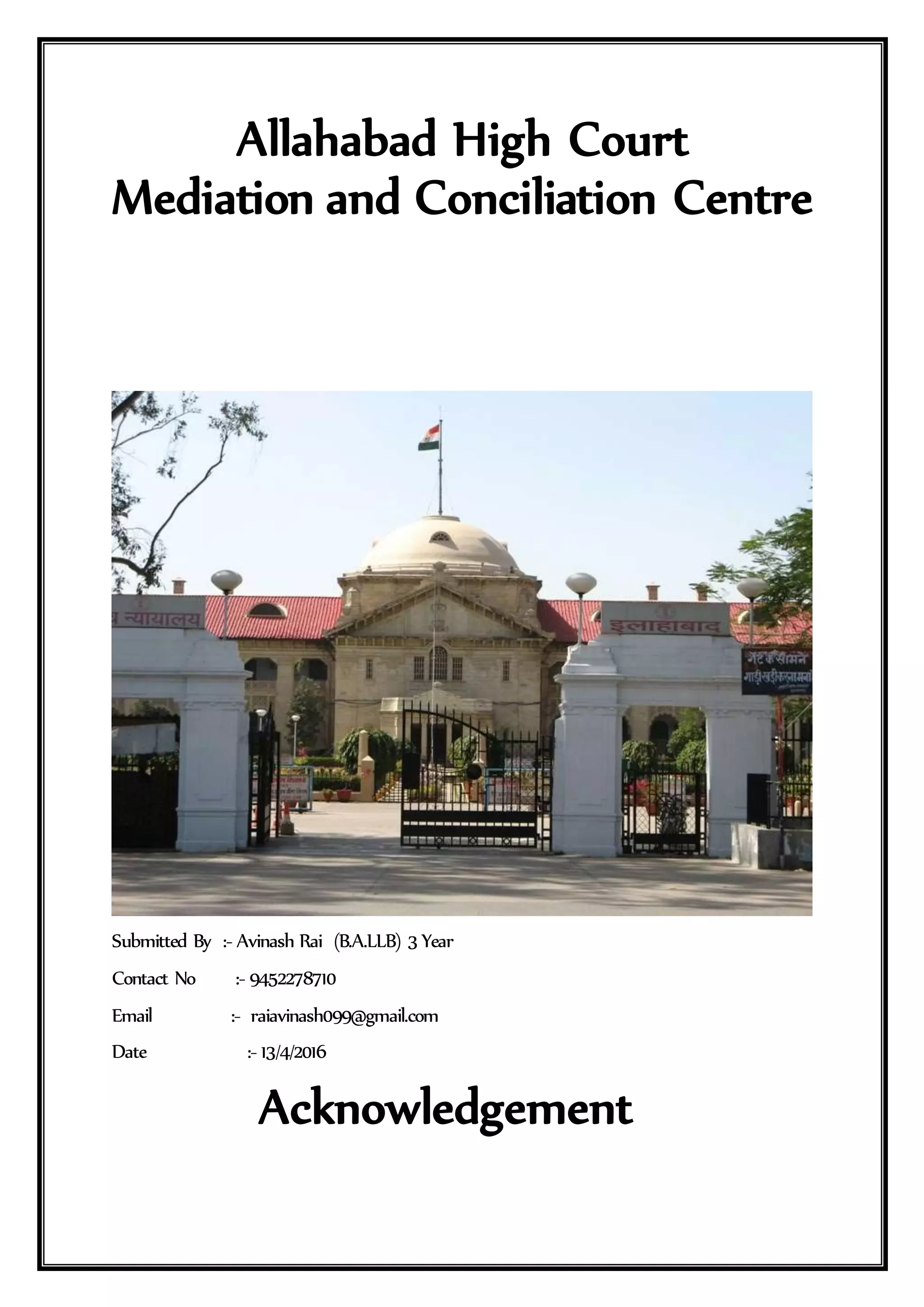
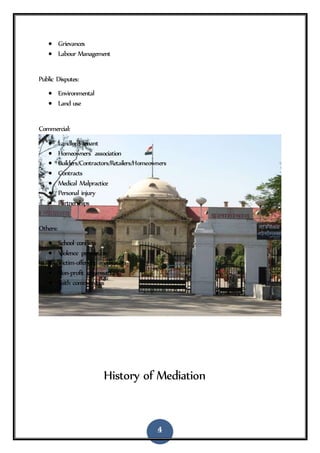
Allahabad High Court
Mediation and Conciliation Centre
Submitted By :- Avinash Rai (B.A.LLB) 3 Year
Contact No :- 9452278710
Email :- raiavinash099@gmail.com
Date :- 13/4/2016
Acknowledgement
1
The successful accomplishment of this project report goes to various individuals. First and
foremost, I would like to thank Mr. Vijay Kumar Singh for his continuous and able guidance
which goes down a long way of helping me to understand the very basic concepts of the
mediation process in general and briefing me about the structure of the internship program at
AHCMCC.
I am highly grateful to Mr. Vijay Kumar Singh for providing me an opportunity of working in
such a wonderfully organized public oriented sector and helping with all queries. It has helped
me a lot in enhancing the knowledge base.
Eventually, I would like to thank everyone associated with this program, the learned mediators
who were real instrument of learning and other support staff for making this session really
interactive.
Thanking You
Avinash Rai
TABLE OF CNTENTS
 Acknowledgement. ........................................Page No 1.
2
 Introduction. ........................................PageNo 3 .
 History of Mediation. ................................ Page No 4 to 5.
 Need for Mediation. ................................ PageNo 6 to 7.
 Legal provision related to Mediation. ................................ Page No 8 to 9.
 Allahabad High Court Mediation And Conciliation Centre.
1. Cases suitable for referral to Mediation.
2. Mediation Proceeding.
3. Report filed into the Hon'ble court by the AHCMCC.
................................ PageNo 9
to 10
 Cases :- ........................... Page No 10 to 11
1. Mediation Case no. 1.
2. Mediation Case No. 2
3. Mediation Case No. 3
4. Mediation Case no. 4
5. Mediation Case no. 5
6. Mediation Case no. 6
7. Mediation Case no. 7
Introduction to the Concept of Mediation
3
Mediation as used in the law is a form of Alternative Dispute Resolution (ADR), a way of
resolving disputes between two or more parties with concrete effects. Typically, a third party,
the mediator assists the parties to negotiate a settlement. Disputants may mediate disputes in a
variety of domains, such as commercial, legal, diplomatic, workplace, community and family
matters.
The term “mediation” broadly refers to any instance in which a third party helps others reach
agreement. More specifically, mediation has a structure. time-table and dynamics that
“ordinary” negotiation lacks/ the process is private and confidential, possibly enforced by law .
Participation is typically voluntary. The mediator acts as a neutral third party and facilitates
rather than direct process.
Mediators use various techniques to open or improve, dialogue between disputants, aiming to
help the parties reach an agreement. Much depends on the mediator’s skill and training. As the
practice gained popularity training programs, certifications and licensing followed, producing
trained, professional mediators committed to the discipline.
In addition to the dispute resolution, mediation can function as a means of dispute prevention,
such as facilitating the process of contract negotiation. Governments can use mediation to
inform and to seek input from stakeholders in formulation or fact-seeking aspects of policy-
making. Mediation is applicable to disputes in many areas:
Family:
 Prenuptial/premarital Agreements.
 Financial or budget Disagreements.
 Separation.
 Divorce.
 Alimony.
 Parenting plans (child custody and visitation).
 Elder Care
 Family Business
 Adult sibling conflicts
 Parent(s) adult children
 Estates
 Medical Ethics and end-of-life
Workplace:
 Wrongful termination
 Discrimination
 Harassment
4
 Grievances
 Labour Management
Public Disputes:
 Environmental
 Land use
Commercial:
 Landlord-tenant
 Homeowners’ association
 Builders/Contractors/Retailers/Homeowners
 Contracts
 Medical Malpractice
 Personal injury
 Partnerships
Others:
 School conflicts
 Violence prevention
 Victim-offender meditation
 Non-profit organisations
 Faith communities
History of Mediation
5
The concept of mediation is ancient and deep rooted in our country. In olden days disputes
used to be resolved in a Panchayat at the community level. Panchs used to be called as Panch
Parmeshwar.
The legislature by the Code of Civil Procedure (Amendment) Act, 1999, amended section 89 of
the CPC with effect from 01/07/2002 whereby mediation was envisaged as one of the modes of
settlement disputes. The amendment in section 89 was made on the recommendation of the
Law Commission of India and the Justice Malimath Committee. It was recommended by the
Law Commission that the court may require attendance of parties to the suit or proceeding to
appear in person with a view to arrive at an amicable settlement of the dispute between them
and make an attempt to settle the dispute amicably. Justice Malimath Committee
recommended making it obligatory for the court to refer the dispute, after issues are framed,
for settlement either by the way of arbitration, conciliation, mediation or judicial settlement
through LokAdalat. It is only when the parties fail to get their disputes settled through any of
the alternative dispute resolution method the suit could precede further. Thus section 89 has
been introduced to promote alternative methods of dispute resolution.
Hon’ble Mr. Justice R.C. Lahoti, the then Chief Justice. Supreme Court of lndia constituted a
Mediation and Conciliation Project Committee (then chaired by Hon’ble Mr. Justice N. Santosh
Hegde). A pilot project on mediation was initiated in Delhi in the month of August, 2005. The
first batches of senior Additional District Judges were imparted mediation training of 40 hours
duration. The trained mediators started judicial mediation from their chambers in the end of
August, 2005. Thereafter. 24 more Additional District Judges were trained as mediators during
the month of September and November, 2005. A permanent Mediation. Centre was all modern
facilities was established at Tis Hazari court complex (Central Hall, 3ml Floor, Room No.325) in
October, 2005. Judicial mediation was started at Karkardooma Court Complex in the month of
December, 2005 and a litigant friendly and modern Mediation Centre was established in May,
2006. Eleven more Additional District Judges have been trained during the month of June,
2006. A large number of cases have been referred to theses Mediation Centres.
NEED FOR MEDIATION
 Cost - While a mediator may charge a fee comparable to that of an attorney, if the
mediation process generally takes much less time than moving a case through standard
legal channels. While a case in the hands of a lawyer or a court may take months or
6
years to resolve, mediation usually achieves a resolution in the matter of hours. Taking
less time means less money or hourly fees and costs.
 Confidentiality- While court hearings are public, mediation remains strictly confidential.
No one but the parties to the dispute and the mediators know what happened actually
in the cabin which is allotted to each and every party. Confidentiality in mediation has
such importance that in most the cases the legal system cannot force a mediator to
testify in court as to the content or progress of mediation. Many mediators destroy
their notes taken during mediation, once that mediation is finished. The only
expectations to such strict confidentiality usually involve child abuse or actual or
threatened criminal acts.
 Control- Mediation increases the control over the parties has over the resolution. In a
court case, the parties obtain a resolution but control resides with the judge or jury.
Often, a judge or jury cannot legally provide solutions that emerge in mediation. Thus,
mediation is more likely to produce a result that is mutually agreeable for the parties.
 Compliance- As the result is attained by the parties working together and is mutually
agreeable, compliance with the mediated agreement is usually high. This further
reduces costs, because the parties do not have to employ an attorney to force
compliance with the agreement. The mediated agreement is, however, fully enforceable
in the court of law.
 Mutuality- Parties to mediation are typically ready to work mutually towards are
solution In most circumstances the mere fact that parties are willing to mediate means
are ready to “move” their position. The parties thus are more amendable to
understanding the other party's side and work on underlying issue to the dispute. This
has added the benefit of often preserving the relationship the parties had before the
dispute.
 Support- Mediators are trained in working with difficult situations. The mediator acts
as a neutral facilitator and guides the parties through the process. The mediator helps
the parties think “outside the box” for possible solutions to the dispute broadening the
range of possible solutions.
7
Legal Provisions Related to Mediation
“The mediation shall be conducted in the manner agreed by the parties. If and to extent that,
the parties have not made such agreement, the mediators shall, in accordance with these rules
determine the manner in which the mediation shall be conducted.”
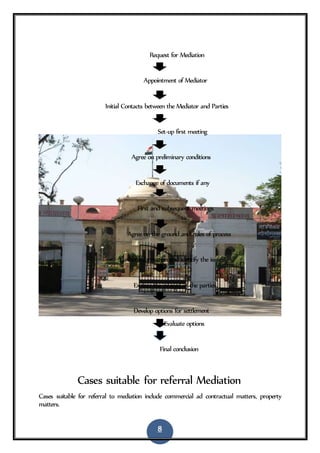
The principal steps of Mediation are as follows:
Commencement
8
Request for Mediation
Appointment of Mediator
Initial Contacts between the Mediator and Parties
Set-up first meeting
Agree on preliminary conditions
Exchange of documents if any
First and subsequent meetings
Agree on the ground and rules of process
Gather information and identify the issues
Explore the interest of the parties
Develop options for settlement
Evaluate options
Final conclusion
Cases suitable for referral Mediation
Cases suitable for referral to mediation include commercial ad contractual matters, property
matters.
9
Partnerships dispute, family matters, including matrimonial and child custody, family business
matter, labour matter, land lord-tenant matters etc.
However the scope of these processes s not limited to the above types and may cover all such
and other disputes which the court may find appropriate for mediation and conciliation.
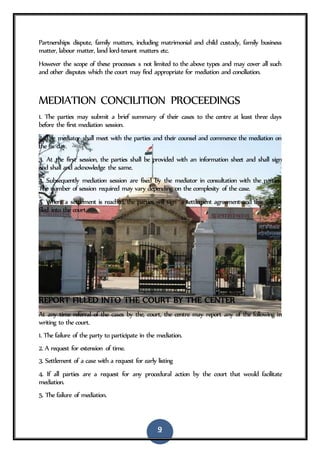
MEDIATION CONCILITION PROCEEDINGS
1. The parties may submit a brief summary of their cases to the centre at least three days
before the first mediation session.
2. The mediator shall meet with the parties and their counsel and commence the mediation on
the fix day.
3. At the first session, the parties shall be provided with an information sheet and shall sign
and shall and acknowledge the same.
4. Subsequently mediation session are fixed by the mediator in consultation with the parties.
The number of session required may vary depending on the complexity of the case.
5. Where a settlement is reached, the parties will sign a settlement agreement and this will be
filed into the court.
REPORT FILLED INTO THE COURT BY THE CENTER
At any time referral of the cases by the, court, the centre may report any of the following in
writing to the court.
1. The failure of the party to participate in the mediation.
2. A request for extension of time.
3. Settlement of a case with a request for early listing
4. If all parties are a request for any procedural action by the court that would facilitate
mediation.
5. The failure of mediation.
10
On receipt of such report on the court may then pass suitable order in the cases.
Due to confidentiality clause in the agreement between the AHCMCC
and the parties, in my report, I will not mention the names of the
parties and mediators.
1. Mediation Case no. 0577/2014
Mediator Name: Mr. XXXXXXXX
Parties :Smt. ABC
11
Proceedings:
 It was a matrimonial dispute.
 Facts: It was a case of domestic violence wherein the husband brutally beat
the wife on a regular basis. At times he didn’t give her food. No child. They
were married for two years.
 Sections involved: 298-A/323,504&506 of IPC/ ¾ of Dowry Prohibition Act.
 This was final hearing of the case and interim settlement was awarded.
Result:
No consensus could be built between the parties. The mediator asked them to reconsider the
matter and to meet again after a month.
Conclusion:
There is mutual distrust between the parties but it is not of such kind
that the relations couldn’t be mended. What is required that both of them be
willing to give the required effort.
2. Mediation Case No 0019/2016
Mediator Name: Mrs. XXXXXXXXXX
Parties : ZZZZZZZZZZZZZZZ
Proceedings:
 It was a case of matrimonial dispute
 Husband has left wife by herself on alleged grounds that she is engaged in
extra-marital affairs. Wife accuses him of leaving her as he wants to do
another marriage. On previous sitting the husband had agreed to take wife
away. They have a five year old daughter. Seven years of marriage.
12
 Sections involved: 498-A, 323, 504&506 of IPC & ¾ of Dowry Prohibition
Act.
 In the present sitting he said that he could not take her as he wants to first
consult his parents. Meanwhile wife alleges that he threatens her by calling
her. The child confirms the same. The wife wants to go back despite all
risks.
Result:
No consensus could be built between the parties. The mediator asked them to
reconsider the matter and to meet again after a month.
Conclusion:
There is mutual distrust between the parties but it is not of such kind
that the relations couldn’t be mended. What is required that both of them be
willing to give the required effort.
3. Mediation Case: No 0126/2016
Mediator Name: ZZZZZZZZZZZZZ
Parties : ABC
Proceedings:
 This was a case of matrimonial dispute and the first sitting.
 Wife accuses husband and his family that they threw her out. She says that
her husband and his family didn’t take her back as she gave birth to a girl
child. Husband says that this is his second marriage and his wife has made
his life as well as that of his family vulnerable as she keeps on taunting him
about his first marriage.
13
 Sections involved: 498-A, 323, 504&506 IPC & ¾ of Dowry Prohibition Act.
 He is ready to secure the life of his girl child and provide some maintenance
to his wife. But the wife does not agree to this. She wants that either the
husband should take her as well as her child back or go for divorce.
Result:
The husband was asked by the mediators to reconsider his stand as one rash
decision of his could affect the lives of both in a grave manner.
Conclusion:
One must try and cooperate with the other partner as the relation cannot be
carried alone and requires efforts from both the partners. Moreover third party
interference must be avoided and even if there is one must remain unaffected.
4. Mediation Case No 0442/2015
Mediator Name: Mrs. ABC
Parties : XYZ and State Of U.P.
Proceedings:
 It was a matrimonial dispute and this was first session.
 The husband said that the wife and her family concealed the fact that one of
the fingers of the girl was missing and fraudulently engaged him in
marriage. Moreover, her behaviour according to him was inappropriate and
intolerable. Wife says that the only cause is her finger and not giving the
demanded dowry of a Volkswagen car apart from the 10 lakh cash. No
genital relations had been formed according to both of them. They’ve been
together for an year(7.12.12-21.11.13)
14
 Sections involved: 125 of CrPC/498-A, 323 & 494 of IPC/ ¾ of Dowry
Prohibition Act. Husband has filed for divorce under section 13 of Hindu
Marriage Act, 1955.
 Wife wants to return back but husband is adamant in his stand.
Result:
No consensus could be built between the parties. The mediator asked
them to reconsider the matter and to meet again after a mon th.
Conclusion:
There is mutual distrust between the parties but it is not of such kind
that the relations couldn’t be mended. What is required that both of them be
willing to give the required effort.
5. Mediation Case No 1302/2015
Mediator Name: Mrs. ABC
Parties : XYZ and state of U.P.
Proceedings:
 It was a matrimonial dispute.
 Husband has left wife and alleges she tortures him mentally and abuses. She
calls him impotent. Wife says that she did no such thing and this is all
because of her mother-in-law. Wife wants to go back but the husband does
not want to.
 Sections involved:498-A,323,504 of IPC & ¾ of Dowry Prohibition Act
15
 Wife wants to go back but the husband does not want to take her back.
Result:
The husband was asked by the mediators to reconsider his stand as one rash
decision of his could affect the lives of both in a grave manner.
Conclusion:
One must try and cooperate with the other partner as the relation cannot be
carried alone and requires efforts from both the partners. Moreover third
party interference must be avoided and even if there is one must remain
unaffected.
6. Mediation Case No 0416/2016
Mediator Name: Mr. ABC
Parties :XXXXXX and State Of U.P.
Proceedings:
 It was a matrimonial dispute and was the first session.
 Husband has left wife and alleges she tortures him mentally and abuses. She
calls him impotent. Wife says that she did no such thing and this is all
because of her mother-in-law. Wife wants to go back but the husband does
not want to.
 Sections involved: 498-A, 323,504,506 of IPC & ¾ of Dowry Prohibition
Act.
16
Result:
No consensus could be built between the parties. The mediator asked
them to reconsider the matter and to meet again after a month.
Conclusion:
There is mutual distrust between the parties but it is not of such kind
that the relations couldn’t be mended. What is required that both of them be
willing to give the required effort.
7. Mediation Case No 0813/2015
Mediator Name: Mr. ABC
Parties: XYZ and State Of U.P.
Proceedings:
 It was a case of matrimonial dispute and domestic violence.
 The wife complains that her husband used to beat her by belt or
plastic wife even for petty things. She has endured it for a long
period but can take this no longer. She wants the husband to pay
the fees and maintain them. The husband was absent in the
previous sitting. He works in Bombay. He wants to take the wife
17
back and take care of her but the wife is adamant not to go back as
she faces threat to her life from her husband.
 Sections involved: 498-A, 323,503,504 of IPC/ ¾ of Dowry
Prohibition Act.
 The wife demands a permanent alimony of
Rs. 15, 00,000 plus that he’d have to maintain the children.
Result:
Mediation failed as there is no faith in the process on the part of one of the
parties.
Conclusion:
The relation had broken down completely and there was no chance
of revival of relationship.

Project(4)a

  • 1.
    Allahabad High Court Mediationand Conciliation Centre Submitted By :- Avinash Rai (B.A.LLB) 3 Year Contact No :- 9452278710 Email :- raiavinash099@gmail.com Date :- 13/4/2016 Acknowledgement
  • 2.
    1 The successful accomplishmentof this project report goes to various individuals. First and foremost, I would like to thank Mr. Vijay Kumar Singh for his continuous and able guidance which goes down a long way of helping me to understand the very basic concepts of the mediation process in general and briefing me about the structure of the internship program at AHCMCC. I am highly grateful to Mr. Vijay Kumar Singh for providing me an opportunity of working in such a wonderfully organized public oriented sector and helping with all queries. It has helped me a lot in enhancing the knowledge base. Eventually, I would like to thank everyone associated with this program, the learned mediators who were real instrument of learning and other support staff for making this session really interactive. Thanking You Avinash Rai TABLE OF CNTENTS  Acknowledgement. ........................................Page No 1.
  • 3.
    2  Introduction. ........................................PageNo3 .  History of Mediation. ................................ Page No 4 to 5.  Need for Mediation. ................................ PageNo 6 to 7.  Legal provision related to Mediation. ................................ Page No 8 to 9.  Allahabad High Court Mediation And Conciliation Centre. 1. Cases suitable for referral to Mediation. 2. Mediation Proceeding. 3. Report filed into the Hon'ble court by the AHCMCC. ................................ PageNo 9 to 10  Cases :- ........................... Page No 10 to 11 1. Mediation Case no. 1. 2. Mediation Case No. 2 3. Mediation Case No. 3 4. Mediation Case no. 4 5. Mediation Case no. 5 6. Mediation Case no. 6 7. Mediation Case no. 7 Introduction to the Concept of Mediation
  • 4.
    3 Mediation as usedin the law is a form of Alternative Dispute Resolution (ADR), a way of resolving disputes between two or more parties with concrete effects. Typically, a third party, the mediator assists the parties to negotiate a settlement. Disputants may mediate disputes in a variety of domains, such as commercial, legal, diplomatic, workplace, community and family matters. The term “mediation” broadly refers to any instance in which a third party helps others reach agreement. More specifically, mediation has a structure. time-table and dynamics that “ordinary” negotiation lacks/ the process is private and confidential, possibly enforced by law . Participation is typically voluntary. The mediator acts as a neutral third party and facilitates rather than direct process. Mediators use various techniques to open or improve, dialogue between disputants, aiming to help the parties reach an agreement. Much depends on the mediator’s skill and training. As the practice gained popularity training programs, certifications and licensing followed, producing trained, professional mediators committed to the discipline. In addition to the dispute resolution, mediation can function as a means of dispute prevention, such as facilitating the process of contract negotiation. Governments can use mediation to inform and to seek input from stakeholders in formulation or fact-seeking aspects of policy- making. Mediation is applicable to disputes in many areas: Family:  Prenuptial/premarital Agreements.  Financial or budget Disagreements.  Separation.  Divorce.  Alimony.  Parenting plans (child custody and visitation).  Elder Care  Family Business  Adult sibling conflicts  Parent(s) adult children  Estates  Medical Ethics and end-of-life Workplace:  Wrongful termination  Discrimination  Harassment
  • 5.
    4  Grievances  LabourManagement Public Disputes:  Environmental  Land use Commercial:  Landlord-tenant  Homeowners’ association  Builders/Contractors/Retailers/Homeowners  Contracts  Medical Malpractice  Personal injury  Partnerships Others:  School conflicts  Violence prevention  Victim-offender meditation  Non-profit organisations  Faith communities History of Mediation
  • 6.
    5 The concept ofmediation is ancient and deep rooted in our country. In olden days disputes used to be resolved in a Panchayat at the community level. Panchs used to be called as Panch Parmeshwar. The legislature by the Code of Civil Procedure (Amendment) Act, 1999, amended section 89 of the CPC with effect from 01/07/2002 whereby mediation was envisaged as one of the modes of settlement disputes. The amendment in section 89 was made on the recommendation of the Law Commission of India and the Justice Malimath Committee. It was recommended by the Law Commission that the court may require attendance of parties to the suit or proceeding to appear in person with a view to arrive at an amicable settlement of the dispute between them and make an attempt to settle the dispute amicably. Justice Malimath Committee recommended making it obligatory for the court to refer the dispute, after issues are framed, for settlement either by the way of arbitration, conciliation, mediation or judicial settlement through LokAdalat. It is only when the parties fail to get their disputes settled through any of the alternative dispute resolution method the suit could precede further. Thus section 89 has been introduced to promote alternative methods of dispute resolution. Hon’ble Mr. Justice R.C. Lahoti, the then Chief Justice. Supreme Court of lndia constituted a Mediation and Conciliation Project Committee (then chaired by Hon’ble Mr. Justice N. Santosh Hegde). A pilot project on mediation was initiated in Delhi in the month of August, 2005. The first batches of senior Additional District Judges were imparted mediation training of 40 hours duration. The trained mediators started judicial mediation from their chambers in the end of August, 2005. Thereafter. 24 more Additional District Judges were trained as mediators during the month of September and November, 2005. A permanent Mediation. Centre was all modern facilities was established at Tis Hazari court complex (Central Hall, 3ml Floor, Room No.325) in October, 2005. Judicial mediation was started at Karkardooma Court Complex in the month of December, 2005 and a litigant friendly and modern Mediation Centre was established in May, 2006. Eleven more Additional District Judges have been trained during the month of June, 2006. A large number of cases have been referred to theses Mediation Centres. NEED FOR MEDIATION  Cost - While a mediator may charge a fee comparable to that of an attorney, if the mediation process generally takes much less time than moving a case through standard legal channels. While a case in the hands of a lawyer or a court may take months or
  • 7.
    6 years to resolve,mediation usually achieves a resolution in the matter of hours. Taking less time means less money or hourly fees and costs.  Confidentiality- While court hearings are public, mediation remains strictly confidential. No one but the parties to the dispute and the mediators know what happened actually in the cabin which is allotted to each and every party. Confidentiality in mediation has such importance that in most the cases the legal system cannot force a mediator to testify in court as to the content or progress of mediation. Many mediators destroy their notes taken during mediation, once that mediation is finished. The only expectations to such strict confidentiality usually involve child abuse or actual or threatened criminal acts.  Control- Mediation increases the control over the parties has over the resolution. In a court case, the parties obtain a resolution but control resides with the judge or jury. Often, a judge or jury cannot legally provide solutions that emerge in mediation. Thus, mediation is more likely to produce a result that is mutually agreeable for the parties.  Compliance- As the result is attained by the parties working together and is mutually agreeable, compliance with the mediated agreement is usually high. This further reduces costs, because the parties do not have to employ an attorney to force compliance with the agreement. The mediated agreement is, however, fully enforceable in the court of law.  Mutuality- Parties to mediation are typically ready to work mutually towards are solution In most circumstances the mere fact that parties are willing to mediate means are ready to “move” their position. The parties thus are more amendable to understanding the other party's side and work on underlying issue to the dispute. This has added the benefit of often preserving the relationship the parties had before the dispute.  Support- Mediators are trained in working with difficult situations. The mediator acts as a neutral facilitator and guides the parties through the process. The mediator helps the parties think “outside the box” for possible solutions to the dispute broadening the range of possible solutions.
  • 8.
    7 Legal Provisions Relatedto Mediation “The mediation shall be conducted in the manner agreed by the parties. If and to extent that, the parties have not made such agreement, the mediators shall, in accordance with these rules determine the manner in which the mediation shall be conducted.” The principal steps of Mediation are as follows: Commencement
  • 9.
    8 Request for Mediation Appointmentof Mediator Initial Contacts between the Mediator and Parties Set-up first meeting Agree on preliminary conditions Exchange of documents if any First and subsequent meetings Agree on the ground and rules of process Gather information and identify the issues Explore the interest of the parties Develop options for settlement Evaluate options Final conclusion Cases suitable for referral Mediation Cases suitable for referral to mediation include commercial ad contractual matters, property matters.
  • 10.
    9 Partnerships dispute, familymatters, including matrimonial and child custody, family business matter, labour matter, land lord-tenant matters etc. However the scope of these processes s not limited to the above types and may cover all such and other disputes which the court may find appropriate for mediation and conciliation. MEDIATION CONCILITION PROCEEDINGS 1. The parties may submit a brief summary of their cases to the centre at least three days before the first mediation session. 2. The mediator shall meet with the parties and their counsel and commence the mediation on the fix day. 3. At the first session, the parties shall be provided with an information sheet and shall sign and shall and acknowledge the same. 4. Subsequently mediation session are fixed by the mediator in consultation with the parties. The number of session required may vary depending on the complexity of the case. 5. Where a settlement is reached, the parties will sign a settlement agreement and this will be filed into the court. REPORT FILLED INTO THE COURT BY THE CENTER At any time referral of the cases by the, court, the centre may report any of the following in writing to the court. 1. The failure of the party to participate in the mediation. 2. A request for extension of time. 3. Settlement of a case with a request for early listing 4. If all parties are a request for any procedural action by the court that would facilitate mediation. 5. The failure of mediation.
  • 11.
    10 On receipt ofsuch report on the court may then pass suitable order in the cases. Due to confidentiality clause in the agreement between the AHCMCC and the parties, in my report, I will not mention the names of the parties and mediators. 1. Mediation Case no. 0577/2014 Mediator Name: Mr. XXXXXXXX Parties :Smt. ABC
  • 12.
    11 Proceedings:  It wasa matrimonial dispute.  Facts: It was a case of domestic violence wherein the husband brutally beat the wife on a regular basis. At times he didn’t give her food. No child. They were married for two years.  Sections involved: 298-A/323,504&506 of IPC/ ¾ of Dowry Prohibition Act.  This was final hearing of the case and interim settlement was awarded. Result: No consensus could be built between the parties. The mediator asked them to reconsider the matter and to meet again after a month. Conclusion: There is mutual distrust between the parties but it is not of such kind that the relations couldn’t be mended. What is required that both of them be willing to give the required effort. 2. Mediation Case No 0019/2016 Mediator Name: Mrs. XXXXXXXXXX Parties : ZZZZZZZZZZZZZZZ Proceedings:  It was a case of matrimonial dispute  Husband has left wife by herself on alleged grounds that she is engaged in extra-marital affairs. Wife accuses him of leaving her as he wants to do another marriage. On previous sitting the husband had agreed to take wife away. They have a five year old daughter. Seven years of marriage.
  • 13.
    12  Sections involved:498-A, 323, 504&506 of IPC & ¾ of Dowry Prohibition Act.  In the present sitting he said that he could not take her as he wants to first consult his parents. Meanwhile wife alleges that he threatens her by calling her. The child confirms the same. The wife wants to go back despite all risks. Result: No consensus could be built between the parties. The mediator asked them to reconsider the matter and to meet again after a month. Conclusion: There is mutual distrust between the parties but it is not of such kind that the relations couldn’t be mended. What is required that both of them be willing to give the required effort. 3. Mediation Case: No 0126/2016 Mediator Name: ZZZZZZZZZZZZZ Parties : ABC Proceedings:  This was a case of matrimonial dispute and the first sitting.  Wife accuses husband and his family that they threw her out. She says that her husband and his family didn’t take her back as she gave birth to a girl child. Husband says that this is his second marriage and his wife has made his life as well as that of his family vulnerable as she keeps on taunting him about his first marriage.
  • 14.
    13  Sections involved:498-A, 323, 504&506 IPC & ¾ of Dowry Prohibition Act.  He is ready to secure the life of his girl child and provide some maintenance to his wife. But the wife does not agree to this. She wants that either the husband should take her as well as her child back or go for divorce. Result: The husband was asked by the mediators to reconsider his stand as one rash decision of his could affect the lives of both in a grave manner. Conclusion: One must try and cooperate with the other partner as the relation cannot be carried alone and requires efforts from both the partners. Moreover third party interference must be avoided and even if there is one must remain unaffected. 4. Mediation Case No 0442/2015 Mediator Name: Mrs. ABC Parties : XYZ and State Of U.P. Proceedings:  It was a matrimonial dispute and this was first session.  The husband said that the wife and her family concealed the fact that one of the fingers of the girl was missing and fraudulently engaged him in marriage. Moreover, her behaviour according to him was inappropriate and intolerable. Wife says that the only cause is her finger and not giving the demanded dowry of a Volkswagen car apart from the 10 lakh cash. No genital relations had been formed according to both of them. They’ve been together for an year(7.12.12-21.11.13)
  • 15.
    14  Sections involved:125 of CrPC/498-A, 323 & 494 of IPC/ ¾ of Dowry Prohibition Act. Husband has filed for divorce under section 13 of Hindu Marriage Act, 1955.  Wife wants to return back but husband is adamant in his stand. Result: No consensus could be built between the parties. The mediator asked them to reconsider the matter and to meet again after a mon th. Conclusion: There is mutual distrust between the parties but it is not of such kind that the relations couldn’t be mended. What is required that both of them be willing to give the required effort. 5. Mediation Case No 1302/2015 Mediator Name: Mrs. ABC Parties : XYZ and state of U.P. Proceedings:  It was a matrimonial dispute.  Husband has left wife and alleges she tortures him mentally and abuses. She calls him impotent. Wife says that she did no such thing and this is all because of her mother-in-law. Wife wants to go back but the husband does not want to.  Sections involved:498-A,323,504 of IPC & ¾ of Dowry Prohibition Act
  • 16.
    15  Wife wantsto go back but the husband does not want to take her back. Result: The husband was asked by the mediators to reconsider his stand as one rash decision of his could affect the lives of both in a grave manner. Conclusion: One must try and cooperate with the other partner as the relation cannot be carried alone and requires efforts from both the partners. Moreover third party interference must be avoided and even if there is one must remain unaffected. 6. Mediation Case No 0416/2016 Mediator Name: Mr. ABC Parties :XXXXXX and State Of U.P. Proceedings:  It was a matrimonial dispute and was the first session.  Husband has left wife and alleges she tortures him mentally and abuses. She calls him impotent. Wife says that she did no such thing and this is all because of her mother-in-law. Wife wants to go back but the husband does not want to.  Sections involved: 498-A, 323,504,506 of IPC & ¾ of Dowry Prohibition Act.
  • 17.
    16 Result: No consensus couldbe built between the parties. The mediator asked them to reconsider the matter and to meet again after a month. Conclusion: There is mutual distrust between the parties but it is not of such kind that the relations couldn’t be mended. What is required that both of them be willing to give the required effort. 7. Mediation Case No 0813/2015 Mediator Name: Mr. ABC Parties: XYZ and State Of U.P. Proceedings:  It was a case of matrimonial dispute and domestic violence.  The wife complains that her husband used to beat her by belt or plastic wife even for petty things. She has endured it for a long period but can take this no longer. She wants the husband to pay the fees and maintain them. The husband was absent in the previous sitting. He works in Bombay. He wants to take the wife
  • 18.
    17 back and takecare of her but the wife is adamant not to go back as she faces threat to her life from her husband.  Sections involved: 498-A, 323,503,504 of IPC/ ¾ of Dowry Prohibition Act.  The wife demands a permanent alimony of Rs. 15, 00,000 plus that he’d have to maintain the children. Result: Mediation failed as there is no faith in the process on the part of one of the parties. Conclusion: The relation had broken down completely and there was no chance of revival of relationship.