MEDIATION
INTRODUCTION
Private Court is a simple cloud-based solution to provide Arbitration services to clients .
 Private Court maintain all privacy and confidentiality.
 Here parties choice of neutral third party to direct negotiations.
 It is less complexity , lower cost and you don’t need to spend more time in your case.
 Private court is fast , simple and online justice for all.
What is Mediation?
Mediation is a type of alternative dispute resolution system
(ADRS). It's a method of seeking dispute resolution other than
court litigation. There is a growing awareness that courts will
not be in position to bear the entire burden of justice system.
Private court provides Mediation facility to parties having
disputes. where a third neutral party assist in such a manner
that a solution can be drawn which is feasible to both the
parties.
Mediator
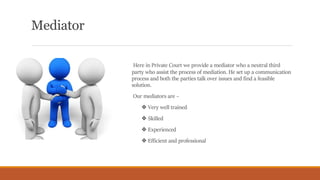
Here in Private Court we provide a mediator who a neutral third
party who assist the process of mediation. He set up a communication
process and both the parties talk over issues and find a feasible
solution.
Our mediators are –
❖ Very well trained
❖ Skilled
❖ Experienced
❖ Efficient and professional
Stage of Mediation
5-stages of mediation Stage:-
 Convening The Mediation Stage
 Opening Session Stage
 Communication Stage
 The Negotiation Stage
 Closure
Advantages of Mediation
Consensual in nature; no one feels ‘summoned to
appear in court’
Lawyer involvement in most cases is minimal.
The parties contribute to the process that results in a
mutually acceptable resolution
The scheduling is up to the parties
The parties contribute to the process that results in a
mutually acceptable resolution
Disadvantages of Mediation
No binding award is issued until the agreement is
memorialized in a written agreement executed by both
parties.
Each party will ‘show its hand’ in the process and that
information may result in a tactical advantage if the
parties later arbitrate or litigate.
Process of Mediation
The mediation process can include some or all of the following six
steps:
1. Planning:
Before the mediation process begins, the mediator helps the
parties decide where they should meet and who should be
present.
2. Mediator’s introduction:
With the parties gathered together in the same room the
mediator, introduces the participants, outlines the mediation
process, and lays out ground rules and presents his goal.
3. Opening remarks:
To describing the issues they believe are at stake, they may
also take time to vent their feelings.
Process of Mediation
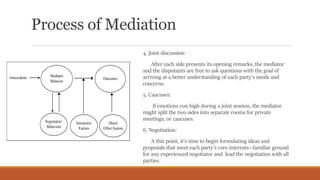
4. Joint discussion:
After each side presents its opening remarks, the mediator
and the disputants are free to ask questions with the goal of
arriving at a better understanding of each party’s needs and
concerns.
5. Caucuses:
If emotions run high during a joint session, the mediator
might split the two sides into separate rooms for private
meetings, or caucuses.
6. Negotiation:
A this point, it’s time to begin formulating ideas and
proposals that meet each party’s core interests—familiar ground
for any experienced negotiator and lead the negotiation with all
parties.
Mediator’s post mediation
May file any necessary paper work with court.
 Monitor implementation of terms of settlement.
Release documents or Funds held pending settlement.
If settlement is not reached this doesn’t mean that
mediation was not successful.
There can be no understanding between
the hand and the brain unless the heart acts
as mediator.
- Fritz Lang

MEDIATION

  • 1.
  • 2.
    INTRODUCTION Private Court isa simple cloud-based solution to provide Arbitration services to clients .  Private Court maintain all privacy and confidentiality.  Here parties choice of neutral third party to direct negotiations.  It is less complexity , lower cost and you don’t need to spend more time in your case.  Private court is fast , simple and online justice for all.
  • 3.
    What is Mediation? Mediationis a type of alternative dispute resolution system (ADRS). It's a method of seeking dispute resolution other than court litigation. There is a growing awareness that courts will not be in position to bear the entire burden of justice system. Private court provides Mediation facility to parties having disputes. where a third neutral party assist in such a manner that a solution can be drawn which is feasible to both the parties.
  • 4.
    Mediator Here in PrivateCourt we provide a mediator who a neutral third party who assist the process of mediation. He set up a communication process and both the parties talk over issues and find a feasible solution. Our mediators are – ❖ Very well trained ❖ Skilled ❖ Experienced ❖ Efficient and professional
  • 5.
    Stage of Mediation 5-stagesof mediation Stage:-  Convening The Mediation Stage  Opening Session Stage  Communication Stage  The Negotiation Stage  Closure
  • 6.
    Advantages of Mediation Consensualin nature; no one feels ‘summoned to appear in court’ Lawyer involvement in most cases is minimal. The parties contribute to the process that results in a mutually acceptable resolution The scheduling is up to the parties The parties contribute to the process that results in a mutually acceptable resolution
  • 7.
    Disadvantages of Mediation Nobinding award is issued until the agreement is memorialized in a written agreement executed by both parties. Each party will ‘show its hand’ in the process and that information may result in a tactical advantage if the parties later arbitrate or litigate.
  • 8.
    Process of Mediation Themediation process can include some or all of the following six steps: 1. Planning: Before the mediation process begins, the mediator helps the parties decide where they should meet and who should be present. 2. Mediator’s introduction: With the parties gathered together in the same room the mediator, introduces the participants, outlines the mediation process, and lays out ground rules and presents his goal. 3. Opening remarks: To describing the issues they believe are at stake, they may also take time to vent their feelings.
  • 9.
    Process of Mediation 4.Joint discussion: After each side presents its opening remarks, the mediator and the disputants are free to ask questions with the goal of arriving at a better understanding of each party’s needs and concerns. 5. Caucuses: If emotions run high during a joint session, the mediator might split the two sides into separate rooms for private meetings, or caucuses. 6. Negotiation: A this point, it’s time to begin formulating ideas and proposals that meet each party’s core interests—familiar ground for any experienced negotiator and lead the negotiation with all parties.
  • 10.
    Mediator’s post mediation Mayfile any necessary paper work with court.  Monitor implementation of terms of settlement. Release documents or Funds held pending settlement. If settlement is not reached this doesn’t mean that mediation was not successful.
  • 11.
    There can beno understanding between the hand and the brain unless the heart acts as mediator. - Fritz Lang