Alternative Dispute ResolutionBy Anil PatelDevikaSighdeoNiladriSahaRavi kantSukanyaSikdar
 Mahatma Gandhi’s Views on ADRGandhiji  said “ I realized that the true function of a lawyer was to unite parties. A large part of my time during the 20 years of my practice as a lawyer occupied in bringing about private compromise of hundred of cases. I lost nothing thereby – not even money, certainly not my soul.”
Concept Of ADRThe court proceedings is the regular process taken up for any dispute resolution.But there are certain alternative mechanisms available before a full-scale court proceedings and that is the Alternative Dispute Resolution.The spirit of ADR is that it emanates to find  a better and more wholesome collaborative method of resolving disputes. ADR refers to the process, other than judicial determination, in which an impartial person assists the parties to  a dispute to resolve the issues between the parties.
Purpose of ADRThe primary purpose of Alternative Dispute Resolution (ADR) methods, of which arbitration is the most popular, is to avoid going to the court. However, intervention by courts is inevitable. At times the interference is desirable so as to prevent the arbitration process from going astray. In most of the jurisdictions, the subordinate judiciary is empowered to look into arbitration matters, however, a number of matters reach the highest court. India follows the same system and a large number of arbitration matters are filed in the lower courts
Advantages of ADRFaster and less expensive.Encourages direct participation of the parties and discourages the implementation of complete procedural law.Satisfactory approach for both parties.Creates less ill will and improves the relationship of the parties.Gives an opportunity to continue the interaction between the parties after they have reached a settlement.
Disadvantages of ADRIt is criticized as rendering a “second-class justice”.May result in going to courtLack of expertiseNo enforceabilityThey are private in nature and not part of a public record, so it is not exposed to public scrutiny.
 ArbitrationArbitration is a domestic forum other than the court of law for determination of disputes and differences, after hearing both the sides, in a judicial manner.Less formal and quicker than any court.Transparency in the decision making process of arbitrator.It seeks dispute as a legal analysis.
Types of ArbitrationDomestic ArbitrationInternational ArbitrationAd hoc ArbitrationInstitutional ArbitrationForeign ArbitrationStatutory ArbitrationExpedited ArbitrationFlip-Flop arbitration
What disputes can be decided through Arbitration?Mostly all the disputes involving Civil Rights, which fall within the jurisdiction of Civil Court are referable to arbitration. The matters, which are excluded from arbitration agreements:Matrimonial matters and those connected with the conjugal rights.
Lunacy proceedings.
Testamentary matters under the Indian Succession Act
Insolvency proceedings, Company matters those relating to winding up.
Matters under Trust Act etc
Determinations of rights and liabilities  under the Guardianship and Wards Act.Appointment of Arbitrator Procedure for appointment of arbitrator is stated in arbitration agreement. Failure to appoint occurs when A party fails to appoint within 30 days from receipt of request to do so from other party Two appointed arbitrator fails to agree on third arbitrator  within 30 days of appointment. In case of agreement failure, appointment of one or three arbittrator should be made upon request by a party, by the Chief justice of High court or any one designated by High court.
Duties of ArbitratorTo ensure that the dispute is within the scope of arbitrationToact judicially  and impartially.He shall have on  interest in the subject matter  of the dispute and parties.He shall disclose in writing any circumstances likely to give rise to doubts of his impartiality and independence .He shall encourage settlement by mediation or conciliation.He shall not exceed his authority and act within the scope of the agreement.He shall follow rules of natural justice.He shall give a final award or if empowered give several awards and file the award in due time.
Features of Arbitration AgreementThe arbitration agreement can be in the form of:An arbitration clause in a contract, orIn a separate agreement.It need not be necessarily signed by the parties.Stamp duty is chargeable.The parties may set out the procedure for appointment of the arbitrators in their agreement.By an agreement, the arbitration agreement can be terminated
Legal Attributes of the Arbitration AgreementThe arbitration agreement to be in writing.It can have a sole arbitrator or odd no of arbitrators.The arbitrators can be named in the agreement or nominated in accordance with the provisions of law.It has to be in accordance with Section 10 of the Indian Contract Act, 1872 for being a valid contract.The parties should intend to showinterest to refer the matter to arbitration.Arbitration agreement to provide place of arbitration and the substantive law applicable to the contract especially in the International Commercial Agreement  for arbitration, it is compulsory to do so.
The various situations as to when the court can intervene When there is an agreement the court is empowered to refer the matter to arbitrationIt can grant interim measuresOn the termination of the mandate of an arbitratorAssist in taking evidenceSetting aside arbitral awardEnforcement of arbitral awardHearing appeal from the original decrees of the court orders.Cost of the arbitration etc…
Conciliation“ Conciliation is a process of persuading parties to reach an agreement .”Characteristics of conciliationConciliation proceeding shall have to commence before any steps are taken for the appointment of arbitrator. Need not to be contractual or prior agreement basis.Two willing party can resolve a dispute in the presence of conciliator.Useful for the cases pending in courts for years.
Role of Conciliator    Conciliation is one of the mechanisms that has to be adopted in reaching early settlements and therefore the conciliator has to play the role as following:The conciliator may advise or determine the process of conciliation whereby resolution is attempted.Conciliator to make suggestions for terms of settlement.Conciliator can give expert advice on likely settlement terms andConciliator can actively encourage the participants to reach an agreement.
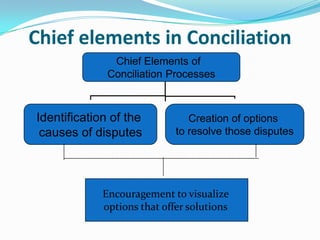
Chief elements in ConciliationEncouragement to visualize options that offer solutions
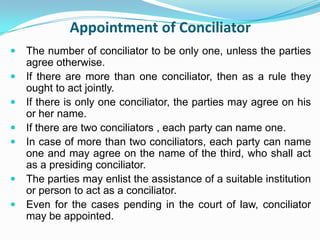
Appointment of ConciliatorThe number of conciliator to be only one, unless the parties agree otherwise.If there are more than one conciliator, then as a rule they ought to act jointly.If there is only one conciliator, the parties may agree on his or her name.If there are two conciliators , each party can name one.In case of more than two conciliators, each party can name one and may agree on the name of the third, who shall act as a presiding conciliator.The parties may enlist the assistance of a suitable institution or person to act as a conciliator.Even for the cases pending in the court of law, conciliator may be appointed.
Arbitration and conciliation law in IndiaArbitration and Conciliation in India is mainly governed by the Arbitration ad Conciliation Act, 1996 The object of the Act is to consolidate and amend the law relating to domestic arbitration, international commercial arbitration and enforcement of foreign arbitral awards.Scope:It is resorted to in relation to disputes out of legal relationships whether  contractual or not.
Proposed  amendments to Arbitration Act In 2001, the 176th Law Commission Report, which was chaired by the then Law Commission Chairman Justice B.P Reddy, had given an exhaustive set of recommendations to overhaul the Arbitration Act. Arbitration and Conciliation (Amendment) Bill, 2003 was introduced in the Rajya Sabha.The Standing Committee on Personnel, Public Grievances, Law and Justice was of the view that the provisions of the Bill gave room for excessive intervention by the Courts in the arbitration proceedings.
MEDIATION	   Mediation, as used in law, is a form of ADR, is a way of resolving disputes between two or more parties. A third party is the Mediator. Mediation is a confidential process and conducted privately.Types of Mediation:Facilitative Mediation Evaluative Mediation
 What  A Mediator Do ?Listens to both sides attentively.Helps them to communicate with each other.Helps to identify the disputed issues & develop options.Mediation results into a satisfactory outcome without proving right or wrong.Meeting with mediator may be together or separately.
Contd..Mediation may be inFamily disputesBusiness disagreementContracts disputesInsurance claimsEmployment and environmental issues
Example A third-party representative may contract and mediate between (say) unions and corporations. When a workers’ union goes on strike, a dispute takes place, the parties may agree to a third party to settle a contract or agreement between the union and the corporation.

Alternative dispute resolution

  • 1.
    Alternative Dispute ResolutionByAnil PatelDevikaSighdeoNiladriSahaRavi kantSukanyaSikdar
  • 2.
    Mahatma Gandhi’sViews on ADRGandhiji said “ I realized that the true function of a lawyer was to unite parties. A large part of my time during the 20 years of my practice as a lawyer occupied in bringing about private compromise of hundred of cases. I lost nothing thereby – not even money, certainly not my soul.”
  • 3.
    Concept Of ADRThecourt proceedings is the regular process taken up for any dispute resolution.But there are certain alternative mechanisms available before a full-scale court proceedings and that is the Alternative Dispute Resolution.The spirit of ADR is that it emanates to find a better and more wholesome collaborative method of resolving disputes. ADR refers to the process, other than judicial determination, in which an impartial person assists the parties to a dispute to resolve the issues between the parties.
  • 4.
    Purpose of ADRTheprimary purpose of Alternative Dispute Resolution (ADR) methods, of which arbitration is the most popular, is to avoid going to the court. However, intervention by courts is inevitable. At times the interference is desirable so as to prevent the arbitration process from going astray. In most of the jurisdictions, the subordinate judiciary is empowered to look into arbitration matters, however, a number of matters reach the highest court. India follows the same system and a large number of arbitration matters are filed in the lower courts
  • 5.
    Advantages of ADRFasterand less expensive.Encourages direct participation of the parties and discourages the implementation of complete procedural law.Satisfactory approach for both parties.Creates less ill will and improves the relationship of the parties.Gives an opportunity to continue the interaction between the parties after they have reached a settlement.
  • 6.
    Disadvantages of ADRItis criticized as rendering a “second-class justice”.May result in going to courtLack of expertiseNo enforceabilityThey are private in nature and not part of a public record, so it is not exposed to public scrutiny.
  • 7.
    ArbitrationArbitration isa domestic forum other than the court of law for determination of disputes and differences, after hearing both the sides, in a judicial manner.Less formal and quicker than any court.Transparency in the decision making process of arbitrator.It seeks dispute as a legal analysis.
  • 8.
    Types of ArbitrationDomesticArbitrationInternational ArbitrationAd hoc ArbitrationInstitutional ArbitrationForeign ArbitrationStatutory ArbitrationExpedited ArbitrationFlip-Flop arbitration
  • 9.
    What disputes canbe decided through Arbitration?Mostly all the disputes involving Civil Rights, which fall within the jurisdiction of Civil Court are referable to arbitration. The matters, which are excluded from arbitration agreements:Matrimonial matters and those connected with the conjugal rights.
  • 10.
  • 11.
    Testamentary matters underthe Indian Succession Act
  • 12.
    Insolvency proceedings, Companymatters those relating to winding up.
  • 13.
  • 14.
    Determinations of rightsand liabilities under the Guardianship and Wards Act.Appointment of Arbitrator Procedure for appointment of arbitrator is stated in arbitration agreement. Failure to appoint occurs when A party fails to appoint within 30 days from receipt of request to do so from other party Two appointed arbitrator fails to agree on third arbitrator within 30 days of appointment. In case of agreement failure, appointment of one or three arbittrator should be made upon request by a party, by the Chief justice of High court or any one designated by High court.
  • 15.
    Duties of ArbitratorToensure that the dispute is within the scope of arbitrationToact judicially and impartially.He shall have on interest in the subject matter of the dispute and parties.He shall disclose in writing any circumstances likely to give rise to doubts of his impartiality and independence .He shall encourage settlement by mediation or conciliation.He shall not exceed his authority and act within the scope of the agreement.He shall follow rules of natural justice.He shall give a final award or if empowered give several awards and file the award in due time.
  • 16.
    Features of ArbitrationAgreementThe arbitration agreement can be in the form of:An arbitration clause in a contract, orIn a separate agreement.It need not be necessarily signed by the parties.Stamp duty is chargeable.The parties may set out the procedure for appointment of the arbitrators in their agreement.By an agreement, the arbitration agreement can be terminated
  • 17.
    Legal Attributes ofthe Arbitration AgreementThe arbitration agreement to be in writing.It can have a sole arbitrator or odd no of arbitrators.The arbitrators can be named in the agreement or nominated in accordance with the provisions of law.It has to be in accordance with Section 10 of the Indian Contract Act, 1872 for being a valid contract.The parties should intend to showinterest to refer the matter to arbitration.Arbitration agreement to provide place of arbitration and the substantive law applicable to the contract especially in the International Commercial Agreement for arbitration, it is compulsory to do so.
  • 18.
    The various situationsas to when the court can intervene When there is an agreement the court is empowered to refer the matter to arbitrationIt can grant interim measuresOn the termination of the mandate of an arbitratorAssist in taking evidenceSetting aside arbitral awardEnforcement of arbitral awardHearing appeal from the original decrees of the court orders.Cost of the arbitration etc…
  • 19.
    Conciliation“ Conciliation isa process of persuading parties to reach an agreement .”Characteristics of conciliationConciliation proceeding shall have to commence before any steps are taken for the appointment of arbitrator. Need not to be contractual or prior agreement basis.Two willing party can resolve a dispute in the presence of conciliator.Useful for the cases pending in courts for years.
  • 20.
    Role of Conciliator Conciliation is one of the mechanisms that has to be adopted in reaching early settlements and therefore the conciliator has to play the role as following:The conciliator may advise or determine the process of conciliation whereby resolution is attempted.Conciliator to make suggestions for terms of settlement.Conciliator can give expert advice on likely settlement terms andConciliator can actively encourage the participants to reach an agreement.
  • 21.
    Chief elements inConciliationEncouragement to visualize options that offer solutions
  • 22.
    Appointment of ConciliatorThenumber of conciliator to be only one, unless the parties agree otherwise.If there are more than one conciliator, then as a rule they ought to act jointly.If there is only one conciliator, the parties may agree on his or her name.If there are two conciliators , each party can name one.In case of more than two conciliators, each party can name one and may agree on the name of the third, who shall act as a presiding conciliator.The parties may enlist the assistance of a suitable institution or person to act as a conciliator.Even for the cases pending in the court of law, conciliator may be appointed.
  • 23.
    Arbitration and conciliationlaw in IndiaArbitration and Conciliation in India is mainly governed by the Arbitration ad Conciliation Act, 1996 The object of the Act is to consolidate and amend the law relating to domestic arbitration, international commercial arbitration and enforcement of foreign arbitral awards.Scope:It is resorted to in relation to disputes out of legal relationships whether contractual or not.
  • 24.
    Proposed amendmentsto Arbitration Act In 2001, the 176th Law Commission Report, which was chaired by the then Law Commission Chairman Justice B.P Reddy, had given an exhaustive set of recommendations to overhaul the Arbitration Act. Arbitration and Conciliation (Amendment) Bill, 2003 was introduced in the Rajya Sabha.The Standing Committee on Personnel, Public Grievances, Law and Justice was of the view that the provisions of the Bill gave room for excessive intervention by the Courts in the arbitration proceedings.
  • 25.
    MEDIATION Mediation, as used in law, is a form of ADR, is a way of resolving disputes between two or more parties. A third party is the Mediator. Mediation is a confidential process and conducted privately.Types of Mediation:Facilitative Mediation Evaluative Mediation
  • 26.
    What A Mediator Do ?Listens to both sides attentively.Helps them to communicate with each other.Helps to identify the disputed issues & develop options.Mediation results into a satisfactory outcome without proving right or wrong.Meeting with mediator may be together or separately.
  • 27.
    Contd..Mediation may beinFamily disputesBusiness disagreementContracts disputesInsurance claimsEmployment and environmental issues
  • 28.
    Example A third-partyrepresentative may contract and mediate between (say) unions and corporations. When a workers’ union goes on strike, a dispute takes place, the parties may agree to a third party to settle a contract or agreement between the union and the corporation.

Editor's Notes

  • #6 Believed to be a more satisfactory approach as in most of the cases both the parties will be satisfied with the outcome as well as their compliance with the agreements reached.Creates less ill will and improves the relationship of the parties, as it is based on an integrative approach than the adversarial court based method of litigation.

  • #7 May result in going to court: In some cases ADR can fail. In these circumstances the court may still be needed. This delays the dispute and if they had taken the case to court in the first place they would have saved on time and cost.Lack of expertise: During the ADR process if a legal issue arises of a complex nature the mediators or arbitrators may lack the legal expertise needed to deal with such a situation. Therefore to avoid any uncertainty the courts may prove to be a better option.No enforceability: Most forms of ADR are not legally binding, therefore making it harder to enforce judgement. It is up to the parties to decide whether they are happy with the judgement.
  • #8 Arbitration is a legal technique for the resolution of disputes outside the courts, wherein the parties to a dispute refer it to one or more persons (the "arbitrators", "arbiters" or "arbitral tribunal"), by whose decision (the "award") they agree to be bound. Arbitration in the United States and in other countries often includes alternative dispute resolution (ADR), a category that more commonly refers to mediation (a form of settlement negotiation facilitated by a neutral third party). It is more helpful, however, simply to classify arbitration as a form of binding dispute resolution, equivalent to litigation in the courts, and entirely distinct from the various forms of non-binding dispute resolution, such as negotiation, mediation, or non-binding determinations by experts. Arbitration is today most commonly used for the resolution of commercial disputes, particularly in the context of international commercial transactions and sometimes used to enforce credit obligations. It is also used in some countries to resolve other types of disputes, such as labour disputes, consumer disputes or family disputes, and for the resolution of certain disputes between states and between investors and states.
  • #9 Ad hoc ArbitrationWhen a dispute or difference arises between the parties in course of commercial transaction and the same could not be settled friendly by negotiation in form of conciliation or mediation, in such case ad-hoc arbitration may be sought by the conflicting parties.Institutional Arbitration: This kind of arbitration there is prior agreement between the parties that in case of future differences or disputes arising between the parties during their commercial transactions, such differences or disputes will be settled by arbitration as per clause provide in the agreement.Foreign Arbitration: When arbitration proceedings are conducted in a place outside India and the Award is required to be enforced in India, it is termed as Foreign ArbitrationExpedited Arbitration is designed for people who want a fast and inexpensive arbitration. Expedited arbitrations are fixed fee arbitrations (less than $6,500 per party including taxes and room fee) with strict time frames and limitations on number of documents, length of briefs and time for the hearing. The process takes less than 90 days from the appointment of the arbitrator to the issuance of the award, and there is only one hearing day.In Flip-Flop Arbitration the arbitrator must decide the case by either granting the requested awardor by dismissing the claim completely. He is not allowed to make an award in between. In caseswhere the arbitrator is neither completely convinced of the claimant's case nor of therespondent's one, he must decide in favour of the party whose position seems closer to thesolution provided by the law as applied by the arbitrator.