Alternative Dispute Resolution
(ADR)
-Shyam Anandjiwala
M.Tech (IIT Delhi)
Why ADR?
• ADR offers a way to settle disputes without needing to
involve the courts, and generally involves bringing in a
neutral and impartial third party.
• The term ADR was first formally used in 1976 in Pound
Conference, United States.
• However, there were various processes which were in
existence before this time.
• At the time, courts were finding themselves
overstretched trying to cope with new filings, and
there were concerns that because of this congestion,
justice was not being served.
Why ADR?
• In response to rising court costs, delays and congestion, the need to
facilitate access to justice and to provide more 'effective' forms of
dispute resolution, the phenomenon known as ADR was born.
• In 1990, the US Congress enacted the Administrative Dispute
Resolution Act which 'gave federal agencies additional authority to
use ADR in most administrative disputes' and the Negotiated
Rulemaking Act which 'directed regulatory agencies to use
negotiation to develop administrative rules.
• In 1996, both of these laws were re-enacted as part of
the Alternative Dispute Resolution Act - an important piece of
legislation which among other things, authorizes district courts to
devise and implement their own ADR programmes.
• In the European Union, the importance of ADR was recently
affirmed in 2007, when Article 65.2(g) of the Treaty of
Lisbon established that the European Parliament and Council shall
adopt measures aimed at ensuring the development of alternative
methods of dispute settlement.
Approaches of ADR
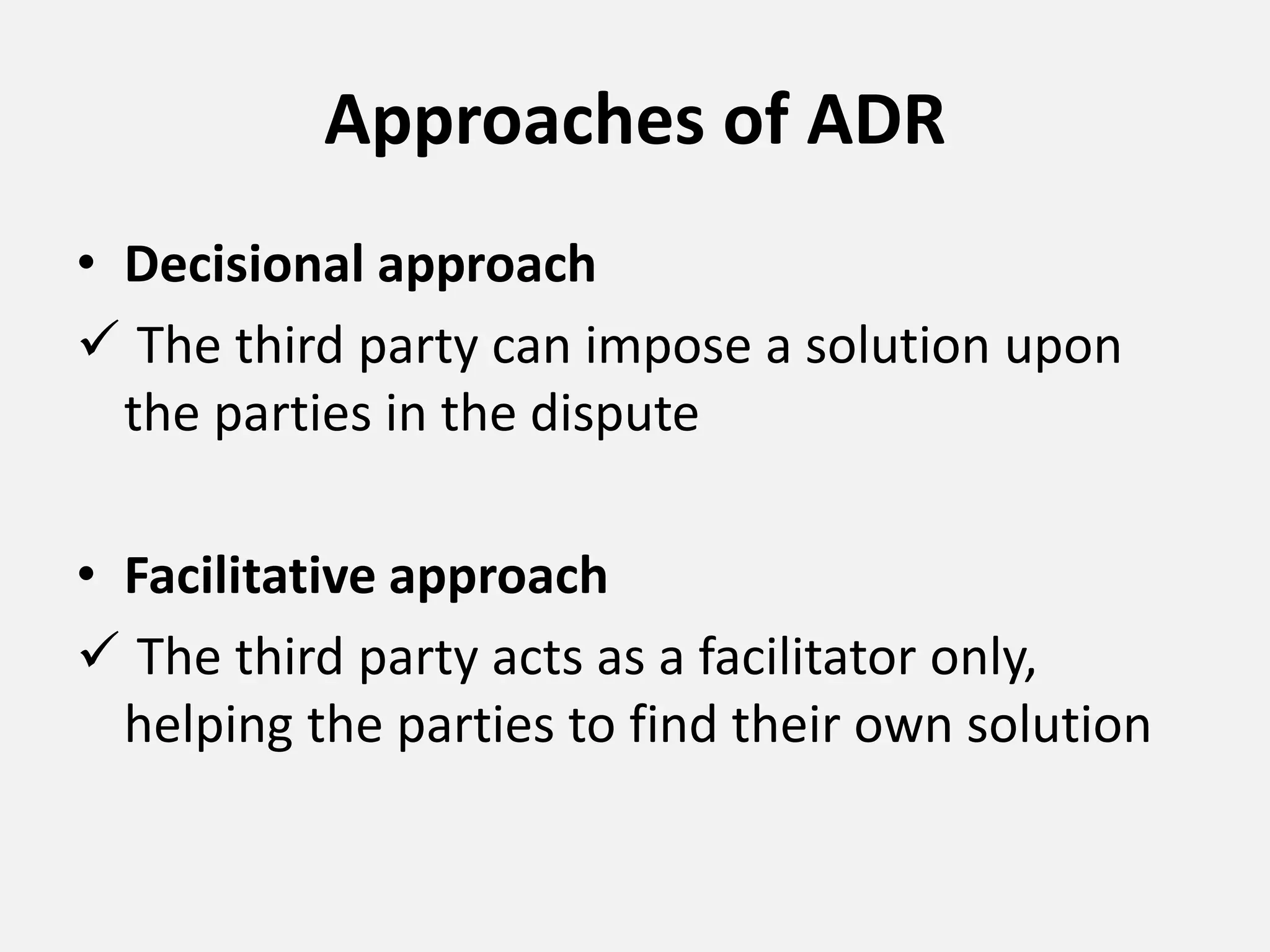
• Decisional approach
 The third party can impose a solution upon
the parties in the dispute
• Facilitative approach
 The third party acts as a facilitator only,
helping the parties to find their own solution
ADR METHODS
ADR METHODS
• Negotiation
• Mediation
• Conciliation
• Construction Adjudication
• Arbitration
• MED-ARB/ARB-MED
• Mini-Trial
• Early Neutral Evaluation
• Expert Determination
• Online Dispute Resolution (ODR)
• Private judging
• Summary Jury Trial
NEGOTIATION
• Negotiation is the most common dispute resolution
technique.
• Negotiation is a form of interaction between disputing
parties where they can reach a solution to the issues
between them without the involvement of a third
party.
• Difference between Bargaining and Negotiation
 Negotiation describes a competitive win-loss situation
whereas Bargaining describes a cooperative win-win
situation
 In Negotiation, one party leaves with a clear
advantage whereas in Bargaining, both the parties are
satisfied with the mutually agreed outcome
NEGOTIATION
• Principled negotiation or negotiation on the merits
developed at the Harvard Negotiation Project:
 Separate the people from the problem
 Focus on interests, not positions.
 Generate a variety of possibilities before deciding
what to do
 Insist that the result be based on some objective
standard.
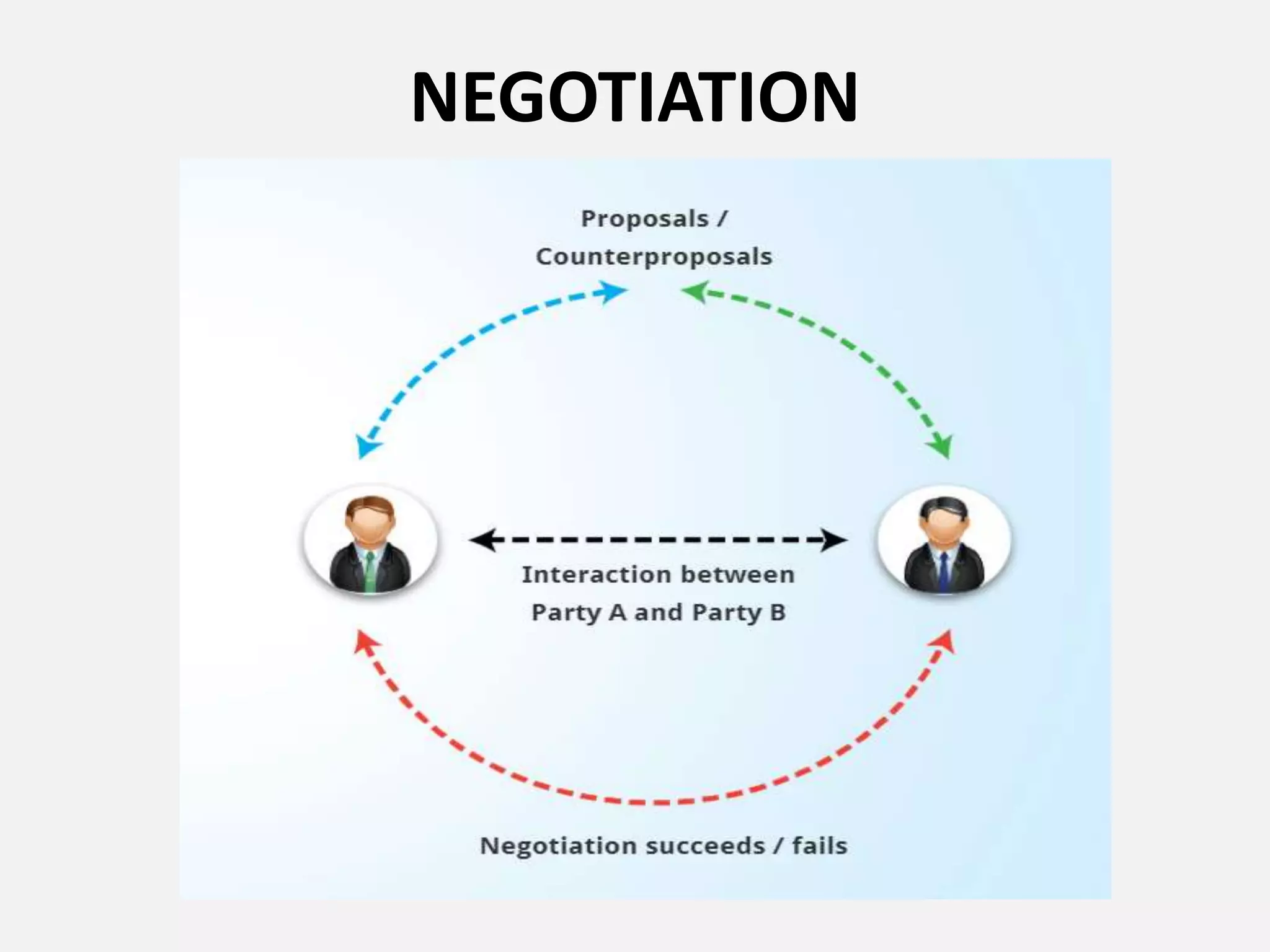
• Negotiation consists of a sequence of proposals (P)
and counterproposals (CP) that continue until
agreement is reached or negotiations break down.
NEGOTIATION
NEGOTIATION
• Negotiation consists of a sequence of
proposals (P) and counterproposals (CP) that
continue until agreement is reached or
negotiations break down.
• This mechanism involves an interaction
between disputing parties whereby, without
compulsion by a third-party adjudicator, they
endeavor to come to an independent, joint
decision concerning the terms of agreement
on the issues between them.
MEDIATION
• Mediation can be defined as the facilitation
by a third party of a negotiated agreement.
• The mediator does not decide the dispute,
but facilitates communication and problem-
solving by the parties.
MEDIATION
• A mediator has no decision-making power
• Primary roles of Mediator
 To facilitate dialogue and communication among the
parties in a structured, constructive way
 To help the parties realistically assess their positions
 To be a catalyst for a resolution designed by the
parties
• Mediation may be performed by international
organizations, by states or by individuals.
MEDIATION
• Advantages of Mediation
 Speed of the procedure
 Expertise of the mediators
 Confidentiality of the procedure
 Avoidance of procedural obstacles of all sorts
MEDIATION
• Procedure of Commercial Mediation
 Signing of a confidentiality agreement
 Outline of the format, given by the mediator, and a confirmation that all
of the parties have the authority to settle
 The mediator then invites both sides to make an opening statement,
which typically will include the facts as they see them and a discussion of
how they have allegedly been damaged by the opposing side
 Once each party has had the opportunity to present its case, the
mediator will summarize the information before hosting joint or private
meetings with the parties.
 Each party then will discuss its position with the mediator - describing its
view of the core issues and what it ultimately seeks as an outcome.
 The mediator should then work to bring about a settlement which
satisfies both parties’ interest.
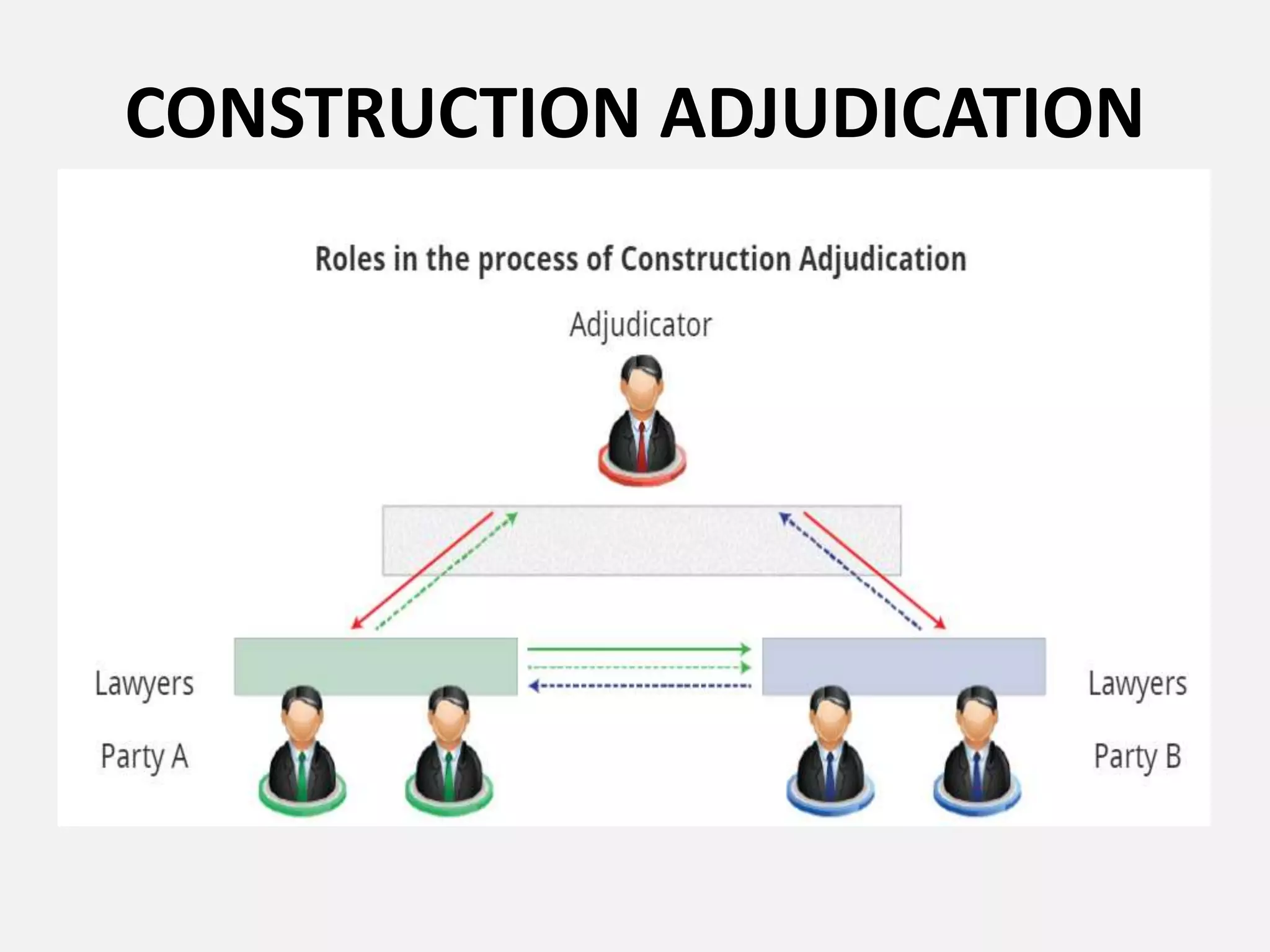
CONSTRUCTION ADJUDICATION
• A process where a neutral third party adjudicator (who may
not be a lawyer) has to reach a decision on matters referred
to him by the complaining party.
• It aims to address the cash-flow problems that contractors
often encounter in connection with disputed progress
payments by providing a speedy settlement that is binding on
both parties until the completion of the contract.
• Typically, adjudication looks at matters of “fairness”, rather
than “legality”. Usually, the issue is not one of the parties
breaking the law, but rather of one of the parties
misinterpreting the terms of the contract.
CONSTRUCTION ADJUDICATION
• Sometimes it is enough for the adjudicator to simply set out
the correct interpretation of the contract, but most disputes
involve claims for money, or for time extensions to the
contract.
• Once the adjudicator comes to a decision, the parties must
act on it immediately.
• An adjudicator must accept and consider any information
properly submitted by the parties and must make any
information submitted by one party, which the adjudicator
intends to consider, available to the other party’.
CONSTRUCTION ADJUDICATION
Process of Adjudication
• The adjudication process is started when the party referring
the dispute to adjudication serves a Notice of Intention to
Adjudication.
• The next step is to appoint an adjudicator within seven days
from service of the Notice.
• The Construction Act sets out a very short timetable for
adjudication to be completed, usually 28 days until the
adjudicator release the ultimate decision.
ARBITRATION
• Arbitration is a process by which parties obtain a resolution to a
dispute by getting a decision from a neutral, impartial and
independent third party. That decision is final and the parties must
abide by it.
• The process takes place, usually in private and on a confidential
basis, pursuant to an agreement between two or more parties.
• The parties agree to be bound by the decision to be given by the
arbitrator according to law or, if so agreed, other considerations,
after a fair hearing, such decisions being enforceable at law.
• Unlike mediation, the parties to arbitration only consent to the
process itself; the final decision is imposed upon them rather than
being a resolution which they have agreed between themselves.
ARBITRATION
• When both parties agree that arbitration is no longer the
best way to resolve their dispute, they may simply ignore
their agreement and process the dispute in another fashion.
• However, when only one party wishes to disavow the
agreement to arbitrate, however, its binding nature becomes
evident.
• An arbitration is not like proceedings in a court of law. There
is simply a group of people seated around a row of tables, in
a room hired for the occasion.
• If it were not for the stacked piles of lever-arch files, the law
books, and the transcript writers; it might look to an outsider
as if a conference or a business meeting was in progress.
ARBITRATION
Difference between Arbitration & Litigation
• Arbitration is a creation of contract (private agreement).
• The entire process derives its power and authority from the
fact that two parties have agreed to make use of an extra-
judicial ADR process. They have effectively said "I agree to be
bound by the decision of the arbitrator".
• This is distinct from the power of a court. No party has to say
"I agree to be bound by the decision of the judge". The judge's
power comes from the power of the state.
• However, the relationship between the courts and
arbitrations is often described as a "partnership"' since some
judicial oversight is needed for arbitration to work (Arbitration
Act).
ARBITRATION
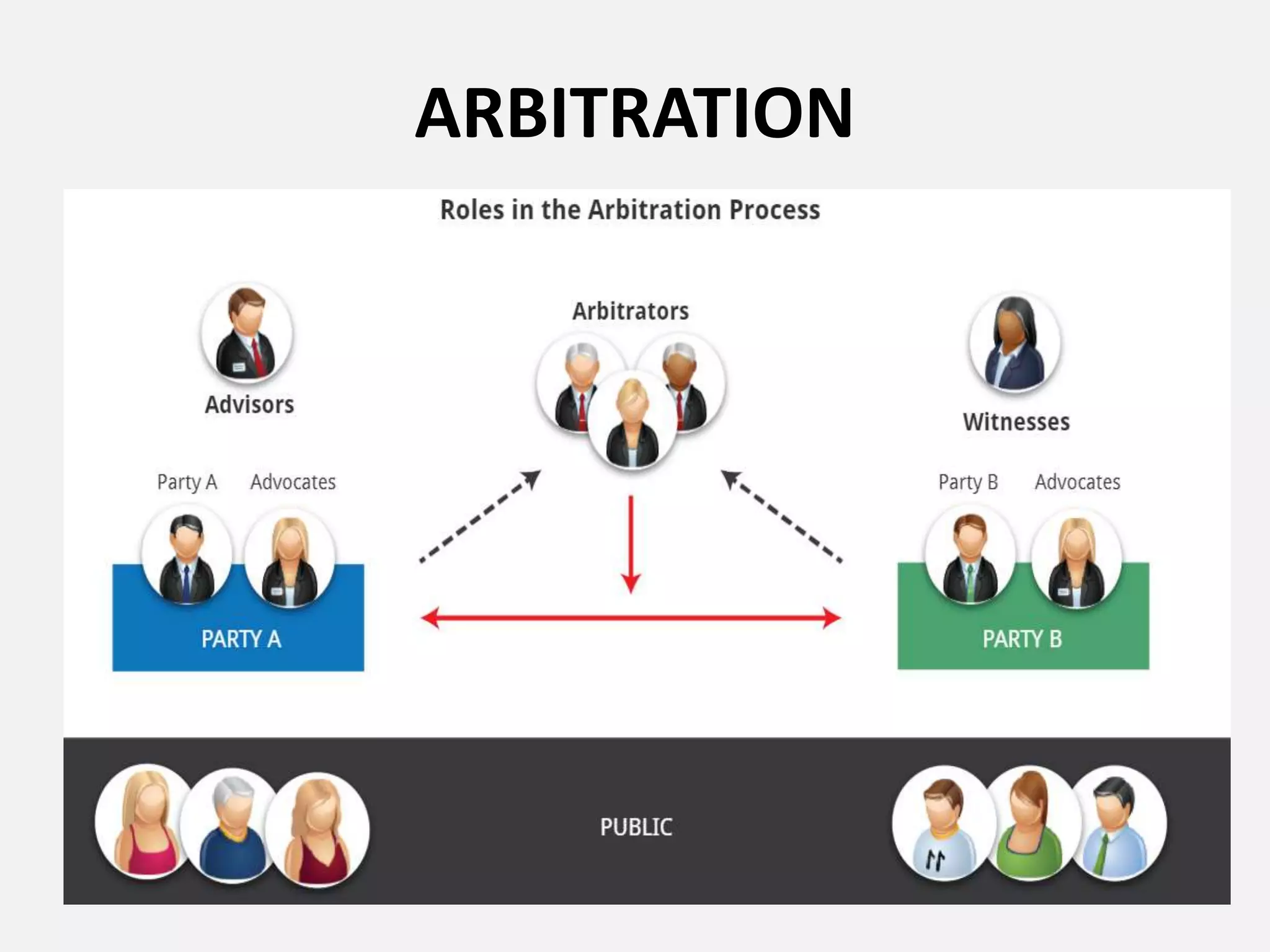
• Arbitrations can be arranged by the parties themselves (ad
hoc) or through institutions that specialize in these services
(institutional).
• Unlike other forms of ADR which require both parties - or at
least their representatives - to participate, arbitrations can
'proceed even without a recalcitrant party present'.
ARBITRATION
ARBITRATION
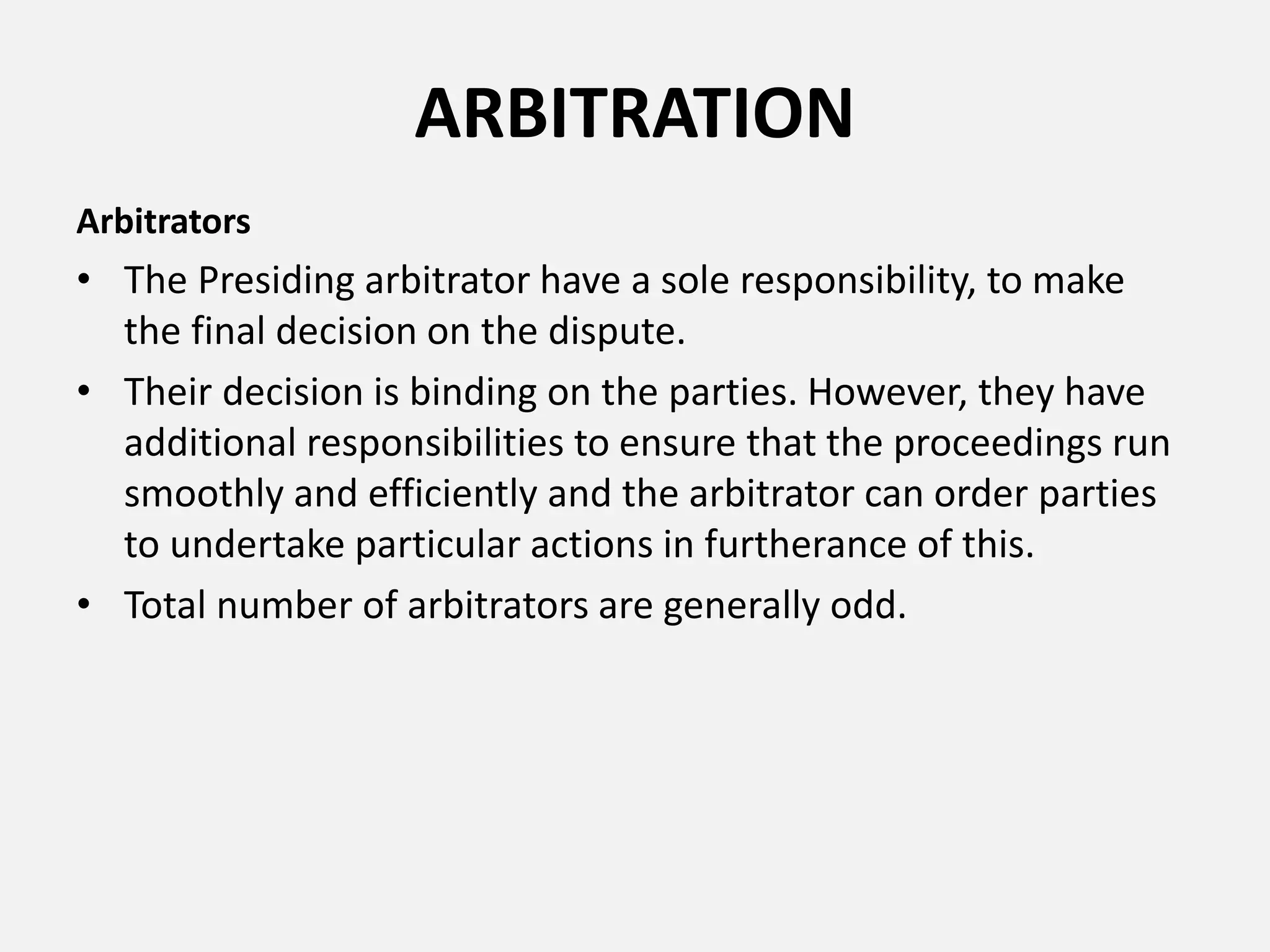
Arbitrators
• The Presiding arbitrator have a sole responsibility, to make
the final decision on the dispute.
• Their decision is binding on the parties. However, they have
additional responsibilities to ensure that the proceedings run
smoothly and efficiently and the arbitrator can order parties
to undertake particular actions in furtherance of this.
• Total number of arbitrators are generally odd.
ARBITRATION
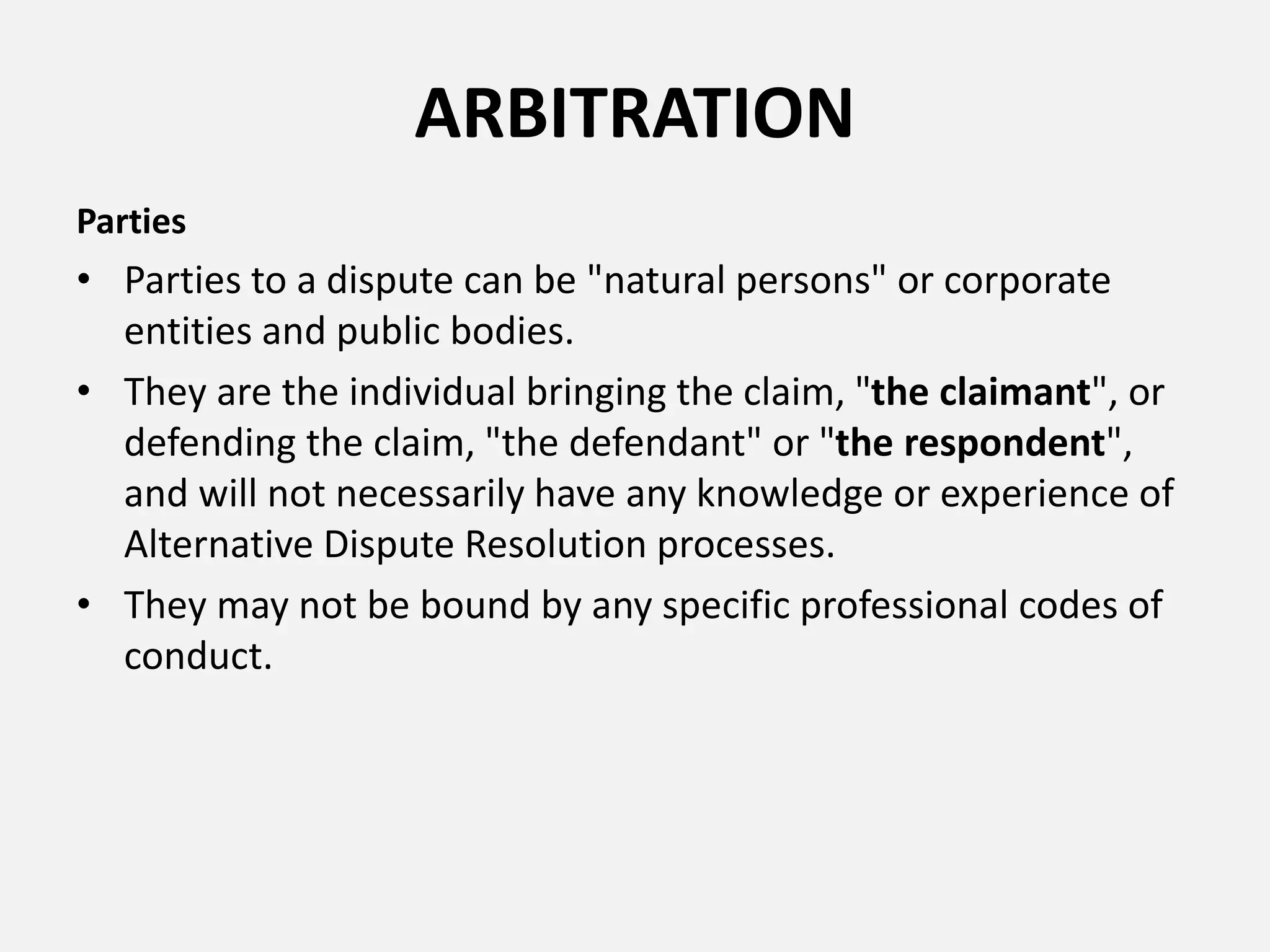
Parties
• Parties to a dispute can be "natural persons" or corporate
entities and public bodies.
• They are the individual bringing the claim, "the claimant", or
defending the claim, "the defendant" or "the respondent",
and will not necessarily have any knowledge or experience of
Alternative Dispute Resolution processes.
• They may not be bound by any specific professional codes of
conduct.
ARBITRATION
Advocates
• These are the lawyers or other specialist advocates who
represent the parties in the dispute.
• They will advise their clients, make submissions to the
arbitrator, and communicate with the opposing advocate
about the dispute.
• Advocates are likely to be qualified lawyers, and therefore
will be governed by specific professional codes of conduct.
Advisers
• In addition to advocates, parties may instruct specialist
advisors to help them construct or defend their claim.
• This is often true where a case involves particular issues such
as taxation or technical engineering problems .
ARBITRATION
Witnesses
• A witness is an individual that presents evidence to the arbitrator.
• Their role is to provide the arbitrator with additional information that will
assist them in making their decision. These witnesses may either be
witnesses of fact, or expert witnesses, who are witnesses of opinion.
The Public
• Unlike court proceedings, arbitration proceedings are generally private
and confidential. Privacy entails strangers being excluded from the
hearings unless consented to by parties (hearing in camera) and
confidentiality broadly entails the prevention of disclosure to persons not
involved in the arbitration including the existence of the arbitration, the
documents produced and the Award.
• This will frequently be governed by the terms of the arbitration
agreement.
ARBITRATION
Domestic Arbitration
• Domestic Arbitration presents a dispute that is related to only
one jurisdiction: while the disputing parties may be from
different jurisdiction, the arbitral seat, substantive and
procedural laws are all from the one jurisdiction.
• International Commercial Arbitration
 The UNCITRAL Model Law on International Commercial
Arbitration as amended by the United Nations Commission on
International Trade Law on 07 July 2006 defines International
Commercial Arbitration at Articles (3) and (4) as follows:
ARBITRATION
• International Commercial Arbitration (CONT…)
 "(3) An arbitration is international if:
 a) the parties to an arbitration agreement have, at the time of the
conclusion of that agreement, their places of business in different states:
or
 b) one of the following places is situated outside the State in which the
parties have their places of business:
(i) the place of arbitration if determined in, or pursuant to, the arbitration
agreement;
(ii) any place where a substantial part of the obligations of the commercial
relationship is to be performed or the place with which the subject-matter of
the dispute is most closely connected; or
 c) the parties have expressly agreed that the subject -matter of the
arbitration agreement related to more than one country."
ARBITRATION
• International Commercial Arbitration (CONT…)
 (4) For the purposes of paragraph (3) of this article:
 (a) if a party has more than one place of business , the place of business is
that which has the closest relationship to the arbitration agreement;
 (b) if a party does not have a place of business, reference is to be made ot
his habitual residence."
• 156 countries have adopted the New York Convention on the
Recognition and Enforcement of Foreign Arbitral Awards. Through
this they have agreed to 'recognize arbitral awards [from other
states] as binding and enforce them in accordance with [their] rules
of procedure', parties can have confidence that their awards will be
enforced almost anywhere in the world.
MED-ARB / ARB-MED
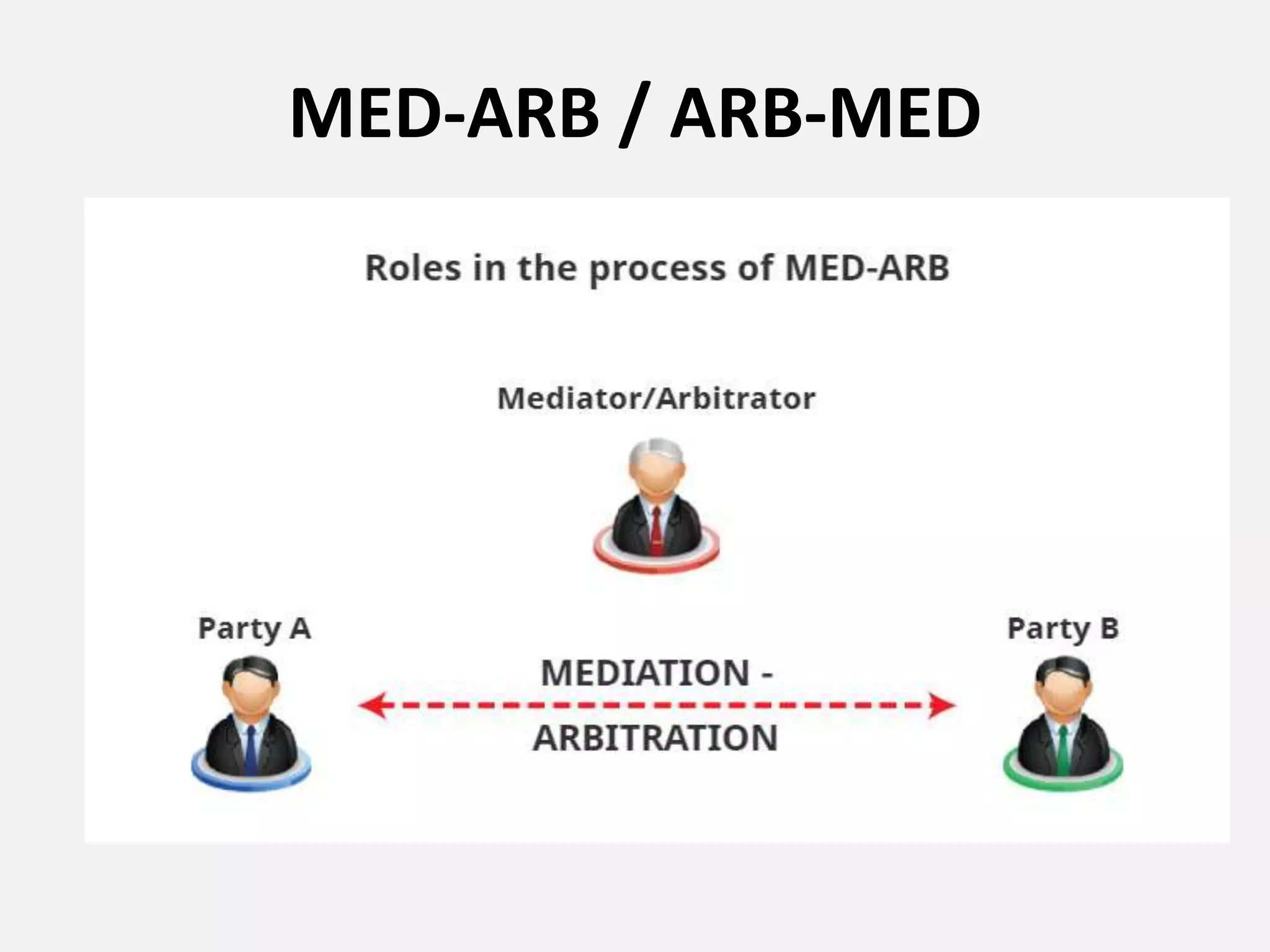
• MED-ARB / ARB-MED is a hybrid process which combines the
use of both mediation and arbitration.
• MED-ARB recognizes that mediation may not resolve all the
issues between the parties but limits the arbitration solely to
the intractable disputes, thereby bringing a cost and time
saving to the parties.
• If no agreement is reached the mediator will then change
roles and become an arbitrator empowered to impose a
binding decision on the parties
• Since he or she is already well-acquainted with the facts and
thus does not have the same learning curve as an appointee
coming fresh to the dispute.
MED-ARB / ARB-MED
• Critics review on Med-Arb
 Critics have argued that MED-ARB does not encourage parties
to be honest about their situation due to a fear that
confidential information disclosed in good faith could
ultimately be used against them in the arbitration stage.
 However, parties are not fooled by the fact that they know
that the med-arbiter has the authority to make the decision if
the parties fail to work out their own arrangement.
 It is precisely that knowledge that is the incentive for the
parties to reach their own agreement'
MED-ARB / ARB-MED
• To overcome this criticism, some have started to reverse the
process by turning it into ARB-MED.
• The most effective way to disarm a possible challenge to one's
ability to maintain impartiality is to switch the order of those
functions by having the arbitrator prepare a final award
before informing the parties .
• Once he is fully vacated of his duties and office as an
arbitrator and that they both agreed, he would be prepared to
attempt to mediate the dispute between them.
• If the mediation fails then and then only arbitration proceeds
& the award (which had already been prepared before) is
made binding to the parties.
MED-ARB / ARB-MED
• To overcome this criticism, some have started to reverse the
process by turning it into ARB-MED.
• The most effective way to disarm a possible challenge to one's
ability to maintain impartiality is to switch the order of those
functions by having the arbitrator prepare a final award
before informing the parties .
• Once he is fully vacated of his duties and office as an
arbitrator and that they both agreed, he would be prepared to
attempt to mediate the dispute between them.
• If the parties are not able to resolve their dispute during the
mediation phase, however, the decision of the neutral third
party, made in the arbitration, is released and they are bound
by it.
MED-ARB / ARB-MED
• However, there can be an argument that as both the
arbitrator and mediator role is played by the neutral person;
there may be possibility that he/she may influence the
mediation process in line with the arbitration award prepared
by him.
• Therefore, another way of conducting MED-ARB or ARB-MED
involves different neutrals fulfilling the roles of mediator and
arbitrator.
• When the parties' desire a private method of dispute
resolution combining the 'consensuality' of mediation with
the 'finality' of arbitration; MED-ARB is both a logical and
appropriate choice.
MED-ARB / ARB-MED
Conciliation
• Conciliation has played an important role in resolving disputes
during the European and American industrial eras.
• Conciliation first appeared in English law, in the Conciliation
Act, 1896.
• In 1913, In the US, Congress expressly authorized the
Department of Labour to establish 'commissions of
conciliation' to help resolve disputes outside of the court
system.
Conciliation
• Difference between Conciliation and Mediation
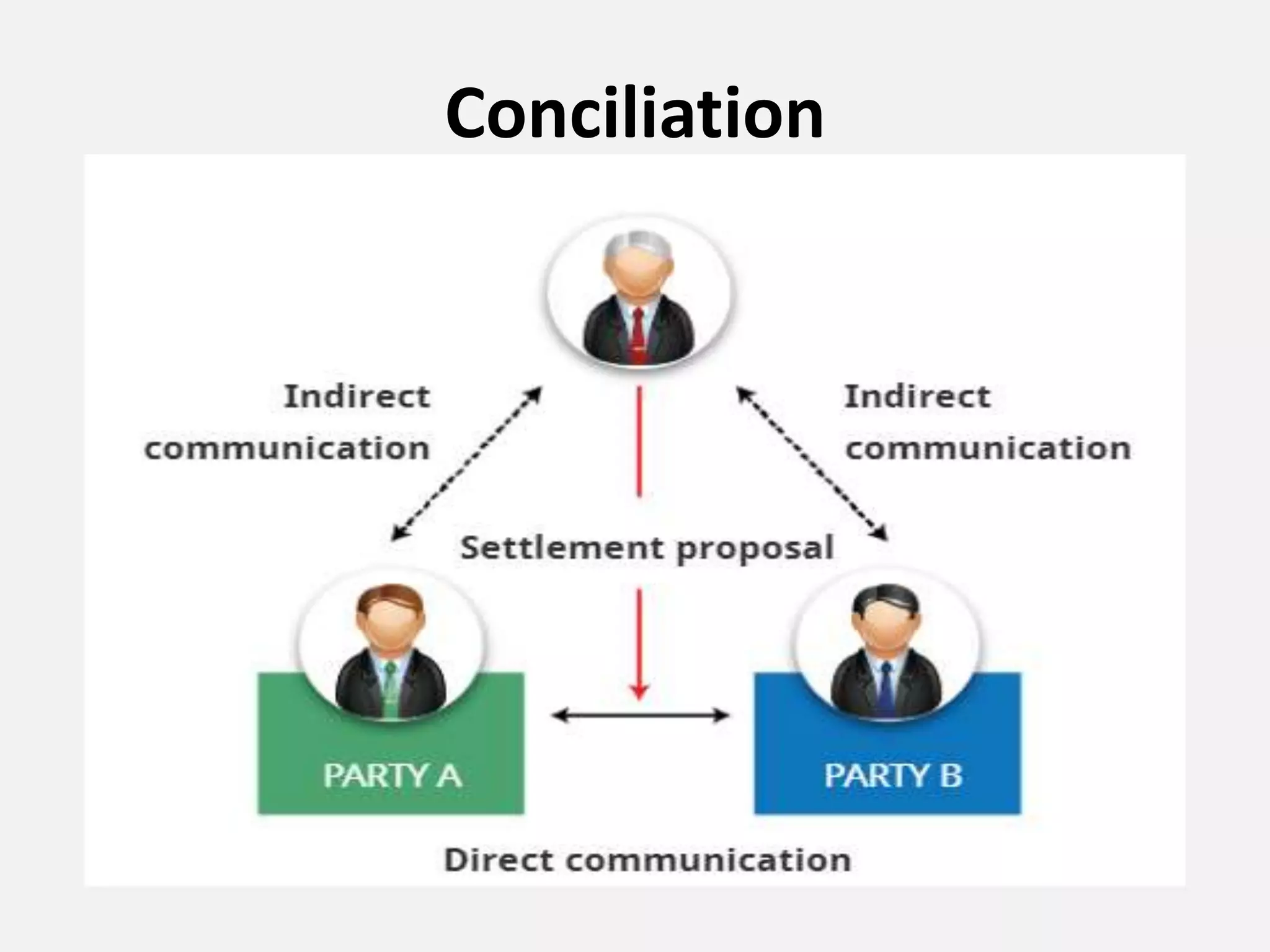
 In conciliation, the third party suggests a solution, more
formal than mediation. However, a conciliator lacks any
authority to impose a solution or procedure on the parties but
rather helps them negotiate with each other. Thus, decision is
not binding to the parties.
Whereas,
 In Mediation the third party facilitates the parties in dispute
achieving their own solution. Can involve separate meetings
between the third party and each party. He does not directly
give any solution.
Conciliation
• The role of the conciliator is to assist the parties to agree on a
process by which they will attempt to resolve their dispute.
• A conciliator will not normally involve himself or herself with
the substantive issues of the dispute other than perhaps to
identify and daily the real issues of fact and law.
• Conciliation gives flexibility to the parties as they are entitled
to craft their own rules, select the conciliator of their choice,
and decide when to abandon the process altogether.
• Conciliation is a non-adversarial mechanism, and it allows the
parties to preserve their relationship.
Conciliation
Mini-Trial
• Despite using the word trial, a Mini-Trial is not really a trial at
all but a carefully structured and refined method that enables
the parties in a dispute to settle the core issues.
• This emphasis on identifying the dispute's substance rather
than being hindered by procedural issues is a defining
attribute of the Mini-Trial.
• Following a brief period of discovery, it consists of a short
hearing (not more than two or three days) and a period of
negotiation (not more than fifteen days).
• The procedures followed for the Mini-Trial hearing are
devised by the parties.
Mini-Trial
• The key characteristic of the Mini-Trial is its ability to provide
information directly to the parties so that they can evaluate
relative strengths and weaknesses of each side and enter into
well-informed, focused settlement discussions.
• The presence of the parties (senior executives) with the
power and desire to settle the dispute is essential to its
success.
• The Mini-Trial has been an ‘appropriate mechanism' in cases
involving complex questions of law and fact such as patent
law, product liability, unfair competition, antitrust and
contract cases which often lead to protracted and very costly
litigation.
Mini-Trial
• Mini-Trials are typically conducted after pre-trial discovery is
under way because the issues need to be sufficiently
developed in order for the hearing to be meaningful.
• In determining when to propose a Mini-Trial, parties should
base their decision on a cost/benefit analysis of the value of
obtaining additional information.
• Ultimately, in Mini-Trial the parties can resolve a dispute
themselves in an informal proceeding in which lawyers and
experts for each side give summary presentations of their
best cases to a jointly selected neutral advisor.
• If the parties cannot reach an agreement the neutral advisor
provides an incentive to settle by indicating what a likely trial
outcome would be'.
Mini-Trial
• The reason the Mini-Trial is such a useful technique is that the
presentation of the evidence is not made to a person with the
authority to issue a binding judgment, but to the parties
themselves.
Early Neutral Evaluation
• In the early 1980s, the US District Court for the Northern
District of California became concerned about improving its
attorneys pre-trial practices and case management.
• The Court argued that it was at the formative stages of
litigation where the most time and money could be saved,
and that more direct communication would have the most
beneficial effects in limiting the scope of many disputes.
• As a result of the Court's efforts, the practice of Early Neutral
Evaluation (ENE) was developed.
• Early Neutral Evaluation (ENE) can be defined as 'an early,
frank and thoughtful' evaluation of the relative positions of
the parties, as well as an evaluation of the overall value of the
case.
Early Neutral Evaluation
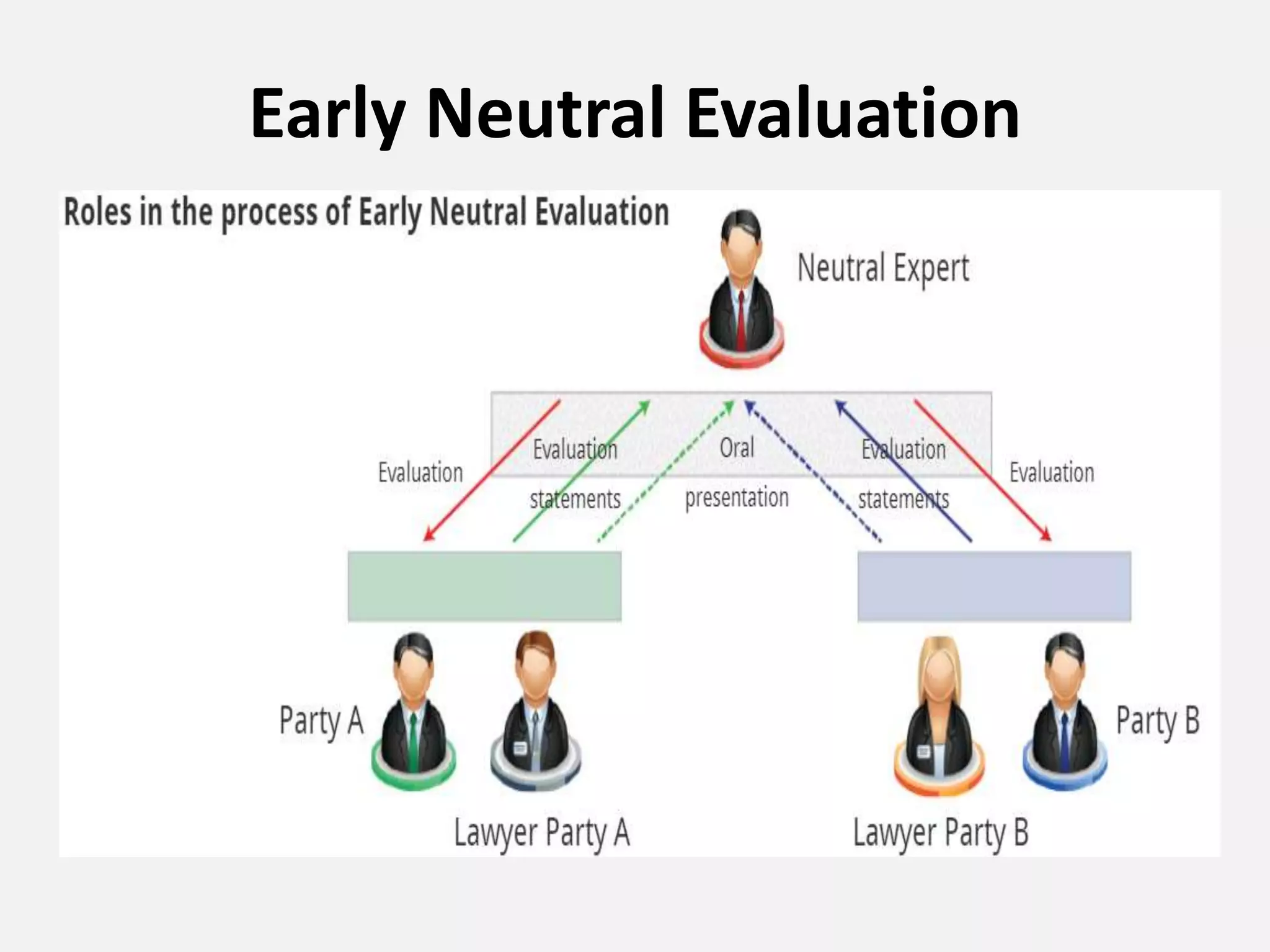
• Process
 The evaluator is a neutral, very experienced and specialist
private practitioner (a neutral expert).
 The evaluation delivered is entirely confidential and is based
on a consideration of the parties' written evaluation
statements and oral presentations.
 It is delivered verbally to the parties and their legal
representative, and aims to offer a realistic view of what
might happen if a case is fully prepared and tried. By doing so,
it is hoped that the parties will wish to avoid the complexities
and costs of a trial, and engage in successful negotiation.
 Even if the dispute is about to go to trail, ENE can still be
attempted as a means to prevent the trail going ahead.
Early Neutral Evaluation
• Confidential Meetings
 In an ENE, disputing parties meet confidentially with a neutral expert to
identify the issues in a dispute, assess the merits of the claims, and
explore any options for settlement of the dispute.
 Sessions normally last around two hours.
 The evaluator identifies the issues on which the parties agree and also
identifies the issues in dispute.
• Communication
 All participants have access to the information and communications that
the neutral expert receives before he or she prepares the evaluation, to
any questions they have asked and answers they have received, and every
part is present for substantive presentations.
Early Neutral Evaluation
Expert Determination
• Traditionally, the role of an expert is that of assessment,
valuation, and certification.
For example, an expert may be asked:
 to value a house or a block of flats
 to assess the price of shares in a private company or a professional
partnership
 to certify the sum payable for work done by a building or engineering
contractor.
• However, the work of the expert extends beyond this
traditional role into that of a 'decision-maker', not just
bringing expert evidence and opinion to a dispute, but going
further and providing a determination of the dispute.
Expert Determination
• Expert Determination (ED) is a process whereby two parties
agree to submit an issue to a third party for determination.
• It is mainly used in disputes which revolve around a technical
area which require an expert to give an opinion on a specific
issue or issues.
• It can be expensive and time-consuming to bring technical
disputes to court, and so ED can often bring disputes to a
close much more efficiently.
• The expert could be a lawyer, accountant or person from
another appropriate professional discipline who is required to
resolve the dispute.
• The parties agree that the decision of the expert is to be final
and binding.
Expert Determination
• The scope of the dispute is limited to questions of fact and in
most cases extend to questions of law or involve mixed
questions of law and fact.
• Thus once the question of fact is determined, the expert's role
ends immediately.
• Experts must act with impartiality, must have no vested
interest in the outcome of the dispute and must not be biased
in any way towards or against either party.
• If the expert becomes aware of any circumstance which might
reasonably be considered to affect his ability to act impartially
and disinterestedly, he must inform the parties' immediately.
Expert Determination
• Appointment of Expert
 The appointment of an expert is generally in the hands of the parties, and
it is up to them to ensure a suitable expert is appointed.
 It is a matter of private contract between the parties, and the criterion for
determining the suitability of an expert to decide issues depends on the
wording of the contract and discussions between the parties.
• Expert determination is not subject to a legislative framework,
and the authority of the independent expert is dependent on
the parties.
• The expert can consider any information which he decides is
relevant to the determination of the issue since the rules of
law on admissibility of evidence do not apply.
Expert Determination
Online Dispute Resolution (ODR)
• Online Dispute Resolution (ODR) refers to the use of ADR
mechanisms through the Internet as a means]to resolve
commercial disputes that arise from online transactions.
• It is believed that ODR was technologically developed in the
US and Canada.
• ADR moved dispute resolution "out of court", ODR moves
even further away from court-to cyberspace.
• The first decision to be rendered after online proceedings was
made in 1996. The case concerned an advertisement
'[promoting] the availability of millions of email addresses' for
sale. Since then, a plethora of ODR 'services [have arisen]
within the Internet community'
Online Dispute Resolution (ODR)
• Online Dispute Resolution (ODR) refers to the use of ADR
mechanisms through the Internet as a means]to resolve
commercial disputes that arise from online transactions.
• It is believed that ODR was technologically developed in the
US and Canada.
• ADR moved dispute resolution "out of court", ODR moves
even further away from court-to cyberspace.
• The first decision to be rendered after online proceedings was
made in 1996. The case concerned an advertisement
promoting the availability of millions of email addresses for
sale. Since then, a plethora of ODR services have arisen within
the Internet community.
Online Dispute Resolution (ODR)
• The population of Internet users is growing every day, and the
increasing development of online interaction between
Internet users will inevitably result in more disputes.
• People will increasingly enter into electronic contracts and
perform their duties without ever exchanging a sheet of
paper.
• Therefore, ODR can be a practical and effective alternative to
traditional court systems.
Online Dispute Resolution (ODR)
• The Founding idea of ODR is online versions of almost all
offline dispute resolution processes.
i.e. mediation, conciliation, arbitration etc.
• Although it was traditionally developed as a means to resolve
online related disputes, ODR can be used to resolve a wide
variety of disputes.
• In those cases where parties are at a distance or when the
need is for a cheaper and faster mechanism for resolving their
disputes the use of online technology appears to be more
appropriate since it avoids the physical limitations of many
ADR forms.
Online Dispute Resolution (ODR)
• While online systems provide several technological
advantages, they may raise many issues related to how to
ensure enforcement of online decisions .
• Despite this, judicial enforcement of these decisions has
increased during the last few years.
Private Judging
• Private Judging (PJ) was first developed in 1976 when two
attorneys decided to use a provision of California's Civil Code
to resolve a complex commercial dispute.
• Legally known as a 'general order of reference', the statutory
framework behind PJ establishes that after consent by all
parties and an order from the presiding judge of a public
court, the parties may appoint a private decision-maker,
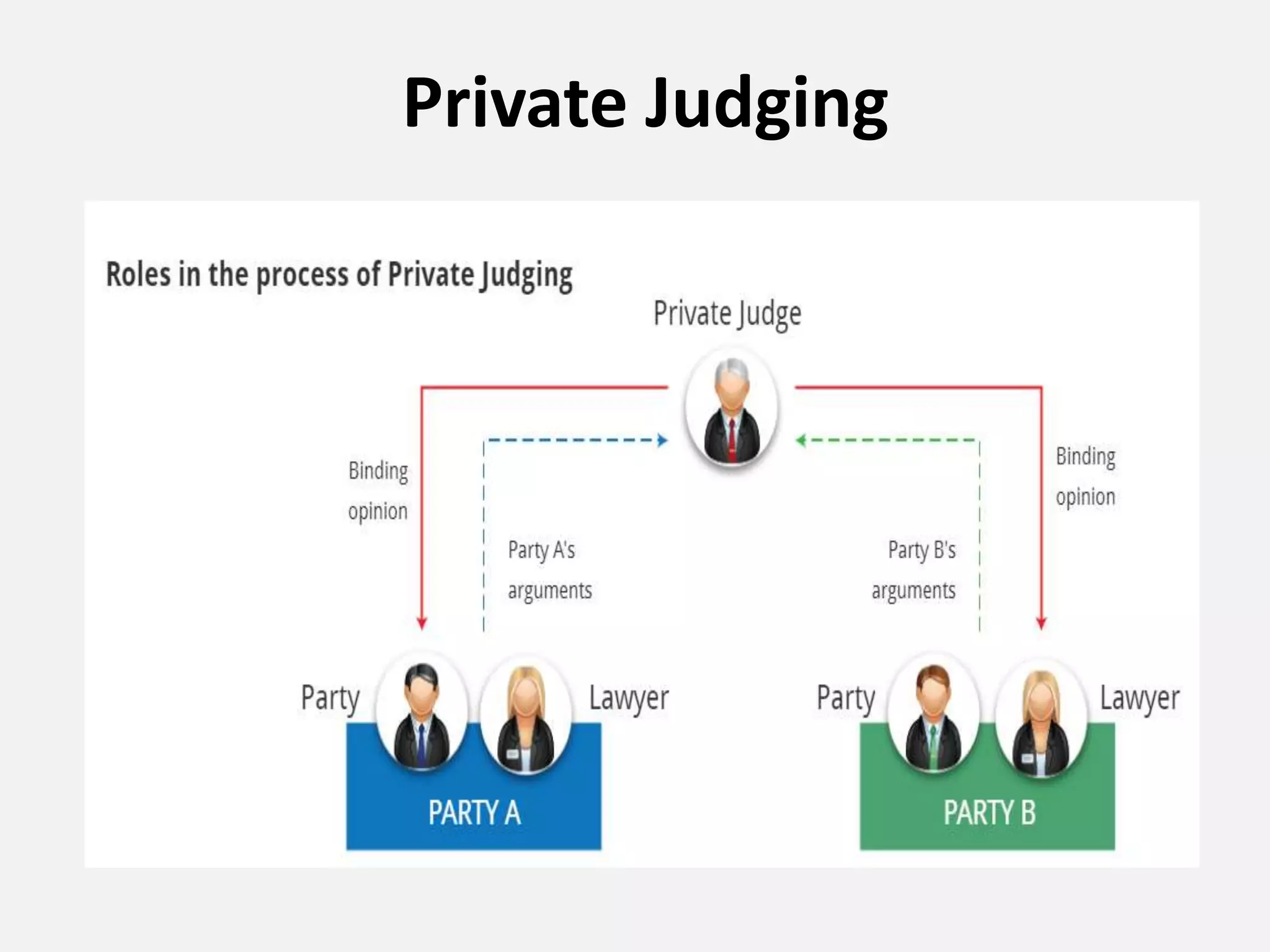
usually a retired judge, who hears the parties' arguments and
then issues a binding opinion.
• These private judges are vested with the authority of public
judges and are subject to the same legal constraints, and issue
judgments that are directly appealable.
Private Judging
• PJ is a procedure whereby litigants bypass the traditional
routes (and protracted costs) of litigation by sharing the cost
of privately "renting" a judge to hear their case. Any decision
is binding on both parties.
• Unlike binding arbitration, however, the decision has the
same legal weight as that of a decision by a state trial court
meaning it can be appealed.
• However, because the parties are able to choose who will be
the judge in their case - typically someone who has
'experience and expertise in the subject matter of the dispute'
- the judge's ruling is generally unlikely to be appealed.
Private Judging
• The private trial can be held at any convenient time and place,
and the parties are under no obligation to admit the general
public.
• Despite the seemingly informal nature of the proceeding,
private judges conduct hearings under the same procedure
and with the same formality as traditional judges.
• The Evidence Code applies to private judging and private
judges may not disregard previous legal decisions impacting
the case.
• Although PJ shares certain similarities with the traditional
litigation system, the proceedings are conducted out of public
view and the result is confidential, making it an ideal
mechanism for parties seeking a quiet resolution to their
dispute.
Private Judging
Summary Jury Trial
• The Summary Jury Trial (SJT) was developed by Judge Thomas
Lambros of the US District Court for the Northern District of
Ohio in 1980.
• The Summary Jury Trial is 'a procedure in which attorneys
present a summary of their cases to an "advisory jury".
• It is designed to encourage litigants to settle their disputes by
illustrating how a trial jury might evaluate the case. The jury's
"verdict" is non-binding'; however, 'the jurors are not usually
told this explicitly'.
Summary Jury Trial
• To minimize the parties' expenses in both cost and time, the
Summary Jury Trial is greatly abbreviated when compared
with a traditional trial.
• It can be completed in a day or less. Typically, six mock jurors
are chosen to hear the parties case summaries.
• Since the mock jurors are drawn from the same pool as
prospective jurors in a real trial, parties participating in a SJT
can be confident that the jury's verdict is a likely reflection of
the verdict a real jury would reach.
• Because the mock jury's verdict is non-binding, however, the
SJT in no way affects parties' right to a full trial if one or both
parties feel the result of the jurors' deliberation is grossly
inequitable, the entire matter can be forgotten.
Summary Jury Trial
• After the verdict has been announced, a short conference is
necessary to discuss the verdict and to establish a timetable
for settlement negotiations
• At least two weeks should be allowed for parties and their
counsel to consider the results.
• SJT has been successfully employed in the US federal system
to help parties avoid the need for a real jury trial.
Summary Jury Trial

Alternative Dispute Resolution (ADR)

  • 1.
    Alternative Dispute Resolution (ADR) -ShyamAnandjiwala M.Tech (IIT Delhi)
  • 2.
    Why ADR? • ADRoffers a way to settle disputes without needing to involve the courts, and generally involves bringing in a neutral and impartial third party. • The term ADR was first formally used in 1976 in Pound Conference, United States. • However, there were various processes which were in existence before this time. • At the time, courts were finding themselves overstretched trying to cope with new filings, and there were concerns that because of this congestion, justice was not being served.
  • 3.
    Why ADR? • Inresponse to rising court costs, delays and congestion, the need to facilitate access to justice and to provide more 'effective' forms of dispute resolution, the phenomenon known as ADR was born. • In 1990, the US Congress enacted the Administrative Dispute Resolution Act which 'gave federal agencies additional authority to use ADR in most administrative disputes' and the Negotiated Rulemaking Act which 'directed regulatory agencies to use negotiation to develop administrative rules. • In 1996, both of these laws were re-enacted as part of the Alternative Dispute Resolution Act - an important piece of legislation which among other things, authorizes district courts to devise and implement their own ADR programmes. • In the European Union, the importance of ADR was recently affirmed in 2007, when Article 65.2(g) of the Treaty of Lisbon established that the European Parliament and Council shall adopt measures aimed at ensuring the development of alternative methods of dispute settlement.
  • 4.
    Approaches of ADR •Decisional approach  The third party can impose a solution upon the parties in the dispute • Facilitative approach  The third party acts as a facilitator only, helping the parties to find their own solution
  • 5.
  • 6.
    ADR METHODS • Negotiation •Mediation • Conciliation • Construction Adjudication • Arbitration • MED-ARB/ARB-MED • Mini-Trial • Early Neutral Evaluation • Expert Determination • Online Dispute Resolution (ODR) • Private judging • Summary Jury Trial
  • 7.
    NEGOTIATION • Negotiation isthe most common dispute resolution technique. • Negotiation is a form of interaction between disputing parties where they can reach a solution to the issues between them without the involvement of a third party. • Difference between Bargaining and Negotiation  Negotiation describes a competitive win-loss situation whereas Bargaining describes a cooperative win-win situation  In Negotiation, one party leaves with a clear advantage whereas in Bargaining, both the parties are satisfied with the mutually agreed outcome
  • 8.
    NEGOTIATION • Principled negotiationor negotiation on the merits developed at the Harvard Negotiation Project:  Separate the people from the problem  Focus on interests, not positions.  Generate a variety of possibilities before deciding what to do  Insist that the result be based on some objective standard. • Negotiation consists of a sequence of proposals (P) and counterproposals (CP) that continue until agreement is reached or negotiations break down.
  • 9.
  • 10.
    NEGOTIATION • Negotiation consistsof a sequence of proposals (P) and counterproposals (CP) that continue until agreement is reached or negotiations break down. • This mechanism involves an interaction between disputing parties whereby, without compulsion by a third-party adjudicator, they endeavor to come to an independent, joint decision concerning the terms of agreement on the issues between them.
  • 11.
    MEDIATION • Mediation canbe defined as the facilitation by a third party of a negotiated agreement. • The mediator does not decide the dispute, but facilitates communication and problem- solving by the parties.
  • 12.
    MEDIATION • A mediatorhas no decision-making power • Primary roles of Mediator  To facilitate dialogue and communication among the parties in a structured, constructive way  To help the parties realistically assess their positions  To be a catalyst for a resolution designed by the parties • Mediation may be performed by international organizations, by states or by individuals.
  • 13.
    MEDIATION • Advantages ofMediation  Speed of the procedure  Expertise of the mediators  Confidentiality of the procedure  Avoidance of procedural obstacles of all sorts
  • 14.
    MEDIATION • Procedure ofCommercial Mediation  Signing of a confidentiality agreement  Outline of the format, given by the mediator, and a confirmation that all of the parties have the authority to settle  The mediator then invites both sides to make an opening statement, which typically will include the facts as they see them and a discussion of how they have allegedly been damaged by the opposing side  Once each party has had the opportunity to present its case, the mediator will summarize the information before hosting joint or private meetings with the parties.  Each party then will discuss its position with the mediator - describing its view of the core issues and what it ultimately seeks as an outcome.  The mediator should then work to bring about a settlement which satisfies both parties’ interest.
  • 15.
    CONSTRUCTION ADJUDICATION • Aprocess where a neutral third party adjudicator (who may not be a lawyer) has to reach a decision on matters referred to him by the complaining party. • It aims to address the cash-flow problems that contractors often encounter in connection with disputed progress payments by providing a speedy settlement that is binding on both parties until the completion of the contract. • Typically, adjudication looks at matters of “fairness”, rather than “legality”. Usually, the issue is not one of the parties breaking the law, but rather of one of the parties misinterpreting the terms of the contract.
  • 16.
    CONSTRUCTION ADJUDICATION • Sometimesit is enough for the adjudicator to simply set out the correct interpretation of the contract, but most disputes involve claims for money, or for time extensions to the contract. • Once the adjudicator comes to a decision, the parties must act on it immediately. • An adjudicator must accept and consider any information properly submitted by the parties and must make any information submitted by one party, which the adjudicator intends to consider, available to the other party’.
  • 17.
  • 18.
    CONSTRUCTION ADJUDICATION Process ofAdjudication • The adjudication process is started when the party referring the dispute to adjudication serves a Notice of Intention to Adjudication. • The next step is to appoint an adjudicator within seven days from service of the Notice. • The Construction Act sets out a very short timetable for adjudication to be completed, usually 28 days until the adjudicator release the ultimate decision.
  • 19.
    ARBITRATION • Arbitration isa process by which parties obtain a resolution to a dispute by getting a decision from a neutral, impartial and independent third party. That decision is final and the parties must abide by it. • The process takes place, usually in private and on a confidential basis, pursuant to an agreement between two or more parties. • The parties agree to be bound by the decision to be given by the arbitrator according to law or, if so agreed, other considerations, after a fair hearing, such decisions being enforceable at law. • Unlike mediation, the parties to arbitration only consent to the process itself; the final decision is imposed upon them rather than being a resolution which they have agreed between themselves.
  • 20.
    ARBITRATION • When bothparties agree that arbitration is no longer the best way to resolve their dispute, they may simply ignore their agreement and process the dispute in another fashion. • However, when only one party wishes to disavow the agreement to arbitrate, however, its binding nature becomes evident. • An arbitration is not like proceedings in a court of law. There is simply a group of people seated around a row of tables, in a room hired for the occasion. • If it were not for the stacked piles of lever-arch files, the law books, and the transcript writers; it might look to an outsider as if a conference or a business meeting was in progress.
  • 21.
    ARBITRATION Difference between Arbitration& Litigation • Arbitration is a creation of contract (private agreement). • The entire process derives its power and authority from the fact that two parties have agreed to make use of an extra- judicial ADR process. They have effectively said "I agree to be bound by the decision of the arbitrator". • This is distinct from the power of a court. No party has to say "I agree to be bound by the decision of the judge". The judge's power comes from the power of the state. • However, the relationship between the courts and arbitrations is often described as a "partnership"' since some judicial oversight is needed for arbitration to work (Arbitration Act).
  • 22.
    ARBITRATION • Arbitrations canbe arranged by the parties themselves (ad hoc) or through institutions that specialize in these services (institutional). • Unlike other forms of ADR which require both parties - or at least their representatives - to participate, arbitrations can 'proceed even without a recalcitrant party present'.
  • 23.
  • 24.
    ARBITRATION Arbitrators • The Presidingarbitrator have a sole responsibility, to make the final decision on the dispute. • Their decision is binding on the parties. However, they have additional responsibilities to ensure that the proceedings run smoothly and efficiently and the arbitrator can order parties to undertake particular actions in furtherance of this. • Total number of arbitrators are generally odd.
  • 25.
    ARBITRATION Parties • Parties toa dispute can be "natural persons" or corporate entities and public bodies. • They are the individual bringing the claim, "the claimant", or defending the claim, "the defendant" or "the respondent", and will not necessarily have any knowledge or experience of Alternative Dispute Resolution processes. • They may not be bound by any specific professional codes of conduct.
  • 26.
    ARBITRATION Advocates • These arethe lawyers or other specialist advocates who represent the parties in the dispute. • They will advise their clients, make submissions to the arbitrator, and communicate with the opposing advocate about the dispute. • Advocates are likely to be qualified lawyers, and therefore will be governed by specific professional codes of conduct. Advisers • In addition to advocates, parties may instruct specialist advisors to help them construct or defend their claim. • This is often true where a case involves particular issues such as taxation or technical engineering problems .
  • 27.
    ARBITRATION Witnesses • A witnessis an individual that presents evidence to the arbitrator. • Their role is to provide the arbitrator with additional information that will assist them in making their decision. These witnesses may either be witnesses of fact, or expert witnesses, who are witnesses of opinion. The Public • Unlike court proceedings, arbitration proceedings are generally private and confidential. Privacy entails strangers being excluded from the hearings unless consented to by parties (hearing in camera) and confidentiality broadly entails the prevention of disclosure to persons not involved in the arbitration including the existence of the arbitration, the documents produced and the Award. • This will frequently be governed by the terms of the arbitration agreement.
  • 28.
    ARBITRATION Domestic Arbitration • DomesticArbitration presents a dispute that is related to only one jurisdiction: while the disputing parties may be from different jurisdiction, the arbitral seat, substantive and procedural laws are all from the one jurisdiction. • International Commercial Arbitration  The UNCITRAL Model Law on International Commercial Arbitration as amended by the United Nations Commission on International Trade Law on 07 July 2006 defines International Commercial Arbitration at Articles (3) and (4) as follows:
  • 29.
    ARBITRATION • International CommercialArbitration (CONT…)  "(3) An arbitration is international if:  a) the parties to an arbitration agreement have, at the time of the conclusion of that agreement, their places of business in different states: or  b) one of the following places is situated outside the State in which the parties have their places of business: (i) the place of arbitration if determined in, or pursuant to, the arbitration agreement; (ii) any place where a substantial part of the obligations of the commercial relationship is to be performed or the place with which the subject-matter of the dispute is most closely connected; or  c) the parties have expressly agreed that the subject -matter of the arbitration agreement related to more than one country."
  • 30.
    ARBITRATION • International CommercialArbitration (CONT…)  (4) For the purposes of paragraph (3) of this article:  (a) if a party has more than one place of business , the place of business is that which has the closest relationship to the arbitration agreement;  (b) if a party does not have a place of business, reference is to be made ot his habitual residence." • 156 countries have adopted the New York Convention on the Recognition and Enforcement of Foreign Arbitral Awards. Through this they have agreed to 'recognize arbitral awards [from other states] as binding and enforce them in accordance with [their] rules of procedure', parties can have confidence that their awards will be enforced almost anywhere in the world.
  • 31.
    MED-ARB / ARB-MED •MED-ARB / ARB-MED is a hybrid process which combines the use of both mediation and arbitration. • MED-ARB recognizes that mediation may not resolve all the issues between the parties but limits the arbitration solely to the intractable disputes, thereby bringing a cost and time saving to the parties. • If no agreement is reached the mediator will then change roles and become an arbitrator empowered to impose a binding decision on the parties • Since he or she is already well-acquainted with the facts and thus does not have the same learning curve as an appointee coming fresh to the dispute.
  • 32.
    MED-ARB / ARB-MED •Critics review on Med-Arb  Critics have argued that MED-ARB does not encourage parties to be honest about their situation due to a fear that confidential information disclosed in good faith could ultimately be used against them in the arbitration stage.  However, parties are not fooled by the fact that they know that the med-arbiter has the authority to make the decision if the parties fail to work out their own arrangement.  It is precisely that knowledge that is the incentive for the parties to reach their own agreement'
  • 33.
    MED-ARB / ARB-MED •To overcome this criticism, some have started to reverse the process by turning it into ARB-MED. • The most effective way to disarm a possible challenge to one's ability to maintain impartiality is to switch the order of those functions by having the arbitrator prepare a final award before informing the parties . • Once he is fully vacated of his duties and office as an arbitrator and that they both agreed, he would be prepared to attempt to mediate the dispute between them. • If the mediation fails then and then only arbitration proceeds & the award (which had already been prepared before) is made binding to the parties.
  • 34.
    MED-ARB / ARB-MED •To overcome this criticism, some have started to reverse the process by turning it into ARB-MED. • The most effective way to disarm a possible challenge to one's ability to maintain impartiality is to switch the order of those functions by having the arbitrator prepare a final award before informing the parties . • Once he is fully vacated of his duties and office as an arbitrator and that they both agreed, he would be prepared to attempt to mediate the dispute between them. • If the parties are not able to resolve their dispute during the mediation phase, however, the decision of the neutral third party, made in the arbitration, is released and they are bound by it.
  • 35.
    MED-ARB / ARB-MED •However, there can be an argument that as both the arbitrator and mediator role is played by the neutral person; there may be possibility that he/she may influence the mediation process in line with the arbitration award prepared by him. • Therefore, another way of conducting MED-ARB or ARB-MED involves different neutrals fulfilling the roles of mediator and arbitrator. • When the parties' desire a private method of dispute resolution combining the 'consensuality' of mediation with the 'finality' of arbitration; MED-ARB is both a logical and appropriate choice.
  • 36.
  • 37.
    Conciliation • Conciliation hasplayed an important role in resolving disputes during the European and American industrial eras. • Conciliation first appeared in English law, in the Conciliation Act, 1896. • In 1913, In the US, Congress expressly authorized the Department of Labour to establish 'commissions of conciliation' to help resolve disputes outside of the court system.
  • 38.
    Conciliation • Difference betweenConciliation and Mediation  In conciliation, the third party suggests a solution, more formal than mediation. However, a conciliator lacks any authority to impose a solution or procedure on the parties but rather helps them negotiate with each other. Thus, decision is not binding to the parties. Whereas,  In Mediation the third party facilitates the parties in dispute achieving their own solution. Can involve separate meetings between the third party and each party. He does not directly give any solution.
  • 39.
    Conciliation • The roleof the conciliator is to assist the parties to agree on a process by which they will attempt to resolve their dispute. • A conciliator will not normally involve himself or herself with the substantive issues of the dispute other than perhaps to identify and daily the real issues of fact and law. • Conciliation gives flexibility to the parties as they are entitled to craft their own rules, select the conciliator of their choice, and decide when to abandon the process altogether. • Conciliation is a non-adversarial mechanism, and it allows the parties to preserve their relationship.
  • 40.
  • 41.
    Mini-Trial • Despite usingthe word trial, a Mini-Trial is not really a trial at all but a carefully structured and refined method that enables the parties in a dispute to settle the core issues. • This emphasis on identifying the dispute's substance rather than being hindered by procedural issues is a defining attribute of the Mini-Trial. • Following a brief period of discovery, it consists of a short hearing (not more than two or three days) and a period of negotiation (not more than fifteen days). • The procedures followed for the Mini-Trial hearing are devised by the parties.
  • 42.
    Mini-Trial • The keycharacteristic of the Mini-Trial is its ability to provide information directly to the parties so that they can evaluate relative strengths and weaknesses of each side and enter into well-informed, focused settlement discussions. • The presence of the parties (senior executives) with the power and desire to settle the dispute is essential to its success. • The Mini-Trial has been an ‘appropriate mechanism' in cases involving complex questions of law and fact such as patent law, product liability, unfair competition, antitrust and contract cases which often lead to protracted and very costly litigation.
  • 43.
    Mini-Trial • Mini-Trials aretypically conducted after pre-trial discovery is under way because the issues need to be sufficiently developed in order for the hearing to be meaningful. • In determining when to propose a Mini-Trial, parties should base their decision on a cost/benefit analysis of the value of obtaining additional information. • Ultimately, in Mini-Trial the parties can resolve a dispute themselves in an informal proceeding in which lawyers and experts for each side give summary presentations of their best cases to a jointly selected neutral advisor. • If the parties cannot reach an agreement the neutral advisor provides an incentive to settle by indicating what a likely trial outcome would be'.
  • 44.
    Mini-Trial • The reasonthe Mini-Trial is such a useful technique is that the presentation of the evidence is not made to a person with the authority to issue a binding judgment, but to the parties themselves.
  • 45.
    Early Neutral Evaluation •In the early 1980s, the US District Court for the Northern District of California became concerned about improving its attorneys pre-trial practices and case management. • The Court argued that it was at the formative stages of litigation where the most time and money could be saved, and that more direct communication would have the most beneficial effects in limiting the scope of many disputes. • As a result of the Court's efforts, the practice of Early Neutral Evaluation (ENE) was developed. • Early Neutral Evaluation (ENE) can be defined as 'an early, frank and thoughtful' evaluation of the relative positions of the parties, as well as an evaluation of the overall value of the case.
  • 46.
    Early Neutral Evaluation •Process  The evaluator is a neutral, very experienced and specialist private practitioner (a neutral expert).  The evaluation delivered is entirely confidential and is based on a consideration of the parties' written evaluation statements and oral presentations.  It is delivered verbally to the parties and their legal representative, and aims to offer a realistic view of what might happen if a case is fully prepared and tried. By doing so, it is hoped that the parties will wish to avoid the complexities and costs of a trial, and engage in successful negotiation.  Even if the dispute is about to go to trail, ENE can still be attempted as a means to prevent the trail going ahead.
  • 47.
    Early Neutral Evaluation •Confidential Meetings  In an ENE, disputing parties meet confidentially with a neutral expert to identify the issues in a dispute, assess the merits of the claims, and explore any options for settlement of the dispute.  Sessions normally last around two hours.  The evaluator identifies the issues on which the parties agree and also identifies the issues in dispute. • Communication  All participants have access to the information and communications that the neutral expert receives before he or she prepares the evaluation, to any questions they have asked and answers they have received, and every part is present for substantive presentations.
  • 48.
  • 49.
    Expert Determination • Traditionally,the role of an expert is that of assessment, valuation, and certification. For example, an expert may be asked:  to value a house or a block of flats  to assess the price of shares in a private company or a professional partnership  to certify the sum payable for work done by a building or engineering contractor. • However, the work of the expert extends beyond this traditional role into that of a 'decision-maker', not just bringing expert evidence and opinion to a dispute, but going further and providing a determination of the dispute.
  • 50.
    Expert Determination • ExpertDetermination (ED) is a process whereby two parties agree to submit an issue to a third party for determination. • It is mainly used in disputes which revolve around a technical area which require an expert to give an opinion on a specific issue or issues. • It can be expensive and time-consuming to bring technical disputes to court, and so ED can often bring disputes to a close much more efficiently. • The expert could be a lawyer, accountant or person from another appropriate professional discipline who is required to resolve the dispute. • The parties agree that the decision of the expert is to be final and binding.
  • 51.
    Expert Determination • Thescope of the dispute is limited to questions of fact and in most cases extend to questions of law or involve mixed questions of law and fact. • Thus once the question of fact is determined, the expert's role ends immediately. • Experts must act with impartiality, must have no vested interest in the outcome of the dispute and must not be biased in any way towards or against either party. • If the expert becomes aware of any circumstance which might reasonably be considered to affect his ability to act impartially and disinterestedly, he must inform the parties' immediately.
  • 52.
    Expert Determination • Appointmentof Expert  The appointment of an expert is generally in the hands of the parties, and it is up to them to ensure a suitable expert is appointed.  It is a matter of private contract between the parties, and the criterion for determining the suitability of an expert to decide issues depends on the wording of the contract and discussions between the parties. • Expert determination is not subject to a legislative framework, and the authority of the independent expert is dependent on the parties. • The expert can consider any information which he decides is relevant to the determination of the issue since the rules of law on admissibility of evidence do not apply.
  • 53.
  • 54.
    Online Dispute Resolution(ODR) • Online Dispute Resolution (ODR) refers to the use of ADR mechanisms through the Internet as a means]to resolve commercial disputes that arise from online transactions. • It is believed that ODR was technologically developed in the US and Canada. • ADR moved dispute resolution "out of court", ODR moves even further away from court-to cyberspace. • The first decision to be rendered after online proceedings was made in 1996. The case concerned an advertisement '[promoting] the availability of millions of email addresses' for sale. Since then, a plethora of ODR 'services [have arisen] within the Internet community'
  • 55.
    Online Dispute Resolution(ODR) • Online Dispute Resolution (ODR) refers to the use of ADR mechanisms through the Internet as a means]to resolve commercial disputes that arise from online transactions. • It is believed that ODR was technologically developed in the US and Canada. • ADR moved dispute resolution "out of court", ODR moves even further away from court-to cyberspace. • The first decision to be rendered after online proceedings was made in 1996. The case concerned an advertisement promoting the availability of millions of email addresses for sale. Since then, a plethora of ODR services have arisen within the Internet community.
  • 56.
    Online Dispute Resolution(ODR) • The population of Internet users is growing every day, and the increasing development of online interaction between Internet users will inevitably result in more disputes. • People will increasingly enter into electronic contracts and perform their duties without ever exchanging a sheet of paper. • Therefore, ODR can be a practical and effective alternative to traditional court systems.
  • 57.
    Online Dispute Resolution(ODR) • The Founding idea of ODR is online versions of almost all offline dispute resolution processes. i.e. mediation, conciliation, arbitration etc. • Although it was traditionally developed as a means to resolve online related disputes, ODR can be used to resolve a wide variety of disputes. • In those cases where parties are at a distance or when the need is for a cheaper and faster mechanism for resolving their disputes the use of online technology appears to be more appropriate since it avoids the physical limitations of many ADR forms.
  • 58.
    Online Dispute Resolution(ODR) • While online systems provide several technological advantages, they may raise many issues related to how to ensure enforcement of online decisions . • Despite this, judicial enforcement of these decisions has increased during the last few years.
  • 59.
    Private Judging • PrivateJudging (PJ) was first developed in 1976 when two attorneys decided to use a provision of California's Civil Code to resolve a complex commercial dispute. • Legally known as a 'general order of reference', the statutory framework behind PJ establishes that after consent by all parties and an order from the presiding judge of a public court, the parties may appoint a private decision-maker, usually a retired judge, who hears the parties' arguments and then issues a binding opinion. • These private judges are vested with the authority of public judges and are subject to the same legal constraints, and issue judgments that are directly appealable.
  • 60.
    Private Judging • PJis a procedure whereby litigants bypass the traditional routes (and protracted costs) of litigation by sharing the cost of privately "renting" a judge to hear their case. Any decision is binding on both parties. • Unlike binding arbitration, however, the decision has the same legal weight as that of a decision by a state trial court meaning it can be appealed. • However, because the parties are able to choose who will be the judge in their case - typically someone who has 'experience and expertise in the subject matter of the dispute' - the judge's ruling is generally unlikely to be appealed.
  • 61.
    Private Judging • Theprivate trial can be held at any convenient time and place, and the parties are under no obligation to admit the general public. • Despite the seemingly informal nature of the proceeding, private judges conduct hearings under the same procedure and with the same formality as traditional judges. • The Evidence Code applies to private judging and private judges may not disregard previous legal decisions impacting the case. • Although PJ shares certain similarities with the traditional litigation system, the proceedings are conducted out of public view and the result is confidential, making it an ideal mechanism for parties seeking a quiet resolution to their dispute.
  • 62.
  • 63.
    Summary Jury Trial •The Summary Jury Trial (SJT) was developed by Judge Thomas Lambros of the US District Court for the Northern District of Ohio in 1980. • The Summary Jury Trial is 'a procedure in which attorneys present a summary of their cases to an "advisory jury". • It is designed to encourage litigants to settle their disputes by illustrating how a trial jury might evaluate the case. The jury's "verdict" is non-binding'; however, 'the jurors are not usually told this explicitly'.
  • 64.
    Summary Jury Trial •To minimize the parties' expenses in both cost and time, the Summary Jury Trial is greatly abbreviated when compared with a traditional trial. • It can be completed in a day or less. Typically, six mock jurors are chosen to hear the parties case summaries. • Since the mock jurors are drawn from the same pool as prospective jurors in a real trial, parties participating in a SJT can be confident that the jury's verdict is a likely reflection of the verdict a real jury would reach. • Because the mock jury's verdict is non-binding, however, the SJT in no way affects parties' right to a full trial if one or both parties feel the result of the jurors' deliberation is grossly inequitable, the entire matter can be forgotten.
  • 65.
    Summary Jury Trial •After the verdict has been announced, a short conference is necessary to discuss the verdict and to establish a timetable for settlement negotiations • At least two weeks should be allowed for parties and their counsel to consider the results. • SJT has been successfully employed in the US federal system to help parties avoid the need for a real jury trial.
  • 66.