

By

Prof. Vivek Y. Dhupdale
Department of Law, SUK
“It is the spirit and
not the form of law
that keeps the
justice alive.”

LJ Earl Warren
 The

concept of Conflict Management
through ADR has introduced a new
mechanism of dispute resolution that is
non-adversarial in nature.
 A dispute is basically ‘lis inter partes’ and
the justice dispensation system in India has
found an alternative to Adversarial
litigation in the form of ADR Mechanism.


ADR facilitates parties to deal with their issues in a more costeffective manner and with increased efficacy.



It provides parties with the opportunity to◦ reduce hostility,
◦ regain a sense of control,
◦ gain acceptance of the outcome,
◦ resolve conflict in a peaceful manner, and
◦ achieve a greater sense of justice in each individual case.



The resolution of disputes takes place usually in
private and is more viable, economic, and efficient.
 The

term "ADR" is often used to describe
a wide variety of dispute resolution
mechanisms that are short of, or alternative
to, full-scale court processes.
 It refers to everything from◦ facilitated settlement negotiations in which
disputants are encouraged to negotiate directly
with each other prior to some other legal
process,
◦ to arbitration systems or minitrials that look
and feel very much like a courtroom process.

 Matters

dealing with community tension
can also be included within the rubric of
ADR.


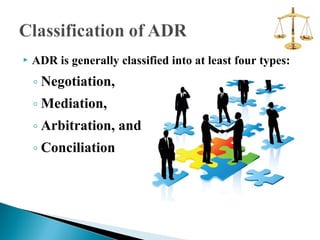
ADR is generally classified into at least four types:

◦ Negotiation,
◦ Mediation,
◦ Arbitration, and
◦ Conciliation
 Negotiation

systems create a structure to
encourage and facilitate direct negotiation
between parties to a dispute, without the
intervention of a third party.
 In negotiation, participation is voluntary and
there is no third party who facilitates the
resolution process or imposes a resolution.
 It is based on the principle of "Helping People
Help Themselves”
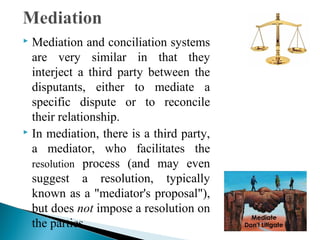
Mediation and conciliation systems
are very similar in that they
interject a third party between the
disputants, either to mediate a
specific dispute or to reconcile
their relationship.
 In mediation, there is a third party,
a mediator, who facilitates the
resolution process (and may even
suggest a resolution, typically
known as a "mediator's proposal"),
but does not impose a resolution on
the parties.

 Arbitration

systems authorize a third party
to decide how a dispute should be resolved.
 In arbitration, participation is typically
voluntary, and there is a third party who, as
a private judge, imposes a resolution.
 Arbitrations often occur because parties to
contracts agree that any future dispute
concerning the agreement will be resolved
by arbitration.
Conciliators

may simply facilitate
communication, or may help
direct and structure a settlement,
but they do not have the authority
to decide or rule on a settlement.
 It

is a non-binding process in which
parties present the facts and the issues to
a neutral case evaluator who advises the
parties on the strengths and weaknesses
of their respective positions, and assesses
how the dispute is likely to be decided by
a jury or other adjudicator.
 It

is a process that takes place soon after a
case has been filed in court. The case is
referred to an expert who is asked to
provide a balanced and neutral evaluation
of the dispute. The evaluation of the
expert can assist the parties in assessing
their case and may influence them
towards a settlement.
 It

is a meeting between members of a
family and members of their extended
related group. At this meeting (or often a
series of meetings) the family becomes
involved in learning skills for interaction
and in making a plan to stop the abuse or
other ill-treatment between its members.
 It

is a process where a neutral third party,
selected either by the disputing parties or
by the court, investigates an issue and
reports or testifies in court. The neutral
fact-finding process is particularly useful
for resolving complex scientific and
factual disputes.
 It

works within the institution to look into
complaints independently and
impartially.
 "Alternative"

dispute resolution is usually
considered to be alternative to litigation.
 It also can be used for allowing a dispute to
drop or as an alternative to violence.
 In recent years there has been more
discussion about taking a systems approach
in order to offer different kinds of options
to people who are in conflict, and to foster
"appropriate" dispute resolution.
About taking a systems approach in order to offer
different kinds of options to people who are in conflict,
and to foster "appropriate" dispute resolution.
 That is, some cases and some complaints in fact ought
to go to formal grievance or to court or to the police or
to a compliance officer or to a government IG.
 Other conflicts could be settled by the parties if they had
enough support and coaching, and yet other cases need
mediation or arbitration.
 Thus "alternative" dispute resolution usually means a
method that is not the courts. "Appropriate" dispute
resolution considers all the possible responsible options
for conflict resolution that are relevant for a given issue.

ADR can increasingly be conducted online, which is
known as Online Dispute Resolution (ODR)
 ODR is an attempt to create a distinctive product.
 ODR services can be provided by government entities,
and as such may form part of the litigation process.
 Moreover, they can be provided on a global scale,
where no effective domestic remedies are available to
disputing parties, as in the case of the domain name
disputes.
 In this respect, ODR might not satisfy the "alternative"
element of ADR.

The ADR movement in the US was launched in the
1970s as a social movement to resolve communitywide civil rights disputes through mediation, and as a
legal movement to address increased delay and
expense in litigation arising from an overcrowded
court system.
 Since then, ADR movement in the US has grown
rapidly with the support of the

◦
◦
◦
◦

American Bar Association,
academics,
courts,
the U.S. Congress and state governments.
The system of dispensing justice in India has come under
great stress for several reasons mainly because of the
huge pendency of cases in courts.
 In India, the number of cases filed in the courts has
shown a tremendous increase in recent years resulting in
pendency and delays underlining the need for alternative
dispute resolution methods.
 It is in this context that a Resolution was adopted by the
Chief Ministers and the Chief Justices of States in a
conference held in New Delhi on 4th December 1993
under the chairmanship of the then Prime Minister and
presided over by the Chief Justice of India.















Suitable for multi-party disputes .
Flexibility of procedure - the process is determined and
controlled by the parties of the dispute.,
Lower costs,
Less complexity ("less is more"),
Parties choice of neutral third party (and therefore expertise in
area of dispute) to direct negotiations/adjudicate ,
Likelihood and speed of settlements,
Practical solutions tailored to parties’ interests and needs (not
rights and wants as they may perceive them),
Durability of agreements,
Confidentiality,
The preservation of relationships and the preservation of
reputations.










Alternative dispute resolution in India is not new and it was in
existence even under the previous Arbitration Act, 1940.
The Arbitration and Conciliation Act, 1996 has been enacted to
accommodate the harmonisation mandates of UNCITRAL Model.
To streamline the Indian legal system the traditional civil law known
as Code of Civil Procedure, (CPC) 1908 has also been amended and
section 89 has been introduced. Section 89 (1) of CPC provides an
option for the settlement of disputes outside the court. It provides that
where it appears to the court that there exist elements, which may be
acceptable to the parties,
The court may formulate the terms of a possible settlement and refer
the same for arbitration, conciliation, mediation or judicial settlement.
Due to extremely slow judicial process, there has been a big thrust on
Alternate Dispute Resolution mechanisms in India. While Arbitration
and Conciliation Act, 1996 is a fairly standard western approach
towards ADR, the Lok Adalat system constituted under National
Legal Services Authority Act, 1987 is a uniquely Indian approach.









The Courts are not in a position to bear the entire burden of
justice system and that a number of disputes lent themselves to
resolution by alternative modes such as arbitration, mediation
and negotiation.
ADR provided procedural flexibility, saved valuable time and
money and avoided the stress of a conventional trial.
In a developing country like India with major economic
reforms under way within the framework of the rule of law,
strategies for swifter resolution of disputes for lessening the
burden on the courts and
To provide means for expeditious resolution of disputes, there
is no better option but to strive to develop alternative modes of
dispute resolution (ADR).
Which establishing facilities for providing settlement of
disputes through arbitration, conciliation, mediation and
negotiation.
Adr

Adr

  • 1.
    By Prof. Vivek Y.Dhupdale Department of Law, SUK
  • 2.
    “It is thespirit and not the form of law that keeps the justice alive.” LJ Earl Warren
  • 3.
     The concept ofConflict Management through ADR has introduced a new mechanism of dispute resolution that is non-adversarial in nature.  A dispute is basically ‘lis inter partes’ and the justice dispensation system in India has found an alternative to Adversarial litigation in the form of ADR Mechanism.
  • 4.
     ADR facilitates partiesto deal with their issues in a more costeffective manner and with increased efficacy.  It provides parties with the opportunity to◦ reduce hostility, ◦ regain a sense of control, ◦ gain acceptance of the outcome, ◦ resolve conflict in a peaceful manner, and ◦ achieve a greater sense of justice in each individual case.  The resolution of disputes takes place usually in private and is more viable, economic, and efficient.
  • 5.
     The term "ADR"is often used to describe a wide variety of dispute resolution mechanisms that are short of, or alternative to, full-scale court processes.  It refers to everything from◦ facilitated settlement negotiations in which disputants are encouraged to negotiate directly with each other prior to some other legal process, ◦ to arbitration systems or minitrials that look and feel very much like a courtroom process.  Matters dealing with community tension can also be included within the rubric of ADR.
  • 6.
     ADR is generallyclassified into at least four types: ◦ Negotiation, ◦ Mediation, ◦ Arbitration, and ◦ Conciliation
  • 7.
     Negotiation systems createa structure to encourage and facilitate direct negotiation between parties to a dispute, without the intervention of a third party.  In negotiation, participation is voluntary and there is no third party who facilitates the resolution process or imposes a resolution.  It is based on the principle of "Helping People Help Themselves”
  • 8.
    Mediation and conciliationsystems are very similar in that they interject a third party between the disputants, either to mediate a specific dispute or to reconcile their relationship.  In mediation, there is a third party, a mediator, who facilitates the resolution process (and may even suggest a resolution, typically known as a "mediator's proposal"), but does not impose a resolution on the parties. 
  • 9.
     Arbitration systems authorizea third party to decide how a dispute should be resolved.  In arbitration, participation is typically voluntary, and there is a third party who, as a private judge, imposes a resolution.  Arbitrations often occur because parties to contracts agree that any future dispute concerning the agreement will be resolved by arbitration.
  • 10.
    Conciliators may simply facilitate communication,or may help direct and structure a settlement, but they do not have the authority to decide or rule on a settlement.
  • 12.
     It is anon-binding process in which parties present the facts and the issues to a neutral case evaluator who advises the parties on the strengths and weaknesses of their respective positions, and assesses how the dispute is likely to be decided by a jury or other adjudicator.
  • 13.
     It is aprocess that takes place soon after a case has been filed in court. The case is referred to an expert who is asked to provide a balanced and neutral evaluation of the dispute. The evaluation of the expert can assist the parties in assessing their case and may influence them towards a settlement.
  • 14.
     It is ameeting between members of a family and members of their extended related group. At this meeting (or often a series of meetings) the family becomes involved in learning skills for interaction and in making a plan to stop the abuse or other ill-treatment between its members.
  • 15.
     It is aprocess where a neutral third party, selected either by the disputing parties or by the court, investigates an issue and reports or testifies in court. The neutral fact-finding process is particularly useful for resolving complex scientific and factual disputes.
  • 16.
     It works withinthe institution to look into complaints independently and impartially.
  • 17.
     "Alternative" dispute resolutionis usually considered to be alternative to litigation.  It also can be used for allowing a dispute to drop or as an alternative to violence.  In recent years there has been more discussion about taking a systems approach in order to offer different kinds of options to people who are in conflict, and to foster "appropriate" dispute resolution.
  • 18.
    About taking asystems approach in order to offer different kinds of options to people who are in conflict, and to foster "appropriate" dispute resolution.  That is, some cases and some complaints in fact ought to go to formal grievance or to court or to the police or to a compliance officer or to a government IG.  Other conflicts could be settled by the parties if they had enough support and coaching, and yet other cases need mediation or arbitration.  Thus "alternative" dispute resolution usually means a method that is not the courts. "Appropriate" dispute resolution considers all the possible responsible options for conflict resolution that are relevant for a given issue. 
  • 19.
    ADR can increasinglybe conducted online, which is known as Online Dispute Resolution (ODR)  ODR is an attempt to create a distinctive product.  ODR services can be provided by government entities, and as such may form part of the litigation process.  Moreover, they can be provided on a global scale, where no effective domestic remedies are available to disputing parties, as in the case of the domain name disputes.  In this respect, ODR might not satisfy the "alternative" element of ADR. 
  • 20.
    The ADR movementin the US was launched in the 1970s as a social movement to resolve communitywide civil rights disputes through mediation, and as a legal movement to address increased delay and expense in litigation arising from an overcrowded court system.  Since then, ADR movement in the US has grown rapidly with the support of the ◦ ◦ ◦ ◦ American Bar Association, academics, courts, the U.S. Congress and state governments.
  • 21.
    The system ofdispensing justice in India has come under great stress for several reasons mainly because of the huge pendency of cases in courts.  In India, the number of cases filed in the courts has shown a tremendous increase in recent years resulting in pendency and delays underlining the need for alternative dispute resolution methods.  It is in this context that a Resolution was adopted by the Chief Ministers and the Chief Justices of States in a conference held in New Delhi on 4th December 1993 under the chairmanship of the then Prime Minister and presided over by the Chief Justice of India. 
  • 22.
              Suitable for multi-partydisputes . Flexibility of procedure - the process is determined and controlled by the parties of the dispute., Lower costs, Less complexity ("less is more"), Parties choice of neutral third party (and therefore expertise in area of dispute) to direct negotiations/adjudicate , Likelihood and speed of settlements, Practical solutions tailored to parties’ interests and needs (not rights and wants as they may perceive them), Durability of agreements, Confidentiality, The preservation of relationships and the preservation of reputations.
  • 23.
         Alternative dispute resolutionin India is not new and it was in existence even under the previous Arbitration Act, 1940. The Arbitration and Conciliation Act, 1996 has been enacted to accommodate the harmonisation mandates of UNCITRAL Model. To streamline the Indian legal system the traditional civil law known as Code of Civil Procedure, (CPC) 1908 has also been amended and section 89 has been introduced. Section 89 (1) of CPC provides an option for the settlement of disputes outside the court. It provides that where it appears to the court that there exist elements, which may be acceptable to the parties, The court may formulate the terms of a possible settlement and refer the same for arbitration, conciliation, mediation or judicial settlement. Due to extremely slow judicial process, there has been a big thrust on Alternate Dispute Resolution mechanisms in India. While Arbitration and Conciliation Act, 1996 is a fairly standard western approach towards ADR, the Lok Adalat system constituted under National Legal Services Authority Act, 1987 is a uniquely Indian approach.
  • 24.
         The Courts arenot in a position to bear the entire burden of justice system and that a number of disputes lent themselves to resolution by alternative modes such as arbitration, mediation and negotiation. ADR provided procedural flexibility, saved valuable time and money and avoided the stress of a conventional trial. In a developing country like India with major economic reforms under way within the framework of the rule of law, strategies for swifter resolution of disputes for lessening the burden on the courts and To provide means for expeditious resolution of disputes, there is no better option but to strive to develop alternative modes of dispute resolution (ADR). Which establishing facilities for providing settlement of disputes through arbitration, conciliation, mediation and negotiation.