LDC- Alternative Dispute Resolution Module 2- Mediation 2025.pdf
1.
POST GRADUATE LEGALSTUDIES &
LEGAL AID
ALTERNATIVE DISPUTE RESOLUTION
(ADR)
MODULE 2: MEDIATION
12 February 2025
2.
Consider the followingquestions
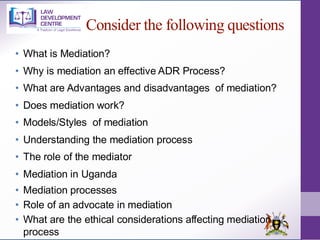
• What is Mediation?
• Why is mediation an effective ADR Process?
• What are Advantages and disadvantages of mediation?
• Does mediation work?
• Models/Styles of mediation
• Understanding the mediation process
• The role of the mediator
• Mediation in Uganda
• Mediation processes
• Role of an advocate in mediation
• What are the ethical considerations affecting mediation
process
3.
Consider the followingquestions
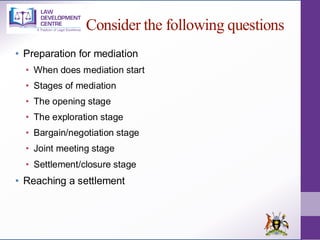
• Preparation for mediation
• When does mediation start
• Stages of mediation
• The opening stage
• The exploration stage
• Bargain/negotiation stage
• Joint meeting stage
• Settlement/closure stage
• Reaching a settlement
4.
Introduction: Difference between
Settlementand Resolution
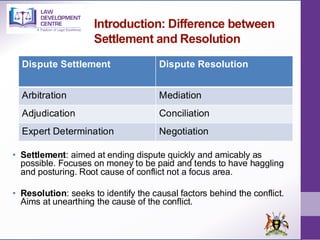
• Settlement: aimed at ending dispute quickly and amicably as
possible. Focuses on money to be paid and tends to have haggling
and posturing. Root cause of conflict not a focus area.
• Resolution: seeks to identify the causal factors behind the conflict.
Aims at unearthing the cause of the conflict.
Dispute Settlement Dispute Resolution
Arbitration Mediation
Adjudication Conciliation
Expert Determination Negotiation
5.
Mediation: what isit?
▪ Appropriately so, as the word “mediation” itself, stems
from Latin and the meaning denotes “in the middle.”
▪ ‘A method of non-binding dispute resolution involving a
neutral third party who tries to help the disputing parties
reach a mutually agreeable solution’
Black's Law Dictionary (8th ed. 2004) , Page 3113
▪ “mediation” means the process by which a neutral third
person facilitates communication between parties to a
dispute and assists them in reaching a mutually agreed
resolution of the dispute.
Section 3, The Judicature (Mediation) Rules, 2013
6.
Mediation: what isit? (ctd)
A structured process comprising one or more sessions in
which one or more mediators—without adjudicating a dispute
or any aspect of it and with the goal of enabling the parties to
take voluntary responsibility for resolving their dispute—
assist the parties to do any or all of the following:
• Identify the issues in dispute.
• Explore and generate options.
• Communicate with one another.
• Reach an agreement regarding the resolution of the whole
or part of the dispute
Mediation Series: Making Mediation Law, 18
7.
Mediation: what isit? (ctd)
▪ The parties have ultimate control of the decision to settle and
the terms of resolution.
▪ The mediator uses a variety of skills and techniques to help
the parties reach a settlement but has no power to make a
decision. The parties remain the decision makers.
▪ Mediation is an interest-based process – in contrast to a
rights-based process – because it is designed to help the
parties clarify any underlying motivations or interests.
8.
Mediation: what isit? (ctd)
▪ It is a confidential and informal way to resolve a dispute with
the help of a neutral third party (mediator) who from the outset,
encourages each party to attempt to understand and evaluate
the interests of the other party.
▪ The mediator works with both (all) parties to help them reach
a mutually agreeable solution to their differences.
▪ The mediator’s role is that he/she is the central figure guiding
parties in reaching agreement on a mutually acceptable
solution.
9.
Mediation: what isit? (Ctd)
• The mediator has no authority to impose an outcome on
the parties if they fail to reach agreement, and both sides are
free to walk away from the process at any time.
• The mediation technique introduced is different from the older
paradigm in that the parties agree to undergo a specific
procedure:
a) improving their consciousness of what the nuclear
points in dispute are;
b) together generating proposals for possible solutions;
c) select proposals for a solution via negotiation and
resting on win‐win and dialogue principals; and
d) execute these proposals to completion
10.
Benefits of Mediation
Mediationis a good tool to, at least partly, achieve the
following objectives:
• Reduce court backlogs.
• Reduce time necessary for contract enforcement.
• Reduce costs of dispute resolution (e.g. by limiting court
and legal fees).
• Increase number of in-court settlements (facilitated by
judges or mediators).
• Reduce formality and complexity of the existing processes.
• Reach geographically dispersed population.
• Increase satisfaction with dispute resolution.
11.
Benefits of Mediation
•Effectively handle complex multiparty disputes.
• Effectively handle disputes where sophisticated expertise is
needed.
• Increase access of disadvantaged groups.
• Support case management and create models for further court
reform.
• Reduce high level of tension in business communities and
promote long lasting relationship between business partners.
• Modify the “culture of dispute resolution” based on adversarial
proceedings and the assumption of hostile mindset.
• Respond to the concerns of equity and relationship.
12.
Why is mediationan effective
ADR Process?
• The mediator can be skilled at calming and diffusing strong
feelings such as anger or pride that may lead the parties to
adopt entrenched positions, or even walk away from direct
negotiations.
• The presence of a mediator helps the parties present thier
own case more effectively to the other side.
• Mediators can help the parties (and thier lawyers) work
through the deadlocks that can be created by purely
positional or competitive negotiations
13.
Why is mediationan effective
ADR Process?
• The mediator introduces an element of detachment into
negotiation process and mediation avoids the need for direct
confrontation and an immediate response that occurs in face
to face negotiation between the parties.
• The mediator will encourage a more accurate and honest
assessment by each party of the merits of their own case.
• The mediator can help the parties to communicate
constructively and effectively with each other.
• The mediation can avoid over-ready concessions between
the parties as the mediator will advise on the timing of the
offers and concessions.
14.
Why is mediationan effective
ADR Process?
• The mediator introduces an element of detachment into
negotiation process and mediation avoids the need for direct
confrontation and an immediate response that occurs in face to
face negotiation between the parties.
• Mediators will bring their own personal attributes to the table
such as patience, empathy,ability to listen, good judgement,
good communication skills, creativity, impartiality, authority etc
all of which can help the parties to review and evaluate their
case.
• Mediators can create a balance between the different
negotiation styles and personalities of the parties and minimise
the pressure that one party can feel when the other side
employs a positional, confrontational negotiating style.
15.
Why is mediationan effective
ADR Process?
• Egan vs Motor Services (Bath) Ltd [2008] 1WLR 1589
• Faida vs Elliot Corporation [2012]EWCA Civ 287
• Wright vs Micxheak Supplies Ltd [2013]EWCA Civ 234
• Bradely vs Heslin [2014] EWHC 3267
Mediation processes
❖Court annexedmediation demonstrates an interaction
between ADR and the legal system
❖ADR as you are aware, is beneficial in that its processes are
expedient and cost effective amongst other factors.
❖Additionally, mediation has similar benefits as with ADR which
arise, generally, in that the parties save significant cost and
time (amongst other benefits) thereby enabling them to focus
on their main interests as opposed to conflicts
❖This gives them the control over the outcomes of their
conflicts that they would not otherwise have had
❖Mediation has a role in increasing access to, participation in,
and to a certain degree, satisfaction in the way that legal
disputes are resolved
18.
Free-standing (private) mediation
Whatis Free-Standing (private) mediation?
• Mediation programs organized without any court
connection or component. This is usually run by a
Chamber of Commerce, private entities/individuals,
professional bodies, Trade Associations, international
organization, or for-profit organizations.
• Agreements arising out of private mediations are
enforced like contracts.
• The main advantages:
• Flexibility in setting the timetable for resolving the dispute.
• The case does not have to be registered with the court.
• The parties do not have to meet with the judge.
• There are no court fees.
19.
Court-annexed mediation
• Thisis mediation program or practices authorized and
used within the court system and controlled by the court.
• Cases are referred to mediation by courts only.
• Often judges or other court officials serve as mediators
(Registrars, magistrates, judges etc)
• An agreement arising out of court-annexed program is
enforceable as a court order (unless otherwise decided
by the parties)- recorded as Consent Judgment.
20.
Court-annexed mediation
• Inthe court-annexed mediation model, the court refers
parties to mediation.
• Usually, the mediation takes place in a court building and
is conducted by court-based mediation practitioners.
• The mediators are drawn from the judiciary, court
personnel, panels of mediators attached to the court, or a
community mediation organization.
Mediation Series: Making Mediation Law, 8 and 9
21.
Court-annexed mediation
Represents aprivate form of court-related mediation, in
which the court outsources mediation services. The
mediators are typically not employed by the court and are
members of a panel of court-approved mediation service
providers who set their own fees that the disputants pay.
Mediation Series: Making Mediation Law, 9
1. Self-Determination
• Mediationrespects, values and encourages the
participants’ ability to make their own decisions regarding
what process to use, and whether and on what terms, to
resolve their disputes.
• Self-determination is the fundamental principle of mediation
that best distinguishes it from the litigation system.
• Participants should be free to choose their own dispute
resolution process and are encouraged to make their own
decisions on all issues.
24.
2. informed Consent
•Informed consent is an important part of the
participants’ right to self-determination.
• Informed consent is supported when mediators
disclose or offer to disclose the information
reasonably necessary for informed decisions on
whether to use the mediator and whether to
participate in the specific mediation process.
25.
2. informed Consent
•Mediators are encouraged to explain the mediation
process and the roles of the mediator, the
participants, their representatives, and others in
attendance.
• Mediators are encouraged to make ongoing, good
faith efforts to assess the participants’ ability to
make voluntary choices consistent with their rights
of self-determination, and may discontinue the
mediation under circumstances manifesting a
participant’s inability to give informed consent.
26.
3. Confidentiality &privilege
Insider–outsider confidentiality
A general duty of confidentiality in the face of outside
parties. This classification means that those parties involved
in a mediation (insiders) cannot make prohibited disclosures
to people outside the mediation (outsiders).
Mediation Series: Making Mediation Law, 10
27.
Confidentiality & Privilege
Insider–insiderconfidentiality
▪ Regulates the flow of information in mediation, especially
in relation to private sessions—also known as
caucuses—between the mediator and a party.
▪ As a matter of practice, mediators manage insider–
insider confidentiality in one of two ways: the open
communication approach or the in-confidence approach.
In the former, information passed to mediators in private
sessions is not treated as confidential unless specifically
requested by the relevant party.
Mediation Series: Making Mediation Law, 10
28.
Confidentiality
Insider–court confidentiality
• Involvesthe rights and obligations associated with
protecting these mediation communications from being
legally discovered or admitted in evidence in court and
arbitral proceedings.
• It is categorized as a specific form of insider–outsider
confidentiality in which the court is the outsider.
Technically, however, this area is not about confidentiality
but rather about admissibility of evidence.
29.
Confidentiality & privilege
•The mediator will conduct the mediation on a confidential
basis, and will not voluntarily disclose information obtained
through the mediation process except to the extent that
such matter is already public or with the consent of the
parties
• An injunction can be obtained, in certain circumstances, to
restrain breach of this obligation (Venture Investment
Placement Ltd v Hall [2005] EWHC 1227 (Ch)).
• In Aird & Aird v Prime Meridian [2006] EWCA Civ 1866, the
court accepted that a confidentiality clause reinforces the
without prejudice rule.
30.
4. Impartiality
• Theduty of impartiality of the mediator is inherent in
the mediation process.
• Mediators should make good faith efforts to avoid
conflicts of interest in recommending the services of
other professionals.
• When a mediator is appointed to mediate, rather than
selected by the parties, the appointing agency or
authority should make reasonable efforts to ensure
the mediator demonstrates impartial regard.
31.
Impartiality
▪ A mediatorshall decline a mediation if the mediator
cannot conduct it in an impartial manner. Impartiality
means freedom from favoritism, bias or prejudice.
▪ A mediator shall conduct a mediation in an impartial
manner and avoid conduct that gives the
appearance of partiality.
32.
Features of Mediation
▪Mediation is generally private, voluntary, and informal
▪ The focus is on problem-solving rather than on determining
who is right and who is wrong
▪ It is a non-adversarial process with the mediator committed
to neutrality and impartiality
▪ Mediator must avoid pre-determined point of view
▪ Outcome of the process is in the hands of the disputants
▪ Empowering because parties have an opportunity to come
up with their own solutions and they have an element of
control
33.
Features of Mediation
▪Primary objective is a win-win situation
▪ Preservation of relationships
▪ Mediators are advocates for the process of mediation
rather than advocates for either party
▪ Containment of escalation
▪ Facilitates communication
▪ Time saving
▪ Creative options
▪ Reduced costs
34.
Features of Mediation
▪It is not an adjudicative process and therefore not
adversarial
▪ It involves the parties negotiating a settlement of the
dispute
▪ It aims at focusing on the real interests of the parties and
generating options for settlement.
▪ A form of third party- assisted, structured negotiation
founded on “without prejudice basis” principle.
G.Kiryabwire, Alternative Dispute Resolution in Uganda; The Ugandan
Court Experience, Law Africa, 2021 pp 90- 109.
35.
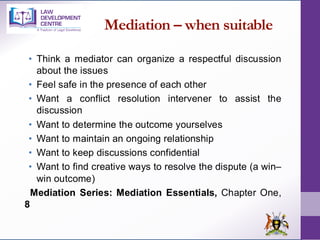
Mediation – whensuitable
• Think a mediator can organize a respectful discussion
about the issues
• Feel safe in the presence of each other
• Want a conflict resolution intervener to assist the
discussion
• Want to determine the outcome yourselves
• Want to maintain an ongoing relationship
• Want to keep discussions confidential
• Want to find creative ways to resolve the dispute (a win–
win outcome)
Mediation Series: Mediation Essentials, Chapter One,
8
36.
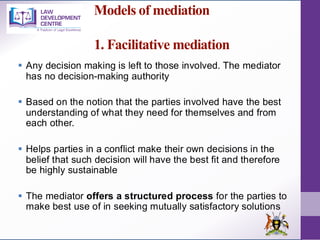
Models of mediation
1.Facilitative mediation
▪ Any decision making is left to those involved. The mediator
has no decision-making authority
▪ Based on the notion that the parties involved have the best
understanding of what they need for themselves and from
each other.
▪ Helps parties in a conflict make their own decisions in the
belief that such decision will have the best fit and therefore
be highly sustainable
▪ The mediator offers a structured process for the parties to
make best use of in seeking mutually satisfactory solutions
37.
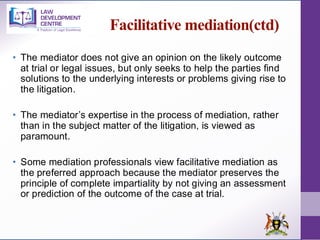
Facilitative mediation(ctd)
• Themediator does not give an opinion on the likely outcome
at trial or legal issues, but only seeks to help the parties find
solutions to the underlying interests or problems giving rise to
the litigation.
• The mediator’s expertise in the process of mediation, rather
than in the subject matter of the litigation, is viewed as
paramount.
• Some mediation professionals view facilitative mediation as
the preferred approach because the mediator preserves the
principle of complete impartiality by not giving an assessment
or prediction of the outcome of the case at trial.
38.
The parties askthe mediator for her legal
opinion on the issues raised by the case.
• How should the mediator respond?
39.
2. Evaluative mediation
▪Evaluative mediators are usually legal practitioners, often
with an expertise in a particular area of law relevant to the
conflict.
▪ Evaluators provide the parties with an evaluation of the
merits of their case with respect to their legal positions
▪ The mediator’s opinion including, for example, a legal
and/or factual evaluation of the case, and sometimes an
assessment of potential legal outcomes is used as a
settlement tool. This approach generally requires mediators
who are experts in the subject matter of the case.
▪ They may provide an anticipated outcome of the dispute.
Direction towards settlement options may also be on offer
40.
Evaluative mediation
▪ Thereis a strong drive towards equitable settlement as
an efficient and economic alternative to legal measures.
▪ Most evaluative mediators also consider the interests of
the parties in attempting to facilitate a settlement.
▪ Many mediators blend facilitation and evaluation,
applying each approach in varying degrees at different
times during the mediation process, depending on the
needs of a given case.
41.
Evaluative mediation
What constitutesevaluative behaviour?
• Predictive behaviour. This involves giving a view on what will
happen in court or other forums. In this regard, the mediator
gives an assessment of the strengths and weaknesses of the
case and makes an opinion on the accuracy of each party’s
views. Much of the discussion on evaluative mediation has
focused on whether it Is the role of the mediator to give his or
her view on the merits of the parties’ dispute.
• Directive behaviour. “Evaluative” mediation has also been
understood to include the mediator directing the parties
towards certain outcomes or solutions. Making a prediction on
court outcome sometimes results in the mediator being
directive by urging the parties to arrive at a solution that is
close to his or her prediction.
42.
Evaluative mediation
The strongreaction against “evaluative mediation”
• Mediator neutrality. Giving an assessment of the merits of the
parties’ case has an impact on mediator impartiality or neutrality.
• Once the mediator gives the impression that he or she is favouring
one party over the other, the parties’ trust in the mediator is affected,
and it may be much more challenging for the mediator to work with
both parties in arriving at a joint resolution to their dispute.
• Parties’ self-determination or autonomy. Mediation’s popularity
can be attributed to how it focuses on party empowerment. Unlike
many other modes of ADR, the allure of mediation lies in how the
parties have the opportunity to exercise self-determination.
• The fundamental ethos underlying mediation appears to be
undermined by evaluative activities that directly impinge on the
parties’ autonomy.
3. Transformative mediation
▪It is a much less structured approach that focuses on two
key interpersonal processes, namely, empowerment
and recognition
▪ A transformative mediator aims to empower the parties
involved to make their own decisions and take their own
actions.
▪ They also work to foster and develop recognition for
and between the parties.
▪ The parties are very much in charge of both the
content (the substantive issues) and the process, and
the mediator works to support both as their conflict
unfolds and the process and relationship builds
45.
Transformative mediation
• Bysupporting recognition, the mediator seeks to "strengthen
people's capacity to see and consider the perspectives of
others.”
• The mediator describes her/his role and objectives in terms
of empowerment and recognition.
• Settlement is presented as one possible outcome of the
mediation process.
• However, reaching a settlement is not presented as the most
important goal of mediation. A successful session is
described as one which produces improved understanding
or more clarity.
46.
4. Narrative Mediation
▪It focuses less on negotiation and more on how the parties
(people) make sense of the world. By telling stories of
events and by giving meaning to these events, people
construct their own reality.
▪ People in conflict will tell conflict stories that help them
make sense of the situation, the other person and
themselves.
▪ Narrative mediators believe that for every conflict story
there is an alternative story that can make co-operation
and trust more available. Narrative mediators help parties
rewrite new and more constructive stories.
▪ This form of mediation thus descends to an individualistic
level
47.
▪ FACILITATIVE mediatorsdo NOT suggest
solutions
▪ EVALUATIVE mediators evaluate & suggest
solutions
▪ TRANSFORMATIVE mediators are not concerned
about solutions. They want to “empower” and
“transform” the parties.
Mediation processes
▪ Quitethe contrary, it operates against a backdrop of dispute
management culture, institutional rules, and varying
regulations
▪ Thus, the manner in which mediation is absorbed and
applied is dependant on the context
▪ When you think of mediation, consider the broader
framework within which ADR was developed
▪ According to Cappeletti, it is part of the third wave in the
world-wide access to justice movement
Capelletti M “Alternative Dispute Resolution Processes within
the Framework of the World-Wide Access-to Justice
Movement”
50.
Mediation Usage
❖Mediation isused in a variety of contexts including:
I. Commercial contracts
II. Civil and land disputes
III. Workplace grievances
IV. Family relationships
V. Community disputes
❖Can you think of other settings where we can find
mediation
51.
Mediation in Uganda
▪Formal ADR practices and the relevant legal
framework can be traced back to the 90s
▪ The three ADR mechanisms that are practised and
have a legal framework governing them include:
1. Conciliation (ACA)
2. Mediation (Judicature (Mediation) Rules, CPR)
3. Arbitration (ACA)
52.
Mediation in Uganda
❖In1999 review of the Uganda Commercial Justice Sector Study
(UCJSS) Report recommended that the Ugandan Judiciary “expand
the use of ADR by mandating its use…in commercial cases”.
❖In response to the report, the Constitutional Commercial Division
(Mediation Pilot Project Rules) Practice Direction (Legal Notice 71
of 2003 was developed.
❖For the first time, court-annexed mediation was allowed to become
part of the case management strategy at commercial court.
❖Mediations under the pilot scheme were referred to CADER to be
managed under its Rules.
❖In 2004, a Survey indicated that 80% of cases filed in commercial
court were settled leading to consent judgments.
53.
Mediation in Uganda
❖Afterthe Pilot project, mandatory mediation was introduced in
commercial Court under the Judicature (Commercial Court
Division) (Mediation) Rules, 2007 SI No. 55/2007.
❖ The 2003, 2007 and 2013 Mediation Rules all have the same
characteristics. Rules define mediation as:
“ Mediation means the process by which. A thirdparty person
facilitates communication between parties to a dispute and
assists them in reaching a mutually agreed resolution of the
dispute”
• Rule 3, The Judicature (Mediation) Rules, 2013
• This means that most forms of mediation such as facilitative and
evaluative mediation can be conducted under these Rules
54.
Mediation in Uganda
❖InDecember 2017, a review committee of Judiciary noted
that the 60-days mandatory period under mediation rules to
attempt mediation was being used by some lawyers as a
mere formality before litigation.
❖It was recommended that mediation or any ADR mechanism
should be court directed/referred under Order 12 rule 1 of
the Civil Procedure Rules during the pre-trial/scheduling
conference.
❖This was to be done after taking out Summons for Directions
at the close of pleadings adopted under the Civil Procedure
(Amendment) Rules, SI No. 33 of 2019
55.
Mediation in Uganda
❖Mediationin Uganda despite being an ADR
mechanism, cannot be held in some instances
unless the process is commenced in a court of
competent jurisdiction
❖Thus, it is said that mediation is a court annexed
process. This entails that the courts which have
jurisdiction to refer cases to mediation are: the High
Court, Subordinate Court and the Industrial Court
❖The Employment Act and the Labour Dispute
(Arbitration & Settlement) Act, 2006 is emphatic on
mediation of labour disputes
56.
Mediation procedure inthe High
Court
❖Every action may, upon being set down for trial, be referred by the
trial judge for mediation
❖The court keeps list of people that have been trained as mediators
❖When a matter has been referred to mediation, the mediator
appointed shall collect the record from the court
❖Upon collection, the mediator contacts parties and fixes a date of
the meeting
❖The parties, once summoned, can appear before him with or
without their representatives
57.
Mediation procedure inthe High
Court
❖Mediation being a confidential process, the mediator should
not keep any record used during the process
❖In the event that mediation fails, the mediator should return
the record to the court
❖Where a settlement has been reached, it shall be registered
in court and shall have the same effect as a judgment
❖There is no appeal against a mediated settlement
58.
mediation in Uganda
❖Isthere a possible reason for why mediation is propounded in
Uganda?
❖How about its relevance in Uganda?
❖Surely, it must have some importance especially bearing in
mind that there are statutory instruments advocating for its use
in certain instances?
❖Consider your argument from this perspective
59.
Global trends inmediation
❖As far as legal integration and utility, mediation is the fastest
growing form of ADR globally
❖Unlike most other types of ADR mechanisms, mediation caters
for a plethora of developments that range from consumer to
environmental interests
❖Why is it then, that, common law jurisdictions are more
inclined towards applying mediation as opposed to civil law
jurisdictions?
60.
Globaltrends inmediation
▪ UNICITRALConciliation Rules, Adopted at UN General Assembly
23 July 1980.
▪ EU Mediation Directive on Civil and Commercial Aspects of
Mediation; Directive 2008/52/EC.
▪ The UN Convention on the International Settlement Agreements
Resulting from Mediation GA Res.73/199 adopted at UN General
Assembly on 20 December 2018 (Singapore Convention)
▪ The UNICITRAL on International Commercial Mediation amends
the Model Law on International Commercial Conciliation 2002
61.
Your thoughts
• Doyou think that, considering the harsh socio-economic
reality in Uganda, mediation is more relevant than you might
have initially thought?
• Do you have any alternate arguments? If so, what are they and
what is the basis of your argument?
Practical steps inthe mediation
process.
▪ Step 1- introduction or intakes
▪ Step 2- Telling the story or information gathering.
▪ Step 3- Identifying facts and issues.
▪ Step 4-Identifying alternative solutions.
▪ Step 5- Revising and discussing solutions.
▪ Step 6-Reaching an agreement.
▪ Step 7-Revising and drafting the final agreement.
64.
The role ofa lawyer in mediation
Pre- Mediation
• Preparation is always important for good results.
• Explain to the Client the mediation and the process that follows.
• Assist the client to formulate the key points of the mediation.
• Assist the Client and discuss the issues related to the dispute, the range of
possible outcomes, and the issues in which the client may have an edge as
compared to the other party.
• Ensure that all the relevant documents are available and prepared prior to
mediation.
• The clients are mostly clueless if advocates are not present to guide them
through the whole process.
65.
The role ofa lawyer in mediation
Pre- Mediation
What do you do to prepare for a mediation?
• (BATNA, Info & Game Plan Pre-Mediation Conferences)
• BATNA- Best Alternative to a Negotiated Agreement
• The term BATNA was originally used by Roger Fisher and William
Ury in their 1981 book entitled “Getting to Yes: Negotiating
Without Giving In.”
• Develop factual information
• Develop legal analysis
• Coordinate with client
• Combine risk analysis with transaction cost analysis to get
BATNA.
• Coordinate internally within Company hierarchy to have
appropriate authority.
66.
The role ofa lawyer in mediation
Pre- Mediation
What do you do to prepare for a mediation?
▪ Set 3 possible deal numbers in advance:
▪ (1) rationally supported best outcome;
▪ (2) reasonable outcome,
▪ (3) outcome that is of equal value to going forward with the case
(BATNA) – BUT stay open to reevaluate – either way – in
mediation.Identify and try to resolve coverage issues in advance of
mediation.
▪ Be sure client prepares the Mediator with good pre-mediation statement
and supporting exhibits/information.
▪ coordinate pre-mediation statement with client, if it does not cause
undue delay.
67.
The role ofa lawyer in mediation
During Mediation-
• The advocate plays the role of a guide.
• He guides and advises his client as to how to present the issues during
the procedure.
• In some cases, the advocates may also represent his clients and
negotiate on their behalf.
• During mediation, various proposals are made by the parties. The
advocate guides the client in understanding the legal aspects of such
proposals along with the risks and gains associated with it.
• They help formulate proposals beneficial for his client.
• The advocates can come up with creative solutions in order to solve
the disputes.
• They also save their client from entering into a pressured settlement.
68.
The role ofa lawyer in
mediation
Post- Mediation
• There are two outcomes to the mediation procedure. If the
process is successful, then the advocate prepares the agreement,
that the clients have settled upon.
• If the parties have settled on an agreement, then the advocate
ensures that the consent decree is executed.
• If the mediation is not successful, then the next best remedy for
the client to approach the court. An advocate is required for the
purpose of litigation.
• Lawyers and clients should act, at all times, in good faith to
attempt to achieve settlement of the dispute.
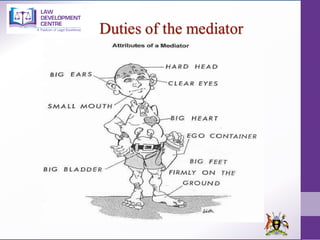
Duties of themediator
1. The mediator shall explain his role and define the process of
mediation;
2. To summon the parties and make an effort to schedule the
conference at a time that is convenient with all participants;
3. Maintain confidentiality;
4. The mediator has a duty to be impartial and to advise all
participants of any circumstances bearing on possible bias,
prejudice or partiality;
5. Reporting the results of mediation to the Court (for court annexed
mediation);
71.
Duties of themediator
6. To help parties resolve their dispute. Brooke LJ in Dunnett v
Railtrack Plc (in railway administration) stated:
“Skilled mediators are now able to achieve results satisfactory to both parties in
many cases which are quite beyond the power of lawyers and courts to achieve.
This court has knowledge of cases where intense feelings have arisen, for
instance in relation to clinical negligence claims. But when the parties are
brought together on neutral soil with a skilled mediator to help them resolve
their differences, it may very well be that the mediator is able to achieve a result
by which the parties shake hands at the end and feel that they have gone away
having settled the dispute on terms with which they are happy to live. A
mediator may be able to provide solutions which are beyond the powers of the
court to provide.”
72.
What are theRoles of Mediator?
• To guide but not advise the parties during the process.
However, in the case of Tapoohi v Lewenberg, a mediator was
held liable for not advising parties on a legal issue that was
omitted in the mediation agreement thereby making one party
suffer loss.
• help people find the best way to resolve their problems
• encourage parties to identify the real issues
• help the parties explain those issues to each other
• identify points of agreement between the two parties
73.
What are theRoles of Mediator?
▪ work with people to find answers that reflect good faith and
common sense
▪ provide an assessment of the risks of the problem escalating
▪ seek a resolution that allows both parties to put the issues
behind them.
▪ help people find a way through their problem that may not
seem immediately apparent
74.
What are theRoles of Mediator?
▪ Help Develop And Maintain Ground rules For Process
▪ Facilitate Communication
▪ Facilitate Negotiation
▪ Model Active Listening
▪ Help Identify Issues
▪ Help Gather Information
▪ Help Identify Interests
▪ Help Set Agenda
▪ Facilitate Generation Of Options; Brainstorm, Look To Create Value
▪ Caucus.
▪ Assist In Negotiation Strategy
▪ Reality Check (On Positions, Options, Alternatives).
▪ Focus Settlement Discussions (Where Driven By Parties)
▪ Clarify Agreement
75.
Roles Of Mediator-ActiveListening
▪ Listen!
▪ Follow, rather than control, the communication.
▪ Leave plenty of room for expression.
▪ Use body language consistent with good listening.
▪ Validate the speaker’s entitlement to his/her perspective.
▪ Show empathy – recognize the emotions and meanings that have
been communicated.
▪ Seek clarification with appropriate, open-ended follow-up questions.
▪ Give reflective feedback summarizing your understanding of the
party’s statements.
76.
What are theRoles of Mediator?
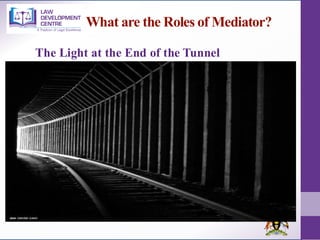
The Light at the End of the Tunnel
77.
What are theRoles of Mediator?
Mediators Can See The Light At End of the Tunnel.
▪ One benefit of using a mediator is that caucuses, distance (neutrality),
experience and insight – as well as information gained in caucus and through
confidential submissions – can enable the mediator to see deal possibilities, or
at least the probability of an eventual resolution, when things might look bleak
indeed.
▪ As a result:
• When the mediator asks you to hang in there, hang in.
• Help the mediator get the best glimpse of available light by sharing information
with the mediator. (smoking gun slide?)
• Be willing to engage in Talk with the Mediator even when there is a vast spread
in the actual offer/concession history. Sometimes “end game” discussions can
be useful ways to break impasse.
• Question for Participants –What do you do/think/prefer? What variables
change your approach?
• Let it happen. The power of trust and its opposite. Light at the end of the
tunnel
78.
An unsophisticated party,with unsophisticated
counsel, is inclined to accept an offer based on a
misunderstanding of the underlying legal principles
that severely undervalues that party’s case.
Does the mediator have any obligation - ethical or
otherwise - to educate that party?
79.
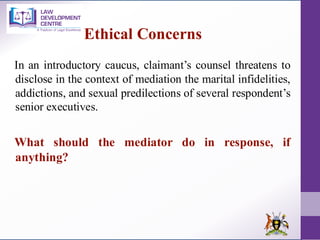
In an introductorycaucus, claimant’s counsel threatens to
disclose in the context of mediation the marital infidelities,
addictions, and sexual predilections of several respondent’s
senior executives.
What should the mediator do in response, if
anything?
Ethical Concerns
80.
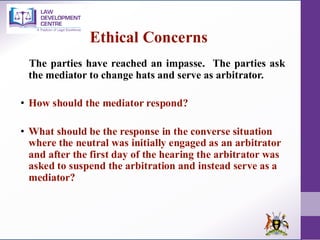
The parties havereached an impasse. The parties ask
the mediator to change hats and serve as arbitrator.
• How should the mediator respond?
• What should be the response in the converse situation
where the neutral was initially engaged as an arbitrator
and after the first day of the hearing the arbitrator was
asked to suspend the arbitration and instead serve as a
mediator?
Ethical Concerns
81.
Reading materials include
❖CivilProcedure Rules as amended in 2019
❖Subordinate court rules
❖Judicature ( Mediation Rules) 2013
❖Dunnett v Railtrack Plc (in railway administration) [2002] 2
All ER 850
❖Alexander N “What’s Law Got To Do With It? Mapping
Modern Mediation Movements in Civil and Common Law
Jurisdictions”
❖Capelletti M “Alternative Dispute Resolution Processes within
the Framework of the World-Wide Access-to Justice
Movement”
82.
Reading materials include
•Geofrey Kiryabwire, Alternative Dispute Resolution in Uganda, The
Ugandan Court Experience (2021) Law Africa Publishing, pp 65- 107.
• Nadja Alexander, Ten Trends In International Mediation (2019) 31
SacLJ, 405
• Hogan Lovells, Implementing An Effective Dispute Resolution Strategy
Which Promotes The Use Of Adr, March 2019
• Murray S. Levin, The Propriety of Evaluative Mediation: Concerns
About The Nature And Quality Of An Evaluative Opinion (2001) Vol.
16:2 Ohio State Journal Of Dispute Resolution
• Dorcas Quek, Facilitative Versus Evaluative Mediation, Is There
Necessarily A Dichotomy? [2013] Asian Journal On Mediation ,66

![Why is mediation an effective
ADR Process?
• Egan vs Motor Services (Bath) Ltd [2008] 1WLR 1589
• Faida vs Elliot Corporation [2012]EWCA Civ 287
• Wright vs Micxheak Supplies Ltd [2013]EWCA Civ 234
• Bradely vs Heslin [2014] EWHC 3267](https://image.slidesharecdn.com/ldc-module2-mediation2025-250301162933-f4b7ce6b/85/LDC-Alternative-Dispute-Resolution-Module-2-Mediation-2025-pdf-15-320.jpg)
![Confidentiality & privilege
• The mediator will conduct the mediation on a confidential
basis, and will not voluntarily disclose information obtained
through the mediation process except to the extent that
such matter is already public or with the consent of the
parties
• An injunction can be obtained, in certain circumstances, to
restrain breach of this obligation (Venture Investment
Placement Ltd v Hall [2005] EWHC 1227 (Ch)).
• In Aird & Aird v Prime Meridian [2006] EWCA Civ 1866, the
court accepted that a confidentiality clause reinforces the
without prejudice rule.](https://image.slidesharecdn.com/ldc-module2-mediation2025-250301162933-f4b7ce6b/85/LDC-Alternative-Dispute-Resolution-Module-2-Mediation-2025-pdf-29-320.jpg)
![Reading materials include
❖Civil Procedure Rules as amended in 2019
❖Subordinate court rules
❖Judicature ( Mediation Rules) 2013
❖Dunnett v Railtrack Plc (in railway administration) [2002] 2
All ER 850
❖Alexander N “What’s Law Got To Do With It? Mapping
Modern Mediation Movements in Civil and Common Law
Jurisdictions”
❖Capelletti M “Alternative Dispute Resolution Processes within
the Framework of the World-Wide Access-to Justice
Movement”](https://image.slidesharecdn.com/ldc-module2-mediation2025-250301162933-f4b7ce6b/85/LDC-Alternative-Dispute-Resolution-Module-2-Mediation-2025-pdf-81-320.jpg)
![Reading materials include
• Geofrey Kiryabwire, Alternative Dispute Resolution in Uganda, The
Ugandan Court Experience (2021) Law Africa Publishing, pp 65- 107.
• Nadja Alexander, Ten Trends In International Mediation (2019) 31
SacLJ, 405
• Hogan Lovells, Implementing An Effective Dispute Resolution Strategy
Which Promotes The Use Of Adr, March 2019
• Murray S. Levin, The Propriety of Evaluative Mediation: Concerns
About The Nature And Quality Of An Evaluative Opinion (2001) Vol.
16:2 Ohio State Journal Of Dispute Resolution
• Dorcas Quek, Facilitative Versus Evaluative Mediation, Is There
Necessarily A Dichotomy? [2013] Asian Journal On Mediation ,66](https://image.slidesharecdn.com/ldc-module2-mediation2025-250301162933-f4b7ce6b/85/LDC-Alternative-Dispute-Resolution-Module-2-Mediation-2025-pdf-82-320.jpg)


