SOURCES OF INFORMATION
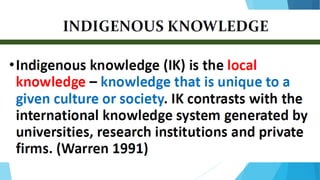
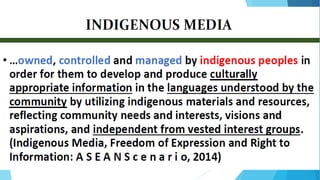
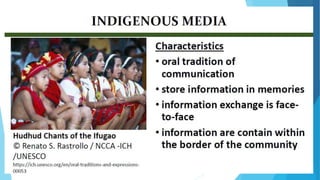
INDIGENOUS KNOWLEDGE
LIBRARY
INTERNET
MASS MEDIA
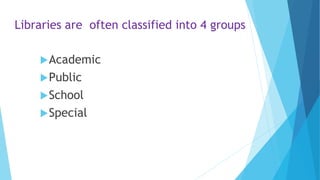
Libraries are often classified into 4 groups
Academic
Public
School
Special
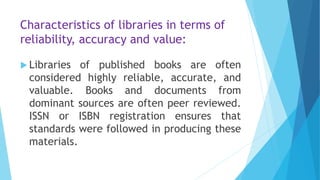
Characteristics of libraries in terms of
reliability, accuracy and value:
 Libraries of published books are often
considered highly reliable, accurate, and
valuable. Books and documents from
dominant sources are often peer reviewed.
ISSN or ISBN registration ensures that
standards were followed in producing these
materials.
INTERNET
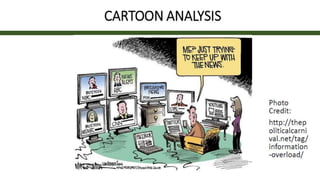
 Information found on the Internet
 Information found on the Internet may be quite
varied in form and content. Thus, it is more difficult
to determine its reliability and accuracy. Accessing
information on the Internet is easy, but requires
more discipline to check and validate. Factual and
fictitious data are often merged together. Sources
always have to be validated.
Alternative media/ Mass Media:
 Other alternative forms of communication and
distribution have become popular. These include
social media, blogs, and flash mob performances.
These alternative forms provide greater freedom
and power to ordinary individuals and are a
quicker way of distributing information. The
downside is that a lot of the information being
passed around is biased and inaccurate.
Skills in Determining the Reliability of Information
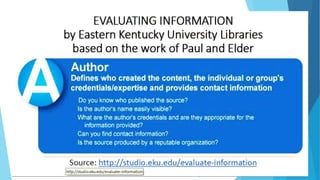
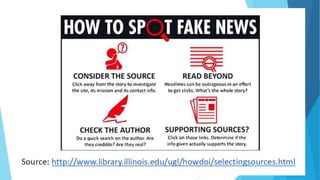
 Check the author. The author’s willingness to be identified is a good indication
of reliability.
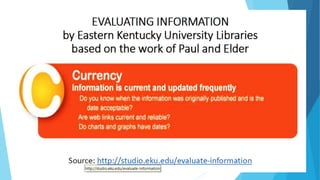
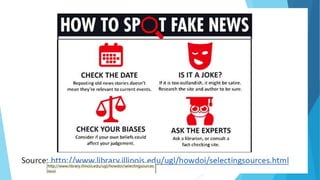
 Check the date of publication or of update. While the information may be
true, it may not be reliable if it is outdated and may have lost relevance.
 Check for citations. Reliable authors have the discipline of citing sources of
their information.
 Check the domain or owner of the site or page. The domains .edu and .gov are
reserved for academic institutions and the government respectively.
Information from such sites are presented with caution and are usually well-
grounded. Site owners may have an agenda that affects the manner by which
information is presented.
 Check the site design and the writing style. Credible sources take time to
make their information accessible and easy to comprehend.
Skills in Determining Accurate Information
 Look for facts.
 Cross-reference with other sources to check for
consistency.
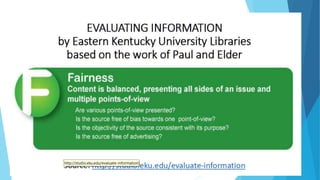
 Determine the reason for writing and publishing the
information. Check if the author is objective or
leaning heavily on a certain point of view.
 Check for advertising. Advertisers may use related
information to market their product.
While it may be difficult to fully
determine the reliability, accuracy,
value, and timeliness of any
information, as well as the authority of
the source, literacy in media and
information benefits from the
development of these skills.
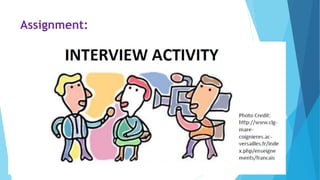
Assignment:
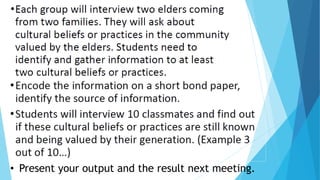
• Present your output and the result next meeting.

MEDIA AND INFORMATION SOURCES.pptx

  • 3.
    SOURCES OF INFORMATION INDIGENOUSKNOWLEDGE LIBRARY INTERNET MASS MEDIA
  • 10.
    Libraries are oftenclassified into 4 groups Academic Public School Special
  • 11.
    Characteristics of librariesin terms of reliability, accuracy and value:  Libraries of published books are often considered highly reliable, accurate, and valuable. Books and documents from dominant sources are often peer reviewed. ISSN or ISBN registration ensures that standards were followed in producing these materials.
  • 12.
    INTERNET  Information foundon the Internet  Information found on the Internet may be quite varied in form and content. Thus, it is more difficult to determine its reliability and accuracy. Accessing information on the Internet is easy, but requires more discipline to check and validate. Factual and fictitious data are often merged together. Sources always have to be validated.
  • 13.
    Alternative media/ MassMedia:  Other alternative forms of communication and distribution have become popular. These include social media, blogs, and flash mob performances. These alternative forms provide greater freedom and power to ordinary individuals and are a quicker way of distributing information. The downside is that a lot of the information being passed around is biased and inaccurate.
  • 20.
    Skills in Determiningthe Reliability of Information  Check the author. The author’s willingness to be identified is a good indication of reliability.  Check the date of publication or of update. While the information may be true, it may not be reliable if it is outdated and may have lost relevance.  Check for citations. Reliable authors have the discipline of citing sources of their information.  Check the domain or owner of the site or page. The domains .edu and .gov are reserved for academic institutions and the government respectively. Information from such sites are presented with caution and are usually well- grounded. Site owners may have an agenda that affects the manner by which information is presented.  Check the site design and the writing style. Credible sources take time to make their information accessible and easy to comprehend.
  • 21.
    Skills in DeterminingAccurate Information  Look for facts.  Cross-reference with other sources to check for consistency.  Determine the reason for writing and publishing the information. Check if the author is objective or leaning heavily on a certain point of view.  Check for advertising. Advertisers may use related information to market their product.
  • 24.
    While it maybe difficult to fully determine the reliability, accuracy, value, and timeliness of any information, as well as the authority of the source, literacy in media and information benefits from the development of these skills.
  • 25.
  • 26.
    • Present youroutput and the result next meeting.