MEDIA PLANNING
PROCESS
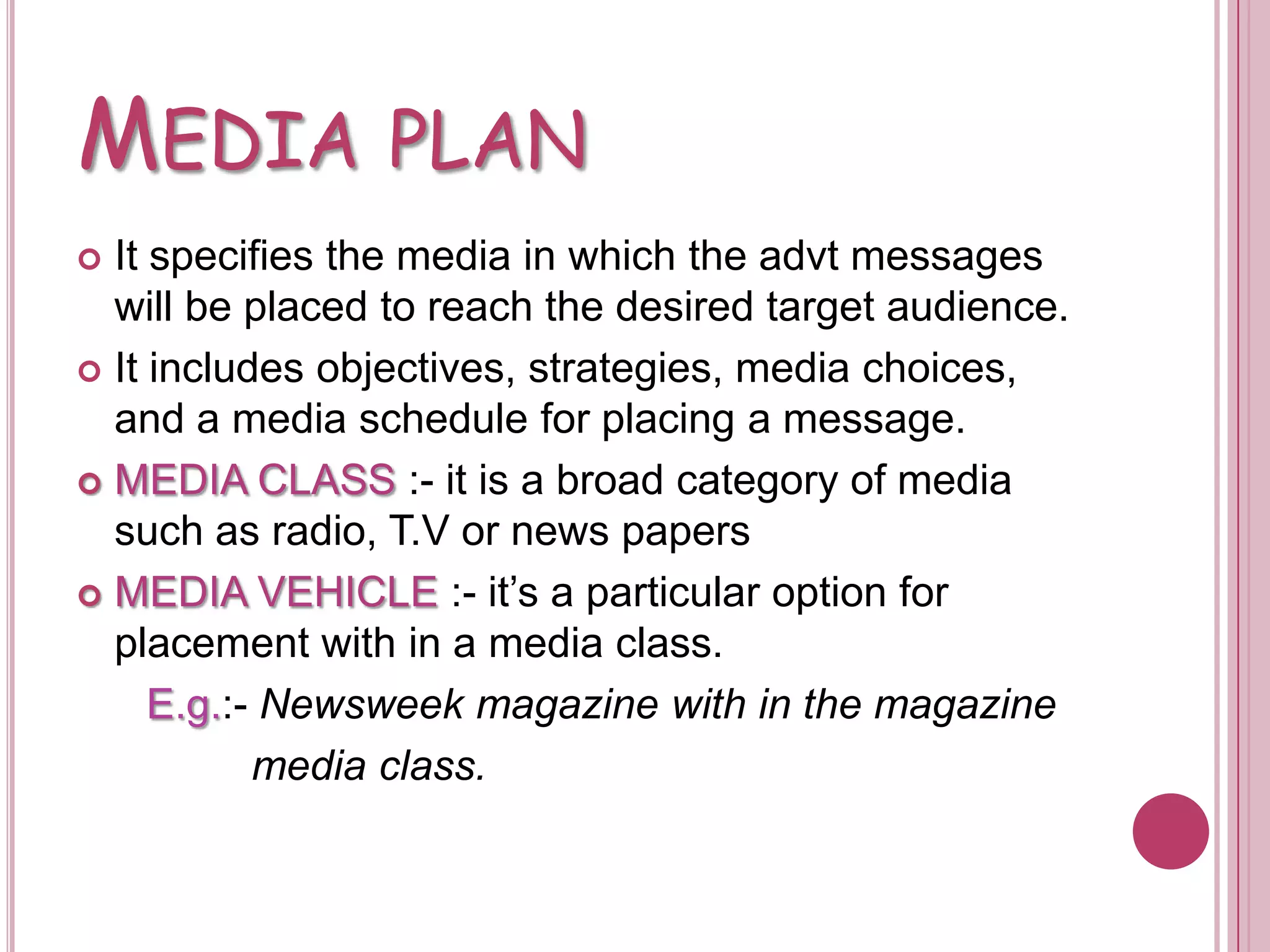
MEDIA PLAN
It specifies the media in which the advt messages
will be placed to reach the desired target audience.
 It includes objectives, strategies, media choices,
and a media schedule for placing a message.
 MEDIA CLASS :- it is a broad category of media
such as radio, T.V or news papers
 MEDIA VEHICLE :- it’s a particular option for
placement with in a media class.
E.g.:- Newsweek magazine with in the magazine
media class.

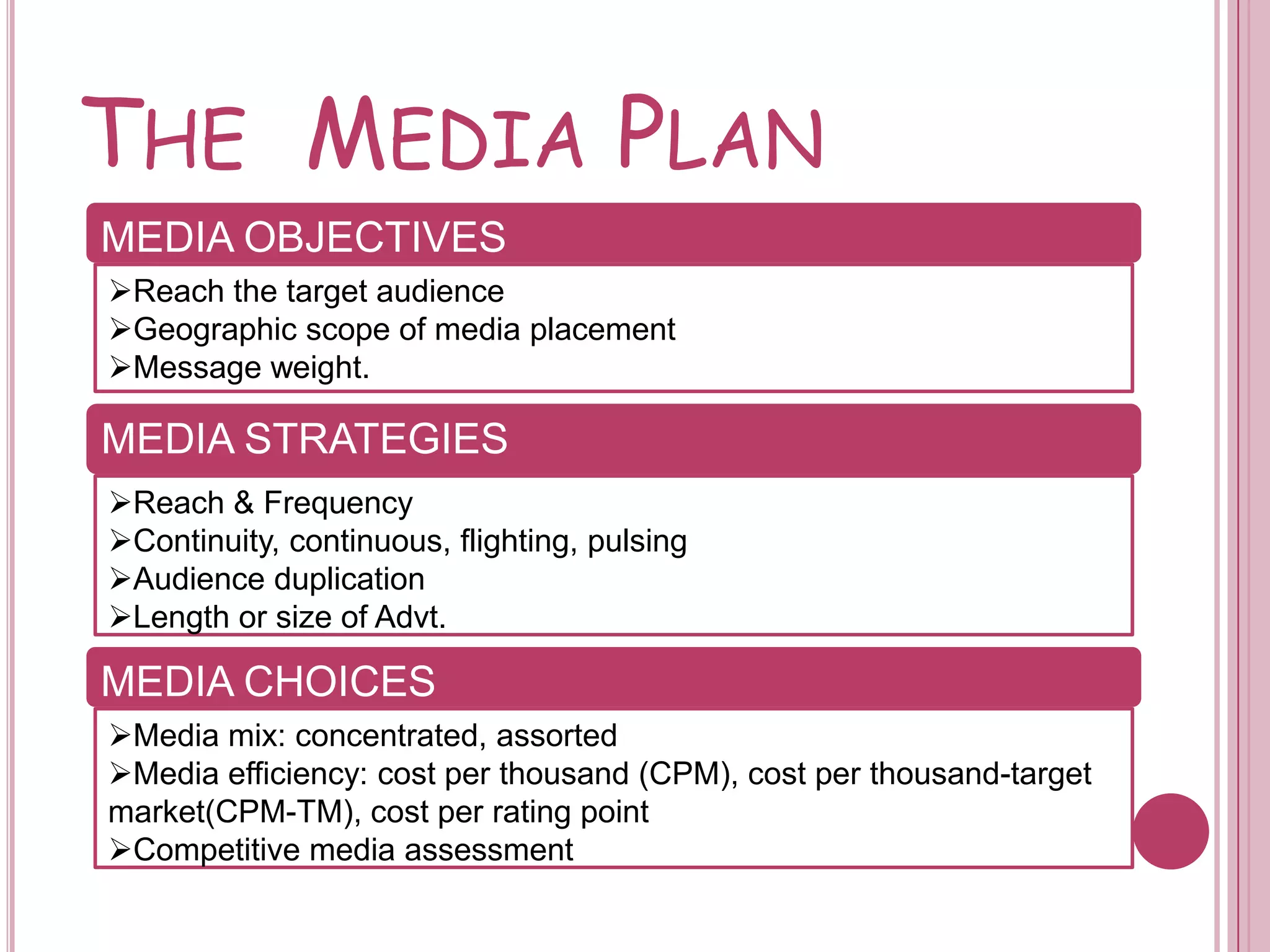
THE MEDIA PLAN
MEDIA OBJECTIVES
Reach the target audience
Geographic scope of media placement
Message weight.

MEDIA STRATEGIES
Reach & Frequency
Continuity, continuous, flighting, pulsing
Audience duplication
Length or size of Advt.

MEDIA CHOICES
Media mix: concentrated, assorted
Media efficiency: cost per thousand (CPM), cost per thousand-target
market(CPM-TM), cost per rating point
Competitive media assessment
MEDIA OBJECTIVES
It set specific goals for a media placement.
Reach the target audience, determine the
geographic scope of placement, and identify the
message weight, or the total mass of advertising
delivered against a target audience.
 Reach the target audience:- using the data
collected/provided by the media research
organizations.
Single-source tracking services:- new
method of research

Determining the geographic scope of media
placement.
Geo-targeting : it is the placement of ads in
geographic regions where higher purchase
tendencies for a brand are evident.
 Message weight: it is the gross number of advt
messages or exposure opportunities delivered by
the vehicles in a schedule. It is expressed in terms
of gross impressions.
 Vehicle duplication: recurring advertisements in the
media vehicles

MEDIA STRATEGIES
Its decisions help to ensure that messages placed
in chosen media have as much impact as possible.
 Reach and frequency:
Reach
refers to the number of people or households in a
target audience that will be exposed to a media
vehicle or schedule at least one time during a given
period of time.
Frequency is the average
num of times an individual or house hold with in a
target audience is exposed to a media in a given
period of time.

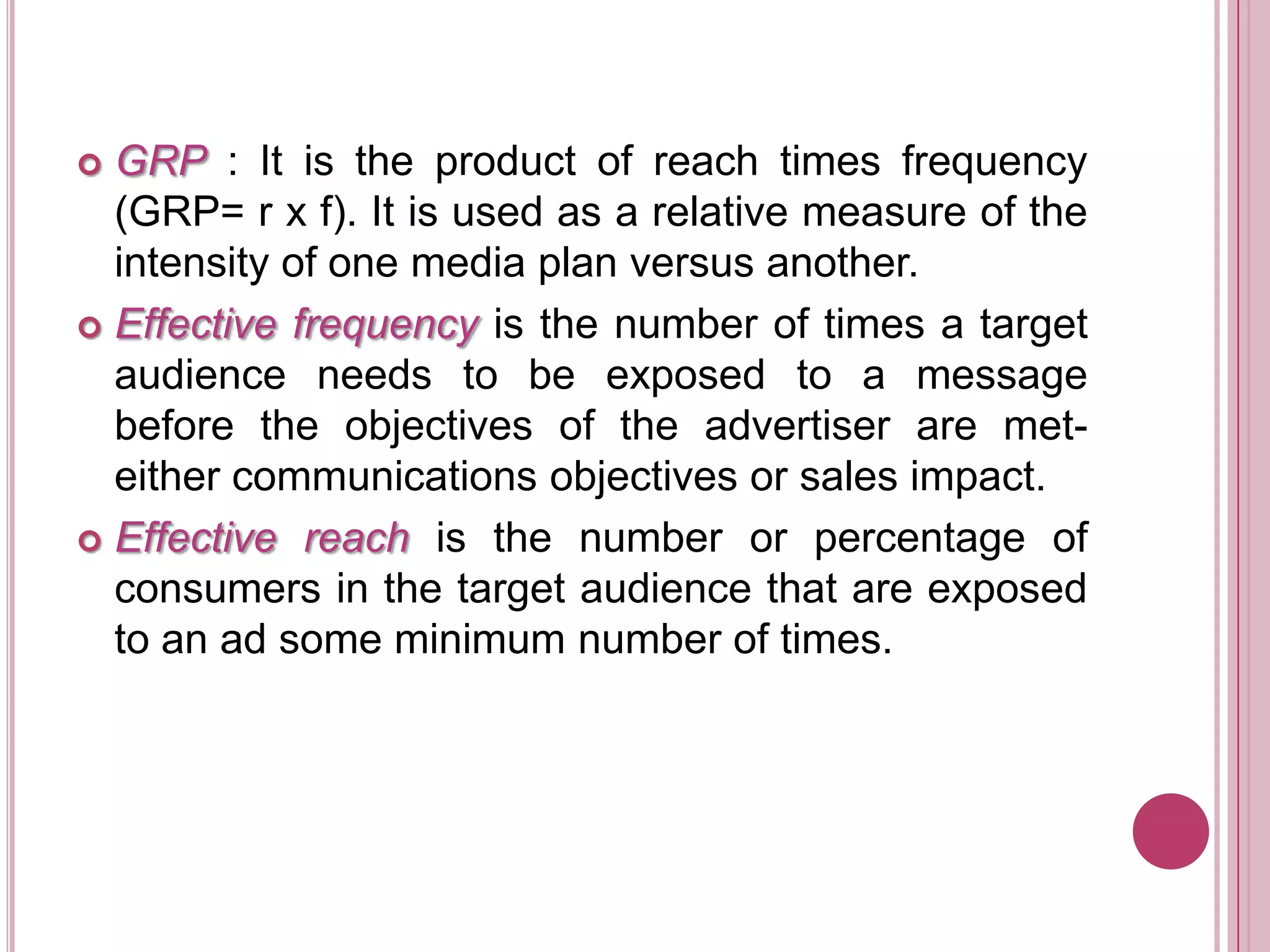
GRP : It is the product of reach times frequency
(GRP= r x f). It is used as a relative measure of the
intensity of one media plan versus another.
 Effective frequency is the number of times a target
audience needs to be exposed to a message
before the objectives of the advertiser are meteither communications objectives or sales impact.
 Effective reach is the number or percentage of
consumers in the target audience that are exposed
to an ad some minimum number of times.

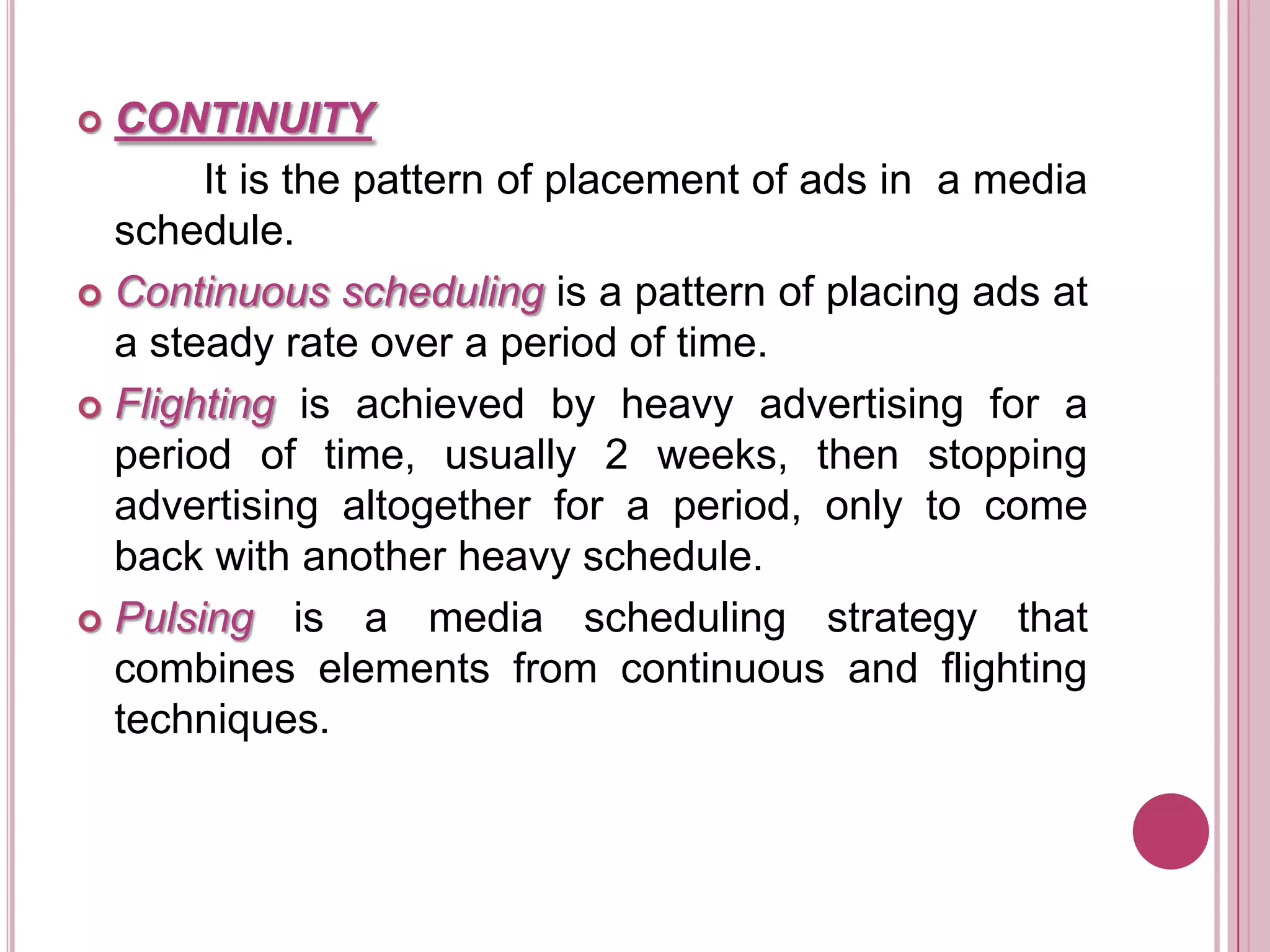
CONTINUITY
It is the pattern of placement of ads in a media
schedule.
 Continuous scheduling is a pattern of placing ads at
a steady rate over a period of time.
 Flighting is achieved by heavy advertising for a
period of time, usually 2 weeks, then stopping
advertising altogether for a period, only to come
back with another heavy schedule.
 Pulsing is a media scheduling strategy that
combines elements from continuous and flighting
techniques.

LENGTH OR SIZE OF THE ADVT
It
depends upon the creative requirements of the ad,
the media budget, and the competitive environment
with in which the ad is running.
 Square Root Law: i.e.“ the recognition of print ads
increase with the square of the illustration”

MEDIA CHOICES
Media mix:
it is the blend of different media that will be
used to effectively reach the target audience.
 Concentrated media mix: It focuses all the media
placement dollars in one medium.
The benefits are:
1. It may allow the advt to be dominant in 1 medium.
2. Brand familiarity might be heightened
3. Concentrating media buys in high-visibility media.
4. A concentration of media dollars may result in
significant volume discounts from media org.

Assorted media mix :
It employs multiple media alternatives to reach
target audiences. It facilitates communication with
multiple markets.
The advantages:
1. Reach of different target audiences.
2. Different messages in different media reaching
single target may enhance the learning effect.
3. It will increase the reach of the message,
compared to concentrating placement in 1
medium.
4. Grater audience reach compared to the other type
of media mix.

Media Efficiency: each media efficiency measures
using
Cost of media buy
 CPM (Cost Per Thousand)=
x 1000


Total audience



CPRP (cost per rating point)=

Dollar cost of ad
Placement on a program
Program rating
MEDIA SCHEDULING AND BUYING
It takes place through out the planning effort.
 All aspects of timing, reach, frequency, and
competitive media assessment are evaluated
during the scheduling phase.
 Heavy-up- scheduling.
 Agency of record.

COMPUTER MEDIA-PLANNING MODELS
Media planners rely heavily upon
computer databases and custom
analytical software to assess a wide
range of possibilities before making
costly media buys
CHALLENGES IN THE MEDIA
ENVIRONMENT
THE PROLIFERATION OF MEDIA
OPTIONS
There are two main areas where media
proliferation is occurring
1:Expansion of traditional media

Cable TV is expanding rapidly

Satellite dishes offer consumers a greater
range of programming

Increasing amount of magazines and
newspapers
2: New media are being developed to reach
consumers in more and different ways





Railroad station (big screens, online
services)
Movie theatre ads
Internet (online information services)
Direct marketing (firms of all types started
to publish newsletters, news magazines
and catalogues targeted at their current
customers and created their own in-house
media options)


Insufficient and Inaccurate Information

The information used to analyse who is
using what medium at what time and in
what numbers is generated as secondary
data by large commercial media research
organizations
 It is often out-of-date and does not
provide the category of measurement the
marketer or advertiser is interested in
 Escalating

Media Costs
The costs of newspaper and magazine ads
or a single spot on TV (traditional media)
can reach a high amount of money. These
costs escalate every year and e.g. depend
on prime-time. Therefore advertisers
scrutinize their media costs and start
thinking about alternatives e.g. placing
advertisements in interactive media.
 Interactive

Media
Interactive media reach beyond TV and
include e.g. interactive telephones,
interactive CDs, electronic kiosks, virtual
billboards, online services, online
versions of magazines and the Internet.
Companies and department stores
started using home pages on the World
Wide Web to inform the consumer


Media Choice and Integrated Brand Promotions
The great array of choices makes it more difficult for
the media planner tries to achieve integrated
marketing communication.
THANK YOU

Media planning process

  • 1.
  • 2.
    MEDIA PLAN It specifiesthe media in which the advt messages will be placed to reach the desired target audience.  It includes objectives, strategies, media choices, and a media schedule for placing a message.  MEDIA CLASS :- it is a broad category of media such as radio, T.V or news papers  MEDIA VEHICLE :- it’s a particular option for placement with in a media class. E.g.:- Newsweek magazine with in the magazine media class. 
  • 3.
    THE MEDIA PLAN MEDIAOBJECTIVES Reach the target audience Geographic scope of media placement Message weight. MEDIA STRATEGIES Reach & Frequency Continuity, continuous, flighting, pulsing Audience duplication Length or size of Advt. MEDIA CHOICES Media mix: concentrated, assorted Media efficiency: cost per thousand (CPM), cost per thousand-target market(CPM-TM), cost per rating point Competitive media assessment
  • 4.
    MEDIA OBJECTIVES It setspecific goals for a media placement. Reach the target audience, determine the geographic scope of placement, and identify the message weight, or the total mass of advertising delivered against a target audience.  Reach the target audience:- using the data collected/provided by the media research organizations. Single-source tracking services:- new method of research 
  • 5.
    Determining the geographicscope of media placement. Geo-targeting : it is the placement of ads in geographic regions where higher purchase tendencies for a brand are evident.  Message weight: it is the gross number of advt messages or exposure opportunities delivered by the vehicles in a schedule. It is expressed in terms of gross impressions.  Vehicle duplication: recurring advertisements in the media vehicles 
  • 6.
    MEDIA STRATEGIES Its decisionshelp to ensure that messages placed in chosen media have as much impact as possible.  Reach and frequency: Reach refers to the number of people or households in a target audience that will be exposed to a media vehicle or schedule at least one time during a given period of time. Frequency is the average num of times an individual or house hold with in a target audience is exposed to a media in a given period of time. 
  • 7.
    GRP : Itis the product of reach times frequency (GRP= r x f). It is used as a relative measure of the intensity of one media plan versus another.  Effective frequency is the number of times a target audience needs to be exposed to a message before the objectives of the advertiser are meteither communications objectives or sales impact.  Effective reach is the number or percentage of consumers in the target audience that are exposed to an ad some minimum number of times. 
  • 8.
    CONTINUITY It is thepattern of placement of ads in a media schedule.  Continuous scheduling is a pattern of placing ads at a steady rate over a period of time.  Flighting is achieved by heavy advertising for a period of time, usually 2 weeks, then stopping advertising altogether for a period, only to come back with another heavy schedule.  Pulsing is a media scheduling strategy that combines elements from continuous and flighting techniques. 
  • 9.
    LENGTH OR SIZEOF THE ADVT It depends upon the creative requirements of the ad, the media budget, and the competitive environment with in which the ad is running.  Square Root Law: i.e.“ the recognition of print ads increase with the square of the illustration” 
  • 10.
    MEDIA CHOICES Media mix: itis the blend of different media that will be used to effectively reach the target audience.  Concentrated media mix: It focuses all the media placement dollars in one medium. The benefits are: 1. It may allow the advt to be dominant in 1 medium. 2. Brand familiarity might be heightened 3. Concentrating media buys in high-visibility media. 4. A concentration of media dollars may result in significant volume discounts from media org. 
  • 11.
    Assorted media mix: It employs multiple media alternatives to reach target audiences. It facilitates communication with multiple markets. The advantages: 1. Reach of different target audiences. 2. Different messages in different media reaching single target may enhance the learning effect. 3. It will increase the reach of the message, compared to concentrating placement in 1 medium. 4. Grater audience reach compared to the other type of media mix. 
  • 12.
    Media Efficiency: eachmedia efficiency measures using Cost of media buy  CPM (Cost Per Thousand)= x 1000  Total audience  CPRP (cost per rating point)= Dollar cost of ad Placement on a program Program rating
  • 13.
    MEDIA SCHEDULING ANDBUYING It takes place through out the planning effort.  All aspects of timing, reach, frequency, and competitive media assessment are evaluated during the scheduling phase.  Heavy-up- scheduling.  Agency of record. 
  • 14.
    COMPUTER MEDIA-PLANNING MODELS Mediaplanners rely heavily upon computer databases and custom analytical software to assess a wide range of possibilities before making costly media buys
  • 15.
    CHALLENGES IN THEMEDIA ENVIRONMENT
  • 16.
    THE PROLIFERATION OFMEDIA OPTIONS There are two main areas where media proliferation is occurring 1:Expansion of traditional media  Cable TV is expanding rapidly  Satellite dishes offer consumers a greater range of programming  Increasing amount of magazines and newspapers
  • 17.
    2: New mediaare being developed to reach consumers in more and different ways     Railroad station (big screens, online services) Movie theatre ads Internet (online information services) Direct marketing (firms of all types started to publish newsletters, news magazines and catalogues targeted at their current customers and created their own in-house media options)
  • 18.
     Insufficient and InaccurateInformation The information used to analyse who is using what medium at what time and in what numbers is generated as secondary data by large commercial media research organizations  It is often out-of-date and does not provide the category of measurement the marketer or advertiser is interested in
  • 19.
     Escalating Media Costs Thecosts of newspaper and magazine ads or a single spot on TV (traditional media) can reach a high amount of money. These costs escalate every year and e.g. depend on prime-time. Therefore advertisers scrutinize their media costs and start thinking about alternatives e.g. placing advertisements in interactive media.
  • 20.
     Interactive Media Interactive mediareach beyond TV and include e.g. interactive telephones, interactive CDs, electronic kiosks, virtual billboards, online services, online versions of magazines and the Internet. Companies and department stores started using home pages on the World Wide Web to inform the consumer
  • 21.
     Media Choice andIntegrated Brand Promotions The great array of choices makes it more difficult for the media planner tries to achieve integrated marketing communication.
  • 22.