Uses:
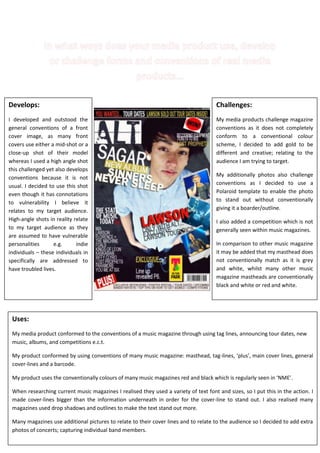
My media product conformed to the conventions of a music magazine through using tag lines, announcing tour dates, new
music, albums, and competitions e.c.t.
My product conformed by using conventions of many music magazine: masthead, tag-lines, ‘plus’, main cover lines, general
cover-lines and a barcode.
My product uses the conventionally colours of many music magazines red and black which is regularly seen in ‘NME’.
When researching current music magazines I realised they used a variety of text font and sizes, so I put this in the action. I
made cover-lines bigger than the information underneath in order for the cover-line to stand out. I also realised many
magazines used drop shadows and outlines to make the text stand out more.
Many magazines use additional pictures to relate to their cover lines and to relate to the audience so I decided to add extra
photos of concerts; capturing individual band members.
Challenges:
My media products challenge magazine
conventions as it does not completely
conform to a conventional colour
scheme, I decided to add gold to be
different and creative; relating to the
audience I am trying to target.
My additionally photos also challenge
conventions as I decided to use a
Polaroid template to enable the photo
to stand out without conventionally
giving it a boarder/outline.
I also added a competition which is not
generally seen within music magazines.
In comparison to other music magazine
it may be added that my masthead does
not conventionally match as it is grey
and white, whilst many other music
magazine mastheads are conventionally
black and white or red and white.
Develops:
I developed and outstood the
general conventions of a front
cover image, as many front
covers use either a mid-shot or a
close-up shot of their model
whereas I used a high angle shot
this challenged yet also develops
conventions because it is not
usual. I decided to use this shot
even though it has connotations
to vulnerability I believe it
relates to my target audience.
High-angle shots in reality relate
to my target audience as they
are assumed to have vulnerable
personalities e.g. indie
individuals – these individuals in
specifically are addressed to
have troubled lives.
MASTHEAD
TAG LINE
COLOUR SCHEME: RED,
BLACK, WHITE, GOLD
MAIN COVER-
LINE/ STORY
LINE
TAG-LINE
‘PLUS’
FRONT COVER
IMAGE
ADDITIONAL
PHOTOS
BARCOD
E
COVER-LINE
My media product challenges conventions of music
magazines as in general when the masthead/logo is
repeated on the contents page it is usually the same size
and colour e.c.t whereas mine is a different colour and size
this I s because I had problems with the layout and colour
scheme. The grey and white mast head did not contrast well
and did not stand out therefore it would not been effective
to use the exact same logo on the front cover.
My product used the conventions of
a music magazine by numbering
photos and stories in order to direct
the reader.
Looking at many
NME magazines I
saw the band
index feature
arise many times
so I decided to
add this feature
to my contents
page.
My magazine
conforms as it
uses many
photos like many
magazines…
My magazine
uses a variety
of text, as do
other
magazines, in
order create
proportion,
clarity and to
address a
certain
layout.
My magazine has a page
number which many
magazines however it
challenges and develops
conventions as it is situated
at the bottom left of the
page which is unusual.
Whilst
researching
many music
magazines I came
across a
‘subscribe’
feature in which
many magazines
use. This Is ideal
for customers as
it saves them
money when
subscribing to
the magazine
monthly
My research of many music magazines
help me conclude that many contents
pages apply the date/month to the
contents page.
Many double page spreads in
magazines usually use a large image
which usually uses direct address,
the models looking directly at the
camera.
Pull-quotes are regularly used on
double page spreads. This is usually
a quote from the celebrity from the
interview.
The name of the artist
whom features in the
article is usually in colour.
Many double page spreads are in
columns this is to ensure that the
article has structure and that it is
easier to read.
The image usually used is of a rather
large scale and on the left hand side
of the page.
I consider my pull-quotes to challenge
the conventions of many double page
spreads as it is smaller than many
other pull-quotes
The mode of
address is
usually
informal and
colloquial
slang to allow
the reader to
feel
comfortable
e.g. ‘talkin’
Many
magazines
take the
convention of
having
information
about the
artists who
feature in the
article for
those who do
not know the
artists.
However I believe my information on the artists
develops conventions as it is usually not boxed at the
bottom left of the page; it is usually fee text
underneath the title just before the article is written.
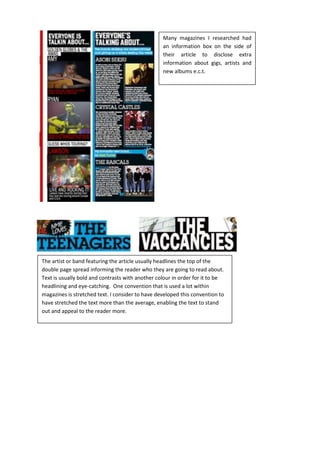
Many magazines I researched had
an information box on the side of
their article to disclose extra
information about gigs, artists and
new albums e.c.t.
The artist or band featuring the article usually headlines the top of the
double page spread informing the reader who they are going to read about.
Text is usually bold and contrasts with another colour in order for it to be
headlining and eye-catching. One convention that is used a lot within
magazines is stretched text. I consider to have developed this convention to
have stretched the text more than the average, enabling the text to stand
out and appeal to the reader more.
HOW DOES YOUR MEDIA PRODUCT REPRESENT PARTICULAR SOCIAL
GROUPS?
My product is mainly aimed at students/teenagers so I used an image of a
teenage boy. Whereas my product is aimed more towards individuals with an
indie/rock personality I ensure that the style of my artist related to the
conventions of an ‘indie/rock’ individual e.g. skinny trouser, shirts, t-shirts,
demin and messy hair. This iconic style relates too many indie relate
individuals, whereas my product was aimed at indie/rock individuals I decided
to dress my model appropriately according to genre.
I used colloquial slang according to my target age e.g. ‘talkin’ this is so that it
relates to and represents my target audience. This relation ensures my reader
feels comfortable and can relate to the product and the people behind the
product.
In my first draft I used a colour scheme of blue and white I developed this as I
considered it to be only directed towards males; therefore I developed my
colour scheme according to conventions addressing both sexes. I also used a
variety of images of both females and males in order to address my mixed
gender target audience.
Whereas my media product is mainly aimed at teenagers/students I ensured
that the product was of an affordable price at £2.00. As according to recent
research, results showed that individuals are more likely to buy my product if
there was a free gift attached or competitions inside. As according to research I
ensured to add this feature to my magazine.
As according to research on magazine conventions, I learnt that these
conventions can be used to attract your audience. For example using certain
colours to contrast and to use bold lettering attracts customers to look at your
product.
My target audience are individuals who have a genuine interest in music
therefore are likely to attend gigs and festivals so I addressed this concept
through applying gig photographs of artists and band performing.
What have you learnt about technologies from the process of constructing
this product?
When we first started using Photoshop I did not understand
how to use it and was not confident at using it either as I
never used it before. However as I became more familiar
with the software and looked at many tutorials on how to use
it on YouTube I became more confident in
understanding how the software worked and how to
use it.
Airbrushing - Photoshop tutorial:
http://www.youtube.com/watch?v=ZM1ldtI4bFI
Removing spots/imperfections – Photoshop tutorial:
http://www.youtube.com/watch?v=AQvtsy_7uxQ
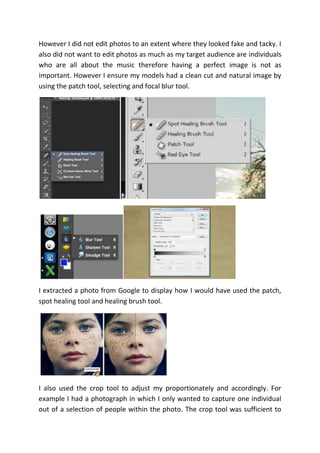
However I did not edit photos to an extent where they looked fake and tacky. I
also did not want to edit photos as much as my target audience are individuals
who are all about the music therefore having a perfect image is not as
important. However I ensure my models had a clean cut and natural image by
using the patch tool, selecting and focal blur tool.
I extracted a photo from Google to display how I would have used the patch,
spot healing tool and healing brush tool.
I also used the crop tool to adjust my proportionately and accordingly. For
example I had a photograph in which I only wanted to capture one individual
out of a selection of people within the photo. The crop tool was sufficient to
crop the other individuals out of the image leaving the one individual that I
needed for my product.
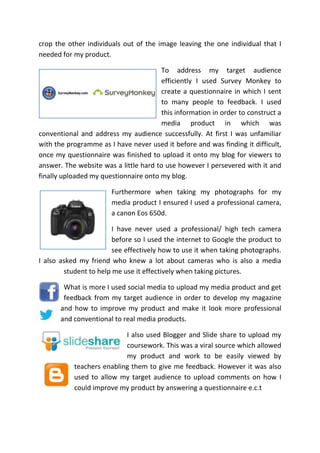
To address my target audience
efficiently I used Survey Monkey to
create a questionnaire in which I sent
to many people to feedback. I used
this information in order to construct a
media product in which was
conventional and address my audience successfully. At first I was unfamiliar
with the programme as I have never used it before and was finding it difficult,
once my questionnaire was finished to upload it onto my blog for viewers to
answer. The website was a little hard to use however I persevered with it and
finally uploaded my questionnaire onto my blog.
Furthermore when taking my photographs for my
media product I ensured I used a professional camera,
a canon Eos 650d.
I have never used a professional/ high tech camera
before so I used the internet to Google the product to
see effectively how to use it when taking photographs.
I also asked my friend who knew a lot about cameras who is also a media
student to help me use it effectively when taking pictures.
What is more I used social media to upload my media product and get
feedback from my target audience in order to develop my magazine
and how to improve my product and make it look more professional
and conventional to real media products.
I also used Blogger and Slide share to upload my
coursework. This was a viral source which allowed
my product and work to be easily viewed by
teachers enabling them to give me feedback. However it was also
used to allow my target audience to upload comments on how I
could improve my product by answering a questionnaire e.c.t
Looking back at your preliminary task, what do you feel like you have learnt
in progression from it to the full product?
Looking back at my preliminary task my research on real media products has
allowed me to understand how real media products address their target
audience through using conventions and features.
Additionally I have learnt how to use Photoshop effectively to create a
professional looking product. Whereas when I created my student magazine I
used Microsoft Publisher therefore my product was not as professional as it
could have been because Publisher does not have the developed and
professional tools in which Photoshop has.
Looking back at my preliminary task I believe it helped me understand how to
use house colours in order to relate and address your target audience. When
creating my preliminary task I used the house colours of blue, red and black as
it related to our schools uniform colour therefore relating to the audience I
was trying to address.
I have also learnt how to develop and adjust photographs accordingly to genre
and professionalism. Previously I did not use the crop tool and I also stretched
my images to much so they did not look professional, this caused the quality to
be affected. Whereas when creating my full product I understood that I had to
ensure that my images were professional and was not un-focused or stretched.

Media evaluation

  • 1.
    Uses: My media productconformed to the conventions of a music magazine through using tag lines, announcing tour dates, new music, albums, and competitions e.c.t. My product conformed by using conventions of many music magazine: masthead, tag-lines, ‘plus’, main cover lines, general cover-lines and a barcode. My product uses the conventionally colours of many music magazines red and black which is regularly seen in ‘NME’. When researching current music magazines I realised they used a variety of text font and sizes, so I put this in the action. I made cover-lines bigger than the information underneath in order for the cover-line to stand out. I also realised many magazines used drop shadows and outlines to make the text stand out more. Many magazines use additional pictures to relate to their cover lines and to relate to the audience so I decided to add extra photos of concerts; capturing individual band members. Challenges: My media products challenge magazine conventions as it does not completely conform to a conventional colour scheme, I decided to add gold to be different and creative; relating to the audience I am trying to target. My additionally photos also challenge conventions as I decided to use a Polaroid template to enable the photo to stand out without conventionally giving it a boarder/outline. I also added a competition which is not generally seen within music magazines. In comparison to other music magazine it may be added that my masthead does not conventionally match as it is grey and white, whilst many other music magazine mastheads are conventionally black and white or red and white. Develops: I developed and outstood the general conventions of a front cover image, as many front covers use either a mid-shot or a close-up shot of their model whereas I used a high angle shot this challenged yet also develops conventions because it is not usual. I decided to use this shot even though it has connotations to vulnerability I believe it relates to my target audience. High-angle shots in reality relate to my target audience as they are assumed to have vulnerable personalities e.g. indie individuals – these individuals in specifically are addressed to have troubled lives.
  • 2.
    MASTHEAD TAG LINE COLOUR SCHEME:RED, BLACK, WHITE, GOLD MAIN COVER- LINE/ STORY LINE TAG-LINE ‘PLUS’ FRONT COVER IMAGE ADDITIONAL PHOTOS BARCOD E COVER-LINE
  • 3.
    My media productchallenges conventions of music magazines as in general when the masthead/logo is repeated on the contents page it is usually the same size and colour e.c.t whereas mine is a different colour and size this I s because I had problems with the layout and colour scheme. The grey and white mast head did not contrast well and did not stand out therefore it would not been effective to use the exact same logo on the front cover. My product used the conventions of a music magazine by numbering photos and stories in order to direct the reader. Looking at many NME magazines I saw the band index feature arise many times so I decided to add this feature to my contents page. My magazine conforms as it uses many photos like many magazines… My magazine uses a variety of text, as do other magazines, in order create proportion, clarity and to address a certain layout. My magazine has a page number which many magazines however it challenges and develops conventions as it is situated at the bottom left of the page which is unusual. Whilst researching many music magazines I came across a ‘subscribe’ feature in which many magazines use. This Is ideal for customers as it saves them money when subscribing to the magazine monthly My research of many music magazines help me conclude that many contents pages apply the date/month to the contents page.
  • 4.
    Many double pagespreads in magazines usually use a large image which usually uses direct address, the models looking directly at the camera. Pull-quotes are regularly used on double page spreads. This is usually a quote from the celebrity from the interview. The name of the artist whom features in the article is usually in colour. Many double page spreads are in columns this is to ensure that the article has structure and that it is easier to read. The image usually used is of a rather large scale and on the left hand side of the page. I consider my pull-quotes to challenge the conventions of many double page spreads as it is smaller than many other pull-quotes The mode of address is usually informal and colloquial slang to allow the reader to feel comfortable e.g. ‘talkin’ Many magazines take the convention of having information about the artists who feature in the article for those who do not know the artists. However I believe my information on the artists develops conventions as it is usually not boxed at the bottom left of the page; it is usually fee text underneath the title just before the article is written.
  • 5.
    Many magazines Iresearched had an information box on the side of their article to disclose extra information about gigs, artists and new albums e.c.t. The artist or band featuring the article usually headlines the top of the double page spread informing the reader who they are going to read about. Text is usually bold and contrasts with another colour in order for it to be headlining and eye-catching. One convention that is used a lot within magazines is stretched text. I consider to have developed this convention to have stretched the text more than the average, enabling the text to stand out and appeal to the reader more.
  • 6.
    HOW DOES YOURMEDIA PRODUCT REPRESENT PARTICULAR SOCIAL GROUPS? My product is mainly aimed at students/teenagers so I used an image of a teenage boy. Whereas my product is aimed more towards individuals with an indie/rock personality I ensure that the style of my artist related to the conventions of an ‘indie/rock’ individual e.g. skinny trouser, shirts, t-shirts, demin and messy hair. This iconic style relates too many indie relate individuals, whereas my product was aimed at indie/rock individuals I decided to dress my model appropriately according to genre. I used colloquial slang according to my target age e.g. ‘talkin’ this is so that it relates to and represents my target audience. This relation ensures my reader feels comfortable and can relate to the product and the people behind the product.
  • 7.
    In my firstdraft I used a colour scheme of blue and white I developed this as I considered it to be only directed towards males; therefore I developed my colour scheme according to conventions addressing both sexes. I also used a variety of images of both females and males in order to address my mixed gender target audience. Whereas my media product is mainly aimed at teenagers/students I ensured that the product was of an affordable price at £2.00. As according to recent research, results showed that individuals are more likely to buy my product if there was a free gift attached or competitions inside. As according to research I ensured to add this feature to my magazine. As according to research on magazine conventions, I learnt that these conventions can be used to attract your audience. For example using certain colours to contrast and to use bold lettering attracts customers to look at your product. My target audience are individuals who have a genuine interest in music therefore are likely to attend gigs and festivals so I addressed this concept through applying gig photographs of artists and band performing. What have you learnt about technologies from the process of constructing this product? When we first started using Photoshop I did not understand how to use it and was not confident at using it either as I never used it before. However as I became more familiar with the software and looked at many tutorials on how to use it on YouTube I became more confident in understanding how the software worked and how to use it. Airbrushing - Photoshop tutorial: http://www.youtube.com/watch?v=ZM1ldtI4bFI Removing spots/imperfections – Photoshop tutorial: http://www.youtube.com/watch?v=AQvtsy_7uxQ
  • 8.
    However I didnot edit photos to an extent where they looked fake and tacky. I also did not want to edit photos as much as my target audience are individuals who are all about the music therefore having a perfect image is not as important. However I ensure my models had a clean cut and natural image by using the patch tool, selecting and focal blur tool. I extracted a photo from Google to display how I would have used the patch, spot healing tool and healing brush tool. I also used the crop tool to adjust my proportionately and accordingly. For example I had a photograph in which I only wanted to capture one individual out of a selection of people within the photo. The crop tool was sufficient to
  • 9.
    crop the otherindividuals out of the image leaving the one individual that I needed for my product. To address my target audience efficiently I used Survey Monkey to create a questionnaire in which I sent to many people to feedback. I used this information in order to construct a media product in which was conventional and address my audience successfully. At first I was unfamiliar with the programme as I have never used it before and was finding it difficult, once my questionnaire was finished to upload it onto my blog for viewers to answer. The website was a little hard to use however I persevered with it and finally uploaded my questionnaire onto my blog. Furthermore when taking my photographs for my media product I ensured I used a professional camera, a canon Eos 650d. I have never used a professional/ high tech camera before so I used the internet to Google the product to see effectively how to use it when taking photographs. I also asked my friend who knew a lot about cameras who is also a media student to help me use it effectively when taking pictures. What is more I used social media to upload my media product and get feedback from my target audience in order to develop my magazine and how to improve my product and make it look more professional and conventional to real media products. I also used Blogger and Slide share to upload my coursework. This was a viral source which allowed my product and work to be easily viewed by teachers enabling them to give me feedback. However it was also used to allow my target audience to upload comments on how I could improve my product by answering a questionnaire e.c.t
  • 10.
    Looking back atyour preliminary task, what do you feel like you have learnt in progression from it to the full product? Looking back at my preliminary task my research on real media products has allowed me to understand how real media products address their target audience through using conventions and features. Additionally I have learnt how to use Photoshop effectively to create a professional looking product. Whereas when I created my student magazine I used Microsoft Publisher therefore my product was not as professional as it could have been because Publisher does not have the developed and professional tools in which Photoshop has. Looking back at my preliminary task I believe it helped me understand how to use house colours in order to relate and address your target audience. When creating my preliminary task I used the house colours of blue, red and black as it related to our schools uniform colour therefore relating to the audience I was trying to address. I have also learnt how to develop and adjust photographs accordingly to genre and professionalism. Previously I did not use the crop tool and I also stretched my images to much so they did not look professional, this caused the quality to be affected. Whereas when creating my full product I understood that I had to ensure that my images were professional and was not un-focused or stretched.