Vicki Dirksen


PLAID SWAN   Media. Marketing. Creative.
Why should I plan my advertising?
 Evaluate all options
 Identify objectives and how to reach them
 Allows for proactive not reactionary spending
 Separate advertising from public relations
 Develop a schedule of when your ads will run
 Provide history for future reference
 Better results
 SAVE MONEY
Your media plan forces you to:
 Review your marketing objectives
 Review the options available.
 Evaluate them against your objectives.
 Set your minimum and maximum budget constraints.
 Create alternative scenarios until you uncover the strategy
  that accomplishes your objectives within those constraints.
 Develop a schedule for each medium.
 Summarize your plan in the form of a calendar and budget.
 Negotiate with media representatives to execute your plan.
Goal Setting & Evaluating
Five Step Approach:
 Why Are You Advertising?
 What Do You Want To Accomplish?
 Who Do You Want To Primarily Target?
 When to You Want to This to Happen?
 Where Do You Want This To Happen?


The Devil Is In The Details
Basic Vocabulary
CPM (aka Cost Per Thousand)
CPM represents the cost of reaching one thousand
people via different types of media. To calculate CPM,
you find the cost for an ad and divide it by the total
circulation/audience the ad reaches (in thousands). By
finding this information and calculating this cost for
each of your options, you can give them a numerical
ranking for comparison.
Basic Vocabulary
Circulation
Print advertising prices are based on the circulation of
the publication in question. Publications will quote you
a circulation figure based on paid subscribers. The
audited circulation figures are verified by monitoring
organizations.
Basic Vocabulary
Audience
Audience is the equivalent of circulation when you're
talking about broadcast media (radio & television).
Audience size varies throughout the day as people tune
in and tune out. Therefore, the price for advertising at
different times of day will vary, based on the audience
size that the day-part delivers.
Basic Vocabulary
Penetration
Penetration describes how much of the total market
available you are reaching. What degree of penetration is
necessary for you depends on whether your strategy is to
dominate the market or to reach a certain niche within
that market.
Basic Vocabulary
Reach
Reach is the total number of people exposed to a
message at least once in a set time period, usually four
weeks. Reach is the broadcast equivalent of circulation
for print advertising. To make reach go up, you buy a
wider market area.
Basic Vocabulary
Frequency
Frequency is the average number of times the people
that are reached are exposed during that time period. To
make frequency go up, you buy more ads during the time
period.
Radio
STRENGTHS                                       WEAKNESSES
 Reaches consumers while they are in            Clutter. Lots of advertisers can make it
  transit.                                        difficult to get competitive separation.
 Greatest value-added capabilities.             Not a good medium for broad
 Radio is an excellent frequency medium.         demographics.
 Targets narrowed demographic age/sex           Audio only. No visual. Advertiser must
  cells in a specific listening area.             “paint a picture” in the mind of the
 Intrusive. It is a one-on-one relationship.
                                                  listener.
                                                 Advertisers must run enough spots on
 Highly negotiable.
                                                  each station to achieve a 3.0 frequency
 Low unit cost and low production cost.
                                                  per station, per week.
 Appeals to listener’s emotional side.
                                                 You must buy more than one station in
 Copy can be changed quickly & easily.           order to achieve reach goals due to
 Multiple messages can run during same           station loyalty. Even then, it is difficult to
  buy.                                            achieve more than a 50% reach.
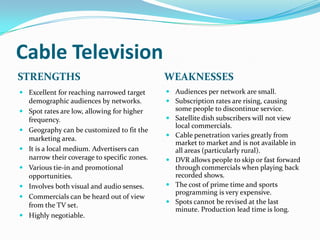
Cable Television
STRENGTHS                                    WEAKNESSES
 Excellent for reaching narrowed target      Audiences per network are small.
  demographic audiences by networks.          Subscription rates are rising, causing
 Spot rates are low, allowing for higher      some people to discontinue service.
  frequency.                                  Satellite dish subscribers will not view
                                               local commercials.
 Geography can be customized to fit the
                                              Cable penetration varies greatly from
  marketing area.
                                               market to market and is not available in
 It is a local medium. Advertisers can        all areas (particularly rural).
  narrow their coverage to specific zones.    DVR allows people to skip or fast forward
 Various tie-in and promotional               through commercials when playing back
  opportunities.                               recorded shows.
 Involves both visual and audio senses.      The cost of prime time and sports
                                               programming is very expensive.
 Commercials can be heard out of view
                                              Spots cannot be revised at the last
  from the TV set.
                                               minute. Production lead time is long.
 Highly negotiable.
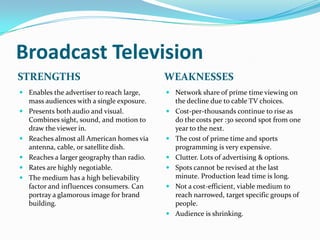
Broadcast Television
STRENGTHS                                  WEAKNESSES
 Enables the advertiser to reach large,    Network share of prime time viewing on
  mass audiences with a single exposure.     the decline due to cable TV choices.
 Presents both audio and visual.           Cost-per-thousands continue to rise as
  Combines sight, sound, and motion to       do the costs per :30 second spot from one
  draw the viewer in.                        year to the next.
 Reaches almost all American homes via     The cost of prime time and sports
  antenna, cable, or satellite dish.         programming is very expensive.
 Reaches a larger geography than radio.    Clutter. Lots of advertising & options.
 Rates are highly negotiable.              Spots cannot be revised at the last
 The medium has a high believability        minute. Production lead time is long.
  factor and influences consumers. Can      Not a cost-efficient, viable medium to
  portray a glamorous image for brand        reach narrowed, target specific groups of
  building.                                  people.
                                            Audience is shrinking.
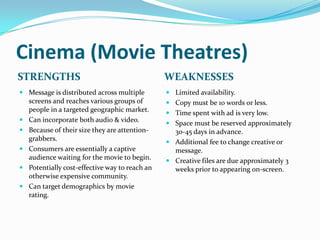
Cinema (Movie Theatres)
STRENGTHS                                      WEAKNESSES
 Message is distributed across multiple        Limited availability.
  screens and reaches various groups of         Copy must be 10 words or less.
  people in a targeted geographic market.       Time spent with ad is very low.
 Can incorporate both audio & video.
                                                Space must be reserved approximately
 Because of their size they are attention-      30-45 days in advance.
  grabbers.                                     Additional fee to change creative or
 Consumers are essentially a captive            message.
  audience waiting for the movie to begin.      Creative files are due approximately 3
 Potentially cost-effective way to reach an     weeks prior to appearing on-screen.
  otherwise expensive community.
 Can target demographics by movie
  rating.
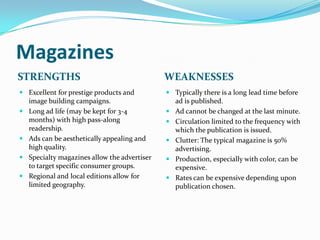
Magazines
STRENGTHS                                    WEAKNESSES
 Excellent for prestige products and         Typically there is a long lead time before
  image building campaigns.                    ad is published.
 Long ad life (may be kept for 3-4           Ad cannot be changed at the last minute.
  months) with high pass-along                Circulation limited to the frequency with
  readership.                                  which the publication is issued.
 Ads can be aesthetically appealing and      Clutter: The typical magazine is 50%
  high quality.                                advertising.
 Specialty magazines allow the advertiser    Production, especially with color, can be
  to target specific consumer groups.          expensive.
 Regional and local editions allow for       Rates can be expensive depending upon
  limited geography.                           publication chosen.
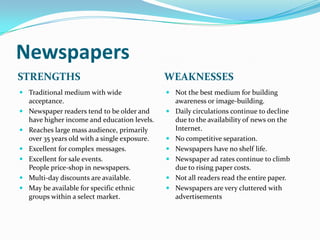
Newspapers
STRENGTHS                                     WEAKNESSES
 Traditional medium with wide                 Not the best medium for building
  acceptance.                                   awareness or image-building.
 Newspaper readers tend to be older and       Daily circulations continue to decline
  have higher income and education levels.      due to the availability of news on the
 Reaches large mass audience, primarily        Internet.
  over 35 years old with a single exposure.    No competitive separation.
 Excellent for complex messages.              Newspapers have no shelf life.
 Excellent for sale events.                   Newspaper ad rates continue to climb
  People price-shop in newspapers.              due to rising paper costs.
 Multi-day discounts are available.           Not all readers read the entire paper.
 May be available for specific ethnic         Newspapers are very cluttered with
  groups within a select market.                advertisements
Free Community Papers
STRENGTHS                                    WEAKNESSES
 Can be targeted to specific demographics    Quickly discarded, no shelf life.
  or lifestyles.                              Low-quality production.
 Typically reaches every household in a      Limited creative options.
  community – particularly for shoppers.      Many ads are overlooked.
 Shoppers appeal to bargain hunters –
                                              High level of clutter.
  ideal for coupons.
                                              Not paid publications so people don’t
 Typically distributed for free.
                                               feel a responsibility to read them.
 Readers vary widely depending on
                                              May have negative view of publication if
  content & focus of publication.              delivered to home without request.
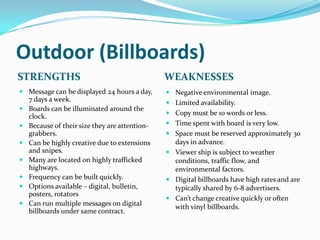
Outdoor (Billboards)
STRENGTHS                                     WEAKNESSES
 Message can be displayed 24 hours a day,     Negative environmental image.
  7 days a week.                               Limited availability.
 Boards can be illuminated around the
                                               Copy must be 10 words or less.
  clock.
 Because of their size they are attention-    Time spent with board is very low.
  grabbers.                                    Space must be reserved approximately 30
 Can be highly creative due to extensions      days in advance.
  and snipes.                                  Viewer ship is subject to weather
 Many are located on highly trafficked         conditions, traffic flow, and
  highways.                                     environmental factors.
 Frequency can be built quickly.              Digital billboards have high rates and are
 Options available – digital, bulletin,        typically shared by 6-8 advertisers.
  posters, rotators
                                               Can’t change creative quickly or often
 Can run multiple messages on digital
                                                with vinyl billboards.
  billboards under same contract.
Added Value
 Items which do not have an actual cost to the medium
    are easier to negotiate.
   Typical added value is 10% of buy.
   Negotiate per buy and per media outlet.
   If you can’t get what you want, ask what they can do.
   Use added value for future buys.
   Remember your sales rep is there to work with you.
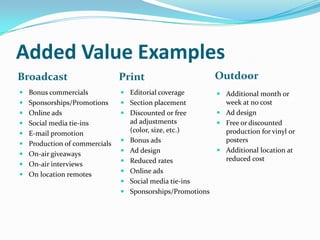
Added Value Examples
Broadcast                     Print                       Outdoor
 Bonus commercials            Editorial coverage         Additional month or
 Sponsorships/Promotions      Section placement           week at no cost
 Online ads                   Discounted or free         Ad design
 Social media tie-ins          ad adjustments             Free or discounted
 E-mail promotion
                                (color, size, etc.)         production for vinyl or
                               Bonus ads                   posters
 Production of commercials
                               Ad design                  Additional location at
 On-air giveaways
                               Reduced rates               reduced cost
 On-air interviews
                               Online ads
 On location remotes
                               Social media tie-ins
                               Sponsorships/Promotions
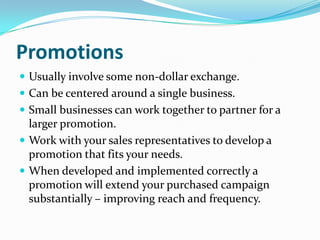
Promotions
 Usually involve some non-dollar exchange.
 Can be centered around a single business.
 Small businesses can work together to partner for a
  larger promotion.
 Work with your sales representatives to develop a
  promotion that fits your needs.
 When developed and implemented correctly a
  promotion will extend your purchased campaign
  substantially – improving reach and frequency.
Questions
For any future inquiries, I can be reached at:
      Vicki Dirksen
      Plaid Swan
      www.plaidswan.com
      563-581-7277
      vicki@plaidswan.com

Media Planning & Buying

  • 1.
    Vicki Dirksen PLAID SWAN Media. Marketing. Creative.
  • 2.
    Why should Iplan my advertising?  Evaluate all options  Identify objectives and how to reach them  Allows for proactive not reactionary spending  Separate advertising from public relations  Develop a schedule of when your ads will run  Provide history for future reference  Better results  SAVE MONEY
  • 3.
    Your media planforces you to:  Review your marketing objectives  Review the options available.  Evaluate them against your objectives.  Set your minimum and maximum budget constraints.  Create alternative scenarios until you uncover the strategy that accomplishes your objectives within those constraints.  Develop a schedule for each medium.  Summarize your plan in the form of a calendar and budget.  Negotiate with media representatives to execute your plan.
  • 4.
    Goal Setting &Evaluating Five Step Approach:  Why Are You Advertising?  What Do You Want To Accomplish?  Who Do You Want To Primarily Target?  When to You Want to This to Happen?  Where Do You Want This To Happen? The Devil Is In The Details
  • 5.
    Basic Vocabulary CPM (akaCost Per Thousand) CPM represents the cost of reaching one thousand people via different types of media. To calculate CPM, you find the cost for an ad and divide it by the total circulation/audience the ad reaches (in thousands). By finding this information and calculating this cost for each of your options, you can give them a numerical ranking for comparison.
  • 6.
    Basic Vocabulary Circulation Print advertisingprices are based on the circulation of the publication in question. Publications will quote you a circulation figure based on paid subscribers. The audited circulation figures are verified by monitoring organizations.
  • 7.
    Basic Vocabulary Audience Audience isthe equivalent of circulation when you're talking about broadcast media (radio & television). Audience size varies throughout the day as people tune in and tune out. Therefore, the price for advertising at different times of day will vary, based on the audience size that the day-part delivers.
  • 8.
    Basic Vocabulary Penetration Penetration describeshow much of the total market available you are reaching. What degree of penetration is necessary for you depends on whether your strategy is to dominate the market or to reach a certain niche within that market.
  • 9.
    Basic Vocabulary Reach Reach isthe total number of people exposed to a message at least once in a set time period, usually four weeks. Reach is the broadcast equivalent of circulation for print advertising. To make reach go up, you buy a wider market area.
  • 10.
    Basic Vocabulary Frequency Frequency isthe average number of times the people that are reached are exposed during that time period. To make frequency go up, you buy more ads during the time period.
  • 11.
    Radio STRENGTHS WEAKNESSES  Reaches consumers while they are in  Clutter. Lots of advertisers can make it transit. difficult to get competitive separation.  Greatest value-added capabilities.  Not a good medium for broad  Radio is an excellent frequency medium. demographics.  Targets narrowed demographic age/sex  Audio only. No visual. Advertiser must cells in a specific listening area. “paint a picture” in the mind of the  Intrusive. It is a one-on-one relationship. listener.  Advertisers must run enough spots on  Highly negotiable. each station to achieve a 3.0 frequency  Low unit cost and low production cost. per station, per week.  Appeals to listener’s emotional side.  You must buy more than one station in  Copy can be changed quickly & easily. order to achieve reach goals due to  Multiple messages can run during same station loyalty. Even then, it is difficult to buy. achieve more than a 50% reach.
  • 12.
    Cable Television STRENGTHS WEAKNESSES  Excellent for reaching narrowed target  Audiences per network are small. demographic audiences by networks.  Subscription rates are rising, causing  Spot rates are low, allowing for higher some people to discontinue service. frequency.  Satellite dish subscribers will not view local commercials.  Geography can be customized to fit the  Cable penetration varies greatly from marketing area. market to market and is not available in  It is a local medium. Advertisers can all areas (particularly rural). narrow their coverage to specific zones.  DVR allows people to skip or fast forward  Various tie-in and promotional through commercials when playing back opportunities. recorded shows.  Involves both visual and audio senses.  The cost of prime time and sports programming is very expensive.  Commercials can be heard out of view  Spots cannot be revised at the last from the TV set. minute. Production lead time is long.  Highly negotiable.
  • 13.
    Broadcast Television STRENGTHS WEAKNESSES  Enables the advertiser to reach large,  Network share of prime time viewing on mass audiences with a single exposure. the decline due to cable TV choices.  Presents both audio and visual.  Cost-per-thousands continue to rise as Combines sight, sound, and motion to do the costs per :30 second spot from one draw the viewer in. year to the next.  Reaches almost all American homes via  The cost of prime time and sports antenna, cable, or satellite dish. programming is very expensive.  Reaches a larger geography than radio.  Clutter. Lots of advertising & options.  Rates are highly negotiable.  Spots cannot be revised at the last  The medium has a high believability minute. Production lead time is long. factor and influences consumers. Can  Not a cost-efficient, viable medium to portray a glamorous image for brand reach narrowed, target specific groups of building. people.  Audience is shrinking.
  • 14.
    Cinema (Movie Theatres) STRENGTHS WEAKNESSES  Message is distributed across multiple  Limited availability. screens and reaches various groups of  Copy must be 10 words or less. people in a targeted geographic market.  Time spent with ad is very low.  Can incorporate both audio & video.  Space must be reserved approximately  Because of their size they are attention- 30-45 days in advance. grabbers.  Additional fee to change creative or  Consumers are essentially a captive message. audience waiting for the movie to begin.  Creative files are due approximately 3  Potentially cost-effective way to reach an weeks prior to appearing on-screen. otherwise expensive community.  Can target demographics by movie rating.
  • 15.
    Magazines STRENGTHS WEAKNESSES  Excellent for prestige products and  Typically there is a long lead time before image building campaigns. ad is published.  Long ad life (may be kept for 3-4  Ad cannot be changed at the last minute. months) with high pass-along  Circulation limited to the frequency with readership. which the publication is issued.  Ads can be aesthetically appealing and  Clutter: The typical magazine is 50% high quality. advertising.  Specialty magazines allow the advertiser  Production, especially with color, can be to target specific consumer groups. expensive.  Regional and local editions allow for  Rates can be expensive depending upon limited geography. publication chosen.
  • 16.
    Newspapers STRENGTHS WEAKNESSES  Traditional medium with wide  Not the best medium for building acceptance. awareness or image-building.  Newspaper readers tend to be older and  Daily circulations continue to decline have higher income and education levels. due to the availability of news on the  Reaches large mass audience, primarily Internet. over 35 years old with a single exposure.  No competitive separation.  Excellent for complex messages.  Newspapers have no shelf life.  Excellent for sale events.  Newspaper ad rates continue to climb People price-shop in newspapers. due to rising paper costs.  Multi-day discounts are available.  Not all readers read the entire paper.  May be available for specific ethnic  Newspapers are very cluttered with groups within a select market. advertisements
  • 17.
    Free Community Papers STRENGTHS WEAKNESSES  Can be targeted to specific demographics  Quickly discarded, no shelf life. or lifestyles.  Low-quality production.  Typically reaches every household in a  Limited creative options. community – particularly for shoppers.  Many ads are overlooked.  Shoppers appeal to bargain hunters –  High level of clutter. ideal for coupons.  Not paid publications so people don’t  Typically distributed for free. feel a responsibility to read them.  Readers vary widely depending on  May have negative view of publication if content & focus of publication. delivered to home without request.
  • 18.
    Outdoor (Billboards) STRENGTHS WEAKNESSES  Message can be displayed 24 hours a day,  Negative environmental image. 7 days a week.  Limited availability.  Boards can be illuminated around the  Copy must be 10 words or less. clock.  Because of their size they are attention-  Time spent with board is very low. grabbers.  Space must be reserved approximately 30  Can be highly creative due to extensions days in advance. and snipes.  Viewer ship is subject to weather  Many are located on highly trafficked conditions, traffic flow, and highways. environmental factors.  Frequency can be built quickly.  Digital billboards have high rates and are  Options available – digital, bulletin, typically shared by 6-8 advertisers. posters, rotators  Can’t change creative quickly or often  Can run multiple messages on digital with vinyl billboards. billboards under same contract.
  • 19.
    Added Value  Itemswhich do not have an actual cost to the medium are easier to negotiate.  Typical added value is 10% of buy.  Negotiate per buy and per media outlet.  If you can’t get what you want, ask what they can do.  Use added value for future buys.  Remember your sales rep is there to work with you.
  • 20.
    Added Value Examples Broadcast Print Outdoor  Bonus commercials  Editorial coverage  Additional month or  Sponsorships/Promotions  Section placement week at no cost  Online ads  Discounted or free  Ad design  Social media tie-ins ad adjustments  Free or discounted  E-mail promotion (color, size, etc.) production for vinyl or  Bonus ads posters  Production of commercials  Ad design  Additional location at  On-air giveaways  Reduced rates reduced cost  On-air interviews  Online ads  On location remotes  Social media tie-ins  Sponsorships/Promotions
  • 21.
    Promotions  Usually involvesome non-dollar exchange.  Can be centered around a single business.  Small businesses can work together to partner for a larger promotion.  Work with your sales representatives to develop a promotion that fits your needs.  When developed and implemented correctly a promotion will extend your purchased campaign substantially – improving reach and frequency.
  • 22.
    Questions For any futureinquiries, I can be reached at: Vicki Dirksen Plaid Swan www.plaidswan.com 563-581-7277 vicki@plaidswan.com