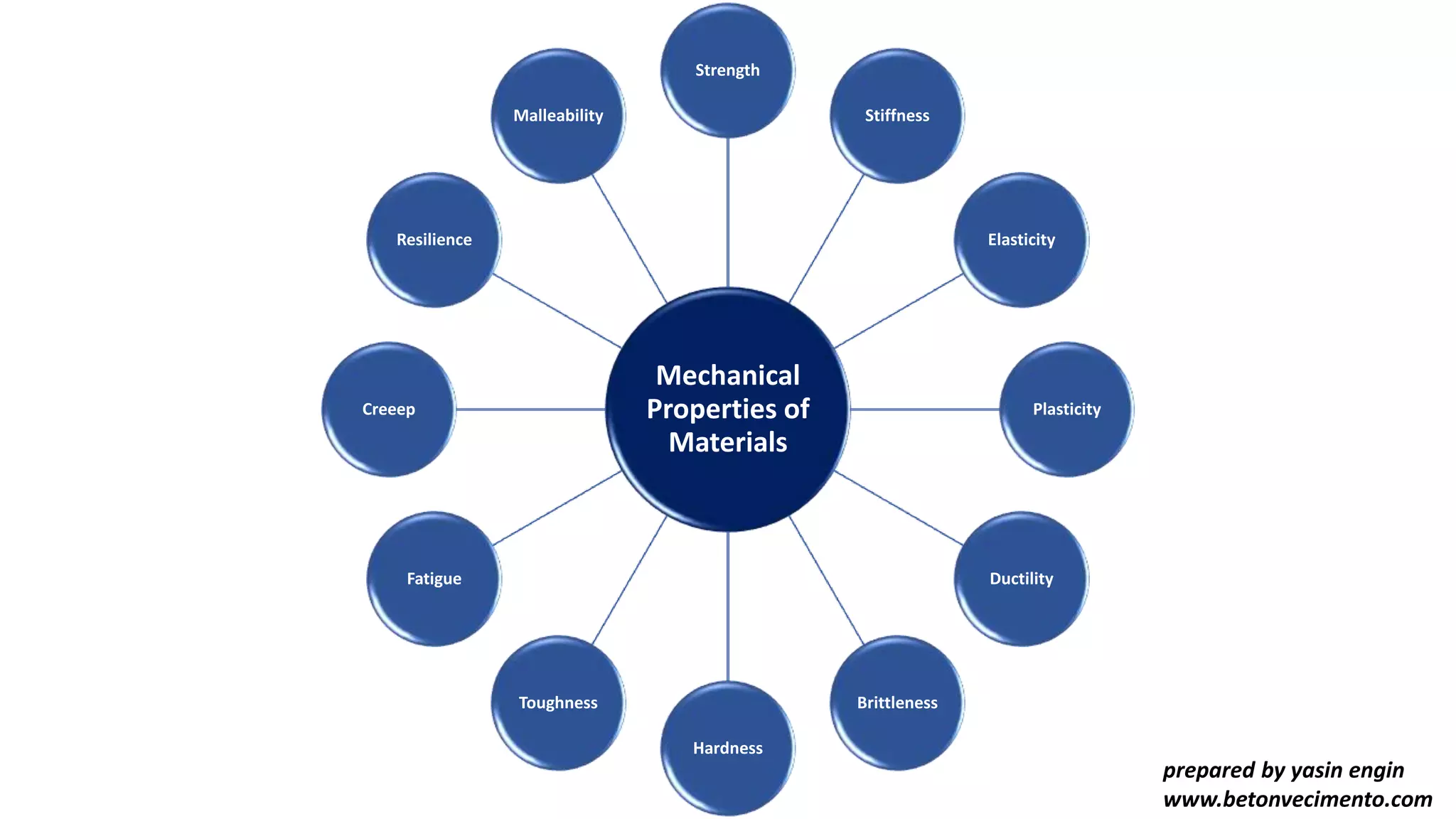
Mechanical
Properties of
Materials
Strength
Stiffness
Elasticity
Plasticity
Ductility
Brittleness
Hardness
Toughness
Fatigue
Creeep
Resilience
Malleability
prepared by yasin engin
www.betonvecimento.com
STRENGTH STIFFNESS
The measurement of how much load a material can
withstand before failure. The more load a material
can bear, the more strength it has. There are 3
different types of strength based on loading types,
which are compressive strength, shear strength and
tensile strength.
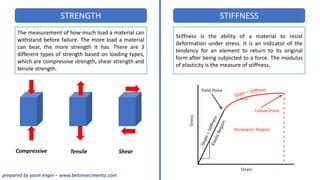
Stiffness is the ability of a material to resist
deformation under stress. It is an indicator of the
tendency for an element to return to its original
form after being subjected to a force. The modulus
of elasticity is the measure of stiffness.
prepared by yasin engin – www.betonvecimento.com
Compressive Tensile Shear
ELASTICITY PLASTICITY
It is the property of a material to regain its original
shape after deformation when the external forces
are removed. This property is desirable for
materials used in tools and machines.
Plasticity is inverse of elasticity. It is a property of a
material which retains the deformation produced
under load permanently. Plastic deformation will
take place only after the elastic range has
been exceeded.
prepared by yasin engin – www.betonvecimento.com
Load applied Deformation due to load
Load removed
Load applied
Load removed
Deformation due to load
DUCTILITY BRITTLENESS
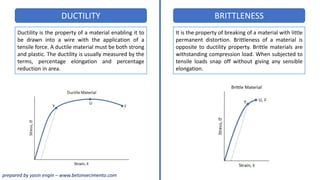
Ductility is the property of a material enabling it to
be drawn into a wire with the application of a
tensile force. A ductile material must be both strong
and plastic. The ductility is usually measured by the
terms, percentage elongation and percentage
reduction in area.
It is the property of breaking of a material with little
permanent distortion. Brittleness of a material is
opposite to ductility property. Brittle materials are
withstanding compression load. When subjected to
tensile loads snap off without giving any sensible
elongation.
prepared by yasin engin – www.betonvecimento.com
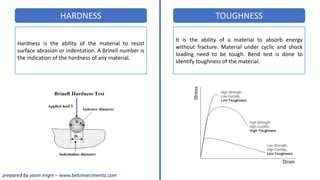
HARDNESS TOUGHNESS
Hardness is the ability of the material to resist
surface abrasion or indentation. A Brinell number is
the indication of the hardness of any material.
It is the ability of a material to absorb energy
without fracture. Material under cyclic and shock
loading need to be tough. Bend test is done to
identify toughness of the material.
prepared by yasin engin – www.betonvecimento.com
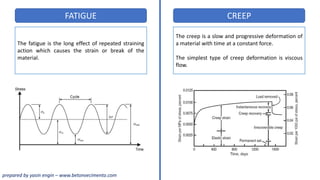
FATIGUE CREEP
The fatigue is the long effect of repeated straining
action which causes the strain or break of the
material.
The creep is a slow and progressive deformation of
a material with time at a constant force.
The simplest type of creep deformation is viscous
flow.
prepared by yasin engin – www.betonvecimento.com
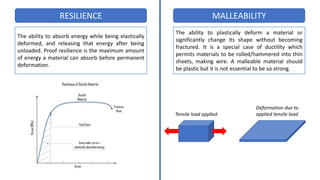
RESILIENCE MALLEABILITY
The ability to absorb energy while being elastically
deformed, and releasing that energy after being
unloaded. Proof resilience is the maximum amount
of energy a material can absorb before permanent
deformation.
The ability to plastically deform a material or
significantly change its shape without becoming
fractured. It is a special case of ductility which
permits materials to be rolled/hammered into thin
sheets, making wire. A malleable material should
be plastic but it is not essential to be so strong.
Tensile load applied
Deformation due to
applied tensile load
1. http://www.mechanicalengineeringsite.com/13-mechanical-properties-material-must-know/
2. https://www.fictiv.com/hwg/design/engineering-fundamentals-refresh-strength-vs-stiffness-vs-hardness
3. https://explainopedia.com/mechanical-properties-of-materials-explained/
4. https://mechtics.com/design/strength-of-material/definition-of-mechanical-properties-of-materials/
5. https://www.theengineerspost.com/mechanical-properties-of-materials/
6. https://extrudesign.com/material-properties/
7. https://www.tr.freelancer.com/community/articles/mechanical-properties-every-mechanical-engineer-should-know
8. https://mechanicalc.com/reference/mechanical-properties-of-materials
SOURCES

Mechanical properties of materials

  • 1.
  • 2.
    STRENGTH STIFFNESS The measurementof how much load a material can withstand before failure. The more load a material can bear, the more strength it has. There are 3 different types of strength based on loading types, which are compressive strength, shear strength and tensile strength. Stiffness is the ability of a material to resist deformation under stress. It is an indicator of the tendency for an element to return to its original form after being subjected to a force. The modulus of elasticity is the measure of stiffness. prepared by yasin engin – www.betonvecimento.com Compressive Tensile Shear
  • 3.
    ELASTICITY PLASTICITY It isthe property of a material to regain its original shape after deformation when the external forces are removed. This property is desirable for materials used in tools and machines. Plasticity is inverse of elasticity. It is a property of a material which retains the deformation produced under load permanently. Plastic deformation will take place only after the elastic range has been exceeded. prepared by yasin engin – www.betonvecimento.com Load applied Deformation due to load Load removed Load applied Load removed Deformation due to load
  • 4.
    DUCTILITY BRITTLENESS Ductility isthe property of a material enabling it to be drawn into a wire with the application of a tensile force. A ductile material must be both strong and plastic. The ductility is usually measured by the terms, percentage elongation and percentage reduction in area. It is the property of breaking of a material with little permanent distortion. Brittleness of a material is opposite to ductility property. Brittle materials are withstanding compression load. When subjected to tensile loads snap off without giving any sensible elongation. prepared by yasin engin – www.betonvecimento.com
  • 5.
    HARDNESS TOUGHNESS Hardness isthe ability of the material to resist surface abrasion or indentation. A Brinell number is the indication of the hardness of any material. It is the ability of a material to absorb energy without fracture. Material under cyclic and shock loading need to be tough. Bend test is done to identify toughness of the material. prepared by yasin engin – www.betonvecimento.com
  • 6.
    FATIGUE CREEP The fatigueis the long effect of repeated straining action which causes the strain or break of the material. The creep is a slow and progressive deformation of a material with time at a constant force. The simplest type of creep deformation is viscous flow. prepared by yasin engin – www.betonvecimento.com
  • 7.
    RESILIENCE MALLEABILITY The abilityto absorb energy while being elastically deformed, and releasing that energy after being unloaded. Proof resilience is the maximum amount of energy a material can absorb before permanent deformation. The ability to plastically deform a material or significantly change its shape without becoming fractured. It is a special case of ductility which permits materials to be rolled/hammered into thin sheets, making wire. A malleable material should be plastic but it is not essential to be so strong. Tensile load applied Deformation due to applied tensile load
  • 8.
    1. http://www.mechanicalengineeringsite.com/13-mechanical-properties-material-must-know/ 2. https://www.fictiv.com/hwg/design/engineering-fundamentals-refresh-strength-vs-stiffness-vs-hardness 3.https://explainopedia.com/mechanical-properties-of-materials-explained/ 4. https://mechtics.com/design/strength-of-material/definition-of-mechanical-properties-of-materials/ 5. https://www.theengineerspost.com/mechanical-properties-of-materials/ 6. https://extrudesign.com/material-properties/ 7. https://www.tr.freelancer.com/community/articles/mechanical-properties-every-mechanical-engineer-should-know 8. https://mechanicalc.com/reference/mechanical-properties-of-materials SOURCES