PROPERTIES OF MATERIALS
Represented by
Nand kumar sharma
B.Tech (M.E.)-VII sem.
CADD CENTRE
HIRAN MAGRI
SECTOR-3
UDAIPUR
PROPERTIES OF MATERIALS
IMPORTANT PROPERTIES OF MATERIALS
• Mechanical Properties
• Chemical Properties
• Magnetic Properties
• Electrical Properties
PROPERTIES OF MATERIALS
Mechanical Properties :-The properties
which can be determine or absorbed by
application of Mechanical Force or Energy.
• Mechanical Force :-A force which required
direct physical contact.
PROPERTIES OF MATERIALS
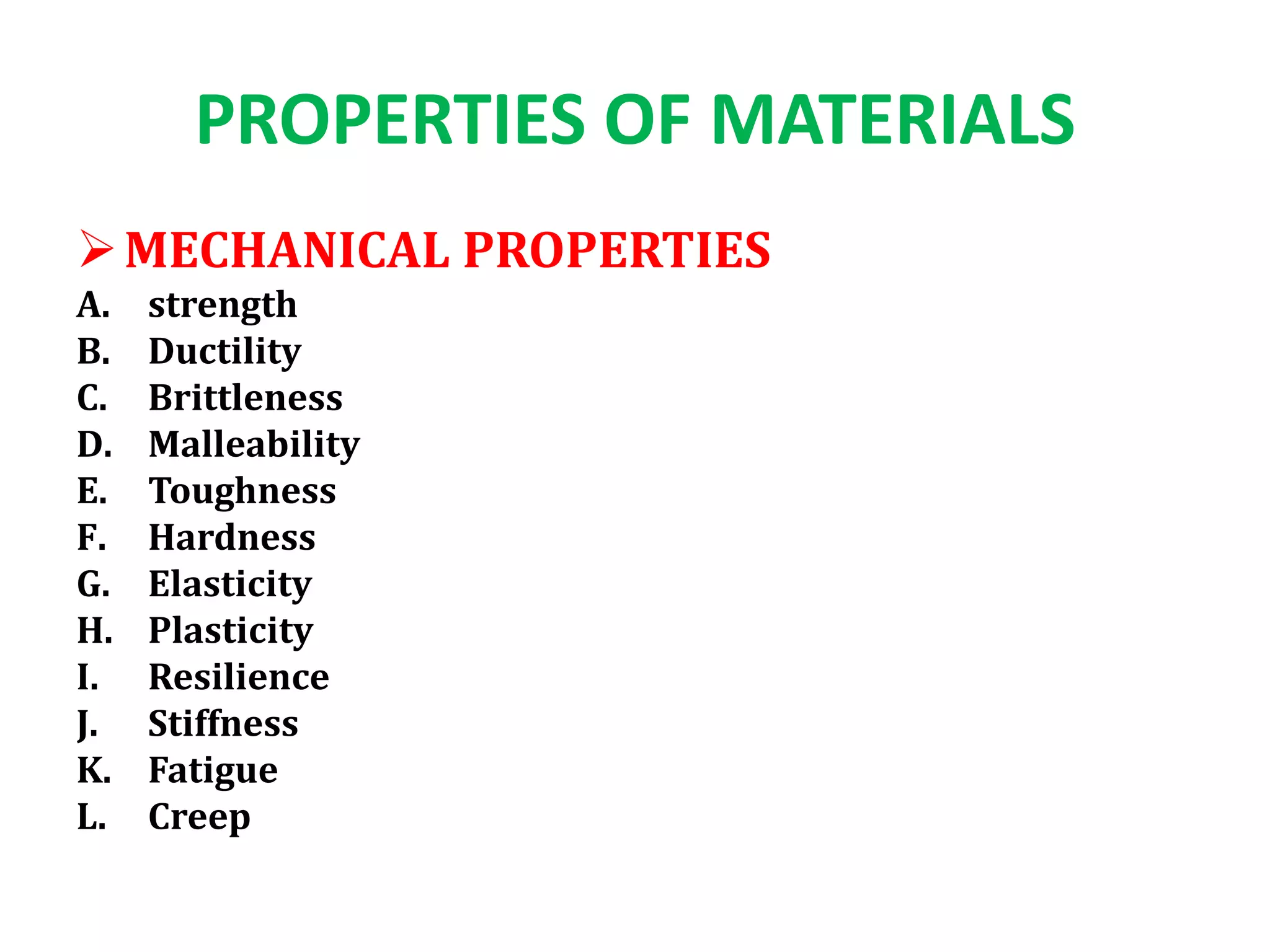
MECHANICAL PROPERTIES
A. strength
B. Ductility
C. Brittleness
D. Malleability
E. Toughness
F. Hardness
G. Elasticity
H. Plasticity
I. Resilience
J. Stiffness
K. Fatigue
L. Creep
PROPERTIES OF MATERIALS
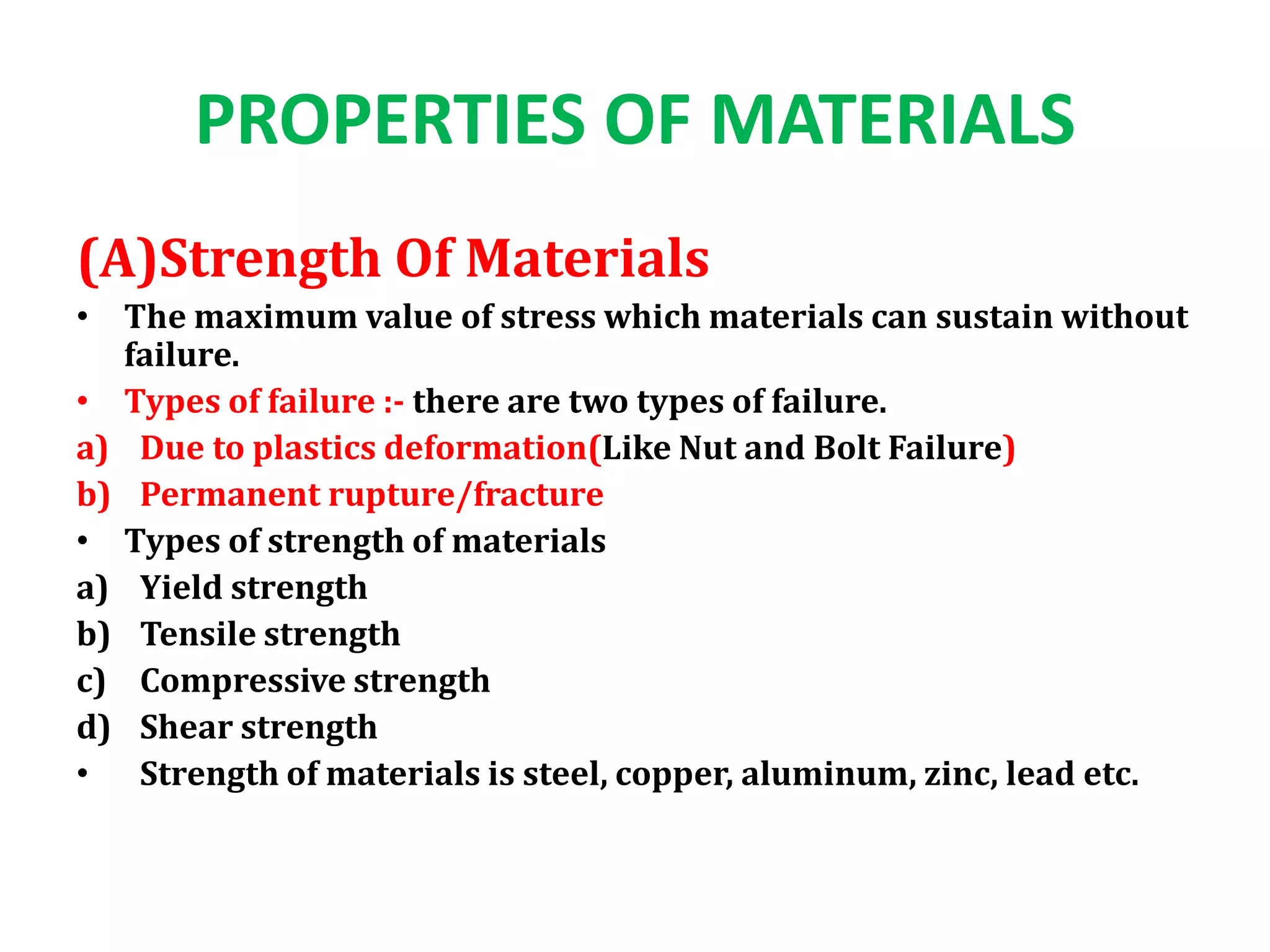
(A)Strength Of Materials
• The maximum value of stress which materials can sustain without
failure.
• Types of failure :- there are two types of failure.
a) Due to plastics deformation(Like Nut and Bolt Failure)
b) Permanent rupture/fracture
• Types of strength of materials
a) Yield strength
b) Tensile strength
c) Compressive strength
d) Shear strength
• Strength of materials is steel, copper, aluminum, zinc, lead etc.
PROPERTIES OF MATERIALS
(B). Ductility
• Ductility is the properties of materials by virtue of which a material give
large degree of plastic deformation before fracture.
• Ductility is a measure of the deformation at fracture-Defined by percent
elongation or percent reduction in area.
• Ductile materials is gold, silver, aluminum, copper, steel etc.
Due to ductility:-
1. High reduction cross-section Area.
2. Very to easy to draw into thin wires.
PROPERTIES OF MATERIALS
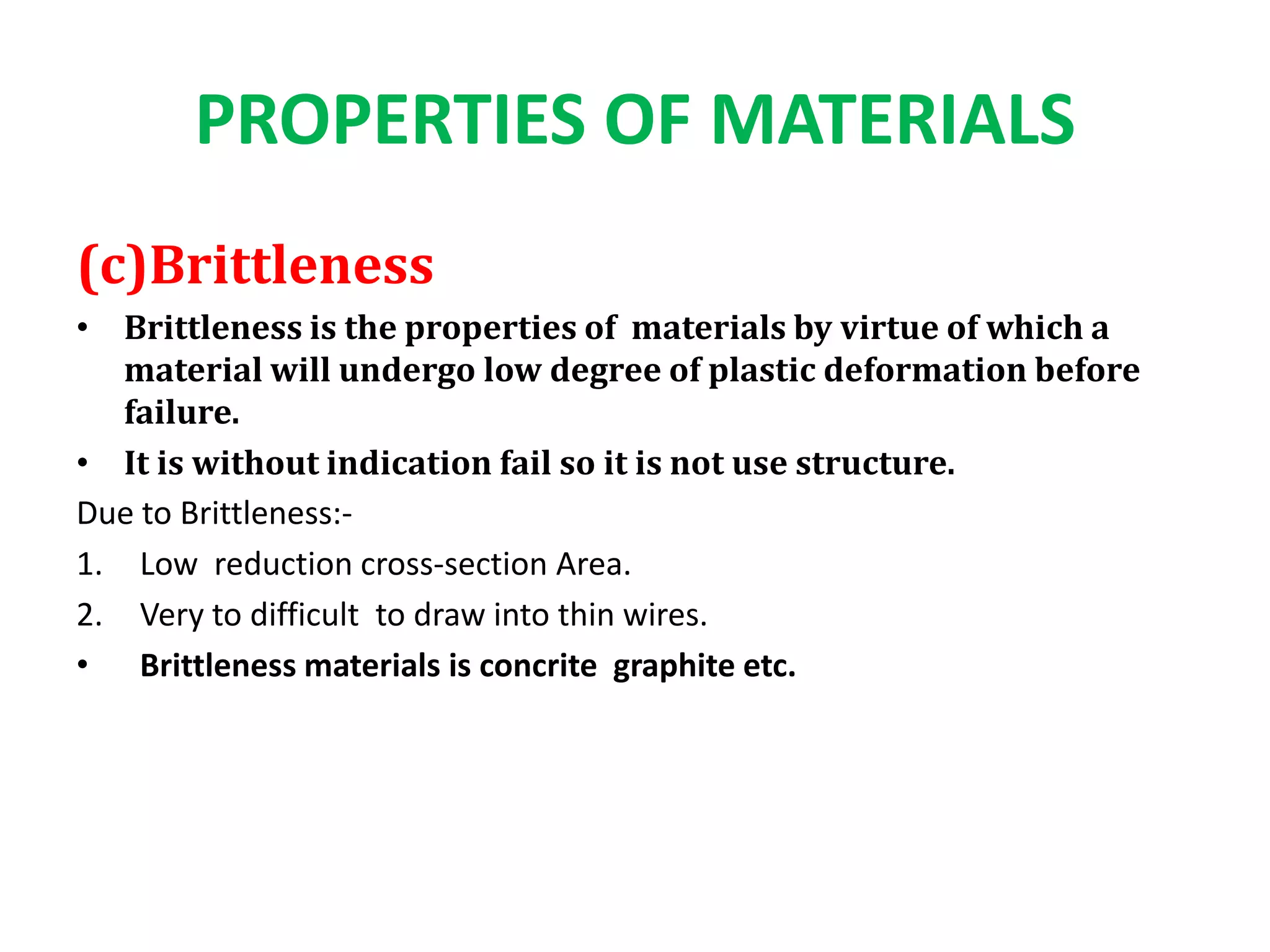
(c)Brittleness
• Brittleness is the properties of materials by virtue of which a
material will undergo low degree of plastic deformation before
failure.
• It is without indication fail so it is not use structure.
Due to Brittleness:-
1. Low reduction cross-section Area.
2. Very to difficult to draw into thin wires.
• Brittleness materials is concrite graphite etc.
PROPERTIES OF MATERIALS
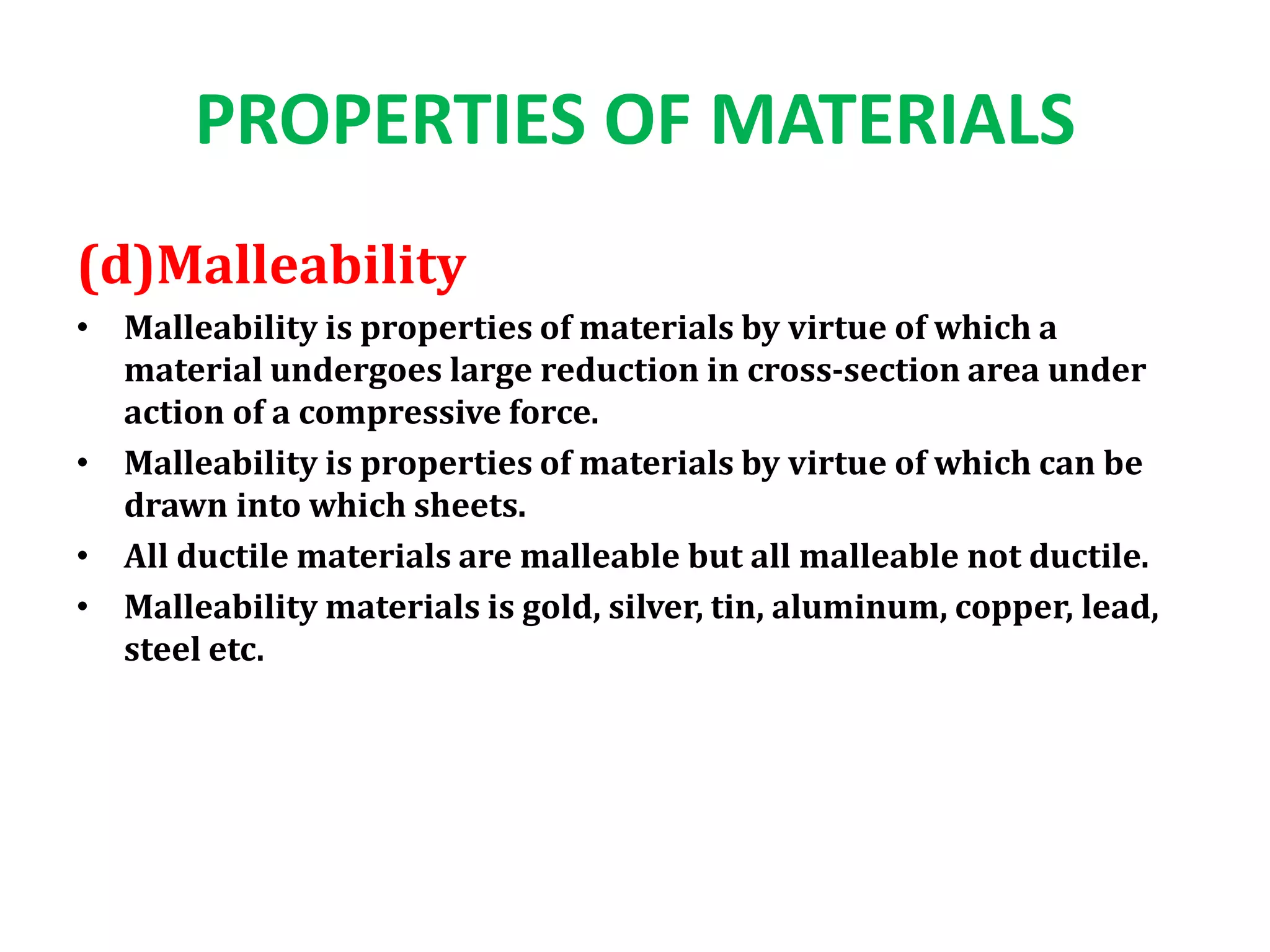
(d)Malleability
• Malleability is properties of materials by virtue of which a
material undergoes large reduction in cross-section area under
action of a compressive force.
• Malleability is properties of materials by virtue of which can be
drawn into which sheets.
• All ductile materials are malleable but all malleable not ductile.
• Malleability materials is gold, silver, tin, aluminum, copper, lead,
steel etc.
PROPERTIES OF MATERIALS
(e)Toughness
• Toughness is the properties of materials by virtue of which a
materials absorbs maximum amount of energy before fracture.
• Area under stress-strain diagram up to fracture :energy absorb
per unit volume of fracture i.e modulus of toughness.
• Toughness materials is wrought iron, mild steel etc.
PROPERTIES OF MATERIALS
(f)Hardness
• Hardness is the properties of materials to ability to with stand
surface indentation and scratching.
• It is a major factor in deciding the workability and use of a
materials for floors and road surfaces.
• Hardness materials is diamond, cubic boron nitride(ceramic),
carbides, hardened, cast, copper, acrylic, aluminum, lead etc.
PROPERTIES OF MATERIALS
(g)Elasticity
• Elasticity is the properties of materials to ability of a body to resist
a distorting influence or stress and to return to its original size
and shape when the stress is removed.
• The ability of an object or materials to resume its normal shape
after being stretched or compressed
• Elasticity materials is iron, rubber etc.
PROPERTIES OF MATERIALS
(h)Plasticity
• Plasticity is the properties of materials to ability of a materials to
undergo irreversible or permanent deformations without
breaking or rupturing.
• It is opposite of brittleness.
• Plastic deformation is the opposite of elastic deformation and is
defined as unrecoverable strain.
• Plasticity materials is wrought iron etc.
PROPERTIES OF MATERIALS
(i)Resilience
• Resilience is the properties of materials to ability of a materials to
absorb energy when it is deformed elastically.
• It is a combination of strength and elasticity.
• Resilience materials is a springs etc.
PROPERTIES OF MATERIALS
(j)Stiffness
• Stiffness is the extent to which an object resists deformation in
response to an applied force.
• The expression of stiffness for an elastic body is as below.
k=f/
• Here, the stiffness is k, applied force is F and deflection is .
ᵟ
ᵟ
PROPERTIES OF MATERIALS
(k)Fatigue
• When the materials are subjected to a repetitive or fluctuating
stress, they will fail at a stress much lower than that required to
cause fracture under steady loads .this behaviour is called as the
fatigue.
• Fatigue is:
1. Increased uncertainly in strength and service life;
2. Loss of ductility;
3. Loss of strength
PROPERTIES OF MATERIALS
(l)Creep
• In many applications , the building materials are required to
sustain steady loads for long periods.
• Such time-dependent deformations of a structure can grow large
and may even result in finals fracture without any increase in
load.
• If the deformation continues even when the load is constant, such
additional deformation is known as the creep.

Properties of materials (udaipur)

  • 1.
    PROPERTIES OF MATERIALS Representedby Nand kumar sharma B.Tech (M.E.)-VII sem. CADD CENTRE HIRAN MAGRI SECTOR-3 UDAIPUR
  • 2.
    PROPERTIES OF MATERIALS IMPORTANTPROPERTIES OF MATERIALS • Mechanical Properties • Chemical Properties • Magnetic Properties • Electrical Properties
  • 3.
    PROPERTIES OF MATERIALS MechanicalProperties :-The properties which can be determine or absorbed by application of Mechanical Force or Energy. • Mechanical Force :-A force which required direct physical contact.
  • 4.
    PROPERTIES OF MATERIALS MECHANICALPROPERTIES A. strength B. Ductility C. Brittleness D. Malleability E. Toughness F. Hardness G. Elasticity H. Plasticity I. Resilience J. Stiffness K. Fatigue L. Creep
  • 5.
    PROPERTIES OF MATERIALS (A)StrengthOf Materials • The maximum value of stress which materials can sustain without failure. • Types of failure :- there are two types of failure. a) Due to plastics deformation(Like Nut and Bolt Failure) b) Permanent rupture/fracture • Types of strength of materials a) Yield strength b) Tensile strength c) Compressive strength d) Shear strength • Strength of materials is steel, copper, aluminum, zinc, lead etc.
  • 6.
    PROPERTIES OF MATERIALS (B).Ductility • Ductility is the properties of materials by virtue of which a material give large degree of plastic deformation before fracture. • Ductility is a measure of the deformation at fracture-Defined by percent elongation or percent reduction in area. • Ductile materials is gold, silver, aluminum, copper, steel etc. Due to ductility:- 1. High reduction cross-section Area. 2. Very to easy to draw into thin wires.
  • 7.
    PROPERTIES OF MATERIALS (c)Brittleness •Brittleness is the properties of materials by virtue of which a material will undergo low degree of plastic deformation before failure. • It is without indication fail so it is not use structure. Due to Brittleness:- 1. Low reduction cross-section Area. 2. Very to difficult to draw into thin wires. • Brittleness materials is concrite graphite etc.
  • 8.
    PROPERTIES OF MATERIALS (d)Malleability •Malleability is properties of materials by virtue of which a material undergoes large reduction in cross-section area under action of a compressive force. • Malleability is properties of materials by virtue of which can be drawn into which sheets. • All ductile materials are malleable but all malleable not ductile. • Malleability materials is gold, silver, tin, aluminum, copper, lead, steel etc.
  • 9.
    PROPERTIES OF MATERIALS (e)Toughness •Toughness is the properties of materials by virtue of which a materials absorbs maximum amount of energy before fracture. • Area under stress-strain diagram up to fracture :energy absorb per unit volume of fracture i.e modulus of toughness. • Toughness materials is wrought iron, mild steel etc.
  • 10.
    PROPERTIES OF MATERIALS (f)Hardness •Hardness is the properties of materials to ability to with stand surface indentation and scratching. • It is a major factor in deciding the workability and use of a materials for floors and road surfaces. • Hardness materials is diamond, cubic boron nitride(ceramic), carbides, hardened, cast, copper, acrylic, aluminum, lead etc.
  • 11.
    PROPERTIES OF MATERIALS (g)Elasticity •Elasticity is the properties of materials to ability of a body to resist a distorting influence or stress and to return to its original size and shape when the stress is removed. • The ability of an object or materials to resume its normal shape after being stretched or compressed • Elasticity materials is iron, rubber etc.
  • 12.
    PROPERTIES OF MATERIALS (h)Plasticity •Plasticity is the properties of materials to ability of a materials to undergo irreversible or permanent deformations without breaking or rupturing. • It is opposite of brittleness. • Plastic deformation is the opposite of elastic deformation and is defined as unrecoverable strain. • Plasticity materials is wrought iron etc.
  • 13.
    PROPERTIES OF MATERIALS (i)Resilience •Resilience is the properties of materials to ability of a materials to absorb energy when it is deformed elastically. • It is a combination of strength and elasticity. • Resilience materials is a springs etc.
  • 14.
    PROPERTIES OF MATERIALS (j)Stiffness •Stiffness is the extent to which an object resists deformation in response to an applied force. • The expression of stiffness for an elastic body is as below. k=f/ • Here, the stiffness is k, applied force is F and deflection is . ᵟ ᵟ
  • 15.
    PROPERTIES OF MATERIALS (k)Fatigue •When the materials are subjected to a repetitive or fluctuating stress, they will fail at a stress much lower than that required to cause fracture under steady loads .this behaviour is called as the fatigue. • Fatigue is: 1. Increased uncertainly in strength and service life; 2. Loss of ductility; 3. Loss of strength
  • 16.
    PROPERTIES OF MATERIALS (l)Creep •In many applications , the building materials are required to sustain steady loads for long periods. • Such time-dependent deformations of a structure can grow large and may even result in finals fracture without any increase in load. • If the deformation continues even when the load is constant, such additional deformation is known as the creep.