UNIVERSE
ITM Universe
ACADAMIC YEAR : 2015-2016
BRANCH : MECHANICAL A
Topic :Material properties
YASH CHAUHAN- 130950119017
Factors Influencing Selection Of
Material
 Availability of materials
 Manufacturing Considerations
 Cost of material
 Material properties
List of materials properties
1 Acoustical properties
2 Atomic properties
3 Chemical properties
4 Electrical properties
5 Environmental properties
6 Magnetic properties
7 Manufacturing properties
8 Mechanical properties
9 Optical properties
10 Radiological properties
11 Thermal properties
https://en.wikipedia.org/wiki/List_of_materials_properties
Fatigue strength
 Fatigue strength is the highest stress that a material can
withstand for a given number of cycles without breaking
Endurance limit
 In fatigue testing, the maximum stress which can be appl
ied to a material for an infinite number of stress cycles wi
thout resulting in failure of the material.
STRENGTH
 The ability of a material to stand up to forces being applied without it
1. Bending
2. Breaking
3. shattering or deforming in any way.
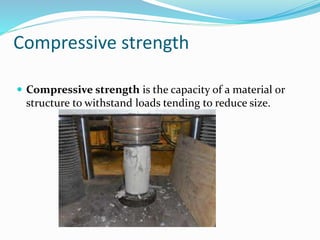
Compressive strength
 Compressive strength is the capacity of a material or
structure to withstand loads tending to reduce size.
TENSILE STRENGTH
 The ability of a material to stretch without breaking or
snapping.
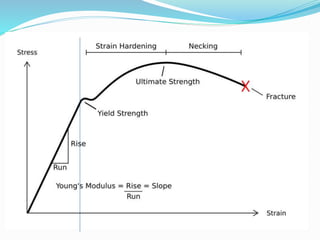
 The tensile strength of a material is the maximum amount of tensile
stress that it can take before failure, for example breaking.
 There are three typical definitions of tensile strength:
 Yield strength - The stress a material can withstand without
permanent deformation. This is not a sharply defined point. Yield
strength is the stress which will cause a permanent deformation of
0.2% of the original dimension.
 Ultimate strength - The maximum stress a material can withstand.
 Breaking strength - The stress coordinate on the stress-strain curve at
the point of rupture.
Ultimate Strength
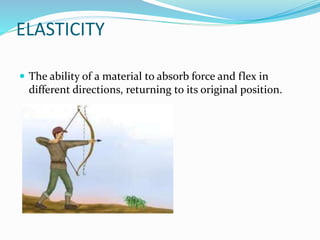
ELASTICITY
 The ability of a material to absorb force and flex in
different directions, returning to its original position.
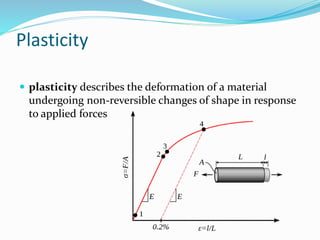
Plasticity
 plasticity describes the deformation of a material
undergoing non-reversible changes of shape in response
to applied forces
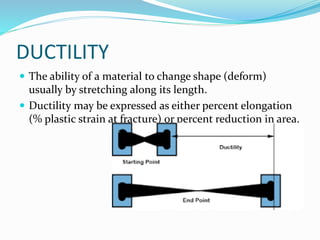
DUCTILITY
 The ability of a material to change shape (deform)
usually by stretching along its length.
 Ductility may be expressed as either percent elongation
(% plastic strain at fracture) or percent reduction in area.
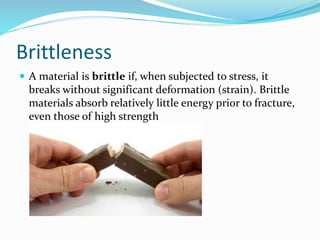
Brittleness
 A material is brittle if, when subjected to stress, it
breaks without significant deformation (strain). Brittle
materials absorb relatively little energy prior to fracture,
even those of high strength
Malleability
 Malleability is a substance's ability to deform under
pressure (compressive stress). If malleable, a material
may be flattened by hammering or rolling.
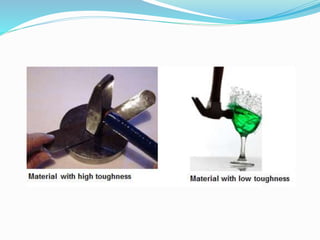
Toughness
 Toughness is the ability of a material to absorb energy
and plastically deform without fracturing
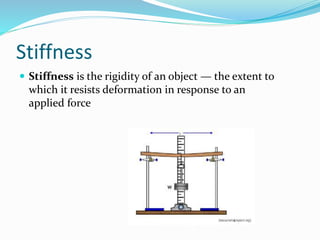
Stiffness
 Stiffness is the rigidity of an object — the extent to
which it resists deformation in response to an
applied force
Resilience.
 resilience is defined as the maximum energy that can
be absorbed within the elastic limit, without creating a
permanent distortion.
 The modulus of resilience is defined as the maximum
energy that can be absorbed per unit volume without
creating a permanent distortion
Hardness
 Hardness is the resistance to plastic deformation (e.g., a
local dent or scratch). Thus, it is a measure
of plastic deformation, as is the tensile strength, so they
are well correlated. Historically, it was measured on an
empirically scale, determined by the ability of a material
to scratch another, diamond being the hardest and talc
the softer.
 There are a few different hardness tests: Rockwell,
Brinell, Vickers, etc. They are popular because they are
easy and non-destructive (except for the small dent).
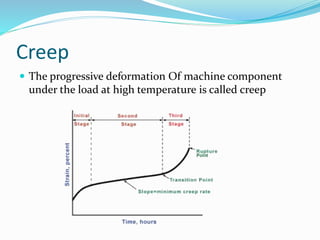
Creep
 The progressive deformation Of machine component
under the load at high temperature is called creep

material properties

  • 1.
    UNIVERSE ITM Universe ACADAMIC YEAR: 2015-2016 BRANCH : MECHANICAL A Topic :Material properties YASH CHAUHAN- 130950119017
  • 2.
    Factors Influencing SelectionOf Material  Availability of materials  Manufacturing Considerations  Cost of material  Material properties
  • 3.
    List of materialsproperties 1 Acoustical properties 2 Atomic properties 3 Chemical properties 4 Electrical properties 5 Environmental properties 6 Magnetic properties 7 Manufacturing properties 8 Mechanical properties 9 Optical properties 10 Radiological properties 11 Thermal properties https://en.wikipedia.org/wiki/List_of_materials_properties
  • 4.
    Fatigue strength  Fatiguestrength is the highest stress that a material can withstand for a given number of cycles without breaking
  • 5.
    Endurance limit  Infatigue testing, the maximum stress which can be appl ied to a material for an infinite number of stress cycles wi thout resulting in failure of the material.
  • 6.
    STRENGTH  The abilityof a material to stand up to forces being applied without it 1. Bending 2. Breaking 3. shattering or deforming in any way.
  • 7.
    Compressive strength  Compressivestrength is the capacity of a material or structure to withstand loads tending to reduce size.
  • 8.
    TENSILE STRENGTH  Theability of a material to stretch without breaking or snapping.  The tensile strength of a material is the maximum amount of tensile stress that it can take before failure, for example breaking.  There are three typical definitions of tensile strength:  Yield strength - The stress a material can withstand without permanent deformation. This is not a sharply defined point. Yield strength is the stress which will cause a permanent deformation of 0.2% of the original dimension.  Ultimate strength - The maximum stress a material can withstand.  Breaking strength - The stress coordinate on the stress-strain curve at the point of rupture.
  • 9.
  • 10.
    ELASTICITY  The abilityof a material to absorb force and flex in different directions, returning to its original position.
  • 11.
    Plasticity  plasticity describesthe deformation of a material undergoing non-reversible changes of shape in response to applied forces
  • 12.
    DUCTILITY  The abilityof a material to change shape (deform) usually by stretching along its length.  Ductility may be expressed as either percent elongation (% plastic strain at fracture) or percent reduction in area.
  • 13.
    Brittleness  A materialis brittle if, when subjected to stress, it breaks without significant deformation (strain). Brittle materials absorb relatively little energy prior to fracture, even those of high strength
  • 14.
    Malleability  Malleability isa substance's ability to deform under pressure (compressive stress). If malleable, a material may be flattened by hammering or rolling.
  • 15.
    Toughness  Toughness isthe ability of a material to absorb energy and plastically deform without fracturing
  • 17.
    Stiffness  Stiffness isthe rigidity of an object — the extent to which it resists deformation in response to an applied force
  • 18.
    Resilience.  resilience isdefined as the maximum energy that can be absorbed within the elastic limit, without creating a permanent distortion.  The modulus of resilience is defined as the maximum energy that can be absorbed per unit volume without creating a permanent distortion
  • 20.
    Hardness  Hardness isthe resistance to plastic deformation (e.g., a local dent or scratch). Thus, it is a measure of plastic deformation, as is the tensile strength, so they are well correlated. Historically, it was measured on an empirically scale, determined by the ability of a material to scratch another, diamond being the hardest and talc the softer.  There are a few different hardness tests: Rockwell, Brinell, Vickers, etc. They are popular because they are easy and non-destructive (except for the small dent).
  • 22.
    Creep  The progressivedeformation Of machine component under the load at high temperature is called creep