8.0 Meat 
8.4 Slaughtering Process, Post 
Harvest Handling and Quality 
Attributes 
8.5 General Processing and Value 
Added Products
Objectives 
 Describe the slaughtering procedure and 
 Classify meat products according to meat processings 
 Identify non-meat ingredients used in meat preservation 
 Identify methods of preservation of meat 
 Describe the labelling and packaging used for meat 
 Identify materials available for packaging of meat and 
meat products
Meat
8.4 SLAUGHTERING PROCESS, POST 
HARVEST HANDLING AND QUALITY 
ATTRIBUTES. 
8.4.1 INTRODUCTION 
 animal product comprise approximately 16% of the 
calories and 55% of the protein in total world food 
supply 
 most of the worlds meat supply comes from 
cattle,buffalo,swine,sheep,goats and horses 
 meat processing already started even before historian 
started to record events 
 up to now the same processes is practiced but they are 
already modified to suit the consumer’s need for 
processed and preserved meat.
8.4.2 SLAUGHTERING PROCEDURE 
 There are few factors to be consider on pre-slaughter 
handling of meat such as at the farm,during transport,at 
the stockyard and also at abattoir. 
 Moreover there are few factors to be consider for 
selection of animal for slaughtering such as age of the 
animal,sex of the animal,size,degree of fatness and also 
health of the animal. 
 There are few steps in managing of animal prior to 
slaughter:fasting,relaxedanimal, handling animals gently 
and also cleaning of animals.
 Steps that are included in slaughtering is 
stunning,sticking,scalding and scarping,removal of the 
head,evisceration,spiltting,post mortem inspection and 
also chilling 
 Actors that affect meat qualities are 
color,texture(tenderness),odour and also flavour. 
 Meat should be handle properly so that it is safe to 
consume by people 
 The uncooked meat should keep in refridgeratorso that it 
wont spoil easily
8.4.3 Meat Quality 
 The grade of meat is vary depend the type of animals 
 Factors such as the breed, maturity, color of the meat, 
and the fat intramuscular and connective tissue 
distribution of the meat( marbling)
8.4.4 Breed 
 Livestock breed can affect the quality characteristics of 
the meat produced, either because the breed has 
naturally adapted to stressful environment conditions or 
because two or more breeds have been purposefully 
crossbred to increase prevalence of desirable qualities 
 Eg :Brahman cattle are used in southwestern United 
State because resistance to adverse environment 
condition but Brahman carcasses has tenderness issue. 
But Japanese Wagyu breed can produces highly marbled 
tender meat. 
 By cross breeding the Brahman cattle and Japanese 
Wagyu cattle producing a Waguli cattle that have high 
degree of marbling and low calpastatin (protein found in 
liver and erythrocytes of mammals) activity in the tissue. 
As a result we have more tender meat immediately after 
slaughtering.
Cross breeding 
Brahman Cattle Japanase Wagyu Cattle 
Waguli 
Cattle
8.4.5 Maturity 
 Maturity of animal influenced the quality of meat 
 5 classification for beef there are A, B, C, D and E 
 A- is for cattle aged 9-10months, A is for cattle aged 12- 
30months, B is for cattle aged 30-50 months, C is for 
cattle aged 60-70 months, D is for older cattle and E is for 
oldest cattle
8.4.6 Meat color 
 Meat color can be affected by the concentration of heme 
pigments like myglobin, haemoglobin , their chemical 
states and the light- scattering properties of the 
meat(Lawrie 2002) 
 At high pH, the heme iron is predominantly in the ferrous 
state(Fe2+), while at low pH accelerates ferrous iron 
conversion to the ferric state (Fe3+) 
 Oxygen can bind to heme iron only if it is in the ferrous 
state(Fe2+) 
 Water can bind to myglobin (Mb) only if the iron is in the 
ferrous form.
 Under low oxygen tension conditions, Mb exists in the 
purple colored, reduces form (Fe2+). Exposed to oxygen 
for a short period of time, the central iron(Fe2+) reversibly 
binds oxygen, producing oxymyglobin(MbO2), which is 
bright pink or red 
 When exposed to O2 for a longer period of time, the 
central iron atom can lose an electron (oxidized to Fe3+), 
producing metmyoglobin (MetMb), which is grey-brown 
 Immediately post slaughter, the oxidized form can be 
reduced by endogenous reducing systems in the meat, 
as long as reducing equivalents (NADH) are available 
and the globin fraction is in its native state (undenatured). 
 Over time, these reducing equivalents are depleted and 
the pigment is irreversibly oxidized
8.4.7 Marbling 
 Marbling is correlated to the distribution of fat deposit 
(intramuscular fat) on connection tissue of 
perimysiumand endomysiumparts 
 A certain level of marbling is necessary to assure 
palatability, in term of juiciness and flavor 
 The degrees of Marbling are abundant, moderately 
abundant, slightly abundant, moderate, modest, small 
and slight 
 Additional degrees: very abundant, traces and practically 
devoid
 Degrees for pork: abundant, moderate, small, slight and 
traces 
 US beef grades: Prime, Choice, Good, Standard and 
Commercial 
 Three other grades of beef there are utility, cutter and 
canner 
 There is relationship between marbling, maturity and 
quality of meat carcass
8.5 GENERAL PROCESSING AND 
VALUE ADDED PRODUCTS. 
8.5.1 Classification of meat products 
according to meat processings 
 Noncomminuted products. (eg. Ham and bacon) 
 Comminuted products ( sauseges and restructured meat 
products. )
8.5.2 Types of processed meat 
 Cured meat. Three methods of curing; dry cure, sweet 
pickle cure, combination method. 
 Sauseges 
 Restructured meat products
8.5.3 Non-meat ingredients used in 
meat preservation 
 Salt 
 Sugar 
 Nitrate/nitrite 
 Phosphates 
 Ascorbates 
 Spices 
 Binders/emulsifiers/filters 
 Vinegar 
 Extenders
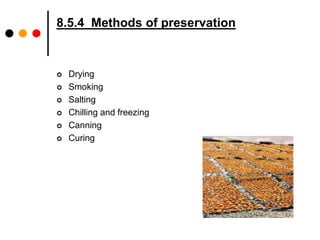
8.5.4 Methods of preservation 
 Drying 
 Smoking 
 Salting 
 Chilling and freezing 
 Canning 
 Curing
8.5.5 Labelling and packaging 
Characteristics of a good packaging material :- 
 Oxygen barrier 
 Moisture barrier 
 Mouldable and pliable 
 Flavourless and tasteless 
 High wet strength and resistant to scraping/tearing 
 Adaptable to labelling 
 Stripability 
 Attractive
8.5.6 Materials available of packaging 
of meat and meat products 
 Glass and metal containers 
 Aluminium foil 
 Paper and paper board 
 Films or plastics like cellophane or polyethylene 
 Saran 
 Chemically treated rubber
8.5.7 Labelling 
 Label shoulld be legible and indelible 
 Label should be more informative :- 
1. name of products 
2. ingredients 
3. quantity 
4. inspection stamp 
5. name and address of processor 
6. data prepared 
7. consumption/expiry date 
8. label must be accurate 

References 
 Fidel Toldra’, 2010, Handbook meat processing, First 
edition, Wiley-Blackwell 
 Amy Brown, 2008, Understanding food Principle & 
Preparation, Third edition, Thomson- Wadsword

Meat part 2

  • 1.
    8.0 Meat 8.4Slaughtering Process, Post Harvest Handling and Quality Attributes 8.5 General Processing and Value Added Products
  • 2.
    Objectives  Describethe slaughtering procedure and  Classify meat products according to meat processings  Identify non-meat ingredients used in meat preservation  Identify methods of preservation of meat  Describe the labelling and packaging used for meat  Identify materials available for packaging of meat and meat products
  • 3.
  • 4.
    8.4 SLAUGHTERING PROCESS,POST HARVEST HANDLING AND QUALITY ATTRIBUTES. 8.4.1 INTRODUCTION  animal product comprise approximately 16% of the calories and 55% of the protein in total world food supply  most of the worlds meat supply comes from cattle,buffalo,swine,sheep,goats and horses  meat processing already started even before historian started to record events  up to now the same processes is practiced but they are already modified to suit the consumer’s need for processed and preserved meat.
  • 5.
    8.4.2 SLAUGHTERING PROCEDURE  There are few factors to be consider on pre-slaughter handling of meat such as at the farm,during transport,at the stockyard and also at abattoir.  Moreover there are few factors to be consider for selection of animal for slaughtering such as age of the animal,sex of the animal,size,degree of fatness and also health of the animal.  There are few steps in managing of animal prior to slaughter:fasting,relaxedanimal, handling animals gently and also cleaning of animals.
  • 6.
     Steps thatare included in slaughtering is stunning,sticking,scalding and scarping,removal of the head,evisceration,spiltting,post mortem inspection and also chilling  Actors that affect meat qualities are color,texture(tenderness),odour and also flavour.  Meat should be handle properly so that it is safe to consume by people  The uncooked meat should keep in refridgeratorso that it wont spoil easily
  • 7.
    8.4.3 Meat Quality  The grade of meat is vary depend the type of animals  Factors such as the breed, maturity, color of the meat, and the fat intramuscular and connective tissue distribution of the meat( marbling)
  • 8.
    8.4.4 Breed Livestock breed can affect the quality characteristics of the meat produced, either because the breed has naturally adapted to stressful environment conditions or because two or more breeds have been purposefully crossbred to increase prevalence of desirable qualities  Eg :Brahman cattle are used in southwestern United State because resistance to adverse environment condition but Brahman carcasses has tenderness issue. But Japanese Wagyu breed can produces highly marbled tender meat.  By cross breeding the Brahman cattle and Japanese Wagyu cattle producing a Waguli cattle that have high degree of marbling and low calpastatin (protein found in liver and erythrocytes of mammals) activity in the tissue. As a result we have more tender meat immediately after slaughtering.
  • 9.
    Cross breeding BrahmanCattle Japanase Wagyu Cattle Waguli Cattle
  • 10.
    8.4.5 Maturity Maturity of animal influenced the quality of meat  5 classification for beef there are A, B, C, D and E  A- is for cattle aged 9-10months, A is for cattle aged 12- 30months, B is for cattle aged 30-50 months, C is for cattle aged 60-70 months, D is for older cattle and E is for oldest cattle
  • 11.
    8.4.6 Meat color  Meat color can be affected by the concentration of heme pigments like myglobin, haemoglobin , their chemical states and the light- scattering properties of the meat(Lawrie 2002)  At high pH, the heme iron is predominantly in the ferrous state(Fe2+), while at low pH accelerates ferrous iron conversion to the ferric state (Fe3+)  Oxygen can bind to heme iron only if it is in the ferrous state(Fe2+)  Water can bind to myglobin (Mb) only if the iron is in the ferrous form.
  • 12.
     Under lowoxygen tension conditions, Mb exists in the purple colored, reduces form (Fe2+). Exposed to oxygen for a short period of time, the central iron(Fe2+) reversibly binds oxygen, producing oxymyglobin(MbO2), which is bright pink or red  When exposed to O2 for a longer period of time, the central iron atom can lose an electron (oxidized to Fe3+), producing metmyoglobin (MetMb), which is grey-brown  Immediately post slaughter, the oxidized form can be reduced by endogenous reducing systems in the meat, as long as reducing equivalents (NADH) are available and the globin fraction is in its native state (undenatured).  Over time, these reducing equivalents are depleted and the pigment is irreversibly oxidized
  • 14.
    8.4.7 Marbling Marbling is correlated to the distribution of fat deposit (intramuscular fat) on connection tissue of perimysiumand endomysiumparts  A certain level of marbling is necessary to assure palatability, in term of juiciness and flavor  The degrees of Marbling are abundant, moderately abundant, slightly abundant, moderate, modest, small and slight  Additional degrees: very abundant, traces and practically devoid
  • 16.
     Degrees forpork: abundant, moderate, small, slight and traces  US beef grades: Prime, Choice, Good, Standard and Commercial  Three other grades of beef there are utility, cutter and canner  There is relationship between marbling, maturity and quality of meat carcass
  • 18.
    8.5 GENERAL PROCESSINGAND VALUE ADDED PRODUCTS. 8.5.1 Classification of meat products according to meat processings  Noncomminuted products. (eg. Ham and bacon)  Comminuted products ( sauseges and restructured meat products. )
  • 19.
    8.5.2 Types ofprocessed meat  Cured meat. Three methods of curing; dry cure, sweet pickle cure, combination method.  Sauseges  Restructured meat products
  • 20.
    8.5.3 Non-meat ingredientsused in meat preservation  Salt  Sugar  Nitrate/nitrite  Phosphates  Ascorbates  Spices  Binders/emulsifiers/filters  Vinegar  Extenders
  • 21.
    8.5.4 Methods ofpreservation  Drying  Smoking  Salting  Chilling and freezing  Canning  Curing
  • 22.
    8.5.5 Labelling andpackaging Characteristics of a good packaging material :-  Oxygen barrier  Moisture barrier  Mouldable and pliable  Flavourless and tasteless  High wet strength and resistant to scraping/tearing  Adaptable to labelling  Stripability  Attractive
  • 23.
    8.5.6 Materials availableof packaging of meat and meat products  Glass and metal containers  Aluminium foil  Paper and paper board  Films or plastics like cellophane or polyethylene  Saran  Chemically treated rubber
  • 24.
    8.5.7 Labelling Label shoulld be legible and indelible  Label should be more informative :- 1. name of products 2. ingredients 3. quantity 4. inspection stamp 5. name and address of processor 6. data prepared 7. consumption/expiry date 8. label must be accurate 
  • 25.
    References  FidelToldra’, 2010, Handbook meat processing, First edition, Wiley-Blackwell  Amy Brown, 2008, Understanding food Principle & Preparation, Third edition, Thomson- Wadsword