Meat
What to think about Wholesomeness  (how healthy is it) Quality  (how good is it; age; what part) Nutritive  Value (how good is it for you) Cost  (is it cheap or expensive) Informative Labeling  (what does the label tell you)
Also think about …  How much can you store in your freezer? How much can you use within a couple of days? How do you like it cut? Which part of the animal do you prefer to eat?
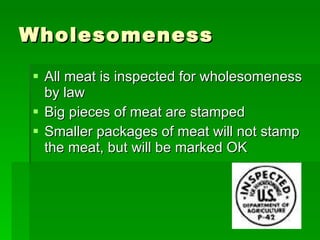
Wholesomeness All meat is inspected for wholesomeness by law Big pieces of meat are stamped Smaller packages of meat will not stamp the meat, but will be marked OK
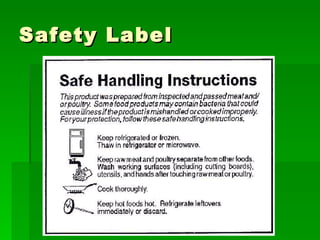
Safety Labels The meat is usually marked with a label on how to be safe  It will tell you how to store it and how to thaw it out if you freeze it
Safety Label
Nutritive Value Meat can have  Protein Niacin B6 B12 Iron Phosphorus Zinc Fat Saturated Fat Cholesterol The amount is different for each piece of meat
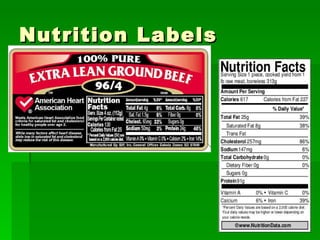
Nutritive Value  Use the  Nutrition Facts  label to find out how healthy the meat is.  All processed meats will have a  Nutrition Facts label
Nutrition Labels
How to choose healthy Choose a diet low in fat, saturated fat and cholesterol Buy lean cuts of meat Organ meats have a lot of cholesterol
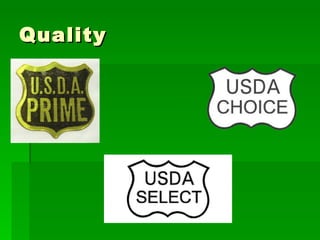
Quality This describes the tenderness, juiciness, and flavor of the meat The meat will have a grade on the package to tell you the quality There will be a shield shaped label on the meat to tell you the quality
Quality
Quality There are 8 grades of meat They are USDA Prime, Choice, Select, Standard, Commercial, Utility, Cutter, and Canner.
The grades USDA Prime, Select, and Choice come from younger beef The highest grade is Prime The grade most used is Choice The lower grades are Utility, Cutter and Canner The rules are similar for other types of meat like lamb and pork
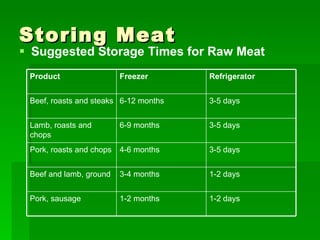
Storing Meat Suggested Storage Times for Raw Meat 1-2 days 1-2 months Pork, sausage 1-2 days 3-4 months Beef and lamb, ground 3-5 days 4-6 months Pork, roasts and chops 3-5 days 6-9 months Lamb, roasts and chops 3-5 days 6-12 months Beef, roasts and steaks Refrigerator Freezer Product
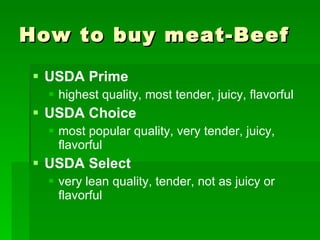
How to buy meat-Beef USDA Prime highest quality, most tender, juicy, flavorful USDA Choice most popular quality, very tender, juicy, flavorful USDA Select very lean quality, tender, not as juicy or flavorful
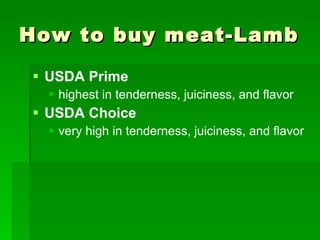
How to buy meat-Lamb USDA Prime highest in tenderness, juiciness, and flavor USDA Choice very high in tenderness, juiciness, and flavor
How to buy meat-Pork USDA Acceptable Quality very lean, firm, with grayish pink color
Cost What can you afford? Plan a budget and stick with it Look for sales

Meat

  • 1.
  • 2.
    What to thinkabout Wholesomeness (how healthy is it) Quality (how good is it; age; what part) Nutritive Value (how good is it for you) Cost (is it cheap or expensive) Informative Labeling (what does the label tell you)
  • 3.
    Also think about… How much can you store in your freezer? How much can you use within a couple of days? How do you like it cut? Which part of the animal do you prefer to eat?
  • 4.
    Wholesomeness All meatis inspected for wholesomeness by law Big pieces of meat are stamped Smaller packages of meat will not stamp the meat, but will be marked OK
  • 5.
    Safety Labels Themeat is usually marked with a label on how to be safe It will tell you how to store it and how to thaw it out if you freeze it
  • 6.
  • 7.
    Nutritive Value Meatcan have Protein Niacin B6 B12 Iron Phosphorus Zinc Fat Saturated Fat Cholesterol The amount is different for each piece of meat
  • 8.
    Nutritive Value Use the Nutrition Facts label to find out how healthy the meat is. All processed meats will have a Nutrition Facts label
  • 9.
  • 10.
    How to choosehealthy Choose a diet low in fat, saturated fat and cholesterol Buy lean cuts of meat Organ meats have a lot of cholesterol
  • 11.
    Quality This describesthe tenderness, juiciness, and flavor of the meat The meat will have a grade on the package to tell you the quality There will be a shield shaped label on the meat to tell you the quality
  • 12.
  • 13.
    Quality There are8 grades of meat They are USDA Prime, Choice, Select, Standard, Commercial, Utility, Cutter, and Canner.
  • 14.
    The grades USDAPrime, Select, and Choice come from younger beef The highest grade is Prime The grade most used is Choice The lower grades are Utility, Cutter and Canner The rules are similar for other types of meat like lamb and pork
  • 15.
    Storing Meat SuggestedStorage Times for Raw Meat 1-2 days 1-2 months Pork, sausage 1-2 days 3-4 months Beef and lamb, ground 3-5 days 4-6 months Pork, roasts and chops 3-5 days 6-9 months Lamb, roasts and chops 3-5 days 6-12 months Beef, roasts and steaks Refrigerator Freezer Product
  • 16.
    How to buymeat-Beef USDA Prime highest quality, most tender, juicy, flavorful USDA Choice most popular quality, very tender, juicy, flavorful USDA Select very lean quality, tender, not as juicy or flavorful
  • 17.
    How to buymeat-Lamb USDA Prime highest in tenderness, juiciness, and flavor USDA Choice very high in tenderness, juiciness, and flavor
  • 18.
    How to buymeat-Pork USDA Acceptable Quality very lean, firm, with grayish pink color
  • 19.
    Cost What canyou afford? Plan a budget and stick with it Look for sales