Cisco Case Study EMBA: Measuring Business Value of IT University of Notre Dame March 19, 2004 Ayelet Baron—aybaron@cisco.com WW Sales Strategy & Planning Cisco Systems, Inc.
Cisco Overview © 2003 Cisco Systems, Inc. All rights reserved.
History of Cisco Systems Started at Stanford IPO; 192 Employees End-to-End Solutions Provider Cisco Routers Power the Internet; LAN/WAN Switching, Remote Access #1 Communications Equipment Supplier Shipped First Router $18.9 Billion Revenue;  34,000 Employees;  IP Telephony, Security, Wireless, Networked Home 1998 1984 1986 1990 1994 2002 2003
Cisco Worldwide 33,000+ employees in 68 countries Average years of service 4.5 1/3 Engineering/IT, 1/3 Sales, 1/3 all others All connected to common  Internet tools All are Cisco shareholders Updated 01/04
Cisco Products Industry’s broadest product line Leadership products in each category R&D = 16.9% of revenue  Enables end-to-end network services
Networking and the Internet WORK LIVE PLAY LEARN
Key Cisco  Frameworks © 2003 Cisco Systems, Inc. All rights reserved.
Cisco’s Financial Benefit from IT Financial Impact FY ’95 FY ’03 FY ’96 FY ’97 FY ’98 FY ’99 FY ’00 FY ’01 FY ’02 Communications Internal Directory External Web Site Support Self-Service $1B Departmental $3B Virtual Supply Chain Online Collaborative Support E-Treasury $1.9B $2.1B $1.7B Inter-Enterprise $2B E-Commerce E-Procurement  E-Learning E-HR Virtual Close $900M Enterprise
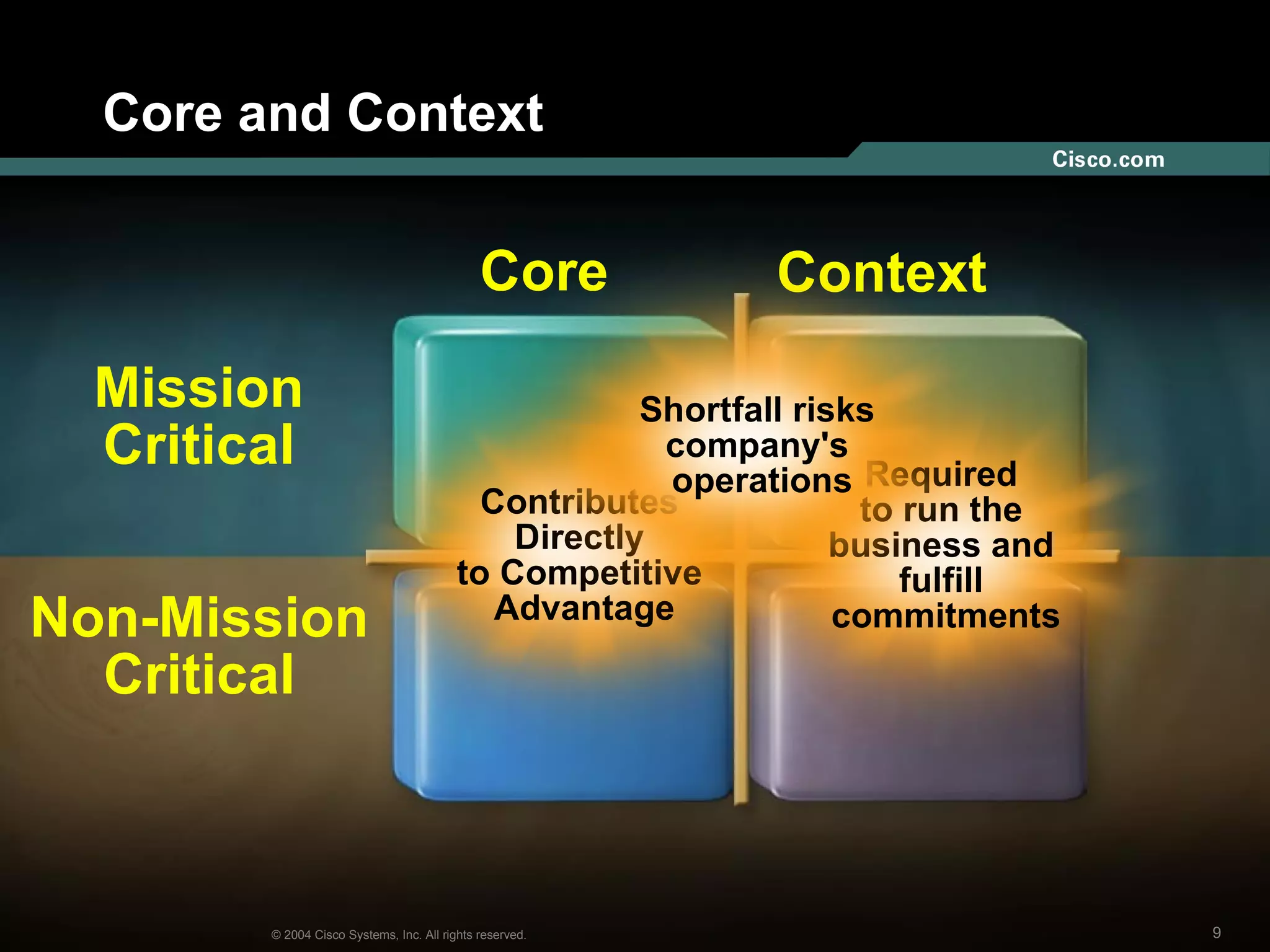
Core and Context Core Context © 2004 Cisco Systems, Inc. All rights reserved. Mission Critical Non-Mission Critical Contributes  Directly  to Competitive  Advantage Required  to run the  business and  fulfill  commitments Shortfall risks  company's  operations
Out-Tasking Versus Out-Sourcing A whole function (IT) Manage contract  and SLAs Separate IT Systems  with reporting Process redesign requires contract renegotiation Elements of a function Real time visibility and active management Shared systems/web services; common data, network standards Allows process redesign and continuous innovation © 2004 Cisco Systems, Inc. All rights reserved.
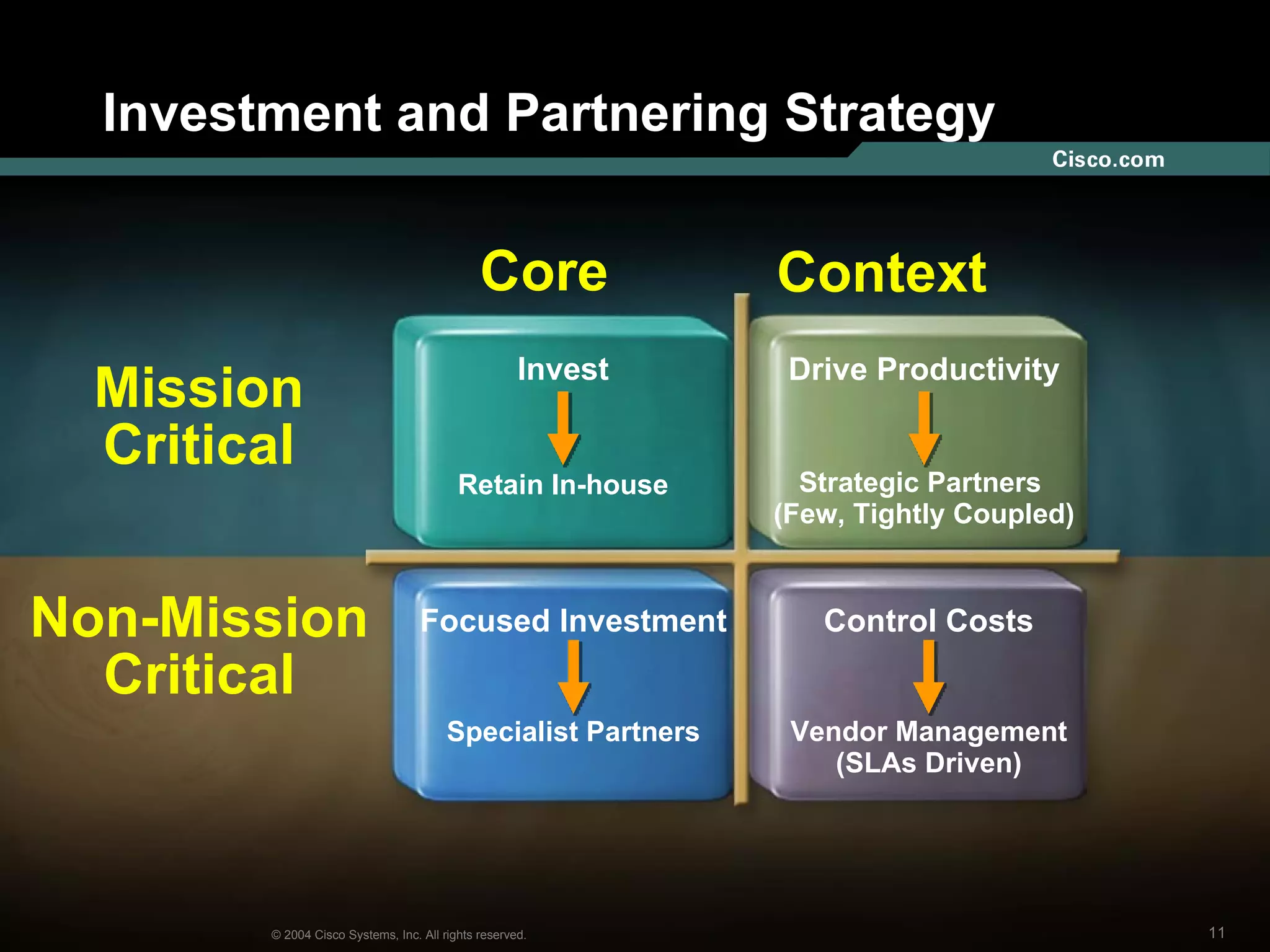
Investment and Partnering Strategy Core Context © 2004 Cisco Systems, Inc. All rights reserved. Mission Critical Non-Mission Critical Invest Retain In-house Drive Productivity Strategic Partners  (Few, Tightly Coupled) Focused Investment Specialist Partners Control Costs Vendor Management (SLAs Driven)
Relative Cisco Functional Out-Tasking Manufacturing Sales HR Finance % Out-Tasked © 2004 Cisco Systems, Inc. All rights reserved. 8712_09_2003 IT Customer Service Inside sales  Advertising Lead qualification Payroll processing Travel Investment Management Temp contracting Benefits admin Global mobility Desktop mgmt Remote office WAN  E-commerce apps Board manufacturing  Final assembly & test   Logistics  &  delivery Level 1 help desk Order admin Field logistics & repair
Cisco IT © 2003 Cisco Systems, Inc. All rights reserved.
Cisco IT Employees—1999 1900+ employees 2500+ vendors ~2.5% of total employee base ~4.5% of expense 65% in US, 25% in EMEA, 10% in AsiaPac / Japan ~$1B in spend
Cisco’s IT Evolution IT works independently of business Seeing as non value adding IT seen as  “high” cost Focus on technical performance IT as Cost Center CFP& ERP Internet Enabler Outcome Defined Trusted Business Partner Value Creation Proactive Reactive 2000 1997 1993-95 1991 IT Supports Business Strategy IT Enables New Capabilities and Roles Business Value Supports business strategy IT seen as a  support process Focus on Return on Investment Supports and enhances business strategy IT seen as a  critical process Focus on cycle time, cost reduction,  service quality Enables business strategy and integral part of the business Effective use  and leverage  of technology  and “virtual” resources Focus on Shareholder value
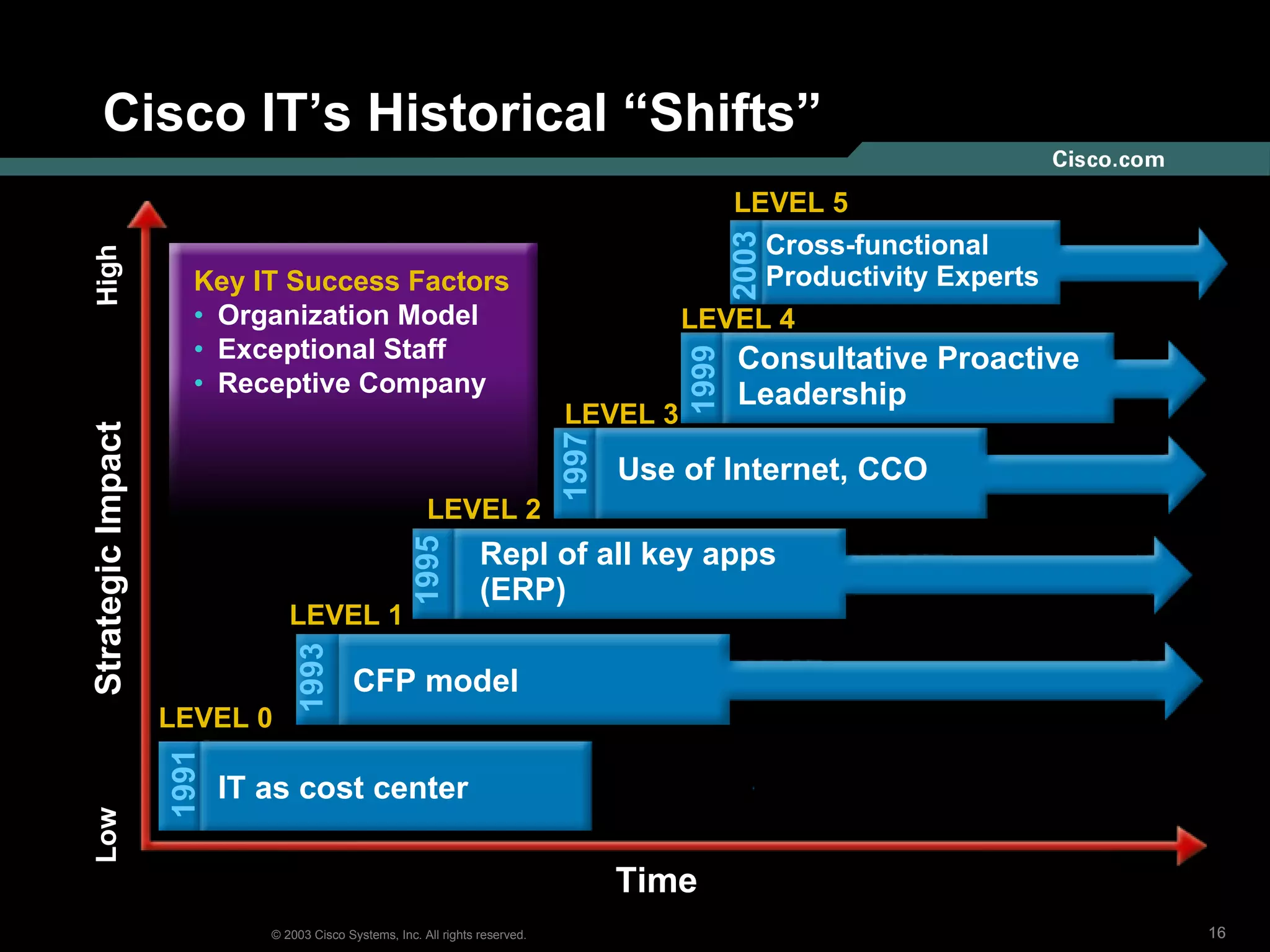
Cisco IT’s Historical “Shifts” Time Key IT Success Factors Organization Model Exceptional Staff Receptive Company  IT as cost center CFP model Use of Internet, CCO Repl of all key apps (ERP) 1991 1993 1995 1997 1999 Consultative Proactive Leadership  LEVEL 0 LEVEL 1 LEVEL 2 LEVEL 3 LEVEL 4 LEVEL 5 2003 Cross-functional  Productivity Experts  Strategic Impact  Low  High
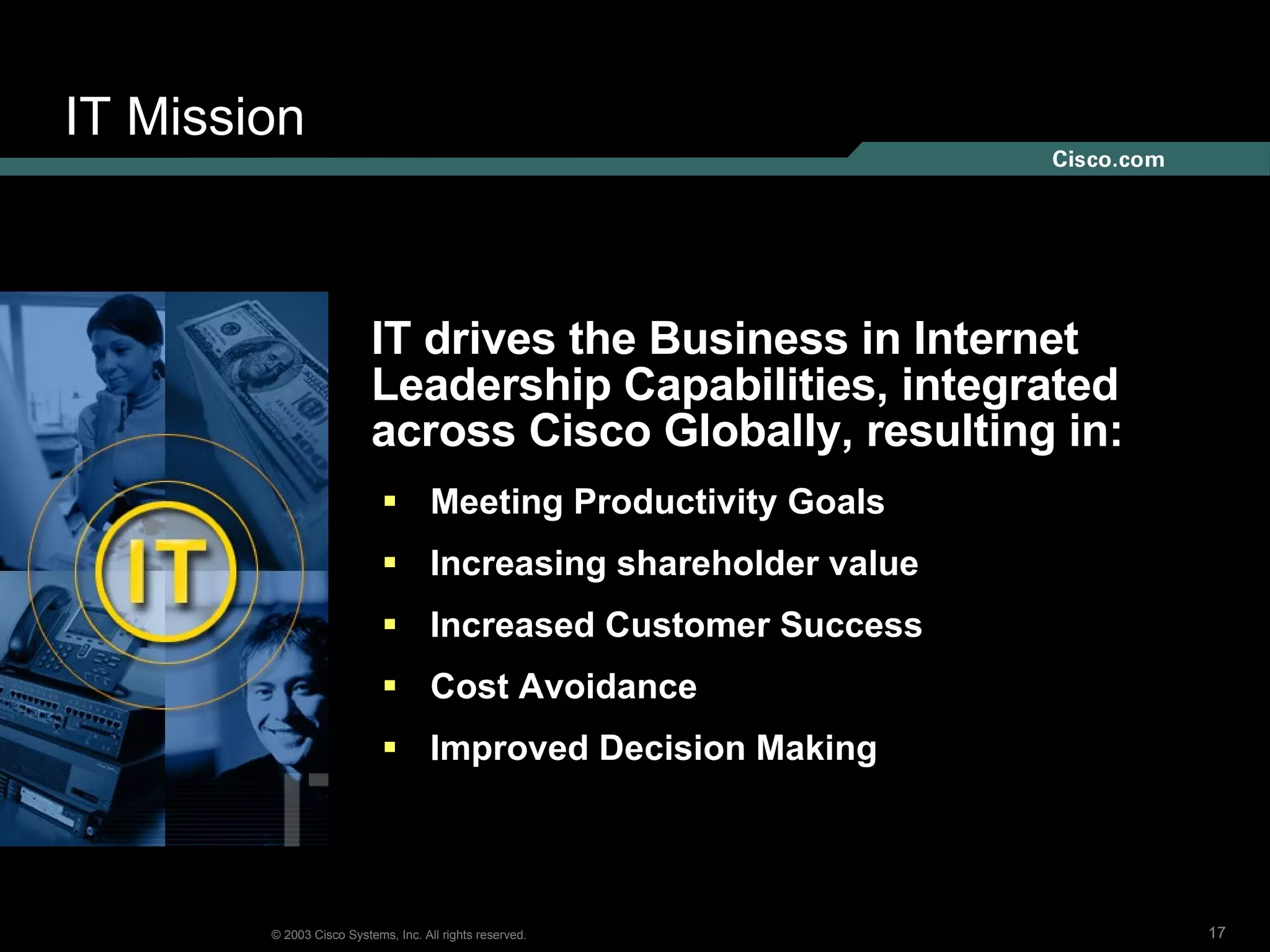
IT Mission IT drives the Business in Internet  Leadership Capabilities, integrated  across Cisco Globally, resulting in: Meeting Productivity Goals Increasing shareholder value Increased Customer Success  Cost Avoidance  Improved Decision Making
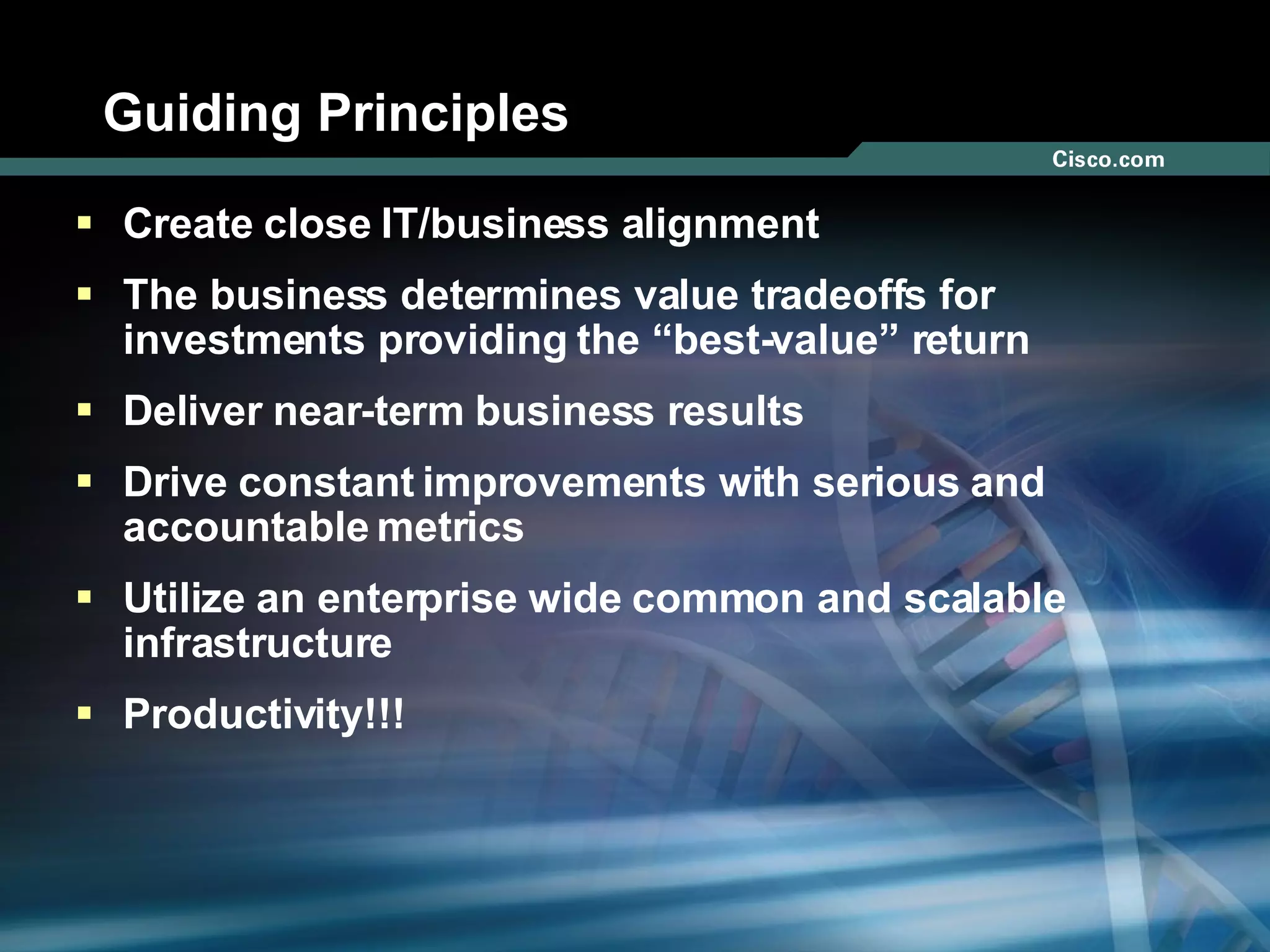
Guiding Principles Create close IT/business alignment  The business determines value tradeoffs for investments providing the “best-value” return  Deliver near-term business results Drive constant improvements with serious and accountable metrics  Utilize an enterprise wide common and scalable infrastructure  Productivity!!!
Cisco’s “Hybrid” IT Organization Advantages Business executives involved with IT project success more than CIO Good alignment of business and IT objectives Promotes the right business decisions Higher degree of client satisfaction Still strict centralized control over standards, architectures to ensure low-cost, high-quality, and rapid cycle times Centralized Infrastructure Data Center, Hosting, Transport, Client Services, Theatre Service Delivery, Infrastructure Applications, VMO, Technical Architecture, Administration Manufacturing Sales Finance Marketing CIO IT Organization IT Organization IT Organization IT Organization
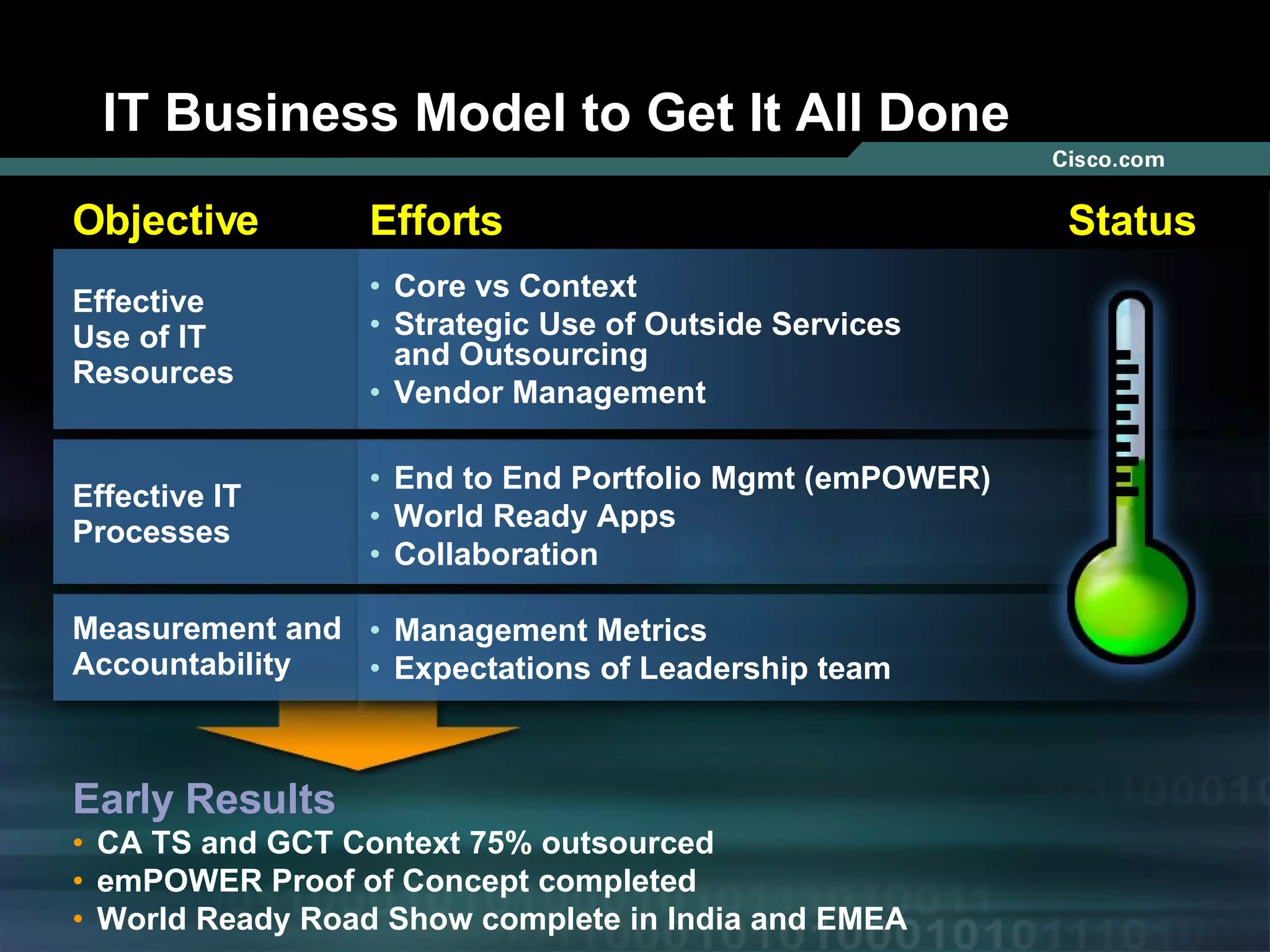
IT Business Model to Get It All Done Effective Use of IT Resources Effective IT Processes Measurement and Accountability Core vs Context Strategic Use of Outside Services and Outsourcing Vendor Management Objective Efforts Status End to End Portfolio Mgmt (emPOWER) World Ready Apps Collaboration  Management Metrics Expectations of Leadership team Early Results CA TS and GCT Context 75% outsourced emPOWER Proof of Concept completed World Ready Road Show complete in India and EMEA
Cisco’s philosophy and financial approach to IT spend has allowed IT investment to grow as fast or faster than revenue (as “return” is accounted for on “business side)  Investment Approach And Impact On Cisco’s IT Investment
Project Guidance and Planning “ In 1998, there were no guidelines, no rules of the road as far as how to do CFP planning and execution. ”  Project Tracking  using a central repository  Project Reporting  on a quarterly basis  Tracking of Budget vs. Actuals  during the project  Compliance  to Architecture & Standards  Execute Commitment  for funding of project execution and delivery  Readiness Reviews  before Go Live  Client Satisfaction  measurements after delivery   Today…
Enterprise IT Portfolio Management Goals Make the correct tradeoff, prioritization decision Ensure business capabilities are created in the right sequence Identify and resolve key barriers Hold key projects accountable for delivery of business value within budget Maximize the Value of Cisco’s IT Investments
IT Governance Model Funding Mechanisms IT Performance Mgt Process Oversight Standards Approach Client Centric  Organization Principles Business Mindset Metrics Strategic Partner IT Business Alignment CULTURE Insuring the maximum value for Cisco’s IT investment
Approach: Cisco IT Governance “How We Ensure Value” Strategic “Instinct”  Co-location CFP Model Operations Metrics  Root Cause Analysis Global Vs Local Decisions  Operations Reviews Performance Metrics Mbo’s and Plans Adherence  Selection Process Emerging Vs Sun-setting Standards Budget Management  Productivity Analysis  Business Justification  Mindset SDLC Model Balance “Risk Vs Innovation” Project Mgr Education ASP System Integrators Web Portals Management Accountability Business Alignment Standards Management Fiscal Controls Development Methods Continuous Improvement End  User  Technology Procurement
Change  Management Framework © 2003 Cisco Systems, Inc. All rights reserved.
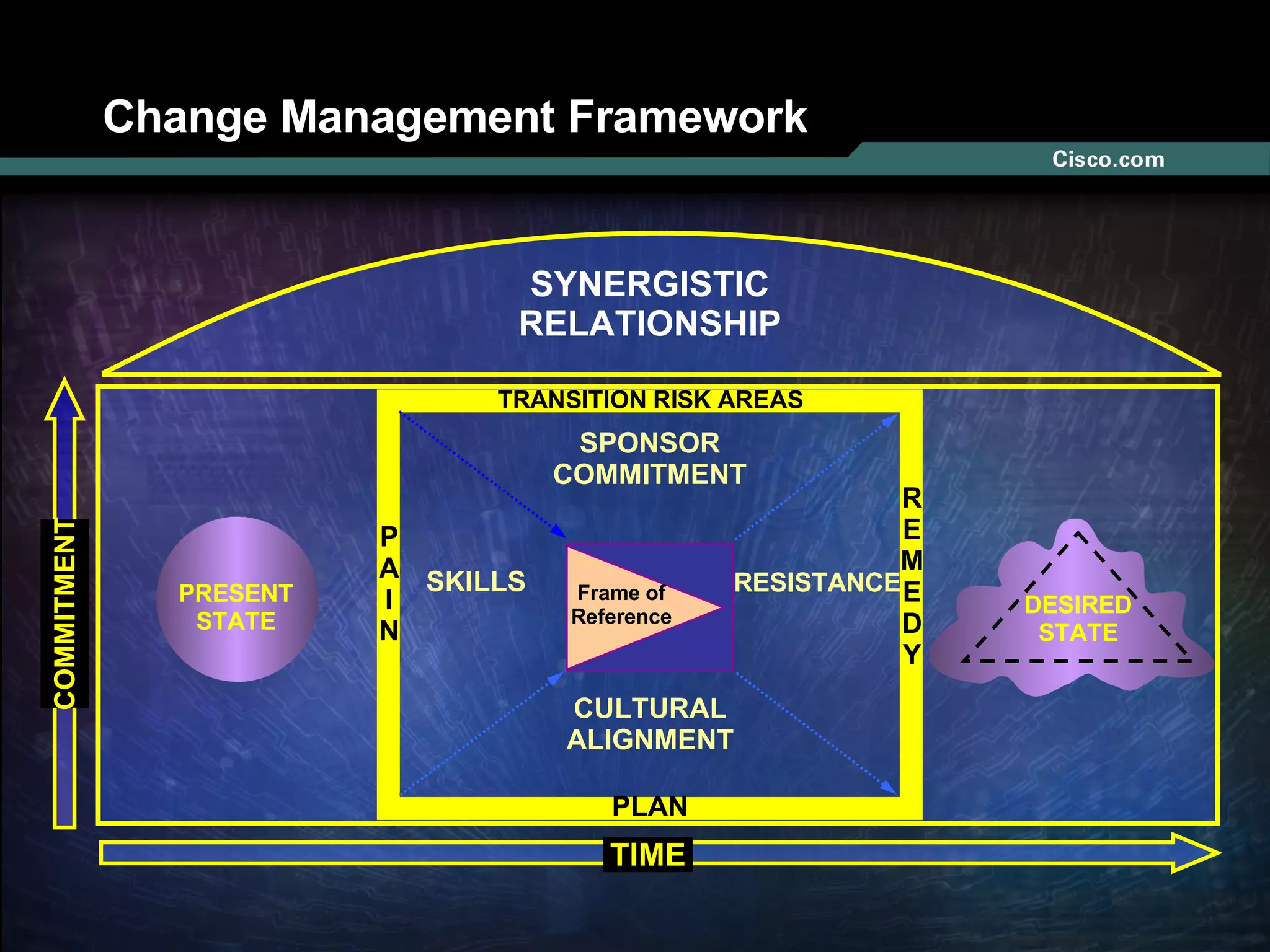
Change Management Framework DESIRED STATE SPONSOR COMMITMENT SKILLS CULTURAL ALIGNMENT RESISTANCE P A I N COMMITMENT TIME SYNERGISTIC RELATIONSHIP R EM E D Y PLAN TRANSITION RISK AREAS Frame of Reference PRESENT STATE
Strategic Direction Framework Future State Strategic Transition State ∆ Current State Tactical C A Understand the Current State Implement Transitional State Define Future State B
Communications Framework Behavior Change Leadership—60% Systems—30% Vehicles—10% Executive Sponsorship—Global and Regional Behaviors—Say & Do Messages Briefings Meetings Structure Compensation Policies Resource allocation Communication with customer administrators Announcements/ Broadcasts Websites/portals Meetings VODs Email Voice mail
Behavior Change Framework Awareness Understanding Translation Commitment Internalization
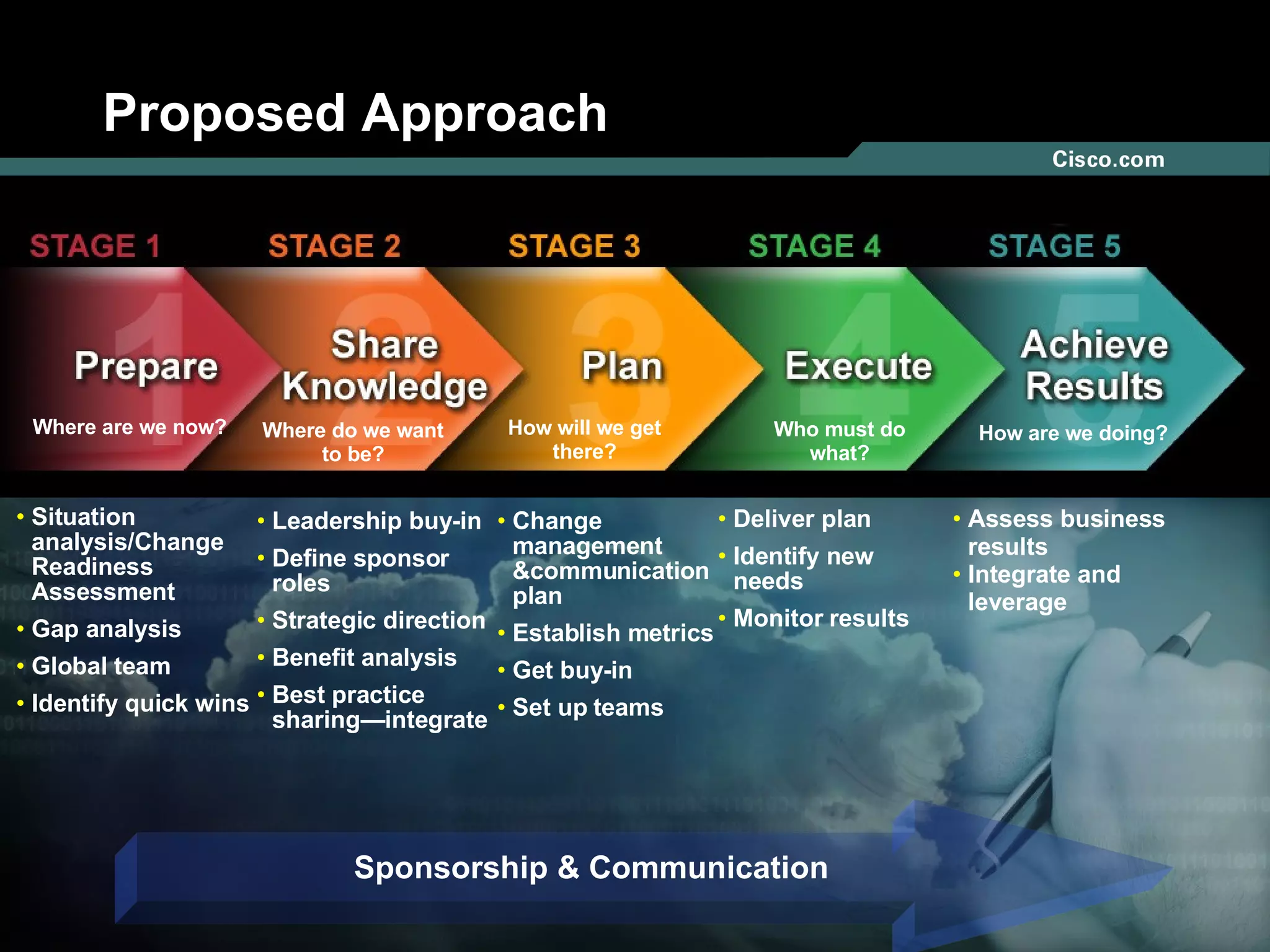
Proposed Approach Situation analysis/Change Readiness Assessment Gap analysis Global team Identify quick wins Leadership buy-in Define sponsor roles Strategic direction Benefit analysis Best practice sharing—integrate Change management &communication plan Establish metrics Get buy-in Set up teams Deliver plan Identify new needs Monitor results Assess business results  Integrate and leverage Sponsorship & Communication Where are we now? Where do we want to be? How will we get there? Who must do what? How are we doing?
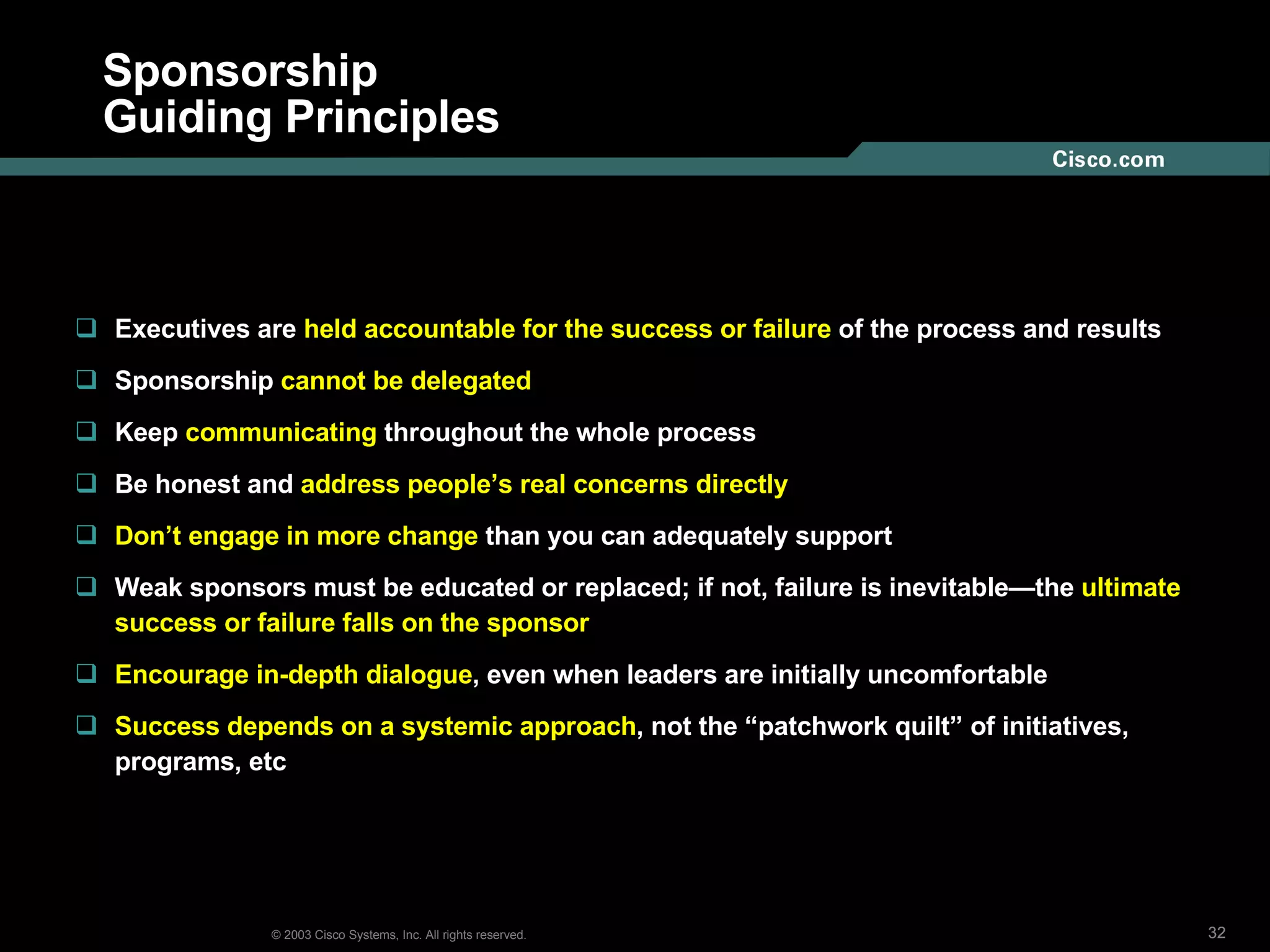
Sponsorship Guiding Principles Executives are  held accountable for the success or failure  of the process and results Sponsorship  cannot be delegated Keep  communicating  throughout the whole process Be honest and  address people’s real concerns directly Don’t engage in more change  than you can adequately support Weak sponsors must be educated or replaced; if not, failure is inevitable—the  ultimate success or failure falls on the sponsor Encourage in-depth dialogue , even when leaders are initially uncomfortable Success depends on a systemic approach , not the “patchwork quilt” of initiatives, programs, etc
Sponsorship Role Power:   the sanctioning power to legitimize the change  Pain:   a level of discomfort with the status quo that makes change attractive Resources:  a thorough understanding of  resources necessary for successful implementation and the ability/willingness/ influence to get the right people The Long View:  an in-depth understanding of the impact the change will have on the organization Sensitivity:  the capacity to fully appreciate and empathize with the personal issues major change raises Scope:  the capacity to understand thoroughly the size of the group to be affected by the change Vision:  a clear definition of what change must occur Public Role:   demonstrates public support & commitment to change A Private Role:   meets privately with individuals or groups to convey strong personal support for the change Consequence Management Techniques:   prepared to reward supporters of change & express displeasure with those who inhibit it A Willingness to Sacrifice :  the commitment to pursue the transition, knowing that there is  a price Persistence:  the capability to demonstrate consistent support for the change and reject any short-term action that is inconsistent with long-term change goals
Sponsor Evaluation To Be Used by CPR Leader to Assess Sponsorship 5 4 3 2 1 The sponsor views this as a cross-functional issue 5 4 3 2 1 The sponsor has a good understanding of how this relates to Cisco’s strategy 5 4 3 2 1 The sponsor demonstrates consistent, sustained support for the initiative 5 4 3 2 1 The sponsor leads by example Strongly Agree Somewhat Agree Neutral Somewhat Disagree Strongly Disagree 5 4 3 2 1 The sponsor sees this as a critical business issue that he/she is committed to address 5 4 3 2 1 The sponsor has a good understanding of the impact of dealing with this issue will have on the organization 5 4 3 2 1 The sponsor understands what resources—in terms of time, budget, dedicated people, training, access to people—are needed for this initiative to be successful  5 4 3 2 1 The sponsor is willing to commit the resources in terms of time, budget, dedicated people, training, access to people— needed for the initiative to succeed  5 4 3 2 1 The sponsor is willing to meet privately with individuals or groups to convey strong personal support for the initiative  5 4 3 2 1 The sponsor is committed to dealing with roadblocks when they arise 5 4 3 2 1 This is one of the sponsor’s top 5 initiatives
Change  Management Across IT © 2003 Cisco Systems, Inc. All rights reserved.
Business Challenge From : A service delivery organization…  To : A Consultative Business Partner offering:  Strategic Solutions A Catalyst for Change Technology Leadership Breakthrough Productivity
Strategic Plan Taking Partnerships to New Heights The Way We  Work Leading Internet Capabilities Ongoing Assessments Cascading Workshops Ongoing Engagement Internal Communication Capability Cross-functional Team: IT & Business Online solutions: IT & Cisco Ongoing Communication IT Senior Staff Internal Clients IT: 75 Interviews Worldwide Strategic Off-site Stages Transform Implement Plan & Engage Assess 1999 2002 2000 Focus & Investment
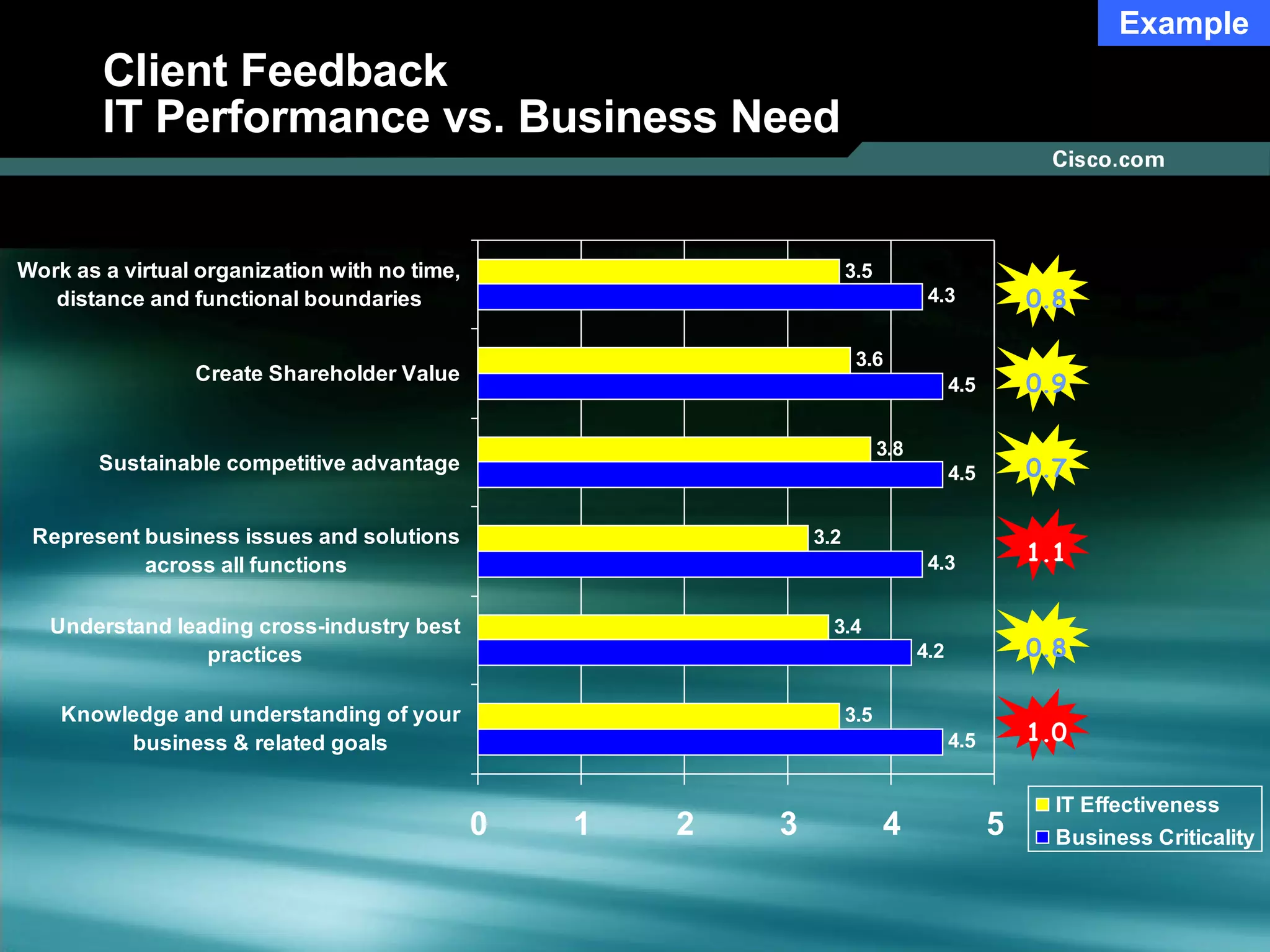
Client Feedback  IT Performance vs. Business Need Example 0.8 0.9 0.7 1.1 0.8 1.0
Change Readiness Assessment Key Risk Areas Strong belief that IT senior staff supports the changes we need to make  Some concern about IT senior staff sharing common goal around Business Partnership  Caution around leadership by example - walking the talk  Management has a history of losing focus on important projects when other problems or issues compete for its attention  Failure to involve middle managers in planning change has resulted in their indifference and opposition to initiatives  Managers in past changes said they supported a change but their behavior often suggested the opposite  Employees understanding of how Cisco’s business goals translate into specific things they can do in their jobs  In deciding to support a change, people do what they think will please their boss rather than what is best for Cisco  There will be some difficulty in explaining BP to employees  Communication in IT is open and candid  IT’s usage of rewards, measurement and other processes to communicate its seriousness and signal a change  A compelling reason to change has not been clearly communicated  Employees will not easily understand the costs associated with not implementing BP Employees expect change to happen at Cisco Employees will not be motivated to achieve Business Partnership  Employees will need to be invested in the new way of operating  Employees will not feel a sense of control in implementing Business Partnership BP will be regarded as requiring employees to make substantial changes to their own day-to-day activities  Employees do not have the assimilation capacity for Business Partnership IT Senior Staff has the skills and abilities to execute and deliver Business Partnership  Managers already possess Business Partnership skills Employees already possess Business Partnership skills  Employees have the skills and abilities they need to accomplish this change  S P O N S O R S H I P RESISI TANCE COMMUNICAT ION SKI LLS Example
Internal Assessment Risk Area: Sponsorship IT Senior Staff ... Example IT Senior Staff Supports This Change...
Leadership Say/Do Gap Analysis  Example 43% GAP 31% GAP 36% GAP
Change Communication Plan IT Connection IT e-Communities IT Client Portal Best Practice Website Meetings & Off-sites Chats with CIO Manager Weekly e-alert Meeting-in-a-Box Client Feedback MBO Alignment Quarterly IT Business Partnership Award   IT Champion Award Performance Reviews CAP Awards Training Program IT Communication Function   Centralized company-wide Training for Sr. Staff Delivery of BP Workshops Quarterly IT All-Hands/IPTV Sr. Staff Meetings Management Staff Meetings Chats with CIO CIO Corner IT Connection Sr. Staff Forums BP Team SYSTEMS/PROCESSES MEDIA LEADERSHIP
Windows 2000 Customer Feedback  It is very important to me that my individual settings are transferred to my Windows 2000 environment Business events may interfere with my conversion to Windows 2000 Mean 4.0 Mean 2.8
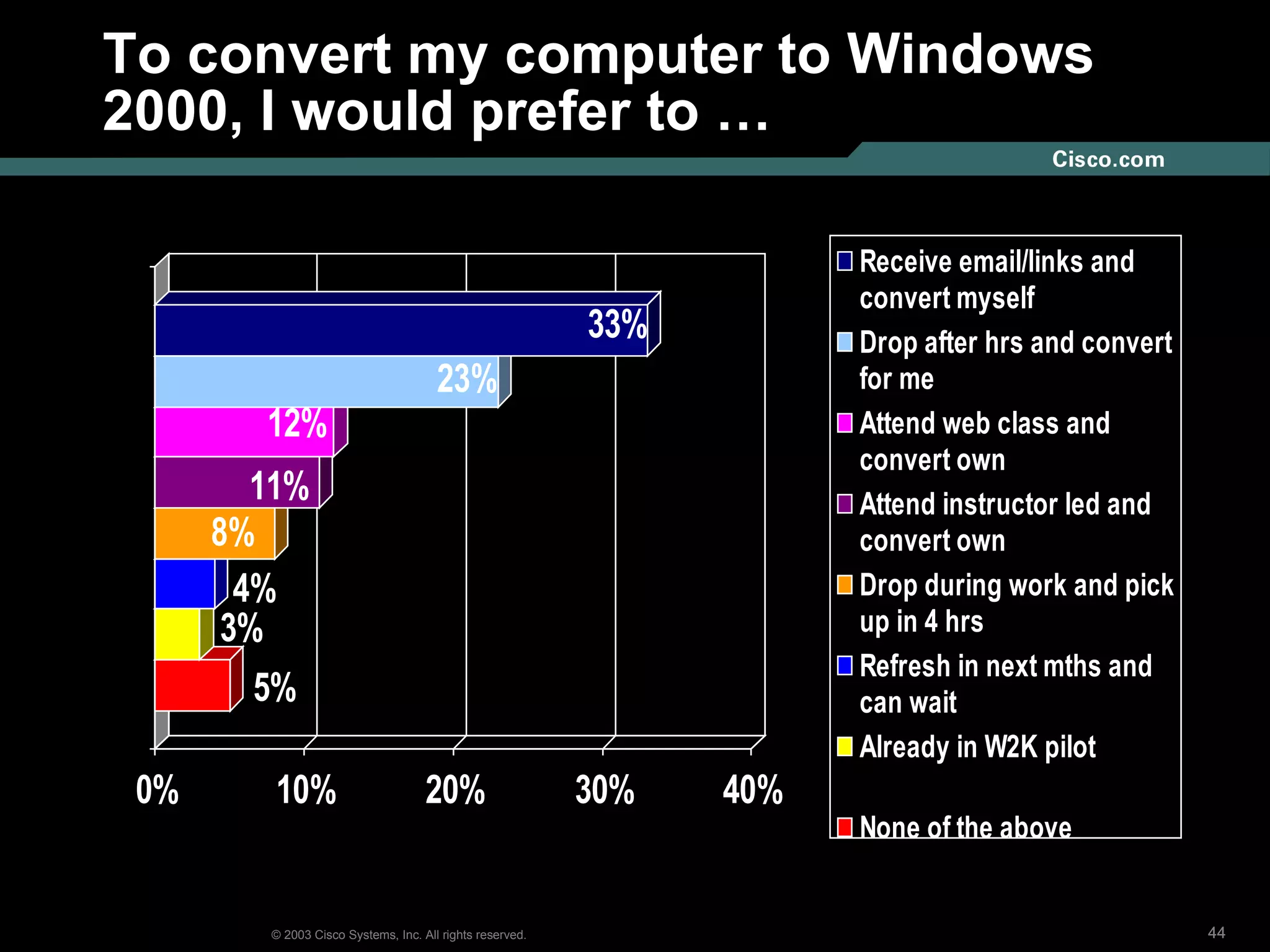
To convert my computer to Windows 2000, I would prefer to …
To learn What's New in Windows 2000, I would prefer to  …
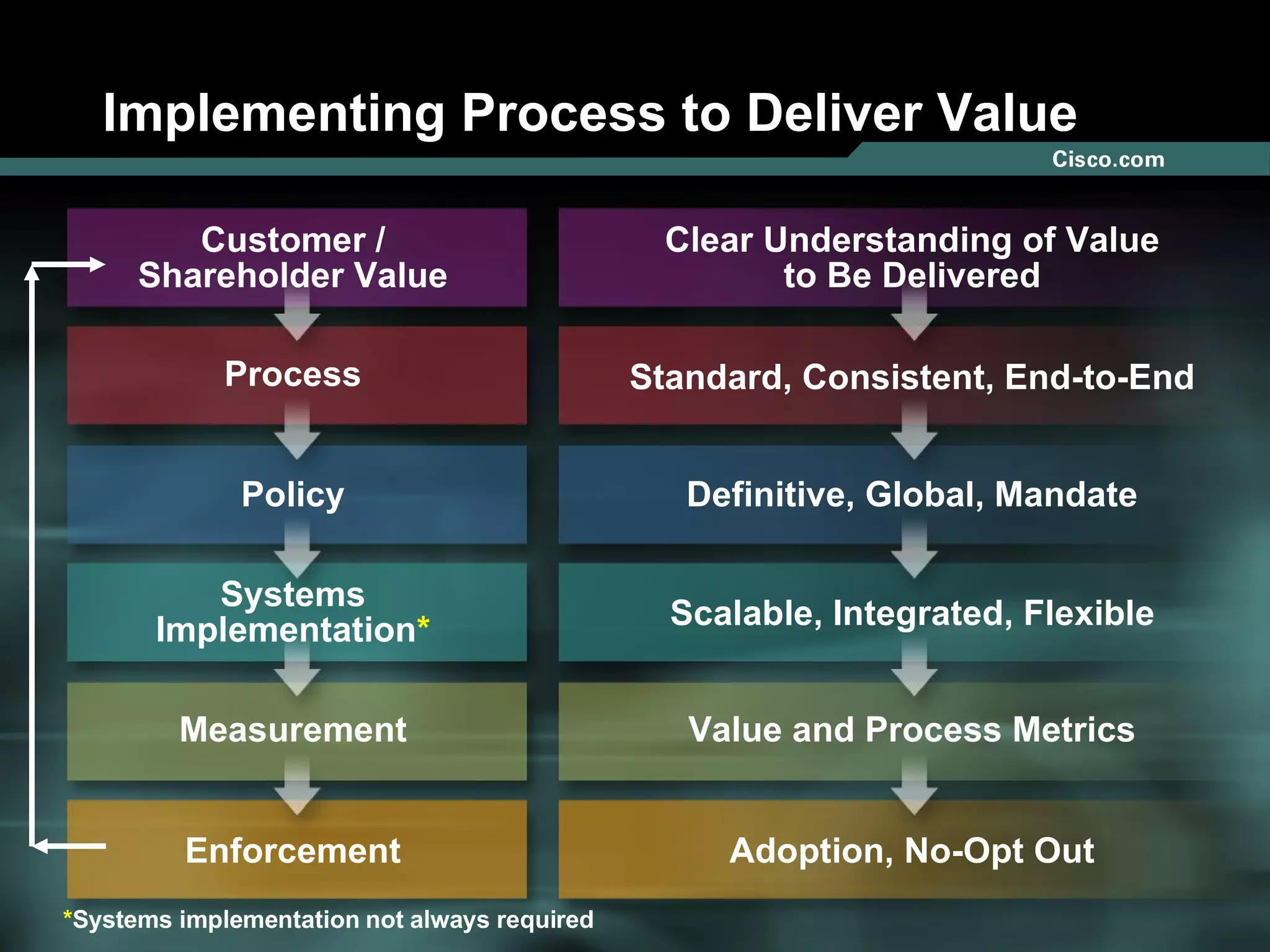
Implementing Process to Deliver Value Clear Understanding of Value to Be Delivered Standard, Consistent, End-to-End Definitive, Global, Mandate Value and Process Metrics Adoption, No-Opt Out Scalable, Integrated, Flexible * Systems implementation not always required Customer / Shareholder Value Process Policy Measurement Enforcement Systems Implementation *
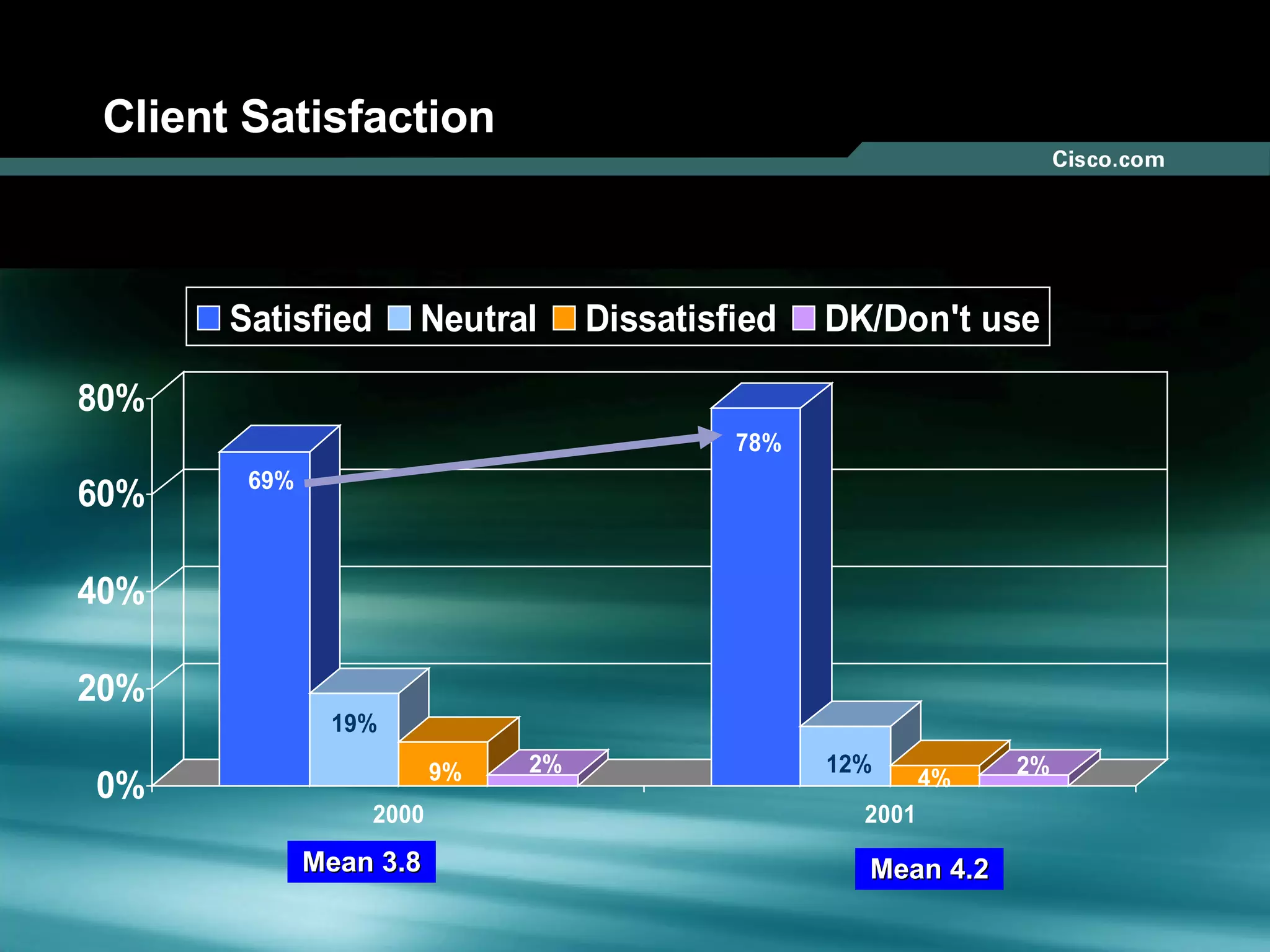
Client Satisfaction Mean 4.2 Mean 3.8
Evolve to an Integrated IT Business Model IT Business  Model Process Metrics Portfolio Management and End-to-End Delivery Architecture & Standards Governance Business Partnership Value Low Total Cost of Ownership Customer and Client Satisfaction Speed and Agility Exploiting New Technology
Q and A © 2003 Cisco Systems, Inc. All rights reserved.
© 2003 Cisco Systems, Inc. All rights reserved. Presentation_ID

Measuring Business Value of IT

  • 1.
    Cisco Case StudyEMBA: Measuring Business Value of IT University of Notre Dame March 19, 2004 Ayelet Baron—aybaron@cisco.com WW Sales Strategy & Planning Cisco Systems, Inc.
  • 2.
    Cisco Overview ©2003 Cisco Systems, Inc. All rights reserved.
  • 3.
    History of CiscoSystems Started at Stanford IPO; 192 Employees End-to-End Solutions Provider Cisco Routers Power the Internet; LAN/WAN Switching, Remote Access #1 Communications Equipment Supplier Shipped First Router $18.9 Billion Revenue; 34,000 Employees; IP Telephony, Security, Wireless, Networked Home 1998 1984 1986 1990 1994 2002 2003
  • 4.
    Cisco Worldwide 33,000+employees in 68 countries Average years of service 4.5 1/3 Engineering/IT, 1/3 Sales, 1/3 all others All connected to common Internet tools All are Cisco shareholders Updated 01/04
  • 5.
    Cisco Products Industry’sbroadest product line Leadership products in each category R&D = 16.9% of revenue Enables end-to-end network services
  • 6.
    Networking and theInternet WORK LIVE PLAY LEARN
  • 7.
    Key Cisco Frameworks © 2003 Cisco Systems, Inc. All rights reserved.
  • 8.
    Cisco’s Financial Benefitfrom IT Financial Impact FY ’95 FY ’03 FY ’96 FY ’97 FY ’98 FY ’99 FY ’00 FY ’01 FY ’02 Communications Internal Directory External Web Site Support Self-Service $1B Departmental $3B Virtual Supply Chain Online Collaborative Support E-Treasury $1.9B $2.1B $1.7B Inter-Enterprise $2B E-Commerce E-Procurement E-Learning E-HR Virtual Close $900M Enterprise
  • 9.
    Core and ContextCore Context © 2004 Cisco Systems, Inc. All rights reserved. Mission Critical Non-Mission Critical Contributes Directly to Competitive Advantage Required to run the business and fulfill commitments Shortfall risks company's operations
  • 10.
    Out-Tasking Versus Out-SourcingA whole function (IT) Manage contract and SLAs Separate IT Systems with reporting Process redesign requires contract renegotiation Elements of a function Real time visibility and active management Shared systems/web services; common data, network standards Allows process redesign and continuous innovation © 2004 Cisco Systems, Inc. All rights reserved.
  • 11.
    Investment and PartneringStrategy Core Context © 2004 Cisco Systems, Inc. All rights reserved. Mission Critical Non-Mission Critical Invest Retain In-house Drive Productivity Strategic Partners (Few, Tightly Coupled) Focused Investment Specialist Partners Control Costs Vendor Management (SLAs Driven)
  • 12.
    Relative Cisco FunctionalOut-Tasking Manufacturing Sales HR Finance % Out-Tasked © 2004 Cisco Systems, Inc. All rights reserved. 8712_09_2003 IT Customer Service Inside sales Advertising Lead qualification Payroll processing Travel Investment Management Temp contracting Benefits admin Global mobility Desktop mgmt Remote office WAN E-commerce apps Board manufacturing Final assembly & test Logistics & delivery Level 1 help desk Order admin Field logistics & repair
  • 13.
    Cisco IT ©2003 Cisco Systems, Inc. All rights reserved.
  • 14.
    Cisco IT Employees—19991900+ employees 2500+ vendors ~2.5% of total employee base ~4.5% of expense 65% in US, 25% in EMEA, 10% in AsiaPac / Japan ~$1B in spend
  • 15.
    Cisco’s IT EvolutionIT works independently of business Seeing as non value adding IT seen as “high” cost Focus on technical performance IT as Cost Center CFP& ERP Internet Enabler Outcome Defined Trusted Business Partner Value Creation Proactive Reactive 2000 1997 1993-95 1991 IT Supports Business Strategy IT Enables New Capabilities and Roles Business Value Supports business strategy IT seen as a support process Focus on Return on Investment Supports and enhances business strategy IT seen as a critical process Focus on cycle time, cost reduction, service quality Enables business strategy and integral part of the business Effective use and leverage of technology and “virtual” resources Focus on Shareholder value
  • 16.
    Cisco IT’s Historical“Shifts” Time Key IT Success Factors Organization Model Exceptional Staff Receptive Company IT as cost center CFP model Use of Internet, CCO Repl of all key apps (ERP) 1991 1993 1995 1997 1999 Consultative Proactive Leadership LEVEL 0 LEVEL 1 LEVEL 2 LEVEL 3 LEVEL 4 LEVEL 5 2003 Cross-functional Productivity Experts Strategic Impact Low High
  • 17.
    IT Mission ITdrives the Business in Internet Leadership Capabilities, integrated across Cisco Globally, resulting in: Meeting Productivity Goals Increasing shareholder value Increased Customer Success Cost Avoidance Improved Decision Making
  • 18.
    Guiding Principles Createclose IT/business alignment The business determines value tradeoffs for investments providing the “best-value” return Deliver near-term business results Drive constant improvements with serious and accountable metrics Utilize an enterprise wide common and scalable infrastructure Productivity!!!
  • 19.
    Cisco’s “Hybrid” ITOrganization Advantages Business executives involved with IT project success more than CIO Good alignment of business and IT objectives Promotes the right business decisions Higher degree of client satisfaction Still strict centralized control over standards, architectures to ensure low-cost, high-quality, and rapid cycle times Centralized Infrastructure Data Center, Hosting, Transport, Client Services, Theatre Service Delivery, Infrastructure Applications, VMO, Technical Architecture, Administration Manufacturing Sales Finance Marketing CIO IT Organization IT Organization IT Organization IT Organization
  • 20.
    IT Business Modelto Get It All Done Effective Use of IT Resources Effective IT Processes Measurement and Accountability Core vs Context Strategic Use of Outside Services and Outsourcing Vendor Management Objective Efforts Status End to End Portfolio Mgmt (emPOWER) World Ready Apps Collaboration Management Metrics Expectations of Leadership team Early Results CA TS and GCT Context 75% outsourced emPOWER Proof of Concept completed World Ready Road Show complete in India and EMEA
  • 21.
    Cisco’s philosophy andfinancial approach to IT spend has allowed IT investment to grow as fast or faster than revenue (as “return” is accounted for on “business side) Investment Approach And Impact On Cisco’s IT Investment
  • 22.
    Project Guidance andPlanning “ In 1998, there were no guidelines, no rules of the road as far as how to do CFP planning and execution. ” Project Tracking using a central repository Project Reporting on a quarterly basis Tracking of Budget vs. Actuals during the project Compliance to Architecture & Standards Execute Commitment for funding of project execution and delivery Readiness Reviews before Go Live Client Satisfaction measurements after delivery Today…
  • 23.
    Enterprise IT PortfolioManagement Goals Make the correct tradeoff, prioritization decision Ensure business capabilities are created in the right sequence Identify and resolve key barriers Hold key projects accountable for delivery of business value within budget Maximize the Value of Cisco’s IT Investments
  • 24.
    IT Governance ModelFunding Mechanisms IT Performance Mgt Process Oversight Standards Approach Client Centric Organization Principles Business Mindset Metrics Strategic Partner IT Business Alignment CULTURE Insuring the maximum value for Cisco’s IT investment
  • 25.
    Approach: Cisco ITGovernance “How We Ensure Value” Strategic “Instinct” Co-location CFP Model Operations Metrics Root Cause Analysis Global Vs Local Decisions Operations Reviews Performance Metrics Mbo’s and Plans Adherence Selection Process Emerging Vs Sun-setting Standards Budget Management Productivity Analysis Business Justification Mindset SDLC Model Balance “Risk Vs Innovation” Project Mgr Education ASP System Integrators Web Portals Management Accountability Business Alignment Standards Management Fiscal Controls Development Methods Continuous Improvement End User Technology Procurement
  • 26.
    Change ManagementFramework © 2003 Cisco Systems, Inc. All rights reserved.
  • 27.
    Change Management FrameworkDESIRED STATE SPONSOR COMMITMENT SKILLS CULTURAL ALIGNMENT RESISTANCE P A I N COMMITMENT TIME SYNERGISTIC RELATIONSHIP R EM E D Y PLAN TRANSITION RISK AREAS Frame of Reference PRESENT STATE
  • 28.
    Strategic Direction FrameworkFuture State Strategic Transition State ∆ Current State Tactical C A Understand the Current State Implement Transitional State Define Future State B
  • 29.
    Communications Framework BehaviorChange Leadership—60% Systems—30% Vehicles—10% Executive Sponsorship—Global and Regional Behaviors—Say & Do Messages Briefings Meetings Structure Compensation Policies Resource allocation Communication with customer administrators Announcements/ Broadcasts Websites/portals Meetings VODs Email Voice mail
  • 30.
    Behavior Change FrameworkAwareness Understanding Translation Commitment Internalization
  • 31.
    Proposed Approach Situationanalysis/Change Readiness Assessment Gap analysis Global team Identify quick wins Leadership buy-in Define sponsor roles Strategic direction Benefit analysis Best practice sharing—integrate Change management &communication plan Establish metrics Get buy-in Set up teams Deliver plan Identify new needs Monitor results Assess business results Integrate and leverage Sponsorship & Communication Where are we now? Where do we want to be? How will we get there? Who must do what? How are we doing?
  • 32.
    Sponsorship Guiding PrinciplesExecutives are held accountable for the success or failure of the process and results Sponsorship cannot be delegated Keep communicating throughout the whole process Be honest and address people’s real concerns directly Don’t engage in more change than you can adequately support Weak sponsors must be educated or replaced; if not, failure is inevitable—the ultimate success or failure falls on the sponsor Encourage in-depth dialogue , even when leaders are initially uncomfortable Success depends on a systemic approach , not the “patchwork quilt” of initiatives, programs, etc
  • 33.
    Sponsorship Role Power: the sanctioning power to legitimize the change Pain: a level of discomfort with the status quo that makes change attractive Resources: a thorough understanding of resources necessary for successful implementation and the ability/willingness/ influence to get the right people The Long View: an in-depth understanding of the impact the change will have on the organization Sensitivity: the capacity to fully appreciate and empathize with the personal issues major change raises Scope: the capacity to understand thoroughly the size of the group to be affected by the change Vision: a clear definition of what change must occur Public Role: demonstrates public support & commitment to change A Private Role: meets privately with individuals or groups to convey strong personal support for the change Consequence Management Techniques: prepared to reward supporters of change & express displeasure with those who inhibit it A Willingness to Sacrifice : the commitment to pursue the transition, knowing that there is a price Persistence: the capability to demonstrate consistent support for the change and reject any short-term action that is inconsistent with long-term change goals
  • 34.
    Sponsor Evaluation ToBe Used by CPR Leader to Assess Sponsorship 5 4 3 2 1 The sponsor views this as a cross-functional issue 5 4 3 2 1 The sponsor has a good understanding of how this relates to Cisco’s strategy 5 4 3 2 1 The sponsor demonstrates consistent, sustained support for the initiative 5 4 3 2 1 The sponsor leads by example Strongly Agree Somewhat Agree Neutral Somewhat Disagree Strongly Disagree 5 4 3 2 1 The sponsor sees this as a critical business issue that he/she is committed to address 5 4 3 2 1 The sponsor has a good understanding of the impact of dealing with this issue will have on the organization 5 4 3 2 1 The sponsor understands what resources—in terms of time, budget, dedicated people, training, access to people—are needed for this initiative to be successful 5 4 3 2 1 The sponsor is willing to commit the resources in terms of time, budget, dedicated people, training, access to people— needed for the initiative to succeed 5 4 3 2 1 The sponsor is willing to meet privately with individuals or groups to convey strong personal support for the initiative 5 4 3 2 1 The sponsor is committed to dealing with roadblocks when they arise 5 4 3 2 1 This is one of the sponsor’s top 5 initiatives
  • 35.
    Change ManagementAcross IT © 2003 Cisco Systems, Inc. All rights reserved.
  • 36.
    Business Challenge From: A service delivery organization… To : A Consultative Business Partner offering: Strategic Solutions A Catalyst for Change Technology Leadership Breakthrough Productivity
  • 37.
    Strategic Plan TakingPartnerships to New Heights The Way We Work Leading Internet Capabilities Ongoing Assessments Cascading Workshops Ongoing Engagement Internal Communication Capability Cross-functional Team: IT & Business Online solutions: IT & Cisco Ongoing Communication IT Senior Staff Internal Clients IT: 75 Interviews Worldwide Strategic Off-site Stages Transform Implement Plan & Engage Assess 1999 2002 2000 Focus & Investment
  • 38.
    Client Feedback IT Performance vs. Business Need Example 0.8 0.9 0.7 1.1 0.8 1.0
  • 39.
    Change Readiness AssessmentKey Risk Areas Strong belief that IT senior staff supports the changes we need to make Some concern about IT senior staff sharing common goal around Business Partnership Caution around leadership by example - walking the talk Management has a history of losing focus on important projects when other problems or issues compete for its attention Failure to involve middle managers in planning change has resulted in their indifference and opposition to initiatives Managers in past changes said they supported a change but their behavior often suggested the opposite Employees understanding of how Cisco’s business goals translate into specific things they can do in their jobs In deciding to support a change, people do what they think will please their boss rather than what is best for Cisco There will be some difficulty in explaining BP to employees Communication in IT is open and candid IT’s usage of rewards, measurement and other processes to communicate its seriousness and signal a change A compelling reason to change has not been clearly communicated Employees will not easily understand the costs associated with not implementing BP Employees expect change to happen at Cisco Employees will not be motivated to achieve Business Partnership Employees will need to be invested in the new way of operating Employees will not feel a sense of control in implementing Business Partnership BP will be regarded as requiring employees to make substantial changes to their own day-to-day activities Employees do not have the assimilation capacity for Business Partnership IT Senior Staff has the skills and abilities to execute and deliver Business Partnership Managers already possess Business Partnership skills Employees already possess Business Partnership skills Employees have the skills and abilities they need to accomplish this change S P O N S O R S H I P RESISI TANCE COMMUNICAT ION SKI LLS Example
  • 40.
    Internal Assessment RiskArea: Sponsorship IT Senior Staff ... Example IT Senior Staff Supports This Change...
  • 41.
    Leadership Say/Do GapAnalysis Example 43% GAP 31% GAP 36% GAP
  • 42.
    Change Communication PlanIT Connection IT e-Communities IT Client Portal Best Practice Website Meetings & Off-sites Chats with CIO Manager Weekly e-alert Meeting-in-a-Box Client Feedback MBO Alignment Quarterly IT Business Partnership Award  IT Champion Award Performance Reviews CAP Awards Training Program IT Communication Function  Centralized company-wide Training for Sr. Staff Delivery of BP Workshops Quarterly IT All-Hands/IPTV Sr. Staff Meetings Management Staff Meetings Chats with CIO CIO Corner IT Connection Sr. Staff Forums BP Team SYSTEMS/PROCESSES MEDIA LEADERSHIP
  • 43.
    Windows 2000 CustomerFeedback It is very important to me that my individual settings are transferred to my Windows 2000 environment Business events may interfere with my conversion to Windows 2000 Mean 4.0 Mean 2.8
  • 44.
    To convert mycomputer to Windows 2000, I would prefer to …
  • 45.
    To learn What'sNew in Windows 2000, I would prefer to …
  • 46.
    Implementing Process toDeliver Value Clear Understanding of Value to Be Delivered Standard, Consistent, End-to-End Definitive, Global, Mandate Value and Process Metrics Adoption, No-Opt Out Scalable, Integrated, Flexible * Systems implementation not always required Customer / Shareholder Value Process Policy Measurement Enforcement Systems Implementation *
  • 47.
  • 48.
    Evolve to anIntegrated IT Business Model IT Business Model Process Metrics Portfolio Management and End-to-End Delivery Architecture & Standards Governance Business Partnership Value Low Total Cost of Ownership Customer and Client Satisfaction Speed and Agility Exploiting New Technology
  • 49.
    Q and A© 2003 Cisco Systems, Inc. All rights reserved.
  • 50.
    © 2003 CiscoSystems, Inc. All rights reserved. Presentation_ID