IT LEADERSHIP --  The most imperative trait for success
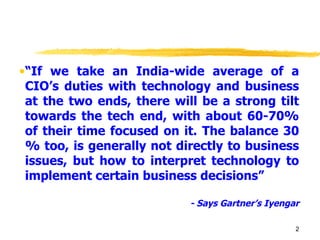
“ If we take an India-wide average of a CIO’s duties with technology and business at the two ends, there will be a strong tilt towards the tech end, with about 60-70% of their time focused on it. The balance 30 % too, is generally not directly to business issues, but how to interpret technology to implement certain business decisions” - Says Gartner’s Iyengar
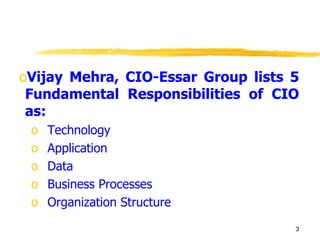
Vijay Mehra, CIO-Essar Group lists 5 Fundamental Responsibilities of CIO as: Technology  Application Data Business Processes Organization Structure
Atul Jayawant, President-Corporate IT and the Group CIO-Aditya Birla Group : “ If you start doing something after your competitor has done it, it’s no longer strategic. I would say the CIO’s job is to enable innovation and do things before the business asks for it.”
General Managers who are told that IT can create competitive advantage and enable transformation of business, find it difficult to evaluate the IT function & contribution of CIO It may be because – Expectations from IT are over-estimations Expectations from IT are under-estimations
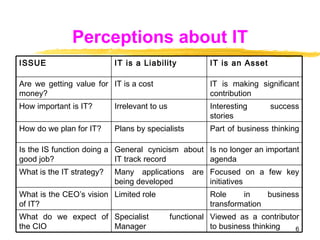
Perceptions about IT ISSUE  IT is a Liability  IT is an Asset Are we getting value for money?  IT is a cost  IT is making significant contribution  How important is IT?  Irrelevant to us  Interesting success stories  How do we plan for IT?  Plans by specialists  Part of business thinking  Is the IS function doing a good job?  General cynicism about IT track record  Is no longer an important agenda What is the IT strategy?  Many applications are being developed  Focused on a few key initiatives  What is the CEO’s vision of IT?  Limited role  Role in business transformation  What do we expect of the CIO  Specialist functional Manager  Viewed as a contributor to business thinking
CIO & CEO --- CIO - Is he viewed as a  Specialist A part of the strategy formation group The CEO - may find an ally in the CIO may find IT as a strategic tool may find IT as irrelevant to the organization
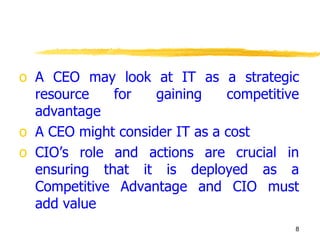
A CEO may look at IT as a strategic resource for gaining competitive advantage A CEO might consider IT as a cost CIO’s role and actions are crucial in ensuring that it is deployed as a Competitive Advantage and CIO must add value
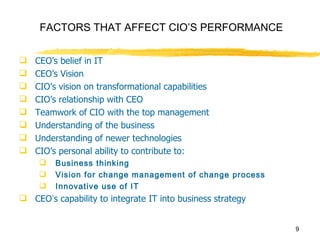
CEO’s belief in IT CEO’s Vision CIO’s vision on transformational capabilities CIO’s relationship with CEO Teamwork of CIO with the top management Understanding of the business Understanding of newer technologies CIO’s personal ability to contribute to: Business thinking Vision for change management of change process Innovative use of IT CEO ’ s capability to integrate IT into business strategy FACTORS THAT AFFECT CIO’S PERFORMANCE
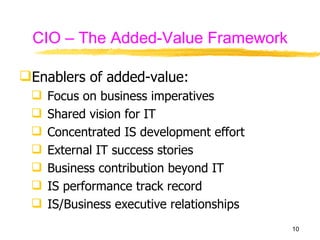
CIO – The Added-Value Framework Enablers of added-value: Focus on business imperatives Shared vision for IT Concentrated IS development effort External IT success stories Business contribution beyond IT IS performance track record IS/Business executive relationships
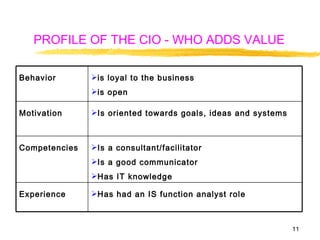
PROFILE OF THE CIO - WHO ADDS VALUE Behavior  is loyal to the business  is open  Motivation  Is oriented towards goals, ideas and systems  Competencies   Is a consultant/facilitator Is a good communicator Has IT knowledge  Experience   Has had an IS function analyst role
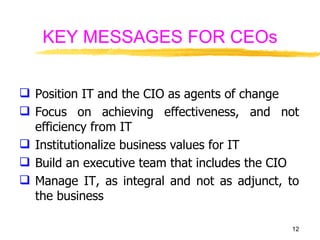
KEY MESSAGES FOR CEOs Position IT and the CIO as agents of change Focus on achieving effectiveness, and not efficiency from IT Institutionalize business values for IT Build an executive team that includes the CIO Manage IT, as integral and not as adjunct, to the business
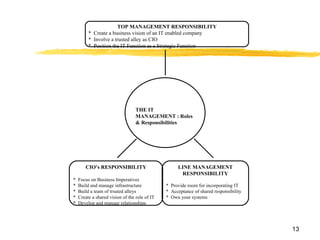
TOP MANAGEMENT RESPONSIBILITY *  Create a business vision of an IT enabled company *  Involve a trusted alley as CIO *  Position the IT Function as a Strategic Function  CIO’s RESPONSIBILITY *  Focus on Business Imperatives *  Build and manage infrastructure *  Build a team of trsuted alleys *  Create a shared vision of the role of IT *  Develop and manage relationships LINE MANAGEMENT RESPONSIBILITY *  Provide room for incorporating IT *  Acceptance of shared responsibility *  Own your systems  THE IT MANAGEMENT : Roles & Responsibilities
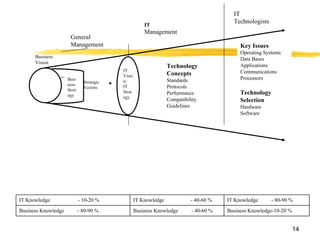
Business Vision IT Vision/ IT Strategy Strategic  Vectors Business Stretegy General  Management IT Management IT Technologists Technology Concepts Standards Protocols Performance Compatibility Guidelines Key Issues Operating Systems  Data Bases Applications Communications Processors Technology Selection Hardware Software IT Knowledge  - 10-20 % IT Knowledge  - 40-60 % IT Knowledge  - 80-90 % Business Knowledge  - 80-90 % Business Knowledge  - 40-60 % Business Knowledge-10-20 %
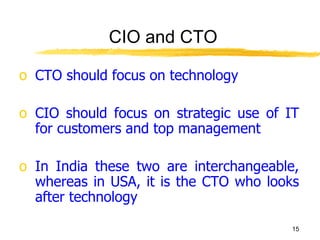
CIO and CTO CTO should focus on technology  CIO should focus on strategic use of IT for customers and top management In India these two are interchangeable, whereas in USA, it is the CTO who looks after technology
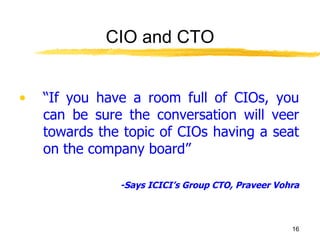
CIO and CTO “ If you have a room full of CIOs, you can be sure the conversation will veer towards the topic of CIOs having a seat on the company board” -Says ICICI’s Group CTO, Praveer Vohra
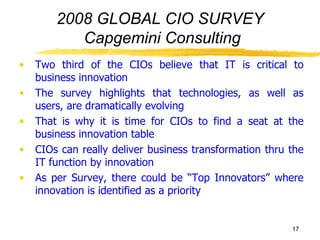
2008 GLOBAL CIO SURVEY  Capgemini Consulting Two third of the CIOs believe that IT is critical to business innovation The survey highlights that technologies, as well as users, are dramatically evolving That is why it is time for CIOs to find a seat at the business innovation table CIOs can really deliver business transformation thru the IT function by innovation As per Survey, there could be “Top Innovators” where innovation is identified as a priority
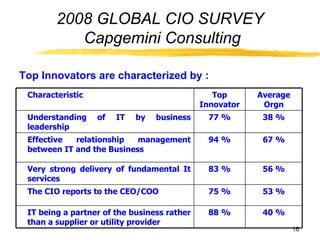
2008 GLOBAL CIO SURVEY  Capgemini Consulting Top Innovators are characterized by : Characteristic Top Innovator Average Orgn Understanding of IT by business leadership 77 % 38 % Effective relationship management between IT and the Business 94 % 67 % Very strong delivery of fundamental It services 83 % 56 % The CIO reports to the CEO/COO 75 % 53 % IT being a partner of the business rather than a supplier or utility provider 88 % 40 %
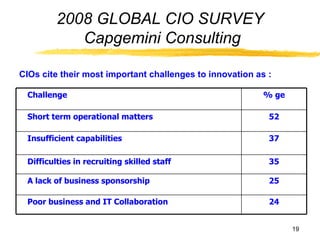
2008 GLOBAL CIO SURVEY  Capgemini Consulting CIOs cite their most important challenges to innovation as : Challenge % ge Short term operational matters 52 Insufficient capabilities 37 Difficulties in recruiting skilled staff 35 A lack of business sponsorship 25 Poor business and IT Collaboration 24
2008 GLOBAL CIO SURVEY  Capgemini Consulting To build a kep role for the IT function in business innovation, the CIOs must recognfigure the IT organization and its governance by : Separating IT fundamentals from business innovation and identifying the correct balance between the two Maximizing available resources and skills by effectively using technology partners and outsourcing Linking technology to innovation instead of cost to show that IT can change the business for the better Partnering with businesses in key innovation areas to improve business processes and identify innovative technology that brings value to the business

Mis 011

  • 1.
    IT LEADERSHIP -- The most imperative trait for success
  • 2.
    “ If wetake an India-wide average of a CIO’s duties with technology and business at the two ends, there will be a strong tilt towards the tech end, with about 60-70% of their time focused on it. The balance 30 % too, is generally not directly to business issues, but how to interpret technology to implement certain business decisions” - Says Gartner’s Iyengar
  • 3.
    Vijay Mehra, CIO-EssarGroup lists 5 Fundamental Responsibilities of CIO as: Technology Application Data Business Processes Organization Structure
  • 4.
    Atul Jayawant, President-CorporateIT and the Group CIO-Aditya Birla Group : “ If you start doing something after your competitor has done it, it’s no longer strategic. I would say the CIO’s job is to enable innovation and do things before the business asks for it.”
  • 5.
    General Managers whoare told that IT can create competitive advantage and enable transformation of business, find it difficult to evaluate the IT function & contribution of CIO It may be because – Expectations from IT are over-estimations Expectations from IT are under-estimations
  • 6.
    Perceptions about ITISSUE IT is a Liability IT is an Asset Are we getting value for money? IT is a cost IT is making significant contribution How important is IT? Irrelevant to us Interesting success stories How do we plan for IT? Plans by specialists Part of business thinking Is the IS function doing a good job? General cynicism about IT track record Is no longer an important agenda What is the IT strategy? Many applications are being developed Focused on a few key initiatives What is the CEO’s vision of IT? Limited role Role in business transformation What do we expect of the CIO Specialist functional Manager Viewed as a contributor to business thinking
  • 7.
    CIO & CEO--- CIO - Is he viewed as a Specialist A part of the strategy formation group The CEO - may find an ally in the CIO may find IT as a strategic tool may find IT as irrelevant to the organization
  • 8.
    A CEO maylook at IT as a strategic resource for gaining competitive advantage A CEO might consider IT as a cost CIO’s role and actions are crucial in ensuring that it is deployed as a Competitive Advantage and CIO must add value
  • 9.
    CEO’s belief inIT CEO’s Vision CIO’s vision on transformational capabilities CIO’s relationship with CEO Teamwork of CIO with the top management Understanding of the business Understanding of newer technologies CIO’s personal ability to contribute to: Business thinking Vision for change management of change process Innovative use of IT CEO ’ s capability to integrate IT into business strategy FACTORS THAT AFFECT CIO’S PERFORMANCE
  • 10.
    CIO – TheAdded-Value Framework Enablers of added-value: Focus on business imperatives Shared vision for IT Concentrated IS development effort External IT success stories Business contribution beyond IT IS performance track record IS/Business executive relationships
  • 11.
    PROFILE OF THECIO - WHO ADDS VALUE Behavior is loyal to the business is open Motivation Is oriented towards goals, ideas and systems Competencies Is a consultant/facilitator Is a good communicator Has IT knowledge Experience Has had an IS function analyst role
  • 12.
    KEY MESSAGES FORCEOs Position IT and the CIO as agents of change Focus on achieving effectiveness, and not efficiency from IT Institutionalize business values for IT Build an executive team that includes the CIO Manage IT, as integral and not as adjunct, to the business
  • 13.
    TOP MANAGEMENT RESPONSIBILITY* Create a business vision of an IT enabled company * Involve a trusted alley as CIO * Position the IT Function as a Strategic Function CIO’s RESPONSIBILITY * Focus on Business Imperatives * Build and manage infrastructure * Build a team of trsuted alleys * Create a shared vision of the role of IT * Develop and manage relationships LINE MANAGEMENT RESPONSIBILITY * Provide room for incorporating IT * Acceptance of shared responsibility * Own your systems THE IT MANAGEMENT : Roles & Responsibilities
  • 14.
    Business Vision ITVision/ IT Strategy Strategic Vectors Business Stretegy General Management IT Management IT Technologists Technology Concepts Standards Protocols Performance Compatibility Guidelines Key Issues Operating Systems Data Bases Applications Communications Processors Technology Selection Hardware Software IT Knowledge - 10-20 % IT Knowledge - 40-60 % IT Knowledge - 80-90 % Business Knowledge - 80-90 % Business Knowledge - 40-60 % Business Knowledge-10-20 %
  • 15.
    CIO and CTOCTO should focus on technology CIO should focus on strategic use of IT for customers and top management In India these two are interchangeable, whereas in USA, it is the CTO who looks after technology
  • 16.
    CIO and CTO“ If you have a room full of CIOs, you can be sure the conversation will veer towards the topic of CIOs having a seat on the company board” -Says ICICI’s Group CTO, Praveer Vohra
  • 17.
    2008 GLOBAL CIOSURVEY Capgemini Consulting Two third of the CIOs believe that IT is critical to business innovation The survey highlights that technologies, as well as users, are dramatically evolving That is why it is time for CIOs to find a seat at the business innovation table CIOs can really deliver business transformation thru the IT function by innovation As per Survey, there could be “Top Innovators” where innovation is identified as a priority
  • 18.
    2008 GLOBAL CIOSURVEY Capgemini Consulting Top Innovators are characterized by : Characteristic Top Innovator Average Orgn Understanding of IT by business leadership 77 % 38 % Effective relationship management between IT and the Business 94 % 67 % Very strong delivery of fundamental It services 83 % 56 % The CIO reports to the CEO/COO 75 % 53 % IT being a partner of the business rather than a supplier or utility provider 88 % 40 %
  • 19.
    2008 GLOBAL CIOSURVEY Capgemini Consulting CIOs cite their most important challenges to innovation as : Challenge % ge Short term operational matters 52 Insufficient capabilities 37 Difficulties in recruiting skilled staff 35 A lack of business sponsorship 25 Poor business and IT Collaboration 24
  • 20.
    2008 GLOBAL CIOSURVEY Capgemini Consulting To build a kep role for the IT function in business innovation, the CIOs must recognfigure the IT organization and its governance by : Separating IT fundamentals from business innovation and identifying the correct balance between the two Maximizing available resources and skills by effectively using technology partners and outsourcing Linking technology to innovation instead of cost to show that IT can change the business for the better Partnering with businesses in key innovation areas to improve business processes and identify innovative technology that brings value to the business