© 2009 Cisco Systems, Inc. All rights reserved. Cisco ConfidentialPresentation_ID 1
Build, Buy or Ally
Growth Strategies
for Business
Joe Deklic
Vice President, Strategic Investments Group
Cisco Systems Canada Co.
© 2009 Cisco Systems, Inc. All rights reserved. Cisco ConfidentialPresentation_ID 2
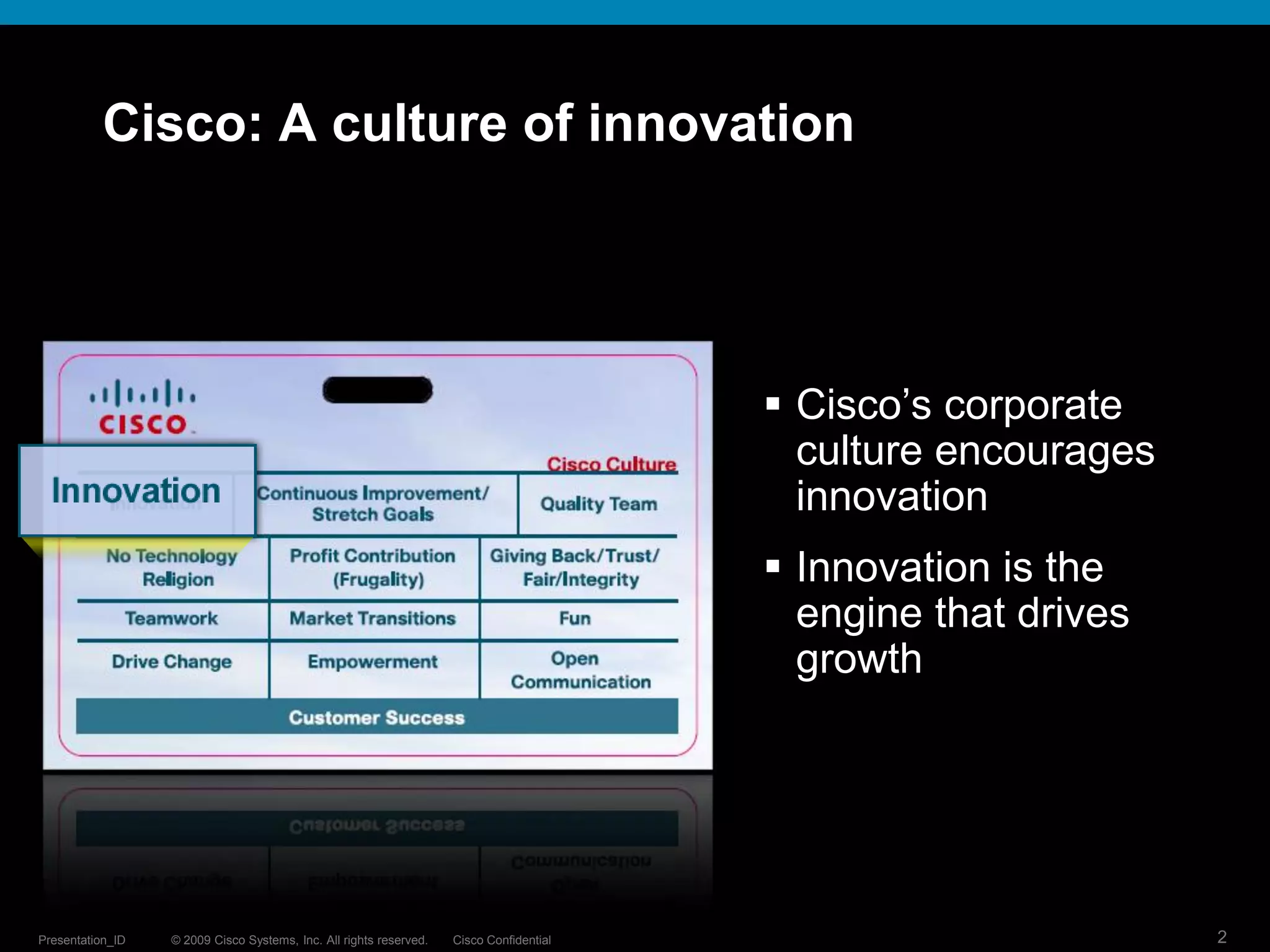
Cisco: A culture of innovation
 Cisco’s corporate
culture encourages
innovation
 Innovation is the
engine that drives
growth
© 2009 Cisco Systems, Inc. All rights reserved. Cisco ConfidentialPresentation_ID 3
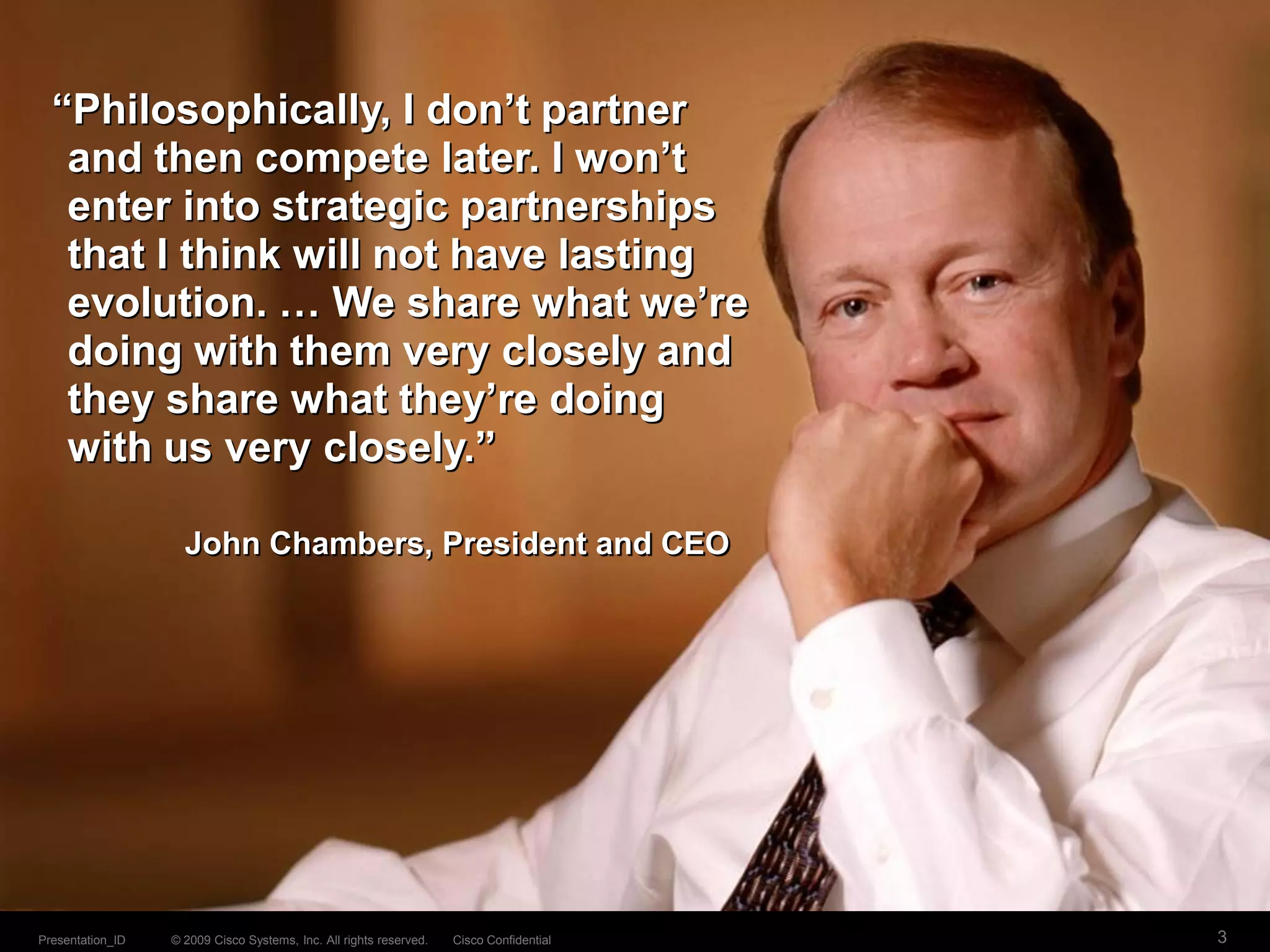
John Chambers, President and CEO
“Philosophically, I don’t partner
and then compete later. I won’t
enter into strategic partnerships
that I think will not have lasting
evolution. … We share what we’re
doing with them very closely and
they share what they’re doing
with us very closely.”
© 2009 Cisco Systems, Inc. All rights reserved. Cisco ConfidentialPresentation_ID 4
“Companies that use both acquisitions and
alliances grow faster than rivals do – as
companies like Cisco have amply
demonstrated.”
© 2009 Cisco Systems, Inc. All rights reserved. Cisco ConfidentialPresentation_ID 5
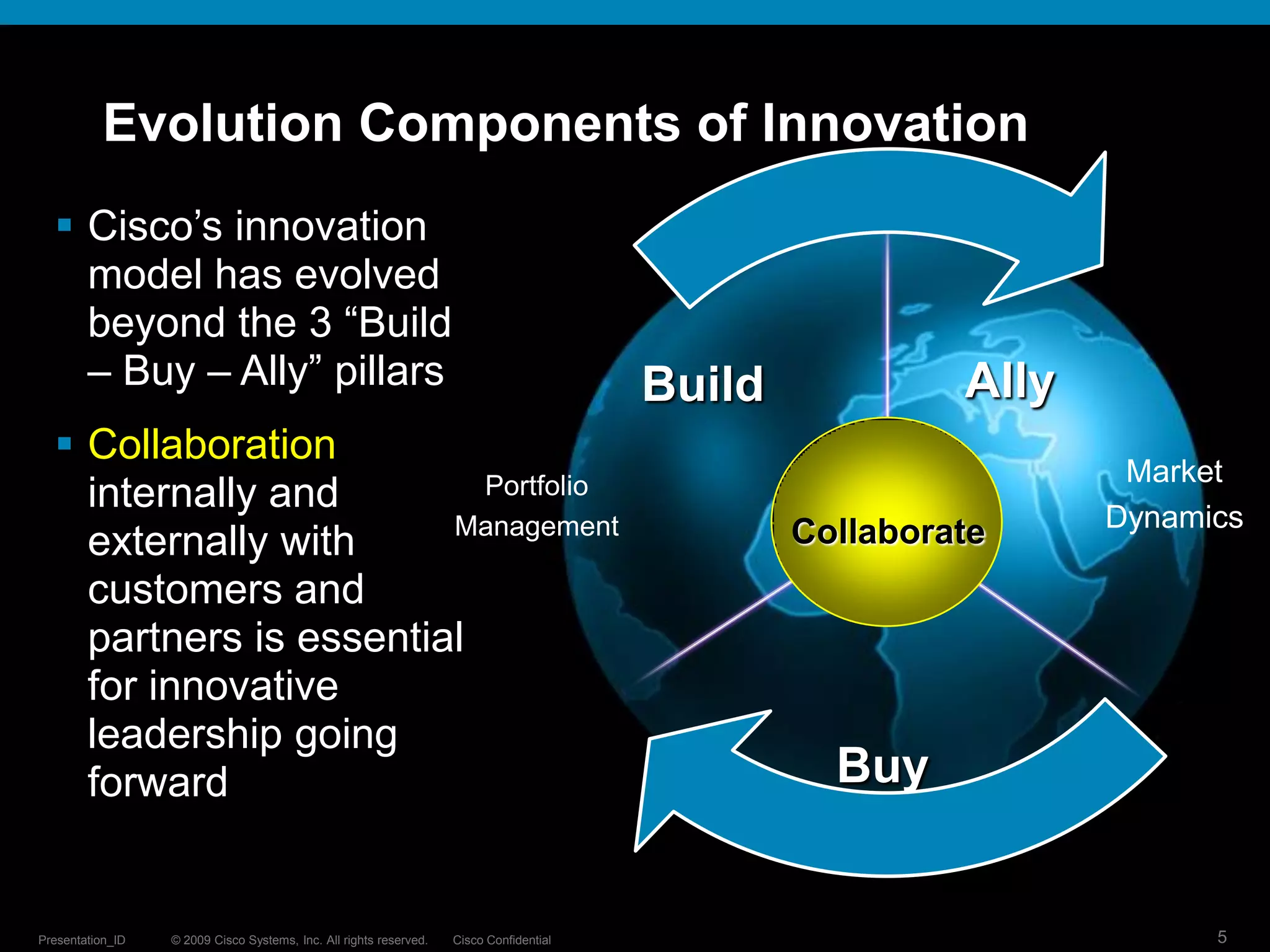
Evolution Components of Innovation
Build Ally
Buy
 Cisco’s innovation
model has evolved
beyond the 3 “Build
– Buy – Ally” pillars
 Collaboration
internally and
externally with
customers and
partners is essential
for innovative
leadership going
forward
Collaborate
Market
Dynamics
Portfolio
Management
© 2009 Cisco Systems, Inc. All rights reserved. Cisco ConfidentialPresentation_ID 6
Why Collaborate : Differentiation
 Power of many
 Time to execution
 Alignment
 Multiple competitive scenarios
 Customers win
© 2009 Cisco Systems, Inc. All rights reserved. Cisco ConfidentialPresentation_ID 7
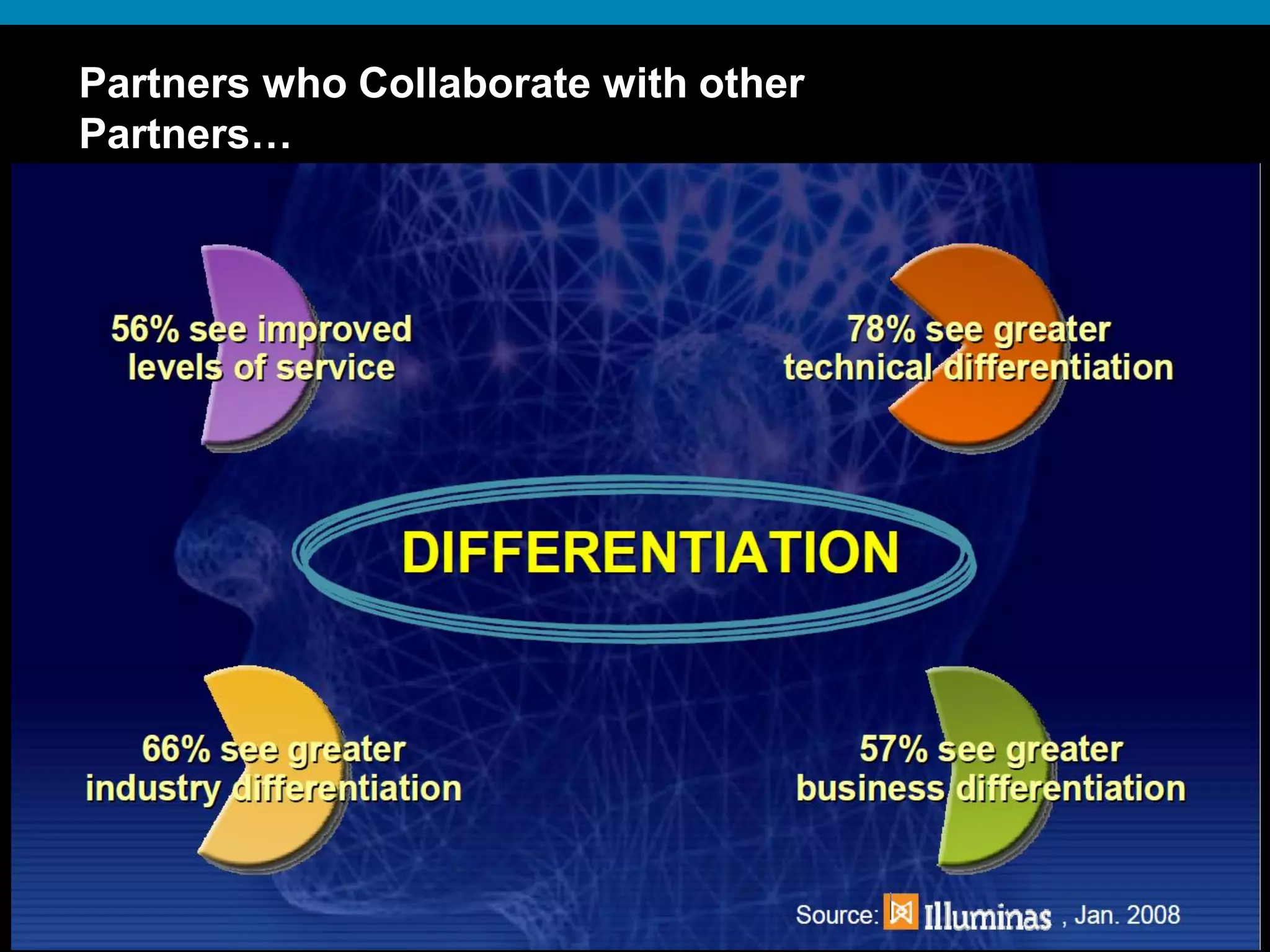
Partners who Collaborate with other
Partners…
© 2009 Cisco Systems, Inc. All rights reserved. Cisco ConfidentialPresentation_ID 8
Why Build: Technology Leadership
 Pioneer in the field
 Patentable technology
 Need to own the intellectual property
 Core business
 Have time or can build in increments
 Have in-house expertise
© 2009 Cisco Systems, Inc. All rights reserved. Cisco ConfidentialPresentation_ID 9
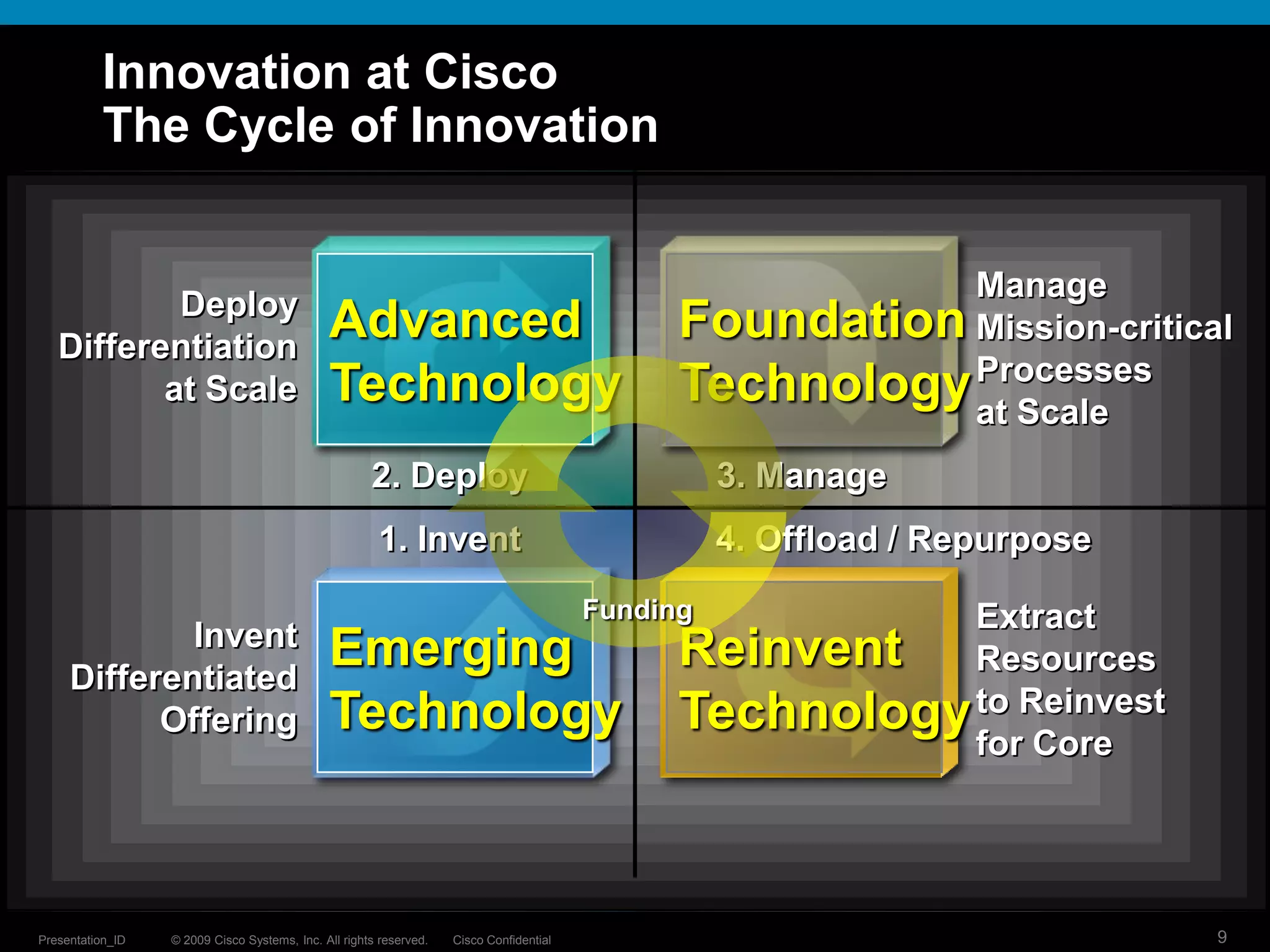
Innovation at Cisco
The Cycle of Innovation
Deploy
Differentiation
at Scale
Invent
Differentiated
Offering
Manage
Mission-critical
Processes
at Scale
Extract
Resources
to Reinvest
for Core
2. Deploy
1. Invent
3. Manage
4. Offload / Repurpose
Advanced
Technology
Foundation
Technology
Emerging
Technology
Reinvent
Technology
Funding
© 2009 Cisco Systems, Inc. All rights reserved. Cisco ConfidentialPresentation_ID 10
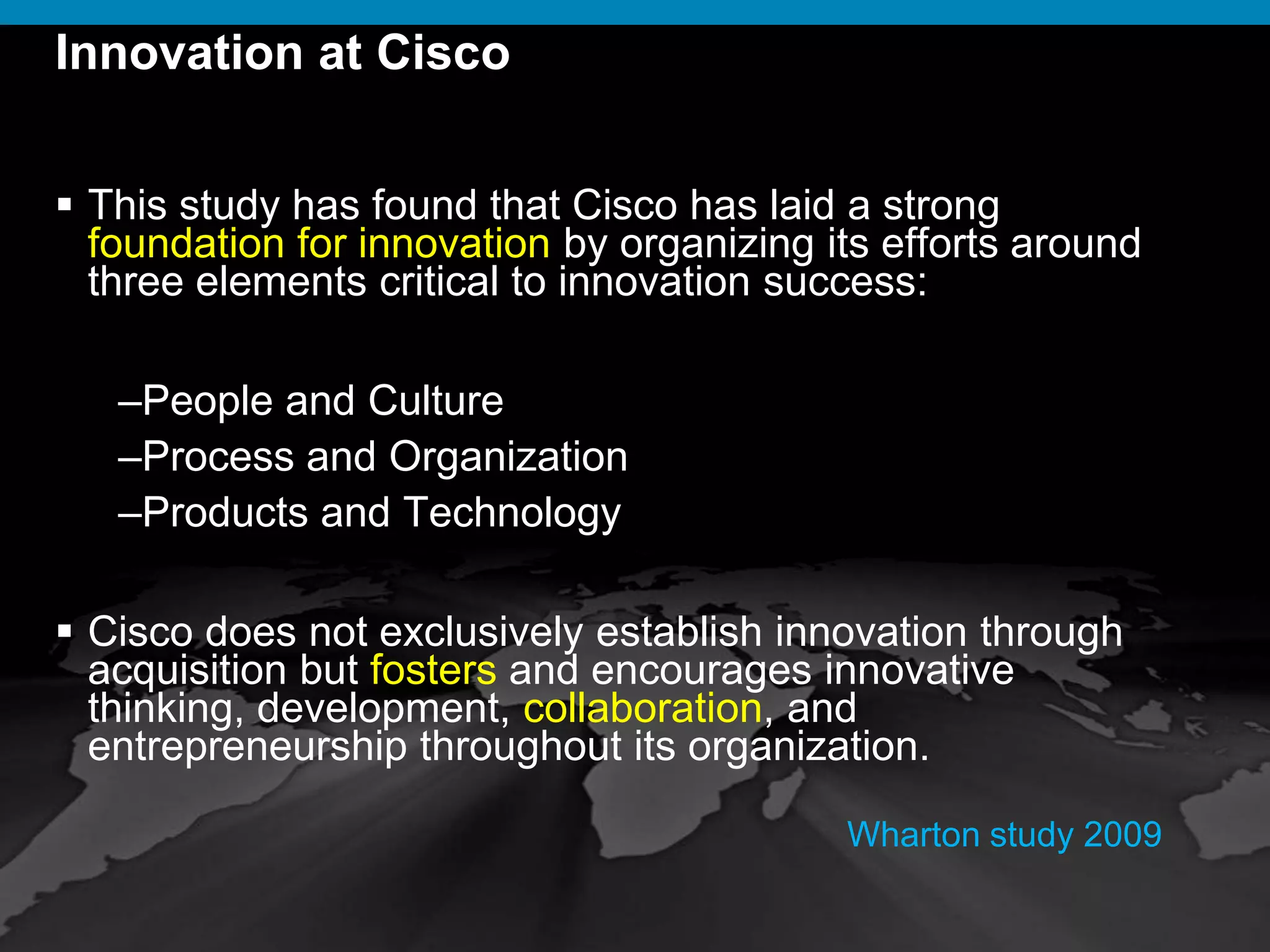
Innovation at Cisco
 This study has found that Cisco has laid a strong
foundation for innovation by organizing its efforts around
three elements critical to innovation success:
–People and Culture
–Process and Organization
–Products and Technology
 Cisco does not exclusively establish innovation through
acquisition but fosters and encourages innovative
thinking, development, collaboration, and
entrepreneurship throughout its organization.
Wharton study 2009
© 2009 Cisco Systems, Inc. All rights reserved. Cisco ConfidentialPresentation_ID 11
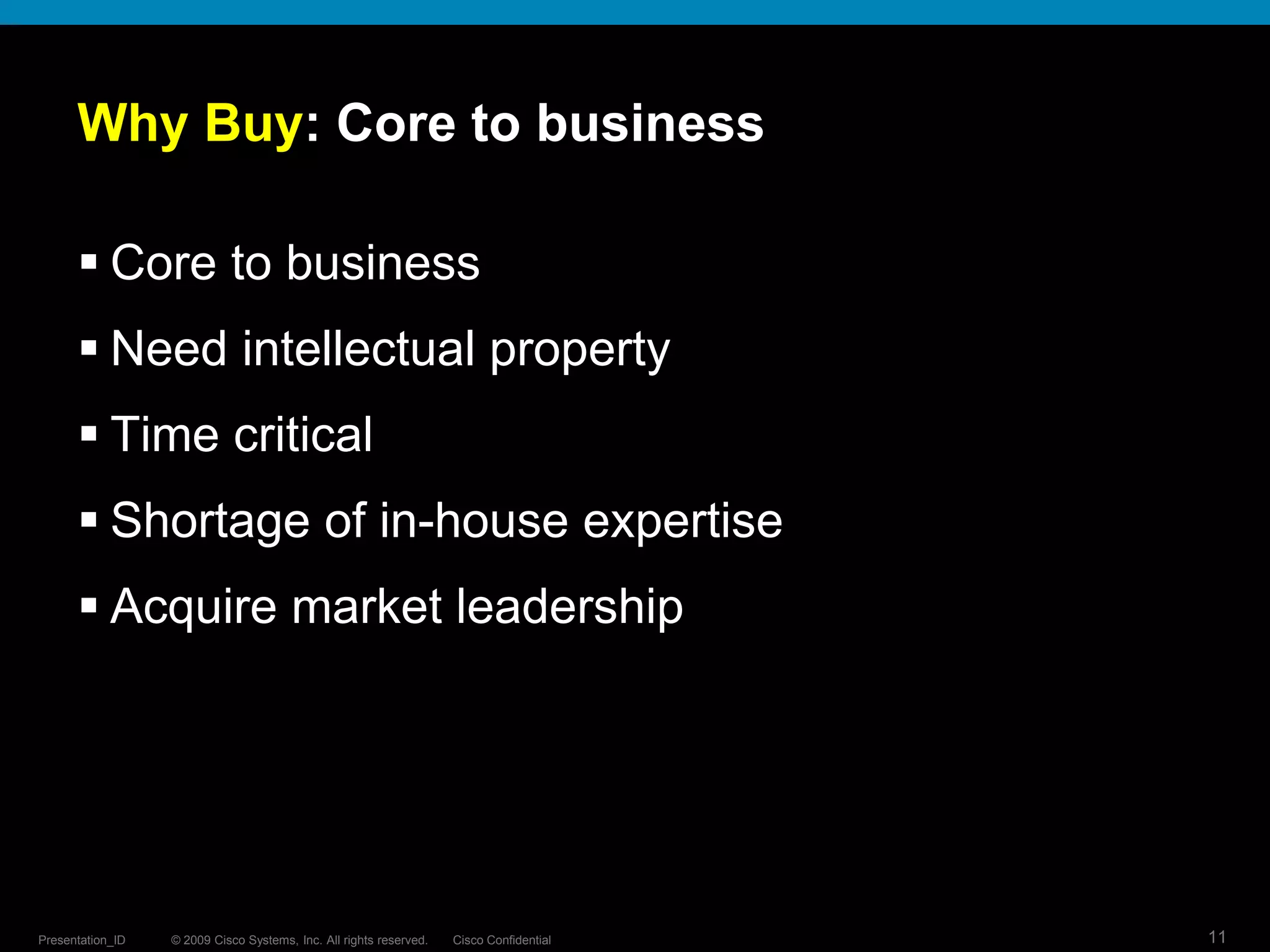
Why Buy: Core to business
 Core to business
 Need intellectual property
 Time critical
 Shortage of in-house expertise
 Acquire market leadership
© 2009 Cisco Systems, Inc. All rights reserved. Cisco ConfidentialPresentation_ID 12
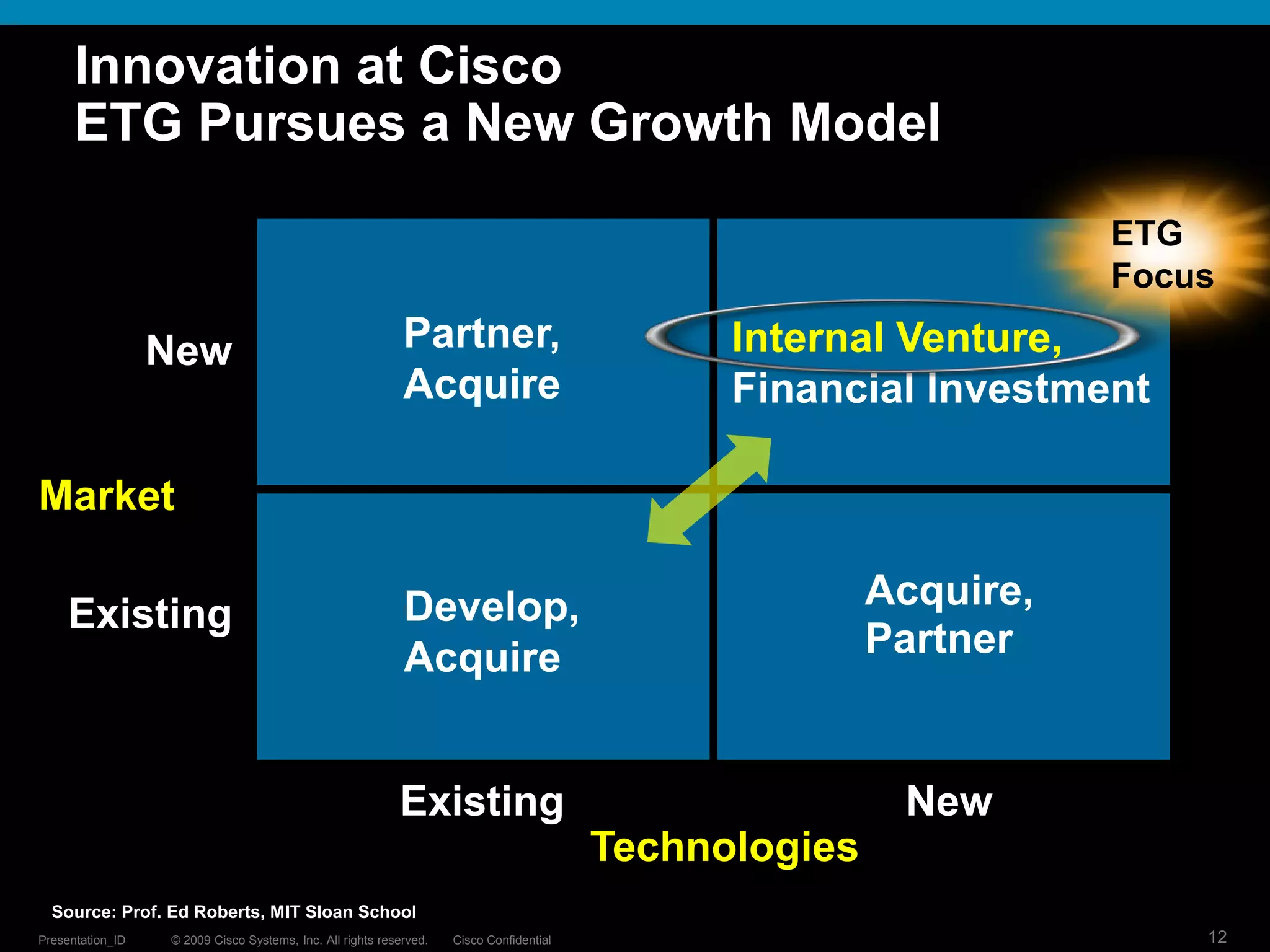
Internal Venture,
Financial Investment
Innovation at Cisco
ETG Pursues a New Growth Model
New
Existing
Existing New
Source: Prof. Ed Roberts, MIT Sloan School
Partner,
Acquire
Develop,
Acquire
Acquire,
Partner
ETG
Focus
Market
Technologies
© 2009 Cisco Systems, Inc. All rights reserved. Cisco ConfidentialPresentation_ID 13
Why Partner: Speed
 Fastest Time to Market
 Reduce Risk
 Leap Frog Competition
 Customize for Specific Markets
 Customers buy best of breed
© 2009 Cisco Systems, Inc. All rights reserved. Cisco ConfidentialPresentation_ID 14
Four Key Dynamics of Alliance Strategies
should be Monitored to understand the Driving Forces in Market Space
Value Migration in the Market Space
Competitive Scenario Mapping
Ecosystem Evolution & our position in the this relative
to the Customer
Life Cycle Management of each Alliance itself
© 2009 Cisco Systems, Inc. All rights reserved. Cisco ConfidentialPresentation_ID 15
Value Migration
We must view Value Migration from the Customer’s Perspective
Process Migration
Design Cycle Time
Quality Systems (Six Sigma)
Fulfillment (Supplier-Distributor Delivery)
Market & Customer Needs Migration
Providing route-to-market for sales and service
-vertical expertise
-solutions integration
-unique geographic access
Providing complementary hardware and software
Providing integrated solutions for products and services
© 2009 Cisco Systems, Inc. All rights reserved. Cisco ConfidentialPresentation_ID 16
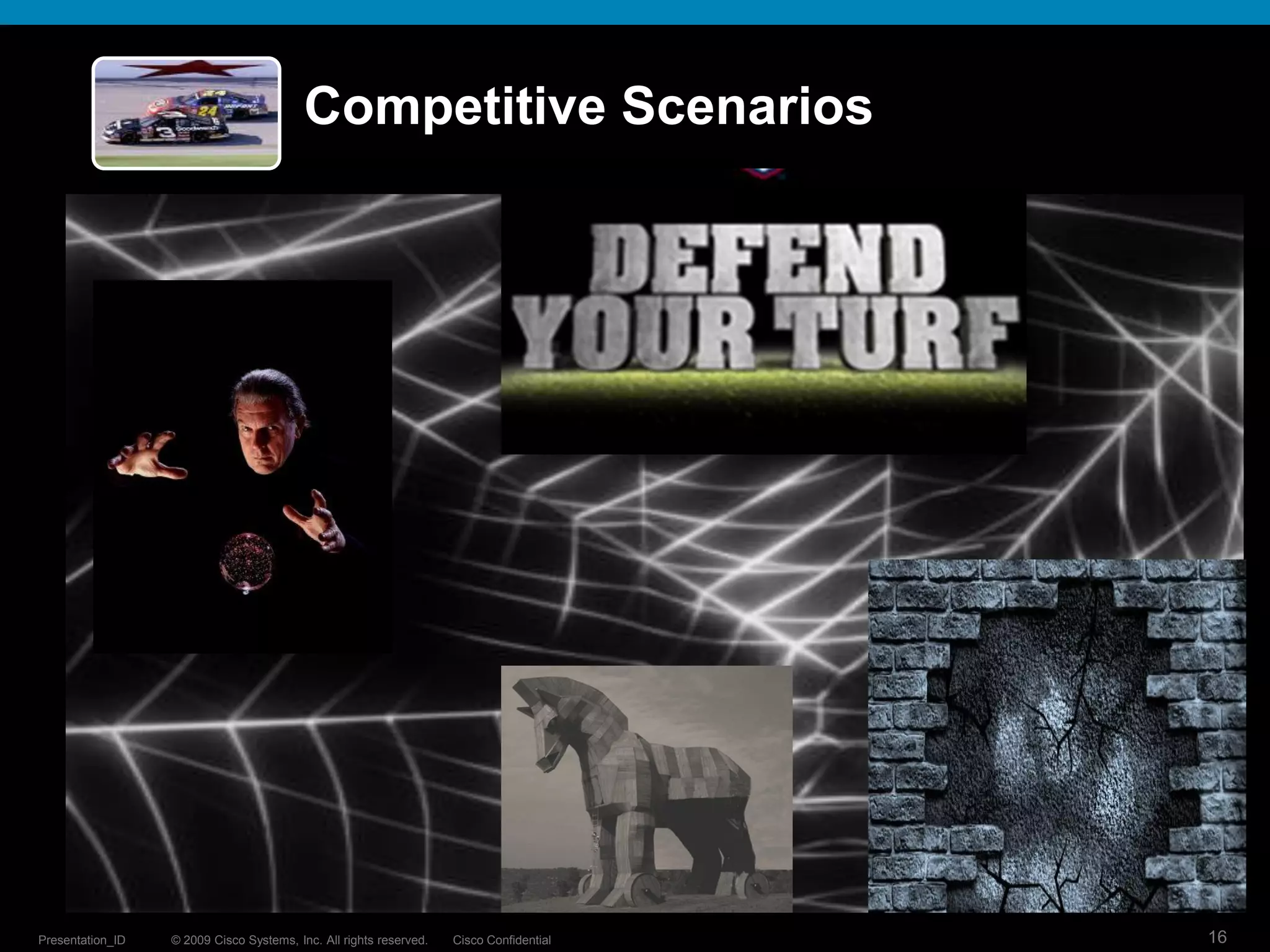
Competitive Scenarios
© 2009 Cisco Systems, Inc. All rights reserved. Cisco ConfidentialPresentation_ID 17
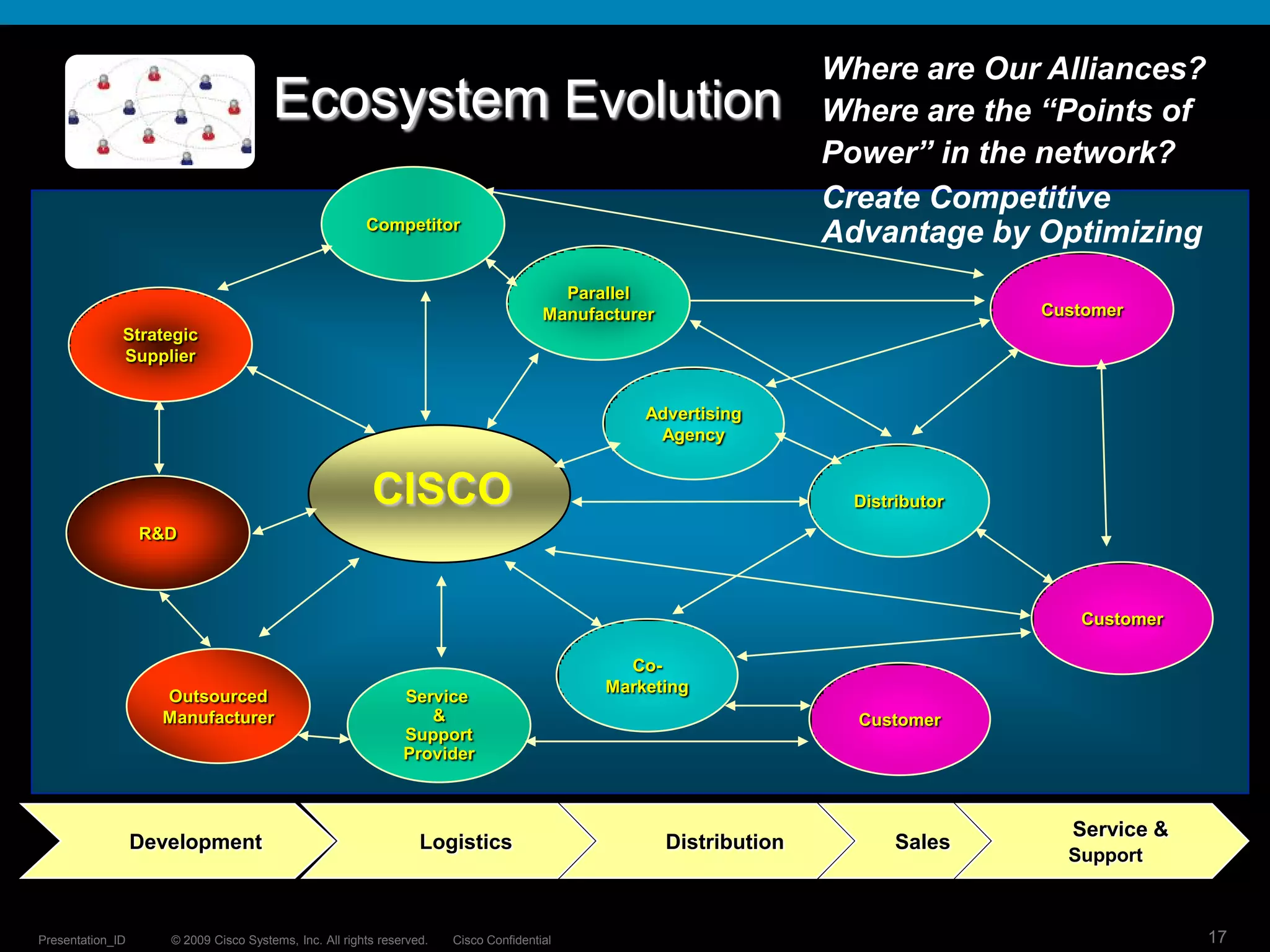
Ecosystem Evolution
Development Logistics Distribution Sales
Service &
Support
CISCO
Strategic
Supplier
R&D
Outsourced
Manufacturer
Service
&
Support
Provider
Customer
Customer
Parallel
Manufacturer
Distributor
Competitor
Co-
Marketing
Customer
Advertising
Agency
Where are Our Alliances?
Where are the “Points of
Power” in the network?
Create Competitive
Advantage by Optimizing
© 2009 Cisco Systems, Inc. All rights reserved. Cisco ConfidentialPresentation_ID 18
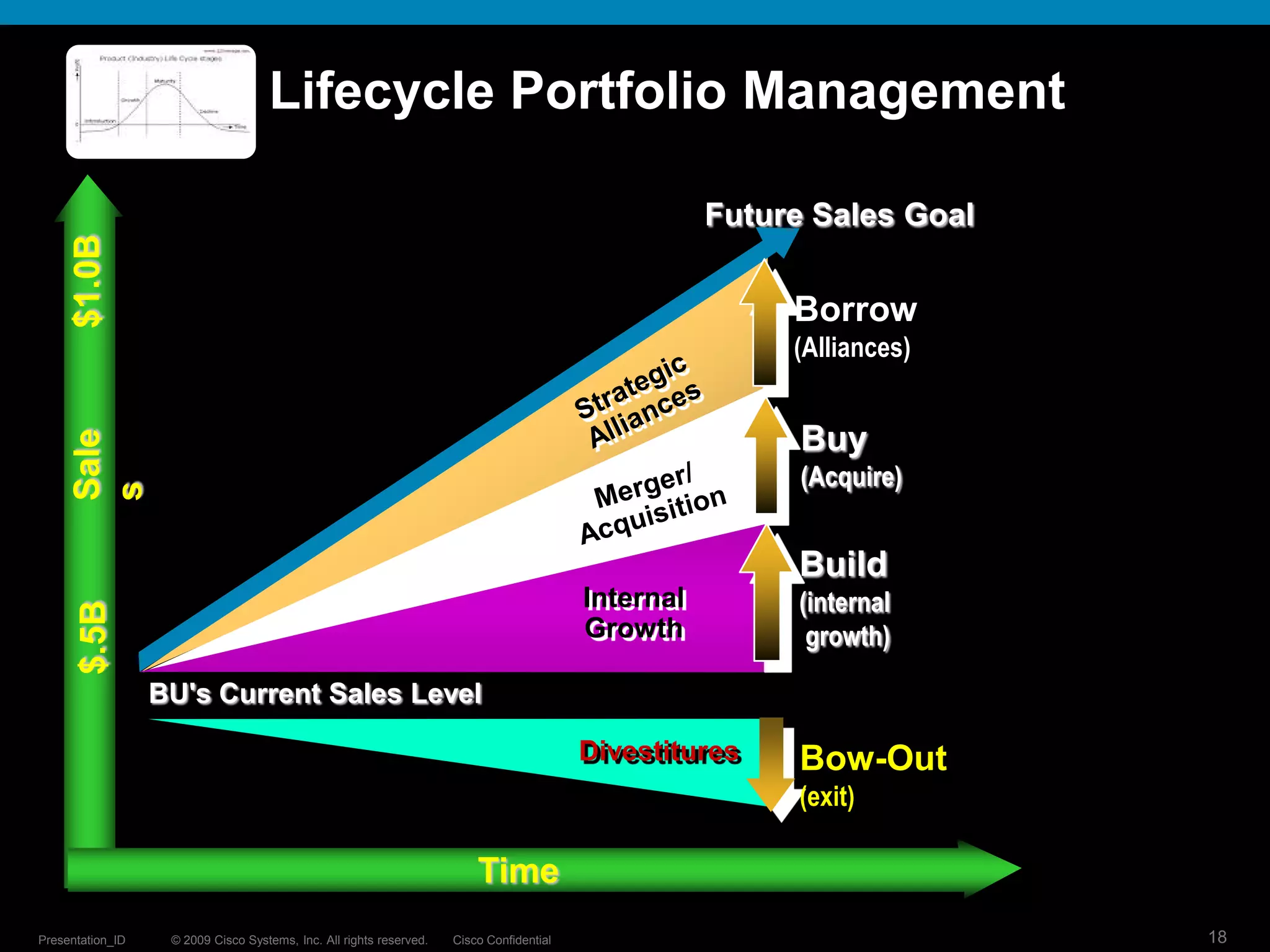
Future Sales Goal
Borrow
(Alliances)
Buy
(Acquire)
Build
(internal
growth)
BU's Current Sales Level
Internal
Growth
$.5B
Time
Sale
s
$1.0B Lifecycle Portfolio Management
Divestitures Bow-Out
(exit)
© 2009 Cisco Systems, Inc. All rights reserved. Cisco ConfidentialPresentation_ID 19
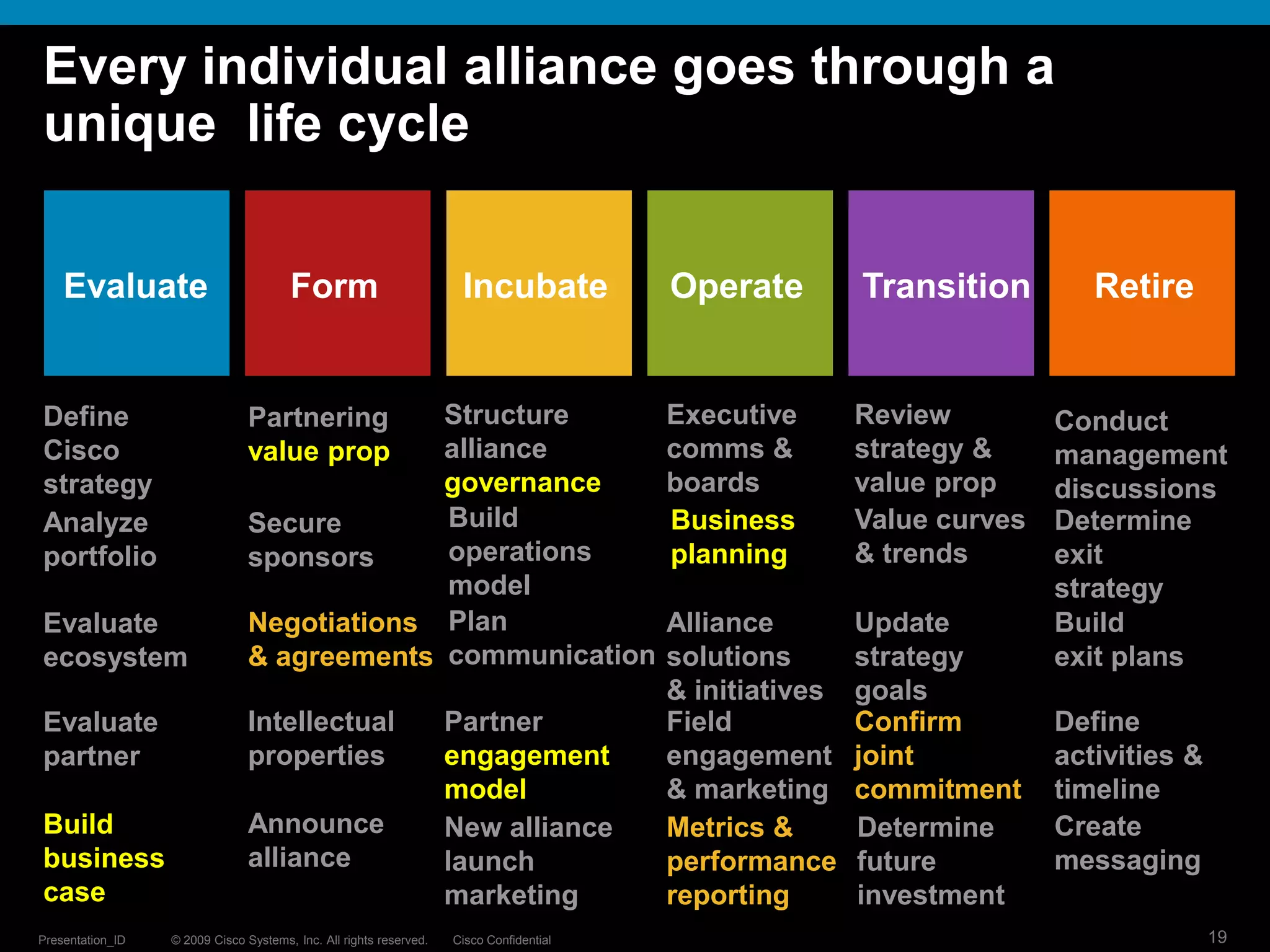
Every individual alliance goes through a
unique life cycle
Evaluate Form Incubate Operate Transition Retire
Plan
communication
Build
operations
model
Business
planning
Partnering
value prop
Partner
engagement
model
Announce
alliance
Alliance
solutions
& initiatives
Field
engagement
& marketing
Secure
sponsors
Negotiations
& agreements
New alliance
launch
marketing
Metrics &
performance
reporting
Review
strategy &
value prop
Value curves
& trends
Update
strategy
goals
Confirm
joint
commitment
Determine
future
investment
Conduct
management
discussions
Determine
exit
strategy
Build
exit plans
Define
activities &
timeline
Create
messaging
Structure
alliance
governance
Executive
comms &
boards
Define
Cisco
strategy
Analyze
portfolio
Evaluate
ecosystem
Evaluate
partner
Build
business
case
Intellectual
properties
© 2009 Cisco Systems, Inc. All rights reserved. Cisco ConfidentialPresentation_ID 20
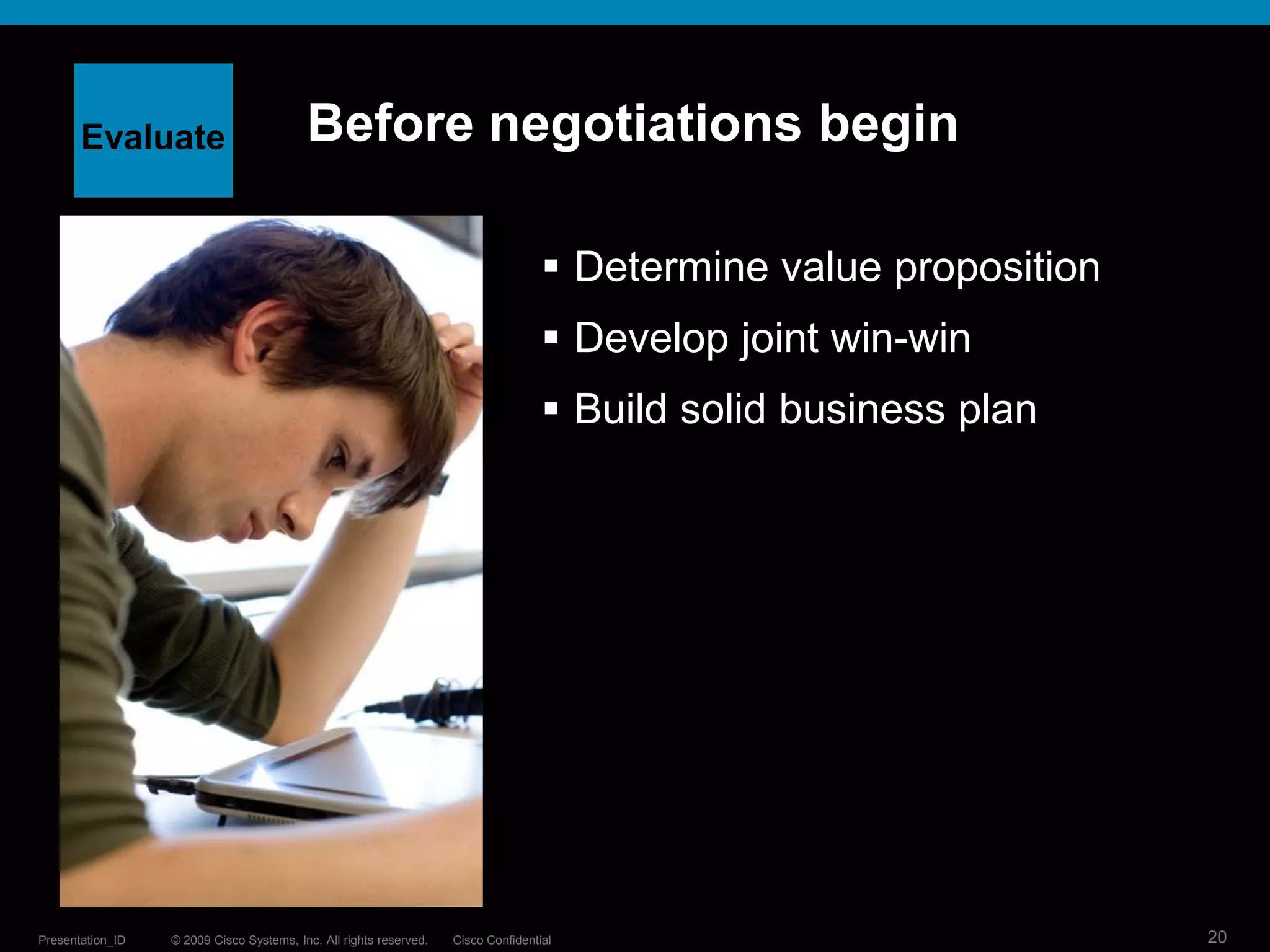
Before negotiations begin
 Determine value proposition
 Develop joint win-win
 Build solid business plan
Evaluate
© 2009 Cisco Systems, Inc. All rights reserved. Cisco ConfidentialPresentation_ID 21
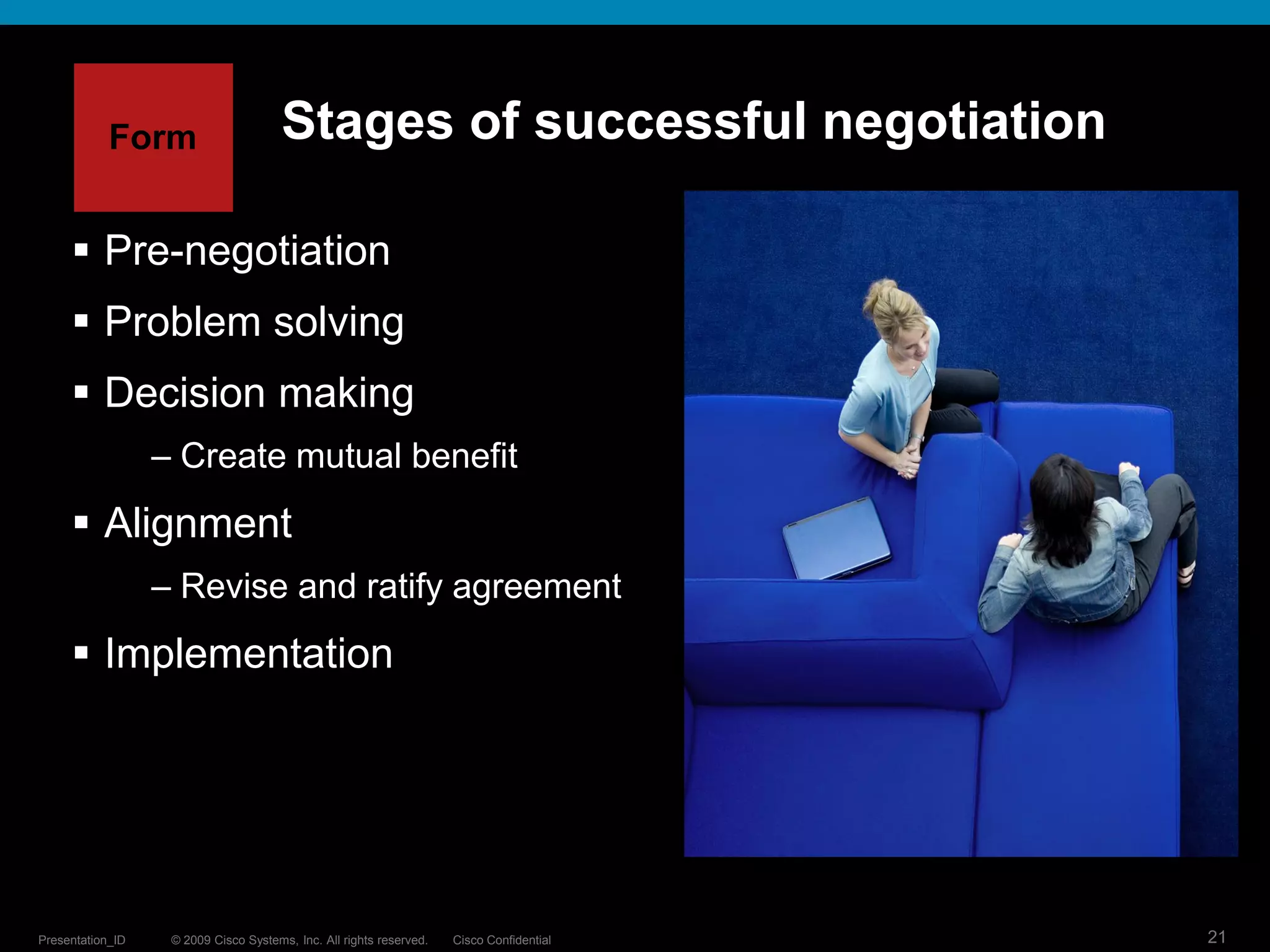
Stages of successful negotiation
 Pre-negotiation
 Problem solving
 Decision making
– Create mutual benefit
 Alignment
– Revise and ratify agreement
 Implementation
Form
© 2009 Cisco Systems, Inc. All rights reserved. Cisco ConfidentialPresentation_ID 22
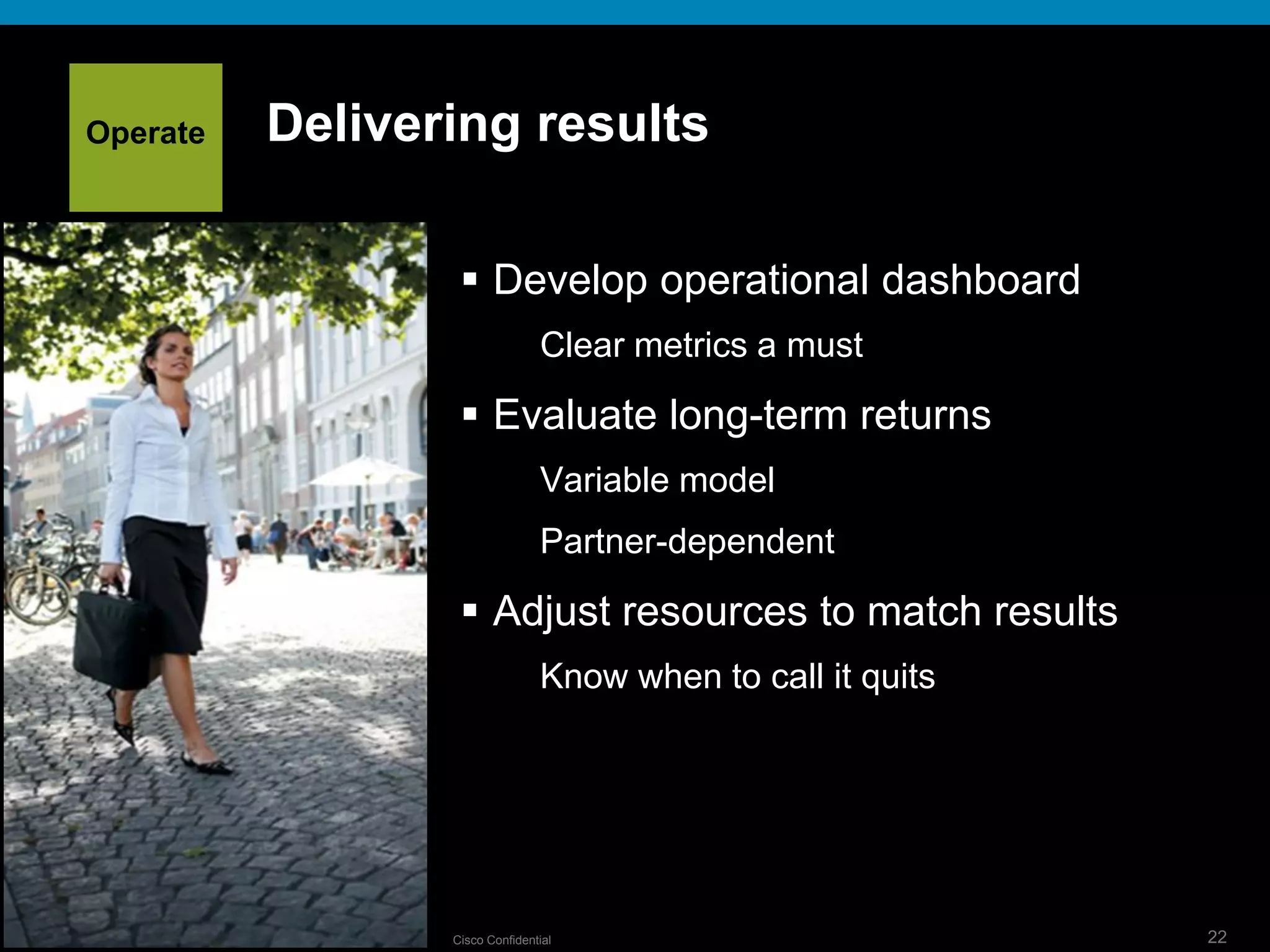
Delivering results
 Develop operational dashboard
Clear metrics a must
 Evaluate long-term returns
Variable model
Partner-dependent
 Adjust resources to match results
Know when to call it quits
Operate
© 2009 Cisco Systems, Inc. All rights reserved. Cisco ConfidentialPresentation_ID 23© 2006 Cisco Systems, Inc. All rights reserved. Cisco ConfidentialPresentation_ID 23
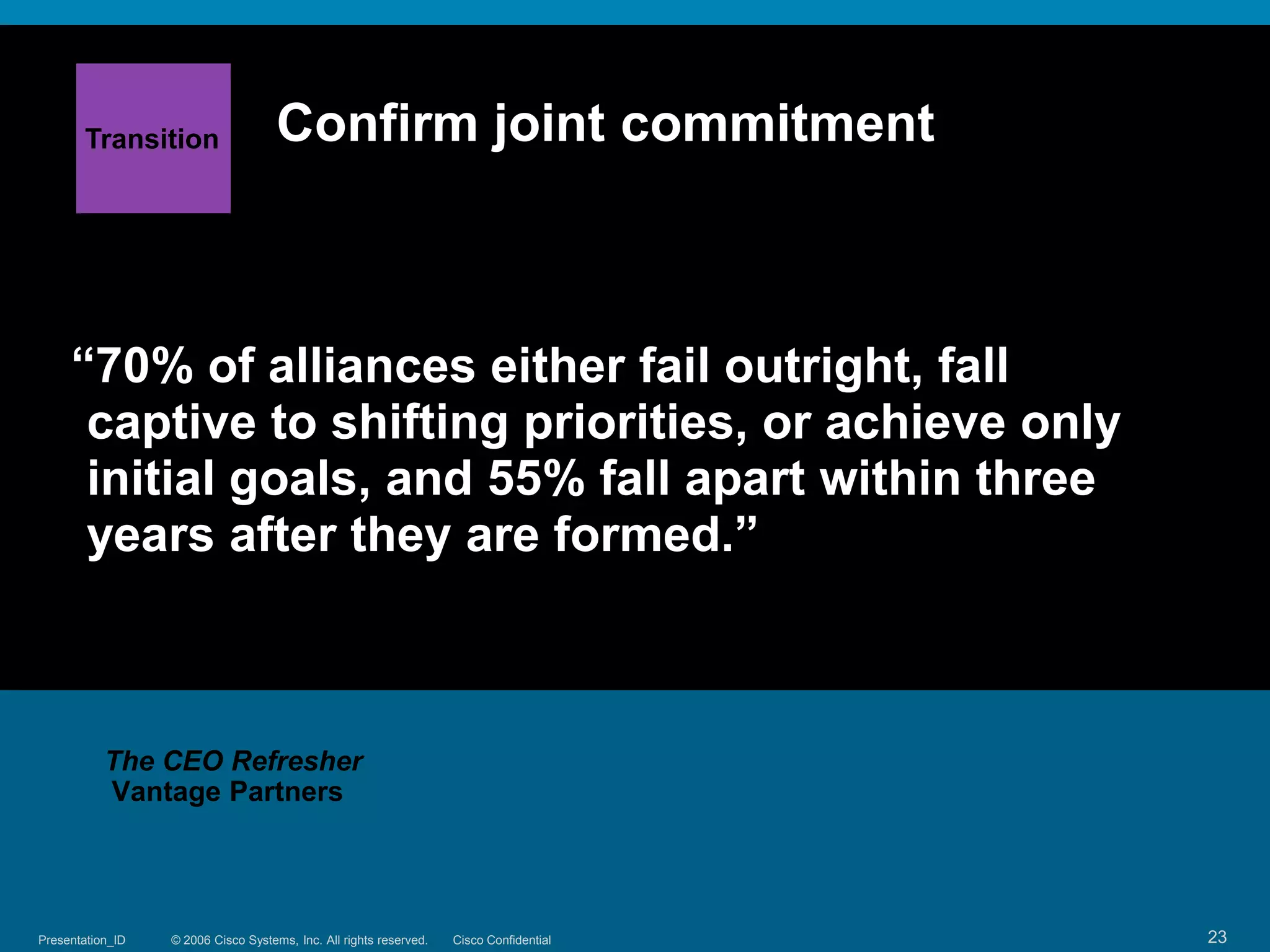
Confirm joint commitment
“70% of alliances either fail outright, fall
captive to shifting priorities, or achieve only
initial goals, and 55% fall apart within three
years after they are formed.”
The CEO Refresher
Vantage Partners
Transition
© 2009 Cisco Systems, Inc. All rights reserved. Cisco ConfidentialPresentation_ID 24
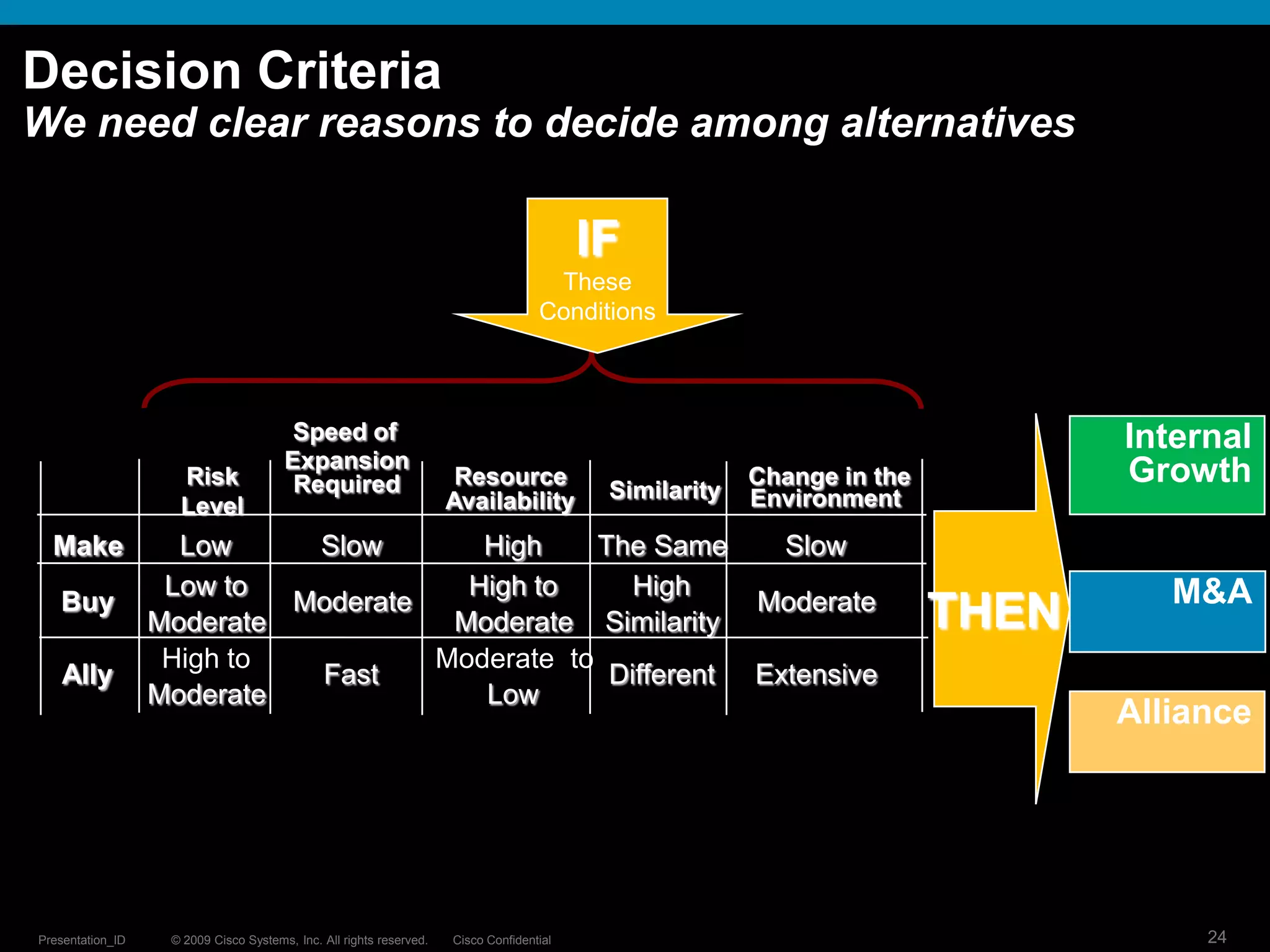
Decision Criteria
We need clear reasons to decide among alternatives
IF
These
Conditions
Risk
Level
Speed of
Expansion
Required Resource
Availability Similarity
Change in the
Environment
Make Low Slow High The Same Slow
Buy
Low to
Moderate
Moderate
High to
Moderate
High
Similarity
Moderate
Ally
High to
Moderate
Fast
Moderate to
Low
Different Extensive
Internal
Growth
M&A
Alliance
THEN
© 2009 Cisco Systems, Inc. All rights reserved. Cisco ConfidentialPresentation_ID 25
In conclusion
 Don’t win the negotiation and lose the alliance.
 Each alliance has its own life cycle . Find it.
 Find ways to win together; collaboration. Play for
keeps.
 Alliances is a learned skill (practice + training).
Invest in it.
© 2009 Cisco Systems, Inc. All rights reserved. Cisco ConfidentialPresentation_ID 26
© 2009 Cisco Systems, Inc. All rights reserved. Cisco ConfidentialPresentation_ID 27
Q and A

Build, Buy or Ally: Joe Deklic, Cisco Canada

  • 1.
    © 2009 CiscoSystems, Inc. All rights reserved. Cisco ConfidentialPresentation_ID 1 Build, Buy or Ally Growth Strategies for Business Joe Deklic Vice President, Strategic Investments Group Cisco Systems Canada Co.
  • 2.
    © 2009 CiscoSystems, Inc. All rights reserved. Cisco ConfidentialPresentation_ID 2 Cisco: A culture of innovation  Cisco’s corporate culture encourages innovation  Innovation is the engine that drives growth
  • 3.
    © 2009 CiscoSystems, Inc. All rights reserved. Cisco ConfidentialPresentation_ID 3 John Chambers, President and CEO “Philosophically, I don’t partner and then compete later. I won’t enter into strategic partnerships that I think will not have lasting evolution. … We share what we’re doing with them very closely and they share what they’re doing with us very closely.”
  • 4.
    © 2009 CiscoSystems, Inc. All rights reserved. Cisco ConfidentialPresentation_ID 4 “Companies that use both acquisitions and alliances grow faster than rivals do – as companies like Cisco have amply demonstrated.”
  • 5.
    © 2009 CiscoSystems, Inc. All rights reserved. Cisco ConfidentialPresentation_ID 5 Evolution Components of Innovation Build Ally Buy  Cisco’s innovation model has evolved beyond the 3 “Build – Buy – Ally” pillars  Collaboration internally and externally with customers and partners is essential for innovative leadership going forward Collaborate Market Dynamics Portfolio Management
  • 6.
    © 2009 CiscoSystems, Inc. All rights reserved. Cisco ConfidentialPresentation_ID 6 Why Collaborate : Differentiation  Power of many  Time to execution  Alignment  Multiple competitive scenarios  Customers win
  • 7.
    © 2009 CiscoSystems, Inc. All rights reserved. Cisco ConfidentialPresentation_ID 7 Partners who Collaborate with other Partners…
  • 8.
    © 2009 CiscoSystems, Inc. All rights reserved. Cisco ConfidentialPresentation_ID 8 Why Build: Technology Leadership  Pioneer in the field  Patentable technology  Need to own the intellectual property  Core business  Have time or can build in increments  Have in-house expertise
  • 9.
    © 2009 CiscoSystems, Inc. All rights reserved. Cisco ConfidentialPresentation_ID 9 Innovation at Cisco The Cycle of Innovation Deploy Differentiation at Scale Invent Differentiated Offering Manage Mission-critical Processes at Scale Extract Resources to Reinvest for Core 2. Deploy 1. Invent 3. Manage 4. Offload / Repurpose Advanced Technology Foundation Technology Emerging Technology Reinvent Technology Funding
  • 10.
    © 2009 CiscoSystems, Inc. All rights reserved. Cisco ConfidentialPresentation_ID 10 Innovation at Cisco  This study has found that Cisco has laid a strong foundation for innovation by organizing its efforts around three elements critical to innovation success: –People and Culture –Process and Organization –Products and Technology  Cisco does not exclusively establish innovation through acquisition but fosters and encourages innovative thinking, development, collaboration, and entrepreneurship throughout its organization. Wharton study 2009
  • 11.
    © 2009 CiscoSystems, Inc. All rights reserved. Cisco ConfidentialPresentation_ID 11 Why Buy: Core to business  Core to business  Need intellectual property  Time critical  Shortage of in-house expertise  Acquire market leadership
  • 12.
    © 2009 CiscoSystems, Inc. All rights reserved. Cisco ConfidentialPresentation_ID 12 Internal Venture, Financial Investment Innovation at Cisco ETG Pursues a New Growth Model New Existing Existing New Source: Prof. Ed Roberts, MIT Sloan School Partner, Acquire Develop, Acquire Acquire, Partner ETG Focus Market Technologies
  • 13.
    © 2009 CiscoSystems, Inc. All rights reserved. Cisco ConfidentialPresentation_ID 13 Why Partner: Speed  Fastest Time to Market  Reduce Risk  Leap Frog Competition  Customize for Specific Markets  Customers buy best of breed
  • 14.
    © 2009 CiscoSystems, Inc. All rights reserved. Cisco ConfidentialPresentation_ID 14 Four Key Dynamics of Alliance Strategies should be Monitored to understand the Driving Forces in Market Space Value Migration in the Market Space Competitive Scenario Mapping Ecosystem Evolution & our position in the this relative to the Customer Life Cycle Management of each Alliance itself
  • 15.
    © 2009 CiscoSystems, Inc. All rights reserved. Cisco ConfidentialPresentation_ID 15 Value Migration We must view Value Migration from the Customer’s Perspective Process Migration Design Cycle Time Quality Systems (Six Sigma) Fulfillment (Supplier-Distributor Delivery) Market & Customer Needs Migration Providing route-to-market for sales and service -vertical expertise -solutions integration -unique geographic access Providing complementary hardware and software Providing integrated solutions for products and services
  • 16.
    © 2009 CiscoSystems, Inc. All rights reserved. Cisco ConfidentialPresentation_ID 16 Competitive Scenarios
  • 17.
    © 2009 CiscoSystems, Inc. All rights reserved. Cisco ConfidentialPresentation_ID 17 Ecosystem Evolution Development Logistics Distribution Sales Service & Support CISCO Strategic Supplier R&D Outsourced Manufacturer Service & Support Provider Customer Customer Parallel Manufacturer Distributor Competitor Co- Marketing Customer Advertising Agency Where are Our Alliances? Where are the “Points of Power” in the network? Create Competitive Advantage by Optimizing
  • 18.
    © 2009 CiscoSystems, Inc. All rights reserved. Cisco ConfidentialPresentation_ID 18 Future Sales Goal Borrow (Alliances) Buy (Acquire) Build (internal growth) BU's Current Sales Level Internal Growth $.5B Time Sale s $1.0B Lifecycle Portfolio Management Divestitures Bow-Out (exit)
  • 19.
    © 2009 CiscoSystems, Inc. All rights reserved. Cisco ConfidentialPresentation_ID 19 Every individual alliance goes through a unique life cycle Evaluate Form Incubate Operate Transition Retire Plan communication Build operations model Business planning Partnering value prop Partner engagement model Announce alliance Alliance solutions & initiatives Field engagement & marketing Secure sponsors Negotiations & agreements New alliance launch marketing Metrics & performance reporting Review strategy & value prop Value curves & trends Update strategy goals Confirm joint commitment Determine future investment Conduct management discussions Determine exit strategy Build exit plans Define activities & timeline Create messaging Structure alliance governance Executive comms & boards Define Cisco strategy Analyze portfolio Evaluate ecosystem Evaluate partner Build business case Intellectual properties
  • 20.
    © 2009 CiscoSystems, Inc. All rights reserved. Cisco ConfidentialPresentation_ID 20 Before negotiations begin  Determine value proposition  Develop joint win-win  Build solid business plan Evaluate
  • 21.
    © 2009 CiscoSystems, Inc. All rights reserved. Cisco ConfidentialPresentation_ID 21 Stages of successful negotiation  Pre-negotiation  Problem solving  Decision making – Create mutual benefit  Alignment – Revise and ratify agreement  Implementation Form
  • 22.
    © 2009 CiscoSystems, Inc. All rights reserved. Cisco ConfidentialPresentation_ID 22 Delivering results  Develop operational dashboard Clear metrics a must  Evaluate long-term returns Variable model Partner-dependent  Adjust resources to match results Know when to call it quits Operate
  • 23.
    © 2009 CiscoSystems, Inc. All rights reserved. Cisco ConfidentialPresentation_ID 23© 2006 Cisco Systems, Inc. All rights reserved. Cisco ConfidentialPresentation_ID 23 Confirm joint commitment “70% of alliances either fail outright, fall captive to shifting priorities, or achieve only initial goals, and 55% fall apart within three years after they are formed.” The CEO Refresher Vantage Partners Transition
  • 24.
    © 2009 CiscoSystems, Inc. All rights reserved. Cisco ConfidentialPresentation_ID 24 Decision Criteria We need clear reasons to decide among alternatives IF These Conditions Risk Level Speed of Expansion Required Resource Availability Similarity Change in the Environment Make Low Slow High The Same Slow Buy Low to Moderate Moderate High to Moderate High Similarity Moderate Ally High to Moderate Fast Moderate to Low Different Extensive Internal Growth M&A Alliance THEN
  • 25.
    © 2009 CiscoSystems, Inc. All rights reserved. Cisco ConfidentialPresentation_ID 25 In conclusion  Don’t win the negotiation and lose the alliance.  Each alliance has its own life cycle . Find it.  Find ways to win together; collaboration. Play for keeps.  Alliances is a learned skill (practice + training). Invest in it.
  • 26.
    © 2009 CiscoSystems, Inc. All rights reserved. Cisco ConfidentialPresentation_ID 26
  • 27.
    © 2009 CiscoSystems, Inc. All rights reserved. Cisco ConfidentialPresentation_ID 27 Q and A