The other measures
of position
QUARTILES, DECILES, AND
PERCENTILES
The quartiles
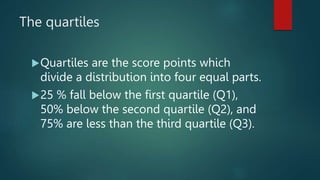
Quartiles are the score points which
divide a distribution into four equal parts.
25 % fall below the first quartile (Q1),
50% below the second quartile (Q2), and
75% are less than the third quartile (Q3).
The quartiles
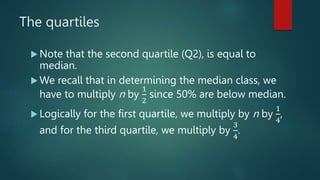
 Note that the second quartile (Q2), is equal to
median.
 We recall that in determining the median class, we
have to multiply n by
1
2
since 50% are below median.
 Logically for the first quartile, we multiply by n by
1
4
,
and for the third quartile, we multiply by
3
4
.
The quartiles
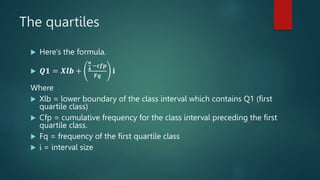
 Here’s the formula.
 𝑸𝟏 = 𝑿𝒍𝒃 +
𝒏
𝟒
−𝒄𝒇𝒑
𝑭𝒒
𝐢
Where
 Xlb = lower boundary of the class interval which contains Q1 (first
quartile class)
 Cfp = cumulative frequency for the class interval preceding the first
quartile class.
 Fq = frequency of the first quartile class
 i = interval size
The quartiles
 Here’s the formula.
 𝑸𝟑 = 𝑿𝒍𝒃 +
𝟑𝒏
𝟒
−𝒄𝒇𝒑
𝑭𝒒
𝒊
Where
 Xlb = lower boundary of the class interval which contains Q3 (third
quartile class)
 Cfp = cumulative frequency for the class interval preceding the third
quartile class.
 Fq = frequency of the third quartile class
 i = interval size
The deciles
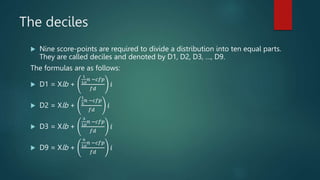
 Nine score-points are required to divide a distribution into ten equal parts.
They are called deciles and denoted by D1, D2, D3, …, D9.
The formulas are as follows:
 D1 = Xlb +
1
1𝑜
𝑛 −𝑐𝑓𝑝
𝑓𝑑
𝑖
 D2 = Xlb +
1
5
𝑛 −𝑐𝑓𝑝
𝑓𝑑
𝑖
 D3 = Xlb +
3
1𝑜
𝑛 −𝑐𝑓𝑝
𝑓𝑑
𝑖
 D9 = Xlb +
9
1𝑜
𝑛 −𝑐𝑓𝑝
𝑓𝑑
𝑖
The percentile
 Percentiles are the ninety-nine score points which divide a
distribution into 100 equal parts.
 They are generally used to characterize values according to
the percentage below them.
 For example the first percentile (P1) separates the lowest 1%
from the other 99%, the second percentile (P2), separates
the lowest 2% from the other 98% and so on.
 15 % are less than the 15th percentile and 20 % are below
the 20th percentile; the middle 80 % is determined by the
10th and the 90th percentiles.
The percentile
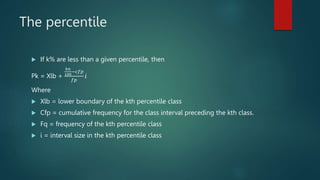
 If k% are less than a given percentile, then
Pk = Xlb +
𝑘𝑛
100
−𝑐𝑓𝑝
𝑓𝑝
𝑖
Where
 Xlb = lower boundary of the kth percentile class
 Cfp = cumulative frequency for the class interval preceding the kth class.
 Fq = frequency of the kth percentile class
 i = interval size in the kth percentile class
Content, graphics and text
belong to the rightful
owner.
No copyright intended

G10 Math Q4.pptx

  • 1.
    The other measures ofposition QUARTILES, DECILES, AND PERCENTILES
  • 2.
    The quartiles Quartiles arethe score points which divide a distribution into four equal parts. 25 % fall below the first quartile (Q1), 50% below the second quartile (Q2), and 75% are less than the third quartile (Q3).
  • 3.
    The quartiles  Notethat the second quartile (Q2), is equal to median.  We recall that in determining the median class, we have to multiply n by 1 2 since 50% are below median.  Logically for the first quartile, we multiply by n by 1 4 , and for the third quartile, we multiply by 3 4 .
  • 4.
    The quartiles  Here’sthe formula.  𝑸𝟏 = 𝑿𝒍𝒃 + 𝒏 𝟒 −𝒄𝒇𝒑 𝑭𝒒 𝐢 Where  Xlb = lower boundary of the class interval which contains Q1 (first quartile class)  Cfp = cumulative frequency for the class interval preceding the first quartile class.  Fq = frequency of the first quartile class  i = interval size
  • 5.
    The quartiles  Here’sthe formula.  𝑸𝟑 = 𝑿𝒍𝒃 + 𝟑𝒏 𝟒 −𝒄𝒇𝒑 𝑭𝒒 𝒊 Where  Xlb = lower boundary of the class interval which contains Q3 (third quartile class)  Cfp = cumulative frequency for the class interval preceding the third quartile class.  Fq = frequency of the third quartile class  i = interval size
  • 6.
    The deciles  Ninescore-points are required to divide a distribution into ten equal parts. They are called deciles and denoted by D1, D2, D3, …, D9. The formulas are as follows:  D1 = Xlb + 1 1𝑜 𝑛 −𝑐𝑓𝑝 𝑓𝑑 𝑖  D2 = Xlb + 1 5 𝑛 −𝑐𝑓𝑝 𝑓𝑑 𝑖  D3 = Xlb + 3 1𝑜 𝑛 −𝑐𝑓𝑝 𝑓𝑑 𝑖  D9 = Xlb + 9 1𝑜 𝑛 −𝑐𝑓𝑝 𝑓𝑑 𝑖
  • 7.
    The percentile  Percentilesare the ninety-nine score points which divide a distribution into 100 equal parts.  They are generally used to characterize values according to the percentage below them.  For example the first percentile (P1) separates the lowest 1% from the other 99%, the second percentile (P2), separates the lowest 2% from the other 98% and so on.  15 % are less than the 15th percentile and 20 % are below the 20th percentile; the middle 80 % is determined by the 10th and the 90th percentiles.
  • 8.
    The percentile  Ifk% are less than a given percentile, then Pk = Xlb + 𝑘𝑛 100 −𝑐𝑓𝑝 𝑓𝑝 𝑖 Where  Xlb = lower boundary of the kth percentile class  Cfp = cumulative frequency for the class interval preceding the kth class.  Fq = frequency of the kth percentile class  i = interval size in the kth percentile class
  • 9.
    Content, graphics andtext belong to the rightful owner. No copyright intended