Dr. T. C. R. Rama Krishnan
 Case vignettes
 Discussion
 Pearls
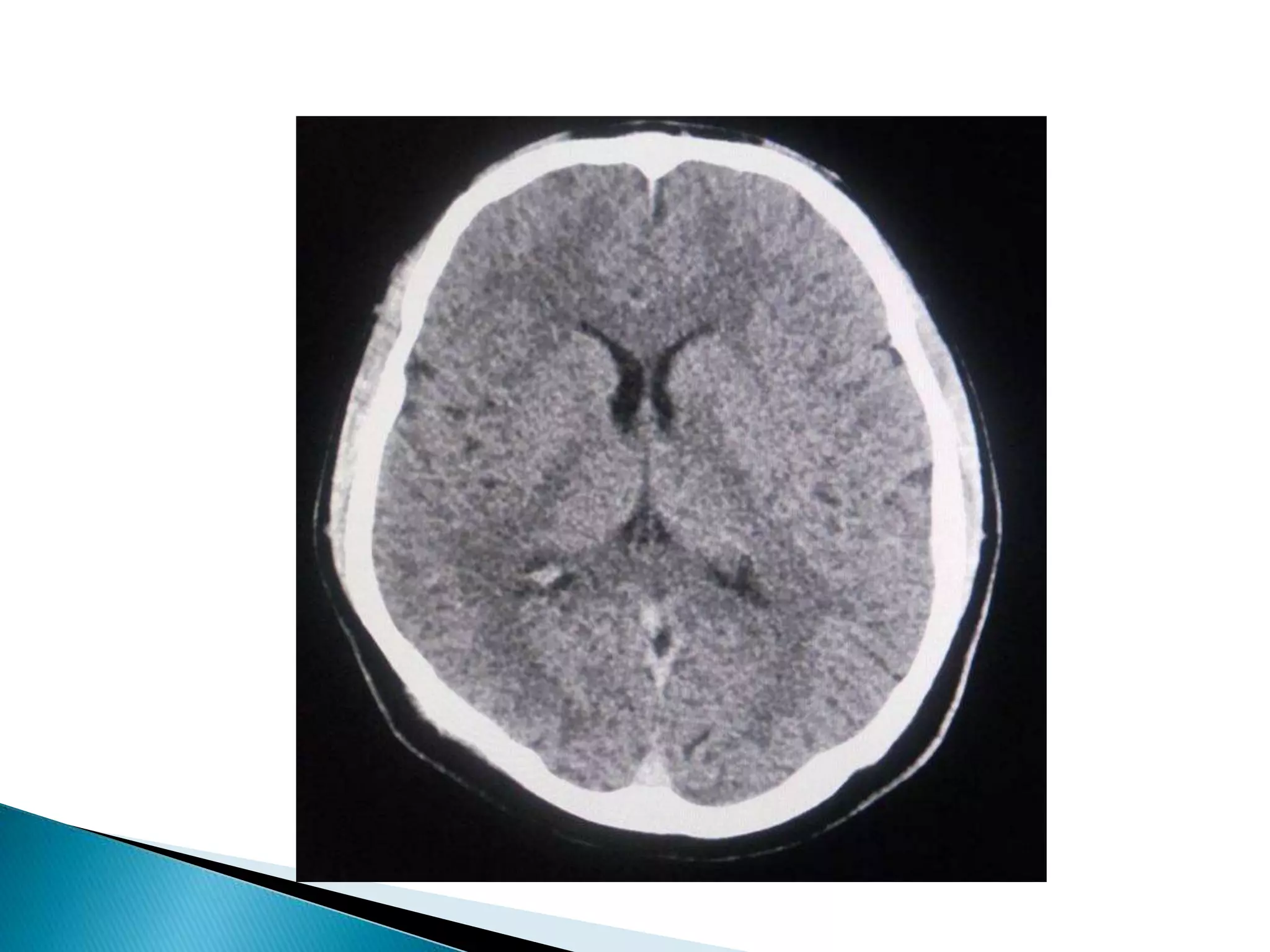
 A 50 year old male who is a known diabetic
came with acute onset of weakness of left
sided limbs of 30 min duration
O/E
 Left UMN facial palsy with Hemiplegia
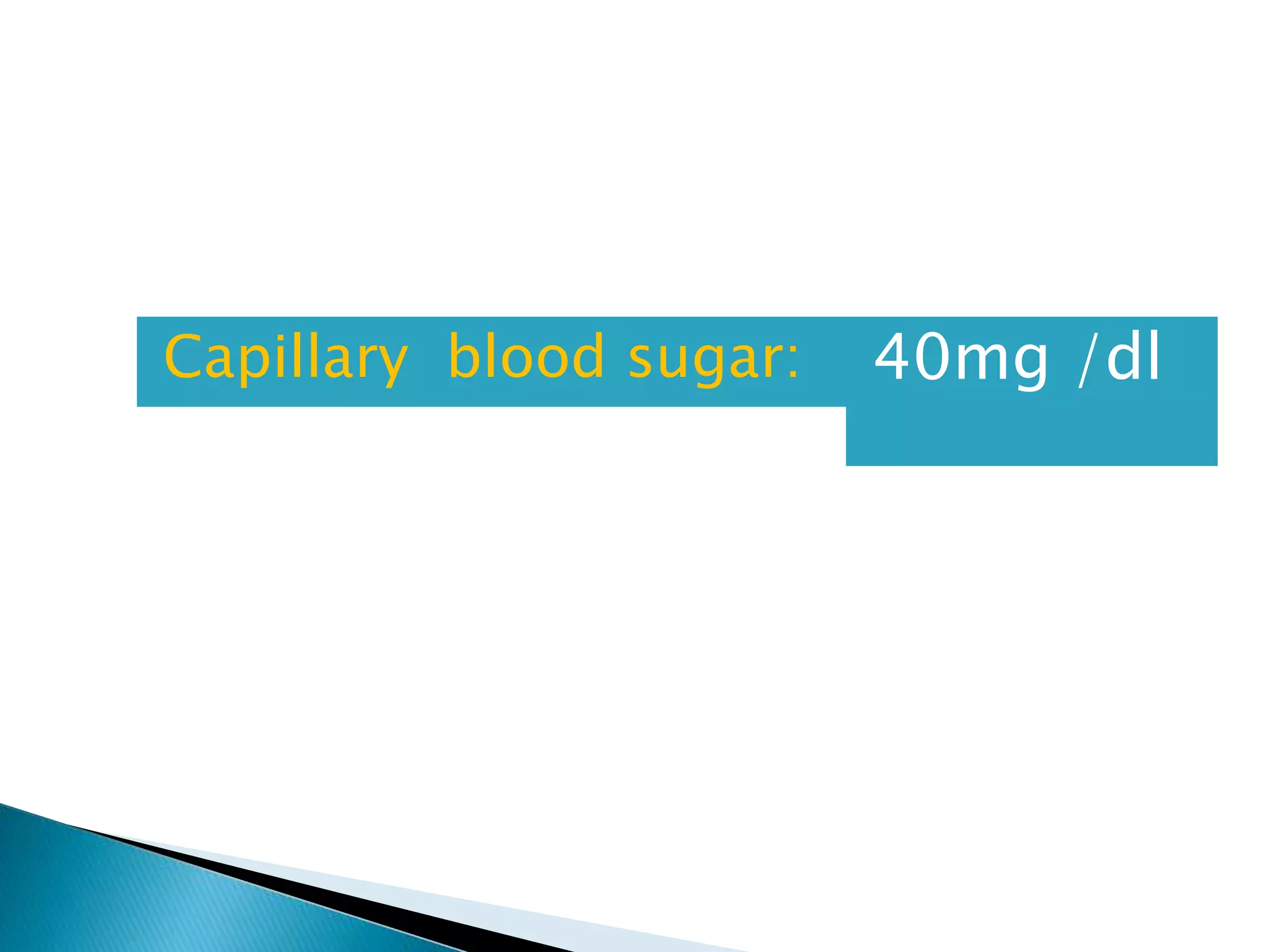
Capillary blood sugar: 40mg /dl
 Serum glucose < 50 mg/dl
 < 30 mg Confusion
 < 10 mg Seizures
Coma
Medullary phase of Hypoglycemia.
 < 70 mg is the level at which counter
regulatory hormones get activated
 Glucose is the exclusive fuel for the brain
 Brain stores only trivial amounts of glucose
as glycogen unlike liver and skeletal muscle
 Hyperglycemia is better tolerated by the brain
than hypoglycemia
 Glucose sensor in the brain- STN
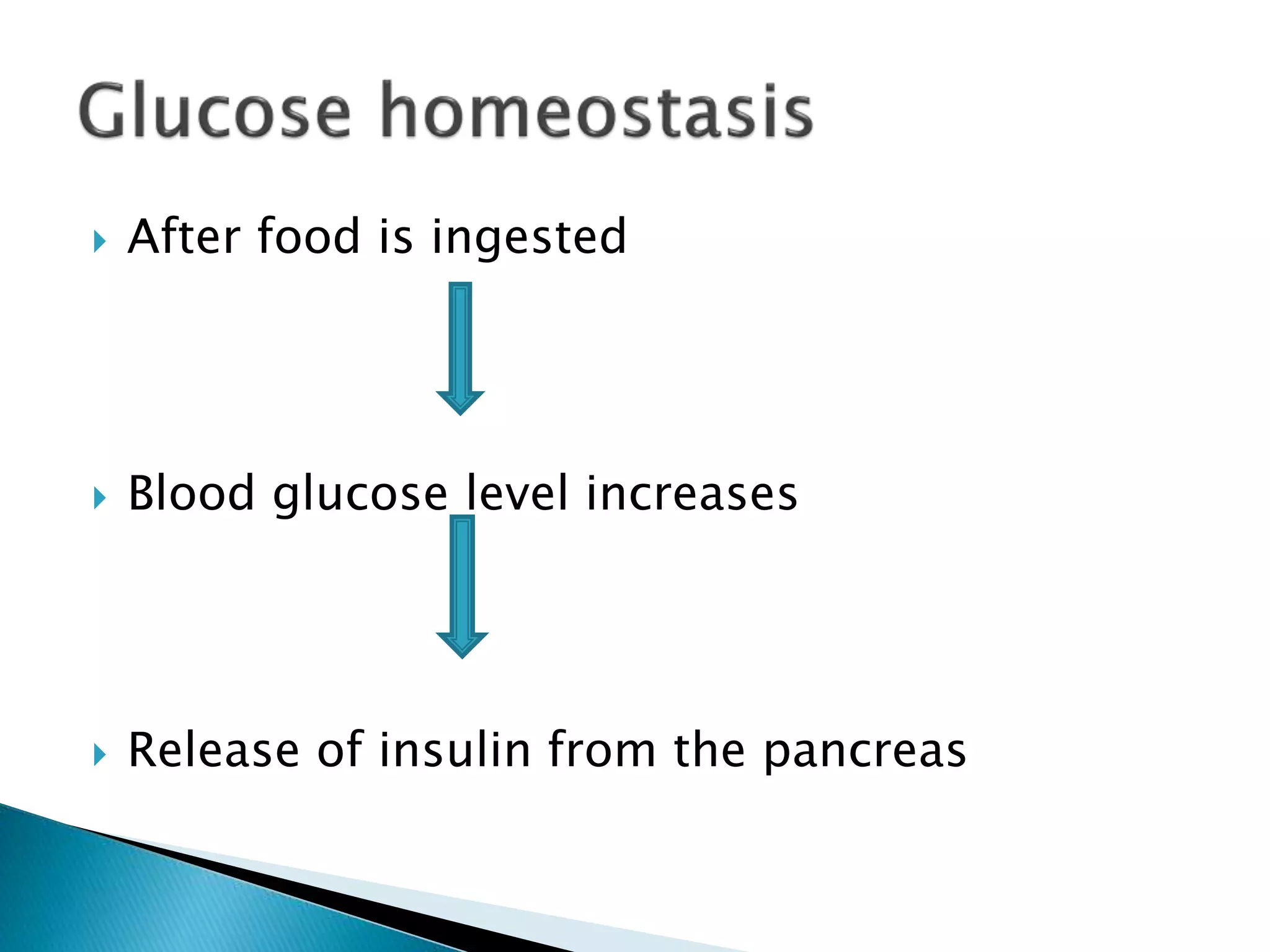
 After food is ingested
 Blood glucose level increases
 Release of insulin from the pancreas
 Insulin causes suppressing of glucose
production in liver and storage of glucose as
glycogen in the liver
 Normally the liver contains sufficient
glycogen stores to maintain the blood
glucose concentration at 80-90 mg/dl for
24-36 hours
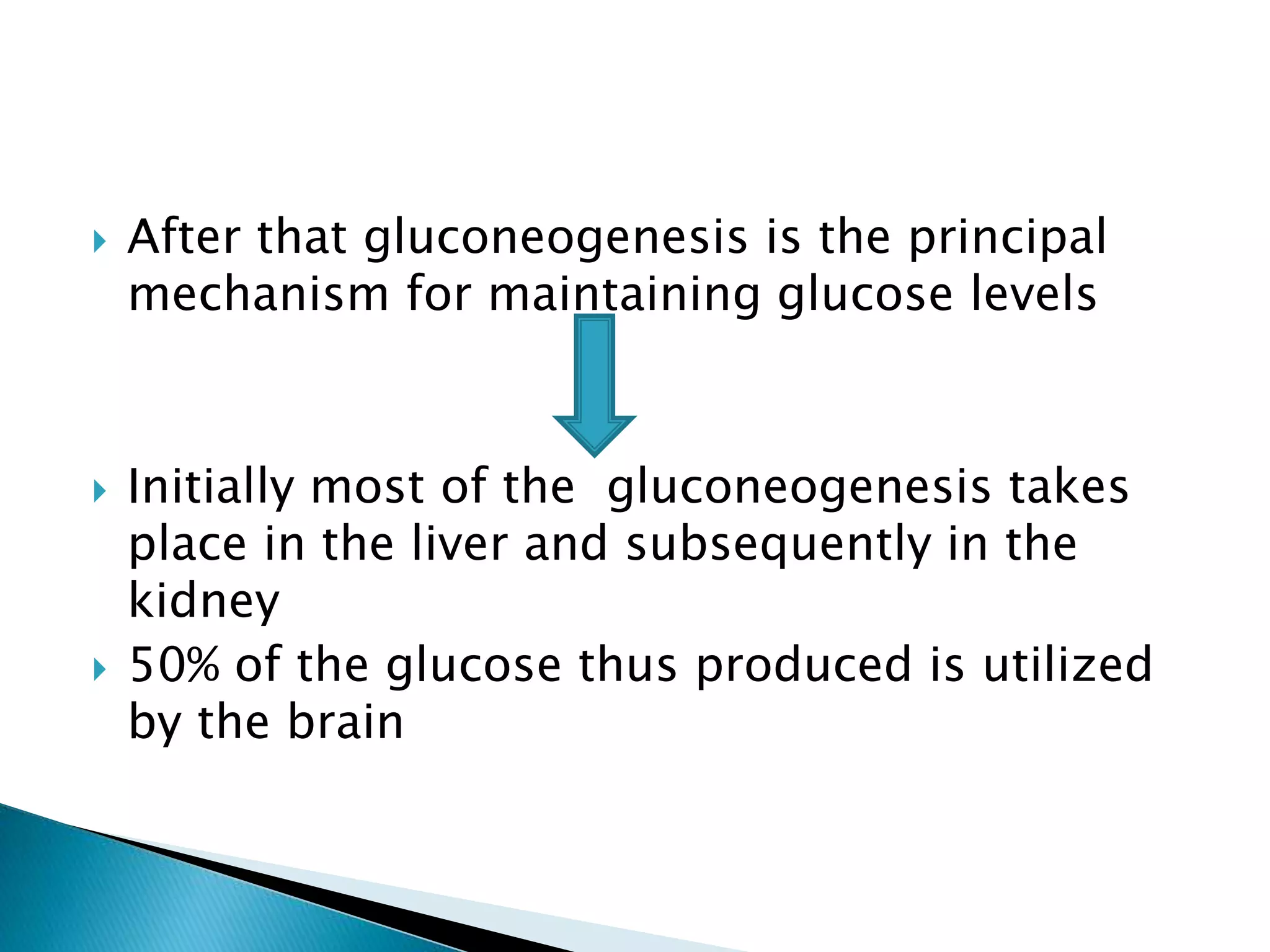
 After that gluconeogenesis is the principal
mechanism for maintaining glucose levels
 Initially most of the gluconeogenesis takes
place in the liver and subsequently in the
kidney
 50% of the glucose thus produced is utilized
by the brain
 Glucose reserve in the brain will sustain
activity for about 30 min once blood
glucose is no longer available.
 If blood sugar falls to < 10 mg / dl &
persists for minutes , recovery is delayed
for weeks & may be incomplete
 Neuroglycopenia is the term used to refer to
symptomatic hypoglycemia
 Sweating, tremor and the sensation of
warmth is due to ANS activation
 Decreased caloric intake
 Liver disease
 Uremia
 Infection and shock
 Burns
 Pregnancy
 Neoplasia
Acute Sub acute Chronic
Usually due to
insulin or OHA
MC form and
occurs in
fasting state
Rare
seen in
obsessively
controlled
diabetics or due to
insulin secreting
tumor
Begins with
vague
symptoms
Symptoms seen
in acute
hypoglycemia
are absent
Always consider
in dementia
acute Subacute Chronic
Patients may
recognize these
symptoms
Usually accompanied
by hypothermia
HbA1C levels are
helpful in making the
diagnosis
Attacks may end
spontaneously or
proceed to Sz and
coma
Any unexplained
hypothermia always
check blood sugar
They usually arrive in
the ED with coma
Always consider in
stroke & seizures
responds well to
treatment
Poor response to
treatment
 Symptoms of hypoglycemia will not be there
if the person is on beta blockers or if they
have autonomic neuropathy.
 Use of Beta Blockers in patients on insulin or
OHA is not advisable
 Hypoglycemia is a medical emergency and
should be considered in all patients with
altered mental status of unknown origin
 Exogenous glucose is harmful to brain
during hypoxia or ischemia and caution must
be exercised in giving glucose to them
 A 54 yr old female not a known diabetic
came with H/O involuntary movements
involving Left sided limbs of 2 days
duration
 Diagnosis left hemiballismus
 Her blood sugar : 640
 Ketones : Negative
 Serum Osmolarity : 311 mosm
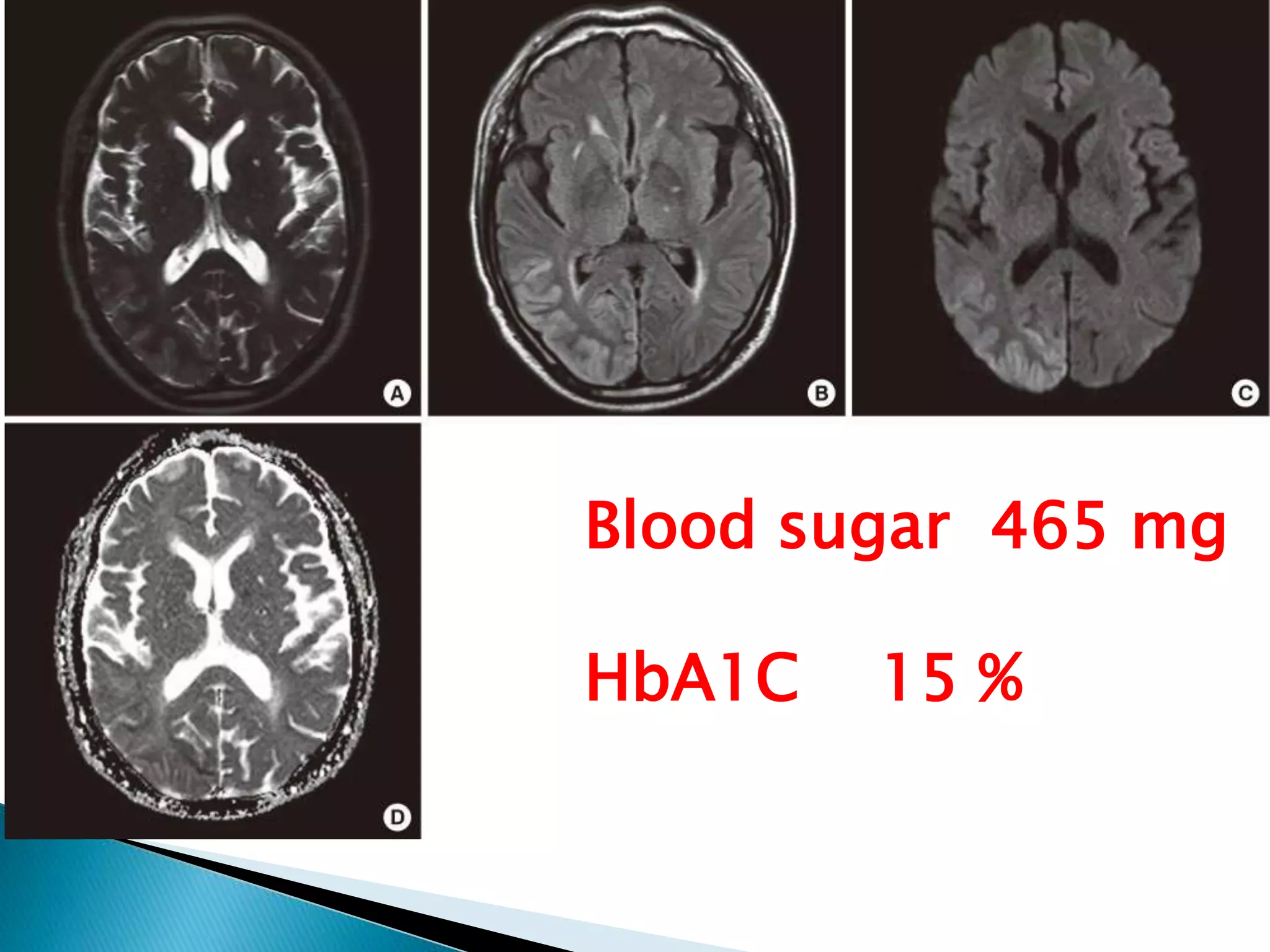
 A 64 years old Non – diabetic presented
with visual disturbances - seeing
continuous flashes of light in Left ½ of
vision x 3d
 O/E
 Left homonymous hemianopia
 Confused
 No focal deficit
Blood sugar 465 mg
HbA1C 15 %
 DIAGNOSIS
 Hyperglycemia induced seizures
 He was treated with insulin , AED for short
time
 MRI repeated after 3 weeks was Normal
 A 45 Year old diabetic presented with acute
onset weakness of left sided limbs of 12
hrs duration
 His CT Brain, MRI Brain ( DWI ) didn`t show
any abnormality
 His blood sugar was 472 mg/ dl and his
HbA1C was 14%
 We treated him with antiplatelets and control
of sugar
 He recovered completely in 4 days time
 Repeat MRI done after 4 days was also normal
 Hyperglycemia could be either associated
with acidosis (DKA) or non – Ketotic
Hyperosmolar coma ( Hyperosmolar
Hyperglycemic state HHS )
 Non ketotic coma may present with
unexplained coma or seizures without any
past history
DKA Non ketotic hyperosmolar coma
Common in type I diabetics Feature of type II diabetes
Precipitated by infection Seen in older people commonly
as first manifestation
Hyperventilation due to
acidosis
Evolves more slowly than DKA
Ketone bodies are positive Clinical symptoms are due to
hypertonicity, hypovolemia and
cerebral dysfunction with
seizures in some
DKA people who die are more
often due to neurogenic
dysfunction than CVS cause
Precipitated by infection, AGE,
pancreatitis and treatment with
steroids and phenytoin
Insulin is the corner stone of
treatment
 Main focus of treatment is correction of
dehydration & electrolyte disturbance
 Overly vigorous treatment with rapid
correction of plasma osmolality can lead to
the development of cerebral edema
 Consider ICP management in DKA patients
who deteriorate
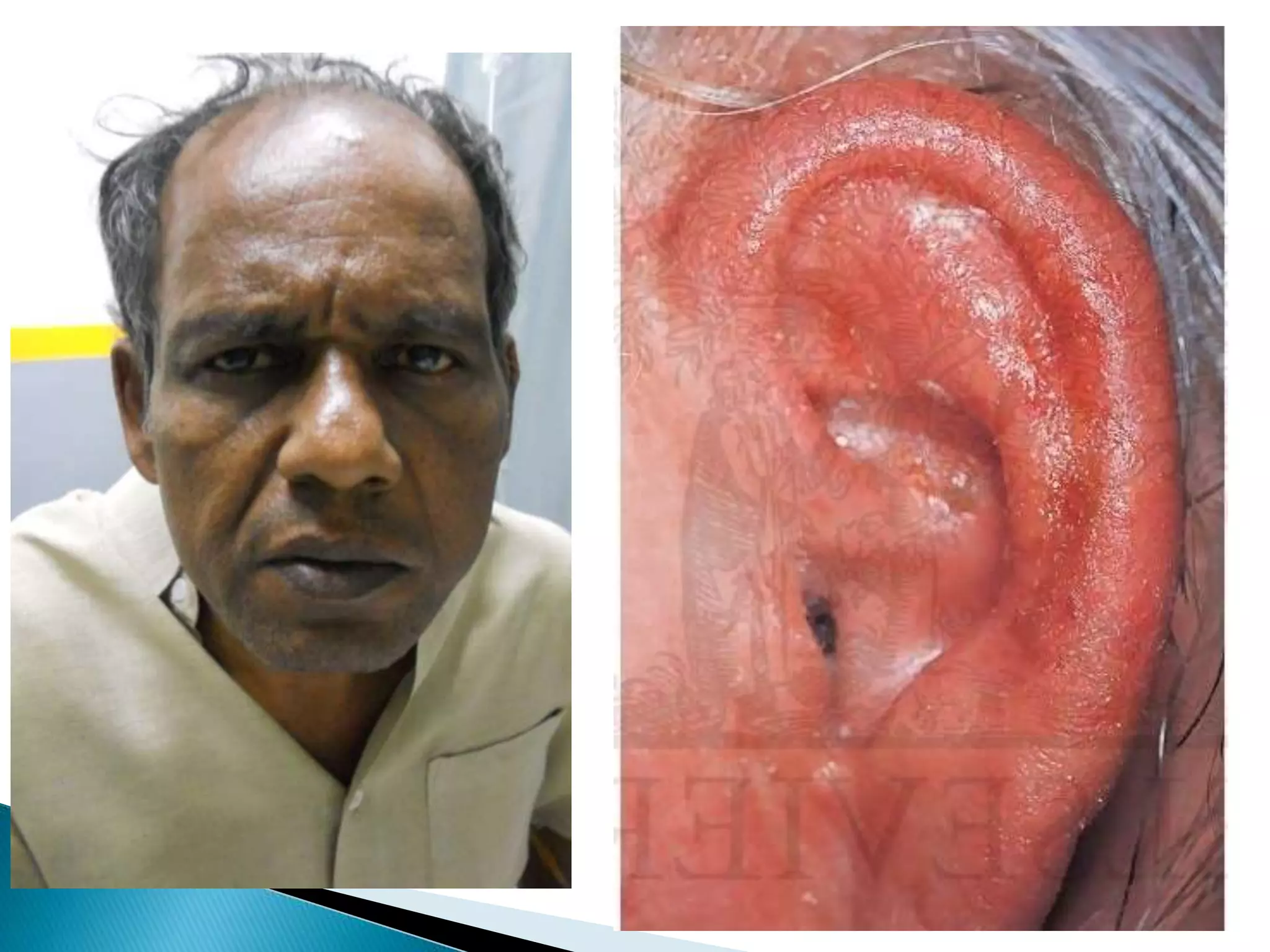
 56 year old male known case of uncontrolled
diabetes –
 Came with history of left side severe ear pain
x 10 days
O/E
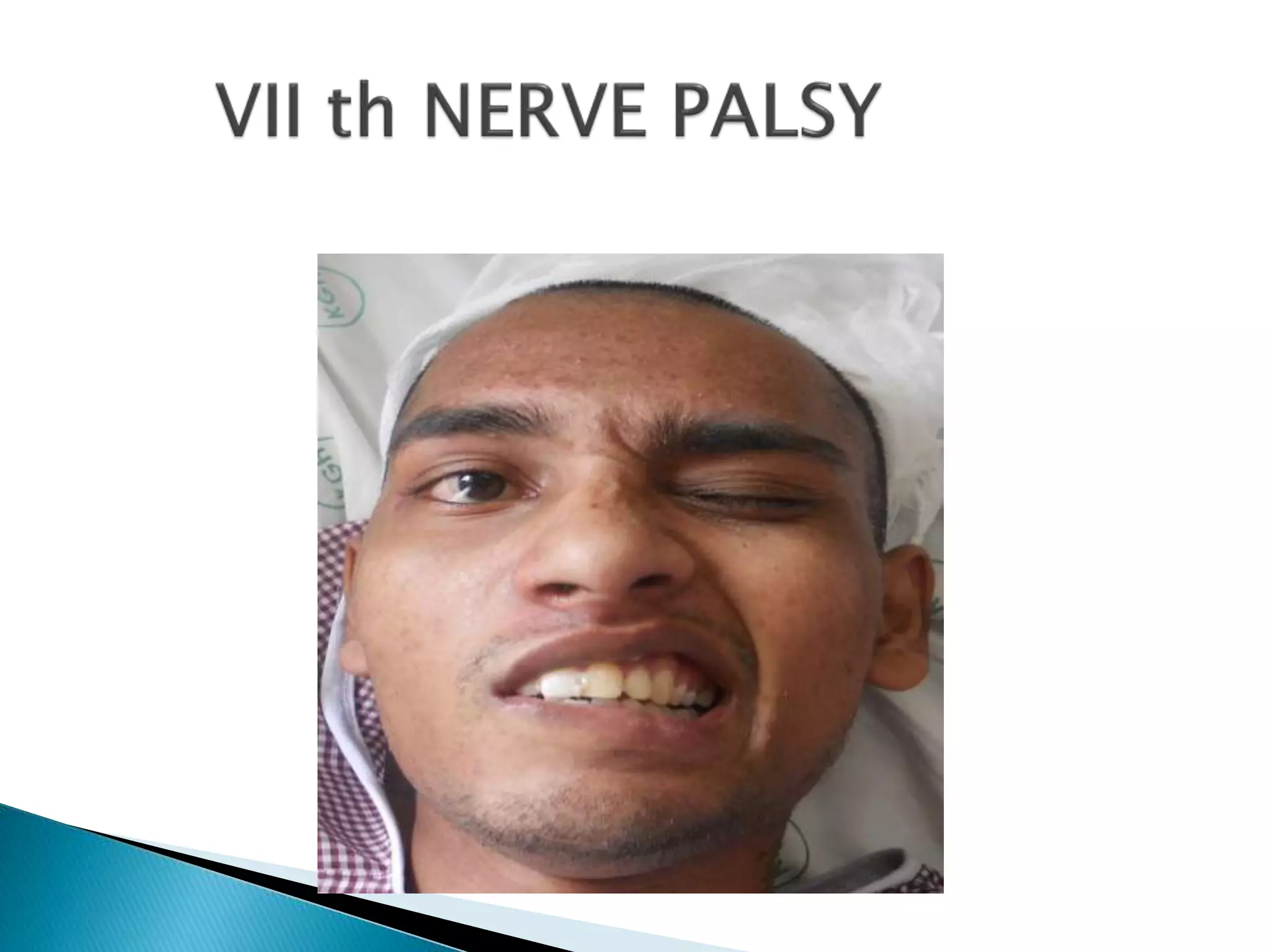
 Left LMN facial palsy
 Swollen Left ear
 He was referred to ENT surgeon
 He was treated with oral quinolones, strict
sugar control
 Local debridement of the wound was done
 DIAGNOSIS
 Malignant Otitis Externa
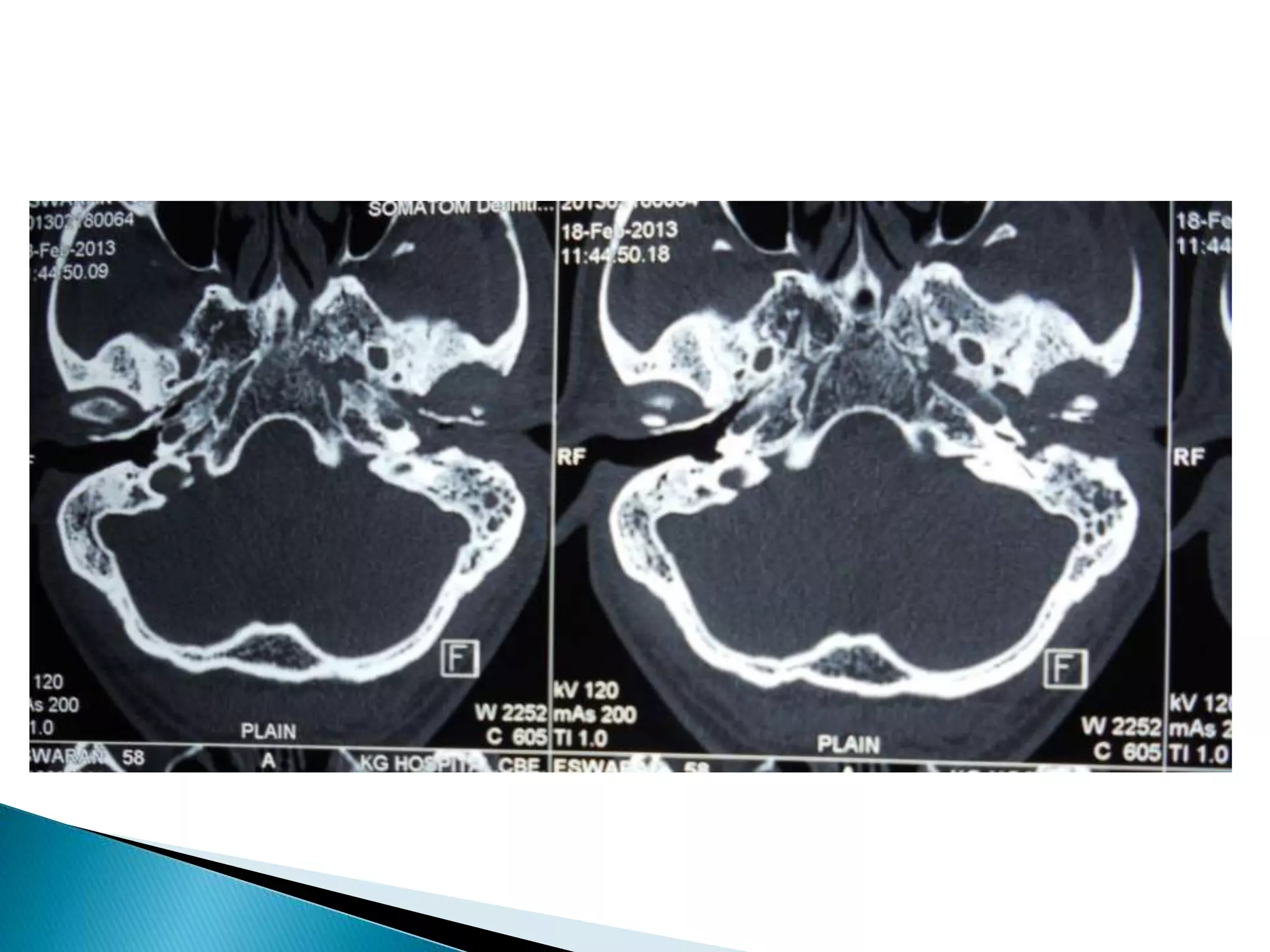
 72 year old male known diabetic came with
deviation of angle of mouth towards right
side of 2 days duration
 Headache of severe degree interfering with
sleep and ADL present
Day 1 Day 2 Day 3 Day 5 Day 7
Left LMN
Facial Palsy
Left LMN
Facial
Palsy
Left LMN Facial
Palsy
Operated Left LMN
Facial Palsy
Proptosis Left
abduction
impaired
Left Complete
Ophthalmoplegia
Right
hemiplegia
 DM WITH FUNGAL SINUSITIS
 He underwent surgery along with
Amphoterecin treatment, antibiotics and
supportive measures
 Unfortunately he succumbed to his illness
 50 yr old known diabetic presented with
acute onset binocular horizontal diplopia on
looking to the right
 O/E Right VI th nerve palsy
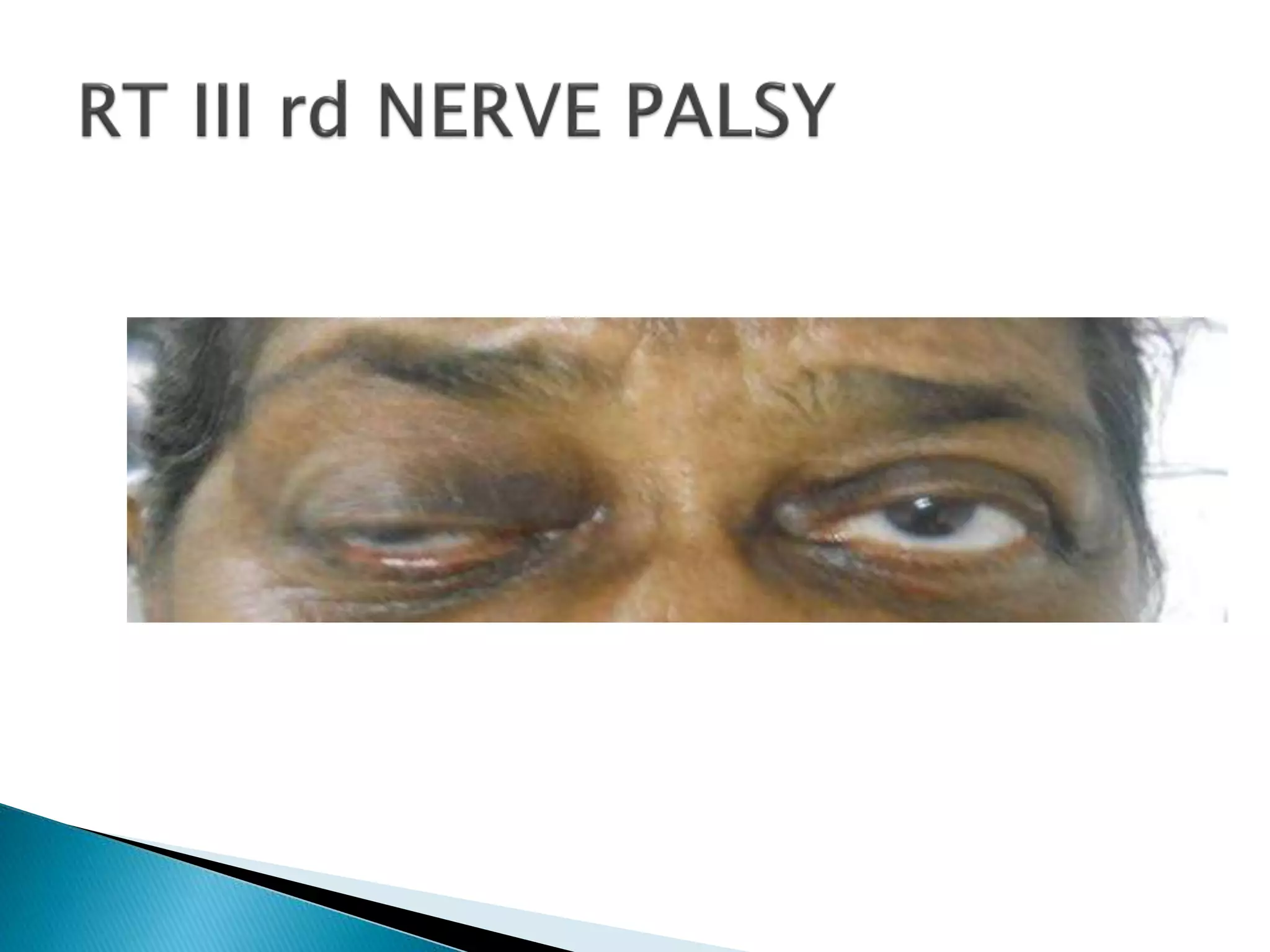
 6O yr old diabetic presented with acute onset
diplopia with drooping of eyelid
 O/E right third nerve palsy
 Treatment for diabetic cranial mono
neuropathy is strict sugar control and
physiotherapy
 Most of them recover over a period of
6 – 12 weeks
 A 50 year old diabetic presented with severe
pain along the costal margin radiating from
back to anterior aspect of 3 months duration
 USG Abdomen
 CT Abdomen
 UGIE, Colonoscopy
 MRI Whole Spine all are normal
 Can present with severe pain in a dermatomal
pattern
 Common in thoracolumbar region in diabetics
 A 40 years old male known diabetic came to
us with numbness in the right hand since 1
month
 Numbness occurred while mixing food and
holding to objects
 Numbness was more during night along with
radiating pain from wrist to arm
 No focal deficit
 Tinel`s sign is negative
 Phalen`s test positive
 Blood sugar 236 mg/dl
 HbA1C 8.2%
 TSH - 1.23 , Free T4 1.35
 NCS report showed Bilateral Carpal Tunnel
Syndrome
 Carpal tunnel Syndrome
 Cock up splint at night
 CTS exercises
 Surgery for severe cases
 Diabetic neuropathy is a length dependent
process
 Usually presents with lower limb sensory
symptoms
 Presentation with upper limb symptoms
always consider Entrapment Neuropathy
 A 54 years old diabetic female came to us
with severe left shoulder pain and inability to
lift the left shoulder overhead of 6 months
 O/E
 Left shoulder abduction restricted
 Wasting of left arm muscles present
 Sensation impaired over Left Axillary nerve
area
She was treated with pregabalin, physiotherapy
 A 56 year old male who is a known case of
diabetic came to us with low back pain
radiating to left lower limb
 Pain is severe in nature interfering with ADL
 Numbness and burning pain in feet present
 O/E
 Wasting of left thigh
 Left KJ absent, Left AJ +
 Sensory - Normal
 He was treated with
 IV Methyl Prednisolone for 3 days
 Pregabalin, Duloxetene and supportive
measures
 Consider hypoglycemia in any altered mental
status in a diabetic
 HHS can present for the first time with
seizures or focal deficit or with delirium
 Always rule out aneurysm in IIIrd nerve palsy
 Facial palsy is not always as simple as it looks
 Shoulder pain in a diabetic is not always
periarthritis shoulder
 Sciatica if not responding to treatment
consider Lumbosacral Plexopathy
 Diabetic neuropathy is more of a sensory
neuropathy
 If patient present with predominant weakness
or if NCS shows demyelinating pathology
consider CIDP
Diabetis & brain

Diabetis & brain

  • 1.
    Dr. T. C.R. Rama Krishnan
  • 2.
     Case vignettes Discussion  Pearls
  • 3.
     A 50year old male who is a known diabetic came with acute onset of weakness of left sided limbs of 30 min duration O/E  Left UMN facial palsy with Hemiplegia
  • 5.
  • 6.
     Serum glucose< 50 mg/dl  < 30 mg Confusion  < 10 mg Seizures Coma Medullary phase of Hypoglycemia.  < 70 mg is the level at which counter regulatory hormones get activated
  • 7.
     Glucose isthe exclusive fuel for the brain  Brain stores only trivial amounts of glucose as glycogen unlike liver and skeletal muscle  Hyperglycemia is better tolerated by the brain than hypoglycemia  Glucose sensor in the brain- STN
  • 8.
     After foodis ingested  Blood glucose level increases  Release of insulin from the pancreas
  • 9.
     Insulin causessuppressing of glucose production in liver and storage of glucose as glycogen in the liver  Normally the liver contains sufficient glycogen stores to maintain the blood glucose concentration at 80-90 mg/dl for 24-36 hours
  • 10.
     After thatgluconeogenesis is the principal mechanism for maintaining glucose levels  Initially most of the gluconeogenesis takes place in the liver and subsequently in the kidney  50% of the glucose thus produced is utilized by the brain
  • 11.
     Glucose reservein the brain will sustain activity for about 30 min once blood glucose is no longer available.  If blood sugar falls to < 10 mg / dl & persists for minutes , recovery is delayed for weeks & may be incomplete
  • 12.
     Neuroglycopenia isthe term used to refer to symptomatic hypoglycemia  Sweating, tremor and the sensation of warmth is due to ANS activation
  • 13.
     Decreased caloricintake  Liver disease  Uremia  Infection and shock  Burns  Pregnancy  Neoplasia
  • 14.
    Acute Sub acuteChronic Usually due to insulin or OHA MC form and occurs in fasting state Rare seen in obsessively controlled diabetics or due to insulin secreting tumor Begins with vague symptoms Symptoms seen in acute hypoglycemia are absent Always consider in dementia
  • 15.
    acute Subacute Chronic Patientsmay recognize these symptoms Usually accompanied by hypothermia HbA1C levels are helpful in making the diagnosis Attacks may end spontaneously or proceed to Sz and coma Any unexplained hypothermia always check blood sugar They usually arrive in the ED with coma Always consider in stroke & seizures responds well to treatment Poor response to treatment
  • 16.
     Symptoms ofhypoglycemia will not be there if the person is on beta blockers or if they have autonomic neuropathy.  Use of Beta Blockers in patients on insulin or OHA is not advisable
  • 17.
     Hypoglycemia isa medical emergency and should be considered in all patients with altered mental status of unknown origin  Exogenous glucose is harmful to brain during hypoxia or ischemia and caution must be exercised in giving glucose to them
  • 18.
     A 54yr old female not a known diabetic came with H/O involuntary movements involving Left sided limbs of 2 days duration
  • 21.
     Diagnosis lefthemiballismus  Her blood sugar : 640  Ketones : Negative  Serum Osmolarity : 311 mosm
  • 23.
     A 64years old Non – diabetic presented with visual disturbances - seeing continuous flashes of light in Left ½ of vision x 3d  O/E  Left homonymous hemianopia  Confused  No focal deficit
  • 24.
    Blood sugar 465mg HbA1C 15 %
  • 25.
     DIAGNOSIS  Hyperglycemiainduced seizures  He was treated with insulin , AED for short time  MRI repeated after 3 weeks was Normal
  • 27.
     A 45Year old diabetic presented with acute onset weakness of left sided limbs of 12 hrs duration  His CT Brain, MRI Brain ( DWI ) didn`t show any abnormality
  • 28.
     His bloodsugar was 472 mg/ dl and his HbA1C was 14%  We treated him with antiplatelets and control of sugar  He recovered completely in 4 days time  Repeat MRI done after 4 days was also normal
  • 29.
     Hyperglycemia couldbe either associated with acidosis (DKA) or non – Ketotic Hyperosmolar coma ( Hyperosmolar Hyperglycemic state HHS )  Non ketotic coma may present with unexplained coma or seizures without any past history
  • 30.
    DKA Non ketotichyperosmolar coma Common in type I diabetics Feature of type II diabetes Precipitated by infection Seen in older people commonly as first manifestation Hyperventilation due to acidosis Evolves more slowly than DKA Ketone bodies are positive Clinical symptoms are due to hypertonicity, hypovolemia and cerebral dysfunction with seizures in some DKA people who die are more often due to neurogenic dysfunction than CVS cause Precipitated by infection, AGE, pancreatitis and treatment with steroids and phenytoin Insulin is the corner stone of treatment
  • 31.
     Main focusof treatment is correction of dehydration & electrolyte disturbance  Overly vigorous treatment with rapid correction of plasma osmolality can lead to the development of cerebral edema  Consider ICP management in DKA patients who deteriorate
  • 32.
     56 yearold male known case of uncontrolled diabetes –  Came with history of left side severe ear pain x 10 days O/E  Left LMN facial palsy  Swollen Left ear
  • 37.
     He wasreferred to ENT surgeon  He was treated with oral quinolones, strict sugar control  Local debridement of the wound was done  DIAGNOSIS  Malignant Otitis Externa
  • 38.
     72 yearold male known diabetic came with deviation of angle of mouth towards right side of 2 days duration  Headache of severe degree interfering with sleep and ADL present
  • 39.
    Day 1 Day2 Day 3 Day 5 Day 7 Left LMN Facial Palsy Left LMN Facial Palsy Left LMN Facial Palsy Operated Left LMN Facial Palsy Proptosis Left abduction impaired Left Complete Ophthalmoplegia Right hemiplegia
  • 42.
     DM WITHFUNGAL SINUSITIS  He underwent surgery along with Amphoterecin treatment, antibiotics and supportive measures  Unfortunately he succumbed to his illness
  • 43.
     50 yrold known diabetic presented with acute onset binocular horizontal diplopia on looking to the right  O/E Right VI th nerve palsy
  • 45.
     6O yrold diabetic presented with acute onset diplopia with drooping of eyelid  O/E right third nerve palsy
  • 48.
     Treatment fordiabetic cranial mono neuropathy is strict sugar control and physiotherapy  Most of them recover over a period of 6 – 12 weeks
  • 49.
     A 50year old diabetic presented with severe pain along the costal margin radiating from back to anterior aspect of 3 months duration  USG Abdomen  CT Abdomen  UGIE, Colonoscopy  MRI Whole Spine all are normal
  • 51.
     Can presentwith severe pain in a dermatomal pattern  Common in thoracolumbar region in diabetics
  • 52.
     A 40years old male known diabetic came to us with numbness in the right hand since 1 month  Numbness occurred while mixing food and holding to objects  Numbness was more during night along with radiating pain from wrist to arm
  • 53.
     No focaldeficit  Tinel`s sign is negative  Phalen`s test positive
  • 55.
     Blood sugar236 mg/dl  HbA1C 8.2%  TSH - 1.23 , Free T4 1.35  NCS report showed Bilateral Carpal Tunnel Syndrome
  • 57.
     Carpal tunnelSyndrome  Cock up splint at night  CTS exercises  Surgery for severe cases
  • 58.
     Diabetic neuropathyis a length dependent process  Usually presents with lower limb sensory symptoms  Presentation with upper limb symptoms always consider Entrapment Neuropathy
  • 59.
     A 54years old diabetic female came to us with severe left shoulder pain and inability to lift the left shoulder overhead of 6 months  O/E  Left shoulder abduction restricted  Wasting of left arm muscles present  Sensation impaired over Left Axillary nerve area
  • 61.
    She was treatedwith pregabalin, physiotherapy
  • 62.
     A 56year old male who is a known case of diabetic came to us with low back pain radiating to left lower limb  Pain is severe in nature interfering with ADL  Numbness and burning pain in feet present  O/E  Wasting of left thigh  Left KJ absent, Left AJ +  Sensory - Normal
  • 63.
     He wastreated with  IV Methyl Prednisolone for 3 days  Pregabalin, Duloxetene and supportive measures
  • 64.
     Consider hypoglycemiain any altered mental status in a diabetic  HHS can present for the first time with seizures or focal deficit or with delirium  Always rule out aneurysm in IIIrd nerve palsy  Facial palsy is not always as simple as it looks
  • 65.
     Shoulder painin a diabetic is not always periarthritis shoulder  Sciatica if not responding to treatment consider Lumbosacral Plexopathy  Diabetic neuropathy is more of a sensory neuropathy  If patient present with predominant weakness or if NCS shows demyelinating pathology consider CIDP