Colorimetry is the use of the human eye
to determine the concentration of colored species.
Spectrophotometry is the use of instruments
to make the same measurements. It extends
the range of possible measurements beyond
those that can be determined by the eye alone.
Note: This experiment will demonstrate
both techniques on the same set of dyes.
Useful Terminology
Visual Observations – Because colorimetry is based on
inspection of materials with the human eye, it is
necessary to review aspects of visible light.
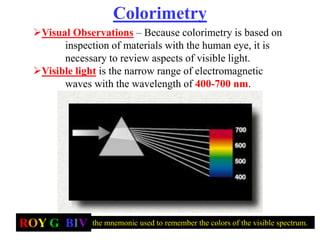
Visible light is the narrow range of electromagnetic
waves with the wavelength of 400-700 nm.
= the mnemonic used to remember the colors of the visible spectrum.
Colorimetry
ROY G. BIV
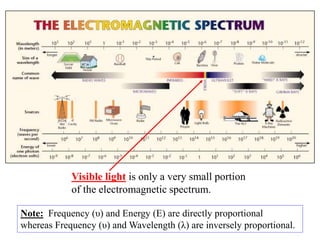
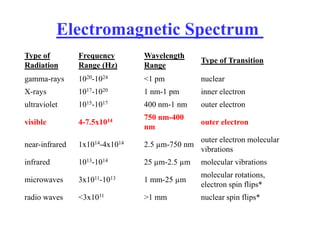
Visible light is only a very small portion
of the electromagnetic spectrum.
Note: Frequency (υ) and Energy (E) are directly proportional
whereas Frequency (υ) and Wavelength (λ) are inversely proportional.
Type of
Radiation
Frequency
Range (Hz)
Wavelength
Range
Type of Transition
gamma-rays 1020-1024 <1 pm nuclear
X-rays 1017-1020 1 nm-1 pm inner electron
ultraviolet 1015-1017 400 nm-1 nm outer electron
visible 4-7.5x10¹⁴ 750 nm-400
nm
outer electron
near-infrared 1x10¹⁴-4x10¹⁴ 2.5 µm-750 nm
outer electron molecular
vibrations
infrared 1013-1014 25 µm-2.5 µm molecular vibrations
microwaves 3x10¹¹-1013 1 mm-25 µm
molecular rotations,
electron spin flips*
radio waves <3x10¹¹ >1 mm nuclear spin flips*
Electromagnetic Spectrum
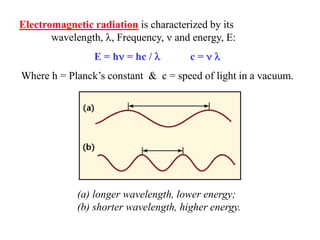
(a) longer wavelength, lower energy;
(b) shorter wavelength, higher energy.
Electromagnetic radiation is characterized by its
wavelength, , Frequency,  and energy, E:
E = h= hc /  c =  
Where h = Planck’s constant & c = speed of light in a vacuum.
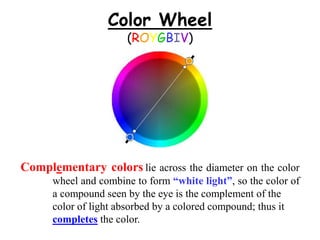
Color Wheel
(ROYGBIV)
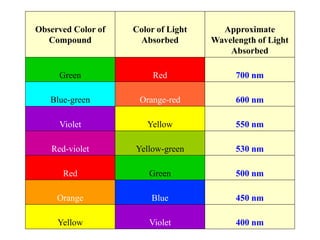
Complementary colors lie across the diameter on the color
wheel and combine to form “white light”, so the color of
a compound seen by the eye is the complement of the
color of light absorbed by a colored compound; thus it
completes the color.
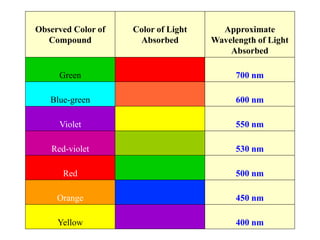
Observed Color of
Compound
Color of Light
Absorbed
Approximate
Wavelength of Light
Absorbed
Green 700 nm
Blue-green 600 nm
Violet 550 nm
Red-violet 530 nm
Red 500 nm
Orange 450 nm
Yellow 400 nm
Observed Color of
Compound
Color of Light
Absorbed
Approximate
Wavelength of Light
Absorbed
Green Red 700 nm
Blue-green Orange-red 600 nm
Violet Yellow 550 nm
Red-violet Yellow-green 530 nm
Red Green 500 nm
Orange Blue 450 nm
Yellow Violet 400 nm
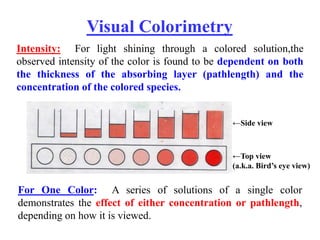
Intensity: For light shining through a colored solution,the
observed intensity of the color is found to be dependent on both
the thickness of the absorbing layer (pathlength) and the
concentration of the colored species.
For One Color: A series of solutions of a single color
demonstrates the effect of either concentration or pathlength,
depending on how it is viewed.
←Side view
←Top view
(a.k.a. Bird’s eye view)
Visual Colorimetry
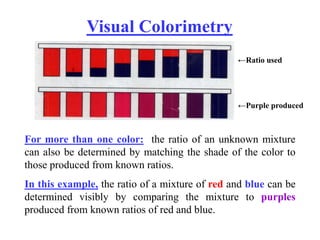
For more than one color: the ratio of an unknown mixture
can also be determined by matching the shade of the color to
those produced from known ratios.
In this example, the ratio of a mixture of red and blue can be
determined visibly by comparing the mixture to purples
produced from known ratios of red and blue.
←Ratio used
←Purple produced
Visual Colorimetry
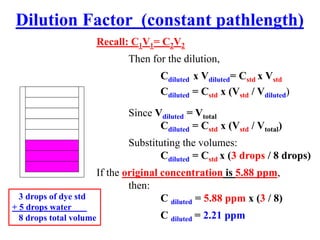
Dilution Factor (constant pathlength)
3 drops of dye std
+ 5 drops water
8 drops total volume
Recall: C1V1= C2V2
Then for the dilution,
Cdiluted x Vdiluted= Cstd x Vstd
Cdiluted = Cstd x (Vstd / Vdiluted)
Since Vdiluted = Vtotal
Cdiluted = Cstd x (Vstd / Vtotal)
Substituting the volumes:
Cdiluted = Cstd x (3 drops / 8 drops)
If the original concentration is 5.88 ppm,
then:
C diluted = 5.88 ppm x (3 / 8)
C diluted = 2.21 ppm
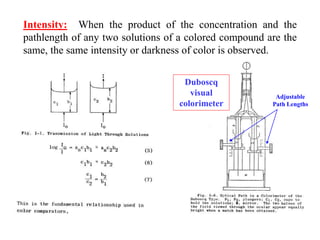
Intensity: When the product of the concentration and the
pathlength of any two solutions of a colored compound are the
same, the same intensity or darkness of color is observed.
Duboscq
visual
colorimeter
Adjustable
Path Lengths
Spectrophotometry
Spectrophotometer - an instrument that measures the amount
of light absorbed, or the intensity of color at a given
wavelength.
The intensity of color can be given a numerical value by
comparing the amount of light prior to passing it through
the sample and after passing through the sample.
These quantitative measurements of light absorbed are the
Transmittance and the Absorbance.
A = abc
A is the absorbance
Beer-Lambert Law (a.k.a. Beer's law) - the linear relationship
between absorbance and concentration of an absorbing species.
Absorbance
Main use of Beer’s Law is to determine the concentration
of various solutions.
“c” is the concentration of the sample in (mol/L)
“a” is molar absorptivity in L/[(mole)(cm)]
Also called “extinction coefficient” or “”;
it is dependent on the material being studied.
“b” is the path length in cm
The diameter of the cuvette or sample holder which is the distance
the light travels through the absorbing sample. “b” is a constant
when the same size cuvette is used for all samples.
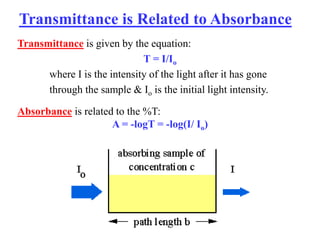
Transmittance is given by the equation:
T = I/Io
where I is the intensity of the light after it has gone
through the sample & Io is the initial light intensity.
Absorbance is related to the %T:
A = -logT = -log(I/ Io)
Transmittance is Related to Absorbance
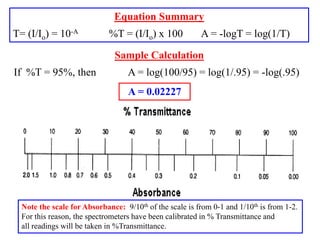
Equation Summary
T= (I/Io) = 10-A %T = (I/Io) x 100 A = -logT = log(1/T)
Note the scale for Absorbance: 9/10th of the scale is from 0-1 and 1/10th is from 1-2.
For this reason, the spectrometers have been calibrated in % Transmittance and
all readings will be taken in %Transmittance.
Sample Calculation
If %T = 95%, then A = log(100/95) = log(1/.95) = -log(.95)
A = 0.02227
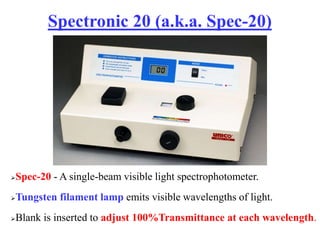
Spectronic 20 (a.k.a. Spec-20)
Spec-20 - A single-beam visible light spectrophotometer.
Tungsten filament lamp emits visible wavelengths of light.
Blank is inserted to adjust 100%Transmittance at each wavelength.
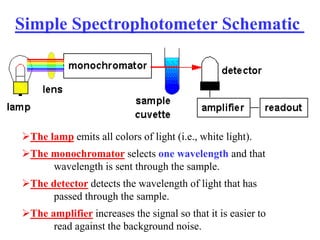
Simple Spectrophotometer Schematic
The lamp emits all colors of light (i.e., white light).
The monochromator selects one wavelength and that
wavelength is sent through the sample.
The detector detects the wavelength of light that has
passed through the sample.
The amplifier increases the signal so that it is easier to
read against the background noise.
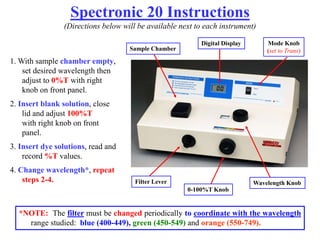
1. With sample chamber empty,
set desired wavelength then
adjust to 0%T with right
knob on front panel.
2. Insert blank solution, close
lid and adjust 100%T
with right knob on front
panel.
3. Insert dye solutions, read and
record %T values.
4. Change wavelength*, repeat
steps 2-4.
*NOTE: The filter must be changed periodically to coordinate with the wavelength
range studied: blue (400-449), green (450-549) and orange (550-749).
Spectronic 20 Instructions
(Directions below will be available next to each instrument)
Sample Chamber
Mode Knob
(set to Trans)
Digital Display
Wavelength Knob
0-100%T Knob
Filter Lever
Plot of Abs. vs nm for Purple
Red/Blue Dye mix
Plot of Abs. vs nm for Blue Dye Plot of Abs. vs nm for Red Dye
Overlay Plot of Blue and Red dye
Abs. vs nm curves

















0
0.1
0.2
0.3
0.4
0.5
0.6
0.7
0.8
0.9
1
400 450 500 550 600 650 700
Absorbance
Wavelength (nm)


  









0
0.2
0.4
0.6
0.8
1
1.2
1.4
400 450 500 550 600 650 700
Absorbance
Wavelength (nm)
  






     
-0.2
0
0.2
0.4
0.6
0.8
1
1.2
1.4
1.6
400 450 500 550 600 650 700
Absorbance
Wavelength (nm)


  









  






     
-0.2
0
0.2
0.4
0.6
0.8
1
1.2
1.4
1.6
400 450 500 550 600 650 700
Absorbance
Wavelength (nm)
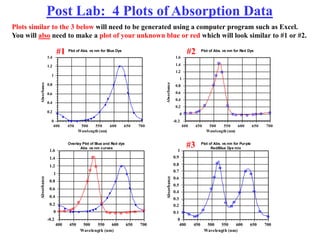
Post Lab: 4 Plots of Absorption Data
Plots similar to the 3 below will need to be generated using a computer program such as Excel.
You will also need to make a plot of your unknown blue or red which will look similar to #1 or #2.
#1 #2
#3
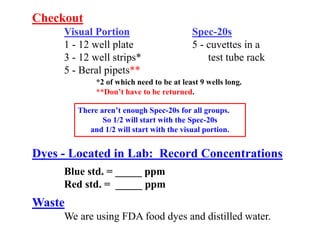
Checkout
Visual Portion Spec-20s
1 - 12 well plate 5 - cuvettes in a
3 - 12 well strips* test tube rack
5 - Beral pipets**
*2 of which need to be at least 9 wells long.
**Don’t have to be returned.
Dyes - Located in Lab: Record Concentrations
Blue std. = _____ ppm
Red std. = _____ ppm
Waste
We are using FDA food dyes and distilled water.
There aren’t enough Spec-20s for all groups.
So 1/2 will start with the Spec-20s
and 1/2 will start with the visual portion.
For April 9-12
Turn In:
Colorimetry & Spectrophotometry pp 51-58
+ 4 Graphs
Read Over:
Antacid Analysis (pp 33-34) in Green Book
& Dimensional Analysis #4-5
(pp 28-34 in the first book).

Introduction to Colorimetry and basics.ppt.pptx

  • 2.
    Colorimetry is theuse of the human eye to determine the concentration of colored species. Spectrophotometry is the use of instruments to make the same measurements. It extends the range of possible measurements beyond those that can be determined by the eye alone. Note: This experiment will demonstrate both techniques on the same set of dyes. Useful Terminology
  • 3.
    Visual Observations –Because colorimetry is based on inspection of materials with the human eye, it is necessary to review aspects of visible light. Visible light is the narrow range of electromagnetic waves with the wavelength of 400-700 nm. = the mnemonic used to remember the colors of the visible spectrum. Colorimetry ROY G. BIV
  • 4.
    Visible light isonly a very small portion of the electromagnetic spectrum. Note: Frequency (υ) and Energy (E) are directly proportional whereas Frequency (υ) and Wavelength (λ) are inversely proportional.
  • 5.
    Type of Radiation Frequency Range (Hz) Wavelength Range Typeof Transition gamma-rays 1020-1024 <1 pm nuclear X-rays 1017-1020 1 nm-1 pm inner electron ultraviolet 1015-1017 400 nm-1 nm outer electron visible 4-7.5x10¹⁴ 750 nm-400 nm outer electron near-infrared 1x10¹⁴-4x10¹⁴ 2.5 µm-750 nm outer electron molecular vibrations infrared 1013-1014 25 µm-2.5 µm molecular vibrations microwaves 3x10¹¹-1013 1 mm-25 µm molecular rotations, electron spin flips* radio waves <3x10¹¹ >1 mm nuclear spin flips* Electromagnetic Spectrum
  • 6.
    (a) longer wavelength,lower energy; (b) shorter wavelength, higher energy. Electromagnetic radiation is characterized by its wavelength, , Frequency,  and energy, E: E = h= hc /  c =   Where h = Planck’s constant & c = speed of light in a vacuum.
  • 7.
    Color Wheel (ROYGBIV) Complementary colorslie across the diameter on the color wheel and combine to form “white light”, so the color of a compound seen by the eye is the complement of the color of light absorbed by a colored compound; thus it completes the color.
  • 8.
    Observed Color of Compound Colorof Light Absorbed Approximate Wavelength of Light Absorbed Green 700 nm Blue-green 600 nm Violet 550 nm Red-violet 530 nm Red 500 nm Orange 450 nm Yellow 400 nm
  • 9.
    Observed Color of Compound Colorof Light Absorbed Approximate Wavelength of Light Absorbed Green Red 700 nm Blue-green Orange-red 600 nm Violet Yellow 550 nm Red-violet Yellow-green 530 nm Red Green 500 nm Orange Blue 450 nm Yellow Violet 400 nm
  • 10.
    Intensity: For lightshining through a colored solution,the observed intensity of the color is found to be dependent on both the thickness of the absorbing layer (pathlength) and the concentration of the colored species. For One Color: A series of solutions of a single color demonstrates the effect of either concentration or pathlength, depending on how it is viewed. ←Side view ←Top view (a.k.a. Bird’s eye view) Visual Colorimetry
  • 11.
    For more thanone color: the ratio of an unknown mixture can also be determined by matching the shade of the color to those produced from known ratios. In this example, the ratio of a mixture of red and blue can be determined visibly by comparing the mixture to purples produced from known ratios of red and blue. ←Ratio used ←Purple produced Visual Colorimetry
  • 12.
    Dilution Factor (constantpathlength) 3 drops of dye std + 5 drops water 8 drops total volume Recall: C1V1= C2V2 Then for the dilution, Cdiluted x Vdiluted= Cstd x Vstd Cdiluted = Cstd x (Vstd / Vdiluted) Since Vdiluted = Vtotal Cdiluted = Cstd x (Vstd / Vtotal) Substituting the volumes: Cdiluted = Cstd x (3 drops / 8 drops) If the original concentration is 5.88 ppm, then: C diluted = 5.88 ppm x (3 / 8) C diluted = 2.21 ppm
  • 13.
    Intensity: When theproduct of the concentration and the pathlength of any two solutions of a colored compound are the same, the same intensity or darkness of color is observed. Duboscq visual colorimeter Adjustable Path Lengths
  • 14.
    Spectrophotometry Spectrophotometer - aninstrument that measures the amount of light absorbed, or the intensity of color at a given wavelength. The intensity of color can be given a numerical value by comparing the amount of light prior to passing it through the sample and after passing through the sample. These quantitative measurements of light absorbed are the Transmittance and the Absorbance.
  • 15.
    A = abc Ais the absorbance Beer-Lambert Law (a.k.a. Beer's law) - the linear relationship between absorbance and concentration of an absorbing species. Absorbance Main use of Beer’s Law is to determine the concentration of various solutions. “c” is the concentration of the sample in (mol/L) “a” is molar absorptivity in L/[(mole)(cm)] Also called “extinction coefficient” or “”; it is dependent on the material being studied. “b” is the path length in cm The diameter of the cuvette or sample holder which is the distance the light travels through the absorbing sample. “b” is a constant when the same size cuvette is used for all samples.
  • 16.
    Transmittance is givenby the equation: T = I/Io where I is the intensity of the light after it has gone through the sample & Io is the initial light intensity. Absorbance is related to the %T: A = -logT = -log(I/ Io) Transmittance is Related to Absorbance
  • 17.
    Equation Summary T= (I/Io)= 10-A %T = (I/Io) x 100 A = -logT = log(1/T) Note the scale for Absorbance: 9/10th of the scale is from 0-1 and 1/10th is from 1-2. For this reason, the spectrometers have been calibrated in % Transmittance and all readings will be taken in %Transmittance. Sample Calculation If %T = 95%, then A = log(100/95) = log(1/.95) = -log(.95) A = 0.02227
  • 18.
    Spectronic 20 (a.k.a.Spec-20) Spec-20 - A single-beam visible light spectrophotometer. Tungsten filament lamp emits visible wavelengths of light. Blank is inserted to adjust 100%Transmittance at each wavelength.
  • 19.
    Simple Spectrophotometer Schematic Thelamp emits all colors of light (i.e., white light). The monochromator selects one wavelength and that wavelength is sent through the sample. The detector detects the wavelength of light that has passed through the sample. The amplifier increases the signal so that it is easier to read against the background noise.
  • 20.
    1. With samplechamber empty, set desired wavelength then adjust to 0%T with right knob on front panel. 2. Insert blank solution, close lid and adjust 100%T with right knob on front panel. 3. Insert dye solutions, read and record %T values. 4. Change wavelength*, repeat steps 2-4. *NOTE: The filter must be changed periodically to coordinate with the wavelength range studied: blue (400-449), green (450-549) and orange (550-749). Spectronic 20 Instructions (Directions below will be available next to each instrument) Sample Chamber Mode Knob (set to Trans) Digital Display Wavelength Knob 0-100%T Knob Filter Lever
  • 21.
    Plot of Abs.vs nm for Purple Red/Blue Dye mix Plot of Abs. vs nm for Blue Dye Plot of Abs. vs nm for Red Dye Overlay Plot of Blue and Red dye Abs. vs nm curves                  0 0.1 0.2 0.3 0.4 0.5 0.6 0.7 0.8 0.9 1 400 450 500 550 600 650 700 Absorbance Wavelength (nm)               0 0.2 0.4 0.6 0.8 1 1.2 1.4 400 450 500 550 600 650 700 Absorbance Wavelength (nm)                -0.2 0 0.2 0.4 0.6 0.8 1 1.2 1.4 1.6 400 450 500 550 600 650 700 Absorbance Wavelength (nm)                              -0.2 0 0.2 0.4 0.6 0.8 1 1.2 1.4 1.6 400 450 500 550 600 650 700 Absorbance Wavelength (nm) Post Lab: 4 Plots of Absorption Data Plots similar to the 3 below will need to be generated using a computer program such as Excel. You will also need to make a plot of your unknown blue or red which will look similar to #1 or #2. #1 #2 #3
  • 22.
    Checkout Visual Portion Spec-20s 1- 12 well plate 5 - cuvettes in a 3 - 12 well strips* test tube rack 5 - Beral pipets** *2 of which need to be at least 9 wells long. **Don’t have to be returned. Dyes - Located in Lab: Record Concentrations Blue std. = _____ ppm Red std. = _____ ppm Waste We are using FDA food dyes and distilled water. There aren’t enough Spec-20s for all groups. So 1/2 will start with the Spec-20s and 1/2 will start with the visual portion.
  • 23.
    For April 9-12 TurnIn: Colorimetry & Spectrophotometry pp 51-58 + 4 Graphs Read Over: Antacid Analysis (pp 33-34) in Green Book & Dimensional Analysis #4-5 (pp 28-34 in the first book).