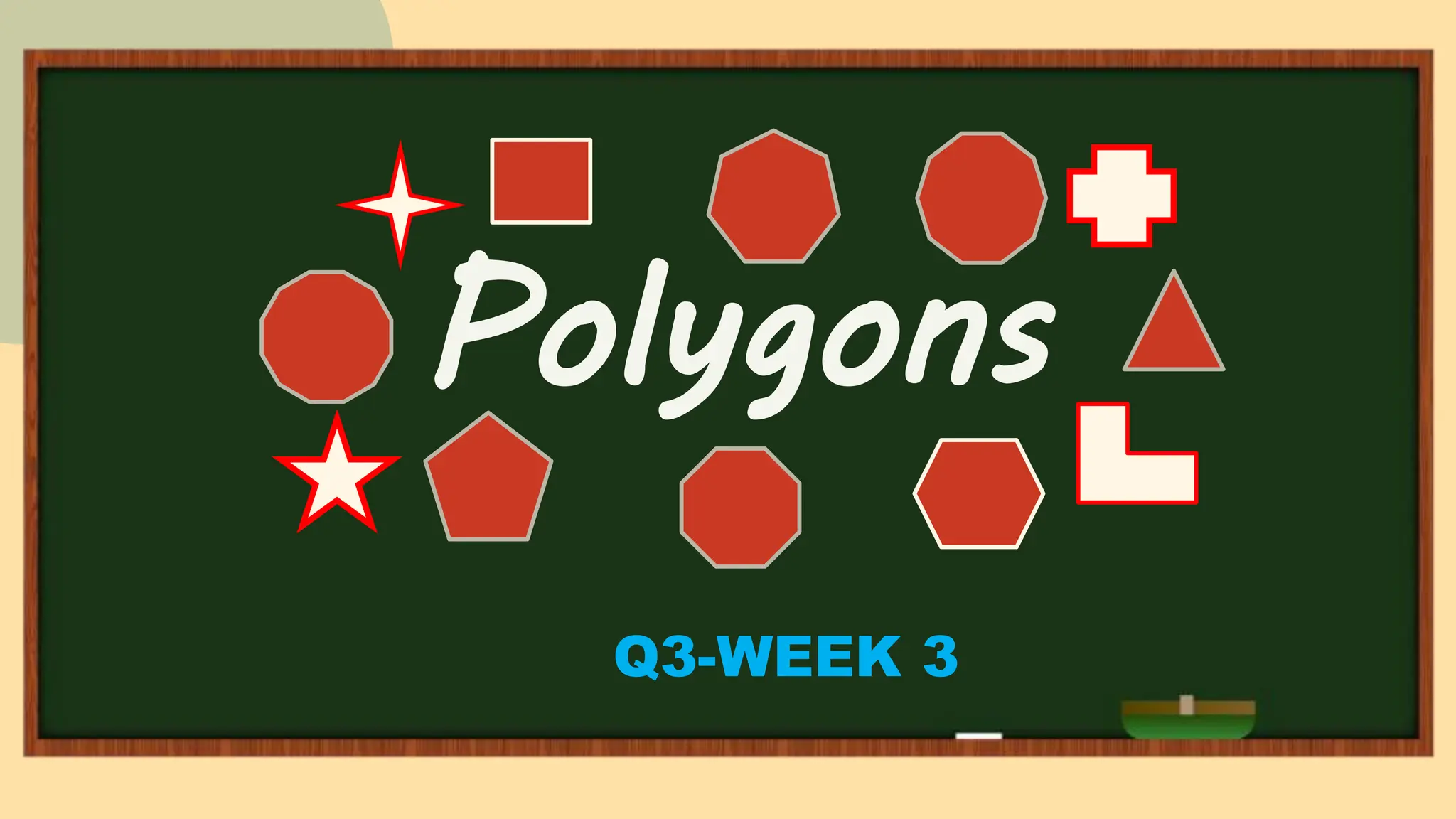
Polygons
Q3-WEEK 3
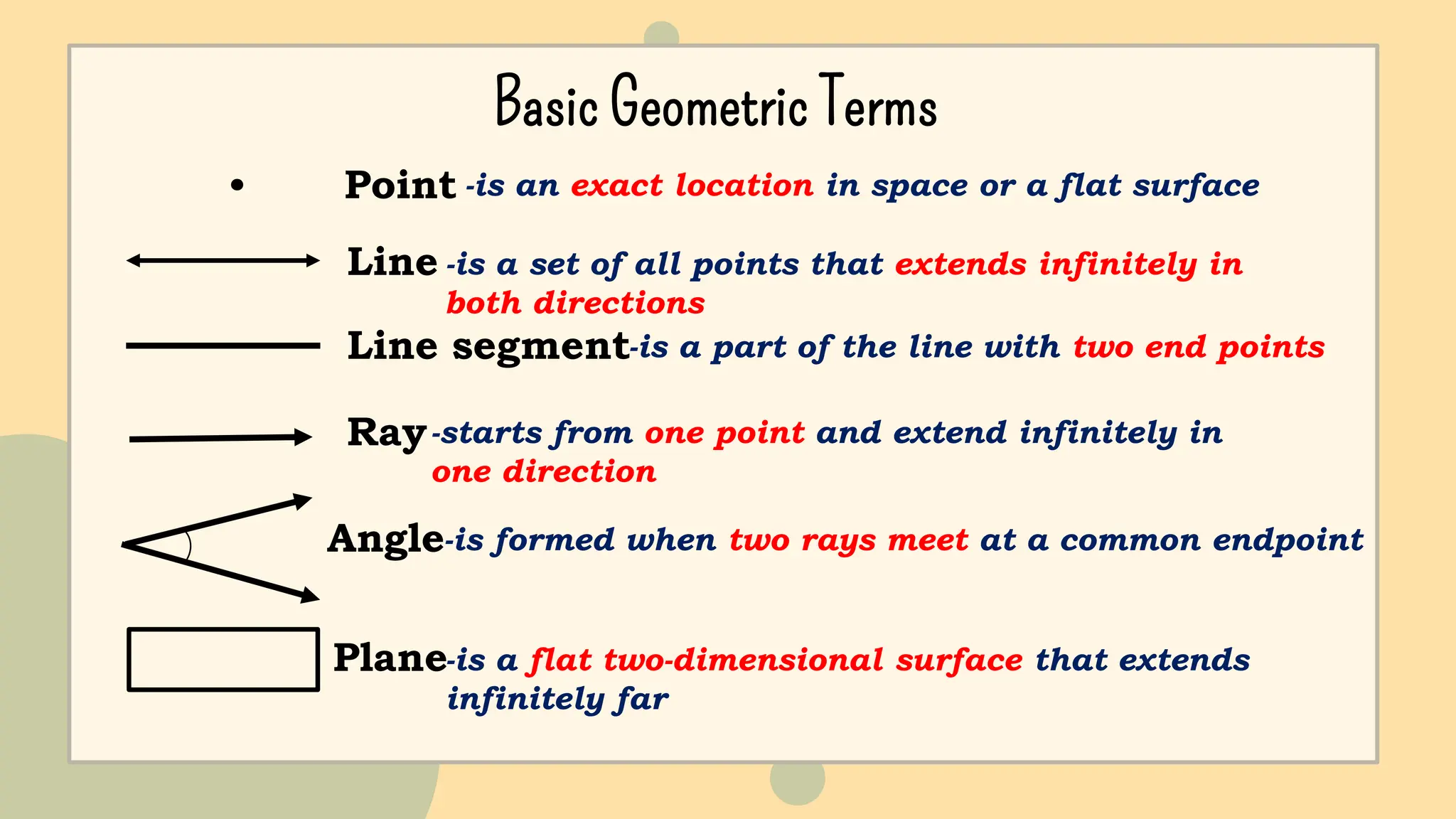
Basic Geometric Terms
. Point
Line
Line segment
Ray
Angle
Plane
-is an exact location in space or a flat surface
-is a set of all points that extends infinitely in
both directions
-is a part of the line with two end points
-starts from one point and extend infinitely in
one direction
-is formed when two rays meet at a common endpoint
-is a flat two-dimensional surface that extends
infinitely far
Visualizing, Naming,
Describing, and Drawing
Polygons with Five or
More Sides
LESSON 1
Polygon
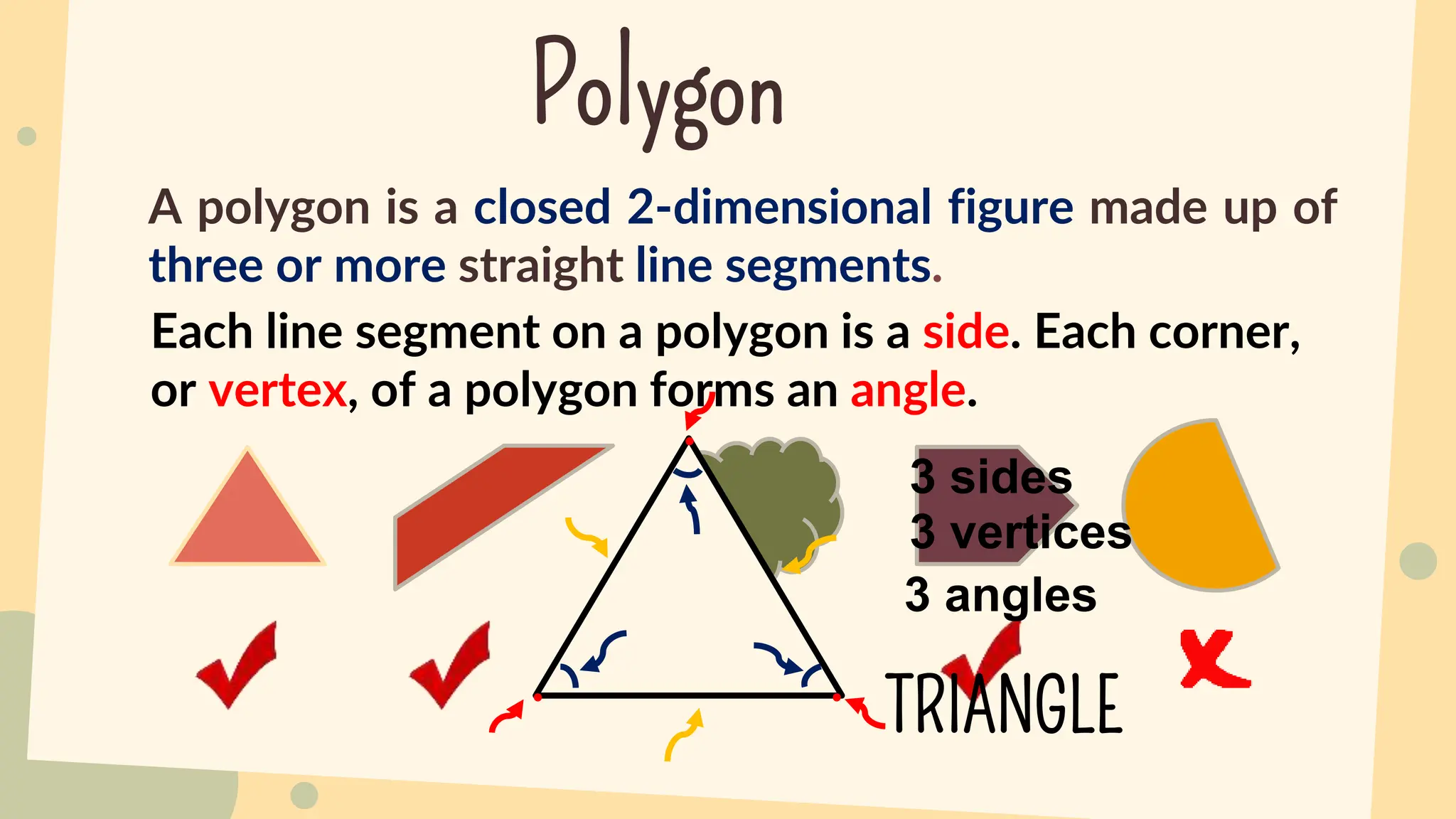
A polygon is a closed 2-dimensional figure made up of
three or more straight line segments.
Each line segment on a polygon is a side. Each corner,
or vertex, of a polygon forms an angle.
3 sides
.
. .
3 vertices
3 angles
TRIANGLE
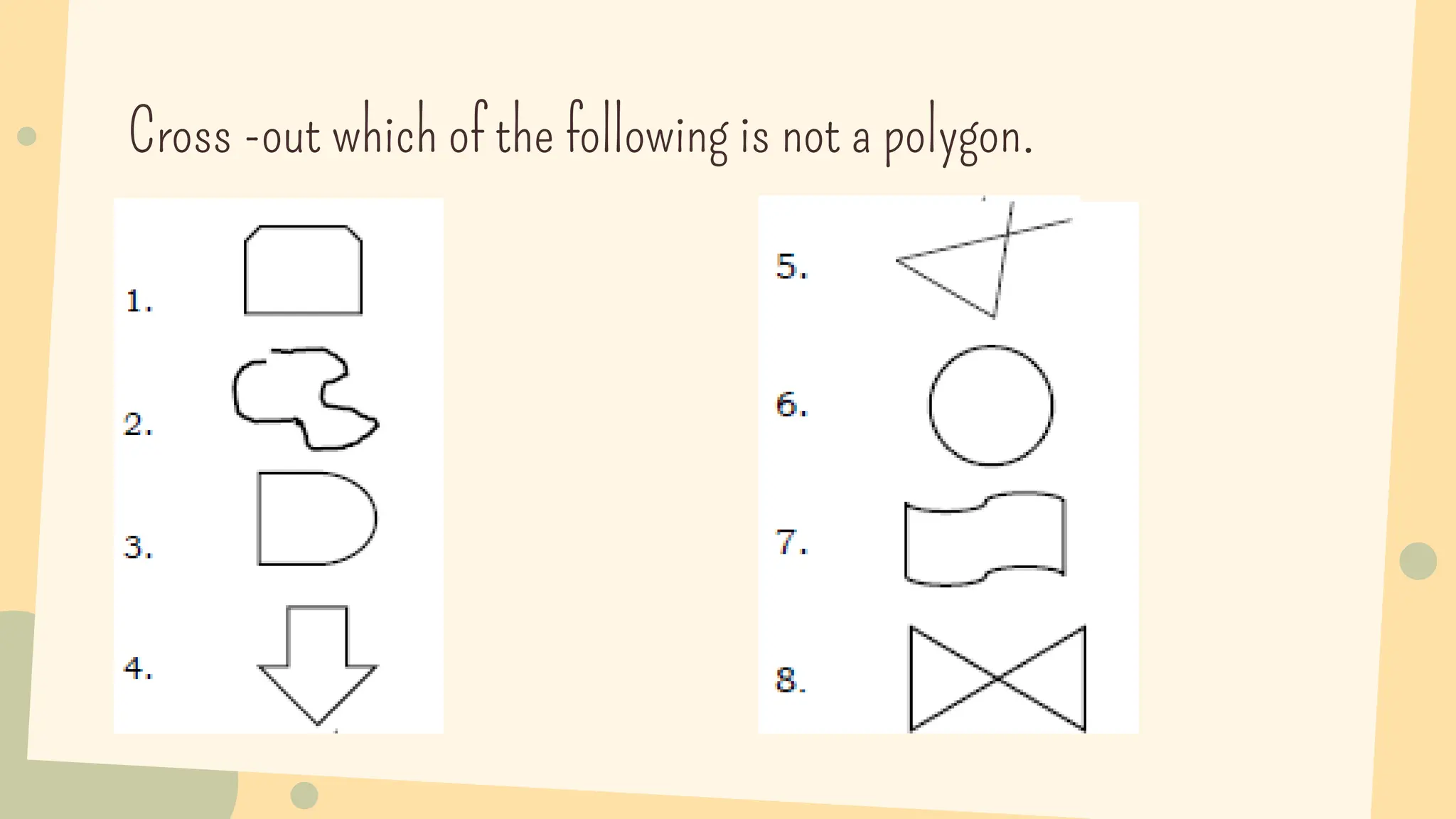
Cross -out which of the following is not a polygon.
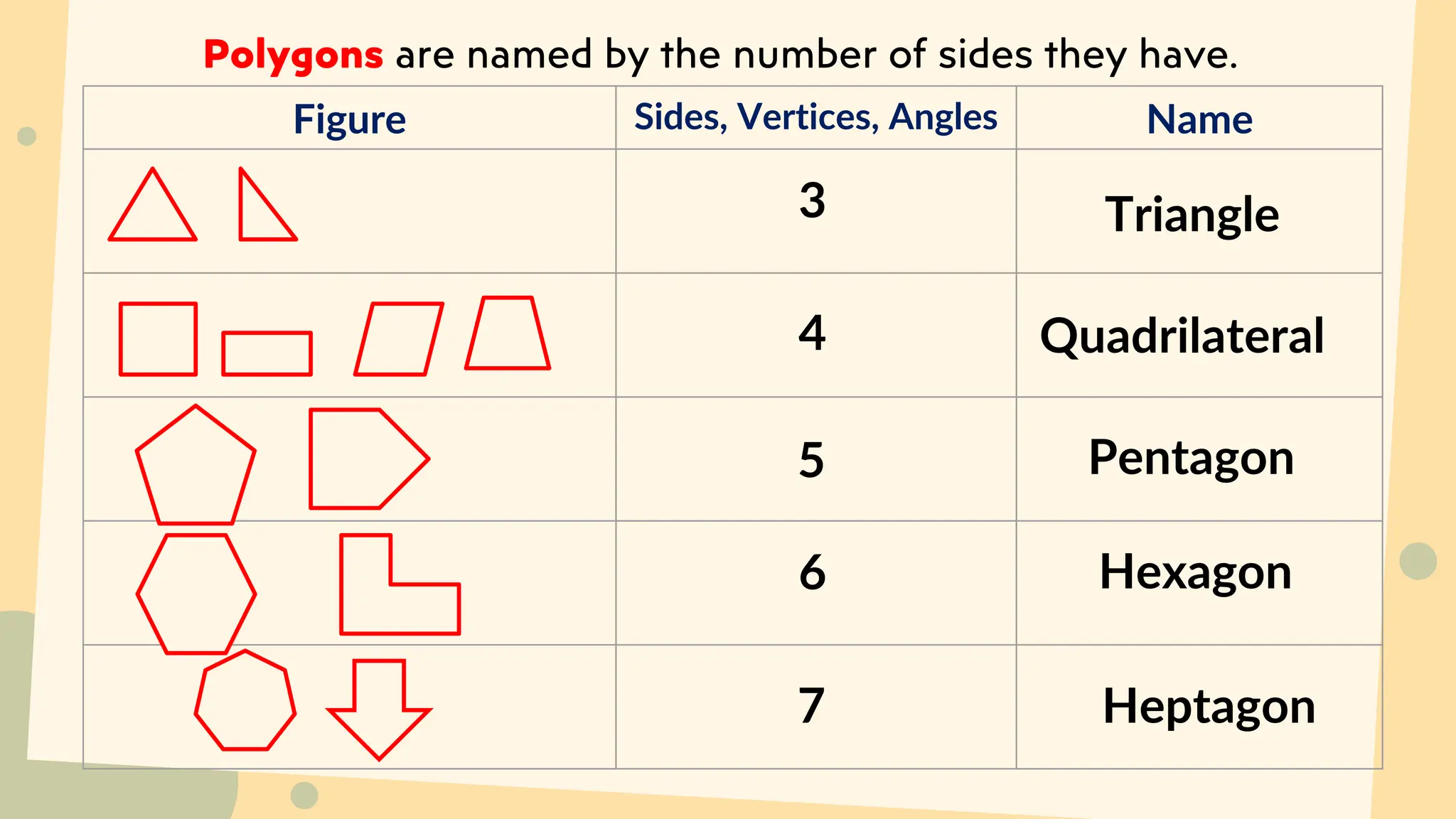
Polygons are named by the number of sides they have.
Figure Sides, Vertices, Angles Name
3 Triangle
4 Quadrilateral
5 Pentagon
6 Hexagon
7 Heptagon
Polygons are named by the number of sides they have.
Figure Sides, Vertices, Angles Name
8 Octagon
9 Nonagon
10 Decagon
11 Undecagon/
Hendecagon
12 Dodecagon
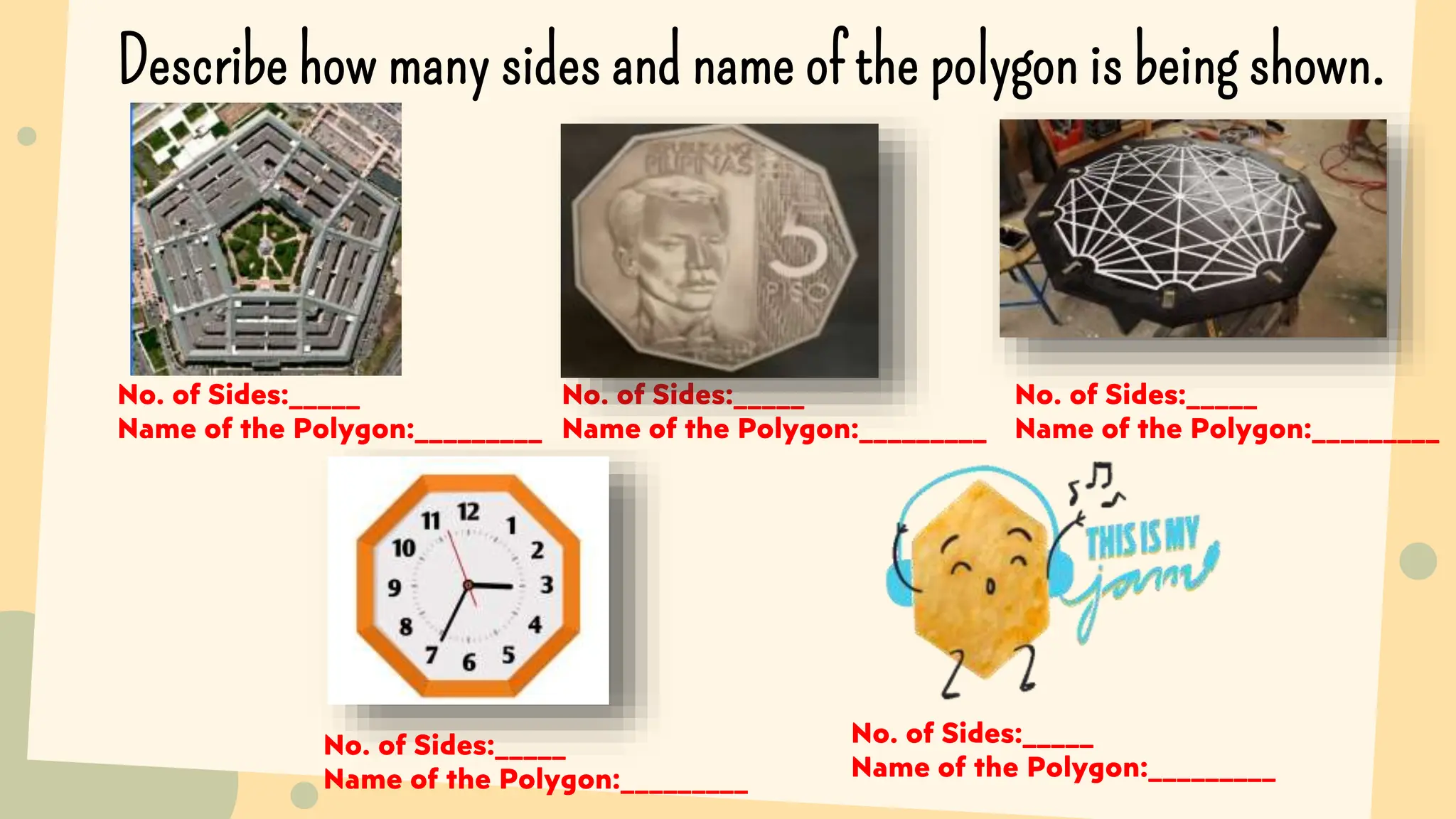
Describe how many sides and name of the polygon is being shown.
No. of Sides:_____
Name of the Polygon:_________
No. of Sides:_____
Name of the Polygon:_________
No. of Sides:_____
Name of the Polygon:_________
No. of Sides:_____
Name of the Polygon:_________
No. of Sides:_____
Name of the Polygon:_________
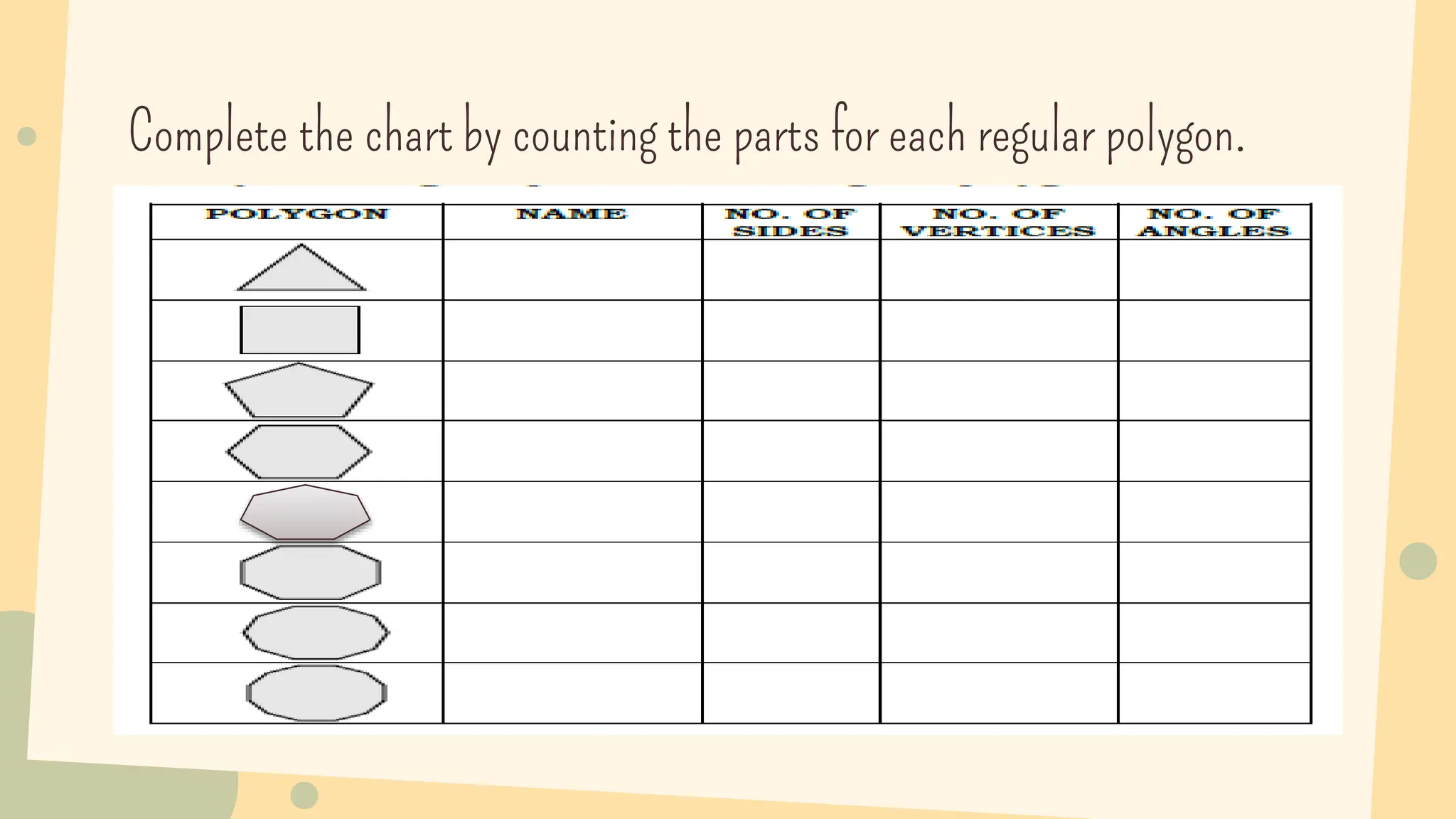
Complete the chart by counting the parts for each regular polygon.
Describing and Comparing
Properties of Polygons
(Regular and Irregular)
LESSON 2
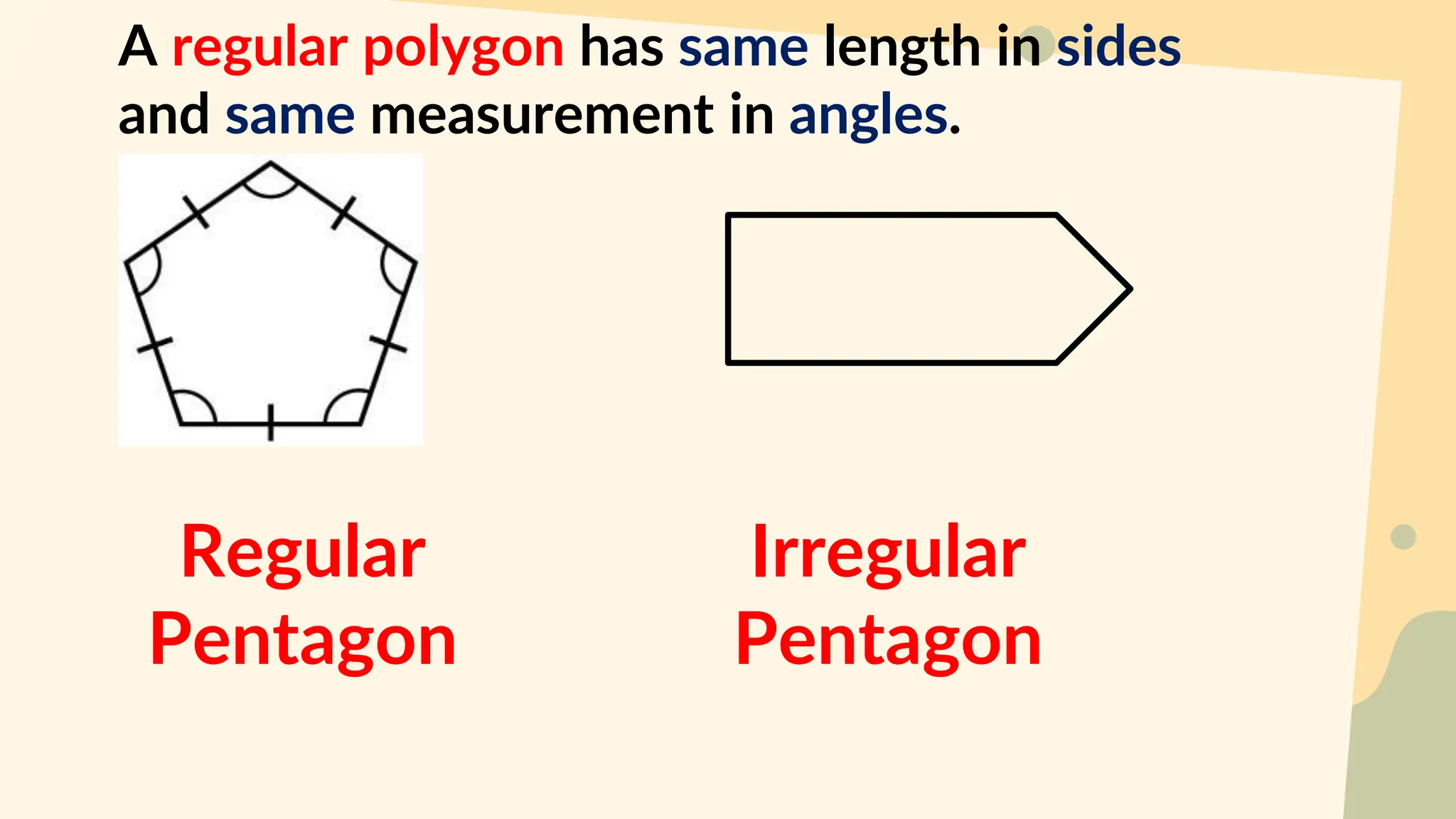
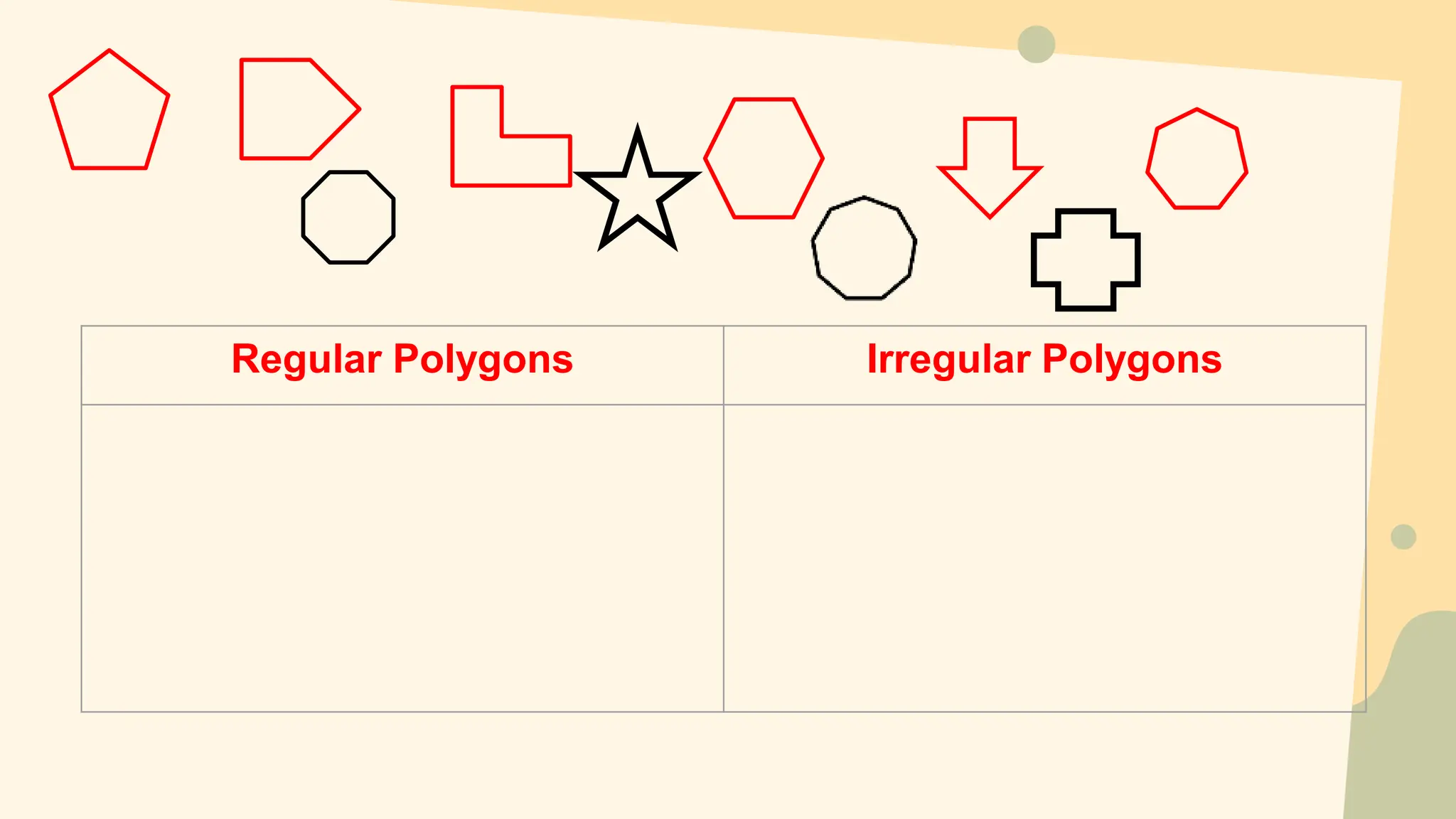
A regular polygon has same length in sides
and same measurement in angles.
Regular
Pentagon
Irregular
Pentagon
Regular Polygons Irregular Polygons
Visualizing Congruent
Polygons
LESSON 3
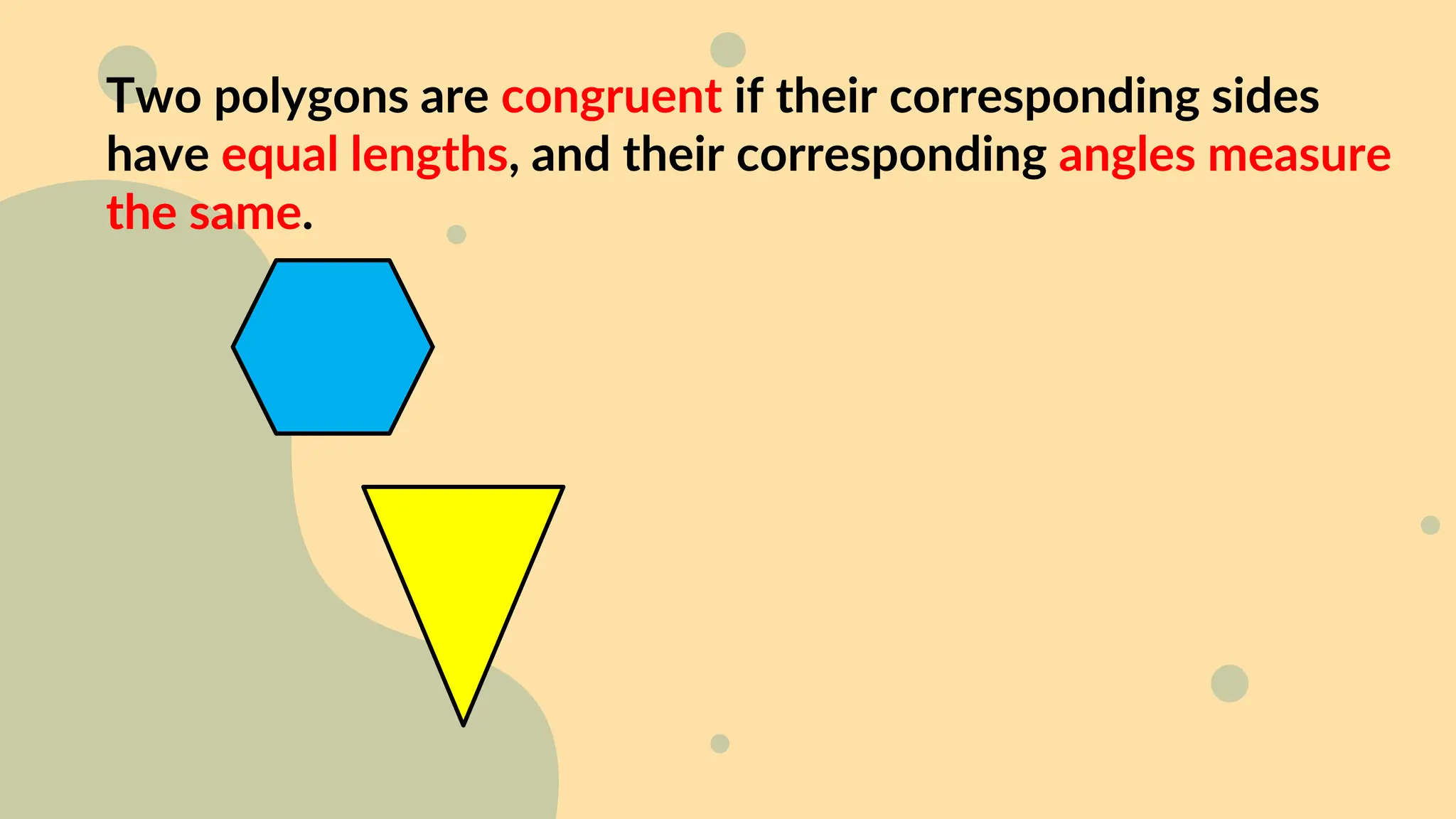
Two polygons are congruent if their corresponding sides
have equal lengths, and their corresponding angles measure
the same.
How to Draw a Regular Polygon Using a Protractor
Materials:
1. Protractor
2. Ruler
3. Pencil
How to Draw a Regular Polygon Using a Protractor
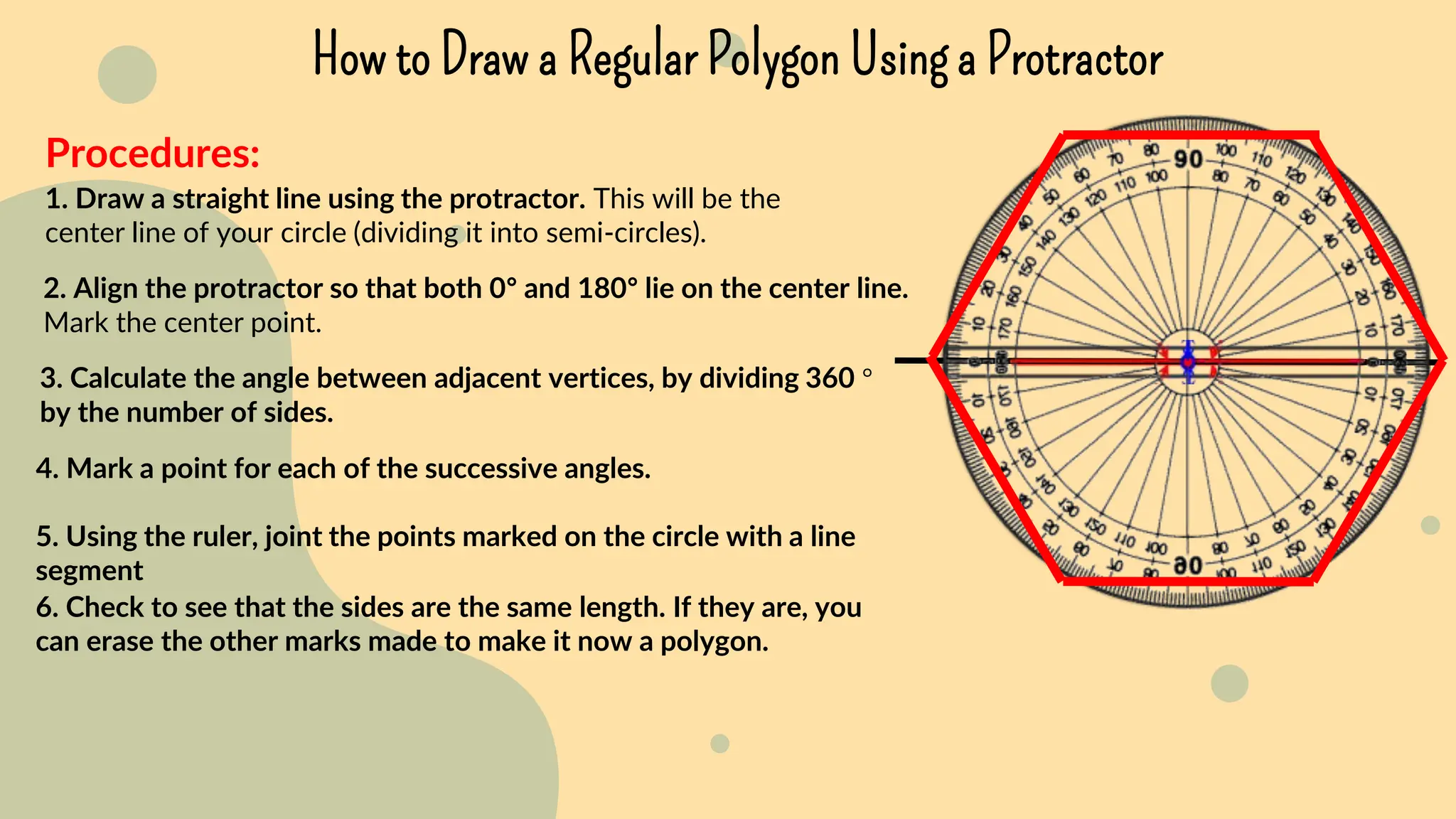
1. Draw a straight line using the protractor. This will be the
center line of your circle (dividing it into semi-circles).
Procedures:
2. Align the protractor so that both 0° and 180° lie on the center line.
Mark the center point.
3. Calculate the angle between adjacent vertices, by dividing 360 °
by the number of sides.
4. Mark a point for each of the successive angles.
5. Using the ruler, joint the points marked on the circle with a line
segment
6. Check to see that the sides are the same length. If they are, you
can erase the other marks made to make it now a polygon.
.
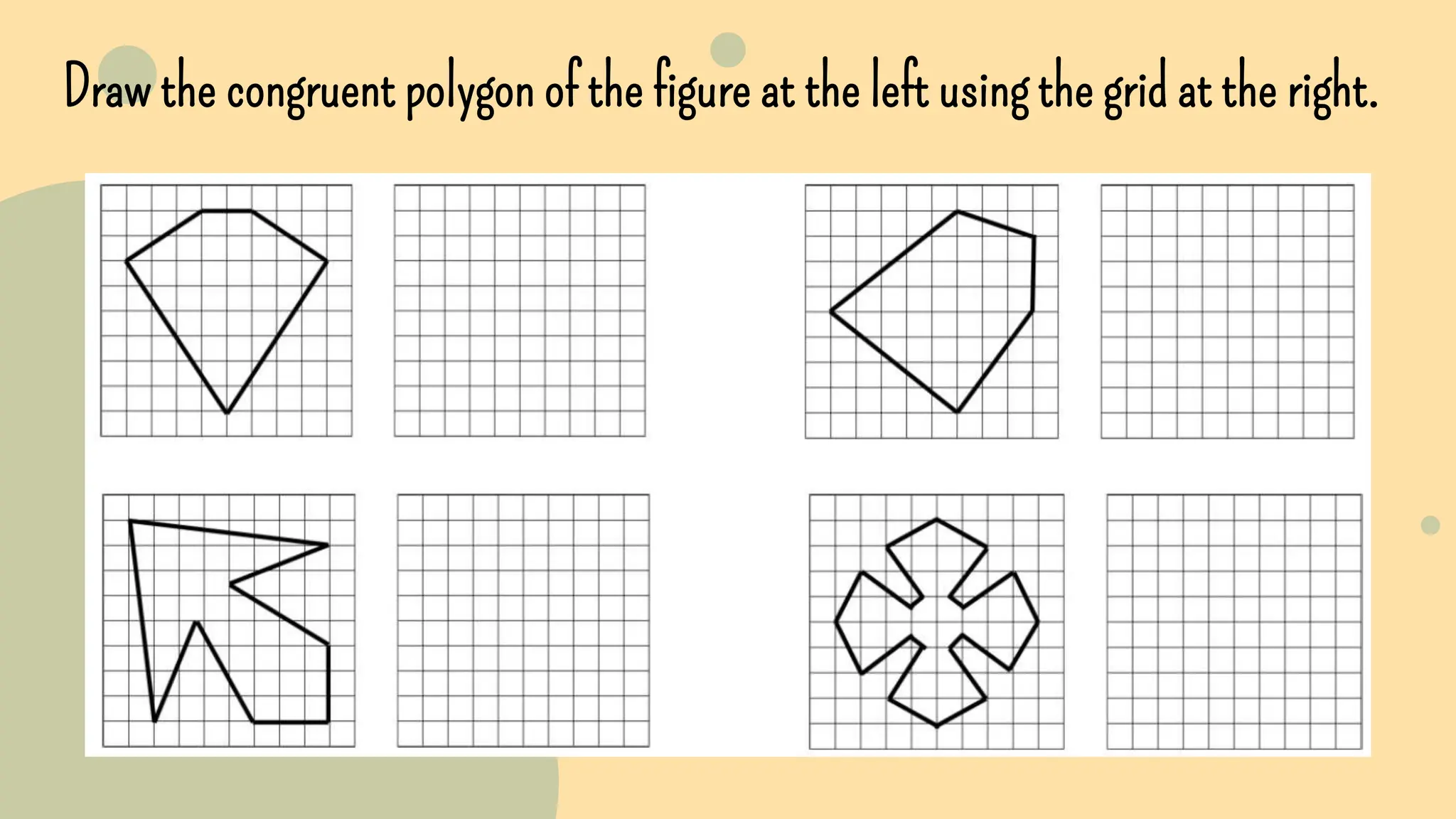
Draw the congruent polygon of the figure at the left using the grid at the right.
MATHtry
Nga!
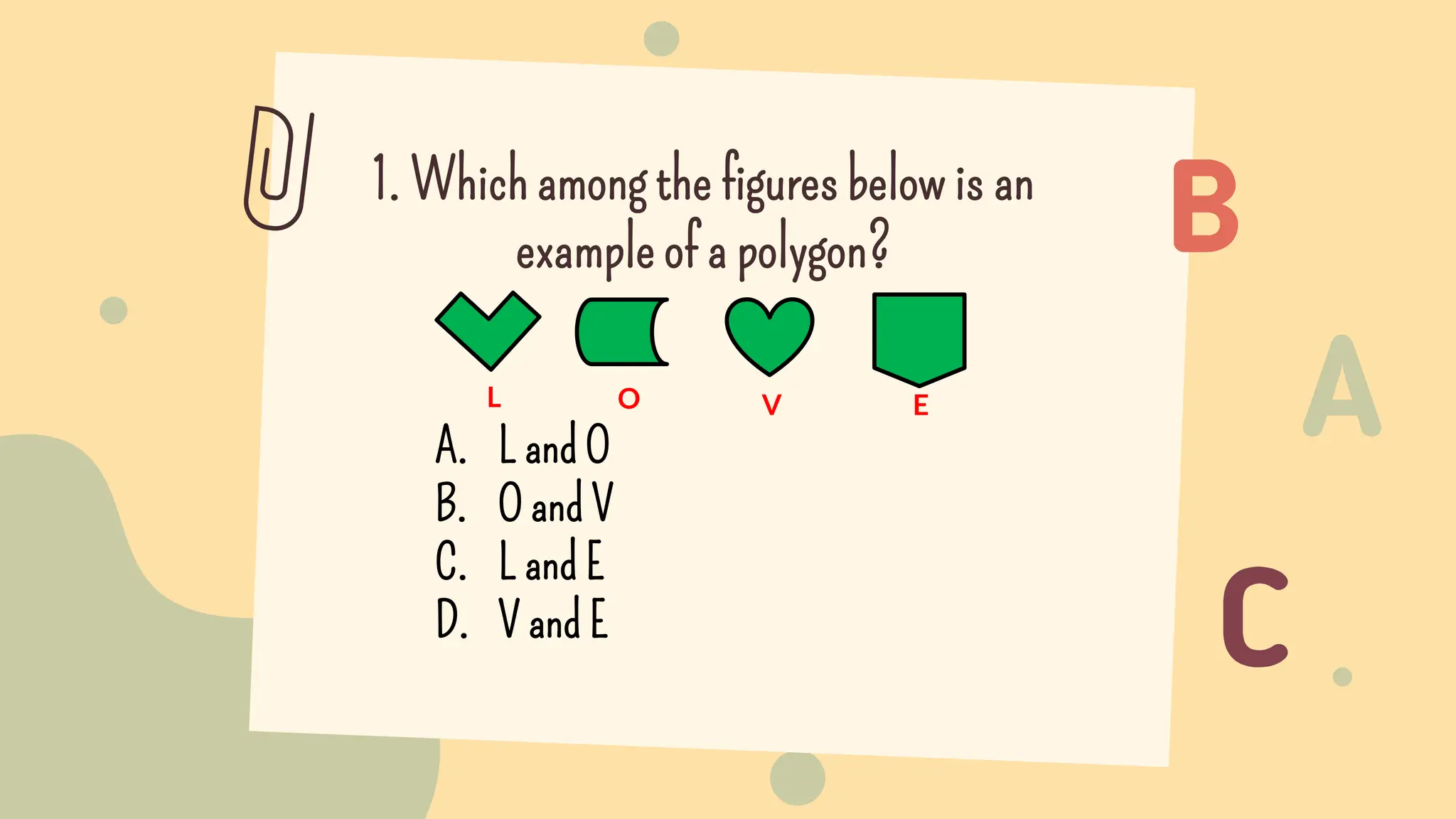
1. Which among the figures below is an
example of a polygon?
A. L and O
B. O and V
C. L and E
D. V and E
L O V E
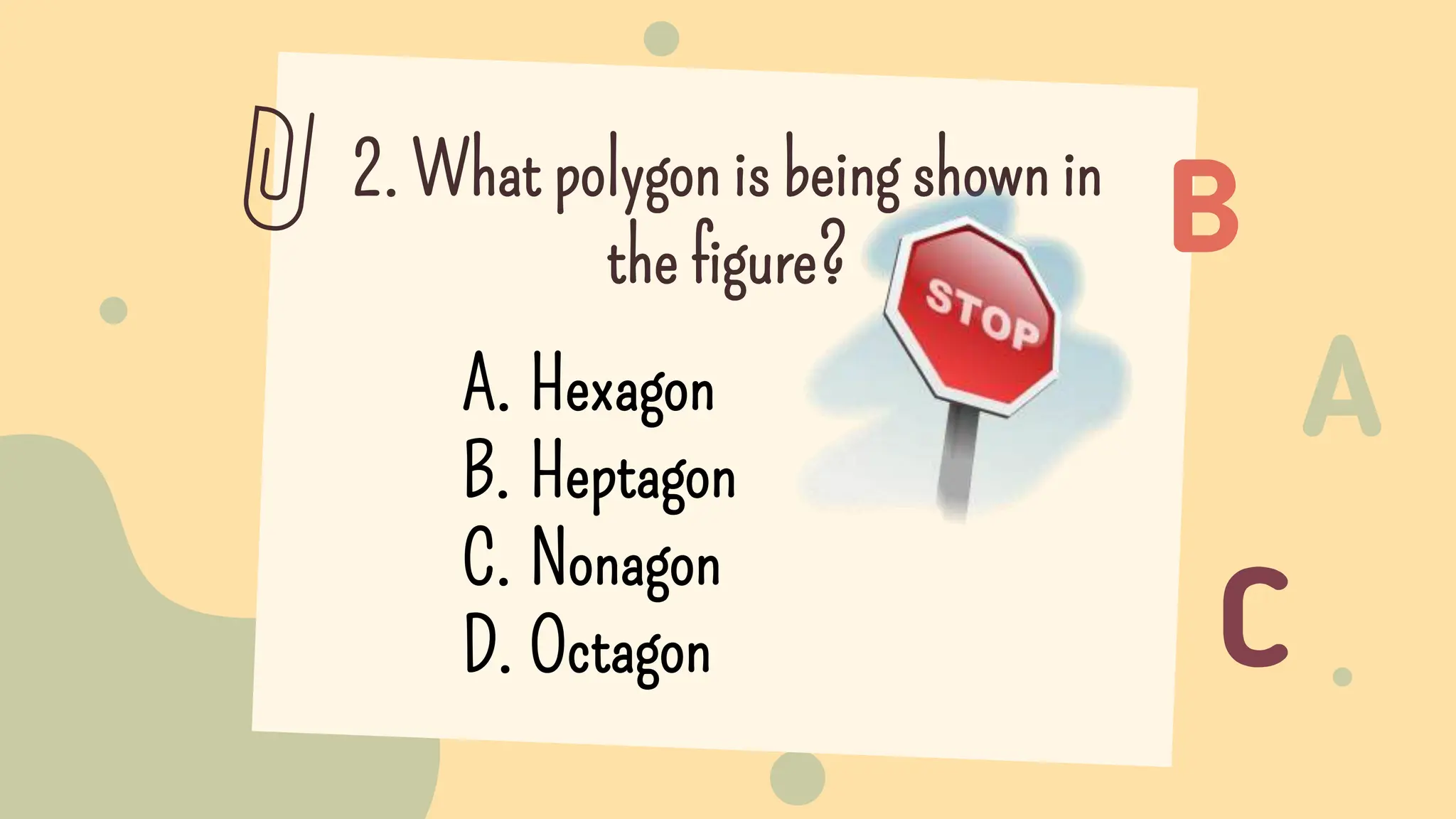
2. What polygon is being shown in
the figure?
A. Hexagon
B. Heptagon
C. Nonagon
D. Octagon
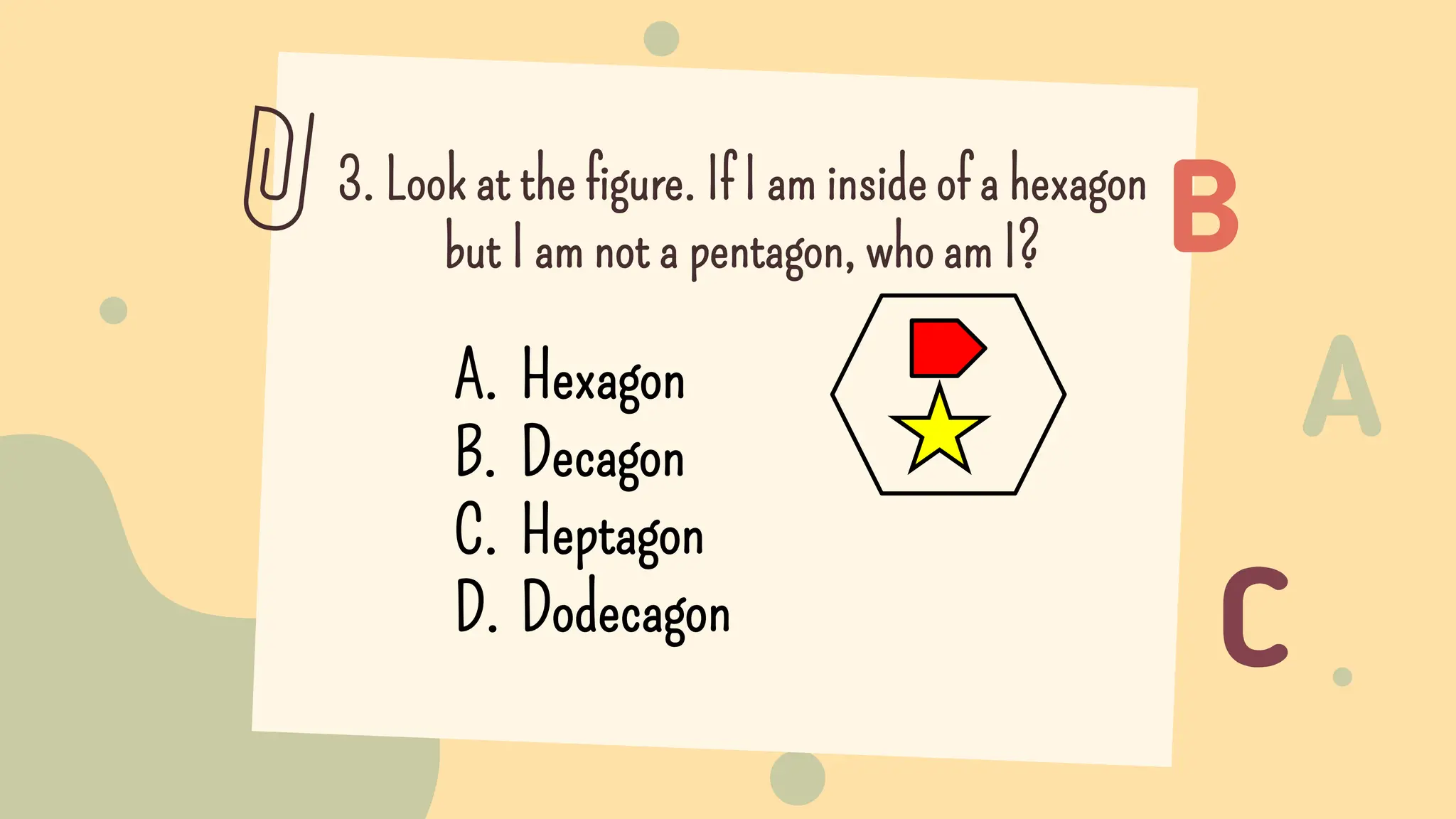
3. Look at the figure. If I am inside of a hexagon
but I am not a pentagon, who am I?
A. Hexagon
B. Decagon
C. Heptagon
D. Dodecagon
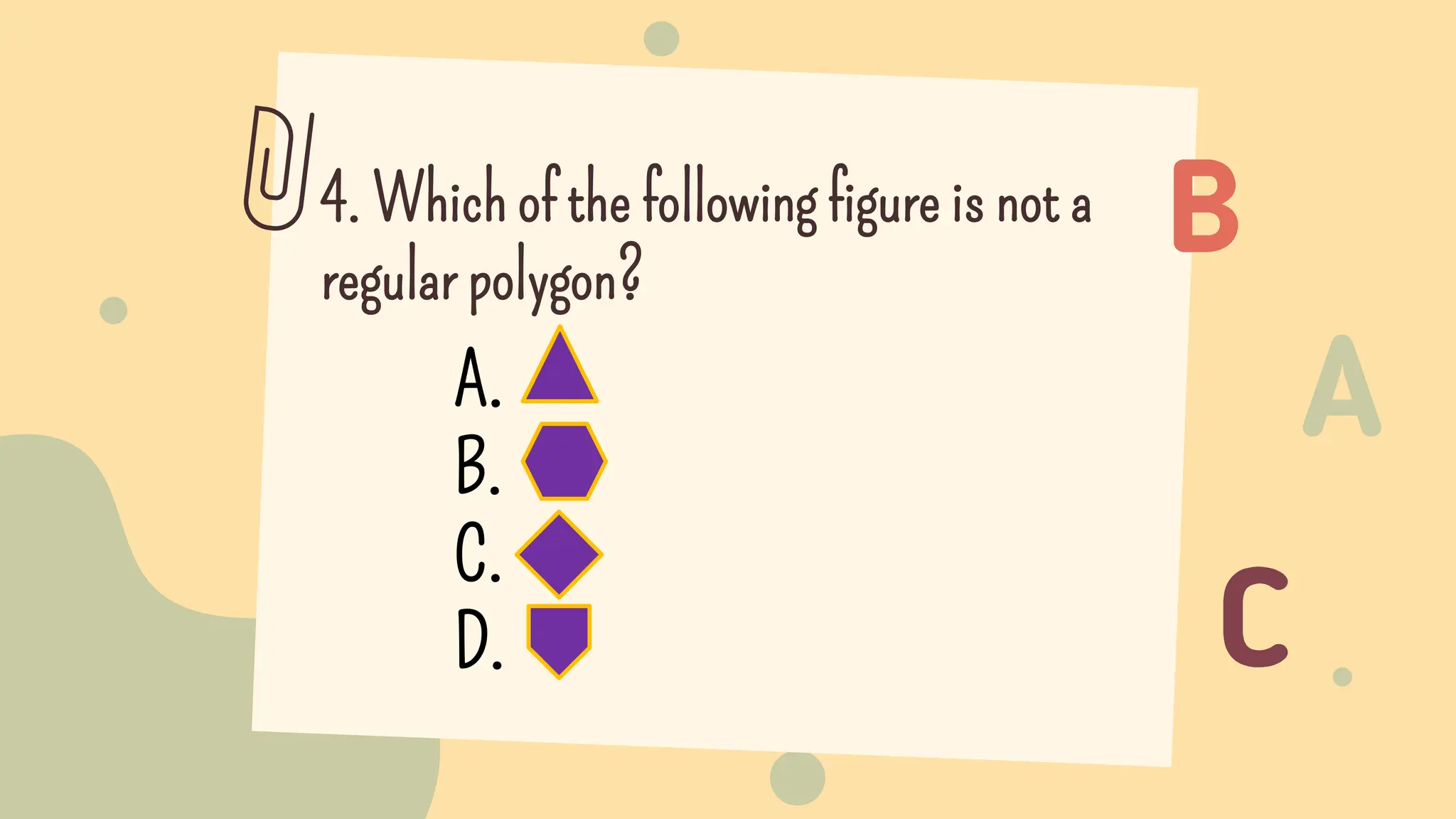
4. Which of the following figure is not a
regular polygon?
A.
B.
C.
D.
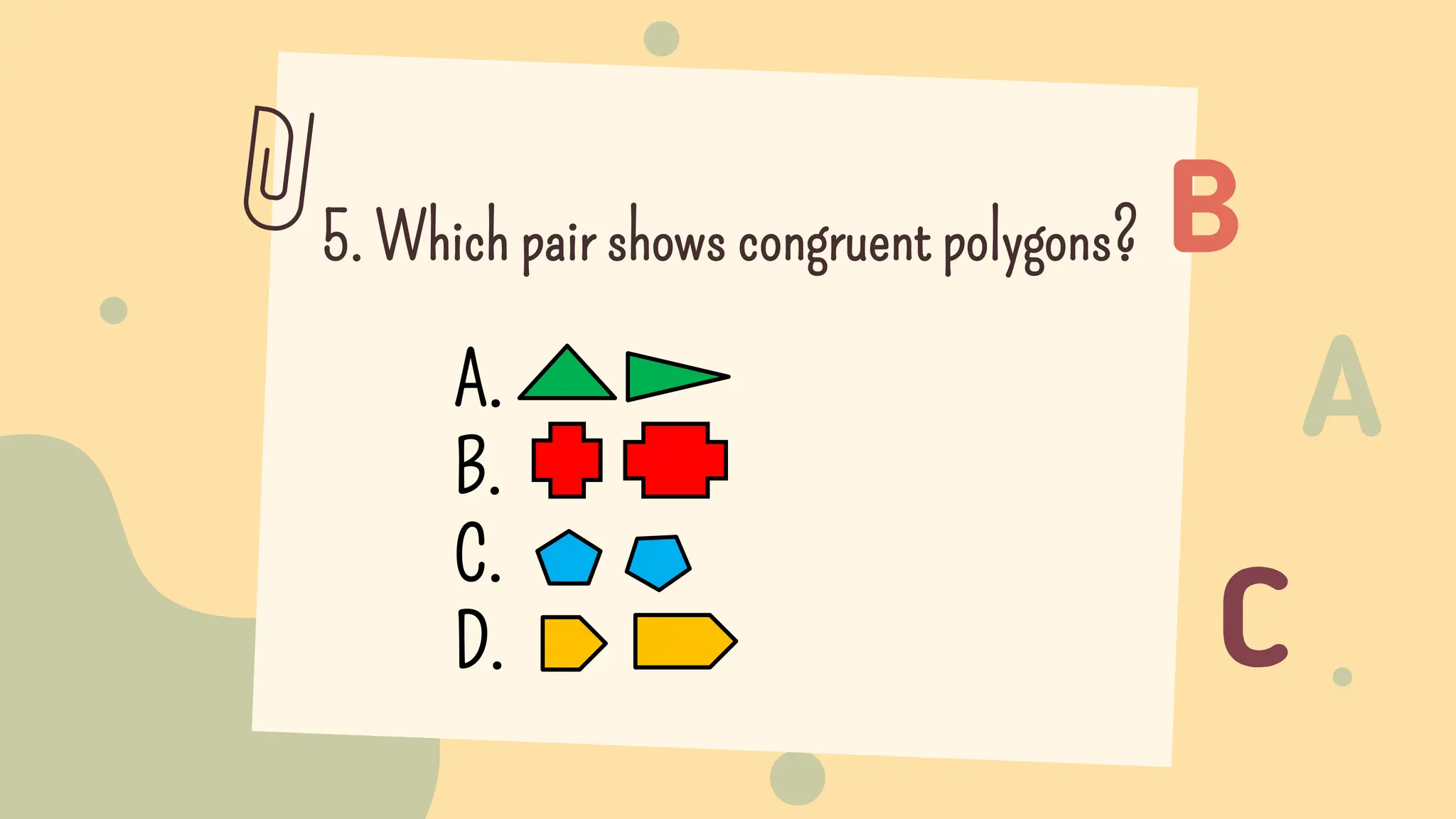
5. Which pair shows congruent polygons?
A.
B.
C.
D.
ASYNCHRONOUS ACTIVITY
What I Can Do and Assessment on
pages 8-9 (SLM)

Polygons.pptx GRADE 5 MATHEMATICS - 3RD QUARTER

  • 1.
  • 2.
    Basic Geometric Terms .Point Line Line segment Ray Angle Plane -is an exact location in space or a flat surface -is a set of all points that extends infinitely in both directions -is a part of the line with two end points -starts from one point and extend infinitely in one direction -is formed when two rays meet at a common endpoint -is a flat two-dimensional surface that extends infinitely far
  • 3.
    Visualizing, Naming, Describing, andDrawing Polygons with Five or More Sides LESSON 1
  • 4.
    Polygon A polygon isa closed 2-dimensional figure made up of three or more straight line segments. Each line segment on a polygon is a side. Each corner, or vertex, of a polygon forms an angle. 3 sides . . . 3 vertices 3 angles TRIANGLE
  • 5.
    Cross -out whichof the following is not a polygon.
  • 6.
    Polygons are namedby the number of sides they have. Figure Sides, Vertices, Angles Name 3 Triangle 4 Quadrilateral 5 Pentagon 6 Hexagon 7 Heptagon
  • 7.
    Polygons are namedby the number of sides they have. Figure Sides, Vertices, Angles Name 8 Octagon 9 Nonagon 10 Decagon 11 Undecagon/ Hendecagon 12 Dodecagon
  • 8.
    Describe how manysides and name of the polygon is being shown. No. of Sides:_____ Name of the Polygon:_________ No. of Sides:_____ Name of the Polygon:_________ No. of Sides:_____ Name of the Polygon:_________ No. of Sides:_____ Name of the Polygon:_________ No. of Sides:_____ Name of the Polygon:_________
  • 9.
    Complete the chartby counting the parts for each regular polygon.
  • 10.
    Describing and Comparing Propertiesof Polygons (Regular and Irregular) LESSON 2
  • 11.
    A regular polygonhas same length in sides and same measurement in angles. Regular Pentagon Irregular Pentagon
  • 12.
  • 13.
  • 14.
    Two polygons arecongruent if their corresponding sides have equal lengths, and their corresponding angles measure the same.
  • 15.
    How to Drawa Regular Polygon Using a Protractor Materials: 1. Protractor 2. Ruler 3. Pencil
  • 16.
    How to Drawa Regular Polygon Using a Protractor 1. Draw a straight line using the protractor. This will be the center line of your circle (dividing it into semi-circles). Procedures: 2. Align the protractor so that both 0° and 180° lie on the center line. Mark the center point. 3. Calculate the angle between adjacent vertices, by dividing 360 ° by the number of sides. 4. Mark a point for each of the successive angles. 5. Using the ruler, joint the points marked on the circle with a line segment 6. Check to see that the sides are the same length. If they are, you can erase the other marks made to make it now a polygon. .
  • 17.
    Draw the congruentpolygon of the figure at the left using the grid at the right.
  • 18.
  • 19.
    1. Which amongthe figures below is an example of a polygon? A. L and O B. O and V C. L and E D. V and E L O V E
  • 20.
    2. What polygonis being shown in the figure? A. Hexagon B. Heptagon C. Nonagon D. Octagon
  • 21.
    3. Look atthe figure. If I am inside of a hexagon but I am not a pentagon, who am I? A. Hexagon B. Decagon C. Heptagon D. Dodecagon
  • 22.
    4. Which ofthe following figure is not a regular polygon? A. B. C. D.
  • 23.
    5. Which pairshows congruent polygons? A. B. C. D.
  • 24.
    ASYNCHRONOUS ACTIVITY What ICan Do and Assessment on pages 8-9 (SLM)