 The nutrients to be supplied daily in the right
proportion for optimum utilization and proper body
maintenance.This can be achieved by taking a
balanced diet every day.
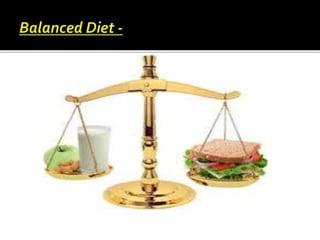
 Definition – “ A balanced diet is one which includes
all the nutrients in correct proportion or adequate
amounts to promote and preserve health.”
 Dietetics – Is a science that deals with the
adequacy of diets during normal life cycle &
modification required during diseased conditions.
 Menu planning – Is the process of planning &
scheduling intake of meals for a general or specific
individual requirements.
 A balanced diet should provide around 60-
70% of total calories from CHO preferable
from complex carbs.About 10-15% from
proteins & 20-30% from fat. In addition a
balanced diet should provide other non-
nutrients i.e. dietary fiber
,antioxidant,phytochemicals which gives +ve
health benefit
 Meets nutritional requirements.
 Prevents degenerative diseases.
 Improve longevity.
 Prolong productive life.
 Improve immunity.
 Increase endurance level.
Antioxidant –VitaminsC,E,A , beta-carotene and
selenium protect the body from free radical
damage .
Phyto chemicals –polyphenols,flavones etc
Spices –Turmeric ,ginger, garlic cumin seeds
and cloves are rich in antioxidant.
1) Recommended Dietary Allowances (RDA)
RDA is defined as the nutrient present in the
diet which satisfies the daily requirement of
nearly all individuals in a population
RDA depends on many factors –
Age
Sex
Physical work
Physiological stress
 2) Food Exchange Lists- Is the groups of
measured foods of the same proteins, fats,
carbohydrates & calorific values
3) Five Food Group System- The five food group
plan permits an individual to plan a menu to
achieve nutrient intake as specified by RDA
 Cereals grains & products
 Pulses & legumes
 Milk & meat products
 Fruit & vegetables
 Fats & sugars
 ERA (EstimatedAverage Requirement)
 TUL (Tolerable Upper Level)
 AI (Adequate Intake)
 LTI (LowerThreshold Intake)
 Meets nutritional requirement
 Meal pattern must fulfill family needs
 Meal planning should save time & energy
 Economic consideration
 Meal plan should give maximum nutrients
 Consideration for individual likes & dislikes
 Planned meal should provide variety
 Meals should give satiety
The total calories distributions
 60-70% of calories from carbohydrates
 10-20% from proteins
 20-25% from fat
 Eat variety of foods.
 Ensure provision of extra food & healthcare for
pregnant & lactating women .
 Promote exclusive breast feeding for six months &
encourage B.F.till two years.
 Eat plenty of fruits & vegetables.
 Ensure moderate use of edible oils, animal foods&
butter/ ghee.
 Overeating should be avoided to prevent
overweight/obesity.
 Use salt in moderation
 Practice right cooking methods & healthy eating
habits.
 Drink plenty of water & take beverages in
moderation.
 Minimize the use of processed foods rich in
salt,sugar&fats.
 Exercise regularly & be physically active.
 Expenditure on food is an important & often largest
part of the family ‘s budget.The following factors to
be consider while budgeting of food
 Number of family members
 Family income Local market
 Home prepared & convenient food
 Snacks items & beverages
 Alternative marketing choice
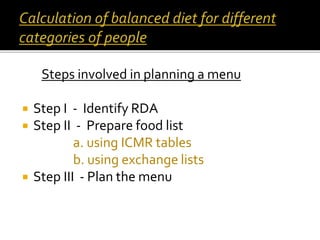
Steps involved in planning a menu
 Step I - Identify RDA
 Step II - Prepare food list
a. using ICMR tables
b. using exchange lists
 Step III - Plan the menu
Balanced Diet 05.ppt

Balanced Diet 05.ppt

  • 2.
     The nutrientsto be supplied daily in the right proportion for optimum utilization and proper body maintenance.This can be achieved by taking a balanced diet every day.  Definition – “ A balanced diet is one which includes all the nutrients in correct proportion or adequate amounts to promote and preserve health.”
  • 3.
     Dietetics –Is a science that deals with the adequacy of diets during normal life cycle & modification required during diseased conditions.  Menu planning – Is the process of planning & scheduling intake of meals for a general or specific individual requirements.
  • 4.
     A balanceddiet should provide around 60- 70% of total calories from CHO preferable from complex carbs.About 10-15% from proteins & 20-30% from fat. In addition a balanced diet should provide other non- nutrients i.e. dietary fiber ,antioxidant,phytochemicals which gives +ve health benefit
  • 5.
     Meets nutritionalrequirements.  Prevents degenerative diseases.  Improve longevity.  Prolong productive life.  Improve immunity.  Increase endurance level.
  • 6.
    Antioxidant –VitaminsC,E,A ,beta-carotene and selenium protect the body from free radical damage . Phyto chemicals –polyphenols,flavones etc Spices –Turmeric ,ginger, garlic cumin seeds and cloves are rich in antioxidant.
  • 9.
    1) Recommended DietaryAllowances (RDA) RDA is defined as the nutrient present in the diet which satisfies the daily requirement of nearly all individuals in a population RDA depends on many factors – Age Sex Physical work Physiological stress
  • 10.
     2) FoodExchange Lists- Is the groups of measured foods of the same proteins, fats, carbohydrates & calorific values
  • 11.
    3) Five FoodGroup System- The five food group plan permits an individual to plan a menu to achieve nutrient intake as specified by RDA  Cereals grains & products  Pulses & legumes  Milk & meat products  Fruit & vegetables  Fats & sugars
  • 12.
     ERA (EstimatedAverageRequirement)  TUL (Tolerable Upper Level)  AI (Adequate Intake)  LTI (LowerThreshold Intake)
  • 16.
     Meets nutritionalrequirement  Meal pattern must fulfill family needs  Meal planning should save time & energy  Economic consideration  Meal plan should give maximum nutrients  Consideration for individual likes & dislikes  Planned meal should provide variety  Meals should give satiety
  • 17.
    The total caloriesdistributions  60-70% of calories from carbohydrates  10-20% from proteins  20-25% from fat
  • 18.
     Eat varietyof foods.  Ensure provision of extra food & healthcare for pregnant & lactating women .  Promote exclusive breast feeding for six months & encourage B.F.till two years.  Eat plenty of fruits & vegetables.  Ensure moderate use of edible oils, animal foods& butter/ ghee.  Overeating should be avoided to prevent overweight/obesity.
  • 19.
     Use saltin moderation  Practice right cooking methods & healthy eating habits.  Drink plenty of water & take beverages in moderation.  Minimize the use of processed foods rich in salt,sugar&fats.  Exercise regularly & be physically active.
  • 20.
     Expenditure onfood is an important & often largest part of the family ‘s budget.The following factors to be consider while budgeting of food  Number of family members  Family income Local market  Home prepared & convenient food  Snacks items & beverages  Alternative marketing choice
  • 21.
    Steps involved inplanning a menu  Step I - Identify RDA  Step II - Prepare food list a. using ICMR tables b. using exchange lists  Step III - Plan the menu