Multiple benefits of energy
 efficiency: the UK perspective


Sarah Meagher
Energy Efficiency Deployment Office
14 March 2012
• Policy assessment framework
• Focus on fuel poverty
• Evaluating benefits
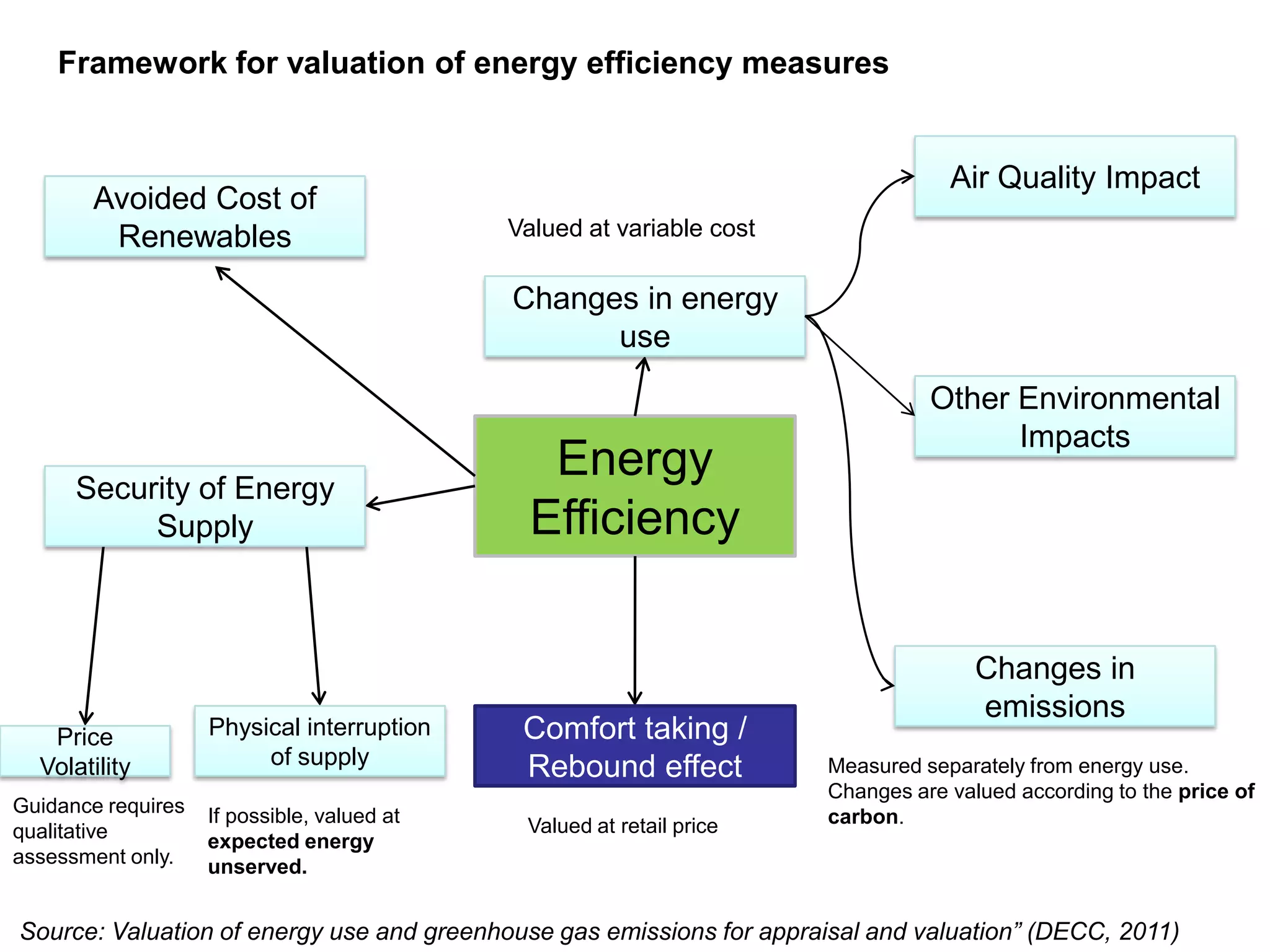
Framework for valuation of energy efficiency measures


                                                                                   Air Quality Impact
       Avoided Cost of
        Renewables                           Valued at variable cost

                                             Changes in energy
                                                   use
                                                                                 Other Environmental
                                                                                       Impacts
      Security of Energy
                                                Energy
           Supply                              Efficiency

                                                                                      Changes in
                                                                                      emissions
   Price            Physical interruption     Comfort taking /
  Volatility             of supply            Rebound effect           Measured separately from energy use.
                                                                       Changes are valued according to the price of
Guidance requires   If possible, valued at    Valued at retail price   carbon.
qualitative         expected energy
assessment only.    unserved.


Source: Valuation of energy use and greenhouse gas emissions for appraisal and valuation” (DECC, 2011)
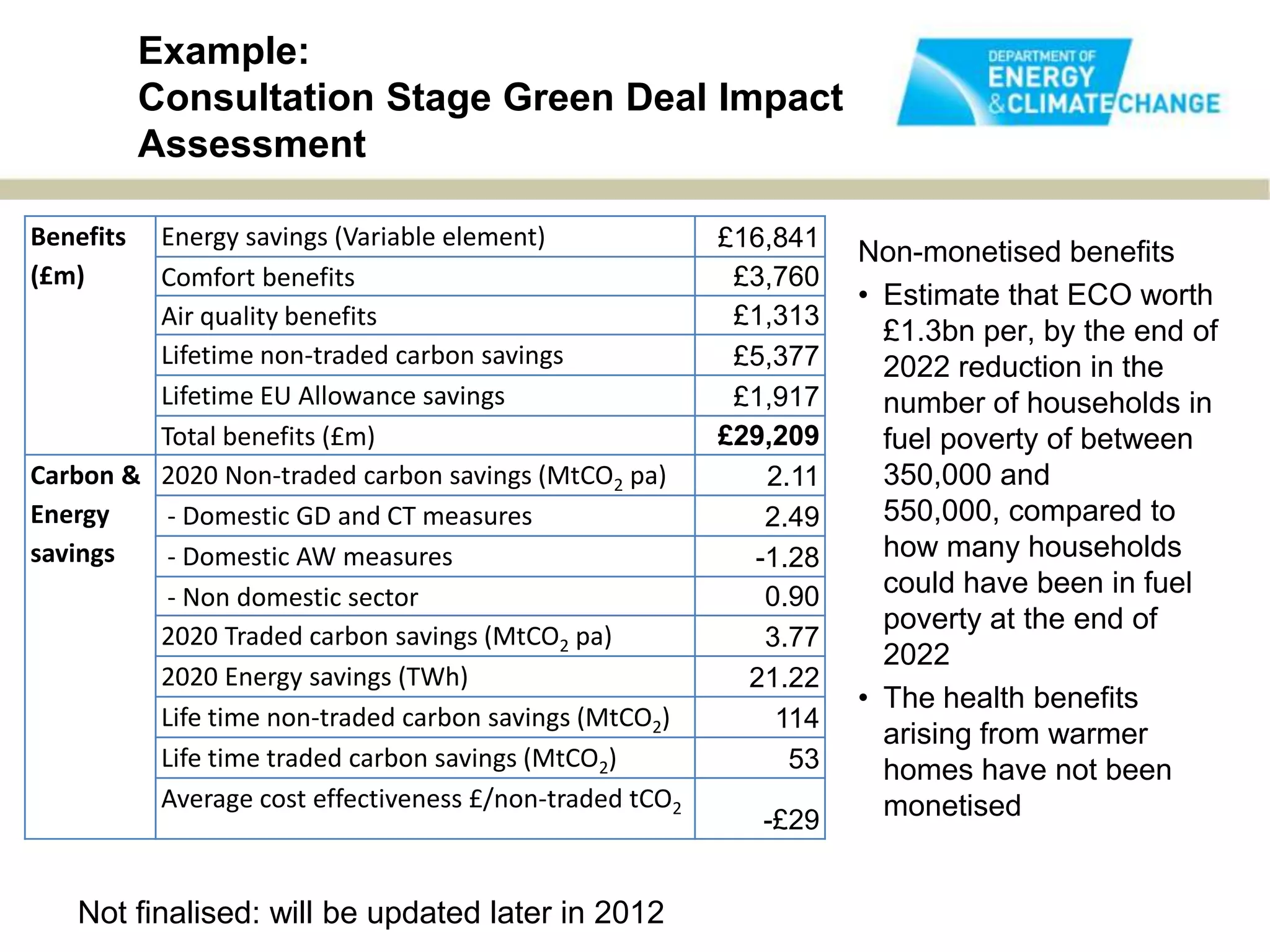
Example:
           Consultation Stage Green Deal Impact
           Assessment

Benefits Energy savings (Variable element)              £16,841
                                                                  Non-monetised benefits
(£m)     Comfort benefits                                £3,760
                                                                  • Estimate that ECO worth
         Air quality benefits                            £1,313
                                                                    £1.3bn per, by the end of
         Lifetime non-traded carbon savings              £5,377     2022 reduction in the
         Lifetime EU Allowance savings                   £1,917     number of households in
         Total benefits (£m)                            £29,209     fuel poverty of between
Carbon & 2020 Non-traded carbon savings (MtCO2 pa)         2.11     350,000 and
Energy    - Domestic GD and CT measures                    2.49     550,000, compared to
savings   - Domestic AW measures                          -1.28     how many households
          - Non domestic sector                            0.90     could have been in fuel
                                                                    poverty at the end of
         2020 Traded carbon savings (MtCO2 pa)             3.77
                                                                    2022
         2020 Energy savings (TWh)                        21.22
                                                                  • The health benefits
         Life time non-traded carbon savings (MtCO2)        114
                                                                    arising from warmer
         Life time traded carbon savings (MtCO2)             53     homes have not been
         Average cost effectiveness £/non-traded tCO2               monetised
                                                           -£29


   Not finalised: will be updated later in 2012
• Policy assessment framework
• Focus on fuel poverty
• Evaluating benefits
Fuel Poverty


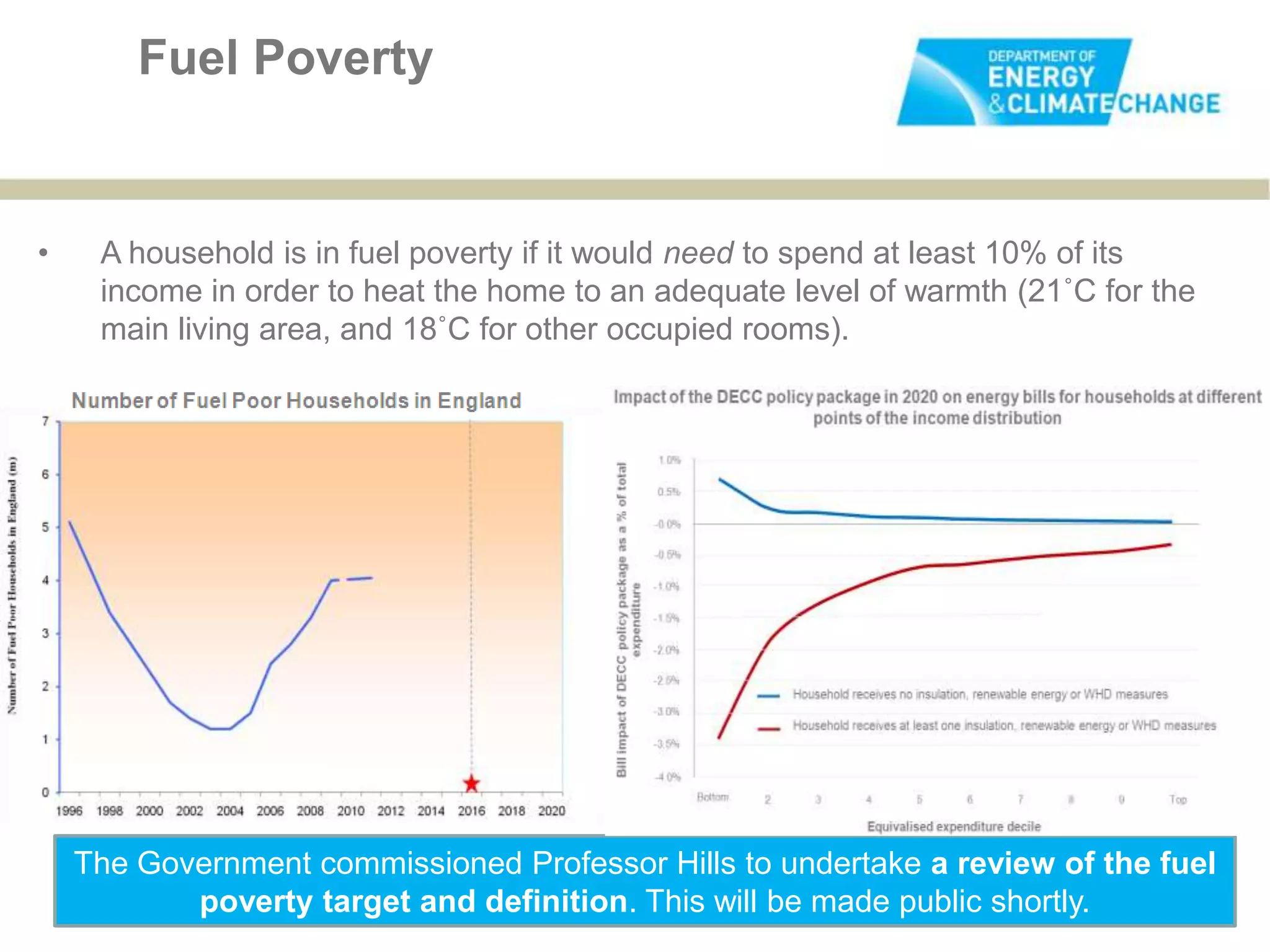
•    A household is in fuel poverty if it would need to spend at least 10% of its
     income in order to heat the home to an adequate level of warmth (21˚C for the
     main living area, and 18˚C for other occupied rooms).


    The Government commissioned Professor Hills to undertake a review of the fuel
           poverty target and definition. This will be made public shortly.
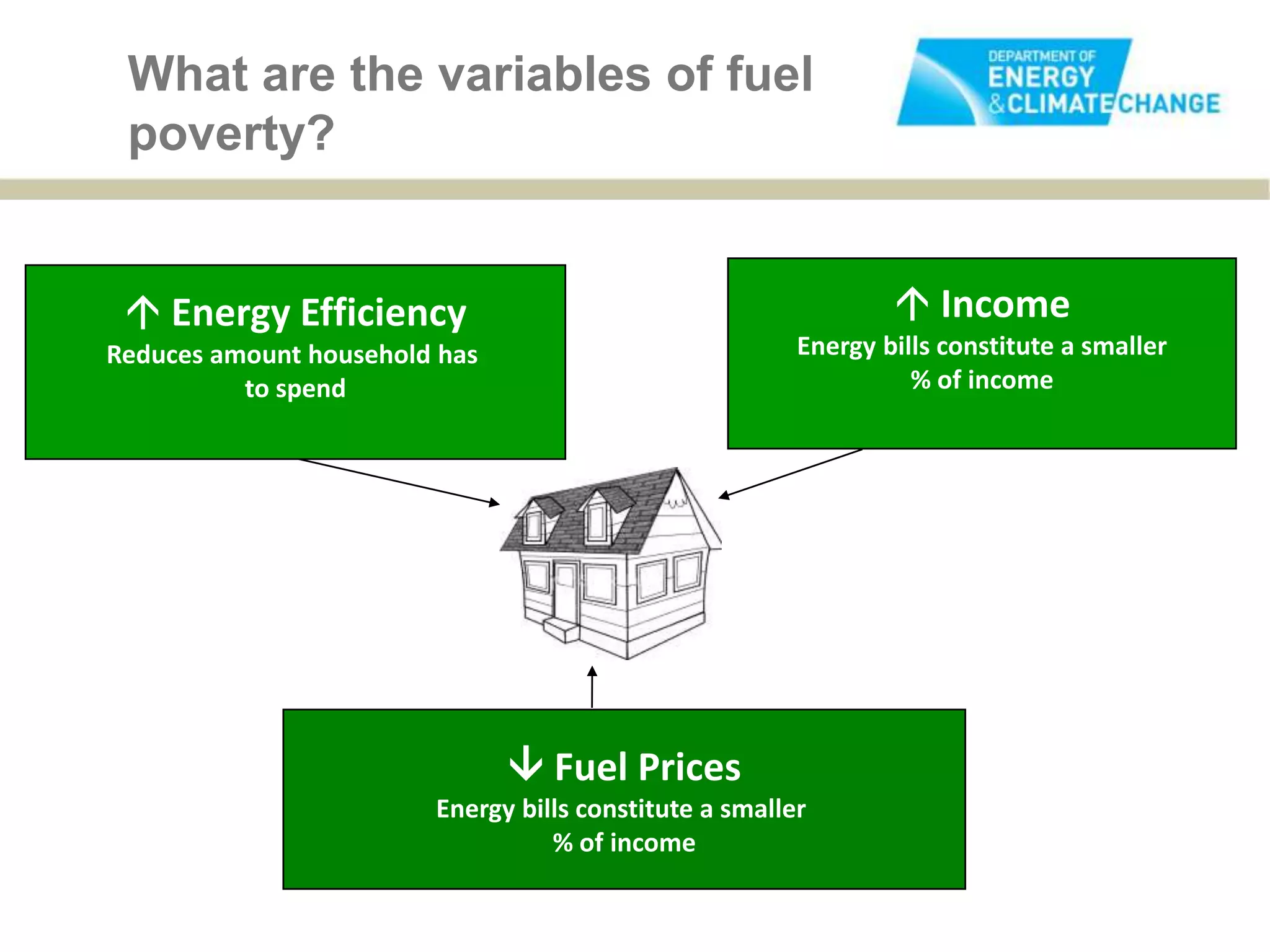
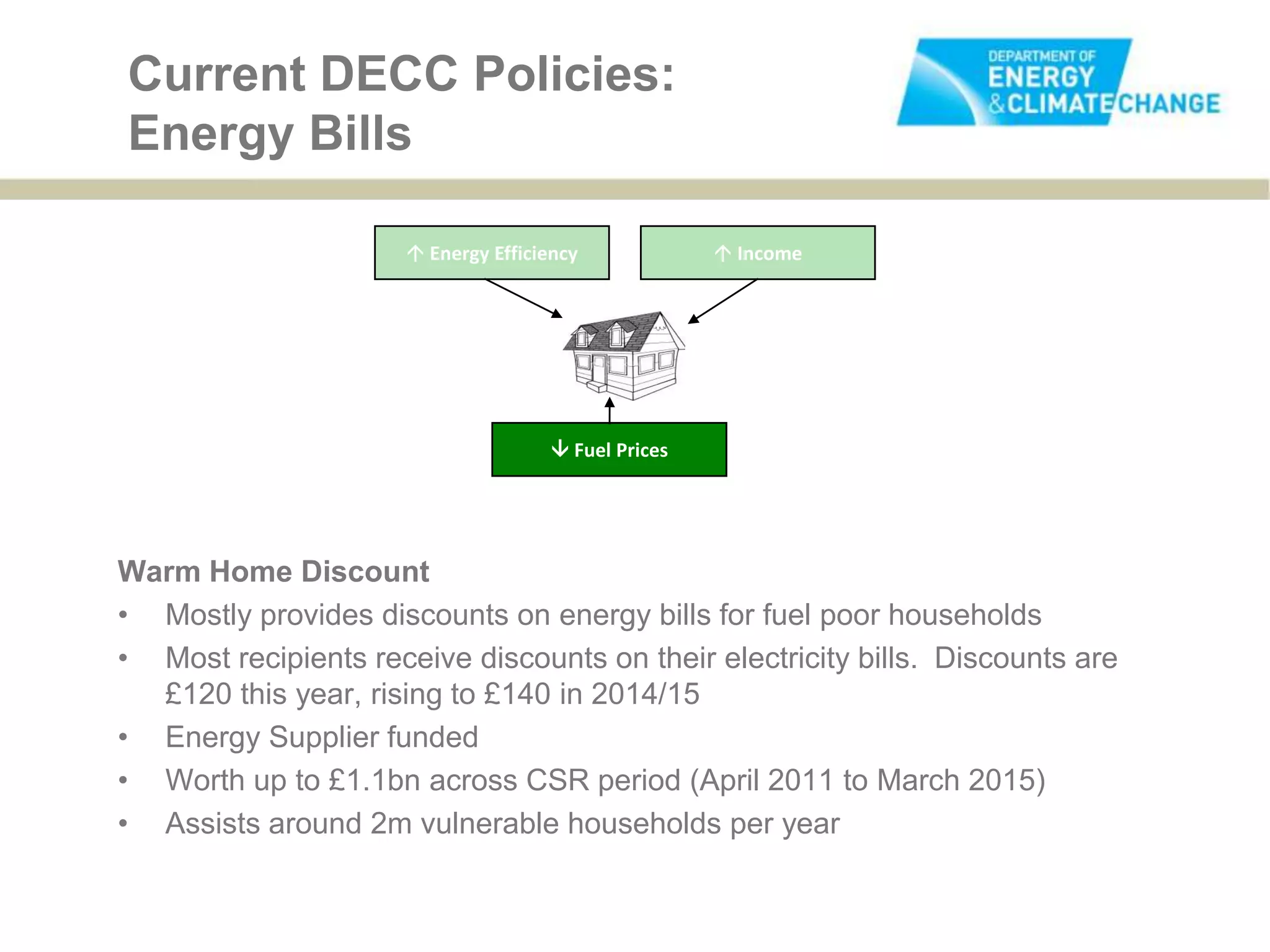
What are the variables of fuel
 poverty?


  Energy Efficiency                                             Income
Reduces amount household has                            Energy bills constitute a smaller
          to spend                                                % of income


                                Fuel Prices
                        Energy bills constitute a smaller
                                  % of income
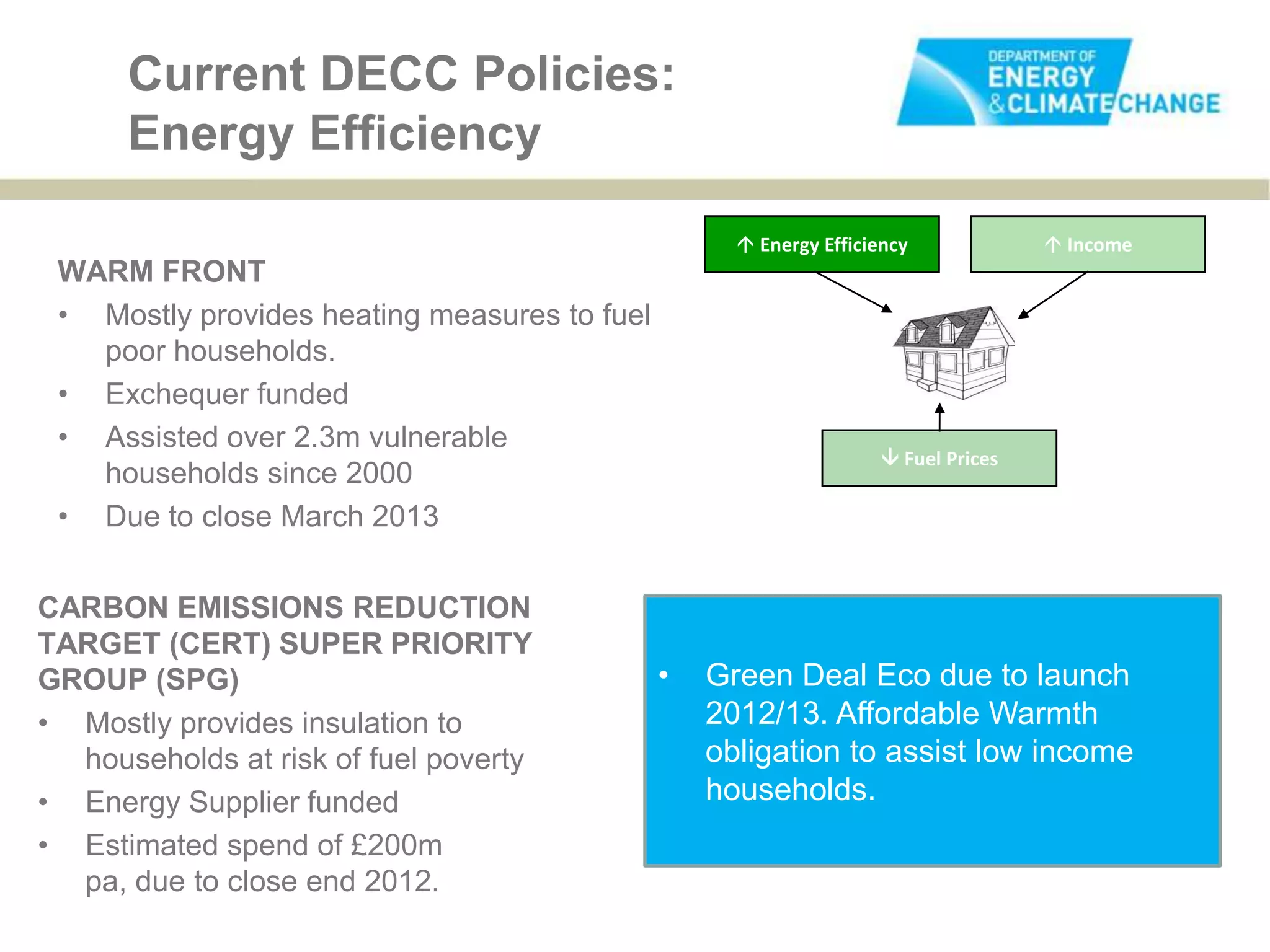
Current DECC Policies:
      Energy Efficiency

                                                     Energy Efficiency              Income
 WARM FRONT
 • Mostly provides heating measures to fuel
   poor households.
 • Exchequer funded
 • Assisted over 2.3m vulnerable
                                                                     Fuel Prices
   households since 2000
 • Due to close March 2013


CARBON EMISSIONS REDUCTION
TARGET (CERT) SUPER PRIORITY
GROUP (SPG)                                   •   Green Deal Eco due to launch
• Mostly provides insulation to                   2012/13. Affordable Warmth
  households at risk of fuel poverty              obligation to assist low income
• Energy Supplier funded                          households.
• Estimated spend of £200m
  pa, due to close end 2012.
Current DECC Policies:
Energy Bills

                       Energy Efficiency             Income


                                      Fuel Prices


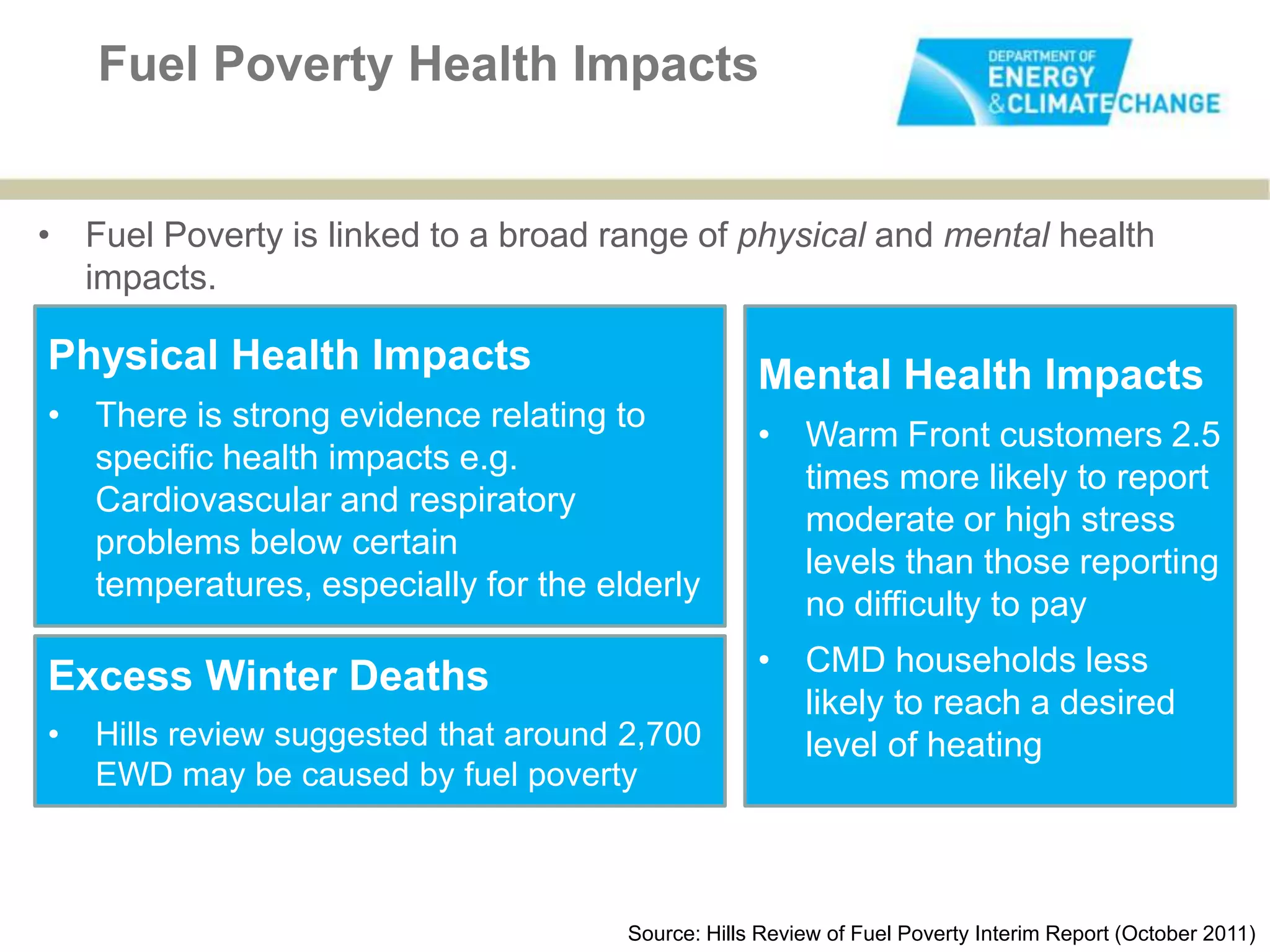
Warm Home Discount
• Mostly provides discounts on energy bills for fuel poor households
• Most recipients receive discounts on their electricity bills. Discounts are
  £120 this year, rising to £140 in 2014/15
• Energy Supplier funded
• Worth up to £1.1bn across CSR period (April 2011 to March 2015)
• Assists around 2m vulnerable households per year
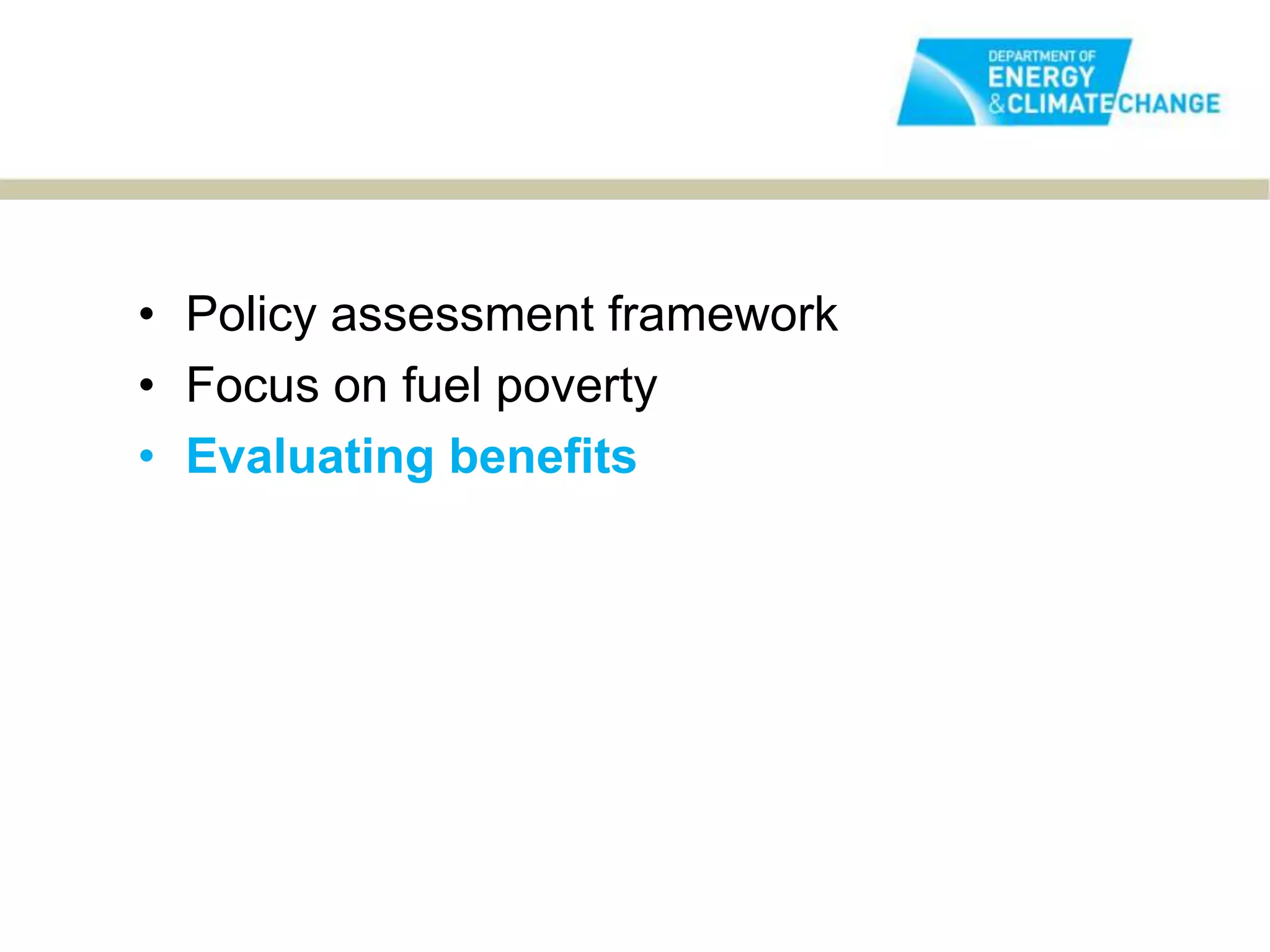
Fuel Poverty Health Impacts


• Fuel Poverty is linked to a broad range of physical and mental health
  impacts.

Physical Health Impacts                             Mental Health Impacts
• There is strong evidence relating to
                                                    • Warm Front customers 2.5
  specific health impacts e.g.
                                                      times more likely to report
  Cardiovascular and respiratory
                                                      moderate or high stress
  problems below certain
                                                      levels than those reporting
  temperatures, especially for the elderly
                                                      no difficulty to pay
                                                    • CMD households less
Excess Winter Deaths
                                                      likely to reach a desired
•   Hills review suggested that around 2,700          level of heating
    EWD may be caused by fuel poverty


                                       Source: Hills Review of Fuel Poverty Interim Report (October 2011)
• Policy assessment framework
• Focus on fuel poverty
• Evaluating benefits
DECC Approach to Ex Post Evaluation


•   DECC Evaluation Board provides strategic leadership, challenge and prioritisation of
    policies / programmes
•   Evaluations are:
     – Considered for all policies / programmes, with monitoring of inputs, outputs and
         delivery process as minimum
     – Undertaken and owned by programmes, with support and QA from central
         Evaluation Team
     – Planned early, alongside monitoring, as part of policy / programme design &
         delivery
•   Consistent approach to evaluation planning
     1. Develop policy logic model (Theory of Change)
     2. Identify evaluation use and questions
     3. Select evaluation approach
     4. Define monitoring and other data requirements, resources , timing etc.
•   Approaches vary, but impact evaluations should consider broad range of impacts and
    always use appropriate comparator / control group to assess counterfactual
•   Meta-evaluations of DECC policies to be undertaken (yearly), to assess relative and
    aggregate impacts of policies, where possible
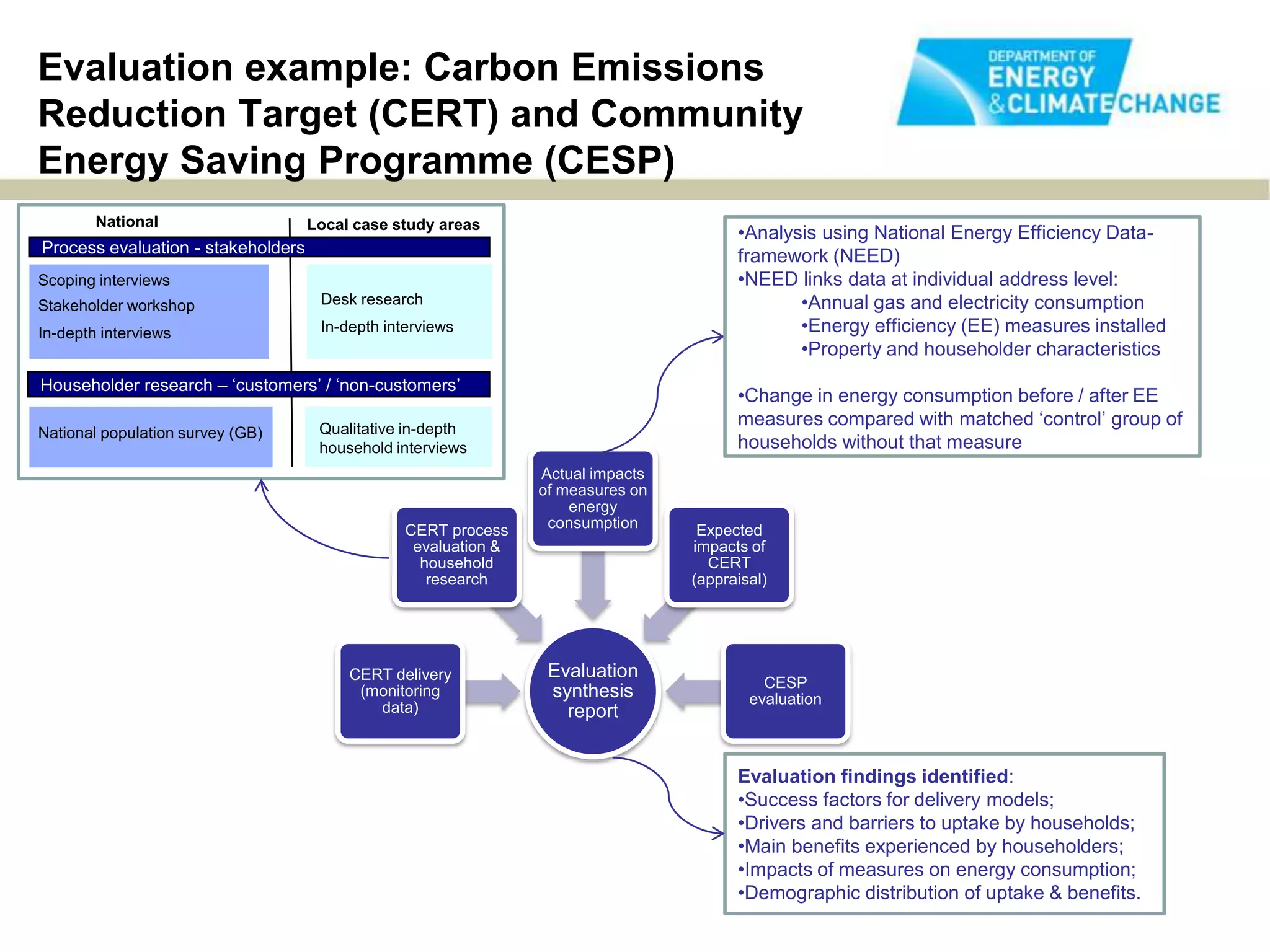
Evaluation example: Carbon Emissions
Reduction Target (CERT) and Community
Energy Saving Programme (CESP)
        National                    Local case study areas
                                                                                        •Analysis using National Energy Efficiency Data-
Process evaluation - stakeholders                                                       framework (NEED)
Scoping interviews                                                                      •NEED links data at individual address level:
Stakeholder workshop                 Desk research                                             •Annual gas and electricity consumption
In-depth interviews                  In-depth interviews                                       •Energy efficiency (EE) measures installed
                                                                                               •Property and householder characteristics
Householder research – ‘customers’ / ‘non-customers’
                                                                                        •Change in energy consumption before / after EE
                                     Qualitative in-depth
                                                                                        measures compared with matched ‘control’ group of
National population survey (GB)
                                     household interviews                               households without that measure
                                                                 Actual impacts
                                                                 of measures on
                                                                     energy
                                                 CERT process     consumption      Expected
                                                  evaluation &                    impacts of
                                                   household                        CERT
                                                    research                      (appraisal)


                                         CERT delivery            Evaluation
                                                                                            CESP
                                          (monitoring             synthesis               evaluation
                                            data)                   report


                                                                                        Evaluation findings identified:
                                                                                        •Success factors for delivery models;
                                                                                        •Drivers and barriers to uptake by households;
                                                                                        •Main benefits experienced by householders;
                                                                                        •Impacts of measures on energy consumption;
                                                                                        •Demographic distribution of uptake & benefits.
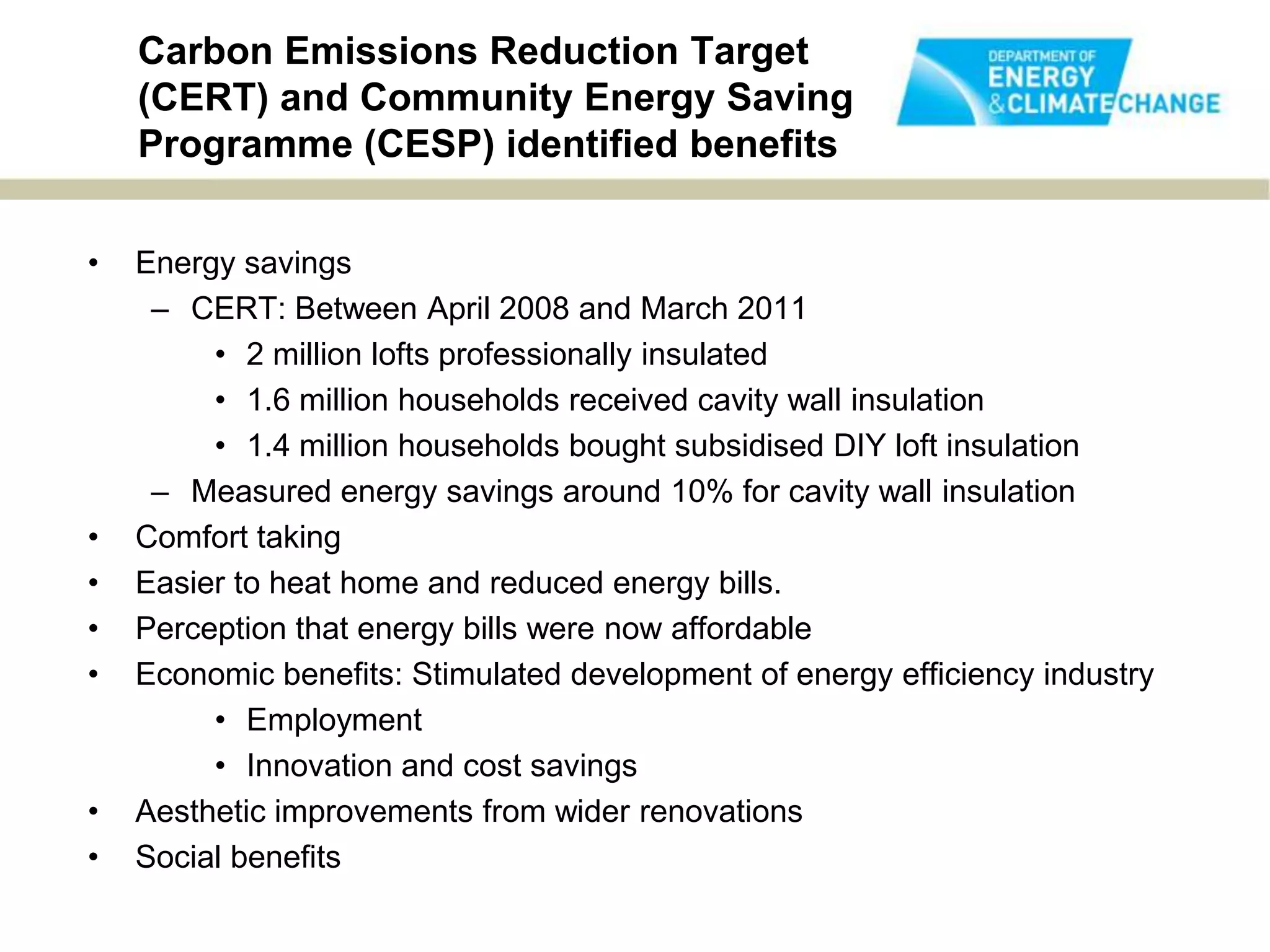
Carbon Emissions Reduction Target
    (CERT) and Community Energy Saving
    Programme (CESP) identified benefits


•   Energy savings
     – CERT: Between April 2008 and March 2011
         • 2 million lofts professionally insulated
         • 1.6 million households received cavity wall insulation
         • 1.4 million households bought subsidised DIY loft insulation
     – Measured energy savings around 10% for cavity wall insulation
•   Comfort taking
•   Easier to heat home and reduced energy bills.
•   Perception that energy bills were now affordable
•   Economic benefits: Stimulated development of energy efficiency industry
         • Employment
         • Innovation and cost savings
•   Aesthetic improvements from wider renovations
•   Social benefits

Multiple Benefits of Energy Efficiency: The UK Perspective

  • 1.
    Multiple benefits ofenergy efficiency: the UK perspective Sarah Meagher Energy Efficiency Deployment Office 14 March 2012
  • 2.
    • Policy assessmentframework • Focus on fuel poverty • Evaluating benefits
  • 3.
    Framework for valuationof energy efficiency measures Air Quality Impact Avoided Cost of Renewables Valued at variable cost Changes in energy use Other Environmental Impacts Security of Energy Energy Supply Efficiency Changes in emissions Price Physical interruption Comfort taking / Volatility of supply Rebound effect Measured separately from energy use. Changes are valued according to the price of Guidance requires If possible, valued at Valued at retail price carbon. qualitative expected energy assessment only. unserved. Source: Valuation of energy use and greenhouse gas emissions for appraisal and valuation” (DECC, 2011)
  • 4.
    Example: Consultation Stage Green Deal Impact Assessment Benefits Energy savings (Variable element) £16,841 Non-monetised benefits (£m) Comfort benefits £3,760 • Estimate that ECO worth Air quality benefits £1,313 £1.3bn per, by the end of Lifetime non-traded carbon savings £5,377 2022 reduction in the Lifetime EU Allowance savings £1,917 number of households in Total benefits (£m) £29,209 fuel poverty of between Carbon & 2020 Non-traded carbon savings (MtCO2 pa) 2.11 350,000 and Energy - Domestic GD and CT measures 2.49 550,000, compared to savings - Domestic AW measures -1.28 how many households - Non domestic sector 0.90 could have been in fuel poverty at the end of 2020 Traded carbon savings (MtCO2 pa) 3.77 2022 2020 Energy savings (TWh) 21.22 • The health benefits Life time non-traded carbon savings (MtCO2) 114 arising from warmer Life time traded carbon savings (MtCO2) 53 homes have not been Average cost effectiveness £/non-traded tCO2 monetised -£29 Not finalised: will be updated later in 2012
  • 5.
    • Policy assessmentframework • Focus on fuel poverty • Evaluating benefits
  • 6.
    Fuel Poverty • A household is in fuel poverty if it would need to spend at least 10% of its income in order to heat the home to an adequate level of warmth (21˚C for the main living area, and 18˚C for other occupied rooms). The Government commissioned Professor Hills to undertake a review of the fuel poverty target and definition. This will be made public shortly.
  • 7.
    What are thevariables of fuel poverty?  Energy Efficiency  Income Reduces amount household has Energy bills constitute a smaller to spend % of income  Fuel Prices Energy bills constitute a smaller % of income
  • 8.
    Current DECC Policies: Energy Efficiency  Energy Efficiency  Income WARM FRONT • Mostly provides heating measures to fuel poor households. • Exchequer funded • Assisted over 2.3m vulnerable  Fuel Prices households since 2000 • Due to close March 2013 CARBON EMISSIONS REDUCTION TARGET (CERT) SUPER PRIORITY GROUP (SPG) • Green Deal Eco due to launch • Mostly provides insulation to 2012/13. Affordable Warmth households at risk of fuel poverty obligation to assist low income • Energy Supplier funded households. • Estimated spend of £200m pa, due to close end 2012.
  • 9.
    Current DECC Policies: EnergyBills  Energy Efficiency  Income  Fuel Prices Warm Home Discount • Mostly provides discounts on energy bills for fuel poor households • Most recipients receive discounts on their electricity bills. Discounts are £120 this year, rising to £140 in 2014/15 • Energy Supplier funded • Worth up to £1.1bn across CSR period (April 2011 to March 2015) • Assists around 2m vulnerable households per year
  • 10.
    Fuel Poverty HealthImpacts • Fuel Poverty is linked to a broad range of physical and mental health impacts. Physical Health Impacts Mental Health Impacts • There is strong evidence relating to • Warm Front customers 2.5 specific health impacts e.g. times more likely to report Cardiovascular and respiratory moderate or high stress problems below certain levels than those reporting temperatures, especially for the elderly no difficulty to pay • CMD households less Excess Winter Deaths likely to reach a desired • Hills review suggested that around 2,700 level of heating EWD may be caused by fuel poverty Source: Hills Review of Fuel Poverty Interim Report (October 2011)
  • 11.
    • Policy assessmentframework • Focus on fuel poverty • Evaluating benefits
  • 12.
    DECC Approach toEx Post Evaluation • DECC Evaluation Board provides strategic leadership, challenge and prioritisation of policies / programmes • Evaluations are: – Considered for all policies / programmes, with monitoring of inputs, outputs and delivery process as minimum – Undertaken and owned by programmes, with support and QA from central Evaluation Team – Planned early, alongside monitoring, as part of policy / programme design & delivery • Consistent approach to evaluation planning 1. Develop policy logic model (Theory of Change) 2. Identify evaluation use and questions 3. Select evaluation approach 4. Define monitoring and other data requirements, resources , timing etc. • Approaches vary, but impact evaluations should consider broad range of impacts and always use appropriate comparator / control group to assess counterfactual • Meta-evaluations of DECC policies to be undertaken (yearly), to assess relative and aggregate impacts of policies, where possible
  • 13.
    Evaluation example: CarbonEmissions Reduction Target (CERT) and Community Energy Saving Programme (CESP) National Local case study areas •Analysis using National Energy Efficiency Data- Process evaluation - stakeholders framework (NEED) Scoping interviews •NEED links data at individual address level: Stakeholder workshop Desk research •Annual gas and electricity consumption In-depth interviews In-depth interviews •Energy efficiency (EE) measures installed •Property and householder characteristics Householder research – ‘customers’ / ‘non-customers’ •Change in energy consumption before / after EE Qualitative in-depth measures compared with matched ‘control’ group of National population survey (GB) household interviews households without that measure Actual impacts of measures on energy CERT process consumption Expected evaluation & impacts of household CERT research (appraisal) CERT delivery Evaluation CESP (monitoring synthesis evaluation data) report Evaluation findings identified: •Success factors for delivery models; •Drivers and barriers to uptake by households; •Main benefits experienced by householders; •Impacts of measures on energy consumption; •Demographic distribution of uptake & benefits.
  • 14.
    Carbon Emissions ReductionTarget (CERT) and Community Energy Saving Programme (CESP) identified benefits • Energy savings – CERT: Between April 2008 and March 2011 • 2 million lofts professionally insulated • 1.6 million households received cavity wall insulation • 1.4 million households bought subsidised DIY loft insulation – Measured energy savings around 10% for cavity wall insulation • Comfort taking • Easier to heat home and reduced energy bills. • Perception that energy bills were now affordable • Economic benefits: Stimulated development of energy efficiency industry • Employment • Innovation and cost savings • Aesthetic improvements from wider renovations • Social benefits

Editor's Notes

  • #7 DefinitionA household is in fuel poverty if it would need to spend at least 10% of its income in order to heat the home to an adequate level of warmth. Given that this is a ratio (energy cost : income) it emphasis is on fuel prices. Left hand graph: Number of Fuel Poor HouseholdsEven though the government have a wide number of policies which tackle fuel poverty, the incidence of fuel poverty has been rising since 2003. STATUTORYTARGET to Eradicate fuel poverty in England by 2016, as far as reasonably practicable (Scotland have a similar target). Hills review has suggested that this is an unfair characterisation of the problem as it is dominated by fuel prices and as such the affect of government policies to tackle the issue is masked. Right hand graph: Impact of DECC policies on Energy Bills60% of households in the bottom 3 deciles get no measures from DECC policies – and see an increase in their bills40% of households in the bottom 3 deciles get measures from DECC policies – and see a decrease in their bills
  • #8 Elements of Fuel Poverty:Energy Efficiency (increases in energy efficiency lower the required energy to heat a house)Fuel Prices (drives the cost of energy as a % of income)Income- Not going to deal with the Income related policies as these are DWP policies not DECC i.e. Winter Fuel Payment, which are not directly targeted at the fuel poor, and Cold Weather Payment, which is targeted at vulnerable individuals.
  • #10 The discounts are off electric bills but is expected that this saving can be transferred by the household to allow them to afford to use more gas if this is what is used to heat their home.
  • #11 Evidence taken from the Hills Review of Fuel Poverty Interim report (published October 2012)CMD is common mental disorderDECC FP Economists are undertaking work to value the health impacts associated with DECC policies. The model will look at building fabric/permeability in relation to key exposures (Radon, PMs etc) and the relationship with the chance of a health impact occurring. The impacts are then monetised.
  • #13 N.B. work to improve evaluation in DECC is fairly new – over the last 18 months, and starting from a low base.So we do not yet have a stock of completed evaluation studies to draw upon for meta-evaluation
  • #14 CERT identified as an evaluation priority – and designed to provide evidence to feed into new policy development (Green Deal and ECO)Approach – process and impact evaluation, made use of monitoring
  • #15 Priority Group consumers, defined as those in receipt of certain income-related benefits and tax credits.