Delivering Affordable Warmth

         Discounting The Future
             Carbon vs. Cost


    David Daniels - University of East Anglia - Adapt Low Carbon Team
What is Affordable Warmth


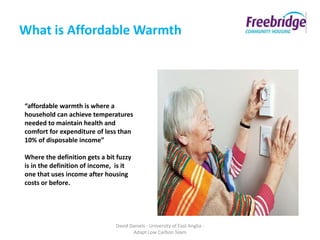
“affordable warmth is where a
household can achieve temperatures
needed to maintain health and
comfort for expenditure of less than
10% of disposable income”

Where the definition gets a bit fuzzy
is in the definition of income, is it
one that uses income after housing
costs or before.


                               David Daniels - University of East Anglia -
                                      Adapt Low Carbon Team
Fuel Poverty


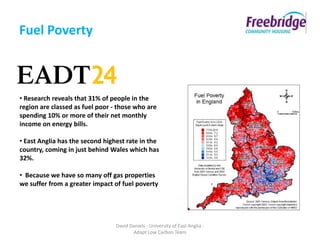
• Research reveals that 31% of people in the
region are classed as fuel poor - those who are
spending 10% or more of their net monthly
income on energy bills.

• East Anglia has the second highest rate in the
country, coming in just behind Wales which has
32%.

• Because we have so many off gas properties
we suffer from a greater impact of fuel poverty


                                 David Daniels - University of East Anglia -
                                        Adapt Low Carbon Team
Consequential Damage

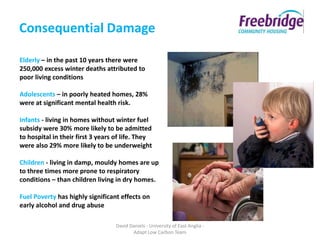
Elderly – in the past 10 years there were
250,000 excess winter deaths attributed to
poor living conditions

Adolescents – in poorly heated homes, 28%
were at significant mental health risk.

Infants - living in homes without winter fuel
subsidy were 30% more likely to be admitted
to hospital in their first 3 years of life. They
were also 29% more likely to be underweight

Children - living in damp, mouldy homes are up
to three times more prone to respiratory
conditions – than children living in dry homes.

Fuel Poverty has highly significant effects on
early alcohol and drug abuse

                                  David Daniels - University of East Anglia -
                                         Adapt Low Carbon Team
So its a problem then

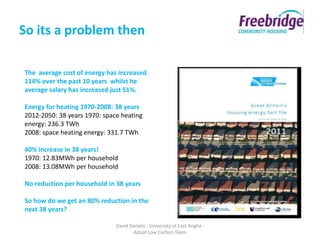
The average cost of energy has increased
114% over the past 10 years whilst he
average salary has increased just 51%.

Energy for heating 1970-2008: 38 years
2012-2050: 38 years 1970: space heating
energy: 236.3 TWh
2008: space heating energy: 331.7 TWh

40% increase in 38 years!
1970: 12.83MWh per household
2008: 13.08MWh per household

No reduction per household in 38 years

So how do we get an 80% reduction in the
next 38 years?

                              David Daniels - University of East Anglia -
                                     Adapt Low Carbon Team
Ouch!

21 million The number of homes that exist today will still be
with us in 2050

7 million The government target for whole house conversions to
be treated by 2020 and all 26m by 2030.

£180 The amount spent per household on energy efficiency

£1,834 The average amount spent per household on alterations

£1,539 The average amount spent per household on energy

£22,750 The average spent on Low Carbon refurbishment by
projects aiming at a minimum 60% reduction

£150,000 The average amount the Technology Strategy Board
has spent per house for its Retrofit for the Future challenge.

                                  David Daniels - University of East Anglia -
                                         Adapt Low Carbon Team
Cash vs. Carbon


 • 83% of resident are interested in
 improving the energy efficiency of
 their home.
 • Far from being driven by a desire to
 do something for the environment ,
 for 78% the primary driver is to save
 money
 • For 20% of those the only driver is
 money.


                               David Daniels - University of East Anglia -
                                      Adapt Low Carbon Team
More carbon


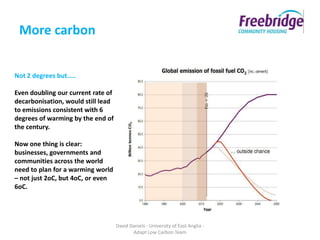
Not 2 degrees but…..

Even doubling our current rate of
decarbonisation, would still lead
to emissions consistent with 6
degrees of warming by the end of
the century.

Now one thing is clear:
businesses, governments and
communities across the world
need to plan for a warming world
– not just 2oC, but 4oC, or even
6oC.


                                    David Daniels - University of East Anglia -
                                           Adapt Low Carbon Team
Legislation


•   Energy Act 2011, Climate Transition Plan,
    Building Regulations, CRC Energy Efficiency
    (Activities), Energy Efficient (Products)
•   CO2 targets 2020 34%, 2050 80%
•   Warm Front 2015 and 2020 targets
•   Energy Performance of Buildings (EPB) August
    2011
•   SAP / EPC / R4TF / D4FC
•   Advisory – UK Parliamentary Group on
    Sustainable Housing
•   Code for Sustainable Homes
•   Lifetime Homes
•   Waste Resource Action Plan
•   Green Guide to Specification
•   Building for Life
•   And and and


                               David Daniels - University of East Anglia -
                                      Adapt Low Carbon Team
Why cant we sell Climate Change
The 3 C’s
 • Clarity - consumers are looking for,
 as a minimum, information
 that is clear and easy to understand

 • Credibility - consumers want
 realistic, accessible and verifiable
 Information

 • Comparability - consumers want
 simple, meaningful and ‘like for-
 like’ comparisons

 Remember Climate Change is based
 on science and scientists are the most
 sceptical so trying to get a scientist to
 sell it just couldn’t be clearer , could it


                                   David Daniels - University of East Anglia -
                                          Adapt Low Carbon Team
Current Stock

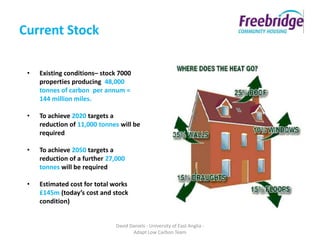
 •   Existing conditions– stock 7000
     properties producing 48,000
     tonnes of carbon per annum =
     144 million miles.

 •   To achieve 2020 targets a
     reduction of 11,000 tonnes will be
     required

 •   To achieve 2050 targets a
     reduction of a further 27,000
     tonnes will be required

 •   Estimated cost for total works
     £145m (today’s cost and stock
     condition)


                              David Daniels - University of East Anglia -
                                     Adapt Low Carbon Team
One size fits all – really

“In Theory- Practice and Theory are the same thing , but in Practice they are not”


                             David Daniels - University of East Anglia -
                                    Adapt Low Carbon Team
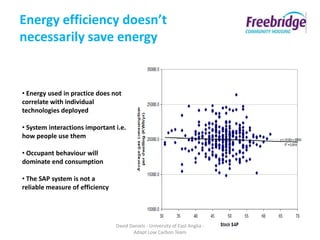
Energy efficiency doesn’t
necessarily save energy


• Energy used in practice does not
correlate with individual
technologies deployed

• System interactions important i.e.
how people use them

• Occupant behaviour will
dominate end consumption

• The SAP system is not a
reliable measure of efficiency


                                 David Daniels - University of East Anglia -
                                        Adapt Low Carbon Team
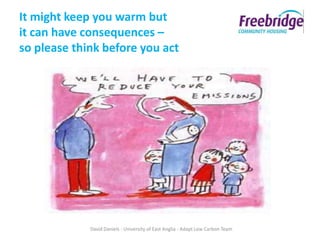
It might keep you warm but
it can have consequences –
so please think before you act


             David Daniels - University of East Anglia - Adapt Low Carbon Team
So what’s changed


•   Current challenges are the same as 10
    years ago except:

        legislation
        awareness
        knowledge
        capability
        and need for speed

     Simply put, we know what to do to
        make a change


                              David Daniels - University of East Anglia -
                                     Adapt Low Carbon Team
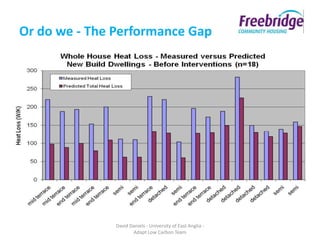
Or do we - The Performance Gap


               David Daniels - University of East Anglia -
                      Adapt Low Carbon Team
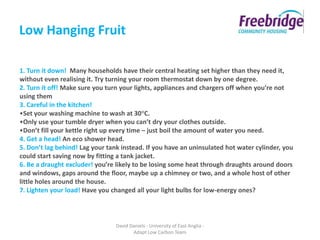
Low Hanging Fruit

1. Turn it down! Many households have their central heating set higher than they need it,
without even realising it. Try turning your room thermostat down by one degree.
2. Turn it off! Make sure you turn your lights, appliances and chargers off when you’re not
using them
3. Careful in the kitchen!
•Set your washing machine to wash at 30°C.
•Only use your tumble dryer when you can’t dry your clothes outside.
•Don’t fill your kettle right up every time – just boil the amount of water you need.
4. Get a head! An eco shower head.
5. Don’t lag behind! Lag your tank instead. If you have an uninsulated hot water cylinder, you
could start saving now by fitting a tank jacket.
6. Be a draught excluder! you’re likely to be losing some heat through draughts around doors
and windows, gaps around the floor, maybe up a chimney or two, and a whole host of other
little holes around the house.
7. Lighten your load! Have you changed all your light bulbs for low-energy ones?


                                 David Daniels - University of East Anglia -
                                        Adapt Low Carbon Team
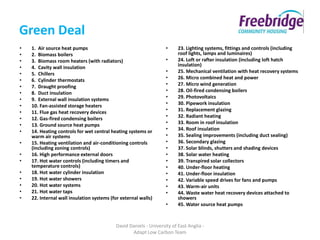
Green Deal
•   1. Air source heat pumps                                       •     23. Lighting systems, fittings and controls (including
•   2. Biomass boilers                                                   roof lights, lamps and luminaires)
•   3. Biomass room heaters (with radiators)                       •     24. Loft or rafter insulation (including loft hatch
•   4. Cavity wall insulation                                            insulation)
•   5. Chillers                                                    •     25. Mechanical ventilation with heat recovery systems
•   6. Cylinder thermostats                                        •     26. Micro combined heat and power
•   7. Draught proofing                                            •     27. Micro wind generation
•   8. Duct insulation                                             •     28. Oil-fired condensing boilers
•   9. External wall insulation systems                            •     29. Photovoltaics
•   10. Fan-assisted storage heaters                               •     30. Pipework insulation
•   11. Flue gas heat recovery devices                             •     31. Replacement glazing
•   12. Gas-fired condensing boilers                               •     32. Radiant heating
•   13. Ground source heat pumps                                   •     33. Room in roof insulation
•   14. Heating controls for wet central heating systems or        •     34. Roof insulation
    warm air systems                                               •     35. Sealing improvements (including duct sealing)
•   15. Heating ventilation and air-conditioning controls          •     36. Secondary glazing
    (including zoning controls)                                    •     37. Solar blinds, shutters and shading devices
•   16. High performance external doors                            •     38. Solar water heating
•   17. Hot water controls (including timers and                   •     39. Transpired solar collectors
    temperature controls)                                          •     40. Under-floor heating
•   18. Hot water cylinder insulation                              •     41. Under-floor insulation
•   19. Hot water showers                                          •     42. Variable speed drives for fans and pumps
•   20. Hot water systems                                          •     43. Warm-air units
•   21. Hot water taps                                             •     44. Waste water heat recovery devices attached to
•   22. Internal wall insulation systems (for external walls)            showers
                                                                   •     45. Water source heat pumps


                                           David Daniels - University of East Anglia -
                                                  Adapt Low Carbon Team
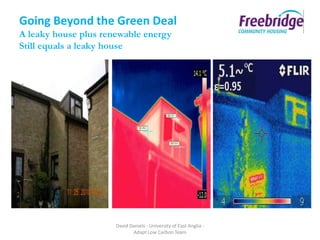
Going Beyond the Green Deal
A leaky house plus renewable energy
Still equals a leaky house


                      David Daniels - University of East Anglia -
                             Adapt Low Carbon Team
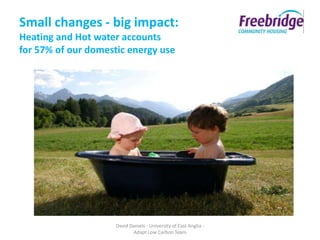
Small changes - big impact:
Heating and Hot water accounts
for 57% of our domestic energy use


                     David Daniels - University of East Anglia -
                            Adapt Low Carbon Team
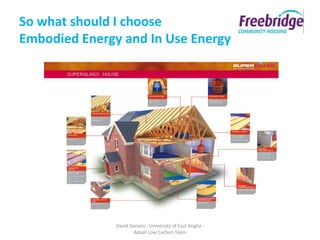
So what should I choose
Embodied Energy and In Use Energy


               David Daniels - University of East Anglia -
                      Adapt Low Carbon Team
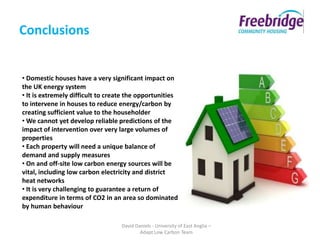
Conclusions


• Domestic houses have a very significant impact on
the UK energy system
• It is extremely difficult to create the opportunities
to intervene in houses to reduce energy/carbon by
creating sufficient value to the householder
• We cannot yet develop reliable predictions of the
impact of intervention over very large volumes of
properties
• Each property will need a unique balance of
demand and supply measures
• On and off-site low carbon energy sources will be
vital, including low carbon electricity and district
heat networks
• It is very challenging to guarantee a return of
expenditure in terms of CO2 in an area so dominated
by human behaviour

                                   David Daniels - University of East Anglia –
                                           Adapt Low Carbon Team
Top down and bottom up
Them and Us

•   Look to be responsible strive to meet
    the needs of the world today without
    jeopardizing the world of tomorrow

•   Environmental, Social, Energy, Climate,
    Materials, Biodiversity and Local Impact


•   It only takes one thought to
    make a change and one change
    to make a difference


                               David Daniels - University of East Anglia -
                                      Adapt Low Carbon Team
Go the extra Mile
You know it makes sense
      “It is unwise to pay too much, but it’s worse to pay too little.
       When you pay too much, you lose a little money - that is all.
      When you pay too little, you sometimes lose everything,
      because the thing you bought was incapable of doing the
      thing it was bought to do.
      The common law of business balance prohibits paying a
      little and getting a lot - it can’t be done.
      If you deal with the lowest bidder, it is well to add something
      for the risk you run. And if you do that, you will have enough
      to pay for something better.”


      •John Ruskin 1860


         David Daniels - University of East Anglia - Adapt Low Carbon Team

Affordable warmth presentation

  • 1.
    Delivering Affordable Warmth Discounting The Future Carbon vs. Cost David Daniels - University of East Anglia - Adapt Low Carbon Team
  • 2.
    What is AffordableWarmth “affordable warmth is where a household can achieve temperatures needed to maintain health and comfort for expenditure of less than 10% of disposable income” Where the definition gets a bit fuzzy is in the definition of income, is it one that uses income after housing costs or before. David Daniels - University of East Anglia - Adapt Low Carbon Team
  • 3.
    Fuel Poverty • Researchreveals that 31% of people in the region are classed as fuel poor - those who are spending 10% or more of their net monthly income on energy bills. • East Anglia has the second highest rate in the country, coming in just behind Wales which has 32%. • Because we have so many off gas properties we suffer from a greater impact of fuel poverty David Daniels - University of East Anglia - Adapt Low Carbon Team
  • 4.
    Consequential Damage Elderly –in the past 10 years there were 250,000 excess winter deaths attributed to poor living conditions Adolescents – in poorly heated homes, 28% were at significant mental health risk. Infants - living in homes without winter fuel subsidy were 30% more likely to be admitted to hospital in their first 3 years of life. They were also 29% more likely to be underweight Children - living in damp, mouldy homes are up to three times more prone to respiratory conditions – than children living in dry homes. Fuel Poverty has highly significant effects on early alcohol and drug abuse David Daniels - University of East Anglia - Adapt Low Carbon Team
  • 5.
    So its aproblem then The average cost of energy has increased 114% over the past 10 years whilst he average salary has increased just 51%. Energy for heating 1970-2008: 38 years 2012-2050: 38 years 1970: space heating energy: 236.3 TWh 2008: space heating energy: 331.7 TWh 40% increase in 38 years! 1970: 12.83MWh per household 2008: 13.08MWh per household No reduction per household in 38 years So how do we get an 80% reduction in the next 38 years? David Daniels - University of East Anglia - Adapt Low Carbon Team
  • 6.
    Ouch! 21 million Thenumber of homes that exist today will still be with us in 2050 7 million The government target for whole house conversions to be treated by 2020 and all 26m by 2030. £180 The amount spent per household on energy efficiency £1,834 The average amount spent per household on alterations £1,539 The average amount spent per household on energy £22,750 The average spent on Low Carbon refurbishment by projects aiming at a minimum 60% reduction £150,000 The average amount the Technology Strategy Board has spent per house for its Retrofit for the Future challenge. David Daniels - University of East Anglia - Adapt Low Carbon Team
  • 7.
    Cash vs. Carbon • 83% of resident are interested in improving the energy efficiency of their home. • Far from being driven by a desire to do something for the environment , for 78% the primary driver is to save money • For 20% of those the only driver is money. David Daniels - University of East Anglia - Adapt Low Carbon Team
  • 8.
    More carbon Not 2degrees but….. Even doubling our current rate of decarbonisation, would still lead to emissions consistent with 6 degrees of warming by the end of the century. Now one thing is clear: businesses, governments and communities across the world need to plan for a warming world – not just 2oC, but 4oC, or even 6oC. David Daniels - University of East Anglia - Adapt Low Carbon Team
  • 9.
    Legislation • Energy Act 2011, Climate Transition Plan, Building Regulations, CRC Energy Efficiency (Activities), Energy Efficient (Products) • CO2 targets 2020 34%, 2050 80% • Warm Front 2015 and 2020 targets • Energy Performance of Buildings (EPB) August 2011 • SAP / EPC / R4TF / D4FC • Advisory – UK Parliamentary Group on Sustainable Housing • Code for Sustainable Homes • Lifetime Homes • Waste Resource Action Plan • Green Guide to Specification • Building for Life • And and and David Daniels - University of East Anglia - Adapt Low Carbon Team
  • 10.
    Why cant wesell Climate Change The 3 C’s • Clarity - consumers are looking for, as a minimum, information that is clear and easy to understand • Credibility - consumers want realistic, accessible and verifiable Information • Comparability - consumers want simple, meaningful and ‘like for- like’ comparisons Remember Climate Change is based on science and scientists are the most sceptical so trying to get a scientist to sell it just couldn’t be clearer , could it David Daniels - University of East Anglia - Adapt Low Carbon Team
  • 11.
    Current Stock • Existing conditions– stock 7000 properties producing 48,000 tonnes of carbon per annum = 144 million miles. • To achieve 2020 targets a reduction of 11,000 tonnes will be required • To achieve 2050 targets a reduction of a further 27,000 tonnes will be required • Estimated cost for total works £145m (today’s cost and stock condition) David Daniels - University of East Anglia - Adapt Low Carbon Team
  • 12.
    One size fitsall – really “In Theory- Practice and Theory are the same thing , but in Practice they are not” David Daniels - University of East Anglia - Adapt Low Carbon Team
  • 13.
    Energy efficiency doesn’t necessarilysave energy • Energy used in practice does not correlate with individual technologies deployed • System interactions important i.e. how people use them • Occupant behaviour will dominate end consumption • The SAP system is not a reliable measure of efficiency David Daniels - University of East Anglia - Adapt Low Carbon Team
  • 14.
    It might keepyou warm but it can have consequences – so please think before you act David Daniels - University of East Anglia - Adapt Low Carbon Team
  • 15.
    So what’s changed • Current challenges are the same as 10 years ago except:  legislation  awareness  knowledge  capability  and need for speed Simply put, we know what to do to make a change David Daniels - University of East Anglia - Adapt Low Carbon Team
  • 16.
    Or do we- The Performance Gap David Daniels - University of East Anglia - Adapt Low Carbon Team
  • 17.
    Low Hanging Fruit 1.Turn it down! Many households have their central heating set higher than they need it, without even realising it. Try turning your room thermostat down by one degree. 2. Turn it off! Make sure you turn your lights, appliances and chargers off when you’re not using them 3. Careful in the kitchen! •Set your washing machine to wash at 30°C. •Only use your tumble dryer when you can’t dry your clothes outside. •Don’t fill your kettle right up every time – just boil the amount of water you need. 4. Get a head! An eco shower head. 5. Don’t lag behind! Lag your tank instead. If you have an uninsulated hot water cylinder, you could start saving now by fitting a tank jacket. 6. Be a draught excluder! you’re likely to be losing some heat through draughts around doors and windows, gaps around the floor, maybe up a chimney or two, and a whole host of other little holes around the house. 7. Lighten your load! Have you changed all your light bulbs for low-energy ones? David Daniels - University of East Anglia - Adapt Low Carbon Team
  • 18.
    Green Deal • 1. Air source heat pumps • 23. Lighting systems, fittings and controls (including • 2. Biomass boilers roof lights, lamps and luminaires) • 3. Biomass room heaters (with radiators) • 24. Loft or rafter insulation (including loft hatch • 4. Cavity wall insulation insulation) • 5. Chillers • 25. Mechanical ventilation with heat recovery systems • 6. Cylinder thermostats • 26. Micro combined heat and power • 7. Draught proofing • 27. Micro wind generation • 8. Duct insulation • 28. Oil-fired condensing boilers • 9. External wall insulation systems • 29. Photovoltaics • 10. Fan-assisted storage heaters • 30. Pipework insulation • 11. Flue gas heat recovery devices • 31. Replacement glazing • 12. Gas-fired condensing boilers • 32. Radiant heating • 13. Ground source heat pumps • 33. Room in roof insulation • 14. Heating controls for wet central heating systems or • 34. Roof insulation warm air systems • 35. Sealing improvements (including duct sealing) • 15. Heating ventilation and air-conditioning controls • 36. Secondary glazing (including zoning controls) • 37. Solar blinds, shutters and shading devices • 16. High performance external doors • 38. Solar water heating • 17. Hot water controls (including timers and • 39. Transpired solar collectors temperature controls) • 40. Under-floor heating • 18. Hot water cylinder insulation • 41. Under-floor insulation • 19. Hot water showers • 42. Variable speed drives for fans and pumps • 20. Hot water systems • 43. Warm-air units • 21. Hot water taps • 44. Waste water heat recovery devices attached to • 22. Internal wall insulation systems (for external walls) showers • 45. Water source heat pumps David Daniels - University of East Anglia - Adapt Low Carbon Team
  • 19.
    Going Beyond theGreen Deal A leaky house plus renewable energy Still equals a leaky house David Daniels - University of East Anglia - Adapt Low Carbon Team
  • 20.
    Small changes -big impact: Heating and Hot water accounts for 57% of our domestic energy use David Daniels - University of East Anglia - Adapt Low Carbon Team
  • 21.
    So what shouldI choose Embodied Energy and In Use Energy David Daniels - University of East Anglia - Adapt Low Carbon Team
  • 22.
    Conclusions • Domestic houseshave a very significant impact on the UK energy system • It is extremely difficult to create the opportunities to intervene in houses to reduce energy/carbon by creating sufficient value to the householder • We cannot yet develop reliable predictions of the impact of intervention over very large volumes of properties • Each property will need a unique balance of demand and supply measures • On and off-site low carbon energy sources will be vital, including low carbon electricity and district heat networks • It is very challenging to guarantee a return of expenditure in terms of CO2 in an area so dominated by human behaviour David Daniels - University of East Anglia – Adapt Low Carbon Team
  • 23.
    Top down andbottom up Them and Us • Look to be responsible strive to meet the needs of the world today without jeopardizing the world of tomorrow • Environmental, Social, Energy, Climate, Materials, Biodiversity and Local Impact • It only takes one thought to make a change and one change to make a difference David Daniels - University of East Anglia - Adapt Low Carbon Team
  • 24.
    Go the extraMile You know it makes sense “It is unwise to pay too much, but it’s worse to pay too little. When you pay too much, you lose a little money - that is all. When you pay too little, you sometimes lose everything, because the thing you bought was incapable of doing the thing it was bought to do. The common law of business balance prohibits paying a little and getting a lot - it can’t be done. If you deal with the lowest bidder, it is well to add something for the risk you run. And if you do that, you will have enough to pay for something better.” •John Ruskin 1860 David Daniels - University of East Anglia - Adapt Low Carbon Team