Behavioural Climate Change
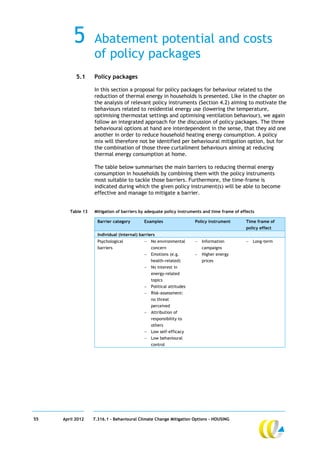
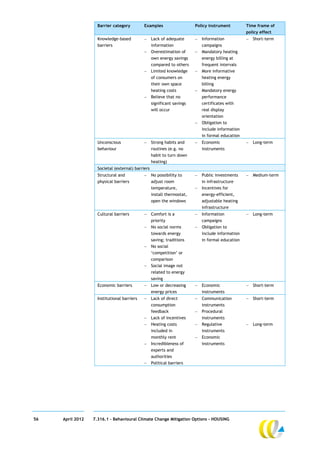
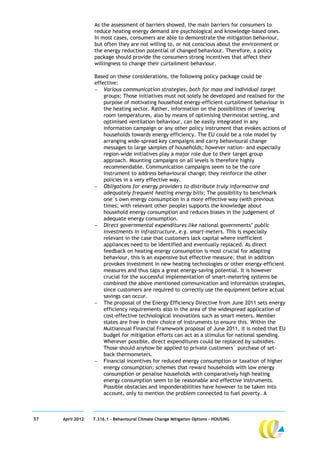
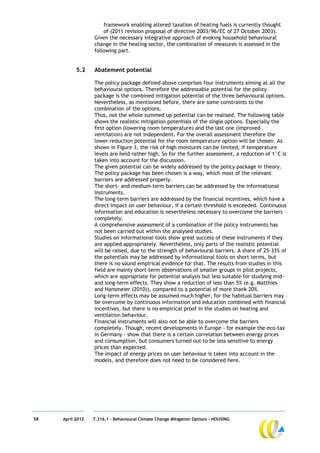
Mitigation Options


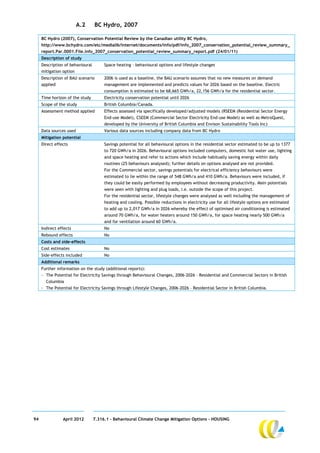
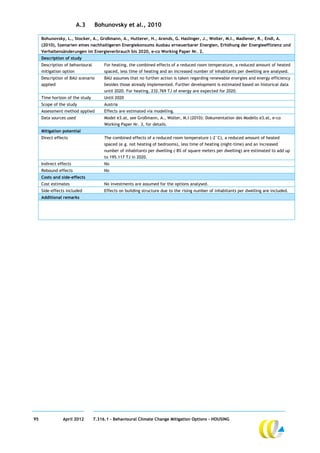
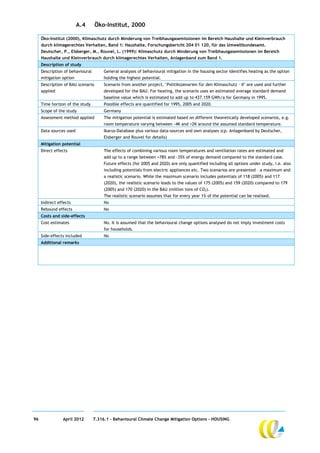
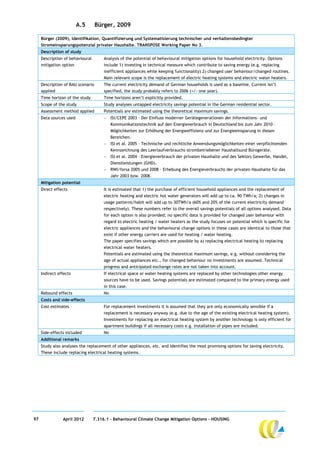
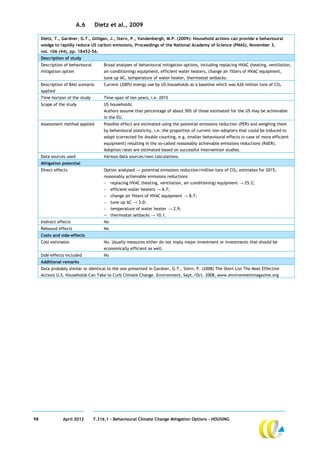
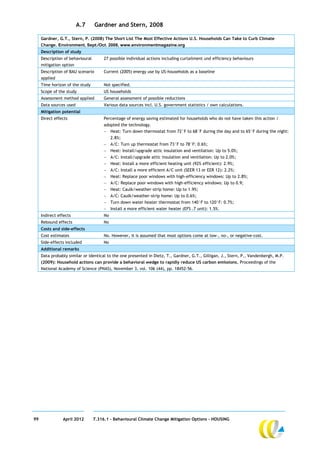
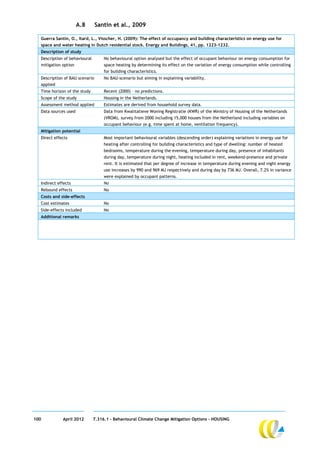
Domain Report Housing


Report
Delft, April 2012


Author(s):
Dr. Clemens Rohde, Dr. Elisabeth Dütschke, Michaela Gigli (Fraunhofer ISI)
Dr. Mart Bles (CE Delft)
Publication Data
                 Bibliographical data:
                 Dr. Clemens Rohde, Dr. Elisabeth Dütschke, Michaela Gigli (Fraunhofer ISI)
                 Dr. Mart Bles (CE Delft)
                 Behavioural Climate Change Mitigation Options
                 Domain Report Housing


                 Delft, CE Delft, April 2012


                 Publication code: 12.7316.01


                 Behaviour / Climate change / Mitigation / Model research / Analysis / Housing


                 CE publications are available from www.cedelft.eu


                 Commissioned by: European Commission, DG Climate Action,
                 contract number 070307/2010/576075/SER/A4.


                 Further information on this study can be obtained from the contact person, Jasper Faber.


                 © copyright, CE Delft, Delft


                    CE Delft
                    Committed to the Environment


                    CE Delft is an independent research and consultancy organisation specialised in
                    developing structural and innovative solutions to environmental problems.
                    CE Delft’s solutions are characterised in being politically feasible, technologically
                    sound, economically prudent and socially equitable.


2   April 2012   7.316.1 – Behavioural Climate Change Mitigation Options - HOUSING
Preface
                 This is the final report on Behavioural Climate Change Mitigation Options in
                 the Housing Domain. It is part of the study ‘Behavioural climate change
                 mitigation options and their appropriate inclusion in quantitative longer term
                 policy scenarios’ for the European Commission, DG Climate Action. The aim of
                 the study is threefold:
                 1. To assess and demonstrate the GHG emission reduction potential of
                     changes in behaviour and consumption patterns.
                 2. To analyse policy options for the further development of community
                     policies and measures inducing changes in behaviour and consumption
                     patterns. And
                 3. To identify the linkages with other technical and economic variables in
                     such a way that it can be used in modelling and scenario development.

                 The study has focused on three domains: transport, food and housing.

                 This report is part of five reports which together constitute the final report of
                 contract 070307/2010/576075/SER/A4. The other reports are:
                 1. The Main Final Report.
                 2. The Transport Domain Final Report.
                 3. The Food Domain Final Report.
                 4. A Technical Report on the appropriate inclusion of results of the analysis in
                     model-based quantitative scenarios.

                 The study has been conducted by a consortium led by CE Delft comprising of
                 Fraunhofer ISI and LEI.

                 Jasper Faber


3   April 2012   7.316.1 – Behavioural Climate Change Mitigation Options - HOUSING
4   April 2012   7.316.1 – Behavioural Climate Change Mitigation Options - HOUSING
Contents
            1      Introduction                                                        11


            2      Overview of behavioural options                                     13
            2.1    Introduction                                                        13
            2.2    Housing                                                             13
            2.3    Non-residential buildings                                           16
            2.4    Selection of behavioural change options                             18


            3      Abatement potential and costs                                       21
            3.1    Assessment of the abatement potential of reducing space heating
                   temperature                                                         22
            3.2    Assessment of the abatement potential of optimising thermostat
                   settings of heating                                                 27
            3.3    Assessment of the abatement potential of optimising ventilation
                   behaviour                                                           29


            4      Barriers, consumer segments and policy instruments                  35
            4.1    Introduction                                                        35
            4.2    Policy instruments in housing                                       43


            5      Abatement potential and costs of policy packages                    55
            5.1    Policy packages                                                     55
            5.2    Abatement potential                                                 58
            5.3    Costs                                                               59


                   References                                                          61


    Annex A        Factsheets behavioural options                                      93


5     April 2012   7.316.1 – Behavioural Climate Change Mitigation Options - HOUSING
6   April 2012   7.316.1 – Behavioural Climate Change Mitigation Options - HOUSING
Summary
                 The EU’s greenhouse gas (GHG) emission reduction policies and the goal to
                 keep the global temperature increase below 2°C commits the EU and its
                 Member States to reduce emissions by at least 20% below 1990 levels by 2020,
                 and by 80-95% by 2050. A significant share of current emissions, in particular
                 of those not covered by the EU Emissions Trading System (ETS) is related to
                 housing and buildings.

                 In the first part of the housing domain report, an overview is established of
                 behavioural GHG mitigation options in the housing sector (residential as well as
                 non-residential buildings) which aim at reducing the demand of space heating
                 energy. It is argued, that occupant behaviour bears an important potential for
                 energy conservation. However, scientific literature on the effects of non-
                 technical policy measures is scarce. Thus, a vast literature survey was
                 conducted on the energy saving potential of changed behaviour with regard to
                 heating and air conditioning. Studies on residential electricity use were out of
                 scope of the current project, since the electricity sector is part of the ETS.
                 From the number of possible behavioural change options, the selection process
                 identified three behavioural change options in the housing domain that were
                 then chosen to be finally analysed. Those are usually not covered by models.
                 The assessment aimed at providing a complete synthesis of the available
                 knowledge in this field. The three behavioural options are:
                 1. Reducing space heating temperature (=lowering room temperature).
                 2. Optimising thermostat settings (e.g. leaving room temperatures at the
                     same level, reducing temperature at night/if absent). And
                 3. Optimising ventilation behaviour.

                 In a next step, regarding the behavioural options selected, their maximum as
                 well as their realistic mitigation potentials could be calculated.
                 The assessment of the abatement potential of reducing space heating
                 temperature by lowering the room temperature shows that the average
                 theoretical reduction potential (2°C) in the EU-27 is about 18% (the 2°C goal
                 as maximum reduction level is chosen in a way that it makes mitigation actions
                 possible by at the same time keeping levels of comfort constant and not
                 imposing significant side-effects). The maximum theoretical CO2 abatement
                 potential for the housing domain declines from 77 Mt in 2020 to 54 Mt in
                 2050 due to better energy efficiency standards in the housing sector.
                 Non-behavioural constraints to the implementation of changed behaviour are
                 for instance technical ones, like non-adjustable heating systems, but also
                 personal needs of different resident groups (e.g. the elderly and children) or
                 possible frost damages that suggest avoiding temperatures beneath a minimal
                 room temperature of about 15°C.
                 The maximum realistic emission reduction potential is therefore the product
                 of:
                  The relative reduction potential per dwelling.
                  The share of dwellings without the technical options to reduce the room
                     temperature.
                  The share of dwellings with people with special needs concerning
                     temperature levels.
                  The overall GHG emissions from space heating.

                 As for indirect effects, the same GHG abatement potential can be accounted
                 for during the production phase of the energy. Possible rebound effects are
                 too difficult to quantify and therefore left out; no monetary end-user costs
                 occur when reducing in-home temperatures. No positive or negative side-
                 effects are evident within a reasonable scope. Due to the above described


7   April 2012   7.316.1 – Behavioural Climate Change Mitigation Options - HOUSING
limitations, only 60% of the theoretical potential can be assumed for
                 realisation. Therefore, the average realistic reduction potential (2°C) in the
                 EU-27 is about 10%; the maximum realistic CO2 abatement potential for
                 reducing room temperatures declines from 45 Mt in 2020 to 32 Mt in 2050. In a
                 similar vein, for optimising thermostat settings, it declines from 21 Mt in 2010
                 to 15 Mt in 2050. As the maximum realistic mitigation potential from optimal
                 ventilation behaviour depends highly on the quality of the building stock, a
                 reduction of the energy consumption by 25% of the ventilation losses is a
                 reasonable assumption for the reduction potential.

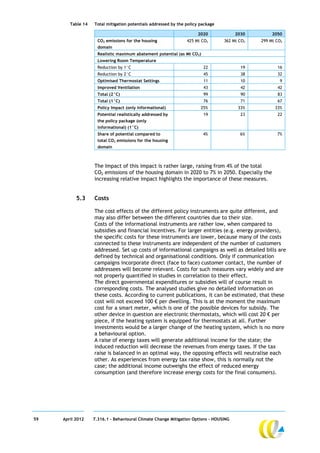
                 The overall reduction potential for all measures sums up to 98 Mt in 2020
                 (2°C reduction; 75 Mt for a 1°C reduction). For 2050 this amount is slightly
                 lower due to a more efficient building stock. Nevertheless the value is still
                 78 Mt for the 2°C and 62 Mt for the 1°C scenario.

                 A major part of the report focuses on barriers of behavioural change,
                 consumer segments and policy instruments. First of all, what characterises the
                 three options for reducing heating energy, is that this kind of behaviour is
                 rather expressed by daily habits and routines. It manifests itself as sequences
                 of small mitigation actions, and therefor is part of people’s lifestyle. It is
                 rather not driven by deliberative thoughts and decision making, as it would be
                 the case when making an investment decision for high-cost technologies.
                 Manifold barriers to domestic energy saving behaviour could be identified, and
                 as a consequence categorised as psychological, knowledge-based, structural-
                 physical, cultural, economic and institutional barriers. At the same time one
                 should not neglect demographics and also unconscious behaviour as possible
                 inhibiting factors. To the most important barriers towards residential energy
                 saving belong limited cognition, as lack of knowledge and awareness about
                 one´s own energy consumption. Furthermore, hindering factors can be
                 worldviews that tend to preclude pro-environmental attitudes, comparisons
                 with other key people (that usually act as drivers) or the attribution of
                 responsibility to others, sunk energy costs, plugged-in behavioural routines,
                 the lack of direct energy consumption feedback or cultural barriers as e.g.
                 people’s needs for comfort. Those barriers are usually strongly correlated to
                 some consumer segments characterised by certain demographic factors, e.g.
                 low income and education, or gender differences.

                 Following this, we provided an in-depth assessment of policy instruments
                 which could be used on a European level to induce changes in behaviour and
                 consumption patterns, by also taking their diffusion patterns and barriers into
                 account. Those instruments were explored and discussed that are able to
                 promote user behavioural change towards optimising room temperatures,
                 thermostat setting and ventilation behaviour. The analysis provided an
                 evaluation of the instruments’ effectiveness, pertaining to behavioural change
                 and GHG emissions reduction. Possible regulative instruments are for instance
                 mandatory heating energy billing at more frequent intervals and rendering the
                 bills more informative at the same time. Financial incentives and subsidies can
                 be subordinated to economic instruments. Direct governmental expenditures,
                 e.g. in smart-metering infrastructure or procedural instruments like voluntary
                 agreements with ESCO’s, companies or schools can also be envisaged. Given
                 that the main barriers to mitigation behaviour identified in this report are of
                 psychological/social nature, the policy instruments to be thought most crucial
                 in tackling behavioural change provide residents with communication and
                 education activities. Those instruments come in diverse forms for various
                 target groups, like information campaigns, networks and community
                 programmes as well as demonstration of best practices and the creation of
                 ICT-based tools.


8   April 2012   7.316.1 – Behavioural Climate Change Mitigation Options - HOUSING
As the assessment of barriers showed, the main barriers for consumers to
                 reduce heating energy demand are psychological and knowledge-based ones.
                 Thus, a policy package for the housing sector is eventually proposed in order
                 to address those main barriers with a combination of effective policy
                 instruments that may act in unison.

                 The following policies are proposed:
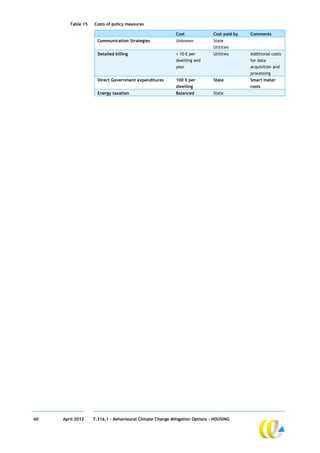
                  various communication strategies, both for mass and individual target
                    groups;
                  obligations for energy providers to distribute truly informative and
                    adequately frequent heating energy bills;
                  direct governmental expenditures like national governments’ public
                    investments in infrastructure, e.g. smart-meters;
                  and as an option: Financial incentives for reduced energy consumption or
                    taxation of higher energy consumption.

                 The overall abatement potential identified for the selected options is equally
                 addressed by the different policy instruments in the policy package. The
                 ability of the policy package to address the potential can only be quantified
                 roughly, as the barriers themselves are of a psychological nature.
                 Even for fiscal instruments the effect on user behaviour has not been
                 quantified in a way that allows describing detailed correlations. From several
                 projects at least a share of 25-30% of the potential can be realistically
                 addressed by the informational measures of the policy package.


9   April 2012   7.316.1 – Behavioural Climate Change Mitigation Options - HOUSING
10   April 2012   7.316.1 – Behavioural Climate Change Mitigation Options - HOUSING
1       Introduction
                  The EU’s greenhouse gas (GHG) emission reduction policies and the goal to
                  keep the global temperature increase below 2°C commits the EU and its
                  Member States to reduce emissions by at least 20% below 1990 levels by 2020,
                  and by 80-95% by 2050.

                  The current models for quantitative assessments of climate policies in the
                  housing domain are implicitly or explicitly focused on technical mitigation
                  measures and less on behavioural changes induced by policy instruments.
                  However, it is known that there is a considerable potential to reduce emissions
                  by changes in consumption patterns, especially in the area of heating energy
                  demand, at low costs. Thus, if ambitious reduction targets are to be reached,
                  shifts in consumption patterns of indoor heating energy may prove essential to
                  complement technological developments.
                  Therefore, it is crucial to assess the emission mitigation potential of
                  residential behavioural changes, but also various kinds of barriers to these
                  changes and eventually policy instruments to overcome the barriers.

                  To sum up, the aim of this report for the housing domain is to assess and
                  demonstrate the GHG emission reduction potential of household changes in
                  behaviour and consumption patterns. In this vein, it tries to properly assess
                  and demonstrate the abatement potential of particular behavioural options
                  with regards to space heating. A further target is the analysis of policy options
                  for the further development of policy packages inducing changes in residential
                  energy mitigation behaviour and consumption patterns. And finally, the
                  presented results aim to identify the linkages with other technical and
                  economic variables in such a way that they can be used in modelling and
                  scenario development.

                  Chapter 2 provides an overview of behavioural options in the housing sector
                  aiming to reduce the demand of residential space heating energy, and
                  concludes with a selection of three behavioural options to be further analysed.
                  Subsequently, Chapter 3 deals with the abatement potential of the options
                  chosen, providing insight into the theoretical and the realistic CO2 mitigation
                  potentials while also discussing possible indirect, rebound and side-effects as
                  well as end-user costs. Next, Chapter 4 on barriers, consumer segments and
                  policy instruments delivers a broad overview of barriers inhibiting domestic
                  curtailment behaviour with regard to the reduction of space heating energy, as
                  cited from scientific studies. After referring to consumer segments and
                  possible diffusion patterns, existing policy instruments with the ability to
                  influence domestic energy saving behaviour are identified and evaluate,
                  focusing on their ability to promote behavioural change. Finally, Chapter 5
                  establishes a policy package on the basis of the most suitable policy
                  instruments. The package´s abatement potential and costs are eventually
                  described when successfully addressing residential behavioural change.


11   April 2012   7.316.1 – Behavioural Climate Change Mitigation Options - HOUSING
12   April 2012   7.316.1 – Behavioural Climate Change Mitigation Options - HOUSING
2       Overview of behavioural options
           2.1    Introduction

                  It is widely acknowledged in the literature that user behaviour significantly
                  influences energy use in the housing sector (e.g. Guerra Santin et al., 2009;
                  Branco et al., 2004; Jeeninga et al., 2001; IWU, 2003). Thus, also saving
                  potentials that are possible from a technological point of view are contingent
                  on user behaviour: “While there is a plethora of studies on the technical
                  possibilities, i.e. the potential energy savings that new technologies allow, it is
                  plain that energy consumption also depends on our attitudes, preferences, and
                  income as well as relative prices.” (Kriström, 2008, p. 95). However, the
                  extent to which variations in energy use are due to variations in user behaviour
                  is still largely unknown (see Guerra Santin et al., 2009). Thus, also
                  quantitative analyses of the potential of behavioural change measures can
                  hardly be found in the literature. This is mirrored for example in the review by
                  Abrahamse et al. (2005) which shows that hardly any study on behavioural
                  change includes quantifications of the resulting effects or similarly, by results
                  from the project BewareE which extensively reviews measures on reducing
                  consumers’ energy consumption throughout Europe (Scharp, 2008; cp. also
                  Gynther, Mikkonen and Smits, 2011, on results from the Behave project).
                  Moreover, the majority of studies focus on residential electricity use which is
                  out of scope of the current project. Furthermore, those studies that analyse
                  behavioural change come to varying results (cp. Kriström, 2008) which is to be
                  expected if the amount of literature is limited. Thus, in sum, the results from
                  the literature and study review on the housing sector which will be presented
                  in the following are less informative than expected.


           2.2    Housing

                  In the residential sector energy is primarily used for space heating and cooling,
                  water heating, lighting and electric appliances. If the focus of analyses is
                  directed to non-electricity space and water heating are the main domains for
                  achieving consumption patterns that are sustainable with regard to climate
                  change. Cooling, e.g. using air-conditioning, is an additional domain,
                  especially for the warmer parts of the EU, that is gaining importance also in
                  relation of the hotter climate to be expected in consequence of climate
                  change. Research has found that energy demand for space heating is positively
                  related to the age of the occupants (older households consuming more
                  energy), household size, income and ownership (more energy used in rented
                  dwellings) (e.g. Jeeninga et al., 2001; Lenzen et al., 2006; Schuler et al.,
                  2000; Guerra Santin et al., 2009). Energy use for heating has been estimated
                  to vary by the factor of two depending on variations in user behaviour
                  (cp. Guerra Santin et al., 2009). Similarly, studies assessing the energy
                  demand by passive housing, show that depending on the user behaviour,
                  energy demand may vary by the factor of four (Gintars and Friedrich, 2003).

                  From a theoretical point of view, behavioural measures with regards to
                  mitigating energy use in households mainly comprise two areas: efficiency
                  and curtailment behaviours (Gardner and Stern, 2002). The first one includes
                  one-shot behaviours like the decision on and investment in equipment used,
                  i.e. the energy source and the appliance for generating energy. The second
                  refers to repetitive efforts, e.g. changes in everyday behaviour, i.e. the


13   April 2012   7.316.1 – Behavioural Climate Change Mitigation Options - HOUSING
operation of appliances, preferred room temperatures, usage patterns with
                  regard to opening windows, etc. Some of these behavioural measures imply a
                  change of routines without changing lifestyle (e.g. optimised operation of
                  heating installations without reducing the room temperature), others imply
                  greater changes (e.g. reduced room temperature). Efficiency behaviour is not
                  the main focus of this study, for it mainly results in the investment into
                  different technologies, but the curtailment behaviour remains unchanged.

                  The impact of efficiency behaviours on energy demand is often assumed to be
                  higher than of curtailment behaviours (cp. Abrahamse et al., 2004).
                  Furthermore it can be hypothesised that efficiency behaviours are more
                  sustainable as they only once call for a certain behaviour (e.g. deciding on an
                  investment) to achieve constant energy savings (not considering direct
                  rebound effects). Curtailment behaviours usually do not require initial
                  investments which may be a barrier to efficiency behaviours.

                  Up to now, first studies confirm that the behavioural potential for saving
                  energy in the area under study is significant. For example, estimates of what is
                  a comfortable room temperature greatly vary. A study by Schlomann et al.
                  (2004) found values between 18 to 25°C to be evaluated as an acceptable
                  temperature for the living room, for bedroom temperatures varied between
                  10 and 22°C. Ministry of the Environment (2008) provide data for an exemplary
                  case, using data from a two-person-household which has an energy demand
                  close to an average Finnish citizen. They come to the conclusion that lowering
                  the room temperature – which is one of several behavioural measures analysed
                  – by 2°C would reduce the CO2 impact per person by 250 kg/a. These results
                  imply that there may be a significant potential for saving energy by reducing
                  room temperatures. With one exception, all of the studies included in the
                  factsheets (see annex) further analyse the potential of changed behaviour with
                  regard to heating thereby including the replacement of less efficient heating
                  systems as well as curtailment behaviour in relation to space heating. Further
                  results are to be expected to be published in the years to come, e.g.
                  EU-funded projects like eSESH (Saving Energy in Social Housing with ICT;
                  www.esesh.eu) and BECA (ICT for energy and water efficiency in social
                  housing) have just started, however, not published results.

                  Thus, while heating is covered to some extent by the results of the literature
                  review, studies on air-conditioning were even harder to identify. This may be
                  due to the fact, that due to the actual climate, in Europe air-conditioning is
                  just about gaining importance with saturation levels not reached up to now
                  (cp. Bertoldi and Atanasiu, 2007; Moussaoui, n.d.). Some studies from the US
                  which are also informative for the scope of this project with regard to heating
                  include data on air-conditioning and were there also included into the
                  factsheets (BC Hydro, 2007; Dietz et al., 2009; Gardner and Stern, 2008).
                  However, behavioural changes in relation to air conditioning were finally
                  removed due to poor data availability and lack of conceivable policy
                  instruments (see Section 2.4). The final list of behavioural options identified is
                  equally provided in that chapter.

                  Measures identified: Summary of factsheets
                  Overview – studies included in factsheets:
                  1. Abrahamse et al. (2007): The effect of tailored information, goal-setting
                     and tailored feedback on household energy use, energy-related behaviours,
                     and behavioural antecedents (plus further material from the same
                     project).
                  2. BC Hydro (2007): Conservation Potential Review by the Canadian utility
                     BC Hydro (plus further material from the same project).


14   April 2012   7.316.1 – Behavioural Climate Change Mitigation Options - HOUSING
3. Bohunovsky et al. 2010: Ausbau erneuerbarer Energien, Erhöhung der
                     Energieeffizienz und Verhaltensänderungen im Energieverbrauch bis 2020
                     (plus further material from the same project –
                     http://www.energiemodell.at/projekte/e-co/).
                  4. Öko-Institut (2000): Klimaschutz durch Minderung von
                     Treibhausgasemissionen im Bereich Haushalte und Kleinverbrauch durch
                     klimagerechtes Verhalten.
                  5. Bürger (2009): Identifikation, Quantifizierung und Systematisierung
                     technischer und verhaltensbedingter Stromeinsparungspotenzial privater
                     Haushalte (Project Transpose - www.uni-muenster.de/Transpose).
                  6. Dietz et al. (2009): Household actions can provide a behavioural wedge to
                     rapidly reduce US carbon emissions.
                  7. Gardner and Stern (2008): The Short List The Most Effective Actions U.S.
                     House-holds Can Take to Curb Climate Change.
                  8. Guerra Santin et al. (2009): The effect of occupancy and building
                     characteristics on energy use for space and water heating in Dutch
                     residential stock.
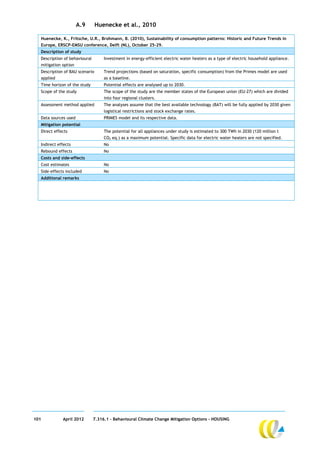
                  9. Huenecke et al. (2010): Sustainability of consumption patterns: Historic
                     and future trends for Europe (http://eupopp.net).


        Table 1   Overview of behavioural measures and related factsheets in housing

                    Behavioural measure                                  Related factsheets
                    Housing
                    Bundle of heating related behaviours including       Abrahamse et al., 2007
                    reducing room temperatures
                    Combined effect of reducing room temperatures and    Öko-Institut, 2000
                    ventilation rates
                    Reduced use of electric ventilation                  BC Hydro, 2007
                    Reducing space heating temperature (lowering room    BC Hydro, 2007; Bohunovsky et al.,
                    temperature)                                         2010; Gardner and Stern, 2008;
                                                                         Guerra Santin et al., 2009
                    Reducing heated space                                BC Hydro, 2007; Bohunovsky et al.,
                                                                         2010; Gardner and Stern, 2008;
                                                                         Guerra Santin et al., 2009
                    Reduced use of space heating                         BC Hydro, 2007; Bohunovsky et al.,
                                                                         2010; Gardner and Stern, 2008;
                                                                         Guerra Santin et al., 2009
                    Optimising thermostat settings of heating, leaving   Dietz et al. (2009);
                    room temperatures at the same level                  Gardner and Stern (2008)
                    Optimising water heater settings                     Dietz et al. (2009);
                                                                         Gardner and Stern (2008)
                    Optimised air-conditioning use                       BC Hydro, 2007; Dietz et al., 2009
                    Reduced hot water use                                BC Hydro, 2007
                    Optimised water heater settings                      Dietz et al. (2009);
                                                                         Gardner and Stern (2008)
                    Replacement of electrical heating/electrical water   Bürger, 2009; Dietz et al. (2009);
                    heaters                                              Huenecke et al. (2010)


                  Time horizons of the studies vary greatly between only referring to the actual
                  situation (e.g. Abrahamse et al., 2007) and 2030 (Huenacke et al., 2010).
                  The scope of most studies is nationally with Austria (I), Canada (I),
                  Germany (II) the Netherlands (II), USA (II) and once the EU-27.
                  Thus, conclusions for the whole EU are difficult to draw as especially colder
                  and warmer climate zones are underrepresented. The assessment methodology
                  mainly relies on modelling exercises, only few studies refer to data on real


15   April 2012   7.316.1 – Behavioural Climate Change Mitigation Options - HOUSING
changes of behaviour. Effects (indirect, rebound, side-effects) besides direct
                  effects are hardly analysed, and if mentioned at all, the analyses are very
                  superficial; the same applies for cost estimates.


           2.3    Non-residential buildings

                  The goal of this part of the literature overview is to provide insight
                  in the behavioural options for heating/cooling energy conservation in
                  non-commercial, non-residential buildings. Whereas residential energy
                  conservation has received at least some attention in the literature (see
                  literature overview on housing), less is known about behavioural options in the
                  non-residential sector. In light of the project goals, the search for literature
                  has been limited in the following ways:
                   As mentioned above, only behavioural options are considered. Technical
                      options (e.g. insulation, heating equipment, thermal control systems) are
                      excluded from this review.
                   The review is to focus solely on heating and cooling energy use.
                      Conservation options in terms of lighting or office equipment are not
                      included, since electricity use will eventually be covered by the EU ETS
                      system.
                   Since commercial enterprises are thought to base their energy behaviours
                      and investments on rational economic arguments, they are excluded from
                      this review. Public sector buildings like schools, universities, hospitals,
                      government buildings and museums are included.

                  Due to this drastic reduction in topics to be covered, it is not surprising that
                  appropriate literature is scarce if not non-existent. This is reflected in the
                  IPCC’s fourth assessment report (Levine et al., 2007), which names occupant
                  behaviour as an important potential for energy conservation. At the same
                  time, they note that little literature is available on the effect of so-called
                  non-technical measures1, and name electricity use and residential heating as
                  the most important options. The majority of literature on behavioural options
                  for energy conservations is focused on electricity, e.g. by motivating people to
                  switch of the lights when they leave a room, or use power-saving modes on
                  office equipment (e.g. Junilla, 2007; Scherbaum et al., 2008). In our view, the
                  narrowing down of the topic only leaves three broad categories of measures
                  that might influence energy performance:
                   building occupants collectively agreeing on adjusting thermostats towards
                      outside temperature (less heating in winter, less cooling in summer);
                   keeping windows closed in buildings with climate regulation systems;
                   allowing building occupants to individually regulate their room’s climate
                      control and motivating them to switch it off when not present.
                  These three options, and the available literature on the topic, are briefly
                  discussed below.


                  1
                       They estimate that, globally, approximately 29% of emissions could be avoided in the
                       residential and commercial building sector through technical measures. Non-technical
                       measures are not quantified due to lack of data.


16   April 2012   7.316.1 – Behavioural Climate Change Mitigation Options - HOUSING
Collective temperature adjustment
                  Perhaps the most obvious behavioural measure to conserve heating/cooling
                  energy in utility buildings is to collectively adjust to an indoor temperature
                  that is nearer to the outside temperature. This prevents heating in winter and
                  cooling in summer, but it would require a collective agreement or
                  management policy to centrally change the temperature2. No literature was
                  found on the potential energy conservation involved with such a measure.
                  Any literature related to this field actually tried to achieve the opposite: to
                  minimise the energy use by calibrating central climate management systems,
                  while maintaining comfort levels of building occupants (e.g. Hoes et al.,
                  2008). We consider this a technical solution.

                  Keeping windows and/or doors closed
                  In buildings with centralised climate control, users may have a significant
                  influence on energy loss by opening windows: heat will dissipate out of the
                  building, possibly counteracting the temperature regulation centralised
                  climate control is trying to achieve. However, instead of trying to influence
                  user behaviour on opening windows3, a whole body of literature is aimed at
                  incorporating occupant behaviour and comfort in building energy models in
                  order to optimise the performance of energy management systems
                  (e.g. Rijal et al., 2007; Roetzel et al., 2010). The only study we found
                  describing the effect of educating people on the use of opening windows,
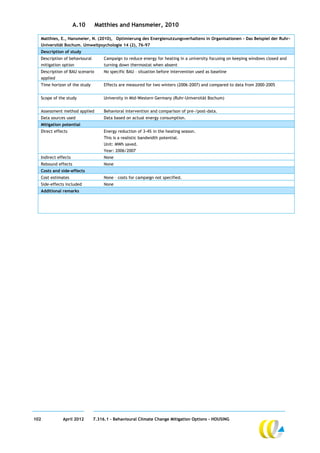
                  is one by Matthies and Hansmeier (2010). They investigated the effect of an
                  information campaign on window-opening behaviour and thermostat regulation
                  (see next paragraph), and observed a 3-4% reduction of energy consumption
                  during the heating season. The topic is also briefly touched upon by Broc et al.
                  (2006, see factsheet), who studied the effect of an information campaign on
                  user-related energy consumption in French office buildings. Although mainly
                  focused on electricity use, heat energy was included for part of the sample,
                  and showed a reduction compared to a baseline period. It should be noted,
                  however, that the sample used in this study was very small (four office
                  buildings), and therefore difficult to extend to a European scale. A study
                  related to this topic, is the issue of shopkeepers keeping their doors open
                  during opening hours. While increasing energy use (i.e. by heat escaping
                  through the open door in the heating season), shopkeepers claim that
                  customers are more likely to enter their shop when the door is open. In light of
                  the ‘Close the Door’ initiative in the UK to stimulate shopkeepers to keep their
                  doors closed, Basarir and Overend (2010) investigated the energy loss incurred
                  by keeping shops’ doors open. Although the scale of the study is very small,
                  and the study is slightly off-topic, a factsheet of this study is included in this
                  review.

                  Individual climate regulation
                  If climate control is halted when users are absent, less energy may be
                  consumed for a building’s climate control. While generally applied by e.g.
                  lowering thermostats outside of opening hours, it may be theoretically possible
                  to achieve this by allowing individual users to control their room temperature.
                  One principal problem in finding behavioural options to conserve heating
                  energy in collective buildings is that their lay-out is generally designed in the
                  opposite fashion. I.e. climate regulation is collectively regulated so that
                  responsibility of energy consumption lies with the building supervisor, not the
                  end-user. This set-up allows a high level of automation of climate control
                  (e.g. centralised thermostat setting, use of efficient heating equipment), and


                  2
                       Or a change to individual climate control; see below.
                  3
                       One way of achieving this, is by preventing windows from opening at all, but this is
                       considered a technical option.


17   April 2012   7.316.1 – Behavioural Climate Change Mitigation Options - HOUSING
takes away responsibility of regulation from the end-user. This seems quite
                  reasonable, given that end-users in utility buildings are usually uninvolved with
                  paying the energy bills. In residential buildings, end-users are often
                  responsible for paying energy bills, and thus have a higher incentive for
                  conserving energy4. One way in which individual users may influence individual
                  room temperature, is by turning down the radiator when they will be absent
                  for a longer time. This behaviour was included in the intervention study by
                  Matthies and Hansmeier (2010), but the effect of single measures could not be
                  quantified.


        Table 2   Overview of behavioural measures and related factsheets in non-residential buildings

                      Behavioural measure                                       Related factsheets
                      Non-residential buildings
                      Collective temperature adjustment                         -
                      Keeping windows and/or doors closed                       Broc et al., 2006;
                                                                                Matthies and Hansmeier, 2010;
                                                                                Basarir and Overend, 2010
                      Individual climate regulation                             Matthies and Hansmeier, 2010
                      Turning off lights/computers (electricity conservation)   Junilla, 2008


                  To sum up for the housing sector, only few behavioural options can be
                  identified from the literature and many of them are related. They mainly refer
                  to reducing the demand of energy for heating by either reducing room
                  temperatures, reducing the amount of heated space, reducing the use of space
                  heating at all. Additional areas analysed are either optimising the settings of
                  water heaters and/or the space heating facilities or relate to ventilation
                  behaviour. However, the list of options presented in the tables is longer as
                  effects of different behavioural options are often studied together and data is
                  only provided for combined effects.


           2.4    Selection of behavioural change options

                  We have applied a three step process for selecting behavioural changes:

                  Step 1: Remove behavioural changes with poor data availability and lack
                            of conceivable policy instruments
                  Behavioural changes with poor data availability do not allow for the
                  calculation of GHG emission reduction potential and costs. Behavioural
                  changes for which no policy instrument is conceivable are excluded because
                  they cannot contribute to the study objective to ‘analyse policy options for the
                  further development of community policies and measures inducing changes in
                  behaviour and consumption patterns’.

                  Step 2: Rank behavioural changes according to their mitigation potentials
                  In this second step the remaining behavioural changes are ranked based on
                  their mitigation potential. The ranking process is complicated by the fact that
                  for some behavioural changes the literature reviewed presented maximum
                  potentials, while for other changes just ‘realistic’ potentials are given. In
                  addition, the time horizon of the mitigation potential estimates differs

                  4
                         A similar issue arises when making decisions about investing in energy-efficient equipment:
                         when the investor does not reap the benefits of the energy efficiency, he is not likely to
                         invest in more expensive equipment, while users. Similarly, when end-users are not
                         responsible for paying the energy bill, they are less likely to mind there spending. This is
                         sometimes referred to as the principal-agent problem (Meier et al., 2007).


18   April 2012   7.316.1 – Behavioural Climate Change Mitigation Options - HOUSING
between studies (and hence behavioural changes). Therefore, the ranking of
                  the various behavioural changes was performed by expert judgement based on
                  the results of the literature review.

                  Step 3: Select options that have high policy relevance and/or are usually
                            not covered by models
                  This step eliminates behavioural changes that have a relatively large GHG
                  abatement potential but are already included in models, and changes that
                  have a relatively large abatement potential but that are studied elsewhere or
                  have little policy relevance for other reasons.

                  The selection process has resulted in the selection of three behavioural
                  changes in the housing domain:
                  1. Reducing space heating temperature (=lowering room temperature).
                  2. Optimising thermostat settings of heating (e.g. leaving room temperatures
                     at the same level, reducing temperature at night/if absent). And
                  3. Optimising ventilation behaviour.

                  The GHG impacts, costs, and barriers are studied in more detail in the next
                  chapters.


19   April 2012   7.316.1 – Behavioural Climate Change Mitigation Options - HOUSING
20   April 2012   7.316.1 – Behavioural Climate Change Mitigation Options - HOUSING
3        Abatement potential and costs
                   After applying a three-step selection procedure, three behavioural change
                   options remained to be further analysed with regards to GHG impacts, costs
                   and important side-effects, as well as barriers of these behavioural changes.

                   The energy consumption of private households is dependent of two classes of
                   factors: building characteristics and user behaviour. Factors like dwelling size,
                   location of the apartment within the house, the heating system, type of
                   windows, insulation or climatic influences etc. are counted among the
                   non-personal housing variables, whereas the very specific user behaviour of
                   the residents, and furthermore occupancy rate (e.g. family or single
                   household), occupancy time (e.g. employed or retired people) or living
                   conditions (e.g. living with small children or elder people) are important
                   determinants of the energy use in buildings.

                   In energetically not optimised and non-retrofitted houses, the absolute effect
                   of energy savings due to curtailment behaviour is high, because the overall
                   energy consumption is high as well.
                   In energetically optimised buildings on the other hand, where the technical
                   energy potential is already more or less exhausted, the heating and natural
                   ventilation behaviour have the highest impact on the energy consumption,
                   given that the energy demand is mainly determined by the ventilation losses.
                   Thus, the absolute potential is higher for old and non-retrofitted houses, but
                   the relative impact and in this vein the importance of behaviour compared to
                   technical changes rises with the quality of the insulation of the houses.
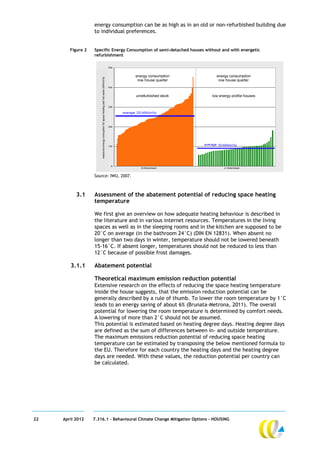
                   The following figure shows the relative amount of manual ventilation (blue)
                   and transmission (red) heating energy losses (transmission means losses due to
                   thermal leaks at e.g. windows, walls and the roof).


        Figure 1   Relative contribution of transmission and ventilation to the overall energy losses of a building

                    100%


                     75%
                                                                                               Transmission
                     50%
                                                                                               Ventilation


                     25%

                      0%
                              building stock        standard           efficient
                                                  new building       new building


                   According to Hacke (2009), the three selected behavioural changes even bear
                   the largest energy reduction potential, stating that domestic energy demand is
                   mostly influenced by temperature choice and manual ventilation behaviour.
                   However, large bandwidths of what users perceive as comfortable room
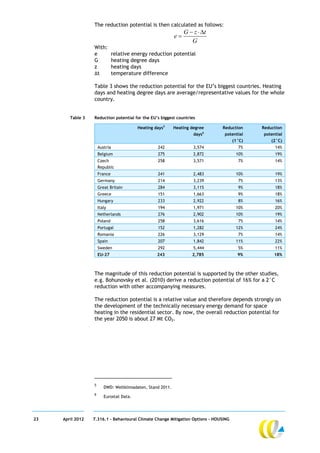
                   temperature or reasonable ventilation behaviour can be found. Figure 2 shows
                   two examples of the effects of user relevant behaviour (see IWU, 2007). At the
                   left side, there is the range of individual energy consumption data in non-
                   retrofitted houses, and on the right of low-energy houses. Even though the
                   average energy consumption in low-energy houses is significantly lower,


21   April 2012    7.316.1 – Behavioural Climate Change Mitigation Options - HOUSING
energy consumption can be as high as in an old or non-refurbished building due
                   to individual preferences.


        Figure 2   Specific Energy Consumption of semi-detached houses without and with energetic
                   refurbishment


                                                                                                        energy consumption              energy consumption


                       measured energy consuption for space heating and hot water (kWh/m²a)
                                                                                                         row house quarter               row house quarter


                                                                                                        unrefurbished stock       low energy profile houses


                                                                                              average


                                                                                                                              average


                   Source: IWU, 2007.


           3.1     Assessment of the abatement potential of reducing space heating
                   temperature

                   We first give an overview on how adequate heating behaviour is described in
                   the literature and in various internet resources. Temperatures in the living
                   spaces as well as in the sleeping rooms and in the kitchen are supposed to be
                   20°C on average (in the bathroom 24°C) (DIN EN 12831). When absent no
                   longer than two days in winter, temperature should not be lowered beneath
                   15-16°C. If absent longer, temperatures should not be reduced to less than
                   12°C because of possible frost damages.

        3.1.1      Abatement potential

                   Theoretical maximum emission reduction potential
                   Extensive research on the effects of reducing the space heating temperature
                   inside the house suggests, that the emission reduction potential can be
                   generally described by a rule of thumb. To lower the room temperature by 1°C
                   leads to an energy saving of about 6% (Brunata-Metrona, 2011). The overall
                   potential for lowering the room temperature is determined by comfort needs.
                   A lowering of more than 2°C should not be assumed.
                   This potential is estimated based on heating degree days. Heating degree days
                   are defined as the sum of differences between in- and outside temperature.
                   The maximum emissions reduction potential of reducing space heating
                   temperature can be estimated by transposing the below mentioned formula to
                   the EU. Therefore for each country the heating days and the heating degree
                   days are needed. With these values, the reduction potential per country can
                   be calculated.


22   April 2012    7.316.1 – Behavioural Climate Change Mitigation Options - HOUSING
The reduction potential is then calculated as follows:
                                                                 G  z  t
                                                            e
                                                                    G
                  With:
                  e            relative energy reduction potential
                  G            heating degree days
                  z            heating days
                  Δt           temperature difference

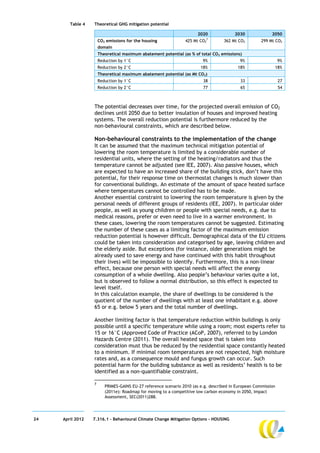
                  Table 3 shows the reduction potential for the EU’s biggest countries. Heating
                  days and heating degree days are average/representative values for the whole
                  country.


        Table 3   Reduction potential for the EU’s biggest countries

                                          Heating days5     Heating degree     Reduction      Reduction
                                                                     days6      potential     potential
                                                                                      (1°C)       (2°C)
                      Austria                      242               3,574              7%         14%
                      Belgium                      275               2,872             10%         19%
                      Czech                        258               3,571              7%         14%
                      Republic
                      France                       241               2,483             10%         19%
                      Germany                      214               3,239              7%         13%
                      Great Britain                284               3,115              9%         18%
                      Greece                       151               1,663              9%         18%
                      Hungary                      233               2,922              8%         16%
                      Italy                        194               1,971             10%         20%
                      Netherlands                  276               2,902             10%         19%
                      Poland                       258               3,616              7%         14%
                      Portugal                     152               1,282             12%         24%
                      Romania                      226               3,129              7%         14%
                      Spain                        207               1,842             11%         22%
                      Sweden                       292               5,444              5%         11%
                      EU-27                        243              2,785               9%         18%


                  The magnitude of this reduction potential is supported by the other studies,
                  e.g. Bohunovsky et al. (2010) derive a reduction potential of 16% for a 2°C
                  reduction with other accompanying measures.

                  The reduction potential is a relative value and therefore depends strongly on
                  the development of the technically necessary energy demand for space
                  heating in the residential sector. By now, the overall reduction potential for
                  the year 2050 is about 27 Mt CO2.


                  5
                         DWD: Weltklimadaten, Stand 2011.
                  6
                         Eurostat Data.


23   April 2012   7.316.1 – Behavioural Climate Change Mitigation Options - HOUSING
Table 4   Theoretical GHG mitigation potential

                                                                      2020               2030              2050
                      CO2 emissions for the housing             425 Mt CO27        362 Mt CO2         299 Mt CO2
                      domain
                      Theoretical maximum abatement potential (as % of total CO2 emissions)
                      Reduction by 1°C                                   9%                9%                   9%
                      Reduction by 2°C                                  18%               18%               18%
                      Theoretical maximum abatement potential (as Mt CO2)
                      Reduction by 1°C                                   38                33                   27
                      Reduction by 2°C                                   77                65                   54


                  The potential decreases over time, for the projected overall emission of CO2
                  declines until 2050 due to better insulation of houses and improved heating
                  systems. The overall reduction potential is furthermore reduced by the
                  non-behavioural constraints, which are described below.

                  Non-behavioural constraints to the implementation of the change
                  It can be assumed that the maximum technical mitigation potential of
                  lowering the room temperature is limited by a considerable number of
                  residential units, where the setting of the heating/radiators and thus the
                  temperature cannot be adjusted (see IEE, 2007). Also passive houses, which
                  are expected to have an increased share of the building stick, don’t have this
                  potential, for their response time on thermostat changes is much slower than
                  for conventional buildings. An estimate of the amount of space heated surface
                  where temperatures cannot be controlled has to be made.
                  Another essential constraint to lowering the room temperature is given by the
                  personal needs of different groups of residents (IEE, 2007). In particular older
                  people, as well as young children or people with special needs, e.g. due to
                  medical reasons, prefer or even need to live in a warmer environment. In
                  these cases, lowering the room temperatures cannot be suggested. Estimating
                  the number of these cases as a limiting factor of the maximum emission
                  reduction potential is however difficult. Demographical data of the EU citizens
                  could be taken into consideration and categorised by age, leaving children and
                  the elderly aside. But exceptions (for instance, older generations might be
                  already used to save energy and have continued with this habit throughout
                  their lives) will be impossible to identify. Furthermore, this is a non-linear
                  effect, because one person with special needs will affect the energy
                  consumption of a whole dwelling. Also people’s behaviour varies quite a lot,
                  but is observed to follow a normal distribution, so this effect is expected to
                  level itself.
                  In this calculation example, the share of dwellings to be considered is the
                  quotient of the number of dwellings with at least one inhabitant e.g. above
                  65 or e.g. below 5 years and the total number of dwellings.

                  Another limiting factor is that temperature reduction within buildings is only
                  possible until a specific temperature while using a room; most experts refer to
                  15 or 16°C (Approved Code of Practice (ACoP, 2007), referred to by London
                  Hazards Centre (2011). The overall heated space that is taken into
                  consideration must thus be reduced by the residential space constantly heated
                  to a minimum. If minimal room temperatures are not respected, high moisture
                  rates and, as a consequence mould and fungus growth can occur. Such
                  potential harm for the building substance as well as residents’ health is to be
                  identified as a non-quantifiable constraint.

                  7
                         PRIMES-GAINS EU-27 reference scenario 2010 (as e.g. described in European Commission
                         (2011e): Roadmap for moving to a competitive low carbon economy in 2050, Impact
                         Assessment, SEC(2011)288.


24   April 2012   7.316.1 – Behavioural Climate Change Mitigation Options - HOUSING
The maximum realistic emission reduction potential is therefore the product of
                   the relative reduction potential per dwelling;
                   the share of dwellings without the technical options to reduce the room
                     temperature;
                   the share of dwellings with people with special needs concerning
                     temperature levels;
                   the overall GHG emissions from space heating.

                  The second and the third value are time-variant variables. Nevertheless, for
                  the assessment of the reduction potential the actual values of 2010 are used.
                  The effect of an ageing population in some countries is therefore neglected.
                  The following table gives an overview of the households with people with
                  special needs in the EU countries. For the EU the share of households with
                  these people is more than 35%.


        Table 5   Share of households with young children and seniors (Eurostat, 2011)

                                                      Children                Seniors      Sum
                                                    (0-5 years)           (>65 years)


                    Belgium                                 9%                    25%       34%
                    Austria                                 8%                    25%       34%
                    Bulgaria                               11%                    26%       37%
                    Cyprus                                 13%                    22%       35%
                    Czech Republic                         10%                    24%       34%
                    Denmark                                 7%                    24%       31%
                    Estonia                                 9%                    26%       35%
                    Finland                                 7%                    25%       32%
                    France                                  9%                    26%       35%
                    Germany                                 7%                    28%       35%
                    Greece                                  9%                    26%       35%
                    Hungary                                10%                    25%       35%
                    Ireland                                12%                    21%       33%
                    Italy                                   9%                    29%       38%
                    Latvia                                 10%                    24%       34%
                    Lithuania                              11%                    26%       37%
                    Luxembourg                             10%                    20%       30%
                    Malta                                  11%                    24%       35%
                    Netherlands                             8%                    23%       31%
                    Poland                                 11%                    23%       34%
                    Portugal                               11%                    27%       37%
                    Romania                                11%                    24%       35%
                    Slovakia                               11%                    22%       33%
                    Slovenia                               11%                    24%       35%
                    Spain                                  10%                    22%       32%
                    Sweden                                  7%                    27%       34%
                    Switzerland                             7%                    25%       32%
                    United Kingdom                          9%                    26%       35%
                    EU-27                                   9%                    26%      35%


25   April 2012   7.316.1 – Behavioural Climate Change Mitigation Options - HOUSING
For the technical options, no sound statistical data on the type of heating
                  system is available. The share of district heating in Europe is 8,5%. Especially
                  in eastern Europe, large flat buildings, which are often supplied with district
                  heat, have centralised heating control systems. In addition, a certain
                  percentage of buildings with other heating systems may not have a system for
                  individual control of the room temperature. An assumption of 10% of dwellings
                  without the technical options to control the room temperature seems
                  reasonable.

                  Indirect effects
                  The reduction in the average energy use of households due to the lowering of
                  room temperatures will also result in less energy use in the production phase
                  of the energy carrier and hence potentially less GHG emissions.

                  Rebound effects
                  It is reasonable to assume the occurrence of a rebound effect deriving from
                  the lowering of room temperatures and thus the saving of money for the
                  residents. A usual behavioural pattern associated with rebound effects, is that
                  the money saved due to energy saving will be invested in purchasing goods,
                  especially electronic devices that in turn undo the saving by their electricity
                  demand. Or that lowering the temperatures in the living room will, via the
                  fact that less money has to be spent, lead to the decision to heat the
                  bedrooms more which were formerly kept at lower temperatures. In the
                  selected studies, no numbers of rebound effects were provided. They are thus
                  too difficult to estimate, and hence cannot be further taken into account. only
                  studies could be identified, that deal with direct rebound effects in relation to
                  the adoption of energy-efficient building technologies, fuel switching or
                  decrease in prices for energy services (Haas and Biermayr, 2000; Hens et al.,
                  2010; Sorrell, S., 2007; Sorrell et al., 2000). Most of those studies agree on a
                  direct rebound effect of typically less than 30%. No study could be identified
                  that investigated rebound effects as mentioned above, i.e. that derive from
                  energy curtailment behaviour of residents, keeping all other factors (like
                  building energy demand or existence of energy-efficient technologies)
                  constant.

        3.1.2     End-user costs
                  There are no direct expenditures related to the behavioural mitigation option
                  of lowering the room temperatures. Neither capital nor operational costs are
                  an obligatory prerequisite of behavioural change in this case. This means that
                  the behaviour and its effects can certainly be facilitated by e.g. the purchase
                  of setback thermostats (see next paragraph) or by isolating smaller window
                  gaps by help of according material. However, with a controllable heating
                  system, the behavioural change of manually lowering the temperature does
                  not bear any further costs. What remains are the negative costs from the
                  reduced energy consumption. Opportunity costs can at fist sight not be
                  quantified. Because of the one-shot characteristic and small possibility to
                  assess the amounts spent, those costs can be ignored. As described in the
                  project tender, the scope of the cost assessment excludes welfare costs. Since
                  literature on this topic with regards to space heating energy reduction, and
                  ventilation behaviour as well, is low or even non-existent, a quantification of
                  welfare costs is not possible. A qualitative discussion shall however be
                  provided. Reductions in room temperatures are resulting in comfort losses,
                  hence in welfare losses. Given that the thermal comfort is considered very
                  important for the majority of residents, those welfare costs can act as a main
                  barrier to behavioural change, even if they can lead to considerable monetary
                  savings.


26   April 2012   7.316.1 – Behavioural Climate Change Mitigation Options - HOUSING
3.1.3     Co-benefits
                  In the case of reduced room temperature within a reasonable scope (see
                  description of behavioural change above), there are no positive or negative
                  side-effects evident from an end-user perspective. As we have seen however in
                  Figure 11, the individual perception of ideal room temperatures can vary
                  enormously, and thus a negative approval of a certain temperature involves a
                  reduction of personal comfort. On the contrary, should the saving behaviour
                  be overdrawn, and temperature lowered to values beneath the suggested
                  ones, it can result in health issues.

        3.1.4     Conclusion: maximum realistic mitigation potential and net costs
                  The theoretical potential given in table has to be reduced due to the
                  limitations described above. Therefore, in a conservative approach, only 60%
                  of the theoretical potential can be assumed to be possibly realised.


        Table 6   Maximum realistic GHG mitigation potential

                                                                    2020              2030   2050
                    Reduction of maximum abatement potential (as % of total CO2 emissions)
                    People with special needs                        35%               35%    35%
                    Technical constraints                            10%               10%    10%
                    Realistic maximum abatement potential (as Mt CO2)
                    Reduction by 1°C                                    22              19     16
                    Reduction by 2°C                                    45              38     32


           3.2    Assessment of the abatement potential of optimising thermostat
                  settings of heating

                  Thermostats control heating appliances in houses. A conventional thermostat
                  regulates house heating at one temperature (for instance, in the winter, a
                  thermostat setting of 20°C will activate the heating system when the house
                  temperature drops below 20°C, or will shut the system off when the house air
                  warms up past 20°C).
                  A setback thermostat gives the user the option of automatically ‘setting back’
                  the thermostat (reducing the set temperature) at night and also during the
                  work day when the occupants have left the house. This can contribute to
                  higher comfort levels of residents in the winter, profiting from the same
                  energy savings of a lowered thermostat setting, while not having to wait for
                  the house to heat up again.
                  Optimised thermostat settings can be characterised by leaving the
                  temperature at the ideal levels described in Section 2.2, while choosing
                  reasonable set back periods (e.g. 11 p.m.-6 a.m. during the night, and
                  9 a.m.-4 p.m. during the day, for working days) (Manning and Swinton, 2005).

        3.2.1     Abatement potential

                  Theoretical maximum emission reduction potential
                  The theoretical maximum potential for emission reduction can be derived from
                  studies which examine the influence of electronic thermostats, which allow
                  case sensitive temperature control. Studies show, that a reduction of 10% of
                  the overall consumption for space heating may be achieved. (Manning, 2005)
                  This effect can only be achieved if the individual temperature in every room is
                  adapted to the actual usage conditions. The variance of energy consumption in
                  comparable houses supports the existence of such a potential. Nevertheless,
                  this is a maximum value, not applicable to the average consumption, but to a
                  dwelling with high specific consumption. If a normal distribution of the energy


27   April 2012   7.316.1 – Behavioural Climate Change Mitigation Options - HOUSING
consumption as shown in Figure 2 is assumed, the maximum impact must
                  therefore be divided by two for the maximum reduction potential refers to the
                  extreme values, not the average. Therefore a potential of 5% of the overall
                  consumption seems realistic for optimal conditions.


        Table 7   Theoretical GHG mitigation potential

                                                                      2020             2030           2050
                    CO2 emissions for the housing domain         425 Mt CO2      362 Mt CO2      299 Mt CO2
                    Theoretical maximum abatement potential (as % of total CO2 emissions)
                    Relative Potential                                    5%                5%          5%
                    Theoretical maximum abatement potential (as Mt CO2)
                    Absolute Potential                                    21                18          15


                  Non-behavioural constraints to the implementation of the change
                  The behavioural change is applicable for high-temperature radiator heating
                  systems.
                  For heating systems, that do not possess modern radiator valves, the usage of
                  thermostats is not possible. Old radiator valves must be exchanged for that
                  purpose.
                  Also for passive houses without conventional heating, which are expected to
                  increase over time, this option is not applicable.
                  There also are limitations for the use of programmable thermostats for homes
                  with heat pumps, electric resistance heating, steam heat, and radiant floor
                  heating (U.S. Department of Energy, 2011).
                  When a heat pump is in its heating mode, setting back its thermostat can
                  cause the unit to operate inefficiently, thereby cancelling out any savings
                  achieved by lowering the temperature setting. According to the U.S.
                  Department’s of Energy website (2011), some companies recently have begun
                  selling specially designed programmable thermostats for heat pumps, which
                  make setting back the thermostat cost effective. These thermostats typically
                  use special algorithms to minimise the use of backup electric resistance heat
                  systems.
                  Electric resistance systems, such as electric baseboard heating, require
                  thermostats capable of directly controlling 120-volt or 240-volt circuits.
                  According to the above mentioned U.S. data, only a few companies
                  manufacture line-voltage programmable thermostats. This is however true for
                  the U.S., the market situation in Europe needs to be assessed.
                  For steam heating and radiant floor heating systems, the problem is their slow
                  response time: both types of systems may have a response time of several
                  hours. This leads some people to suggest that setback is inappropriate for
                  these systems. However, some manufacturers now offer thermostats that track
                  the performance of your heating system to determine when to turn it on in
                  order to achieve comfortable temperatures at your programmed time.
                  Nevertheless this is no more a behavioural option, but a technical one.
                  The share of households without the ability to control the room temperature
                  over time as described before has to be larger than the one for the first
                  option. With increasing quality of the insulation, this share of buildings will
                  furthermore be increased, because if the heating demand nears zero, no
                  significant time variance of the temperature levels will occur.
                  The effect of people with special needs also influences this option. These
                  people have much higher attendance rates at their dwellings and therefore a
                  lower potential for reduction (comp. Section 3.1.1 for numbers).


28   April 2012   7.316.1 – Behavioural Climate Change Mitigation Options - HOUSING
Indirect effects
                  The mentioned indirect effects of behavioural change involving lowering the
                  temperature can be cited here. Results will be the reduced energy use in the
                  production phase of the energy, and hence potentially less GHG emissions.
                  Furthermore, the production and merchandise of the thermostats requires
                  certain amounts of energy input, which cannot be estimated in the framework
                  of this project.

                  Rebound effects
                  For further reasoning on possible rebound deriving from room temperature
                  reduction, please refer to Section 3.1.1.

        3.2.2     End-user costs
                  Direct expenditures involved in the behavioural option in question, the use of
                  (set-back) thermometers, is connected to the cost of purchasing and installing
                  the thermometer (price for the item, travelling cost for shopping, etc.).
                  Operational costs are assumed to be low, since a thermometer is usually not
                  prone for abrasion and associated repairing costs.

        3.2.3     Co-benefits
                  For further reasoning on possible side-effects deriving from room temperature
                  reduction, please refer to Section 3.1.3.

        3.2.4     Conclusion: maximum realistic mitigation potential and net costs
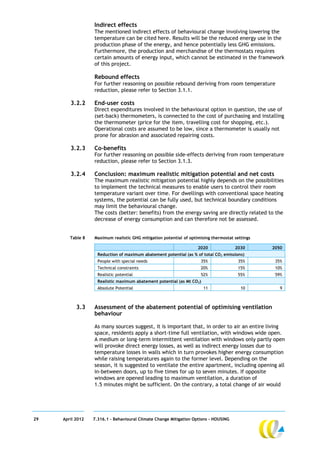
                  The maximum realistic mitigation potential highly depends on the possibilities
                  to implement the technical measures to enable users to control their room
                  temperature variant over time. For dwellings with conventional space heating
                  systems, the potential can be fully used, but technical boundary conditions
                  may limit the behavioural change.
                  The costs (better: benefits) from the energy saving are directly related to the
                  decrease of energy consumption and can therefore not be assessed.


        Table 8   Maximum realistic GHG mitigation potential of optimising thermostat settings

                                                                    2020              2030       2050
                    Reduction of maximum abatement potential (as % of total CO2 emissions)
                    People with special needs                        35%                35%       35%
                    Technical constraints                            20%                15%       10%
                    Realistic potential                              52%                55%       59%
                    Realistic maximum abatement potential (as Mt CO2)
                    Absolute Potential                                  11               10         9


           3.3    Assessment of the abatement potential of optimising ventilation
                  behaviour

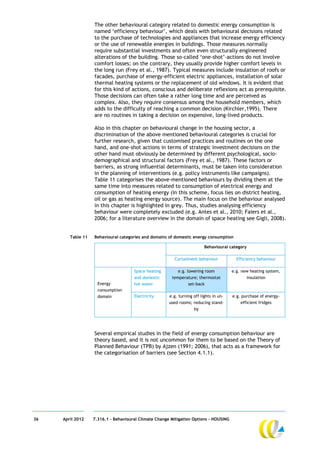
                  As many sources suggest, it is important that, in order to air an entire living
                  space, residents apply a short-time full ventilation, with windows wide open.
                  A medium or long-term intermittent ventilation with windows only partly open
                  will provoke direct energy losses, as well as indirect energy losses due to
                  temperature losses in walls which in turn provokes higher energy consumption
                  while raising temperatures again to the former level. Depending on the
                  season, it is suggested to ventilate the entire apartment, including opening all
                  in-between doors, up to five times for up to seven minutes. If opposite
                  windows are opened leading to maximum ventilation, a duration of
                  1.5 minutes might be sufficient. On the contrary, a total change of air would


29   April 2012   7.316.1 – Behavioural Climate Change Mitigation Options - HOUSING
take one hour with an only partly open window. While used warm air is lost
                   due to transmissions, the radiator valve needs to be closed.
                   This behavioural change has high interdependencies with the other two
                   options. Temperature and humidity are no independent variables in building
                   physics. Low room temperature combined with high moisture will lead to
                   fungus. This is to be avoided in any case, for the benefits of energy saving will
                   be thwarted by the negative impact of fungus on health and the building
                   structure.
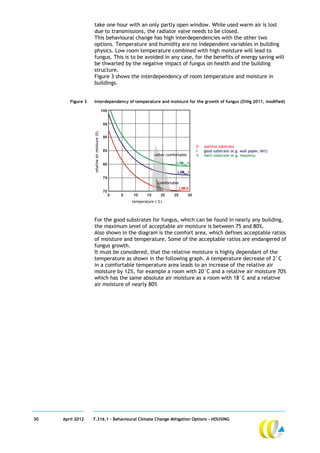
                   Figure 3 shows the interdependency of room temperature and moisture in
                   buildings.


        Figure 3   Interdependency of temperature and moisture for the growth of fungus (Zillig 2011, modified)


                   For the good substrates for fungus, which can be found in nearly any building,
                   the maximum level of acceptable air moisture is between 75 and 80%.
                   Also shown in the diagram is the comfort area, which defines acceptable ratios
                   of moisture and temperature. Some of the acceptable ratios are endangered of
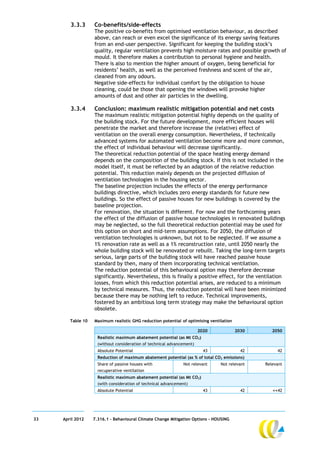
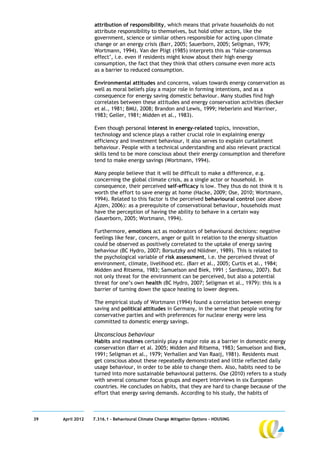
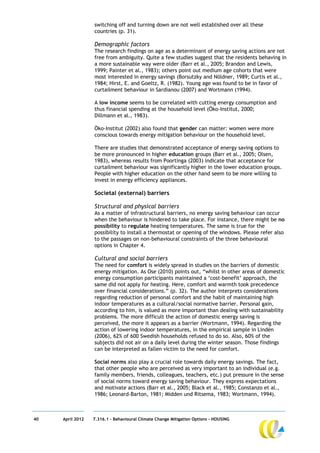
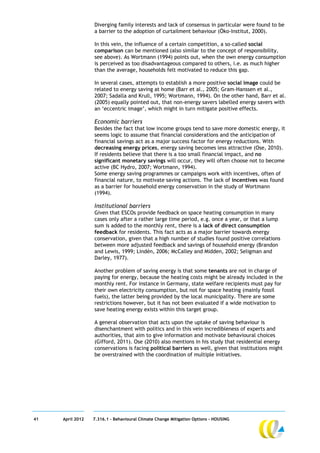
                   fungus growth.
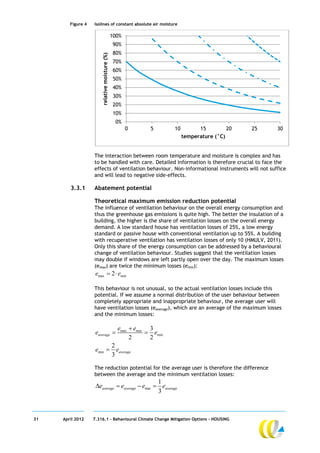
                   It must be considered, that the relative moisture is highly dependant of the
                   temperature as shown in the following graph. A temperature decrease of 2°C
                   in a comfortable temperature area leads to an increase of the relative air
                   moisture by 12%, for example a room with 20°C and a relative air moisture 70%
                   which has the same absolute air moisture as a room with 18°C and a relative
                   air moisture of nearly 80%


30   April 2012    7.316.1 – Behavioural Climate Change Mitigation Options - HOUSING
Figure 4   Isolines of constant absolute air moisture

                                               100%
                                               90%
                                               80%


                       relative moisture (%)
                                               70%
                                               60%
                                               50%
                                               40%
                                               30%
                                               20%
                                               10%
                                                 0%
                                                      0       5       10         15         20   25   30
                                                                           temperature (°C)


                   The interaction between room temperature and moisture is complex and has
                   to be handled with care. Detailed Information is therefore crucial to face the
                   effects of ventilation behaviour. Non-informational instruments will not suffice
                   and will lead to negative side-effects.

        3.3.1      Abatement potential

                   Theoretical maximum emission reduction potential
                   The influence of ventilation behaviour on the overall energy consumption and
                   thus the greenhouse gas emissions is quite high. The better the insulation of a
                   building, the higher is the share of ventilation losses on the overall energy
                   demand. A low standard house has ventilation losses of 25%, a low energy
                   standard or passive house with conventional ventilation up to 55%. A building
                   with recuperative ventilation has ventilation losses of only 10 (HMULV, 2011).
                   Only this share of the energy consumption can be addressed by a behavioural
                   change of ventilation behaviour. Studies suggest that the ventilation losses
                   may double if windows are left partly open over the day. The maximum losses
                   (emax) are twice the minimum losses (emin):
                    emax  2  emin

                   This behaviour is not unusual, so the actual ventilation losses include this
                   potential. If we assume a normal distribution of the user behaviour between
                   completely appropriate and inappropriate behaviour, the average user will
                   have ventilation losses (eaverage), which are an average of the maximum losses
                   and the minimum losses:

                                                  emax  emin 3
                    eaverage                                 emin
                                                       2      2
                                               2
                    emin                        eaverage
                                               3

                   The reduction potential for the average user is therefore the difference
                   between the average and the minimum ventilation losses:
                                                 1
                    eaverage  eaverage  emin  eaverage
                                                 3


31   April 2012    7.316.1 – Behavioural Climate Change Mitigation Options - HOUSING
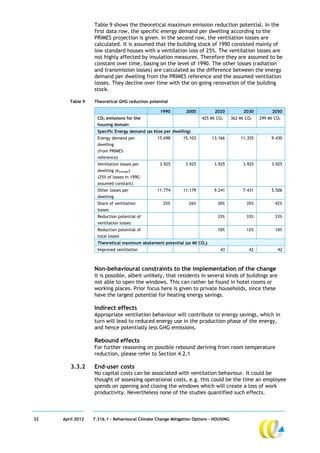
Table 9 shows the theoretical maximum emission reduction potential. In the
                  first data row, the specific energy demand per dwelling according to the
                  PRIMES projection is given. In the second row, the ventilation losses are
                  calculated. It is assumed that the building stock of 1990 consisted mainly of
                  low standard houses with a ventilation loss of 25%. The ventilation losses are
                  not highly affected by insulation measures. Therefore they are assumed to be
                  constant over time, basing on the level of 1990. The other losses (radiation
                  and transmission losses) are calculated as the difference between the energy
                  demand per dwelling from the PRIMES reference and the assumed ventilation
                  losses. They decline over time with the on-going renovation of the building
                  stock.

        Table 9   Theoretical GHG reduction potential

                                                  1990        2000          2020            2030         2050
                    CO2 emissions for the                             425 Mt CO2      362 Mt CO2   299 Mt CO2
                    housing domain
                    Specific Energy demand (as ktoe per dwelling)
                    Energy demand per           15.698       15.103       13.166          11.355        9.430
                    dwelling
                    (from PRIMES
                    reference)
                    Ventilation losses per        3.925       3.925        3.925           3.925        3.925
                    dwelling (eaverage)
                    (25% of losses in 1990,
                    assumed constant)
                    Other losses per            11.774       11.179        9.241           7.431        5.506
                    dwelling
                    Share of ventilation           25%          26%          30%             35%          42%
                    losses
                    Reduction potential of                                   33%             33%          33%
                    ventilation losses
                    Reduction potential of                                   10%             12%          14%
                    total losses
                    Theoretical maximum abatement potential (as Mt CO2)
                    Improved ventilation                                      43              42           42


                  Non-behavioural constraints to the implementation of the change
                  It is possible, albeit unlikely, that residents in several kinds of buildings are
                  not able to open the windows. This can rather be found in hotel rooms or
                  working places. Prior focus here is given to private households, since these
                  have the largest potential for heating energy savings.

                  Indirect effects
                  Appropriate ventilation behaviour will contribute to energy savings, which in
                  turn will lead to reduced energy use in the production phase of the energy,
                  and hence potentially less GHG emissions.

                  Rebound effects
                  For further reasoning on possible rebound deriving from room temperature
                  reduction, please refer to Section 4.2.1

        3.3.2     End-user costs
                  No capital costs can be associated with ventilation behaviour. It could be
                  thought of assessing operational costs, e.g. this could be the time an employee
                  spends on opening and closing the windows which will create a loss of work
                  productivity. Nevertheless none of the studies quantified such effects.


32   April 2012   7.316.1 – Behavioural Climate Change Mitigation Options - HOUSING
3.3.3      Co-benefits/side-effects
                   The positive co-benefits from optimised ventilation behaviour, as described
                   above, can reach or even excel the significance of its energy saving features
                   from an end-user perspective. Significant for keeping the building stock’s
                   quality, regular ventilation prevents high moisture rates and possible growth of
                   mould. It therefore makes a contribution to personal hygiene and health.
                   There is also to mention the higher amount of oxygen, being beneficial for
                   residents’ health, as well as the perceived freshness and scent of the air,
                   cleaned from any odours.
                   Negative side-effects for individual comfort by the obligation to house
                   cleaning, could be those that opening the windows will provoke higher
                   amounts of dust and other air particles in the dwelling.

        3.3.4      Conclusion: maximum realistic mitigation potential and net costs
                   The maximum realistic mitigation potential highly depends on the quality of
                   the building stock. For the future development, more efficient houses will
                   penetrate the market and therefore increase the (relative) effect of
                   ventilation on the overall energy consumption. Nevertheless, if technically
                   advanced systems for automated ventilation become more and more common,
                   the effect of individual behaviour will decrease significantly.
                   The theoretical reduction potential of the space heating energy demand
                   depends on the composition of the building stock. If this is not included in the
                   model itself, it must be reflected by an adaption of the relative reduction
                   potential. This reduction mainly depends on the projected diffusion of
                   ventilation technologies in the housing sector.
                   The baseline projection includes the effects of the energy performance
                   buildings directive, which includes zero energy standards for future new
                   buildings. So the effect of passive houses for new buildings is covered by the
                   baseline projection.
                   For renovation, the situation is different. For now and the forthcoming years
                   the effect of the diffusion of passive house technologies in renovated buildings
                   may be neglected, so the full theoretical reduction potential may be used for
                   this option on short and mid-term assumptions. For 2050, the diffusion of
                   ventilation technologies is unknown, but not to be neglected. If we assume a
                   1% renovation rate as well as a 1% reconstruction rate, until 2050 nearly the
                   whole building stock will be renovated or rebuilt. Taking the long-term targets
                   serious, large parts of the building stock will have reached passive house
                   standard by then, many of them incorporating technical ventilation.
                   The reduction potential of this behavioural option may therefore decrease
                   significantly. Nevertheless, this is finally a positive effect, for the ventilation
                   losses, from which this reduction potential arises, are reduced to a minimum
                   by technical measures. Thus, the reduction potential will have been minimized
                   because there may be nothing left to reduce. Technical improvements,
                   fostered by an ambitious long term strategy may make the behavioural option
                   obsolete.

        Table 10   Maximum realistic GHG reduction potential of optimising ventilation

                                                                        2020             2030      2050
                     Realistic maximum abatement potential (as Mt CO2)
                     (without consideration of technical advancement)
                     Absolute Potential                                   43               42        42
                     Reduction of maximum abatement potential (as % of total CO2 emissions)
                     Share of passive houses with              Not relevant     Not relevant    Relevant
                     recuperative ventilation
                     Realistic maximum abatement potential (as Mt CO2)
                     (with consideration of technical advancement)
                     Absolute Potential                                   43               42      <<42


33   April 2012    7.316.1 – Behavioural Climate Change Mitigation Options - HOUSING
34   April 2012   7.316.1 – Behavioural Climate Change Mitigation Options - HOUSING
4       Barriers, consumer segments and
                  policy instruments
           4.1    Introduction

                  In Section 2.4, we selected three relevant behavioural mitigation options
                  aiming at a reduction of energy consumption and thus at climate change
                  mitigation:
                   reducing space heating temperature;
                   optimising thermostat settings;
                   optimising ventilation behaviour.

                  Those options pertain to the housing sector, and in particular to the reduction
                  of space heating energy consumption (not electricity consumption in
                  appliances).
                  Heating and cooling of dwellings and water heating are the single largest
                  contributors to residential energy use, representing as much as 80% of total
                  residential energy demand in OECD member countries (OECD, 2007). According
                  to IER (2000), space heating alone accounts for 70% of total residential energy
                  demand in most countries – corresponding to a 15-22% share of total final
                  energy demand.
                  Furthermore, for research purposes it is important to establish a definition of
                  the energy-related behaviour that we focus on, which will be described below.
                  The assessment is based on existing literature, and there are manifold sources
                  in the social science literature that deal with the determinants and the
                  barriers of domestic energy saving. Often however, effects of empirical studies
                  are not communicated for single behavioural options, but for a mix of
                  comparable environmental behaviours. For those reasons, the structure of this
                  chapter will be as follows:
                  A definition of the analysed behaviour will be followed by a short overview of
                  theoretical reflections in the field. Some notes on the development of the
                  research paradigm over time will serve as an introduction to the collection of
                  studies comprising the barriers of domestic energy saving behaviours. In a first
                  step, we will give an overview of the general findings of curtailment behaviour
                  in housing; after that, a detailed classification of the barriers explicitly
                  applying to the three specific behavioural options will be provided, wherever
                  possible.

                  For the general domestic curtailment options, as well as for each selected
                  option of behavioural change wherever possible, we will discuss their potential
                  diffusion path and speed and the interactions with relevant barriers.

                  Definition of the energy saving behaviour at hand
                  From an environment-psychological point of view, two categories of domestic
                  energy mitigating behaviour must be distinguished. The first is ‘curtailment
                  behavior’, with examples in the residential sector like reducing room
                  temperatures, drying clothes without using a tumble dryer, or turning off
                  lights in unused rooms. In order to carry out this behaviour, no changes of the
                  building’s interior or exterior are necessary, neither does it require any (or
                  significant) financial investments. However, daily routines and living habits, or
                  what we may call lifestyles, have to be altered, and residents might happen to
                  perceive this as a reduction of comfort. To sum up, those actions are steered
                  by habits and routines, after persons have internalised them.


35   April 2012   7.316.1 – Behavioural Climate Change Mitigation Options - HOUSING
The other behavioural category related to domestic energy consumption is
                   named ‘efficiency behaviour’, which deals with behavioural decisions related
                   to the purchase of technologies and appliances that increase energy efficiency
                   or the use of renewable energies in buildings. Those measures normally
                   require substantial investments and often even structurally engineered
                   alterations of the building. Those so-called ‘one-shot’-actions do not involve
                   comfort losses; on the contrary, they usually provide higher comfort levels in
                   the long run (Frey et al., 1987). Typical measures include insulation of roofs or
                   facades, purchase of energy-efficient electric appliances, installation of solar
                   thermal heating systems or the replacement of old windows. It is evident that
                   for this kind of actions, conscious and deliberate reflexions act as prerequisite.
                   Those decisions can often take a rather long time and are perceived as
                   complex. Also, they require consensus among the household members, which
                   adds to the difficulty of reaching a common decision (Kirchler,1995). There
                   are no routines in taking a decision on expensive, long-lived products.

                   Also in this chapter on behavioural change in the housing sector, a
                   discrimination of the above mentioned behavioural categories is crucial for
                   further research, given that customised practices and routines on the one
                   hand, and one-shot actions in terms of strategic investment decisions on the
                   other hand must obviously be determined by different psychological, socio-
                   demographical and structural factors (Frey et al., 1987). These factors or
                   barriers, as strong influential determinants, must be taken into consideration
                   in the planning of interventions (e.g. policy instruments like campaigns).
                   Table 11 categorises the above-mentioned behaviours by dividing them at the
                   same time into measures related to consumption of electrical energy and
                   consumption of heating energy (in this scheme, focus lies on district heating,
                   oil or gas as heating energy source). The main focus on the behaviour analysed
                   in this chapter is highlighted in grey. Thus, studies analysing efficiency
                   behaviour were completely excluded (e.g. Antes et al., 2010; Faiers et al.,
                   2006; for a literature overview in the domain of space heating see Gigli, 2008).


        Table 11   Behavioural categories and domains of domestic energy consumption

                                                                          Behavioural category

                                                         Curtailment behaviour            Efficiency behaviour

                                      Space heating        e.g. lowering room           e.g. new heating system,
                                      and domestic      temperature; thermostat                insulation
                     Energy           hot water                set-back
                     consumption
                     domain           Electricity      e.g. turning off lights in un-   e.g. purchase of energy-
                                                       used rooms; reducing stand-          efficient fridges
                                                                   by


                   Several empirical studies in the field of energy consumption behaviour are
                   theory based, and it is not uncommon for them to be based on the Theory of
                   Planned Behaviour (TPB) by Ajzen (1991; 2006), that acts as a framework for
                   the categorisation of barriers (see Section 4.1.1).


36   April 2012    7.316.1 – Behavioural Climate Change Mitigation Options - HOUSING
4.1.1     Barriers of domestic energy saving behaviour: Reducing space
                  heating temperature, optimising thermostat settings and optimising
                  ventilation behaviour
                  As mentioned above, a number of studies based on a socio-ecological research
                  paradigm have dealt with the barriers and determinants of domestic energy
                  saving. An overview of barriers and influential factors will be provided,
                  assuming that the absence of success factors can in some cases be interpreted
                  as a barrier. A categorisation of barriers serves then to identify common
                  patterns and characteristics for the various behavioural mitigation options.
                  The scheme that was proposed earlier matched the categorisation in scientific
                  reports to a great extent and therefore will be kept here. Effort has been
                  made to rank the compendium of barriers, or rather determinants, in sequence
                  of their relative impact on people’s resistance to change behaviour, under
                  each category. Since no study at hand evaluated the barriers with regards to
                  their importance, this ranking is based on a qualitative understanding of
                  conclusions in the literature. The studies that empirically accounted for the
                  impact of the following factors will be cited.


                    Barrier category                 Examples                       Factor in Theory of
                                                                                    Planned Behaviour
                    Individual (internal) barriers
                    Psychological barriers              No environmental           Attitude toward
                                                         concern                    behavioural change
                                                        Emotions (e.g. health-
                                                         related)
                                                        No interest in energy-
                                                         related topics
                                                        Political attitudes
                                                        Risk-assessment: no        Subjective norm
                                                         threat perceived
                                                        Attribution of             Perceived behavioural
                                                         responsibility to others   control
                                                        Low self-efficacy
                                                        Low behavioural control
                    Knowledge-based barriers            Lack of adequate           Attitude toward
                                                         information                behavioural change
                                                        Overestimation of own
                                                         energy savings
                                                         compared to others
                                                        Limited knowledge of       Perceived behavioural
                                                         consumers on their own     control
                                                         space heating costs
                                                        Believe that no
                                                         significant savings will
                                                         occur
                    Unconscious behaviour               Strong habits and          No planned behaviour
                                                         routines (e.g. no habit
                                                         to turn down heating)
                    Demographic factors                 Low income                 Attitude toward
                                                        Younger age                behavioural change
                                                        Gender differences         Subjective norm
                                                                                    Perceived behavioural
                                                                                    control


37   April 2012   7.316.1 – Behavioural Climate Change Mitigation Options - HOUSING
Barrier category                   Examples                        Factor in Theory of
                                                                                       Planned Behaviour
                    Societal (external) barriers
                    Structural and physical barriers      No possibility to adjust    Perceived behavioural
                                                           room temperature,           control
                                                           install thermostat, open
                                                           the windows
                    Cultural barriers                     Comfort is a priority       Subjective norm
                                                          No social norms towards
                                                           energy saving; traditions
                                                          No social ‘competition’
                                                           or comparison
                                                          Social image not related
                                                           to energy saving
                    Economic barriers                     Low or decreasing           Attitude toward
                                                           energy prices               behavioural change
                                                          Lack of incentives          Perceived behavioural
                                                                                       control
                    Institutional barriers                Lack of direct              Perceived behavioural
                                                           consumption feedback        control
                                                          Heating costs included
                                                           in monthly rent
                                                          Incredibleness of
                                                           experts and authorities
                                                          Political barriers


                  Individual (internal) barriers

                  Psychological factors
                  Concerning cognitive and psychological barriers hindering curtailment
                  behaviour in housing, we found the following variables to be of relevance.

                  Information tends to result in higher knowledge levels, and as many studies
                  indicate, knowledge seems to be one of the most important factors influencing
                  the uptake of energy saving actions. As a first barrier, information might not
                  reach the target groups because it is too general (Ose, 2010) or too complex.
                  Knowledge is mostly referred to as the knowledge about the amount of the
                  own energy consumption or energy prices and on how to save energy, and
                  which are the options in the household with the highest saving impact. Also,
                  some studies established correlations between a high knowledge about the
                  current and future energy and climatic situation or residents’ knowledge about
                  their own position of energy use compared to that of other households
                  (Brandon and Lewis, 1999; Geller, 1981; Hutton et al., 1986; Staats et al.,
                  1996; Seligman, 1979; Winett et al., 1979; Wortmann, 1994; BMVBS, 2007).
                  Specifically for the three behavioural options in regard, Ose (2010) observed in
                  his samples a lack of knowledge regarding efficient airing and healthy indoor
                  temperatures (p. 31). When households believe that their knowledge on the
                  above mentioned facts is reasonably high, even though it might not be,
                  conservation behaviour can be inhibited (Öko-Institut, 2000).
                  Borsutzky and Nöldner (1989) and BMVBS (2007) found out that residents
                  underestimate energy consumption in the domain of space heating, whereas
                  they overestimated energy consumption in other consumption domains, like
                  electricity. They also tend to overestimate their own energy savings compared
                  to other households. For instance, almost 44% of private households in a study
                  by Borsutzky and Nöldner (1989) believed that they were consuming less
                  energy than comparable households. Only little necessity for behavioural
                  change might therefore be perceived. This is similar to the concept of


38   April 2012   7.316.1 – Behavioural Climate Change Mitigation Options - HOUSING
attribution of responsibility, which means that private households do not
                  attribute responsibility to themselves, but hold other actors, like the
                  government, science or similar others responsible for acting upon climate
                  change or an energy crisis (Barr, 2005; Sauerborn, 2005; Seligman, 1979;
                  Wortmann, 1994). Van der Pligt (1985) interprets this as ‘false-consensus
                  effect’, i.e. even if residents might know about their high energy
                  consumption, the fact that they think that others consume even more acts
                  as a barrier to reduced consumption.

                  Environmental attitudes and concerns, values towards energy conservation as
                  well as moral beliefs play a major role in forming intentions, and as a
                  consequence for energy saving domestic behaviour. Many studies find high
                  correlates between these attitudes and energy conservation activities (Becker
                  et al., 1981; BMU, 2008; Brandon and Lewis, 1999; Heberlein and Warriner,
                  1983; Geller, 1981; Midden et al., 1983).

                  Even though personal interest in energy-related topics, innovation,
                  technology and science plays a rather crucial role in explaining energy
                  efficiency and investment behaviour, it also serves to explain curtailment
                  behaviour. People with a technical understanding and also relevant practical
                  skills tend to be more conscious about their energy consumption and therefore
                  tend to make energy savings (Wortmann, 1994).

                  Many people believe that it will be difficult to make a difference, e.g.
                  concerning the global climate crisis, as a single actor or household. In
                  consequence, their perceived self-efficacy is low. They thus do not think it is
                  worth the effort to save energy at home (Hacke, 2009; Ose, 2010; Wortmann,
                  1994). Related to this factor is the perceived behavioural control (see above
                  Ajzen, 2006): as a prerequisite of conservational behaviour, households must
                  have the perception of having the ability to behave in a certain way
                  (Sauerborn, 2005; Wortmann, 1994).

                  Furthermore, emotions act as moderators of behavioural decisions: negative
                  feelings like fear, concern, anger or guilt in relation to the energy situation
                  could be observed as positively correlated to the uptake of energy saving
                  behaviour (BC Hydro, 2007; Borsutzky and Nöldner, 1989). This is related to
                  the psychological variable of risk assessment, i.e. the perceived threat of
                  environment, climate, livelihood etc. (Barr et al., 2005; Curtis et al., 1984;
                  Midden and Ritsema, 1983; Samuelson and Biek, 1991 ; Sardianou, 2007). But
                  not only threat for the environment can be perceived, but also a potential
                  threat for one’s own health (BC Hydro, 2007; Seligman et al., 1979): this is a
                  barrier of turning down the space heating to lower degrees.

                  The empirical study of Wortmann (1994) found a correlation between energy
                  saving and political attitudes in Germany, in the sense that people voting for
                  conservative parties and with preferences for nuclear energy were less
                  committed to domestic energy savings.

                  Unconscious behaviour
                  Habits and routines certainly play a major role as a barrier in domestic energy
                  conservation (Barr et al. 2005; Midden and Ritsema, 1983; Samuelson and Biek,
                  1991; Seligman et al., 1979; Verhallen and Van Raaij, 1981). Residents must
                  get conscious about these repeatedly demonstrated and little reflected daily
                  usage behaviour, in order to be able to change them. Also, habits need to be
                  turned into more sustainable behavioural patterns. Ose (2010) refers to a study
                  with several consumer focus groups and expert interviews in six European
                  countries. He concludes on habits, that they are hard to change because of the
                  effort that energy saving demands. According to his study, the habits of


39   April 2012   7.316.1 – Behavioural Climate Change Mitigation Options - HOUSING
switching off and turning down are not well established over all these
                  countries (p. 31).

                  Demographic factors
                  The research findings on age as a determinant of energy saving actions are not
                  free from ambiguity. Quite a few studies suggest that the residents behaving in
                  a more sustainable way were older (Barr et al., 2005; Brandon and Lewis,
                  1999; Painter et al., 1983); others point out medium age cohorts that were
                  most interested in energy savings (Borsutzky and Nöldner, 1989; Curtis et al.,
                  1984; Hirst, E. and Goeltz, R. (1982). Young age was found to be in favor of
                  curtailment behaviour in Sardianou (2007) and Wortmann (1994).

                  A low income seems to be correlated with cutting energy consumption and
                  thus financial spending at the household level (Öko-Institut, 2000;
                  Dillmann et al., 1983).

                  Öko-Institut (2002) also found that gender can matter: women were more
                  conscious towards energy mitigation behaviour on the household level.

                  There are studies that demonstrated acceptance of energy saving options to
                  be more pronounced in higher education groups (Barr et al., 2005; Olsen,
                  1983), whereas results from Poortinga (2003) indicate that acceptance for
                  curtailment behaviour was significantly higher in the lower education groups.
                  People with higher education on the other hand seem to be more willing to
                  invest in energy efficiency appliances.

                  Societal (external) barriers

                  Structural and physical barriers
                  As a matter of infrastructural barriers, no energy saving behaviour can occur
                  when the behaviour is hindered to take place. For instance, there might be no
                  possibility to regulate heating temperatures. The same is true for the
                  possibility to install a thermostat or opening of the windows. Please refer also
                  to the passages on non-behavioural constraints of the three behavioural
                  options in Chapter 4.

                  Cultural and social barriers
                  The need for comfort is widely spread in studies on the barriers of domestic
                  energy mitigation. As Ose (2010) points out, “whilst in other areas of domestic
                  energy consumption participants maintained a ‘cost-benefit’ approach, the
                  same did not apply for heating. Here, comfort and warmth took precedence
                  over financial considerations.” (p. 32). The author interprets considerations
                  regarding reduction of personal comfort and the habit of maintaining high
                  indoor temperatures as a cultural/social normative barrier. Personal gain,
                  according to him, is valued as more important than dealing with sustainability
                  problems. The more difficult the action of domestic energy saving is
                  perceived, the more it appears as a barrier (Wortmann, 1994). Regarding the
                  action of lowering indoor temperatures, in the empirical sample in Lindén
                  (2006), 62% of 600 Swedish households refused to do so. Also, 60% of the
                  subjects did not air on a daily level during the winter season. Those findings
                  can be interpreted as fallen victim to the need for comfort.

                  Social norms also play a crucial role towards daily energy savings. The fact,
                  that other people who are perceived as very important to an individual (e.g.
                  family members, friends, colleagues, teachers, etc.) put pressure in the sense
                  of social norms toward energy saving behaviour. They express expectations
                  and motivate actions (Barr et al., 2005; Black et al., 1985; Constanzo et al.,
                  1986; Leonard-Barton, 1981; Midden und Ritsema, 1983; Wortmann, 1994).


40   April 2012   7.316.1 – Behavioural Climate Change Mitigation Options - HOUSING
Diverging family interests and lack of consensus in particular were found to be
                  a barrier to the adoption of curtailment behaviour (Öko-Institut, 2000).

                  In this vein, the influence of a certain competition, a so-called social
                  comparison can be mentioned (also similar to the concept of responsibility,
                  see above). As Wortmann (1994) points out, when the own energy consumption
                  is perceived as too disadvantageous compared to others, i.e. as much higher
                  than the average, households felt motivated to reduce this gap.

                  In several cases, attempts to establish a more positive social image could be
                  related to energy saving at home (Barr et al., 2005; Gram-Hanssen et al.,
                  2007; Sadalla and Krull, 1995; Wortmann, 1994). On the other hand, Barr et al.
                  (2005) equally pointed out, that non-energy savers labelled energy savers with
                  an ‘eccentric image’, which might in turn mitigate positive effects.

                  Economic barriers
                  Besides the fact that low income groups tend to save more domestic energy, it
                  seems logic to assume that financial considerations and the anticipation of
                  financial savings act as a major success factor for energy reductions. With
                  decreasing energy prices, energy saving becomes less attractive (Ose, 2010).
                  If residents believe that there is a too small financial impact, and no
                  significant monetary savings will occur, they will often choose not to become
                  active (BC Hydro, 2007; Wortmann, 1994).
                  Some energy saving programmes or campaigns work with incentives, often of
                  financial nature, to motivate saving actions. The lack of incentives was found
                  as a barrier for household energy conservation in the study of Wortmann
                  (1994).

                  Institutional barriers
                  Given that ESCOs provide feedback on space heating consumption in many
                  cases only after a rather large time period, e.g. once a year, or that a lump
                  sum is added to the monthly rent, there is a lack of direct consumption
                  feedback for residents. This fact acts as a major barrier towards energy
                  conservation, given that a high number of studies found positive correlations
                  between more adjusted feedback and savings of household energy (Brandon
                  and Lewis, 1999; Lindén, 2006; McCalley and Midden, 2002; Seligman and
                  Darley, 1977).

                  Another problem of saving energy is that some tenants are not in charge of
                  paying for energy, because the heating costs might be already included in the
                  monthly rent. For instance in Germany, state welfare recipients must pay for
                  their own electricity consumption, but not for space heating (mainly fossil
                  fuels), the latter being provided by the local municipality. There are some
                  restrictions however, but it has not been evaluated if a wide motivation to
                  save heating energy exists within this target group.

                  A general observation that acts upon the uptake of saving behaviour is
                  disenchantment with politics and in this vein incredibleness of experts and
                  authorities, that aim to give information and motivate behavioural choices
                  (Gifford, 2011). Ose (2010) also mentions in his study that residential energy
                  conservations is facing political barriers as well, given that institutions might
                  be overstrained with the coordination of multiple initiatives.


41   April 2012   7.316.1 – Behavioural Climate Change Mitigation Options - HOUSING
4.1.2     Consumer segments and diffusion patterns
                  Öko-Institut (2000) found in their empirical study in Germany different
                  consumer segments, stating that they differ in the way they prefer to obtain
                  information. For employed couples and single persons, it seemed in to be of
                  most importance that information is provided to them in a convenient and
                  handy way. In general, however, they already feel very well informed. It is
                  argued, that this social group has a comparatively high income, therefore a
                  modern home equipped with various appliances, and is often in transit. This
                  group´s interest in new technologies is rather high. Traditional values like
                  sufficiency and parsimony are below average compared to the German society.
                  Furthermore the authors argue, that this consumer segment is unlikely to be
                  motivated with traditional energy saving appeals or programmes, being not
                  modern and innovative enough.

                  Further results to preferences depending on income are those of Stern and
                  Gardner, who already 1981 argued that households with higher incomes are
                  keener on investing in technologies, rather than curtailing their daily energy
                  use behaviour. This result is confirmed by Clinch and Healy (2000),
                  Poortinga et al. (2003) and Schipper and Hawk (1991). In this vein, Scott
                  (1997) reported that Irish households with low incomes owned significantly
                  less energy-efficient household and building appliances.

                  Furthermore, empirical results demonstrate that on the average, women seem
                  to be more energy conscious than men, which leads to the conclusion that
                  policy instruments should take this fact into consideration as well
                  (Öko-Institut, 2000).

                  The interaction of age and financial resources is interesting in the way, that
                  the elder generation in Germany with comparatively low income, shows lower
                  information levels but at the same time a high interest to realise energy saving
                  possibilities. Youth and adolescents tend to demonstrate lower knowledge
                  levels despite the fact that they show an over average interest in climate
                  change mitigation. Along with these results, Öko-Institut (2000) equally found
                  behavioural preferences depending on age: the younger cohort preferred
                  curtailment behaviours, while the older cohort were more in favour of
                  purchasing energy saving bulbs or energy-efficient appliances.

                  The diffusion patterns of behavioural change options depend heavily on the
                  type of barriers involved. Due to lack of literature, we need to make
                  assumptions here and to regard the three behaviours in question as a bundle.
                  Tackling the mentioned psychological or cultural/social barriers will take more
                  time than removing infrastructural, economic or institutional barriers.
                  Individual attitudes and beliefs as well as social norms are rather consistent
                  over time, and they ask for long-term interventions to be changed. A lack of
                  infrastructure or high investment costs, on the other hand, could be changed
                  comparatively quickly: it would be of outmost importance, that more
                  adequate and more frequent feedback on space heating consumption is
                  provided to consumers (e.g. by smart-metering, see below). This increases the
                  level of knowledge, and thus acts as a facilitator to behavioural change. Also
                  financial or non-financial incentives can be provided in initiatives, and when
                  combined with educational measures they might tend to have rather fast
                  effects.

                  Inducing perceived personal self efficacy and putting societal pressure and
                  social norms towards the adoption of responsibility, can decrease high
                  demands for comfort. It is hard to tackle those variables with policy
                  instruments, but even if it takes time, constantly informing different target
                  groups on energy saving and inducing these norms have the potential to be


42   April 2012   7.316.1 – Behavioural Climate Change Mitigation Options - HOUSING
successful, as was evaluated over various programmes and initiatives
                  (Abrahamse et al.,2005; Dwyer et al., 1993; see also Steg and Vlek, 2009).

        4.1.3     Conclusion
                  When considering energy saving behaviour on the household level, a distinction
                  of curtailment and efficiency behaviours must be made, the latter addressing
                  investments in usually high-cost efficiency technologies in buildings. The focus
                  of the report at hand lies on curtailment behaviour, which is driven by daily
                  habits and routines and manifests itself as part of people´s lifestyles (e.g.
                  turning of the lights or the heating in unused rooms). A further distinction to
                  understand barriers of the three behaviours in consideration (reducing space
                  heating temperature; optimising thermostat settings; optimising ventilation
                  behaviour) is to focus on heating energy provided mostly by fossil fuels or
                  district heating on the one hand, and energy consumption through the use of
                  electrical appliances on the other hand.

                  A categorisation of barriers according to a given framework was helpful for
                  identifying common patterns and characteristics for the various behavioural
                  mitigation options. To the most important barriers towards residential energy
                  saving belong limited cognition, as lack of knowledge and awareness about
                  one´s own energy consumption. Furthermore, hindering factors can be
                  worldviews that tend to preclude pro-environmental attitudes, comparisons
                  with key other people (that usually act as a driver) or the attribution of
                  responsibility to others, sunk energy costs, plugged-in behavioural routines and
                  the lack of direct energy consumption feedback. Those barriers are usually
                  strongly correlated to some demographic factors, e.g. low income and
                  education or gender differences.

                  It can be suggested that for several patterns (e.g. particular behavioural
                  routines of different societal groups), specific policy instruments will be
                  helpful; whereas for common patterns that were found to be existing among
                  the public (e.g. lack of knowledge, behavioural concern, social norms etc.)
                  more general policy instruments may be preferred. As for diffusion patterns,
                  governmental efforts are seen as a first step to act upon people´s resistance
                  to change by means of different communication and awareness rising
                  instruments. Packages of policies, including instruments like e.g. financial
                  incentives or provision of consumer feedback, seem to be appropriate to
                  tackle barriers towards household heating energy reduction.


           4.2    Policy instruments in housing

                  In this section we follow an integrated approach for the exploration and
                  discussion of policy instruments. The three behavioural options at hand are
                  interdependent in the sense, that they aid one another in order to reduce
                  household heat energy consumption. Policy instruments are thus not identified
                  per behavioural mitigation option, but for the combination of behaviours
                  aiming at reducing thermal energy consumption at home. Table 12 shows an
                  overview of possible policy instruments that can address the before mentioned
                  behaviour.


43   April 2012   7.316.1 – Behavioural Climate Change Mitigation Options - HOUSING
Table 12   Overview of policy instruments in housing with examples

                     Policy category                   Examples
                     Regulative instruments           Mandatory heating energy billing at frequent intervals
                                                      More informative heating energy billing
                                                      Mandatory energy performance certificates with real
                                                       display orientation
                                                      Obligation to include information in formal education
                     Economic instruments             Higher energy prices
                                                      Taxation of high energy consumption
                                                      Subsidies e.g. on purchase of smart-metering equipment
                                                       or set-back thermometers
                                                      Incentives for energy-efficient, adjustable heating
                                                       infrastructure
                     Communication                    Information campaigns (large scale; demonstration
                                                       projects; informal advice networks; community progr.)
                                                      Communicate best practices
                                                      Communicate the direct link between GHG reduction and
                                                       space heating consumption
                                                      Creating ICT-based energy efficiency evaluation tools
                     Direct governmental              Public investments in infrastructure, like smart-meters
                     expenditures
                     Procedural instruments           Voluntary agreements with companies, schools, etc.
                                                      Voluntary contracting agreements with ESCO’s


                   The housing sector in Europe is addressed by a wide variety of policy
                   instruments, which mainly promote technical improvements of existing
                   buildings or adequate technical design of new buildings. Nevertheless there
                   are some aspects of actual legislation, which promote change of user
                   behaviour. Wherever possible, the following analysis will provide an evaluation
                   of the different instruments’ effectiveness (pertaining to changing of
                   behaviour and the reduction of GHG emissions). Possible side-effects are
                   mentioned where appropriate. As for the cost-effectiveness, the aim to
                   provide concrete numbers could hardly be fulfilled due to the lack of analyses
                   for these very behavioural options.

                   Regulative Instruments
                   On a European level, the directive on the energy performance of buildings
                   (EPBD), (2002/91/EC and its 2010 recast directive 2010/31/EU) requires
                   energy performance certificates for buildings. These have been implemented
                   gradually in the EU member states. The energy performance certificates
                   mainly aim at investment decisions, e.g. for retrofitting, and should enable
                   residents to include energetic aspects in their decision process. More efficient
                   are even Display Energy Certificates (DECs), as they are used for instance in
                   Great Britain in public buildings, and also in Germany, because they are based
                   upon the actual energy usage of a building and thus increase transparency
                   about the energy efficiency of buildings. Nevertheless, by providing
                   information about the energetic performance of a building, a change in user
                   behaviour is also aimed at. This is especially true for the DECs, where the
                   actual energy use of the inhabitants is displayed. The impact of energy
                   performance certificates so far still tends to be low (Amecke, 2011), which
                   seems to be due to a lack of the instrument´s spread and usage. This could be
                   explained due to side-effects, as experts refer to the observation that possible
                   tenants, if aware of their rights, are in reality often hesitant to demand the
                   reading the certificates from the owners, especially in areas where the
                   housing situation is tough. However, CIP (2011) states that even though energy
                   performance certificates are not very effective, at least in Germany, they are


44   April 2012    7.316.1 – Behavioural Climate Change Mitigation Options - HOUSING
trusted more than other forms of information and could be more effective
                   once they become fully mandatory. This can be indicative for the need of
                   inclusion of regulative instruments into policy mixes.

                   Therefore the combination with other instruments, such as detailed billing or
                   smart-metering can be helpful to provide users with sound information on
                   their individual behaviour, that way enabling them to improve it.
                   By using in-home energy displays, which communicate real-time information to
                   consumers, awareness of energy efficiency benefits can rise if consumers are
                   educated about how to use this information. UNEP (2007) refers to results of
                   on average 10% of electricity saving by applying detailed billing and disclosure
                   programmes (see Figure 5).


        Figure 5   Summary table for detailed billing and disclosure programmes


                   Source: UNEP, 2007 (p. 45).


                   Especially the installation of smart meters, which is mandatory for electricity,
                   gas and district heating, due to the ‘Energy Services Directive’ or ESD (EU
                   Directive 2006/32/EC on Energy End Use Efficiency and Energy Services), has a
                   large potential for changing user behaviour by providing detailed consumption
                   feedback. Nevertheless, momentarily research on smart-metering mainly
                   focuses on electric power, which excludes most of the energy consumption for
                   space heating. Furthermore, individual metering is not mandatory when
                   technically impossible or not cost-effective in relation to the estimated
                   potential savings in the long-term, whereas those evaluations are very difficult
                   to carry out.
                   As regards informative billing of energy consumption, statements on the
                   frequency of the billing (“billing on the basis of actual consumption shall be
                   performed frequently enough to enable customers to regulate their own
                   energy consumption”, Article 13) are rather unsealed, and Member States shall
                   ensure merely where appropriate that end consumers are provided with actual
                   energy prices and energy consumption, relevant comparisons and consumers’
                   organisations contact information together with their bill. In this regard, the
                   observation of Ifeu (2007), that electricity bills in Germany tend not to be
                   efficiently informative and comprehensible enough and appear too rarely, can
                   be mentioned. Those facts from studies on electricity bills can surely be
                   transferred to the billing of heating energy.

                   On a national and regional level the instrument of energy saving obligations
                   (white certificates scheme), which is used – among others – in The UK, France
                   and Italy, can include technical and informative measures which promote
                   behavioural change to achieve a rational use of energy. In the United Kingdom,
                   the Carbon Emission Reduction Target (CERT), (formerly the Energy Efficiency
                   Commitment) is an energy reduction target imposed on the gas and electricity
                   transporters and suppliers. 293 million tonnes of carbon dioxide (lifetime) are
                   to be collectively achieved by suppliers from 2008 until the end of 2012. Not
                   only technical measures are propagated, but also real time displays (RTDs) and


45   April 2012    7.316.1 – Behavioural Climate Change Mitigation Options - HOUSING
home energy advice packages (HEAs) as qualifying actions are included. The
                  latest ofgem-update (August 2011) on CERT, where data collected from
                  suppliers are published on a quarterly basis, states that behavioural measures,
                  comprising of both RTDs and HEAs, have increased from 1.4 Mt CO2 at the end
                  of the last update to 2.2 Mt CO2, increasing the portion of savings by
                  behavioural measures from 0.8% to 1.1% (including carryover). This increase
                  was predominantly a result of increased RTD activity. To sum up, a total of
                  1.1% of CO2 savings could so far be realised due to behavioural measures.

                  An effective policy measure can be realised by including residential energy
                  saving practices as mandatory part of schools´ curriculum (manifold material
                  are existent, see e.g. in Germany the ‘KlimaNet’, an interactive internet
                  platform for pupils; or other projects of the UN Decade of Education for
                  Sustainable Development (ESD) 2005-2014).

                  Economic instruments
                  Any policy with a direct or indirect influence on oil, gas or district heating
                  prices, or electricity where used as heating energy source, has the ability to
                  change user behaviour by reducing the demand. This was confirmed in the
                  analysis of studies from different scientific backgrounds (OECD, 2008b:
                  Chapter Taxes and Charges). For example, the so-called ecological tax reform
                  (Ökologische Steuerreforn; Ökosteuer) in Germany has lead to significant
                  reductions of overall energy use in households. The MURE database
                  (www.mure2.com)8 references on evaluation studies that argue for a total
                  cumulated impact of the ecological tax reform since its introduction in 1999
                  on final energy consumption, which amounts to about 78 TJ, meaning a
                  reduction of total CO2 emissions by 2.4 Mt. In the household sector about 35%
                  of this reduction is achieved, which means a relatively high impact compared
                  to the total energy consumption of this sector. To sum up, from an equity
                  point of view, if an energy tax is increased, equity impacts will depend on how
                  revenues are returned.
                  Instruments fostering investment in energy efficiency technologies could be
                  thought to be extended towards behavioural curtailment behaviour in
                  households, if only by taking advantage of communicating information to
                  households already approached. To mention are the ‘fiscal incentives for
                  energy saving in the household sector’ (Italy) or the ‘reduction of income tax
                  for RUE investments’ in Belgium, similar measures being currently carried out
                  in Finland, France and Sweden.
                  Another instrument, to our knowledge not applied yet, is that of progressively
                  rising taxes per unit of consumed heating energy per capita within households.
                  It is however crucial here to make sure that low-income households will not
                  face any negative side-effects, which would be a rather complex undertaking
                  (Ifeu, 2008). In this vein it was stated by ADEME (2009), “far reaching policy
                  on energy savings can lead to energy poverty, high costs that are difficult to
                  cope with by poor families. Moreover, poor families pay relatively much
                  money for energy due to the low quality of the houses. Therefore a specific
                  policy on poor household must be part of savings policy. Some countries
                  already have (conventional) policy measures in place that combat energy
                  poverty as well. Examples are the UK fuel poverty schemes and the scheme
                  for households with low income from Slovakia.” (p. 78).
                  The Community Energy Saving Programme (CESP) targets tenants across Great
                  Britain, in areas of low income, to improve energy efficiency standards, and

                  8
                       The MURE II database is an information platform on energy efficiency policies in Europe and a
                       policy evaluation tool. It is part of the ODYSSEE-MURE project and has been designed and
                       developed within the framework of the SAVE and 'Intelligent Energy - Europe' Programmes by
                       a team of European experts, led and co-ordinated by ISIS (Institute of Studies for the
                       Integration of Systems, Rome) and the Fraunhofer Institute for Systems and Innovation
                       Research ISI (Germany).


46   April 2012   7.316.1 – Behavioural Climate Change Mitigation Options - HOUSING
reduce fuel bills. It is funded by an obligation on energy suppliers and
                  electricity generators, and promotes a ‘whole house’ approach i.e. packages
                  of energy efficiency measures best suited to the individual property, including
                  energy audits. The programme is delivered through the development of
                  community-based partnerships between local authorities, community groups
                  and energy companies, via a house-by-house, street-by-street approach. This
                  is similar to the ‘WarmFront’ Scheme in Great Britain as well, where grants
                  are available for improvements on gas, electric, liquid petroleum gas or oil
                  heating systems, and also to the ‘National Grid Affordable Warmth Solutions’,
                  where the installation of new heating systems and other energy efficiency
                  measures is supplemented by tailored energy saving and tariff advice.
                  In this vein, a case-study in Germany seems to be of interest: Low-income
                  households can participate in the project ‘Stromspar-Check’, where energy
                  advices are given on the ground on a face-to-face level, concerning not only
                  electricity saving, but also saving of heating energy. Small energy saving
                  appliances are granted, like e.g. water savers (that will take effect on heating
                  energy saving if warm water is produced by central heating), or thermo
                  hygrometers, that can measure relative air humidity and temperature, thus
                  indicate when lowering the room temperature or ventilation behaviour would
                  be appropriate. An evaluation of the project’s pilot study indicated possible
                  savings of 2,500 kWh of power, more than 2,200 kWh of heating energy and
                  more than 2 t CO2 per household over the lifetime of the installed appliances,
                  including the realisation of behavioural advices. Interesting enough, it was
                  calculated that the expenditures by the local government for the sample in
                  view (96,700 €) would be redeemed by 141,000 € due to future energy saving.
                  Specifically, in the pilot study, the overall compliance of householders to
                  heating energy saving advices was considerable: 31% of the target group
                  indicates having switched over to efficient ventilation behaviour, and 25%
                  declare to now lowering room temperatures in certain rooms or when absent.
                  (Ifeu and ISOE, 2009). By now, more than 50,000 German households have
                  been reached by this programme, which can equally be regarded as a
                  communication instrument.

                  Further instruments that grant subsidies for different energy efficiency
                  measures can be found e.g. in Norway (‘Energy saving loans, Husbankslån’, as
                  of 1996), which also subsidises the installation of meters in heating systems for
                  individual readings, and equipment for thermostatic control. An evaluation of
                  the policy measure could not be found (see Mure: NOR12). Overall, wherever
                  old and not adjustable heating systems (especially true for the eastern MS due
                  to at times over dimensioned district heating schemes) are replaced by
                  adjustable ones, this technical advancement leaves room for people do decide
                  on manually lowering room temperatures as well. As it is suggested by OECD
                  (2008) dealing with , incentive-based instruments probably belong to the most
                  cost-effective in meeting an energy-saving objective.

                  Communication
                  A large variety of educational and informational programmes and campaigns or
                  other more bottom-up initiatives (like e.g. community programmes), and
                  schemes for consultancies and audits, exist on a national and even more often
                  on a regional and local level. Aim of these initiatives is to promote behavioural
                  change for more energy efficiency. The effectiveness of these measures is
                  generally low compared to technical solutions, and also quite difficult to
                  assess, for the measure-impact causality is uncertain and the real impact is
                  difficult to quantify (Steg, 2008).


47   April 2012   7.316.1 – Behavioural Climate Change Mitigation Options - HOUSING
Examples of on-going or completed communication campaigns with a direct
                  link to heat energy savings (even though no programme was found that solely
                  focuses on behavioural change in the area of heating and ventilation) in
                  Europe are summarised as follows, which were deduced from the Mure-
                  database (www.mure2.com) on energy efficiency policies in Europe.

                      Czech Republic (as of 2001) ‘Edification – state support to activities leading
                       to reduction in heat energy consumption in the residential sector’.
                       Description: Development and availability of various information
                       concerning the reduction in energy performance of buildings rapidly
                       improved over the last years. Impact evaluation: Savings of heat and
                       electricity in the housing sector are calculated with 0.291 PJ between
                       2008-2016.
                      Finland (1996-2005) ‘Energy conservation education for inhabitants of
                       buildings, ‘the energy expert’–education. Description: Energy experts’
                       monitor the energy use and water consumption of the building, recognise
                       possible problems and inform the maintenance personnel about them and,
                       if necessary, prompt for action. Energy experts also distribute information
                       on energy conservation and its cost effects to other inhabitants. They are
                       link persons between inhabitants, janitors, house maintenance personnel
                       and service companies. Impact evaluation: not available.
                      Finland (2002-2006; 2007-2016) ‘Programme for energy conservation in oil-
                       heated buildings, the “Höylä II + Höylä III” programme’. Description:
                       information campaigns (by energy agencies, energy suppliers) for the
                       general public. The programme’s primary aim however is to rise the rate of
                       more efficient technologies, by ensuring that buildings and their oil
                       heating systems are maintained in accordance with the specific energy
                       efficiency requirements and by focussing on the energy efficiency of oil
                       heating systems. Impact evaluation: not available.
                      Germany (as of late 1970s) ‘Energy advise for private consumers’.
                       Description: The independent information and advisory services on all
                       questions related to efficient energy use, including the use of renewable
                       energies by the consumer associations, is supported and carried out by the
                       headquarter Verbraucherzentrale Bundesverband (vzbv) and consumer
                       associations in the Federal Länder. In total, about 400 advice centres exist.
                       Impact evaluation: the Mure references evaluation studies which state that
                       CO2 reductions of at least 300-600 kt were calculated for the year 2004.
                       This is equivalent to final energy savings of 1-2 TWh (or 4-7 PJ).
                      Ireland (as of 2006) ‘The Power of One’. Description: Mass media campaign
                       that provides practical steps to help the public improve their own personal
                       energy efficiency through small changes in behaviour and choices,
                       including heating tips. Impact evaluation: An impact assessment on the
                       behavioural changes concerning heat energy could not be found, however
                       adoption rates of the electricity saving tips amount to 25-37% in average
                       (e.g. Fully switch off electrical equipment rather than leaving it on
                       standby) and consumer attitudes have also changed significantly
                       (Cawley NeaTBWA and OMD, 2010).
                      The Netherlands (1991-2001) ‘Ecoteams’. Description: An Eco team is a
                       voluntary group of eight people from different households. The Eco team
                       members meet each month for eight months. The goal of those meetings is
                       to minimise the environmental impact and energy use of the team
                       members. In the meetings six themes are discussed: garbage, gas,
                       electricity, water, transport and consuming behaviour. The members
                       monitor their gas, water and electricity use, the weight of their garbage
                       and the amount of car-kilometres they drive. These results are collected
                       by the team members, discussed and sent to the regional Eco team centre.
                       These regional centres recruit and support Eco teams and give monthly
                       feedback to the teams. Impact evaluation: According to Mure, an


48   April 2012   7.316.1 – Behavioural Climate Change Mitigation Options - HOUSING
evaluation (in Dutch) on the Eco teams site shows that 10,000 households
                       have been involved by the programmes during the period 1991-2001. Total
                       amounts of 25 kt CO2 have been avoided (including transportation), but no
                       information is given on the amount of energy. In total, the measure impact
                       level seems rather low.
                      The Netherlands (as of 2000) ‘MilieuCentraal, COEN (Consumer and Energy)
                       and HIER campaign’. Description: Several initiatives are carried out in this
                       context.
                        Tailored energy advice (in Dutch ‘Energie op maat’): The ‘Energie op
                          Maat’ website provides interested consumers with tips and instructions
                          on how to make their energy consumption more Sustainable.
                        Helpdesk for consumers: MilieuCentraal answers questions by telephone
                          and via emails that are sent to the Helpdesk.
                        Hier (in English ‘Here’): (www.hier.nu) is the name of a large Dutch
                          climate program whose fundamental idea it is to stress the immediate
                          necessity to implement adaptation projects and initiatives to climate
                          change.
                       Impact evaluation: The impact can only be estimated in combination with
                       many other policy measures. No evaluations have been made so far.
                      Norway (as of 2003) ‘Energy information helpline (Enovas svartjeneste)’.
                       Description: Information and advice are provided free of charge through a
                       national energy information helpline. The information helpline covers all
                       the country and may be contacted by telephone, e-mail or Internet/chat.
                       The service includes information on energy efficiency measures, energy
                       advises and ordering brochures, publications and other material. Private
                       people may free of charge get energy advices, publications or other
                       information material. Impact evaluation: none was found.
                      Norway (as of 1999) ‘Energy act on informative billing, Energiloven’.
                       Description: The regulations for invoicing of grid services aim to make the
                       household aware of its electricity consumption. A household with an
                       annual consumption of more than 8,000 kWh will as a minimum be invoiced
                       every third month based on electricity meter reading. The electricity bill
                       has to be easy to understand. Every electricity bill has to contain a
                       graphical comparison of the consumption in the settling period of this year
                       compared to the corresponding period last year. Electricity bills are based
                       on actual consumption instead of an estimated consumption of each
                       period. The focus on reducing electricity in Norway is of particular
                       relevance also for heating purposes, given that about 70% of Norwegian
                       households use electricity as main heating source (Sopha et al., 2010).
                       Impact evaluation: According to MURE, bills that are easy to understand
                       and at the same time informative, led to a decrease in energy consumption
                       by 6% or 6,500 TJ of electricity.
                      Romania (as of 2005) ‘Energy efficiency improvement of heating-cooling
                       systems on individual housing’. Description: along with a regulation on
                       minimum performance standards for boilers designed for heating and the
                       supply of hot water and for household air conditioning devices, information
                       campaigns are carried out along with measuring the consumption in
                       individual homes. Impact evaluation: There is no specific quantitative
                       evaluation of the measures.
                      Great Britain (as of 2007; mass rollout 2014). ‘Smart Metering and Billing’.
                       Description: The government confirmed its commitment to the rollout of
                       electricity and gas smart meters to all homes in Great Britain. The
                       foundation stage will enable the industry to build and test all the systems
                       required to start the mass rollout, ensuring positive consumer engagement
                       and delivering energy saving benefits. A key part of this will be learning
                       from early installations. It will also enable the companies to test and learn
                       what works best for consumers, and how to help people get the best from
                       their meters. During this stage the Government will also establish the Data


49   April 2012   7.316.1 – Behavioural Climate Change Mitigation Options - HOUSING
and Communications Company, which will provide data and
                       communications services for the smart-metering system nationwide. The
                       Government expects the mass rollout to start in early 2014 and to be
                       completed in 2019 (DECC, 2011).
                      EU-23 (as of 2004; Campaign for Take Off: 1999-2003). ‘Public Awareness
                       Campaign for an Energy Sustainable Europe’ in the frame of IEE.
                       Description: The aims are to bring about a genuine change in behaviour
                       and commitment towards more efficient, clean and sustainable energy
                       production and consumption schemes. Changing behaviour through
                       awareness activities is a demonstrated as a six-step process, starting with
                       raising ‘awareness of the problem’, followed by the ‘acceptance of
                       personal/corporate involvement’, an ‘attitudes’ phase, the ‘intention’ to
                       change behaviour, the ‘experimental behaviour’ and, finally, the ‘habitual
                       behaviour’. Different promotion/communication methods and tools are
                       required throughout this process. Impact evaluation: not available yet.
                      EU–11 Member States (as of April 2011) ‘ECCC European Citizens Climate
                       Cup’. Description: ECCC addresses European private householders, families
                       and singles, and is based on the energy consumption of their houses.
                       Participants have one year to implement in their own houses strategies and
                       measures to reduce their overall energy consumption. Winners will be the
                       ones having adopted the best strategy to reduce their households’ energy
                       consumption. Participants from the same country will compete against
                       each other and also in team for the ‘Climate Cup’ title at European level.
                       Impact evaluation: not available yet.

                       The developers of the above mentioned project ECCC, which is supported
                       by Intelligent Energy Europe, have produced a very interesting summary on
                       further existing campaigns and tools aiming to reduce energy consumption
                       and dependence from fossil fuels at the domestic sector9. Figure 6 gives an
                       overview of the fact sheet summarising the most interesting tools.
                       Attention could be paid to especially interesting initiatives like ‘ECHO
                       Action’, ‘Energy Neighbourhoods’, ‘energyoffice’, ‘Ecoville’ and others.


                  9
                       Retrieved from www.theclimatecup.eu; 31.08.2011.


50   April 2012   7.316.1 – Behavioural Climate Change Mitigation Options - HOUSING
Figure 6   Overview of communication tools in Europe


                   Source: ECCC European Citizens Climate Cup.


                   Another useful source on communication policy instruments is the IEE project
                   (2007-2010) ‘Energy Services: Reducing the Energy Consumption of Residents
                   by Behavioural Changes’ (BewareE), which has gathered examples of energy
                   awareness services throughout Europe in the BewareE Database
                   (www.izt.de/bewaree), from in total 139 energy awareness services, that
                   were provided by housing companies, NGOs, utilities, consumer associations
                   and similar organisations, and which address tenants and house owners,
                   36 ‘best-practices’ were selected and analysed by five criteria: 1) resident
                   acceptance; 2) potential market size (% of the whole market); 3) energy
                   reduction potential (% of total domestic energy use); 4) initial costs
                   (€ per service unit for enterprises, home owners or per household/year);
                   5) development stage.
                   As for ICT or Internet based communication tools, online information
                   instruments can provide a valuable vehicle for delivering awareness-rising and
                   educational messages. Interactive websites can provide households with
                   further educational and practical information, learning tools, resources and
                   peer-networks (OECD, 2010). But they are at times difficult to use, since they
                   don´t always provide tailored information (CIP, 2011) for certain target groups
                   or the households particular circumstances.


51   April 2012    7.316.1 – Behavioural Climate Change Mitigation Options - HOUSING
Having so far mainly focused on top-down initiatives, it should be noted that
                  special consideration has to be given to participatory (‘grass-root’)
                  approaches, regarding the local people as experts for the issues at hand and
                  empower them to find solutions for the reduction of heat energy consumption.
                  As also the OECD (2010, p. 79) points out, in order to be effective, education
                  and awareness strategies must go beyond addressing information asymmetries
                  in individual transactions, and help promote critical and active engagement by
                  consumers generally. Thus, the government can support local leadership
                  programmes (informal advice networks) through the provision of training in
                  communication and technical skills and providing scientists space for
                  transdisciplinary research.
                  As it is often repeated in the literature (e.g. OECD, 2010), evaluating the
                  effectiveness of education campaigns can be a complex undertaking. Even
                  thought it is mostly possible to quantify the costs, it is hard to measure the
                  benefits since educational programmes often have long-term effects (as
                  opposed to communication campaigns, which are seen to bear rather short-
                  term effects). Furthermore, whereas it is mostly feasible to evaluate the
                  amount of information and knowledge acquired by the consumers, it can
                  hardly be proved that energy saving behaviours has occurred as a causal
                  consequence of exactly this intervention (ibid.).
                  As a positive side-effect, information programmes can reduce the rebound
                  effect which is bound to undo regulatory and control policy measures (UNEP,
                  2007).

                  Direct governmental expenditures
                  The government could set a good example within their own buildings by
                  lowering room temperatures where appropriate, by means of manual lowering
                  and right use of thermostat setting, in combination with adjusted ventilation
                  behaviour. In this vein, the government can act as a role-model as well as
                  actually reducing the CO2 emissions in its usually vast building stock. As
                  discussed above, subsidies for changing the heating infrastructure to more
                  efficient and adjustable heating systems would be a way to facilitate user
                  behaviour. As an example, the sustainable development service of the city of
                  Mulhouse in France offered a ‘Climate Box’, which contained, among other
                  appliances, three energy saving bulbs, two water saving appliances and one
                  mercury thermometer to control space heating. As cited by the BewarE
                  database, each household could save 110 kg CO2 and about 90 Euro. Also, in
                  line with the discussion on teleworking, synergies with working at home could
                  occur when office occupation decreases.

                  Procedural instruments
                  Similar to the other areas in this report, voluntary agreements by the
                  government with groups of organisations (like e.g. schools) could be
                  concluded. An OECD Report (2003) based on different case studies in firms and
                  households arrives at the conclusion, that the environmental targets were
                  most often met. Given that voluntary approaches have the advantage that
                  they require less preparation to put in place than regulatory measures (OECD
                  2003), and also that in this behavioural field any regulations can be difficult to
                  install and monitor, they seem to be one of the most crucial instruments for
                  behavioural change. By providing higher flexibility of the energy saving goals
                  to be met, voluntary agreements can lead to a higher cost-effectiveness than
                  regulations (ibid.).
                  Official voluntary agreements with households seem difficult, however there is
                  to say that self-commitment of individuals and groups towards energy
                  reduction is a method that is well known for being used in campaigns
                  (Homburg and Matthies, 1998) and can unfold its effectiveness especially when
                  combined with other individual measures, like e.g. competitions (see e.g.
                  European Citizens Climate Cup (ECCC)). As for ESCOs, they could be convinced


52   April 2012   7.316.1 – Behavioural Climate Change Mitigation Options - HOUSING
by the government to provide their customers with set-back thermostats or
                  even energy-efficiency appliances with higher costs, combined with
                  counselling. Alternatively, energy performance contracting could be an option.

                  All policy instruments that lead to the saving of heating energy and the
                  application of good ventilation behaviour bear the positive side-effect that the
                  household will save money, thus mitigating fuel poverty. Especially ventilation
                  can lead to higher comfort levels by improving the indoor climate, and
                  targeted communication initiatives or consumption feedback can save time for
                  households to collect this information on their own (ADEME, 2009). Negative
                  side-effects, especially from communication campaigns, can result from the
                  fact that people who feel restricted in their freedom of choice by external
                  circumstances, which may be caused by policy instruments, tend to maintain
                  or restore their freedom (psychological resistance). This implies that people
                  may respond to policy instruments by refusing compliance or even display
                  opposite behaviour to what was intended to regain freedom. For example,
                  governmental communication to persuade consumers to heat less and wear
                  warmer cloths may result in feelings of restrictions in free choice by
                  consumers and hence will be ignored by these consumers.
                  Furthermore, encouraging people to manifest certain behaviours that they
                  would have manifested anyway, mostly out of environmental concern, could
                  remove their intrinsic motivation. Values and concerns may then not be the
                  main reason anymore to optimise thermostat setting or ventilation behaviour.
                  In the short term, the crowding out of intrinsic motivations will not lead to
                  other behaviour. However, in the long run unwanted effects may be evoked.
                  Firstly, if people attribute their behaviour to a policy instrument (e.g. a
                  subsidy), they are likely to stop this behaviour when the policy instrument is
                  being removed. Secondly, if the intrinsic motivation is crowded out in a
                  specific area, people may generalise this to other (similar) areas. In that case
                  people might not reduce their stand-by demand if only heating energy, but not
                  electricity saving behaviour is subsidised.


53   April 2012   7.316.1 – Behavioural Climate Change Mitigation Options - HOUSING
54   April 2012   7.316.1 – Behavioural Climate Change Mitigation Options - HOUSING
5        Abatement potential and costs
                   of policy packages
           5.1     Policy packages

                   In this section a proposal for policy packages for behaviour related to the
                   reduction of thermal energy in households is presented. Like in the chapter on
                   the analysis of relevant policy instruments (Section 4.2) aiming to motivate the
                   behaviours related to residential energy use (lowering the temperature,
                   optimising thermostat settings and optimising ventilation behaviour), we again
                   follow an integrated approach for the discussion of policy packages. The three
                   behavioural options at hand are interdependent in the sense, that they aid one
                   another in order to reduce household heating energy consumption. A policy
                   mix will therefore not be identified per behavioural mitigation option, but for
                   the combination of those three curtailment behaviours aiming at reducing
                   thermal energy consumption at home.

                   The table below summarises the main barriers to reducing thermal energy
                   consumption in households by combining them with the policy instruments
                   most suitable to tackle those barriers. Furthermore, the time-frame is
                   indicated during which the given policy instrument(s) will be able to become
                   effective and manage to mitigate a barrier.


        Table 13   Mitigation of barriers by adequate policy instruments and time frame of effects

                     Barrier category        Examples                  Policy instrument     Time frame of
                                                                                             policy effect
                     Individual (internal) barriers
                     Psychological              No environmental         Information          Long-term
                     barriers                    concern                   campaigns
                                                Emotions (e.g.           Higher energy
                                                 health-related)           prices
                                                No interest in
                                                 energy-related
                                                 topics
                                                Political attitudes
                                                Risk-assessment:
                                                 no threat
                                                 perceived
                                                Attribution of
                                                 responsibility to
                                                 others
                                                Low self-efficacy
                                                Low behavioural
                                                 control


55   April 2012    7.316.1 – Behavioural Climate Change Mitigation Options - HOUSING
Barrier category         Examples                    Policy instrument         Time frame of
                                                                                                   policy effect
                    Knowledge-based               Lack of adequate         Information              Short-term
                    barriers                       information               campaigns
                                                  Overestimation of        Mandatory heating
                                                   own energy savings        energy billing at
                                                   compared to others        frequent intervals
                                                  Limited knowledge        More informative
                                                   of consumers on           heating energy
                                                   their own space           billing
                                                   heating costs            Mandatory energy
                                                  Believe that no           performance
                                                   significant savings       certificates with
                                                   will occur                real display
                                                                             orientation
                                                                            Obligation to
                                                                             include information
                                                                             in formal education
                    Unconscious                   Strong habits and        Economic                 Long-term
                    behaviour                      routines (e.g. no         instruments
                                                   habit to turn down
                                                   heating)
                    Societal (external) barriers
                    Structural and                No possibility to        Public investments       Medium-term
                    physical barriers              adjust room               in infrastructure
                                                   temperature,             Incentives for
                                                   install thermostat,       energy-efficient,
                                                   open the windows          adjustable heating
                                                                             infrastructure
                    Cultural barriers             Comfort is a             Information              Long-term
                                                   priority                  campaigns
                                                  No social norms          Obligation to
                                                   towards energy            include information
                                                   saving; traditions        in formal education
                                                  No social
                                                   ‘competition’ or
                                                   comparison
                                                  Social image not
                                                   related to energy
                                                   saving
                    Economic barriers             Low or decreasing        Economic                 Short-term
                                                   energy prices             instruments
                    Institutional barriers        Lack of direct           Communication            Short-term
                                                   consumption               instruments
                                                   feedback                 Procedural
                                                  Lack of incentives        instruments
                                                  Heating costs            Regulative               Long-term
                                                   included in               instruments
                                                   monthly rent             Economic
                                                  Incredibleness of         instruments
                                                   experts and
                                                   authorities
                                                  Political barriers


56   April 2012   7.316.1 – Behavioural Climate Change Mitigation Options - HOUSING
As the assessment of barriers showed, the main barriers for consumers to
                  reduce heating energy demand are psychological and knowledge-based ones.
                  In most cases, consumers are able to demonstrate the mitigation behaviour,
                  but often they are not willing to, or not conscious about the environment or
                  the energy reduction potential of changed behaviour. Therefore, a policy
                  package should provide the consumers strong incentives that affect their
                  willingness to change their curtailment behaviour.

                  Based on these considerations, the following policy package could be
                  effective:
                   Various communication strategies, both for mass and individual target
                      groups; Those initiatives must not solely be developed and realised for the
                      purpose of motivating household energy-efficient curtailment behaviour in
                      the heating sector. Rather, information on the possibilities of lowering
                      room temperatures, also by means of optimising thermostat setting, and
                      optimised ventilation behaviour, can be easily integrated in any
                      information campaign or any other policy instrument that evokes actions of
                      households towards energy efficiency. The EU could be a role model by
                      arranging wide-spread key campaigns and carry behavioural change
                      messages to large samples of households; however nation- and especially
                      region-wide initiatives play a major role due to their target group
                      approach. Mounting campaigns on all levels is therefore highly
                      recommendable. Communication campaigns seem to be the core
                      instrument to address behavioural change; they reinforce the other
                      policies in a very effective way.
                   Obligations for energy providers to distribute truly informative and
                      adequately frequent heating energy bills; The possibility to benchmark
                      one´s own energy consumption in a more effective way (with previous
                      times; with relevant other people) supports the knowledge about
                      household energy consumption and reduces biases in the judgement of
                      adequate energy consumption.
                   Direct governmental expenditures like national governments’ public
                      investments in infrastructure, e.g. smart-meters. This is especially
                      relevant in the case that customers lack capital where inefficient
                      appliances need to be identified and eventually replaced. As direct
                      feedback on heating energy consumption is most crucial for adapting
                      behaviour, this is an expensive but effective measure, that in addition
                      provokes investment in new heating technologies or other energy-efficient
                      measures and thus taps a great energy-saving potential. It is however
                      crucial for the successful implementation of smart-metering systems be
                      combined the above mentioned communication and information strategies,
                      since customers are required to correctly use the equipment before actual
                      savings can occur.
                   The proposal of the Energy Efficiency Directive from June 2011 sets energy
                      efficiency requirements also in the area of the widespread application of
                      cost-effective technological innovations such as smart meters. Member
                      states are free in their choice of instruments to ensure this. Within the
                      Multiannual Financial Framework proposal of June 2011, it is noted that EU
                      budget for mitigation efforts can act as a stimulus for national spending.
                      Wherever possible, direct expenditures could be replaced by subsidies.
                      Those should anyhow be applied to private customers´ purchase of set-
                      back thermometers.
                   Financial incentives for reduced energy consumption or taxation of higher
                      energy consumption; schemes that reward households with low energy
                      consumption or penalise households with comparatively high heating
                      energy consumption seem to be reasonable and effective instruments.
                      Possible obstacles and imponderabilities have however to be taken into
                      account, only to mention the problem connected to fuel poverty. A


57   April 2012   7.316.1 – Behavioural Climate Change Mitigation Options - HOUSING
framework enabling altered taxation of heating fuels is currently thought
                      of (2011 revision proposal of directive 2003/96/EC of 27 October 2003).
                  Given the necessary integrative approach of evoking household behavioural
                  change in the heating sector, the combination of measures is assessed in the
                  following part.


           5.2    Abatement potential

                  The policy package defined above comprises four instruments aiming at all the
                  behavioural options. Therefore the addressable potential for the policy
                  package is the combined mitigation potential of the three behavioural options.
                  Nevertheless, as mentioned before, there are some constraints to the
                  combination of the options.
                  Thus, not the whole summed up potential can be realised. The following table
                  shows the realistic mitigation potentials of the single options. Especially the
                  first option (lowering room temperature) and the last one (improved
                  ventilation) are not independent. For the overall assessment therefore the
                  lower reduction potential for the room temperature option will be chosen. As
                  shown in Figure 3, the risk of high moistures can be limited, if temperature
                  levels are held rather high. So for the further assessment, a reduction of 1°C is
                  taken into account for the discussion.
                  The given potential can be widely addressed by the policy package in theory.
                  The policy package has been chosen is a way, which most of the relevant
                  barriers are addressed properly.
                  The short- and medium-term barriers can be addressed by the informational
                  instruments.
                  The long-term barriers are addressed by the financial incentives, which have a
                  direct impact on user behaviour, if a certain threshold is exceeded. Continuous
                  information and education is nevertheless necessary to overcome the barriers
                  completely.
                  A comprehensive assessment of a combination of the policy instruments has
                  not been carried out within the analysed studies.
                  Studies on informational tools show great success of these instruments if they
                  are applied appropriately. Nevertheless, only parts of the realistic potential
                  will be raised, due to the strength of behavioural barriers. A share of 25-33% of
                  the potentials may be addressed by informational tools on short terms, but
                  there is no sound empirical evidence for that. The results from studies in this
                  field are mainly short-term observations of smaller groups in pilot projects,
                  which are appropriate for potential analysis but less suitable for studying mid-
                  and long-term effects. They show a reduction of less than 5% (e.g. Matthies
                  and Hansmeier (2010)), compared to a potential of more thank 20%.
                  Long-term effects may be assumed much higher, for the habitual barriers may
                  be overcome by continuous information and education combined with financial
                  incentives, but there is no empirical proof in the studies on heating and
                  ventilation behaviour.
                  Financial instruments will also not be able to overcome the barriers
                  completely. Though, recent developments in Europe – for example the eco-tax
                  in Germany - show that there is a certain correlation between energy prices
                  and consumption, but consumers turned out to be less sensitive to energy
                  prices than expected.
                  The impact of energy prices on user behaviour is taken into account in the
                  models, and therefore does not need to be considered here.


58   April 2012   7.316.1 – Behavioural Climate Change Mitigation Options - HOUSING
Table 14   Total mitigation potentials addressed by the policy package

                                                                     2020              2030        2050
                     CO2 emissions for the housing              425 Mt CO2       362 Mt CO2   299 Mt CO2
                     domain
                     Realistic maximum abatement potential (as Mt CO2)
                     Lowering Room Temperature
                     Reduction by 1°C                                    22              19          16
                     Reduction by 2°C                                    45              38          32
                     Optimised Thermostat Settings                       11              10           9
                     Improved Ventilation                                43              42          42
                     Total (2°C)                                         99              90          83
                     Total (1°C)                                         76              71          67
                     Policy Impact (only informational)                25%              33%         33%
                     Potential realistically addressed by                19              23          22
                     the policy package (only
                     informational) (1°C)
                     Share of potential compared to                      4%              6%          7%
                     total CO2 emissions for the housing
                     domain


                   The Impact of this impact is rather large, raising from 4% of the total
                   CO2 emissions of the housing domain in 2020 to 7% in 2050. Especially the
                   increasing relative impact highlights the importance of these measures.


           5.3     Costs

                   The cost effects of the different policy instruments are quite different, and
                   may also differ between the different countries due to their size.
                   Costs of the informational instruments are rather low, when compared to
                   subsidies and financial incentives. For larger entities (e.g. energy providers),
                   the specific costs for these instruments are lower, because many of the costs
                   connected to these instruments are independent of the number of customers
                   addressed. Set up costs of informational campaigns as well as detailed bills are
                   defined by technical and organisational conditions. Only if communication
                   campaigns incorporate direct (face to face) customer contact, the number of
                   addressees will become relevant. Costs for such measures vary widely and are
                   not properly quantified in studies in correlation to their effect.
                   The direct governmental expenditures or subsidies will of course result in
                   corresponding costs. The analysed studies give no detailed information on
                   these costs. According to current publications, it can be estimated, that these
                   cost will not exceed 100 € per dwelling. This is at the moment the maximum
                   cost for a smart meter, which is one of the possible devices for subsidy. The
                   other device in question are electronic thermostats, which will cost 20 € per
                   piece, if the heating system is equipped for thermostats at all. Further
                   investments would be a larger change of the heating system, which is no more
                   a behavioural option.
                   A raise of energy taxes will generate additional income for the state; the
                   induced reduction will decrease the revenues from energy taxes. If the tax
                   raise is balanced in an optimal way, the opposing effects will neutralise each
                   other. As experiences from energy tax raise show, this is normally not the
                   case; the additional income outweighs the effect of reduced energy
                   consumption (and therefore increase energy costs for the final consumers).


59   April 2012    7.316.1 – Behavioural Climate Change Mitigation Options - HOUSING
Table 15   Costs of policy measures

                                                          Cost              Cost paid by   Comments
                     Communication Strategies             Unknown           State
                                                                            Utilities
                     Detailed billing                     < 10 € per        Utilities      Additional costs
                                                          dwelling and                     for data
                                                          year                             acquisition and
                                                                                           processing
                     Direct Government expenditures       100 € per         State          Smart meter
                                                          dwelling                         costs
                     Energy taxation                      Balanced          State


60   April 2012    7.316.1 – Behavioural Climate Change Mitigation Options - HOUSING
References
                  Abrahamse et al., 2005
                  W. Abrahamse, L. Steg, C. Vlek, T. Rothengatter
                  A review of intervention studies aimed at household energy conservation
                  In: Journal of Environmental Psychology, no.25 (2005); p. 273-291

                  Abrahamse et al., 2007
                  W. Abrahamse, L. Steg, C. Vlek, T. Rothengatter
                  The effect of tailored information, goal-setting and tailored feedback on
                  household energy use, energy-related behaviors, and behavioral antecedents
                  In: Journal of Environmental Psychology, 27 (2207); p. 265-276

                  ADAC, 2005
                  Andrea Gärtner
                  Study on the effectiveness of Directive 1999/94/EC relating to the availability
                  of consumer information on fuel economy and CO2 emissions in respect of the
                  marketing of new passenger cars, final report
                  München : ADAC e.V., 2005

                  ADEME, 2009a
                  Energy Efficiency Trends and Policies in the Household & Tertiary sectors in
                  the EU 27 : Lessons from the Odyssee/Mure project
                  Paris : ADEMA, 2009

                  ADEME, 2009b
                  Gaël Callonnec, Isabelle Sannié
                  Evaluation of the economic and ecological effects of the French ‘bonus malus’
                  Paris : ADEME, 2009

                  AEA, 2009
                  Charlotte Brannigan, Tom Hazeldine, Dominic Schofield,
                  Johannes von Einem, Sarah Halsey
                  EU transport GHG: Roads to 2050? Information to raise awareness and
                  instruments to stimulate innovation and development: Paper 9
                  London : AEA, 2009

                  AEA et al., 2010
                  Ian Skinner (AEA Associate); Huib van Essen (CE Delft); Richard Smokers (TNO);
                  Nikolas Hill (AEA)
                  EU Transport GHG: Routes to 2050? : Towards the decarbonisation of the EU’s
                  transport sector by 2050
                  London : AEA, 2010

                  AGMEMOD, 2011
                  Information about the structure of the AGMEMOD Model
                  AGMEMOD
                  Retrieved from: http://www.tnet.teagasc.ie/agmemod/

                  Ajzen, 1991
                  Icek Azjen
                  The theory of planned behaviour
                  In : Organizational Behavior and Human Decision Processes, Vol. 50, Iss. 2,
                  (1991); p. 179-211


61   April 2012   7.316.1 – Behavioural Climate Change Mitigation Options - HOUSING
Ajzen, 2006
                  Homepage of Icek Ajzen, Professor of Psychology, University of Massachusetts
                  Available at: http://www.people.umass.edu/aizen/tpb.diag.html
                  Accessed at 10/06/2011

                  Amecke, 2011
                  H. Amecke
                  The relevance of the European Energy Performance Certificate for purchasing
                  decisions
                  Berlin : Climate Policy Initiative, 2011

                  American Heart Association, 2011
                  Vegetarian diets
                  Retrieved from: http://www.americanheart.org/presenter.jhtml
                  ?identifier=4777

                  Andriessen, 2007
                  J.H. Andriessen
                  Less mobile, more virtual : Learning remote communication to save costs and
                  the climate
                  Delft : University of Technology, 2007

                  Arnfalk, 2002
                  P. Arnfalk
                  Can virtual meetings replace business travel?
                  In: D. Pamlin, (Ed.) Sustainability at the speed of light: opportunities and
                  challenges for tomorrow’s society, Stockholm : WWF Sweden, 2002

                  Antes et al., 2010
                  R. Antes, I. Antoni-Komar, K. Fichter
                  Diffusionspfade nachhaltiger Konsumlösungen : Fallstudien zu
                  Erfolgsbedingungen der Verbreitung nachhaltiger Konsumlösungen im Bereich
                  häuslicher Energieeinsatz und Ernährung
                  Forschungsverbundprojekt WENKE2 – Wege zum nachhaltigen Konsum –
                  Energie, Ernährung
                  Oldenburg : Carl von Ossietzky Universität Oldenburg, 2010

                  Arnfalk, 2004
                  P. Arnfalk
                  Can virtual meetings replace business travel?
                  In: D. Pamlin (Ed.), Sustainability at the speed of light : opportunities and
                  challenges for tomorrow’s society
                  Stockholm : WWF, 2004

                  AVV, 2004
                  A.G. Boumans, M. van Twuijver
                  Telewerken : de stand van zaken revisited
                  Rotterdam : Ministerie van Verkeer en Waterstaat, Rijkswaterstaat,
                  Adviesdienst Verkeer en Vervoer (RWS, AVV), 2004

                  Axsen et al., 2010
                  J. Axsen, K.S. Kurani, A. Burke
                  Are batteries ready for plug-in hybrid buyers?
                  In: Transport Policy, No.17, p. 175-182, 2010


62   April 2012   7.316.1 – Behavioural Climate Change Mitigation Options - HOUSING
Bakken, 2008
                  D. Bakken
                  Car talk : the role and impact of word of mouth in brand choice
                  Presentation at ESOMAR Automotive Conference, Lausanne, 2008

                  Bamberg et al., 2011
                  S. Bamberg, S. Fujii, M. Friman, T. Gärling
                  Behaviour theory and soft transport policy measures
                  In: Transport Policy, no. 18, (2011); p. 228-235, 2011

                  Banister et al., 2007
                  D. Banister, C. Newson, M. Ledbury
                  The costs of transport on the environment : the role of teleworking in reducing
                  carbon emissions
                  Oxford : University of Oxford, 2007

                  BarEnergy, 2010
                  Sophie Emmert, Martin van de Lindt and Helma Luiten (eds.)
                  Barriers to changes in energy behaviour among end consumers and households,
                  final report
                  Oslo : S.n., 2010

                  Barr et al., 2005
                  S. Barr, A.W. Gilg, N. Ford
                  The household energy gap : examining the divide between habitual- and
                  purchase-related conservation behaviours
                  In : Energy Policy, vol.33, no.11(2005); p. 1425-1444

                  Basarir and Overend, 2010
                  M. Basarir and M. Overend
                  Assessing the effect of open doors on energy consumption and thermal
                  comfort. Interim Report on the Energy Appraisal of Retail Units
                  Cambridge : University of Cambridge, 2010

                  BC Hydro, 2007
                  Conservation Potential Review by the Canadian utility BC Hydro
                  Available at :
                  http://www.bchydro.com/etc/medialib/internet/documents/info/pdf/info_2
                  007_conservation_potential_review_summary_report.Par.0001.File.info_2007_
                  conservation_potential_review_summary_report.pdf
                  Accessed at: 24/01/11

                  Becker et al., 1981
                  L.J. Becker, C. Seligman, R.H. Fazio, J.M. Darley
                  Relating attitudes to residential energy use
                  In: Environment and Behavior, Vol.13, No.5 (1981) p. 590–609

                  Bertoldi, P., Rezessy, S., 2010
                  Voluntary agreements in the field of energy efficiency and emission reduction:
                  review and analysis of the experience in member states of the European Union
                  Seville: Joint Research Centre of the European Commission, 2010


63   April 2012   7.316.1 – Behavioural Climate Change Mitigation Options - HOUSING
Bio Intelligence Service et al., 2006
                  Bio Intelligence Service, Free University Amsterdam, PSI, Ecologic, PBL, TML,
                  GHK
                  Designing policy to influence consumers : consumer behaviour relating to the
                  purchasing of environmentally preferable goods
                  London : Policy Studies Institute, 2006

                  Biointelligence Service, 2010
                  AEA Energy and Environment, UmweltBundesamt
                  Preparatory Study on Food Waste across EU-27, final report for DG ENV,
                  October 2010
                  London : Policy Studies Institute, 2010

                  Black et al., 1985
                  J.S. Black, P. Stern and J.T. Elworth
                  Personal and contextual influences on household energy adaptations
                  In: Journal of Applied Psychology, vol.70, no.1 (1985); p. 3–21

                  Blakemore, 2003
                  Douglas Blakemore
                  Impact of gender and race on attitudes toward telework
                  Minneapolis : Capella University, 2003

                  Blonk et al., 2008
                  H. Blonk, A. Kool en B. Luske
                  Milieueffecten van Nederlandse consumptie van eiwitrijke
                  producten : Gevolgen van vervanging dierlijke eiwitten anno 2008
                  Gouda : Blonk Milieu Advies, 2008

                  BMU, 2008
                  Umweltbewusstsein in Deutschland 2008 : Ergebnisse einer repräsentativen
                  Bevölkerungsumfrage
                  Berlin : Ministerium für Umwelt, Naturschutz und Reaktorsicherheit (BMU),
                  2008

                  BMU, 2008-2010
                  Umweltbewusstsein 2008-2010
                  Berlin : Bundesministerium für Umwelt, Naturschutz und Reaktorsicherheit
                  (BMU), 2008-2010

                  BMVBS, 2007
                  CO2 Gebäudereport 2007
                  Berlin : Bundesministerium für Verkehr, Bau und Stadtentwicklung (BMVBS),
                  2007

                  Bohunovsky et al., 2010
                  L. Bohunovsky, A. Stocker, A. Großmann, H. Hutterer, G. Arends,
                  J. Haslinger, M.I. Wolter, R. Madlener, A. Endl
                  Szenarien eines nachhaltigeren Energiekonsums Ausbau erneuerbarer Energien,
                  Erhöhung der Energieeffizienz und Verhaltensänderungen im Energieverbrauch
                  bis 2020
                  Wien : SERI, 2010

                  Booz Allen Hamilton, 2002
                  The worlds most effective polices for the e-economy
                  London : Booz Allen Hamilton, 2002


64   April 2012   7.316.1 – Behavioural Climate Change Mitigation Options - HOUSING
Borsutzky und Nöldner,1989
                  D. Borsutzky und W. Nöldner
                  Psychosoziale Determinanten des Energiesparverhaltens
                  Regensburg : S. Roderer Verlag, 1989

                  Bouwman and Mol, 2000
                  M.E. Bouwman and H.C. Moll
                  Energy use reduction potential of passenger transport in Europe
                  In: Transport Reviews 20 (2), p. 191–203

                  Branco et al., 2004
                  G. Branco, B. Lachal, P. Gallinelli, W. Weber
                  Predicted versus observed heat consumption of a low energy multifamily
                  complex in Switzerland based on long-term experimental data
                  In: Energy and Building, Vol. 36, Iss. 6, (2004); p. 543–555

                  Brandon and Lewis, 1999
                  Gwendolyn Brandon, Alan Lewis
                  Reducing household energy consumption : A qualitative and quantitative field
                  study
                  In: Journal of Environmental Psychology, Vol. 19, Iss.1 (1999); p. 75–85

                  Britz and Witzke, 2008
                  W. Britz and P. Witzke (eds.)
                  CAPRI model documentation 2008 : Version 2
                  Retrieved from: http://www.capri-model.org/docs/capri_
                  documentation.pdf

                  Broc et al.,2006
                  Jean-Sébastien Broc, Bertrand Combes, Sandrine Hartmann,
                  Bernard Bourges, Marie-Isabelle Fernandez, Jérôme Adnot
                  Raising awareness for energy efficiency in the service sector:
                  learning from success stories to disseminate good practices
                  In: Improving Energy Efficiency in Commercial Buildings, (2006); p.339-354

                  Brohmann et al., 2000
                  Zie Öko-Institut

                  Brunata-Metrona, 2011
                  1 Grad Celsius = 6 Prozent Heizkostenersparnis?, Pressemitteilung
                  Hamburg : Brunata-Metrona, 2011
                  Available at http://www.brunata-metrona.de/index.php?id=5849
                  Accessed 03/06/2010

                  Bürger, 2009
                  V. Bürger
                  Identifikation, Quantifizierung und Systematisierung technischer und
                  verhaltensbedingter Stromeinsparungspotenzial privater Haushalte
                  TRANSPOSE Working Paper No 3
                  Münster ; Berlin : Westfälische Wilhelms-Universität ; Freie Universität Berlin,
                  2009


65   April 2012   7.316.1 – Behavioural Climate Change Mitigation Options - HOUSING
Byrne and Polonsky, 2001
                  M.R. Byrne, M.J. Polonsky
                  Real and perceived impedimenta to consumer purchasing : alternative fuel
                  vehicles
                  Paper at: Ninth International Conference of Greening of Industry Network,
                  Bangkok, January 21-25, 2001

                  Cairns et al., 2008
                  S. Cairns, L. Sloman, C. Newson, J. Anable, A. Kirkbride, P. Goodwin
                  Smarter choices : assessing the potential to achieve traffic reduction using
                  ‘soft measures’
                  In: Transport Reviews, vol. 28, no.5 (2008); p. 593-618

                  Cameron, 1985
                  T. Cameron
                  A nested logit model of energy conservation activities by owners of existing
                  single family dwellings
                  In: Review of Economics and Statistics, vol. 67, no.2 (1985); p. 205–211

                  Capros et al.
                  P. Capros, T. Georgakopoulos, A. Filippoupolitis, S. Kotsomiti, G. Atsaves S.
                  Proost, D. Van Regemorter, K. Conrad, T. Schmidt
                  The GEM-E3 model : reference manual,
                  http://www.e3mlab.ntua.gr/manuals/GEMref.PDF; see also www.gem-e3.net

                  Cawley Nea/TBWA and OMD, 2010
                  Power for One : Energy efficiency for Ireland, Gold Winner - New Launch
                  http://adfx.ie/cases/cases08/powerofone.pdf
                  Accessed 31.08.2011

                  CE, 2007
                  R.T.M. (Richard) Smokers, L.C. (Eelco) den Boer, J.F. (Jasper) Faber
                  State-of-the-art CO2 en Mobiliteit
                  Deel I - Kwantitatieve gegevens sector Verkeer en Vervoer
                  Deel II - Inzicht in oplossingsrichtingen en aangrijpingspunten
                  Delft : CE Delft, 2007

                  CE, 2008a
                  B.E. (Bettina) Kampman, M.B.J. (Matthijs) Otten, R.T.M. (Richard) Smokers
                  Duurzamer leasen : Effecten van het Duurzame Mobiliteitsplan van Athlon Car
                  Lease
                  Delft : CE Delft, 2008

                  CE, 2008b
                  M.J. (Martijn) Blom, A. (Arno) Schroten. L.C. (Eelco) den Boer,
                  B.L. (Benno) Schepers, S.M. (Sander) de Bruyn (CE Delft),
                  Prof. P. (Peter) Kavelaars en D. (Dirk) Albregtse (EUR/FEI)
                  Fiscale vergroening : Effecten en beoordeling van opties ten behoeve van het
                  Belastingplan 2009
                  Delft : CE Delft, 2008

                  CE, 2008c
                  B.E. (Bettina) Kampman, L.C. (Eelco) den Boer, M.B.J. (Matthijs) Otten
                  Kosten en effecten van beleidsmaatregelen
                  Delft : CE Delft, 2008


66   April 2012   7.316.1 – Behavioural Climate Change Mitigation Options - HOUSING
CE, 2009
                  A. (Arno) Schroten, M.J. (Martijn) Blom, F.L. (Femke) de Jong
                  Stimulering zuinige auto’s via de BPM : Een vergelijkend onderzoek van
                  verschillende BPM-systemen
                  Delft : CE Delft, 2009

                  CE, 2010
                  Bettina Kampman, Cor Leguijt, Dorien Bennink, Lonneke Wielders,
                  Xander Rijkee, Ab de Buck, Willem Braat
                  Green power for electric cars : Development of policy recommendations to
                  harvest the potential of electric vehicles
                  Delft : CE Delft, 2010

                  CE, ICF, Ecologic, 2011
                  Impacts of electric vehicles
                  Delft : CE Delft, 2011

                  CE Delft et al., 2011
                  Huib van Essen, Bettina Kampman
                  Impact of Electic Vehicles
                  Delft : CE Delft, 2011

                  CERNA, 1998
                  Peter Börkey, Matthieu Glachant and François Lévêque
                  Voluntary approaches for environmental policy in OECD countries: An
                  assessment
                  Paris : CERNA, Centre d’économie industrielle, 1998

                  Choo and Mokhatarian, 2004
                  S. Choo and P.L. Mokhtarian
                  What type of vehicle do people drive? The role of attitude and lifestyle in
                  influencing vehicle type choice
                  In: Transportation Research Part A 38 (2004); p. 201-222

                  CIP Report, 2011
                  DIW, Lund University, Fraunhofer ISI, IÖW, National Consumer Research Center
                  of Finland, Environmental Change Institute, Oxford University
                  Information tools for energy demand reduction in existing residential buildings
                  S.l. : Climate Policy Initiative (CIP), 2011

                  Clinch and Healy,2000
                  J.P. Clinch and J.D. Healy
                  Domestic energy efficiency in Ireland : correcting market failure
                  In: Energy Policy, Vol. 28, No.1(2000); p. 1-8

                  Constanzo et al., 1986
                  M. Constanzo, D. Archer, E. Aronson and T. Pettigrew
                  Energy conservation behaviour : the difficult path from information to action
                  In: American Psychologist, vol. 41, no. 5 (1986); p. 521–528

                  Copenhagen Economics, 2010
                  Company car taxation
                  Copenhagen : Copenhagen Economics, 2010

                  COWI, 2002
                  Fiscal measures to reduce CO2 emissions from new passenger cars
                  Copenhagen : COWI A/S, 2002


67   April 2012   7.316.1 – Behavioural Climate Change Mitigation Options - HOUSING
CROW, 2010
                  Parkeermaatregelen voor een schonere lucht
                  Ede : CROW, 2010

                  Curtis et al.,1984
                  F. Curtis, P. Simpson-Housley and S. Drever
                  Household energy conservation
                  In: Energy Policy, vol. 12, no.4 (1984); p. 452–456

                  Darby, 2006
                  S. Darby
                  Social learning and public policy: lessons from an energy conscious village
                  In: Energy Policy, vol. 34, Iss. 17 (2006); p. 2929–2940

                  DECC, 2011
                  DECC lays foundations for smart meters rollout
                  Press release: 11/032, 30. March 2011
                  London: Department of Energy and Climate Change, 2011
                  Online: http://www.decc.gov.uk/en/content/cms/news/pn11_032/
                  pn11_032.aspx
                  Accessed at 31.08.2011

                  Delenay et al., 2004
                  A. Delenay, B. Lough, M. Whelan, M. Cameron
                  A review of mass media campaigns in road safety
                  Melbourne : Monash University, Accident Research Centre, 2004

                  Derek Halden Consultancy, 2006
                  Scoping the impacts on travel behaviour in Scotland of e-working and other
                  ICTs
                  Edinburgh : Derek Halden Consultancy, 2006

                  DfT, 2004
                  Assessing the impact of graduated vehicle excise duty : quantitative report
                  London : Department of Transport (DfT), 2004

                  Dietz et al., 2009
                  T. Dietz, G.T. Gardner, J. Gilligan, P. Stern and M.P. Vandenbergh
                  Household actions can provide a behavioural wedge to rapidly reduce US
                  carbon emissions
                  In: Proceedings of the National Academy of Science (PNAS), Vol. 106,
                  No. 44 (2009); p. 18452-18456

                  Dillman et al., 1983
                  D.A. Dillman, E.A. Rosa and J.J. Dillman
                  Lifestyle and home energy conservation in the United States : the poor accept
                  lifestyle cutbacks while the wealthy invest in conservation
                  In: Journal of Economic Psychology, Vol.3, Iss. 3-4 (1983); p. 299–315

                  Dijkgraaf et al., 2009
                  E. Dijkgraaf, J.M. de Jong, M., Spijkerman and O. Tanis
                  Effectiviteit convenanten energiebeleid
                  Rotterdam : Erasmus University, 2009


68   April 2012   7.316.1 – Behavioural Climate Change Mitigation Options - HOUSING
Dwyer et al., 1993
                  W.O. Dwyer, F.C. Leeming, M.K. Cobern, B.E. Porter and J.M. Jackson
                  Critical review of behavioral interventions to preserve the
                  environment : Research since 1980
                  In: Environment and Behavior, Vol. 25 no. 5 (1993); p. 275–321

                  EC, 2003
                  Council Directive 2003/96/EC restructuring the Community framework for the
                  taxation of energy products and electricity
                  Brussels : European Commission (EC), 2003

                  EC, 2005
                  Proposal for a Council Directive on passenger car related taxes
                  COM(2005)/261
                  Brussels : European Commission (EC), 2005

                  EC, 2009
                  Action Plan on Urban Mobility : Communication from the Commission to
                  the European Parliament, the Council, the European Economic and Social
                  Committee and the Committee of the Regions
                  COM(2009)0490
                  Brussels : European Commission (EC), 2009

                  EC, 2010a
                  P. Bertoldi, S. Rezessy
                  Voluntary agreements in the field of energy efficiency and emission reduction:
                  review and analysis of the experience in member states of the European Union
                  Ispra : Joint Research Centre of the European Commission (JRC), 2010

                  EC, 2010b
                  A Digital Agenda for Europe : Communication from the Commission to the
                  European the European Parliament, the Council and Social Committee and the
                  Committee of the regions, COM(2010)/0245
                  Brussels : European Commission (EC), 2010

                  EC, 2011a
                  A budget for Europe 2020
                  Part II: Policy fiches, Communication from the Commission to the European
                  Parliament, the Council and Social Committee and the Committee of the
                  regions, COM(2011)/500
                  Brussels : European Commission (EC), 2011

                  EC, 2011b
                  Digital Agenda Scoreboard : Commission Staff Working Paper
                  SEC(2011)/708
                  Brussels : European Commission (EC), 2011

                  EC, 2011c
                  Impact Assessment : Commission staff working paper
                  Accompanying document to the proposal for a council directive amending
                  Directive 2003/96/EC restructuring the Community framework for the taxation
                  of energy products and electricity
                  Brussels : European Commission (EC), 2011


69   April 2012   7.316.1 – Behavioural Climate Change Mitigation Options - HOUSING
EC, 2011e
                  Impact Assessment : Commission staff working paper
                  Accompanying document to the Communication from the Commission to the
                  European Parliament, the Council, the European Economic and Social
                  Committee and the Committee of the Regions
                  Roadmap for moving to a competitive low carbon economy in 2050,
                  SEC(2011)288 final
                  Brussels : European Commission (EC), 2011

                  EC, 2011d
                  Communication from the Commission to the European the European
                  Parliament, the Council The European Economic and Social Committee and the
                  Committee of the regions
                  Roadmap for moving to a competitive low carbon economy in 2050 (COM(2011)
                  112 final)
                  Brussels : European Commission (EC), 2011

                  EC, 2011f
                  White Paper: Roadmap to a Single European Transport Area : Towards a
                  competitive and resource efficient transport system. The Transport White
                  Paper (COM(2011) 144 final)
                  Brussels : European Commission (EC), 2011

                  EC, 2011g
                  Commission Staff working paper Impact Assessment. Accompanying document
                  to the White Paper Roadmap to a Single European Transport Area : Towards a
                  competitive and resource efficient transport system
                  SEC(2011)358 final
                  Brussels : European Commission (EC), 2011

                  EC, 2011h
                  Commission staff working document. Consumer Conditions Scoreboard –
                  Consumers at home in the single market :Monitoring the integration of the
                  retail single market and consumer conditions in the
                  Member States (SEC(2011)299 final
                  Brussels : European Commission (EC), 2011

                  ECMT, 2007
                  Cutting Transport CO2 emissions : What progress?
                  Paris : OECD/ECMT, 2007

                  ECODRIVEN, 2008
                  ECODRIVEN Campaign Catalogue for European Ecodriving & Traffic Safety
                  Campaigns
                  S.l. : ECODRIVEN, 2008

                  Ecofys, 2008
                  The potential global CO2 reductions from ICT use : Identifying and assessing
                  the opportunities to reduce the first billion tonnes of CO2
                  Solna : WWF Sweden, 2008

                  Ecofys et al., 2009
                  Ecofys, WWF, CONNECORE
                  From workplace to anyplace : assessing the opportunities to reduce
                  greenhouse gas emissions with virtual meetings and telecommuting
                  S.l. : S.n. 2009


70   April 2012   7.316.1 – Behavioural Climate Change Mitigation Options - HOUSING
Ecologic, IEEP, BIO, 2010
                  Max Grünig (Ecologic), Ian Skinner (IEEP), Mary Ann Kong (BIO), Benjamin
                  Boteler (Ecologic)
                  Study on consumer information on fuel economy and CO2 emissions of new
                  passenger cars
                  Brussels : European Parliament, 2010

                  Economist Intelligence Unit, 2008
                  Managing the company’s carbon footprint : The emerging role of ICT
                  London : The Economist, 2008

                  Ecorys, 2011
                  Robert Kok, Koen Vervoort, Roelof-Jan Molemaker, Bjørn Volkerink m.m.v.
                  Richard Smokers (TNO)
                  Fiscale stimulering (zeer) zuinige auto’s : Onderzoek aanpassing
                  zuinigheidsgrenzen
                  Rotterdam : Ecorys, 2011

                  EEA, 2009
                  Wiebke Zimmer, Florian Hacker, Ralph Harthan, Felix Matthes
                  Environmental impacts and impact on the electricity market of a large scale
                  introduction of electric cars in Europe : Critical Review of Literature
                  Copenhagen : European Environmental Agency (EEA), 2009

                  Ekins and Potter, 2010
                  P. Ekins, S. Potter
                  Reducing Carbon Emissions Through Transport Taxation : Briefing Paper 6 for
                  the Green Fiscal Commission
                  Online: http://www.greenfiscalcommission.org.uk/images/uploads/
                  gfcBriefing6_PDF_ISBN_v7.pdf

                  Elder et al., 2004
                  R.W. Elder, R.A. Shults, D.A. Sleet, J.L. Nichols, R.S. Thompson and
                  W. Rajab
                  Effectiveness of mass media campaigns for reducing drinking and driving and
                  alcohol-involved crashes : A systematic review
                  In: American Journal of Preventive Medicine, vol. 27, no.1 (2004);
                  p. 57-65

                  ENVert Consulting, 2011
                  Daniel Lee, Tom Posavad, Paul Nowosielski and Brent Mclean
                  Marketing alternative fuelled vehicles
                  Waterloo, Ontario(CA) : University of Waterloo, 2011

                  Environics, 2009
                  Canadians’ perceptions of electric vehicle technology
                  Toronto (CA) : Environics Research Group, 2009

                  EST, 2002
                  Soft measures and transport behaviour
                  Berlin : Environmentally Sustainable Transport (EST), etuc 2002

                  ETC/ACC, 2008
                  Potentials for a modal shift from road to rail and ship – A methodological
                  approach
                  Berlin : ETC/ACC, 2008


71   April 2012   7.316.1 – Behavioural Climate Change Mitigation Options - HOUSING
Ettema, 2010
                  D. Ettema
                  The impact of telecommuting on residential relocation and residential
                  preferences
                  In: The journal of transport and land use, vo. 3, no.1 (2010); p. 7-24

                  ETUC and UNICE-UEAPME, 2002
                  Framework Agreement on Telework
                  Brussels : The European Trade Union Confederation (ETUC), 2002

                  EU, 2010
                  F. Nemry and M. Brons
                  Plug-in Hybrid and Battery Electric Vehicles Market penetration scenarios of
                  electric drive vehicles, Draft technical note
                  Luxembourg : European Union, Joint Research Centre, institute for Prospective
                  Technological Studies, 2010

                  Eurofound, 2010
                  Telework in the European Union, European Foundation for the Improvement of
                  Living and Working Conditions
                  Dublin : European Foundation for the Improvement of Living and Working
                  Conditions (Eurofound), 2010

                  Evans, 2003
                  C. Evans
                  Studying the studies : an overview of recent research into taxation operation
                  costs
                  In: Journal of Tax Research, vol. 1, no.1 (2003); p. 64-92

                  Faiers et al., 2007
                  A. Faiers, M. Cook and C. Neame
                  Towards a contemporary approach for understanding consumer behaviour in
                  the context of domestic energy use
                  In: Energy Policy, Vol. 35, No. 8 (2007); p. 4381-4390

                  Fischer, 2007
                  Corinna Fischer (Hrsg.)
                  Strom Sparen im Haushalt : Ein unmögliches Unterfangen?, (S. 175-192)
                  München : Oekom Verlag GmbH, 2007

                  Flade et al., 2003
                  A. Flade, S. Hallmann, G. Lohmann and B Mack
                  Wohnen in Passiv- und Niedrigenergiehäusern aus sozialwissenschaftlicher
                  Sicht, Abschlussbericht
                  Darmstadt : Institut Wohnen und Umwelt GmbH (IWU), 2003

                  Frey et al., 1987
                  D. Frey, C. Heise, D. Stahlberg and K. Wortmann
                  Psychologische Forschung zum Energiesparen
                  In: J. Schulz-Gambard (Hrsg.), Angewandte Sozialpsychologie. (S. 275-289)
                  München : Psychologie Verlags Union, 1987

                  FAO, 2006
                  World Agriculture : towards 2030-2050
                  Rome : Food and Agriculture Organization (FAO), 2006


72   April 2012   7.316.1 – Behavioural Climate Change Mitigation Options - HOUSING
Gani and Toleman, 2006
                  Z. Gani and M. Toleman
                  Success factors and barriers to telework adoption in e-business in Australia and
                  Singapore : the influence of culture and organizational culture
                  In: Journal of theoretical and applied electronic commerce research,
                  vol. 1, no.3 (2006), p. 81-92

                  Gardner and Stern, 2002
                  G.T. Gardner and P.C. Stern
                  Environmental Problems and Human Behaviour
                  Boston : Pearson, 2002

                  Gardner and Stern, 2008
                  G.T. Gardner and P.C. Stern
                  The Short List The Most Effective Actions U.S. Households Can Take to Curb
                  Climate Change
                  In: Environment, Sept./Oct., 2008
                  Available at www.environmentmagazine.org

                  Gareis, 2003
                  Karsten Gareis
                  The intensity of telework in 2002 in the EU, Switzerland and the USA, Paper
                  presented at the International Congress Sustainability in the New Economy:
                  Designing a New Work Space, Spain, 2003

                  Gärling and Thøgersen, 2001
                  Anita Gärlin and John Thøgersen
                  Marketing of electric vehicles
                  In: Business Strategy and the Environment, vol.10, (2001); p. 53-65

                  Geller, 1981
                  E.S. Geller
                  Evaluating energy conservation programs: Is verbal report enough?
                  In: Journal of Consumer Research Vol. 8, Iss 3,(1981); p. 331-35

                  Giblin and McNabola, 2009
                  S. Giblin and A. McNabola
                  Modelling the impacts of a carbon emission-differentiated vehicle tax system
                  on CO2 emissions intensity from new vehicle purchases in Ireland
                  In: Energy Policy, Vol. 37, No.4 (2009); p. 1404-1411

                  Gifford, 2011
                  R. Gifford
                  The dragons of inaction : Psychological barriers that limit climate change
                  mitigation and adaptation
                  In: American Psychologist, Vol. 66, no.4 (2011); p. 290-302

                  Gigli, 2008
                  Michaela Gigli
                  Erfolgsfaktoren und Barrieren der Realisierung von energetischen Sanierungen
                  durch Eigenheimbesitzer = Success Factors and barriers of energy efficient
                  refurbishments, Unveröffentlichte Diplomarbeit
                  Trier : Universität Trier, 2008
                  Avaiable at http://psydok.sulb.uni-saarland.de/volltexte/2009/2362/pdf/
                  M.Gigli_DiplArbeit_11.08.pdf
                  Accessed 14/06/11


73   April 2012   7.316.1 – Behavioural Climate Change Mitigation Options - HOUSING
Gilg et al., 2005
                  A. Gilg, S. Barr and N. Ford
                  Green consumption or sustainable lifestyles? Identifying the sustainable
                  consumer
                  In: Futures, vol. 37, no.6 (2005); p. 481-504

                  Gintars and Friedrich, 2003
                  D. Gintars and U. Friedrich (BINE)
                  Wohnen in Passivhäusern
                  Karlruhe : Fachinformationszentrum (FIZ), 2003

                  Gössling et al., 2010
                  S. Gossling, C.M. Hall, P. Peeters and D. Scott
                  The Future of Tourism: Can Tourism Growth and Climate Policy be Reconciled?
                  : A Climate Change Mitigation Perspective.
                  In: Tourism Recreation Research, vol.35 , no.2 (2010); p. 119-130

                  Gonzales et al., 1988
                  Marti Hope Gonzales, Elliot Aronson and Mark A. Costanzo
                  Using social cognition and persuasion to promote energy conservation: a quasi-
                  experiment
                  In: Journal of Applied Social Psychology, Vol.18, Iss.12 (1988); p. 1049-1066

                  Goodman et al., 2004
                  J. Goodman, V. Alakeson and B. Jorgensen
                  Encouraging green telework
                  Prepared by forum for the future for Sun Microsystems, 2004

                  Goudappel Coffeng, PWC, 2006
                  Monitoring en evaluatie Het Nieuwe Rijden 2006
                  Deventer : Goudappel Coffeng/PWC, 2006

                  Goudappel Coffeng, CE, 2008
                  Milieu- en kosteneffecten van milieuzonering voor personenauto’s
                  Deventer ; Delft : Goudappel Coffeng ; CE Delft, 2008

                  Guerra Santin et al.,2009
                  O. Guerra Santin, L. Itard and H. Visscher
                  The effect of occupancy and building characteristics on energy use for space
                  and water heating in Dutch residential stock
                  In: Energy and Buildings, Vol. 41, Iss. 11, (2009); p. 1223-1232

                  Gynther et al., 2011
                  L. Gynther, I. Mikkonen and A. Smits,
                  Evaluation of European energy behavioural change programmes
                  In: Energy Efficiency, Special Issue, 2011

                  Haas and Biermayr, 2000
                  Reinhard Haas and Peter Biermayr
                  The rebound effect for space heating. Empirical evidence from Austria
                  In: Energy Policy, Vol. 28, No. 6-7 (2000); p. 403-410

                  Hacke, 2007
                  U. Hacke
                  Supporting European Housing Tenants In Optimising Resource Consumption
                  Deliverable 2.1: Tenant and organisational requirements
                  S.l. : SAVE@WORK4HOMES, 2007


74   April 2012   7.316.1 – Behavioural Climate Change Mitigation Options - HOUSING
Hacke, 2009
                  U. Hacke
                  Nutzerverhalten im Mietwohnbereich, Thesenpapier
                  Darmstadt : Institut für Wohnen und Umwelt GmbH (IWU), 2009

                  Haddad and Tanzman, 2003
                  Ella H Haddad and Jay S Tanzman
                  What do vegetarians in the United States eat?
                  In: American Journal of Clinical Nutrition, 78 suppl. (2003), p. 626S-632S

                  Heberlein and Warriner, 1983
                  T.A. Heberlein and Warriner
                  The influence of price and attitude on shifting residential electricity
                  consumption from on- to offpeak periods
                  In: Journal of Economic Psychology, Vol. 4, Iss. 1-2(1983) p. 107–130

                  Heiskanen et al., 2009
                  E. Heiskanen, B. Brohmann, N. Schönherr, K. Aalto
                  Policies to Promote Sustainable Consumption: Framework For a
                  Future-Oriented Evaluation
                  Paper for the Conference Proceedings of the Future of the Consumer Society,
                  28-29 May (2009), Tampere, Finland
                  Policies to Promote Sustainable Consumption: Framework For a Future-
                  Oriented Evaluation

                  Held, 1983
                  M. Held
                  Social impacts of energy conservation
                  In: Journal of Economic Psychology, Vol. 3, No. 3-4 (1983); p. 379-394

                  Hens et al. 2010
                  H. Hens, P. Wout and Deurincka
                  Energy consumption for heating and rebound effects
                  In: Energy and Buildings Vol.42, Iss. 1, (2010); p. 105-110

                  Hines, 1987
                  J.M. Hines, H.R. Hungerford and A.N. Tomera
                  Analysis and synthesis of research on responsible environmental behavior: a
                  meta analysis
                  In: Journal of Environmental Education, Vol. 18, No. 2 (1987); p.1–8

                  Hirst and Goeltz, 1982
                  E. Hirst and R. Goeltz
                  Residential energy-conservation actions: analysis of disaggregate data
                  In: Energy Systems and Policy, Vol. 6, No.2 (1982); p. 135-149

                  HM Revenue & Customs, 2006
                  Report on the Evaluation of the Company Car Tax Reform: Stage 2
                  London : HM Revenue & Customs

                  HMUELV, 2011
                  Lüftung im Wohngebäude : Wissenswertes über den Luftwechsel und moderne
                  Lüfungsmethoden
                  Wiesbaden : Hessisches Ministerium für Umwelt, Energie, Landwirtschaft und
                  Verbraucherschutz (HMUELV), 2011
                  http://www.iwu.de/fileadmin/user_upload/dateien/energie/espi/espi8.pdf
                  (11/2011)


75   April 2012   7.316.1 – Behavioural Climate Change Mitigation Options - HOUSING
Hof, 2008
                  Tineke Hof
                  Strategies to influence habitual road user behaviour
                  Paper at the 21st ICTCT workshop
                  Soesterberg : TNO Defence, Security and Safety, 2008

                  Homburg and Matthies, 1998
                  A. Homburg and E. Matthies
                  Umweltpsychologie: Umweltkrise, Gesellschaft und Individuum
                  München : Juventa, 1998

                  Hori and Ohasi, 2004
                  M. Hori and M. Ohashi
                  Teleworking and mental health. Collaborative work to maintain and manage
                  the mental health for women’s teleworkers
                  Paper prepared to the 37th Hawaii International Conference on System
                  Sciences, 5-8 Jan, 2004

                  Huenecke et al., 2010
                  K. Huenecke, U.R. Fritsche and B. Brohmann
                  Sustainability of consumption patterns : Historic and Future Trends in Europe
                  Conference paper presented at the ERSCP-EMSU conference, Delft (NL),
                  October 25-29, 2010

                  Hutton et al., 1986
                  R.B. Hutton, G.A. Mauser, P. Filiatrault and O.T. Ahtola
                  Effects of cost-related feedback on consumer knowledge and consumption
                  behavior : A field experimental approach
                  In: Journal of Consumer Research, Vol. 13, No. 3, (1986) p. 327–336

                  IEA, 2008
                  Outlook for hybrid and electric vehicles – 2008
                  Paris : IEA, 2008

                  IEA, 2010
                  Outlook for hybrid and electric vehicles – 2010
                  Paris : IEA, 2010

                  IEEP, ABRL, COWI, 2006
                  Improving the Knowledge Base on Car Purchasing : Decision Mechanisms and
                  the Environmental Impact of Company Car Taxation
                  London ; Brussels : IEEP et al., 2006

                  IER, 2000
                  Effective Policy Instruments for Energy Efficiency in Residential Space
                  Heating : an international Empirical Analysis (EPISODE), Forschungsbericht,
                  Stuttgart : Institut für Energiewirtschaft und Rationelle Energieanwendung
                  (IER), 2000

                  Ifeu, 2007
                  E. Dünnhoff und M. Duscha
                  Innovative Stromrechnungen als Beitrag zur nachhaltigen Transformation des
                  Elektrizitätssystems
                  Heidelberg : Institut für Energie- und Umweltforschung GmbH (Ifeu), 2007


76   April 2012   7.316.1 – Behavioural Climate Change Mitigation Options - HOUSING
Ifeu, 2008
                  E. Dünnhoff und M. Gigli
                  Zur Diskussion um die Einführung von Energie-Sozialtarifen in Deutschland,
                  Working paper
                  Heidelberg : Institut für Energie- und Umweltforschung GmbH (Ifeu), 2008

                  Ifeu und ISOE, 2009
                  E. Dünnhoff, I. Stieß, M. Gigli und B. Birzle-Harder
                  Evaluation des Cariteam Energiesparservice in Frnakfurt a.M., Endbericht im
                  Auftrag des Bundesministeriums für Umwelt, Naturschutz und
                  Reaktorschicherheit
                  Heidelberg : Frankfurt: Institut für Energie- und Umweltforschung GmbH (Ifeu)
                  ; Institut für sozial-ökologische Forschung GmbH (ISOE), 2009

                  IIASA, 2005
                  G. Klaassen, C. Berglund and F. Wagner
                  The GAINS Model for Greenhouse Gases – Version 1.0: Carbon Dioxide (CO2),
                  Interim report
                  Laxenburg (AU) : International Institute for Applied Systems Analysis (IIASA),
                  2005

                  IEE, 2007
                  Ulrike Hacke
                  Supporting European Housing Tenants In Optimising Resource Consumption
                  Deliverable 2.1: Tenant and organisational requirements
                  Brussels : Intelligent Energy Europe (IEE), 2007

                  IMPACT, 2008
                  Internalisation Measures and Policies of All external Costs of Transport –
                  Deliverable 3
                  Delft : CE Delft, 2008

                  ISIS, PWC, 2009
                  Study on urban access restrictions
                  Rome : ISIS, PWC, 2009

                  IWU, 2003
                  A. Flade, S. Hallmann, G. Lohmann und B. Mack
                  Wohnen in Passiv- und Niedrigenergiehäusern aus sozialwissenschaftlicher
                  Sicht, Abschlussbericht
                  Darmstadt : Institut Wohnen und Umwelt (IWU), 2003

                  IWU, 2007
                  T. Loga, N. Diefenbach, A. Enseling, U. Hacke, R. Born, J. Knissel und
                  E. Hinz
                  Querschnittsbericht Energieeffizienz im Wohngebäudebestand : Techniken,
                  Potenziale, Kosten und Wirtschaftlichkeit
                  Darmstadt : Institut Wohnen und Umwelt (IWU), 2007

                  Jeeninga et al., 2001
                  H. Jeeninga, M. Uyterlimde and J. Uitzinger(IVAM)
                  Energy Use of Energy Efficient Residences
                  Petten : ECN, 2001
                  Only in Dutch


77   April 2012   7.316.1 – Behavioural Climate Change Mitigation Options - HOUSING
Johansson-Stenman and Martinsson, 2006
                  O. Johansson-Stenman and P. Martinsson
                  Honestly, why are you driving a BMW?
                  In: Journal of Economic Behavior and Organization, Vol.60, No.2 (2006);
                  p. 129-146

                  Jong and Gunn, 2001
                  G. de Jong and H. Gunn
                  Recent Evidence on Car Cost and Time Elasticities of Travel Demand in Europe
                  In: Journal of Transport Economics and Policy, Vol. 35, No.2 (2001);
                  p. 137-160

                  Junilla, 2007
                  S. Junilla
                  The potential effect of end-users on energy conservation in office buildings
                  In: Facilities, vol. 25, no.7/8 (2007); p. 329-339

                  Kalhammer et al., 2007
                  F.R. Kalhammer, B.M. Kopf, D.H. Swan and V.P. Roan
                  Status and prospects for zero emissions vehicle technology
                  Report of the ARB independent expert panel 2007
                  Sacramento : State of California Air Resources Board, 2007

                  King, 2007
                  J. King
                  The King Review of low-carbon cars
                  Part 1: the potential for CO2 reduction
                  London : HM Treasury, 2007

                  Kirchler, 1995
                  E. Kirchler
                  Wirtschaftspsychologie
                  Göttingen : Hogrefe Verlag, 1995

                  Kitamura et al., 2000
                  Ryuich iKitamura, et al.
                  Accessibility and Auto Use in a Motorized Metropolis
                  Center for Activity Systems Analysis, Institute of Transportation Studies, UC
                  Irvine

                  Krail, 2009
                  M. Krail
                  System-Based Analysis of Income Distribution Impacts on Mobility Behaviour
                  Baden-Baden : NOMOS-Verlag, 2009

                  Kriström, 2008
                  Residential Energy Demand
                  In: Household Behaviour and the Environment : Reviewing the evidence Paris :
                  OECD, 2008

                  Kurani, et al., 2007
                  K.S. Kurani, R.R. Heffner and T.S. Turrentine
                  Driving plug-in hybrid electric vehicles : reports form U.S. Drivers of HEVs
                  converted to PHEVs
                  Davis : University of California, 2007


78   April 2012   7.316.1 – Behavioural Climate Change Mitigation Options - HOUSING
Labouze et al., 2003
                  E. Labouze, V. Monier, Y. Le Guern and J.-B. Puyou
                  Study on external environmental effects related to the lifecycle of products
                  and services – Final Report
                  Version 2, European Commission, Directorate General Environment,
                  Directorate A –Sustainable Development and Policy support,
                  Paris : BIO Intelligence Service/O2 France, 2003

                  Lane, 2005
                  B. Lane
                  Car buyer research report : Consumer attitudes to low carbon and fuel
                  efficient passenger cars, Final report Low Carbon Vehicle Partnership
                  Bristol : Ecolane Transport Consultancy, 2005

                  Lane and Potter, 2007
                  B. Lane and S. Potter
                  The adoption of cleaner vehicles in the UK: exploring the consumer attitude –
                  action gap In: Journal of Cleaner Production No.15 (2007);
                  p. 1085-1092

                  Lenzen et al., 2006
                  W. Lenzen, H. Cohen and S. Pachauri
                  A comparative multivariate analysis of household energy requirements in
                  Australia, Brazil, Denmark, India and Japan
                  In: Energy, No. 31 (2006); p. 181–207

                  Levine et al., 2007
                  M. Levine, D. Ürge-Vorsatz, K. Blok, L. Geng, D. Harvey, S. Lang,
                  G. Levermore, A. Mongameli Mehlwana, S. Mirasgedis, A. Novikova,
                  J. Rilling, H. Yoshino
                  Residential and commercial buildings
                  In: Climate Change 2007 : Mitigation
                  Contribution of Working Group III to the Fourth Assessment Report of the
                  Intergovernmental Panel on Climate Change [B. Metz, O.R. Davidson,
                  P.R. Bosch, R. Dave, L.A. Meyer (eds)]
                  Cambridge (UK), New York (USA) : Cambridge University Press, 2007

                  Leonard-Barton, 1981
                  D. Leonard-Barton
                  Voluntary simplicity lifestyles and energy conservation
                  In: Journal of Consumer Research, Vol. 8, No. 3, (1981); p. 243–252

                  Lindén et al., 2006
                  A.L. Lindén, A. Carlsson-Kanyama and B. Eriksson
                  Efficient and inefficient aspects of residential energy behaviour : What are the
                  policy instruments for change?
                  In: Energy Policy, Vol. 34, Iss. 14 (2006); p. 1918–1927

                  London Hazards Centre, 2011
                  Factsheet on Air, Light And Temperature
                  Available At: http://www.lhc.org.uk/members/pubs/factsht/47fact.htm
                  Accessed 15/06/2011


79   April 2012   7.316.1 – Behavioural Climate Change Mitigation Options - HOUSING
Magali, 2010
                  Pierre Magali
                  Limiting the fuel consumption of vehicles – main barriers and drivers towards a
                  mobility behavioural change, WP3
                  S.l. : BarEnergy, 2010

                  Manning and Swinton, 2005
                  M. Manning and M. Swinton
                  Effects of Thermostat Setting on Energy Consumption
                  Ontario : Mortgage and Housing Corporation, 2005
                  In: Research Highlight, Technical Series 05-100

                  Matthies and Hansmeier, 2010
                  Ellen Matthies and Nadine Hansemeier
                  Optimierung des Energienutzungsverhaltens in Organisationen : Das Beispiel
                  der Ruhr-Universität Bochum (Optimizing energy consumption in organizations-
                  Ruhr-University Bochum as an example)
                  In: Umweltpsychologie , Vol.14, No.2 (2010); p. 76–97

                  McCalley and Midden, 2002
                  L.T. McCalley and C.J.H. Midden
                  Energy conservation through product-integrated feedback : The roles of goal-
                  setting and social orientation
                  In: Journal of Economic Psychology, Vol. 23, Iss. 2 (2002); p. 589–603

                  McDougal et al., 1981
                  G. McDougal, J. Claxton, J. Ritchie and D. Anderson
                  Consumer energy research: a review
                  In: Journal of Consumer Research, Vol.8, No. 2 (1981); p. 343–354

                  Midden et al., 1983
                  C.J.H. Midden, J.E. Meter, M.H. Weenig and H.J.A. Zieverink
                  Using feedback, reinforcement and information to reduce energy consumption
                  in households : A field-experiment
                  In: Journal of Economic Psychology, Vol. 3, Iss.1 (1983); p. 65–86

                  Midden and Ritsema, 1983
                  G.J. H. Midden and B.S.M. Ritsema
                  The meaning of normative processes for energy conservation
                  In: Journal of Economic Psychology, Vol. 4, No. 1-2 (1983), 37–55

                  Ministry of the Environment, 2001
                  Eva Heiskanen, Minna Halme, Mikko Jalas, Anna Kärnä and R. Lovio
                  Dematerialization : the potential of ICT and Services
                  Helsinki : Ministry of the Environment, 2001

                  Ministry of the Environment, 2008
                  E. Kotakorpi, S. Lähteenoja and M. Lettenmeier
                  Household MIPS Natural resource consumption of Finnish households and its
                  reduction
                  Helsinki : Ministry of the Environment, 2008

                  MMG Advies, 2008
                  Evaluatierapport Werkgroep evaluatie energielabel en bonus/malus regeling
                  BPM 2006
                  Bijlage bij Kamerstuk 31492, nr.2
                  Den Haag : Tweede Kamer der Staten-Generaal, 2008


80   April 2012   7.316.1 – Behavioural Climate Change Mitigation Options - HOUSING
Moll et al., 2004
                  S. Moll, J. Acosta and A. Villanueva
                  Environmental implications of resource use –insights from input-output
                  analyses
                  Copenhagen : the European Topic Centre on Waste and Material flows (ETC
                  WMF), 2004

                  Monsivais and Drewnowski, 2007
                  Monsivais, P. and A. Drewnowski
                  The Rising Cost of Low-Energy-Density Foods
                  In: Journal of American Dietetic Association 107:2071-207

                  Moser and Bamberg, 2008
                  G. Moser and S. Bamberg
                  The effectiveness of soft transport policy measures : a critical assessment and
                  meta-analysis of empirical evidence
                  In: Journal of Environmental Psychology, Vol. 28, No.1 (2008); p. 10-26

                  Moussaoui, [n.d.]
                  Isabelle Moussaoui
                  Appliances: Shifting for renewable, refurbishment, purchase and use
                  WP3: Specifications of the empirical studies, D15 from the BARENERGY project
                  Available at: http://www.barenergy.eu/uploads/media/D15_
                  Appliances.pdf
                  Accesed 24/01/2011

                  Nathanail and Eliou, 2008
                  Eftihia Nathanail and Nikolaos Eliou
                  Road user attitude and behaviour: evaluation of the effectiveness of a mass
                  media campaign on road safety
                  Presentation on the 4th International Conference on Traffic & Transport
                  Psychology, Washington, August 31–September 4, 2008

                  Nemry et al., 2002
                  Zie EU, 2010

                  Nijdam en Wilting, 2003
                  D.S. Nijdam and H.C. Wilting
                  Milieudruk consumptie in beeld (A view on environmental pressure on
                  consumption)
                  Bilthoven : Rijksinstituut voor Volksgezondheid en Milieu (National Institute for
                  Public Health and Environment), 2003

                  Nilsson and Küller, 2000
                  Maria Nilsson and Rikard Küller
                  Travel behaviour and environmental concern
                  In: Transportation Research D 5 (2000); p. 211-234

                  Nordic Council, 2010
                  EA comparative analysis of taxes and CO2 emissions from passenger cars in the
                  Nordic countries
                  Copenhagen : Nordic Council, 2010

                  Nuyts and Van Hout, 2007
                  E. Nuyts and K. Van Hout
                  Bicycle or car? : The potential for cycling in Flanders
                  Diepenbeek : Regional University College of Limburg, 2007


81   April 2012   7.316.1 – Behavioural Climate Change Mitigation Options - HOUSING
NVV, 2011
                  Nederlandse Vereniging voor Veganisme (NVV)
                  Wat is veganisme?
                  Retrieved from: http://www.veganisme.org/?over_veganisme

                  OECD, 1999
                  Involving international business : voluntary agreements and competitiveness,
                  Background paper
                  Paris : OECD Round table on Sustainable Development, 1999

                  OECD, 2003
                  Voluntary approaches for environmental policy : Effectiveness, efficiency and
                  usage in policy mixes
                  Paris : Organisation for Economic Co-Operation and Development (OECD), 2003

                  OECD, 2007
                  Instrument Mixes for Environmental Policy
                  Paris : Organisation for Economic Co-Operation and Development (OECD), 2007

                  OECD, 2008a
                  Household behaviour and the environment: Reviewing the evidence
                  Paris : Organisation for Economic Co-Operation and Development (OECD), 2008

                  OECD, 2008b
                  Promoting sustainable consumption. Good practices in OECD countries Paris:
                  Organisation for Economic Co-Operation and Development (OECD), 2008

                  OECD, 2008c
                  Broadband and the Economy, Ministerial Background Report
                  Presented at the OECD Ministerial Meeting on the Future of the Internet
                  Economy, Seoul, Korea, 17-18 June 2008

                  OECD, 2010a
                  Consumer Policy Toolkit
                  Chapter 4: Consumer Policy Instruments
                  Paris : Organisation for Economic Co-Operation and Development (OECD), 2010

                  OECD, 2010b
                  Obesity and the economics of prevention : Fit not Fat
                  Paris : Organisation for Economic Co-Operation and Development (OECD), 2010

                  Ofgem, 2011
                  Carbon Emissions Reduction Target (CERT) update 12 - August 2011 (revised)
                  London : Office of the Gas and Electricity Markets, 2011
                  Online: http://www.ofgem.gov.uk/Sustainability/Environment
                  /EnergyEff/CU/Pages/CU.aspx
                  Accessed 30-08-2011

                  Öko-Institut, 2000
                  B. Brohmann, M. Cames and A. Herold
                  Klimaschutz durch Minderung von Treibhausgasemissionen im Bereich
                  Haushalte und Kleinverbrauch durch klimagerechtes Verhalten
                  Forschungsbericht 20401120. Umweltforschungsplan des BMU.
                  Darmstadt : Öko-Institut, 2000


82   April 2012   7.316.1 – Behavioural Climate Change Mitigation Options - HOUSING
Olsen, 1981
                  M. Olsen
                  Consumers attitudes toward energy conservation
                  In: Journal of Social Issues, Vol. 37, No. 2 (1981); p. 108–131

                  Olsen, 1983
                  M. Olsen
                  Public acceptance of consumer energy conservation strategies
                  In: Journal of Economic Psychology, Vol. 4, No.1–2 (1983); p. 183–196

                  Ory and Mokhtarian, 2006
                  D.T. Ory and P.L. Mokhtarian
                  Which came first, the telecommuting or the residential relocation? An
                  empirical analysis of causality
                  Davis : University of California, 2006

                  Ose, 2010
                  Tommy Ose (SIFO)
                  Energy Saving
                  In: BarEnergy : Barriers to changes in energy behaviour among end consumers
                  and households, final report: Integration of three empirical studies; p. 29-70

                  Painter et al., 1983
                  J. Painter, R. Semenik and R. Belk
                  Is there a generalized conservation ethic? A comparison of the determinants of
                  gasoline and home heating energy conservation
                  In: Journal of Economic Psychology, Vol. 3, No. 3-4 (1983); p. 317–331

                  PBL, 2009
                  S.F. Kieboom and K.T. Geurs
                  Energielabels en autotypekeuze : Effect van het energielabel op de aanschaf
                  van nieuwe personenauto’s door consumenten
                  Bilthoven : Planbureau voor de Leefomgeving (PBL), 2009

                  PBL and CE, 2010
                  G.P. Geilenkirchen, K. Geurs (PBL); H.P. van Essen, A. Schroten, B. Boon (CE
                  Delft)
                  Effecten van prijsbeleid in verkeer en vervoer
                  Bilthoven ; Delft : Planbureau voor de Leefomgeving (PBL) ; CE Delft, 2010

                  PBL, 2011
                  Henk Westhoek, Trudy Rood, Maurits van den Berg, Jan Janse,
                  Durk Nijdam, Melchert Reudink, Elke Stehfest
                  The Protein Puzzle : The consumption and production of meat, dairy and fish
                  in the European Union
                  Bilthoven : PBL, Netherlands Environmental Assessment Agency, 2011

                  Perez et al., 2002
                  M.P. Perez, A.M. Sanchez and M.P. De Luis Carnicer
                  Benefits and barriers of telework: perception differences of human resources
                  managers according to company’s operations strategy
                  In: Technovation, No.22, (2202); p. 775-783


83   April 2012   7.316.1 – Behavioural Climate Change Mitigation Options - HOUSING
Peters and Den Dulk, 2003
                  Pascal Peters and Laura Den Dulk
                  Cross cultural differences in managers’ support for home-based telework :
                  a theoretical elaboration
                  In: International Journal of Cross Cultural Management, Vol. 3, No.3 (2003); p.
                  329-346

                  Peters and Van der Lippe, 2004
                  P. Peters and T. Van der Lippe
                  Who can telework? : The influence of job category and individual job traits on
                  employees’ access to weekly home-based telework: a multi-actor perspective
                  Nijmegen : Radboud University Nijmegen, 2004

                  Peters et al., 2010
                  A. Peters, E. Dütschke and C. Dol
                  Consumer and user preferences towards electric mobility
                  Paper at the 12th WCTR, July 11-15, 2010, Lisbon

                  Peters and Heusinkveld, 2010
                  P. Peters and S. Heusinkveld
                  Institutional explanations for managers’ attitudes towards telehomeworking
                  In: Human Relations, Vol. 63, No.1 (2010); p. 107-135

                  Pitts and Wittenbach, 1981
                  R.E. Pitts and J.L. Wittenbach
                  Tax credits as a means of influencing consumer behaviour
                  In: Journal of Consumer Research, Vol. 8, No.3 (1981); p. 335–338

                  Pligt, 1985
                  Joop van der Pligt
                  Energy conservation : Two easy ways out
                  In: Journal of Applied Social Psychology, Vol.15, No.1 (1985); p. 3-15

                  Poortinga et al., 2003
                  W. Poortinga, L. Steg, C. Vleg and G. Wiesma
                  Household preferences for energy-saving measures : A conjoint analysis
                  In: Journal of Economic Psychology, Vol. 24, No. 1 (2003); p. 49–64

                  PRIMES, 2010
                  Primes Model: Version used for the 2010 scenarios for the European
                  Commission including new sub-models
                  Available at: http://www.e3mlab.ntua.gr/e3mlab/PRIMES%20Manual/
                  The_PRIMES_MODEL_2010.pdf

                  PSI et al., 2006
                  PSI, Bio Intelligence Service, Free University Amsterdam,, Ecologic, PBL, TML,
                  GHK
                  Designing policy to influence consumers : consumer behaviour relating to the
                  purchasing of environmentally preferable goods
                  London : Policies Studies Institute (PSI), 2006

                  PWC, 2011
                  Een verkenning van macro-economische effecten van Het Nieuwe Werken
                  Amsterdam : PWC, 2011


84   April 2012   7.316.1 – Behavioural Climate Change Mitigation Options - HOUSING
Raaij and Verhallen, 1983
                  W.F. Van Raaij and T.M.M. Verhallen
                  A behavioral model of residential energy use
                  In: Journal of Economic Psychology, Vol.3, No.1 (1983); p. 39-63

                  Ricardo et al., (ongoing)
                  Ricardo, TNO, AEA, CE, Ökopol, IHS, TML
                  Support for the revision of regulation (EC) No 443/2009 on CO2 emissions from
                  cars
                  Cambridge, ongoing

                  Rijal et al., 2007
                  H.B. Rijal, P. Tuohy, M.A. Humphreys, J.F. Nicol, A. Samuel, J. Clarke
                  Using results from field surveys to predict the effect of open windows on
                  thermal comfort and energy use in buildings
                  In: Energy and Buildings, Vol. 39, No.7 (2007); p. 823–836

                  Rijkswaterstaat, 2010 (uit Transport)
                  Beleidsevaluatie TaskForce Mobiliteitsmanagement 2010
                  Den Haag : Rijkswaterstaat, 2010

                  Ritchie et al., 1981
                  J.R.B. Ritchie, G.H.G. McGougall and J.D. Claxton
                  Complexities of household energy consumption and conservation
                  In: Journal of Consumer Research, Vol. 8, No.3 (1981); p. 233–242

                  Roetzel et al., 2010
                  A. Roetzel, A. Tsangrassoulis, U. Dietrich and S. Busching
                  A review of occupant control on natural ventilation
                  In: Renewable Sustainable Energy Reviews, Vol.14, Iss.3 (2010);
                  p.1001–1013

                  Sadalla and Krull, 1995
                  E.K. Sadalla and J.L. Krull
                  Self-presentational barriers to resource conservation
                  In: Environment and Behavior, Vol.27, No.3 (1995); p. 328–353

                  Samuelson and Biek, 1991
                  C.D. Samuelson and B.S.M. Biek
                  Attitudes toward energy conservation: a confirmatory factor analysis
                  In: Journal of Applied Social Psychology, Vol. 21, No. 7 (1991); p. 549–568

                  Sardianou, 2007
                  E. Sardianou
                  Estimating energy conservation patterns of Greek households
                  In: Energy Policy, Vol. 35, No.7 (2007); p. 3778-3791

                  Sasu and Ariton, 2011
                  C. Sasu and M.V. Ariton
                  Factors influencing passenger car consumer behaviour and their use in the
                  environmental public policy
                  In: EuroEconomica, Vol. 2, No. 1 (2011); 7 p.


85   April 2012   7.316.1 – Behavioural Climate Change Mitigation Options - HOUSING
Sauerborn, 2005
                  K. Sauerborn
                  Motive und Handlungsbedingungen für ein ökologisches Bauen und
                  Wohnen : Eine handlungstheoretische Erklärung und empirische Untersuchung
                  für die Akteurgruppe der privaten Bauherren
                  Hamburg : Verlag Dr. Kovac, 2005

                  Schade, 2005
                  W. Schade
                  Strategic Sustainability Analysis : Concept and application for the assessment
                  of European Transport Policy
                  Baden-Baden : NOMOS-Verlag, 2005

                  Scharp, 2008
                  M. Scharp, (ed)
                  Energy Services : Service Inventory Europe, working paper
                  Berlin : Institute for Futures Studies and Technology Assessment GmbH, 2008

                  Scherbaum et al., 2008
                  C.A. Scherbaum, P.M. Popovich and S. Finlinson
                  Exploring Individual-Level Factors Related to Employee Energy Conservation
                  Behaviours at Work
                  In: Journal of Applied Social Psychology, Vol. 38, No. 3 (2008); p. 818-835

                  Schipper and Hawk, 1991
                  L. Schipper and D. Hawk
                  More efficient household electricity use: an international perspective
                  In: Energy Policy, Vol. 19, No. 3 (1991); p. 244–265

                  Schlomann et al., 2004
                  B. Schlomann et al.
                  Energieverbrauch der privaten Haushalte und des Sektors Gewerbe, Handel,
                  Dienstleistungen (GHD), Abschlussbericht
                  Karlsruhe, et al. : Fraunhofer ISI, et al., 2004

                  Schuler et al., 2000
                  A. Schuler, C. Weber and U. Fahl
                  Energy consumption for space heating of west-German household : empirical
                  evidence, scenario projections and policy implications
                  In: Energy Policy, Vol. 28, Iss. 12 (2000); p. 877–894

                  Scott, 1993
                  S. Scott
                  Energy conservation in the home : are we contrary?
                  In: Issues in Irish energy policy, J. FitzGerald and D. McCoy (Eds.)
                  Dublin : Economic and Social Research Institute, 1993

                  Seligman and Darley, 1977
                  C. Seligman and J. M. Darley
                  Feedback as a means of decreasing residential energy consumption
                  In: Journal of Applied Psychology, Vol. 62, No. 4 (1977); p. 363–368

                  Seligman et al., 1979
                  C. Seligman, M. Kriss, J.M. Darley, R.H. Fazio, L.J. Becker and J.B. Pryor
                  Predicting Summer Energy Consumption from Homeowners’ Attitudes
                  In: Journal of Applied Social Psychology, Vol. 9, No. 1 (1979); p. 70–90


86   April 2012   7.316.1 – Behavioural Climate Change Mitigation Options - HOUSING
Shemesh and Zapatero, 2011
                  J. Shemesh and F. Zapatero
                  Thou shalt not covet thy (suburban) neighbor’s car
                  Available at SSRN: http://ssrn.com/abstract=1805206

                  Siikavirta, 2003 (uit Transport)
                  Hanne Siikavirta, Mikko Punakivi, Mikko Kärkkäinen,
                  and Lassi Linnanen
                  Effects of E-commerce on greenhouse gas emissions : A case study of grocery
                  home delivery in Finland
                  In: Reprint from Journal of Industrial Ecology, vol. 6, no.2 (2003); p. 83-97

                  Sloman, 2003
                  L. Sloman
                  Less traffic where people live : how local transport schemes can help cut
                  traffic
                  London : University of Westminster, 2003

                  Sloman et al., 2004
                  L. Sloman, S. Cairns, J. Anable, A. Kirkbridge and P. Goodwin
                  Smarter choices : changing the way we travel
                  London : Department for Transport, 2004

                  Smart, 2010
                  Plugged-in report : How consumers in the UK view electric cars
                  S.l. : S.n., 2010

                  Snyder, 2007
                  L.B. Snyder
                  Health Communication Campaigns and their impact on behaviour
                  In: Journal of Nutrition Education and Behavior, vol. 39, no.2S (2007);
                  p. 32-40

                  Sopha et al., 2010
                  B.M. Sopha, C.A. Klöckner, G. Skjevrak, E.G. Hertwich
                  Norwegian households’ perception of wood pellet stove compared to air-to-air
                  heat pump and electric heating
                  In: Energy Policy, Vol. 38, No. 7 (2010); p. 3744-3754

                  Sorrell et al., 2000
                  S. Sorrell, J. Dimitropoulos and M. Sommerville
                  Empirical estimates of the direct rebound effect: A review
                  In: Energy Policy, Vol. 37, No.4 (2000); p. 1356–1371

                  Sorrell, 2007
                  S. Sorrell
                  The rebound effect : an assessment of the evidence for economy-wide energy
                  savings from improved energy efficiency
                  London : UK Energy Research Centre, 2007

                  Spitsmijden, 2009
                  De effecten van belonen in Spitsmijden 2. Hoe verleid je automobilisten?
                  S.l. : Samenwerkingsverband Spitsmijden, 2009


87   April 2012   7.316.1 – Behavioural Climate Change Mitigation Options - HOUSING
Staats et al., 1996
                  H.J. Staats, A.P. Wit and C.Y.H. Midden
                  Communicating the greenhouse effect to the public : Evaluation of a mass
                  media campaign from a social dilemma perspective
                  In: Journal of Environmental Management, No. 45 (1996); p. 189–203

                  Steg, 1996
                  Linda Steg
                  Gedragsverandering ter vermindering van het autogebruik
                  Groningen : Rijksuniversiteit Groningen, 1996

                  Steg, 2005
                  Linda Steg
                  Car use : lust and must. Instrumental, symbolic and affective motives for car
                  use
                  In: Transportation Research A 39 (2005); p.147-162

                  Steg, 2008
                  Linda Steg
                  Promoting household energy conservation
                  In: Energy Policy, Vol. 36, Iss. 12, (2008) ; p. 4449-4453
                  Foresight Sustainable Energy Management and the Built Environment Project

                  Steg and Vlek, 2009
                  L. Steg and C. Vlek
                  Encouraging pro-environmental behaviour : an integrative review and research
                  agenda
                  In: Journal of Environmental Psychology, No. 29 (2009); p. 309–317

                  Stern et al., 1982
                  P.C. Stern, J.S. Black and J.T. Elworth
                  Influences on household energy adaptation : Investments, modifications,
                  sacrifices
                  Paper presented at the meeting of the American Association for the
                  Advancement of Science, Washington, DC, 1982

                  Stern, 1992
                  P.C. Stern
                  Psychological dimensions of global environmental change
                  In : Annual Review of Psychology, vol. 43 (1992); p.269-302

                  Stern, 2002 (main)
                  Zie Gardner en Stern

                  Stough and Button, 2006
                  R. Stough and K. Button
                  Final report of ITS Center project: Telework
                  Fairfax (VA) : Transportation Policy, Operations and Logistics Center, 2006

                  Sustel, 2004
                  Is teleworking sustainable? : An analysis of its economic, environmental and
                  social impacts
                  S.l. : Sustainable Teleworking (Sustel), EU project, 2004

                  Swedish Energy Agency, 2009
                  Knowledge base for the market in electric vehicles and plug-in hybrids
                  Stockholm : Swedish Energy Agency, 2009


88   April 2012   7.316.1 – Behavioural Climate Change Mitigation Options - HOUSING
Synovate, 2011
                  Synovate survey reveals whether consumers will stay away from electric
                  powertrain vehicles because they don’t understand how they work
                  Press release Synovate, 9 March 2011

                  TAPASTRY, 2003
                  Campaign solutions for transport : Cross-site Analysis, final version
                  S.l. : S.n., 2003

                  Tay, 2005
                  R. Tay
                  Mass media campaigns reduce the incidence of drinking and driving
                  In: Evidence-Based Healthcare and Public health, Vol. 9, No.1 (2005);
                  p. 26-29

                  The Climate Group, 2008
                  SMART 2020 : Enabling the low carbon economy in the information age
                  S.l. : The Climate Group, 2008

                  TIAX, 2007
                  The energy and greenhouse gas emissions impact of telecommuting and
                  e-commerce
                  Cambridge (MA) : TIAX LLC, 2007

                  Tikka, 2009
                  K. Tikka
                  Developing a teleworking pilot project through the participants’
                  socio-demographic aspects
                  Laurea Lohja : Laurea University of Applied Sciences, 2009

                  TML, 2007
                  Griet De Ceuster, Bart van Herbruggen, Olga Ivanova, Kristof Carlier (TML);
                  Angelo Martino, Davide Fiorello (TRT)
                  TREMOVE: Service contract for the further development and application
                  of the transport and environmental TREMOVE model
                  Lot 1: Improvement of the data set and model structure, final report
                  Leuven : Transport and Mobility Leuven (TML), 2007

                  TNO, 2009
                  G.A. Klunder, K. Malone, J. Mak, I.R. Wilmink, A. Schirokoff, N.Sihvola,
                  C. Holmén, A. Berger, R. de Lange, W. Roeterdink, E. Kosmatopoulos
                  Impact of Information and Communication Technologies on Energy Efficiency in
                  Road Transport, final report
                  Delft : TNO, 2009

                  TNO, IEEP, LAT, 2006
                  Review and analysis of the reduction potential and costs of technological and
                  other measures to reduce CO2 emissions from passenger cars
                  Delft : TNO Science and Industry ; Institute for European Environmental Policy
                  (IEEP) ; Laboratory of Applied Thermodynamics (LAT), 2006

                  TNS Automotive, 2011
                  De auto: elektrisch, hybride of plugin? : Kennis, houding en gedragsintentie
                  van de Nederlandse autobezitter
                  Amsterdam : TNS Automotive, 2011


89   April 2012   7.316.1 – Behavioural Climate Change Mitigation Options - HOUSING
TNS NIPO, 2006
                  Trackingonderzoek Het Nieuwe Rijden
                  Amsterdam : TNS NIPO, 2006

                  Tukker et al., 2006
                  A. Tukker, G. Huppes, J. Guinée, R. Heijungs, A. de Koning, L. van Oers,
                  et al.
                  Environmental impact of products (EIPRO); analysis of the life cycle
                  environmental impacts related to the final consumption of the EU-25.
                  Brussels : European Commission, DG JRC, Institute for Prospective
                  Technological Studies, 2006

                  Turrentine and Kurani, 2006
                  T.S. Turrentine and T.S. Kurani
                  Car buyers and fuel economy?
                  In: Energy Policy, Vol. 35 (2007); p. 1213-1223

                  UBA, 2010
                  Stefan Rodt et al.
                  CO2-Emissionsminderung im Verkehr in Deutschland : Mögliche Maßnahmen und
                  ihre Minderungspotenziale
                  Dessau-Roßlau : Umweltbundesamt (UBA), 2010

                  UKERC, 2007
                  Steve Sorrell
                  The Rebound Effect : an assessment of the evidence for economy-wide energy
                  savings from improved energy efficiency
                  London : University of Sussex ; UK Energy Research Centre (UKERC), 2007

                  UNEP, 2007
                  S. Koeppel and D. Ürge-Vorsatz
                  Assessment of policy instruments for reducing greenhouse gas emissions from
                  buildings, Report for the UNEP-Sustainable Buildings and Construction
                  Initiative
                  Budapest : Central European University, 2007

                  U.S. Department of Energy, 2011
                  Website on Energy Savers
                  http://www.energysavers.gov/your_home/space_heating_cooling/index.cfm/
                  mytopic=12720
                  Accessed at 04/06/2011

                  Vlierden, 2007
                  Karin van Vlierden
                  Snelheidsgedrag : motieven en beïnvloedende factoren
                  Diepenbeek : Steunpunt verkeersveiligheid, 2007

                  Verhallen en Van Raaij, 1981
                  T.M.M. Verhallen and W.F. Van Raaij
                  Household behavior and the use of natural gas for home heating
                  In: Journal of Consumer Research, Vol. 8, No.3 (1981); p. 253–257

                  Van Raaij, W.F. and Verhallen, T.M.M., 1983
                  A behavioral model of residential energy use
                  In : Journal of Economic Psychology, 3 (1), 39-63


90   April 2012   7.316.1 – Behavioural Climate Change Mitigation Options - HOUSING
Visser and Ramos Martin, 2008
                  J. Visser and N. Ramos Martin
                  Expert Report on the Implementation of the social partner’s Framework
                  Agreement on Telework
                  Amsterdam : University of Amsterdam, 2008

                  Weidema et al., 2005
                  B.P. Weidema, M. Wesnaes, J. Hermansen, T. Kristensen and N. Halberg,
                  Environmental Improvement Potentials of Meat and Dairy Products, JRC (IMPRO
                  Study)
                  Seville : European Commission, Joint Research Centre, Institute for
                  Prospective Technological Studies, 2005

                  WHO/FAO, 2002
                  Joint WHO/FAO expert consultation on Diet, nutrition and the prevention of
                  chronic diseases
                  Geneva : WHO/FAO, 2002

                  Wilhite et al., 1996
                  H. Wilhite, H. Nagakami, T. Masuda, Y. Yamaga and H. Haneda
                  A cross-cultural analysis of household energy use behaviour in Japan and
                  Norway
                  In: Energy Policy, Vol. 24, No. 9 (1996); p. 795–803

                  Winett et al., 1979
                  R.A. Winett, M.S. Neale and H.C. Grier
                  Effects of selfmonitoring and feedback on residential electricity consumption
                  In: Journal of Applied Behavior Analysis, Vol. 12, No.2 (1979); p. 173–184

                  WWF, 2009
                  Virtual meetings and Climate innoVation in the 21st Century : Can offsetting
                  CO2 emissions from flights by investing in videoconferencing be a way to
                  support transformative change?
                  Stockholm : WWF, 2009


91   April 2012   7.316.1 – Behavioural Climate Change Mitigation Options - HOUSING
92   April 2012   7.316.1 – Behavioural Climate Change Mitigation Options - HOUSING
Annex A Fact sheets
                         A.1      Abrahamse et al., 2007

     Abrahamse, W., Steg, L., Vlek, C., Rothengatter, T. (2007): The effect of tailored information, goal-setting and tailored
     feedback on household energy use, energy-related behaviors, and behavioral antecedents, Journal of Environmental
     Psychology, 27, pp 265-276
     Description of study
     Description of behavioural        Tailored feedback as a means for households to reduce direct energy use, including heating.
     mitigation option
     Description of BAU scenario       Control group without intervention (n=55 households).
     applied
     Time horizon of the study         Current
     Scope of the study                Groningen, Netherlands – sample included more men than women, is slightly older and wealthier
                                       than the Dutch average. Overrepresentation of home-owners. Energy use below average.
     Assessment method applied         Measurement of behavioural change of two types of interventions in two experimental groups
                                       (n=71 and n=66).
     Data sources used                 Own data (questionnaire data from study participants)
     Mitigation potential
     Direct effects                    Interventions
                                        No intervention (control group)
                                        Tailored information, individual goal (-5%), tailored individual feedback
                                            (experimental group 1)
                                        Tailored information, individual goal (-5%), tailored individual feedback, group goal (-5%),
                                            group feedback (experimental group 2)
                                       Total energy use is calculated at household level (before and after intervention). Total energy
                                       use included direct (electricity, fuels, natural gas) and indirect energy (e.g. purchase of
                                       products). Energy savings were calculated based on self-reports of behaviour. Households in the
                                       experimental group reduced their energy use by 5.1% (11,951 MJ) (5,0% for group 1 and 5,3% for
                                       group 2) compared to a slight increase in the control group (0.7%). Savings of direct energy
                                       added up to 7466 MJ group 1) and 10,802 MJ (group 2). Direct energy use included options like
                                       lowering the thermostat day or night, turning off when absent/leaving/in empty rooms, leave on
                                       while air from outside is coming in, closing doors between rooms. Low-cost behaviours, i.e. in
                                       terms of time, effort and convenience, e.g. lowering thermostat. Detailed quantifications for
                                       behaviours are not provided in the paper. Benders et al. (2006) presenting data from the same
                                       project estimate the average energy reduction from lowering the thermostat during daytime to
                                       1250 MJ/household and to 720 MJ for night-time; fewer heated rooms and closing inner doors
                                       contribute 350 MJ each on average. No future effects estimated.
     Indirect effects                  No
     Rebound effects                   No
     Costs and side-effects
     Cost estimates                    No
     Side-effects included             No
     Additional remarks
     Further information on the study and the intervention instrument used is provided by Benders, R.M.J., Kok, R., Moll, H.C.,
     Wiersma, G., Noorman, K.J. (2006) New approaches for household energy conservation—In search of personal household energy
     budgets and energy reduction options. Energy policy, 34, pp 3612-3622.


93              April 2012        7.316.1 – Behavioural Climate Change Mitigation Options - HOUSING
A.2      BC Hydro, 2007

     BC Hydro (2007), Conservation Potential Review by the Canadian utility BC Hydro,
     http://www.bchydro.com/etc/medialib/internet/documents/info/pdf/info_2007_conservation_potential_review_summary_
     report.Par.0001.File.info_2007_conservation_potential_review_summary_report.pdf (24/01/11)
     Description of study
     Description of behavioural        Space heating – behavioural options and lifestyle changes
     mitigation option
     Description of BAU scenario       2006 is used as a baseline, the BAU scenario assumes that no new measures on demand
     applied                           management are implemented and predicts values for 2026 based on the baseline. Electric
                                       consumption is estimated to be 68,665 GWh/a, 22,156 GWh/a for the residential sector.
     Time horizon of the study         Electricity conservation potential until 2026
     Scope of the study                British Columbia/Canada.
     Assessment method applied         Effects assessed via specifically developed/adjusted models (RSEEM (Residential Sector Energy
                                       End-use Model), CSEEM (Commercial Sector Electricity End-use Model) as well as MetroQuest,
                                       developed by the University of British Columbia and Envison Sustainability Tools Inc)
     Data sources used                 Various data sources including company data from BC Hydro
     Mitigation potential
     Direct effects                    Savings potential for all behavioural options in the residential sector estimated to be up to 1377
                                       to 720 GWh/a in 2026. Behavioural options included computers, domestic hot water use, lighting
                                       and space heating and refer to actions which include habitually saving energy within daily
                                       routines (25 behaviours analysed); further details on options analysed are not provided.
                                       For the Commercial sector, savings potentials for electrical efficiency behaviours were
                                       estimated to lie within the range of 548 GWh/a and 410 GWh/a. Behaviours were included, if
                                       they could be easily performed by employees without decreasing productivity. Main potentials
                                       were seen with lighting and plug loads, i.e. outside the scope of this project.
                                       For the residential sector, lifestyle changes were analysed as well including the management of
                                       heating and cooling. Possible reductions in electricity use for all lifestyle options are estimated
                                       to add up to 2,017 GWh/a in 2026 whereby the effect of optimised air conditioning is estimated
                                       around 70 GWh/a, for water heaters around 150 GWh/a, for space heating nearly 500 GWh/a
                                       and for ventilation around 60 GWh/a.
     Indirect effects                  No
     Rebound effects                   No
     Costs and side-effects
     Cost estimates                    No
     Side-effects included             No
     Additional remarks
     Further information on the study (additional reports):
     - The Potential for Electricity Savings through Behavioural Changes, 2006-2026 – Residential and Commercial Sectors in British
       Columbia
     - The Potential for Electricity Savings through Lifestyle Changes, 2006-2026 – Residential Sector in British Columbia.


94              April 2012        7.316.1 – Behavioural Climate Change Mitigation Options - HOUSING
A.3      Bohunovsky et al., 2010

     Bohunovsky, L., Stocker, A., Großmann, A., Hutterer, H., Arends, G. Haslinger, J., Wolter, M.I., Madlener, R., Endl, A.
     (2010), Szenarien eines nachhaltigeren Energiekonsums Ausbau erneuerbarer Energien, Erhöhung der Energieeffizienz und
     Verhaltensänderungen im Energieverbrauch bis 2020, e-co Working Paper Nr. 2.
     Description of study
     Description of behavioural        For heating, the combined effects of a reduced room temperature, a reduced amount of heated
     mitigation option                 spaced, less time of heating and an increased number of inhabitants per dwelling are analysed.
     Description of BAU scenario       BAU assumes that no further action is taken regarding renewable energies and energy efficiency
     applied                           besides those already implemented. Further development is estimated based on historical data
                                       until 2020. For heating, 232.769 TJ of energy are expected for 2020.
     Time horizon of the study         Until 2020
     Scope of the study                Austria
     Assessment method applied         Effects are estimated via modelling.
     Data sources used                 Model e3.at, see Großmann, A., Wolter, M.I (2010): Dokumentation des Modells e3.at, e-co
                                       Working Paper Nr. 3, for details.
     Mitigation potential
     Direct effects                    The combined effects of a reduced room temperature (-2°C), a reduced amount of heated
                                       spaced (e.g. not heating of bedrooms), less time of heating (night-time) and an increased
                                       number of inhabitants per dwelling (-8% of square meters per dwelling) are estimated to add up
                                       to 195.117 TJ in 2020.
     Indirect effects                  No
     Rebound effects                   No
     Costs and side-effects
     Cost estimates                    No investments are assumed for the options analysed.
     Side-effects included             Effects on building structure due to the rising number of inhabitants per dwelling are included.
     Additional remarks


95              April 2012        7.316.1 – Behavioural Climate Change Mitigation Options - HOUSING
A.4       Öko-Institut, 2000

     Öko-Institut (2000), Klimaschutz durch Minderung von Treibhausgasemissionen im Bereich Haushalte und Kleinverbrauch
     durch klimagerechtes Verhalten, Band 1: Haushalte, Forschungsbericht 204 01 120, für das Umweltbundesamt.
     Deutscher, P., Elsberger, M., Rouvel, L. (1999): Klimaschutz durch Minderung von Treibhausgasemissionen im Bereich
     Haushalte und Kleinverbrauch durch klimagerechtes Verhalten, Anlagenband zum Band 1.
     Description of study
     Description of behavioural        General analyses of behavioural mitigation in the housing sector identifies heating as the option
     mitigation option                 holding the highest potential.
     Description of BAU scenario       Scenario from another project, ‘Politikszenarien für den Klimaschutz – II’ are used and further
     applied                           developed for the BAU. For heating, the scenario uses an estimated average standard demand
                                       baseline value which is estimated to add up to 437.159 GWh/a for Germany in 1995.
     Time horizon of the study         Possible effects are quantified for 1995, 2005 and 2020.
     Scope of the study                Germany
     Assessment method applied         The mitigation potential is estimated based on different theoretically developed scenarios, e.g.
                                       room temperature varying between -4K and +2K around the assumed standard temperature.
     Data sources used                 Ikarus-Database plus various data-sources and own analyses (cp. Anlagenband by Deutscher,
                                       Elsberger and Rouvel for details)
     Mitigation potential
     Direct effects                    The effects of combining various room temperatures and ventilation rates are estimated and
                                       add up to a range between +78% and -35% of energy demand compared to the standard case.
                                       Future effects (for 2005 and 2020) are only quantified including all options under study, i.e. also
                                       including potentials from electric appliances etc. Two scenarios are presented – a maximum and
                                       a realistic scenario. While the maximum scenario includes potentials of 118 (2005) and 117
                                       (2020), the realistic scenario leads to the values of 175 (2005) and 159 (2020) compared to 179
                                       (2005) and 170 (2020) in the BAU (million tons of CO2).
                                       The realistic scenario assumes that for every year 1% of the potential can be realised.
     Indirect effects                  No
     Rebound effects                   No
     Costs and side-effects
     Cost estimates                    No. It is assumed that the behavioural change options analysed do not imply investment costs
                                       for households.
     Side-effects included             No
     Additional remarks


96              April 2012        7.316.1 – Behavioural Climate Change Mitigation Options - HOUSING
A.5       Bürger, 2009

     Bürger (2009), Identifikation, Quantifizierung und Systematisierung technischer und verhaltensbedingter
     Stromeinsparungspotenzial privater Haushalte. TRANSPOSE Working Paper No 3.
     Description of study
     Description of behavioural        Analysis of the potential of behavioural mitigation options for household electricity. Options
     mitigation option                 include 1) investing in technical measure which contribute to saving energy (e.g. replacing
                                       inefficient appliances while keeping functionality) 2) changed user behaviour/changed routines.
                                       Main relevant scope is the replacement of electric heating systems and electric water heaters.
     Description of BAU scenario       The current electricity demand of German households is used as a baseline. Current isn’t
     applied                           specified, the study probably refers to 2006 (+/- one year).
     Time horizon of the study         Time horizons aren’t explicitly provided.
     Scope of the study                Study analyses untapped electricity savings potential in the German residential sector.
     Assessment method applied         Potentials are estimated using the theoretical maximum savings.
     Data sources used                  ISI/CEPE 2003 – Der Einfluss moderner Gerätegenerationen der Informations- und
                                            Kommunikationstechnik auf den Energieverbrauch in Deutschland bis zum Jahr 2010 –
                                            Möglichkeiten zur Erhöhung der Energieeffizienz und zur Energieeinsparung in diesen
                                            Bereichen.
                                        ISI et al. 2005 – Technische und rechtliche Anwendungsmöglichkeiten einer verpflichtenden
                                            Kennzeichnung des Leerlaufverbrauchs strombetriebener Haushaltsund Bürogeräte.
                                        ISI et al. 2004 – Energieverbrauch der privaten Haushalte und des Sektors Gewerbe, Handel,
                                            Dienstleistungen (GHD).
                                        RWI/forsa 2005 und 2008 – Erhebung des Energieverbrauchs der privaten Haushalte für das
                                            Jahr 2003 bzw. 2008.
     Mitigation potential
     Direct effects                    It is estimated that 1) the purchase of efficient household appliances and the replacement of
                                       electric heating and electric hot water generators will add up to ca. 90 TWh/a; 2) changes in
                                       usage patterns/habit will add up to 30TWh/a (60% and 20% of the current electricity demand
                                       respectively). These numbers refer to the overall savings potentials of all options analysed. Data
                                       for each option is also provided; no specific data is provided for changed user behaviour with
                                       regard to electric heating / water heaters as the study focuses on potential which is specific for
                                       electric appliances and the behavioural change options in these cases are identical to those that
                                       exist if other energy carriers are used for heating / water heating.
                                       The paper specifies savings which are possible by a) replacing electrical heating b) replacing
                                       electrical water heaters.
                                       Potentials are estimated using the theoretical maximum savings, e.g. without considering the
                                       age of actual appliances etc., for changed behaviour no investments are assumed. Technical
                                       progress and anticipated exchange rates are not taken into account.
     Indirect effects                  If electrical space or water heating systems are replaced by other technologies other energy
                                       sources have to be used. Savings potentials are estimated compared to the primary energy used
                                       in this case.
     Rebound effects                   No
     Costs and side-effects
     Cost estimates                    For replacement investments it is assumed that they are only economically sensible if a
                                       replacement is necessary anyway (e.g. due to the age of the existing electrical heating system).
                                       Investments for replacing an electrical heating system by another technology is only efficient for
                                       apartment buildings if all necessary costs e.g. installation of pipes are included.
     Side-effects included             No
     Additional remarks
     Study also analyses the replacement of other appliances, etc. and identifies the most promising options for saving electricity.
     These include replacing electrical heating systems.


97              April 2012        7.316.1 – Behavioural Climate Change Mitigation Options - HOUSING
A.6       Dietz et al., 2009

     Dietz, T., Gardner, G.T., Gilligan, J., Stern, P., Vandenbergh, M.P. (2009): Household actions can provide a behavioural
     wedge to rapidly reduce US carbon emissions, Proceedings of the National Academy of Science (PNAS), November 3,
     vol. 106 (44), pp. 18452-56.
     Description of study
     Description of behavioural        Broad analyses of behavioural mitigation options, including replacing HVAC (heating, ventilation,
     mitigation option                 air-conditioning) equipment, efficient water heaters, change air filters of HVAC equipment,
                                       tune up AC, temperature of water heater, thermostat setbacks.
     Description of BAU scenario       Current (2005) energy use by US-households as a baseline which was 626 million tons of CO2
     applied
     Time horizon of the study         Time-span of ten years, i.e. 2015
     Scope of the study                US households;
                                       Authors assume that percentage of about 50% of those estimated for the US may be achievable
                                       in the EU.
     Assessment method applied         Possible effect are estimated using the potential emissions reduction (PER) and weighing them
                                       by behavioural plasticity, i.e. the proportion of current non-adopters that could be induced to
                                       adopt (corrected for double counting, e.g. smaller behavioural effects in case of more efficient
                                       equipment) resulting in the so-called reasonably achievable emissions reductions (RAER).
                                       Adoption rates are estimated based on successful intervention studies.
     Data sources used                 Various data sources/own calculations.
     Mitigation potential
     Direct effects                    Option analysed → potential emissions reduction/million tons of CO2; estimates for 2015,
                                       reasonably achievable emissions reductions
                                        replacing HVAC (heating, ventilation, air-conditioning) equipment → 25.2;
                                        efficient water heaters → 6.7;
                                        change air filters of HVAC equipment → 8.7;
                                        tune up AC → 3.0;
                                        temperature of water heater → 2.9;
                                           thermostat setbacks → 10.1.
     Indirect effects                  No
     Rebound effects                   No
     Costs and side-effects
     Cost estimates                    No. Usually measures either do not imply major investment or investments that should be
                                       economically efficient as well.
     Side-effects included             No
     Additional remarks
     Data probably similar or identical to the one presented in Gardner, G.T., Stern, P. (2008) The Short List The Most Effective
     Actions U.S. Households Can Take to Curb Climate Change. Environment, Sept./Oct. 2008, www.environmentmagazine.org


98              April 2012        7.316.1 – Behavioural Climate Change Mitigation Options - HOUSING
A.7       Gardner and Stern, 2008

     Gardner, G.T., Stern, P. (2008) The Short List The Most Effective Actions U.S. Households Can Take to Curb Climate
     Change. Environment, Sept./Oct. 2008, www.environmentmagazine.org
     Description of study
     Description of behavioural        27 possible individual actions including curtailment und efficiency behaviours
     mitigation option
     Description of BAU scenario       Current (2005) energy use by US-households as a baseline
     applied
     Time horizon of the study         Not specified.
     Scope of the study                US households
     Assessment method applied         General assessment of possible reductions
     Data sources used                 Various data sources incl. U.S. government statistics / own calculations.
     Mitigation potential
     Direct effects                    Percentage of energy saving estimated for households who do not have taken this action /
                                       adopted the technology.
                                        Heat: Turn down thermostat from 72°F to 68°F during the day and to 65°F during the night:
                                            2.8%;
                                        A/C: Turn up thermostat from 73°F to 78°F: 0.6%;
                                        Heat: Install/upgrade attic insulation and ventilation: Up to 5.0%;
                                        A/C: Install/upgrade attic insulation and ventilation: Up to 2.0%;
                                        Heat: Install a more efficient heating unit (92% efficient): 2.9%;
                                        A/C: Install a more efficient A/C unit (SEER 13 or EER 12): 2.2%;
                                        Heat: Replace poor windows with high-efficiency windows: Up to 2.8%;
                                        A/C: Replace poor windows with high-efficiency windows: Up to 0.9;
                                        Heat: Caulk/weather-strip home: Up to 1.9%;
                                        A/C: Caulk/weather-strip home: Up to 0.6%;
                                        Turn down water heater thermostat from 140°F to 120°F: 0.7%;
                                        Install a more efficient water heater (EFS .7 unit): 1.5%.
     Indirect effects                  No
     Rebound effects                   No
     Costs and side-effects
     Cost estimates                    No. However, it is assumed that most options come at low-, no-, or negative-cost.
     Side-effects included             No
     Additional remarks
     Data probably similar or identical to the one presented in Dietz, T., Gardner, G.T., Gilligan, J., Stern, P., Vandenbergh, M.P.
     (2009): Household actions can provide a behavioral wedge to rapidly reduce US carbon emissions, Proceedings of the
     National Academy of Science (PNAS), November 3, vol. 106 (44), pp. 18452-56.


99              April 2012        7.316.1 – Behavioural Climate Change Mitigation Options - HOUSING
A.8       Santin et al., 2009

  Guerra Santin, O., Itard, L., Visscher, H. (2009): The effect of occupancy and building characteristics on energy use for
  space and water heating in Dutch residential stock. Energy and Buildings, 41, pp. 1223-1232.
  Description of study
  Description of behavioural        No behavioural option analysed but the effect of occupant behaviour on energy consumption for
  mitigation option                 space heating by determining its effect on the variation of energy consumption while controlling
                                    for building characteristics.
  Description of BAU scenario       No BAU-scenario but aiming in explaining variability.
  applied
  Time horizon of the study         Recent (2000) – no predictions.
  Scope of the study                Housing in the Netherlands.
  Assessment method applied         Estimates are derived from household survey data.
  Data sources used                 Data from Kwalitatieve Woning Registratie (KWR) of the Ministry of Housing of the Netherlands
                                    (VROM), survey from 2000 including 15,000 houses from the Netherland including variables on
                                    occupant behaviour (e.g. time spent at home, ventilation frequency).
  Mitigation potential
  Direct effects                    Most important behavioural variables (descending order) explaining variations in energy use for
                                    heating after controlling for building characteristics and type of dwelling: number of heated
                                    bedrooms, temperature during the evening, temperature during day, presence of inhabitants
                                    during day, temperature during night, heating included in rent, weekend-presence and private
                                    rent. It is estimated that per degree of increase in temperature during evening and night energy
                                    use increases by 990 and 969 MJ respectively and during day by 736 MJ. Overall, 7.2% in variance
                                    were explained by occupant patterns.
  Indirect effects                  No
  Rebound effects                   No
  Costs and side-effects
  Cost estimates                    No
  Side-effects included             No
  Additional remarks


100          April 2012        7.316.1 – Behavioural Climate Change Mitigation Options - HOUSING
A.9       Huenecke et al., 2010

  Huenecke, K., Fritsche, U.R., Brohmann, B. (2010), Sustainability of consumption patterns: Historic and Future Trends in
  Europe, ERSCP-EMSU conference, Delft (NL), October 25-29.
  Description of study
  Description of behavioural        Investment in energy-efficient electric water heaters as a type of electric household appliance.
  mitigation option
  Description of BAU scenario       Trend projections (based on saturation, specific consumption) from the Primes model are used
  applied                           as a baseline.
  Time horizon of the study         Potential effects are analysed up to 2030.
  Scope of the study                The scope of the study are the member states of the European union (EU-27) which are divided
                                    into four regional clusters.
  Assessment method applied         The analyses assume that the best available technology (BAT) will be fully applied by 2030 given
                                    logistical restrictions and stock exchange rates.
  Data sources used                 PRIMES model and its respective data.
  Mitigation potential
  Direct effects                    The potential for all appliances under study is estimated to 300 TWh in 2030 (120 million t
                                    CO2 eq.) as a maximum potential. Specific data for electric water heaters are not specified.
  Indirect effects                  No
  Rebound effects                   No
  Costs and side-effects
  Cost estimates                    No
  Side-effects included             No
  Additional remarks


101          April 2012        7.316.1 – Behavioural Climate Change Mitigation Options - HOUSING
A.10       Matthies and Hansmeier, 2010

  Matthies, E., Hansmeier, N. (2010), Optimierung des Energienutzungsverhaltens in Organisationen – Das Beispiel der Ruhr-
  Universität Bochum. Umweltpsychologie 14 (2), 76-97
  Description of study
  Description of behavioural        Campaign to reduce energy for heating in a university focusing on keeping windows closed and
  mitigation option                 turning down thermostat when absent
  Description of BAU scenario       No specific BAU – situation before intervention used as baseline
  applied
  Time horizon of the study         Effects are measured for two winters (2006-2007) and compared to data from 2000-2005


  Scope of the study                University in Mid-Western Germany (Ruhr-Universität Bochum)


  Assessment method applied         Behavioral intervention and comparison of pre-/post-data.
  Data sources used                 Data based on actual energy consumption.
  Mitigation potential
  Direct effects                    Energy reduction of 3-4% in the heating season.
                                    This is a realistic bandwidth potential.
                                    Unit: MWh saved.
                                    Year: 2006/2007
  Indirect effects                  None
  Rebound effects                   None
  Costs and side-effects
  Cost estimates                    None – costs for campaign not specified.
  Side-effects included             None
  Additional remarks


102          April 2012        7.316.1 – Behavioural Climate Change Mitigation Options - HOUSING

Behavioural climate change

  • 1.
    Behavioural Climate Change MitigationOptions Domain Report Housing Report Delft, April 2012 Author(s): Dr. Clemens Rohde, Dr. Elisabeth Dütschke, Michaela Gigli (Fraunhofer ISI) Dr. Mart Bles (CE Delft)
  • 2.
    Publication Data Bibliographical data: Dr. Clemens Rohde, Dr. Elisabeth Dütschke, Michaela Gigli (Fraunhofer ISI) Dr. Mart Bles (CE Delft) Behavioural Climate Change Mitigation Options Domain Report Housing Delft, CE Delft, April 2012 Publication code: 12.7316.01 Behaviour / Climate change / Mitigation / Model research / Analysis / Housing CE publications are available from www.cedelft.eu Commissioned by: European Commission, DG Climate Action, contract number 070307/2010/576075/SER/A4. Further information on this study can be obtained from the contact person, Jasper Faber. © copyright, CE Delft, Delft CE Delft Committed to the Environment CE Delft is an independent research and consultancy organisation specialised in developing structural and innovative solutions to environmental problems. CE Delft’s solutions are characterised in being politically feasible, technologically sound, economically prudent and socially equitable. 2 April 2012 7.316.1 – Behavioural Climate Change Mitigation Options - HOUSING
  • 3.
    Preface This is the final report on Behavioural Climate Change Mitigation Options in the Housing Domain. It is part of the study ‘Behavioural climate change mitigation options and their appropriate inclusion in quantitative longer term policy scenarios’ for the European Commission, DG Climate Action. The aim of the study is threefold: 1. To assess and demonstrate the GHG emission reduction potential of changes in behaviour and consumption patterns. 2. To analyse policy options for the further development of community policies and measures inducing changes in behaviour and consumption patterns. And 3. To identify the linkages with other technical and economic variables in such a way that it can be used in modelling and scenario development. The study has focused on three domains: transport, food and housing. This report is part of five reports which together constitute the final report of contract 070307/2010/576075/SER/A4. The other reports are: 1. The Main Final Report. 2. The Transport Domain Final Report. 3. The Food Domain Final Report. 4. A Technical Report on the appropriate inclusion of results of the analysis in model-based quantitative scenarios. The study has been conducted by a consortium led by CE Delft comprising of Fraunhofer ISI and LEI. Jasper Faber 3 April 2012 7.316.1 – Behavioural Climate Change Mitigation Options - HOUSING
  • 4.
    4 April 2012 7.316.1 – Behavioural Climate Change Mitigation Options - HOUSING
  • 5.
    Contents 1 Introduction 11 2 Overview of behavioural options 13 2.1 Introduction 13 2.2 Housing 13 2.3 Non-residential buildings 16 2.4 Selection of behavioural change options 18 3 Abatement potential and costs 21 3.1 Assessment of the abatement potential of reducing space heating temperature 22 3.2 Assessment of the abatement potential of optimising thermostat settings of heating 27 3.3 Assessment of the abatement potential of optimising ventilation behaviour 29 4 Barriers, consumer segments and policy instruments 35 4.1 Introduction 35 4.2 Policy instruments in housing 43 5 Abatement potential and costs of policy packages 55 5.1 Policy packages 55 5.2 Abatement potential 58 5.3 Costs 59 References 61 Annex A Factsheets behavioural options 93 5 April 2012 7.316.1 – Behavioural Climate Change Mitigation Options - HOUSING
  • 6.
    6 April 2012 7.316.1 – Behavioural Climate Change Mitigation Options - HOUSING
  • 7.
    Summary The EU’s greenhouse gas (GHG) emission reduction policies and the goal to keep the global temperature increase below 2°C commits the EU and its Member States to reduce emissions by at least 20% below 1990 levels by 2020, and by 80-95% by 2050. A significant share of current emissions, in particular of those not covered by the EU Emissions Trading System (ETS) is related to housing and buildings. In the first part of the housing domain report, an overview is established of behavioural GHG mitigation options in the housing sector (residential as well as non-residential buildings) which aim at reducing the demand of space heating energy. It is argued, that occupant behaviour bears an important potential for energy conservation. However, scientific literature on the effects of non- technical policy measures is scarce. Thus, a vast literature survey was conducted on the energy saving potential of changed behaviour with regard to heating and air conditioning. Studies on residential electricity use were out of scope of the current project, since the electricity sector is part of the ETS. From the number of possible behavioural change options, the selection process identified three behavioural change options in the housing domain that were then chosen to be finally analysed. Those are usually not covered by models. The assessment aimed at providing a complete synthesis of the available knowledge in this field. The three behavioural options are: 1. Reducing space heating temperature (=lowering room temperature). 2. Optimising thermostat settings (e.g. leaving room temperatures at the same level, reducing temperature at night/if absent). And 3. Optimising ventilation behaviour. In a next step, regarding the behavioural options selected, their maximum as well as their realistic mitigation potentials could be calculated. The assessment of the abatement potential of reducing space heating temperature by lowering the room temperature shows that the average theoretical reduction potential (2°C) in the EU-27 is about 18% (the 2°C goal as maximum reduction level is chosen in a way that it makes mitigation actions possible by at the same time keeping levels of comfort constant and not imposing significant side-effects). The maximum theoretical CO2 abatement potential for the housing domain declines from 77 Mt in 2020 to 54 Mt in 2050 due to better energy efficiency standards in the housing sector. Non-behavioural constraints to the implementation of changed behaviour are for instance technical ones, like non-adjustable heating systems, but also personal needs of different resident groups (e.g. the elderly and children) or possible frost damages that suggest avoiding temperatures beneath a minimal room temperature of about 15°C. The maximum realistic emission reduction potential is therefore the product of:  The relative reduction potential per dwelling.  The share of dwellings without the technical options to reduce the room temperature.  The share of dwellings with people with special needs concerning temperature levels.  The overall GHG emissions from space heating. As for indirect effects, the same GHG abatement potential can be accounted for during the production phase of the energy. Possible rebound effects are too difficult to quantify and therefore left out; no monetary end-user costs occur when reducing in-home temperatures. No positive or negative side- effects are evident within a reasonable scope. Due to the above described 7 April 2012 7.316.1 – Behavioural Climate Change Mitigation Options - HOUSING
  • 8.
    limitations, only 60%of the theoretical potential can be assumed for realisation. Therefore, the average realistic reduction potential (2°C) in the EU-27 is about 10%; the maximum realistic CO2 abatement potential for reducing room temperatures declines from 45 Mt in 2020 to 32 Mt in 2050. In a similar vein, for optimising thermostat settings, it declines from 21 Mt in 2010 to 15 Mt in 2050. As the maximum realistic mitigation potential from optimal ventilation behaviour depends highly on the quality of the building stock, a reduction of the energy consumption by 25% of the ventilation losses is a reasonable assumption for the reduction potential. The overall reduction potential for all measures sums up to 98 Mt in 2020 (2°C reduction; 75 Mt for a 1°C reduction). For 2050 this amount is slightly lower due to a more efficient building stock. Nevertheless the value is still 78 Mt for the 2°C and 62 Mt for the 1°C scenario. A major part of the report focuses on barriers of behavioural change, consumer segments and policy instruments. First of all, what characterises the three options for reducing heating energy, is that this kind of behaviour is rather expressed by daily habits and routines. It manifests itself as sequences of small mitigation actions, and therefor is part of people’s lifestyle. It is rather not driven by deliberative thoughts and decision making, as it would be the case when making an investment decision for high-cost technologies. Manifold barriers to domestic energy saving behaviour could be identified, and as a consequence categorised as psychological, knowledge-based, structural- physical, cultural, economic and institutional barriers. At the same time one should not neglect demographics and also unconscious behaviour as possible inhibiting factors. To the most important barriers towards residential energy saving belong limited cognition, as lack of knowledge and awareness about one´s own energy consumption. Furthermore, hindering factors can be worldviews that tend to preclude pro-environmental attitudes, comparisons with other key people (that usually act as drivers) or the attribution of responsibility to others, sunk energy costs, plugged-in behavioural routines, the lack of direct energy consumption feedback or cultural barriers as e.g. people’s needs for comfort. Those barriers are usually strongly correlated to some consumer segments characterised by certain demographic factors, e.g. low income and education, or gender differences. Following this, we provided an in-depth assessment of policy instruments which could be used on a European level to induce changes in behaviour and consumption patterns, by also taking their diffusion patterns and barriers into account. Those instruments were explored and discussed that are able to promote user behavioural change towards optimising room temperatures, thermostat setting and ventilation behaviour. The analysis provided an evaluation of the instruments’ effectiveness, pertaining to behavioural change and GHG emissions reduction. Possible regulative instruments are for instance mandatory heating energy billing at more frequent intervals and rendering the bills more informative at the same time. Financial incentives and subsidies can be subordinated to economic instruments. Direct governmental expenditures, e.g. in smart-metering infrastructure or procedural instruments like voluntary agreements with ESCO’s, companies or schools can also be envisaged. Given that the main barriers to mitigation behaviour identified in this report are of psychological/social nature, the policy instruments to be thought most crucial in tackling behavioural change provide residents with communication and education activities. Those instruments come in diverse forms for various target groups, like information campaigns, networks and community programmes as well as demonstration of best practices and the creation of ICT-based tools. 8 April 2012 7.316.1 – Behavioural Climate Change Mitigation Options - HOUSING
  • 9.
    As the assessmentof barriers showed, the main barriers for consumers to reduce heating energy demand are psychological and knowledge-based ones. Thus, a policy package for the housing sector is eventually proposed in order to address those main barriers with a combination of effective policy instruments that may act in unison. The following policies are proposed:  various communication strategies, both for mass and individual target groups;  obligations for energy providers to distribute truly informative and adequately frequent heating energy bills;  direct governmental expenditures like national governments’ public investments in infrastructure, e.g. smart-meters;  and as an option: Financial incentives for reduced energy consumption or taxation of higher energy consumption. The overall abatement potential identified for the selected options is equally addressed by the different policy instruments in the policy package. The ability of the policy package to address the potential can only be quantified roughly, as the barriers themselves are of a psychological nature. Even for fiscal instruments the effect on user behaviour has not been quantified in a way that allows describing detailed correlations. From several projects at least a share of 25-30% of the potential can be realistically addressed by the informational measures of the policy package. 9 April 2012 7.316.1 – Behavioural Climate Change Mitigation Options - HOUSING
  • 10.
    10 April 2012 7.316.1 – Behavioural Climate Change Mitigation Options - HOUSING
  • 11.
    1 Introduction The EU’s greenhouse gas (GHG) emission reduction policies and the goal to keep the global temperature increase below 2°C commits the EU and its Member States to reduce emissions by at least 20% below 1990 levels by 2020, and by 80-95% by 2050. The current models for quantitative assessments of climate policies in the housing domain are implicitly or explicitly focused on technical mitigation measures and less on behavioural changes induced by policy instruments. However, it is known that there is a considerable potential to reduce emissions by changes in consumption patterns, especially in the area of heating energy demand, at low costs. Thus, if ambitious reduction targets are to be reached, shifts in consumption patterns of indoor heating energy may prove essential to complement technological developments. Therefore, it is crucial to assess the emission mitigation potential of residential behavioural changes, but also various kinds of barriers to these changes and eventually policy instruments to overcome the barriers. To sum up, the aim of this report for the housing domain is to assess and demonstrate the GHG emission reduction potential of household changes in behaviour and consumption patterns. In this vein, it tries to properly assess and demonstrate the abatement potential of particular behavioural options with regards to space heating. A further target is the analysis of policy options for the further development of policy packages inducing changes in residential energy mitigation behaviour and consumption patterns. And finally, the presented results aim to identify the linkages with other technical and economic variables in such a way that they can be used in modelling and scenario development. Chapter 2 provides an overview of behavioural options in the housing sector aiming to reduce the demand of residential space heating energy, and concludes with a selection of three behavioural options to be further analysed. Subsequently, Chapter 3 deals with the abatement potential of the options chosen, providing insight into the theoretical and the realistic CO2 mitigation potentials while also discussing possible indirect, rebound and side-effects as well as end-user costs. Next, Chapter 4 on barriers, consumer segments and policy instruments delivers a broad overview of barriers inhibiting domestic curtailment behaviour with regard to the reduction of space heating energy, as cited from scientific studies. After referring to consumer segments and possible diffusion patterns, existing policy instruments with the ability to influence domestic energy saving behaviour are identified and evaluate, focusing on their ability to promote behavioural change. Finally, Chapter 5 establishes a policy package on the basis of the most suitable policy instruments. The package´s abatement potential and costs are eventually described when successfully addressing residential behavioural change. 11 April 2012 7.316.1 – Behavioural Climate Change Mitigation Options - HOUSING
  • 12.
    12 April 2012 7.316.1 – Behavioural Climate Change Mitigation Options - HOUSING
  • 13.
    2 Overview of behavioural options 2.1 Introduction It is widely acknowledged in the literature that user behaviour significantly influences energy use in the housing sector (e.g. Guerra Santin et al., 2009; Branco et al., 2004; Jeeninga et al., 2001; IWU, 2003). Thus, also saving potentials that are possible from a technological point of view are contingent on user behaviour: “While there is a plethora of studies on the technical possibilities, i.e. the potential energy savings that new technologies allow, it is plain that energy consumption also depends on our attitudes, preferences, and income as well as relative prices.” (Kriström, 2008, p. 95). However, the extent to which variations in energy use are due to variations in user behaviour is still largely unknown (see Guerra Santin et al., 2009). Thus, also quantitative analyses of the potential of behavioural change measures can hardly be found in the literature. This is mirrored for example in the review by Abrahamse et al. (2005) which shows that hardly any study on behavioural change includes quantifications of the resulting effects or similarly, by results from the project BewareE which extensively reviews measures on reducing consumers’ energy consumption throughout Europe (Scharp, 2008; cp. also Gynther, Mikkonen and Smits, 2011, on results from the Behave project). Moreover, the majority of studies focus on residential electricity use which is out of scope of the current project. Furthermore, those studies that analyse behavioural change come to varying results (cp. Kriström, 2008) which is to be expected if the amount of literature is limited. Thus, in sum, the results from the literature and study review on the housing sector which will be presented in the following are less informative than expected. 2.2 Housing In the residential sector energy is primarily used for space heating and cooling, water heating, lighting and electric appliances. If the focus of analyses is directed to non-electricity space and water heating are the main domains for achieving consumption patterns that are sustainable with regard to climate change. Cooling, e.g. using air-conditioning, is an additional domain, especially for the warmer parts of the EU, that is gaining importance also in relation of the hotter climate to be expected in consequence of climate change. Research has found that energy demand for space heating is positively related to the age of the occupants (older households consuming more energy), household size, income and ownership (more energy used in rented dwellings) (e.g. Jeeninga et al., 2001; Lenzen et al., 2006; Schuler et al., 2000; Guerra Santin et al., 2009). Energy use for heating has been estimated to vary by the factor of two depending on variations in user behaviour (cp. Guerra Santin et al., 2009). Similarly, studies assessing the energy demand by passive housing, show that depending on the user behaviour, energy demand may vary by the factor of four (Gintars and Friedrich, 2003). From a theoretical point of view, behavioural measures with regards to mitigating energy use in households mainly comprise two areas: efficiency and curtailment behaviours (Gardner and Stern, 2002). The first one includes one-shot behaviours like the decision on and investment in equipment used, i.e. the energy source and the appliance for generating energy. The second refers to repetitive efforts, e.g. changes in everyday behaviour, i.e. the 13 April 2012 7.316.1 – Behavioural Climate Change Mitigation Options - HOUSING
  • 14.
    operation of appliances,preferred room temperatures, usage patterns with regard to opening windows, etc. Some of these behavioural measures imply a change of routines without changing lifestyle (e.g. optimised operation of heating installations without reducing the room temperature), others imply greater changes (e.g. reduced room temperature). Efficiency behaviour is not the main focus of this study, for it mainly results in the investment into different technologies, but the curtailment behaviour remains unchanged. The impact of efficiency behaviours on energy demand is often assumed to be higher than of curtailment behaviours (cp. Abrahamse et al., 2004). Furthermore it can be hypothesised that efficiency behaviours are more sustainable as they only once call for a certain behaviour (e.g. deciding on an investment) to achieve constant energy savings (not considering direct rebound effects). Curtailment behaviours usually do not require initial investments which may be a barrier to efficiency behaviours. Up to now, first studies confirm that the behavioural potential for saving energy in the area under study is significant. For example, estimates of what is a comfortable room temperature greatly vary. A study by Schlomann et al. (2004) found values between 18 to 25°C to be evaluated as an acceptable temperature for the living room, for bedroom temperatures varied between 10 and 22°C. Ministry of the Environment (2008) provide data for an exemplary case, using data from a two-person-household which has an energy demand close to an average Finnish citizen. They come to the conclusion that lowering the room temperature – which is one of several behavioural measures analysed – by 2°C would reduce the CO2 impact per person by 250 kg/a. These results imply that there may be a significant potential for saving energy by reducing room temperatures. With one exception, all of the studies included in the factsheets (see annex) further analyse the potential of changed behaviour with regard to heating thereby including the replacement of less efficient heating systems as well as curtailment behaviour in relation to space heating. Further results are to be expected to be published in the years to come, e.g. EU-funded projects like eSESH (Saving Energy in Social Housing with ICT; www.esesh.eu) and BECA (ICT for energy and water efficiency in social housing) have just started, however, not published results. Thus, while heating is covered to some extent by the results of the literature review, studies on air-conditioning were even harder to identify. This may be due to the fact, that due to the actual climate, in Europe air-conditioning is just about gaining importance with saturation levels not reached up to now (cp. Bertoldi and Atanasiu, 2007; Moussaoui, n.d.). Some studies from the US which are also informative for the scope of this project with regard to heating include data on air-conditioning and were there also included into the factsheets (BC Hydro, 2007; Dietz et al., 2009; Gardner and Stern, 2008). However, behavioural changes in relation to air conditioning were finally removed due to poor data availability and lack of conceivable policy instruments (see Section 2.4). The final list of behavioural options identified is equally provided in that chapter. Measures identified: Summary of factsheets Overview – studies included in factsheets: 1. Abrahamse et al. (2007): The effect of tailored information, goal-setting and tailored feedback on household energy use, energy-related behaviours, and behavioural antecedents (plus further material from the same project). 2. BC Hydro (2007): Conservation Potential Review by the Canadian utility BC Hydro (plus further material from the same project). 14 April 2012 7.316.1 – Behavioural Climate Change Mitigation Options - HOUSING
  • 15.
    3. Bohunovsky etal. 2010: Ausbau erneuerbarer Energien, Erhöhung der Energieeffizienz und Verhaltensänderungen im Energieverbrauch bis 2020 (plus further material from the same project – http://www.energiemodell.at/projekte/e-co/). 4. Öko-Institut (2000): Klimaschutz durch Minderung von Treibhausgasemissionen im Bereich Haushalte und Kleinverbrauch durch klimagerechtes Verhalten. 5. Bürger (2009): Identifikation, Quantifizierung und Systematisierung technischer und verhaltensbedingter Stromeinsparungspotenzial privater Haushalte (Project Transpose - www.uni-muenster.de/Transpose). 6. Dietz et al. (2009): Household actions can provide a behavioural wedge to rapidly reduce US carbon emissions. 7. Gardner and Stern (2008): The Short List The Most Effective Actions U.S. House-holds Can Take to Curb Climate Change. 8. Guerra Santin et al. (2009): The effect of occupancy and building characteristics on energy use for space and water heating in Dutch residential stock. 9. Huenecke et al. (2010): Sustainability of consumption patterns: Historic and future trends for Europe (http://eupopp.net). Table 1 Overview of behavioural measures and related factsheets in housing Behavioural measure Related factsheets Housing Bundle of heating related behaviours including Abrahamse et al., 2007 reducing room temperatures Combined effect of reducing room temperatures and Öko-Institut, 2000 ventilation rates Reduced use of electric ventilation BC Hydro, 2007 Reducing space heating temperature (lowering room BC Hydro, 2007; Bohunovsky et al., temperature) 2010; Gardner and Stern, 2008; Guerra Santin et al., 2009 Reducing heated space BC Hydro, 2007; Bohunovsky et al., 2010; Gardner and Stern, 2008; Guerra Santin et al., 2009 Reduced use of space heating BC Hydro, 2007; Bohunovsky et al., 2010; Gardner and Stern, 2008; Guerra Santin et al., 2009 Optimising thermostat settings of heating, leaving Dietz et al. (2009); room temperatures at the same level Gardner and Stern (2008) Optimising water heater settings Dietz et al. (2009); Gardner and Stern (2008) Optimised air-conditioning use BC Hydro, 2007; Dietz et al., 2009 Reduced hot water use BC Hydro, 2007 Optimised water heater settings Dietz et al. (2009); Gardner and Stern (2008) Replacement of electrical heating/electrical water Bürger, 2009; Dietz et al. (2009); heaters Huenecke et al. (2010) Time horizons of the studies vary greatly between only referring to the actual situation (e.g. Abrahamse et al., 2007) and 2030 (Huenacke et al., 2010). The scope of most studies is nationally with Austria (I), Canada (I), Germany (II) the Netherlands (II), USA (II) and once the EU-27. Thus, conclusions for the whole EU are difficult to draw as especially colder and warmer climate zones are underrepresented. The assessment methodology mainly relies on modelling exercises, only few studies refer to data on real 15 April 2012 7.316.1 – Behavioural Climate Change Mitigation Options - HOUSING
  • 16.
    changes of behaviour.Effects (indirect, rebound, side-effects) besides direct effects are hardly analysed, and if mentioned at all, the analyses are very superficial; the same applies for cost estimates. 2.3 Non-residential buildings The goal of this part of the literature overview is to provide insight in the behavioural options for heating/cooling energy conservation in non-commercial, non-residential buildings. Whereas residential energy conservation has received at least some attention in the literature (see literature overview on housing), less is known about behavioural options in the non-residential sector. In light of the project goals, the search for literature has been limited in the following ways:  As mentioned above, only behavioural options are considered. Technical options (e.g. insulation, heating equipment, thermal control systems) are excluded from this review.  The review is to focus solely on heating and cooling energy use. Conservation options in terms of lighting or office equipment are not included, since electricity use will eventually be covered by the EU ETS system.  Since commercial enterprises are thought to base their energy behaviours and investments on rational economic arguments, they are excluded from this review. Public sector buildings like schools, universities, hospitals, government buildings and museums are included. Due to this drastic reduction in topics to be covered, it is not surprising that appropriate literature is scarce if not non-existent. This is reflected in the IPCC’s fourth assessment report (Levine et al., 2007), which names occupant behaviour as an important potential for energy conservation. At the same time, they note that little literature is available on the effect of so-called non-technical measures1, and name electricity use and residential heating as the most important options. The majority of literature on behavioural options for energy conservations is focused on electricity, e.g. by motivating people to switch of the lights when they leave a room, or use power-saving modes on office equipment (e.g. Junilla, 2007; Scherbaum et al., 2008). In our view, the narrowing down of the topic only leaves three broad categories of measures that might influence energy performance:  building occupants collectively agreeing on adjusting thermostats towards outside temperature (less heating in winter, less cooling in summer);  keeping windows closed in buildings with climate regulation systems;  allowing building occupants to individually regulate their room’s climate control and motivating them to switch it off when not present. These three options, and the available literature on the topic, are briefly discussed below. 1 They estimate that, globally, approximately 29% of emissions could be avoided in the residential and commercial building sector through technical measures. Non-technical measures are not quantified due to lack of data. 16 April 2012 7.316.1 – Behavioural Climate Change Mitigation Options - HOUSING
  • 17.
    Collective temperature adjustment Perhaps the most obvious behavioural measure to conserve heating/cooling energy in utility buildings is to collectively adjust to an indoor temperature that is nearer to the outside temperature. This prevents heating in winter and cooling in summer, but it would require a collective agreement or management policy to centrally change the temperature2. No literature was found on the potential energy conservation involved with such a measure. Any literature related to this field actually tried to achieve the opposite: to minimise the energy use by calibrating central climate management systems, while maintaining comfort levels of building occupants (e.g. Hoes et al., 2008). We consider this a technical solution. Keeping windows and/or doors closed In buildings with centralised climate control, users may have a significant influence on energy loss by opening windows: heat will dissipate out of the building, possibly counteracting the temperature regulation centralised climate control is trying to achieve. However, instead of trying to influence user behaviour on opening windows3, a whole body of literature is aimed at incorporating occupant behaviour and comfort in building energy models in order to optimise the performance of energy management systems (e.g. Rijal et al., 2007; Roetzel et al., 2010). The only study we found describing the effect of educating people on the use of opening windows, is one by Matthies and Hansmeier (2010). They investigated the effect of an information campaign on window-opening behaviour and thermostat regulation (see next paragraph), and observed a 3-4% reduction of energy consumption during the heating season. The topic is also briefly touched upon by Broc et al. (2006, see factsheet), who studied the effect of an information campaign on user-related energy consumption in French office buildings. Although mainly focused on electricity use, heat energy was included for part of the sample, and showed a reduction compared to a baseline period. It should be noted, however, that the sample used in this study was very small (four office buildings), and therefore difficult to extend to a European scale. A study related to this topic, is the issue of shopkeepers keeping their doors open during opening hours. While increasing energy use (i.e. by heat escaping through the open door in the heating season), shopkeepers claim that customers are more likely to enter their shop when the door is open. In light of the ‘Close the Door’ initiative in the UK to stimulate shopkeepers to keep their doors closed, Basarir and Overend (2010) investigated the energy loss incurred by keeping shops’ doors open. Although the scale of the study is very small, and the study is slightly off-topic, a factsheet of this study is included in this review. Individual climate regulation If climate control is halted when users are absent, less energy may be consumed for a building’s climate control. While generally applied by e.g. lowering thermostats outside of opening hours, it may be theoretically possible to achieve this by allowing individual users to control their room temperature. One principal problem in finding behavioural options to conserve heating energy in collective buildings is that their lay-out is generally designed in the opposite fashion. I.e. climate regulation is collectively regulated so that responsibility of energy consumption lies with the building supervisor, not the end-user. This set-up allows a high level of automation of climate control (e.g. centralised thermostat setting, use of efficient heating equipment), and 2 Or a change to individual climate control; see below. 3 One way of achieving this, is by preventing windows from opening at all, but this is considered a technical option. 17 April 2012 7.316.1 – Behavioural Climate Change Mitigation Options - HOUSING
  • 18.
    takes away responsibilityof regulation from the end-user. This seems quite reasonable, given that end-users in utility buildings are usually uninvolved with paying the energy bills. In residential buildings, end-users are often responsible for paying energy bills, and thus have a higher incentive for conserving energy4. One way in which individual users may influence individual room temperature, is by turning down the radiator when they will be absent for a longer time. This behaviour was included in the intervention study by Matthies and Hansmeier (2010), but the effect of single measures could not be quantified. Table 2 Overview of behavioural measures and related factsheets in non-residential buildings Behavioural measure Related factsheets Non-residential buildings Collective temperature adjustment - Keeping windows and/or doors closed Broc et al., 2006; Matthies and Hansmeier, 2010; Basarir and Overend, 2010 Individual climate regulation Matthies and Hansmeier, 2010 Turning off lights/computers (electricity conservation) Junilla, 2008 To sum up for the housing sector, only few behavioural options can be identified from the literature and many of them are related. They mainly refer to reducing the demand of energy for heating by either reducing room temperatures, reducing the amount of heated space, reducing the use of space heating at all. Additional areas analysed are either optimising the settings of water heaters and/or the space heating facilities or relate to ventilation behaviour. However, the list of options presented in the tables is longer as effects of different behavioural options are often studied together and data is only provided for combined effects. 2.4 Selection of behavioural change options We have applied a three step process for selecting behavioural changes: Step 1: Remove behavioural changes with poor data availability and lack of conceivable policy instruments Behavioural changes with poor data availability do not allow for the calculation of GHG emission reduction potential and costs. Behavioural changes for which no policy instrument is conceivable are excluded because they cannot contribute to the study objective to ‘analyse policy options for the further development of community policies and measures inducing changes in behaviour and consumption patterns’. Step 2: Rank behavioural changes according to their mitigation potentials In this second step the remaining behavioural changes are ranked based on their mitigation potential. The ranking process is complicated by the fact that for some behavioural changes the literature reviewed presented maximum potentials, while for other changes just ‘realistic’ potentials are given. In addition, the time horizon of the mitigation potential estimates differs 4 A similar issue arises when making decisions about investing in energy-efficient equipment: when the investor does not reap the benefits of the energy efficiency, he is not likely to invest in more expensive equipment, while users. Similarly, when end-users are not responsible for paying the energy bill, they are less likely to mind there spending. This is sometimes referred to as the principal-agent problem (Meier et al., 2007). 18 April 2012 7.316.1 – Behavioural Climate Change Mitigation Options - HOUSING
  • 19.
    between studies (andhence behavioural changes). Therefore, the ranking of the various behavioural changes was performed by expert judgement based on the results of the literature review. Step 3: Select options that have high policy relevance and/or are usually not covered by models This step eliminates behavioural changes that have a relatively large GHG abatement potential but are already included in models, and changes that have a relatively large abatement potential but that are studied elsewhere or have little policy relevance for other reasons. The selection process has resulted in the selection of three behavioural changes in the housing domain: 1. Reducing space heating temperature (=lowering room temperature). 2. Optimising thermostat settings of heating (e.g. leaving room temperatures at the same level, reducing temperature at night/if absent). And 3. Optimising ventilation behaviour. The GHG impacts, costs, and barriers are studied in more detail in the next chapters. 19 April 2012 7.316.1 – Behavioural Climate Change Mitigation Options - HOUSING
  • 20.
    20 April 2012 7.316.1 – Behavioural Climate Change Mitigation Options - HOUSING
  • 21.
    3 Abatement potential and costs After applying a three-step selection procedure, three behavioural change options remained to be further analysed with regards to GHG impacts, costs and important side-effects, as well as barriers of these behavioural changes. The energy consumption of private households is dependent of two classes of factors: building characteristics and user behaviour. Factors like dwelling size, location of the apartment within the house, the heating system, type of windows, insulation or climatic influences etc. are counted among the non-personal housing variables, whereas the very specific user behaviour of the residents, and furthermore occupancy rate (e.g. family or single household), occupancy time (e.g. employed or retired people) or living conditions (e.g. living with small children or elder people) are important determinants of the energy use in buildings. In energetically not optimised and non-retrofitted houses, the absolute effect of energy savings due to curtailment behaviour is high, because the overall energy consumption is high as well. In energetically optimised buildings on the other hand, where the technical energy potential is already more or less exhausted, the heating and natural ventilation behaviour have the highest impact on the energy consumption, given that the energy demand is mainly determined by the ventilation losses. Thus, the absolute potential is higher for old and non-retrofitted houses, but the relative impact and in this vein the importance of behaviour compared to technical changes rises with the quality of the insulation of the houses. The following figure shows the relative amount of manual ventilation (blue) and transmission (red) heating energy losses (transmission means losses due to thermal leaks at e.g. windows, walls and the roof). Figure 1 Relative contribution of transmission and ventilation to the overall energy losses of a building 100% 75% Transmission 50% Ventilation 25% 0% building stock standard efficient new building new building According to Hacke (2009), the three selected behavioural changes even bear the largest energy reduction potential, stating that domestic energy demand is mostly influenced by temperature choice and manual ventilation behaviour. However, large bandwidths of what users perceive as comfortable room temperature or reasonable ventilation behaviour can be found. Figure 2 shows two examples of the effects of user relevant behaviour (see IWU, 2007). At the left side, there is the range of individual energy consumption data in non- retrofitted houses, and on the right of low-energy houses. Even though the average energy consumption in low-energy houses is significantly lower, 21 April 2012 7.316.1 – Behavioural Climate Change Mitigation Options - HOUSING
  • 22.
    energy consumption canbe as high as in an old or non-refurbished building due to individual preferences. Figure 2 Specific Energy Consumption of semi-detached houses without and with energetic refurbishment energy consumption energy consumption measured energy consuption for space heating and hot water (kWh/m²a) row house quarter row house quarter unrefurbished stock low energy profile houses average average Source: IWU, 2007. 3.1 Assessment of the abatement potential of reducing space heating temperature We first give an overview on how adequate heating behaviour is described in the literature and in various internet resources. Temperatures in the living spaces as well as in the sleeping rooms and in the kitchen are supposed to be 20°C on average (in the bathroom 24°C) (DIN EN 12831). When absent no longer than two days in winter, temperature should not be lowered beneath 15-16°C. If absent longer, temperatures should not be reduced to less than 12°C because of possible frost damages. 3.1.1 Abatement potential Theoretical maximum emission reduction potential Extensive research on the effects of reducing the space heating temperature inside the house suggests, that the emission reduction potential can be generally described by a rule of thumb. To lower the room temperature by 1°C leads to an energy saving of about 6% (Brunata-Metrona, 2011). The overall potential for lowering the room temperature is determined by comfort needs. A lowering of more than 2°C should not be assumed. This potential is estimated based on heating degree days. Heating degree days are defined as the sum of differences between in- and outside temperature. The maximum emissions reduction potential of reducing space heating temperature can be estimated by transposing the below mentioned formula to the EU. Therefore for each country the heating days and the heating degree days are needed. With these values, the reduction potential per country can be calculated. 22 April 2012 7.316.1 – Behavioural Climate Change Mitigation Options - HOUSING
  • 23.
    The reduction potentialis then calculated as follows: G  z  t e G With: e relative energy reduction potential G heating degree days z heating days Δt temperature difference Table 3 shows the reduction potential for the EU’s biggest countries. Heating days and heating degree days are average/representative values for the whole country. Table 3 Reduction potential for the EU’s biggest countries Heating days5 Heating degree Reduction Reduction days6 potential potential (1°C) (2°C) Austria 242 3,574 7% 14% Belgium 275 2,872 10% 19% Czech 258 3,571 7% 14% Republic France 241 2,483 10% 19% Germany 214 3,239 7% 13% Great Britain 284 3,115 9% 18% Greece 151 1,663 9% 18% Hungary 233 2,922 8% 16% Italy 194 1,971 10% 20% Netherlands 276 2,902 10% 19% Poland 258 3,616 7% 14% Portugal 152 1,282 12% 24% Romania 226 3,129 7% 14% Spain 207 1,842 11% 22% Sweden 292 5,444 5% 11% EU-27 243 2,785 9% 18% The magnitude of this reduction potential is supported by the other studies, e.g. Bohunovsky et al. (2010) derive a reduction potential of 16% for a 2°C reduction with other accompanying measures. The reduction potential is a relative value and therefore depends strongly on the development of the technically necessary energy demand for space heating in the residential sector. By now, the overall reduction potential for the year 2050 is about 27 Mt CO2. 5 DWD: Weltklimadaten, Stand 2011. 6 Eurostat Data. 23 April 2012 7.316.1 – Behavioural Climate Change Mitigation Options - HOUSING
  • 24.
    Table 4 Theoretical GHG mitigation potential 2020 2030 2050 CO2 emissions for the housing 425 Mt CO27 362 Mt CO2 299 Mt CO2 domain Theoretical maximum abatement potential (as % of total CO2 emissions) Reduction by 1°C 9% 9% 9% Reduction by 2°C 18% 18% 18% Theoretical maximum abatement potential (as Mt CO2) Reduction by 1°C 38 33 27 Reduction by 2°C 77 65 54 The potential decreases over time, for the projected overall emission of CO2 declines until 2050 due to better insulation of houses and improved heating systems. The overall reduction potential is furthermore reduced by the non-behavioural constraints, which are described below. Non-behavioural constraints to the implementation of the change It can be assumed that the maximum technical mitigation potential of lowering the room temperature is limited by a considerable number of residential units, where the setting of the heating/radiators and thus the temperature cannot be adjusted (see IEE, 2007). Also passive houses, which are expected to have an increased share of the building stick, don’t have this potential, for their response time on thermostat changes is much slower than for conventional buildings. An estimate of the amount of space heated surface where temperatures cannot be controlled has to be made. Another essential constraint to lowering the room temperature is given by the personal needs of different groups of residents (IEE, 2007). In particular older people, as well as young children or people with special needs, e.g. due to medical reasons, prefer or even need to live in a warmer environment. In these cases, lowering the room temperatures cannot be suggested. Estimating the number of these cases as a limiting factor of the maximum emission reduction potential is however difficult. Demographical data of the EU citizens could be taken into consideration and categorised by age, leaving children and the elderly aside. But exceptions (for instance, older generations might be already used to save energy and have continued with this habit throughout their lives) will be impossible to identify. Furthermore, this is a non-linear effect, because one person with special needs will affect the energy consumption of a whole dwelling. Also people’s behaviour varies quite a lot, but is observed to follow a normal distribution, so this effect is expected to level itself. In this calculation example, the share of dwellings to be considered is the quotient of the number of dwellings with at least one inhabitant e.g. above 65 or e.g. below 5 years and the total number of dwellings. Another limiting factor is that temperature reduction within buildings is only possible until a specific temperature while using a room; most experts refer to 15 or 16°C (Approved Code of Practice (ACoP, 2007), referred to by London Hazards Centre (2011). The overall heated space that is taken into consideration must thus be reduced by the residential space constantly heated to a minimum. If minimal room temperatures are not respected, high moisture rates and, as a consequence mould and fungus growth can occur. Such potential harm for the building substance as well as residents’ health is to be identified as a non-quantifiable constraint. 7 PRIMES-GAINS EU-27 reference scenario 2010 (as e.g. described in European Commission (2011e): Roadmap for moving to a competitive low carbon economy in 2050, Impact Assessment, SEC(2011)288. 24 April 2012 7.316.1 – Behavioural Climate Change Mitigation Options - HOUSING
  • 25.
    The maximum realisticemission reduction potential is therefore the product of  the relative reduction potential per dwelling;  the share of dwellings without the technical options to reduce the room temperature;  the share of dwellings with people with special needs concerning temperature levels;  the overall GHG emissions from space heating. The second and the third value are time-variant variables. Nevertheless, for the assessment of the reduction potential the actual values of 2010 are used. The effect of an ageing population in some countries is therefore neglected. The following table gives an overview of the households with people with special needs in the EU countries. For the EU the share of households with these people is more than 35%. Table 5 Share of households with young children and seniors (Eurostat, 2011) Children Seniors Sum (0-5 years) (>65 years) Belgium 9% 25% 34% Austria 8% 25% 34% Bulgaria 11% 26% 37% Cyprus 13% 22% 35% Czech Republic 10% 24% 34% Denmark 7% 24% 31% Estonia 9% 26% 35% Finland 7% 25% 32% France 9% 26% 35% Germany 7% 28% 35% Greece 9% 26% 35% Hungary 10% 25% 35% Ireland 12% 21% 33% Italy 9% 29% 38% Latvia 10% 24% 34% Lithuania 11% 26% 37% Luxembourg 10% 20% 30% Malta 11% 24% 35% Netherlands 8% 23% 31% Poland 11% 23% 34% Portugal 11% 27% 37% Romania 11% 24% 35% Slovakia 11% 22% 33% Slovenia 11% 24% 35% Spain 10% 22% 32% Sweden 7% 27% 34% Switzerland 7% 25% 32% United Kingdom 9% 26% 35% EU-27 9% 26% 35% 25 April 2012 7.316.1 – Behavioural Climate Change Mitigation Options - HOUSING
  • 26.
    For the technicaloptions, no sound statistical data on the type of heating system is available. The share of district heating in Europe is 8,5%. Especially in eastern Europe, large flat buildings, which are often supplied with district heat, have centralised heating control systems. In addition, a certain percentage of buildings with other heating systems may not have a system for individual control of the room temperature. An assumption of 10% of dwellings without the technical options to control the room temperature seems reasonable. Indirect effects The reduction in the average energy use of households due to the lowering of room temperatures will also result in less energy use in the production phase of the energy carrier and hence potentially less GHG emissions. Rebound effects It is reasonable to assume the occurrence of a rebound effect deriving from the lowering of room temperatures and thus the saving of money for the residents. A usual behavioural pattern associated with rebound effects, is that the money saved due to energy saving will be invested in purchasing goods, especially electronic devices that in turn undo the saving by their electricity demand. Or that lowering the temperatures in the living room will, via the fact that less money has to be spent, lead to the decision to heat the bedrooms more which were formerly kept at lower temperatures. In the selected studies, no numbers of rebound effects were provided. They are thus too difficult to estimate, and hence cannot be further taken into account. only studies could be identified, that deal with direct rebound effects in relation to the adoption of energy-efficient building technologies, fuel switching or decrease in prices for energy services (Haas and Biermayr, 2000; Hens et al., 2010; Sorrell, S., 2007; Sorrell et al., 2000). Most of those studies agree on a direct rebound effect of typically less than 30%. No study could be identified that investigated rebound effects as mentioned above, i.e. that derive from energy curtailment behaviour of residents, keeping all other factors (like building energy demand or existence of energy-efficient technologies) constant. 3.1.2 End-user costs There are no direct expenditures related to the behavioural mitigation option of lowering the room temperatures. Neither capital nor operational costs are an obligatory prerequisite of behavioural change in this case. This means that the behaviour and its effects can certainly be facilitated by e.g. the purchase of setback thermostats (see next paragraph) or by isolating smaller window gaps by help of according material. However, with a controllable heating system, the behavioural change of manually lowering the temperature does not bear any further costs. What remains are the negative costs from the reduced energy consumption. Opportunity costs can at fist sight not be quantified. Because of the one-shot characteristic and small possibility to assess the amounts spent, those costs can be ignored. As described in the project tender, the scope of the cost assessment excludes welfare costs. Since literature on this topic with regards to space heating energy reduction, and ventilation behaviour as well, is low or even non-existent, a quantification of welfare costs is not possible. A qualitative discussion shall however be provided. Reductions in room temperatures are resulting in comfort losses, hence in welfare losses. Given that the thermal comfort is considered very important for the majority of residents, those welfare costs can act as a main barrier to behavioural change, even if they can lead to considerable monetary savings. 26 April 2012 7.316.1 – Behavioural Climate Change Mitigation Options - HOUSING
  • 27.
    3.1.3 Co-benefits In the case of reduced room temperature within a reasonable scope (see description of behavioural change above), there are no positive or negative side-effects evident from an end-user perspective. As we have seen however in Figure 11, the individual perception of ideal room temperatures can vary enormously, and thus a negative approval of a certain temperature involves a reduction of personal comfort. On the contrary, should the saving behaviour be overdrawn, and temperature lowered to values beneath the suggested ones, it can result in health issues. 3.1.4 Conclusion: maximum realistic mitigation potential and net costs The theoretical potential given in table has to be reduced due to the limitations described above. Therefore, in a conservative approach, only 60% of the theoretical potential can be assumed to be possibly realised. Table 6 Maximum realistic GHG mitigation potential 2020 2030 2050 Reduction of maximum abatement potential (as % of total CO2 emissions) People with special needs 35% 35% 35% Technical constraints 10% 10% 10% Realistic maximum abatement potential (as Mt CO2) Reduction by 1°C 22 19 16 Reduction by 2°C 45 38 32 3.2 Assessment of the abatement potential of optimising thermostat settings of heating Thermostats control heating appliances in houses. A conventional thermostat regulates house heating at one temperature (for instance, in the winter, a thermostat setting of 20°C will activate the heating system when the house temperature drops below 20°C, or will shut the system off when the house air warms up past 20°C). A setback thermostat gives the user the option of automatically ‘setting back’ the thermostat (reducing the set temperature) at night and also during the work day when the occupants have left the house. This can contribute to higher comfort levels of residents in the winter, profiting from the same energy savings of a lowered thermostat setting, while not having to wait for the house to heat up again. Optimised thermostat settings can be characterised by leaving the temperature at the ideal levels described in Section 2.2, while choosing reasonable set back periods (e.g. 11 p.m.-6 a.m. during the night, and 9 a.m.-4 p.m. during the day, for working days) (Manning and Swinton, 2005). 3.2.1 Abatement potential Theoretical maximum emission reduction potential The theoretical maximum potential for emission reduction can be derived from studies which examine the influence of electronic thermostats, which allow case sensitive temperature control. Studies show, that a reduction of 10% of the overall consumption for space heating may be achieved. (Manning, 2005) This effect can only be achieved if the individual temperature in every room is adapted to the actual usage conditions. The variance of energy consumption in comparable houses supports the existence of such a potential. Nevertheless, this is a maximum value, not applicable to the average consumption, but to a dwelling with high specific consumption. If a normal distribution of the energy 27 April 2012 7.316.1 – Behavioural Climate Change Mitigation Options - HOUSING
  • 28.
    consumption as shownin Figure 2 is assumed, the maximum impact must therefore be divided by two for the maximum reduction potential refers to the extreme values, not the average. Therefore a potential of 5% of the overall consumption seems realistic for optimal conditions. Table 7 Theoretical GHG mitigation potential 2020 2030 2050 CO2 emissions for the housing domain 425 Mt CO2 362 Mt CO2 299 Mt CO2 Theoretical maximum abatement potential (as % of total CO2 emissions) Relative Potential 5% 5% 5% Theoretical maximum abatement potential (as Mt CO2) Absolute Potential 21 18 15 Non-behavioural constraints to the implementation of the change The behavioural change is applicable for high-temperature radiator heating systems. For heating systems, that do not possess modern radiator valves, the usage of thermostats is not possible. Old radiator valves must be exchanged for that purpose. Also for passive houses without conventional heating, which are expected to increase over time, this option is not applicable. There also are limitations for the use of programmable thermostats for homes with heat pumps, electric resistance heating, steam heat, and radiant floor heating (U.S. Department of Energy, 2011). When a heat pump is in its heating mode, setting back its thermostat can cause the unit to operate inefficiently, thereby cancelling out any savings achieved by lowering the temperature setting. According to the U.S. Department’s of Energy website (2011), some companies recently have begun selling specially designed programmable thermostats for heat pumps, which make setting back the thermostat cost effective. These thermostats typically use special algorithms to minimise the use of backup electric resistance heat systems. Electric resistance systems, such as electric baseboard heating, require thermostats capable of directly controlling 120-volt or 240-volt circuits. According to the above mentioned U.S. data, only a few companies manufacture line-voltage programmable thermostats. This is however true for the U.S., the market situation in Europe needs to be assessed. For steam heating and radiant floor heating systems, the problem is their slow response time: both types of systems may have a response time of several hours. This leads some people to suggest that setback is inappropriate for these systems. However, some manufacturers now offer thermostats that track the performance of your heating system to determine when to turn it on in order to achieve comfortable temperatures at your programmed time. Nevertheless this is no more a behavioural option, but a technical one. The share of households without the ability to control the room temperature over time as described before has to be larger than the one for the first option. With increasing quality of the insulation, this share of buildings will furthermore be increased, because if the heating demand nears zero, no significant time variance of the temperature levels will occur. The effect of people with special needs also influences this option. These people have much higher attendance rates at their dwellings and therefore a lower potential for reduction (comp. Section 3.1.1 for numbers). 28 April 2012 7.316.1 – Behavioural Climate Change Mitigation Options - HOUSING
  • 29.
    Indirect effects The mentioned indirect effects of behavioural change involving lowering the temperature can be cited here. Results will be the reduced energy use in the production phase of the energy, and hence potentially less GHG emissions. Furthermore, the production and merchandise of the thermostats requires certain amounts of energy input, which cannot be estimated in the framework of this project. Rebound effects For further reasoning on possible rebound deriving from room temperature reduction, please refer to Section 3.1.1. 3.2.2 End-user costs Direct expenditures involved in the behavioural option in question, the use of (set-back) thermometers, is connected to the cost of purchasing and installing the thermometer (price for the item, travelling cost for shopping, etc.). Operational costs are assumed to be low, since a thermometer is usually not prone for abrasion and associated repairing costs. 3.2.3 Co-benefits For further reasoning on possible side-effects deriving from room temperature reduction, please refer to Section 3.1.3. 3.2.4 Conclusion: maximum realistic mitigation potential and net costs The maximum realistic mitigation potential highly depends on the possibilities to implement the technical measures to enable users to control their room temperature variant over time. For dwellings with conventional space heating systems, the potential can be fully used, but technical boundary conditions may limit the behavioural change. The costs (better: benefits) from the energy saving are directly related to the decrease of energy consumption and can therefore not be assessed. Table 8 Maximum realistic GHG mitigation potential of optimising thermostat settings 2020 2030 2050 Reduction of maximum abatement potential (as % of total CO2 emissions) People with special needs 35% 35% 35% Technical constraints 20% 15% 10% Realistic potential 52% 55% 59% Realistic maximum abatement potential (as Mt CO2) Absolute Potential 11 10 9 3.3 Assessment of the abatement potential of optimising ventilation behaviour As many sources suggest, it is important that, in order to air an entire living space, residents apply a short-time full ventilation, with windows wide open. A medium or long-term intermittent ventilation with windows only partly open will provoke direct energy losses, as well as indirect energy losses due to temperature losses in walls which in turn provokes higher energy consumption while raising temperatures again to the former level. Depending on the season, it is suggested to ventilate the entire apartment, including opening all in-between doors, up to five times for up to seven minutes. If opposite windows are opened leading to maximum ventilation, a duration of 1.5 minutes might be sufficient. On the contrary, a total change of air would 29 April 2012 7.316.1 – Behavioural Climate Change Mitigation Options - HOUSING
  • 30.
    take one hourwith an only partly open window. While used warm air is lost due to transmissions, the radiator valve needs to be closed. This behavioural change has high interdependencies with the other two options. Temperature and humidity are no independent variables in building physics. Low room temperature combined with high moisture will lead to fungus. This is to be avoided in any case, for the benefits of energy saving will be thwarted by the negative impact of fungus on health and the building structure. Figure 3 shows the interdependency of room temperature and moisture in buildings. Figure 3 Interdependency of temperature and moisture for the growth of fungus (Zillig 2011, modified) For the good substrates for fungus, which can be found in nearly any building, the maximum level of acceptable air moisture is between 75 and 80%. Also shown in the diagram is the comfort area, which defines acceptable ratios of moisture and temperature. Some of the acceptable ratios are endangered of fungus growth. It must be considered, that the relative moisture is highly dependant of the temperature as shown in the following graph. A temperature decrease of 2°C in a comfortable temperature area leads to an increase of the relative air moisture by 12%, for example a room with 20°C and a relative air moisture 70% which has the same absolute air moisture as a room with 18°C and a relative air moisture of nearly 80% 30 April 2012 7.316.1 – Behavioural Climate Change Mitigation Options - HOUSING
  • 31.
    Figure 4 Isolines of constant absolute air moisture 100% 90% 80% relative moisture (%) 70% 60% 50% 40% 30% 20% 10% 0% 0 5 10 15 20 25 30 temperature (°C) The interaction between room temperature and moisture is complex and has to be handled with care. Detailed Information is therefore crucial to face the effects of ventilation behaviour. Non-informational instruments will not suffice and will lead to negative side-effects. 3.3.1 Abatement potential Theoretical maximum emission reduction potential The influence of ventilation behaviour on the overall energy consumption and thus the greenhouse gas emissions is quite high. The better the insulation of a building, the higher is the share of ventilation losses on the overall energy demand. A low standard house has ventilation losses of 25%, a low energy standard or passive house with conventional ventilation up to 55%. A building with recuperative ventilation has ventilation losses of only 10 (HMULV, 2011). Only this share of the energy consumption can be addressed by a behavioural change of ventilation behaviour. Studies suggest that the ventilation losses may double if windows are left partly open over the day. The maximum losses (emax) are twice the minimum losses (emin): emax  2  emin This behaviour is not unusual, so the actual ventilation losses include this potential. If we assume a normal distribution of the user behaviour between completely appropriate and inappropriate behaviour, the average user will have ventilation losses (eaverage), which are an average of the maximum losses and the minimum losses: emax  emin 3 eaverage   emin 2 2 2 emin  eaverage 3 The reduction potential for the average user is therefore the difference between the average and the minimum ventilation losses: 1 eaverage  eaverage  emin  eaverage 3 31 April 2012 7.316.1 – Behavioural Climate Change Mitigation Options - HOUSING
  • 32.
    Table 9 showsthe theoretical maximum emission reduction potential. In the first data row, the specific energy demand per dwelling according to the PRIMES projection is given. In the second row, the ventilation losses are calculated. It is assumed that the building stock of 1990 consisted mainly of low standard houses with a ventilation loss of 25%. The ventilation losses are not highly affected by insulation measures. Therefore they are assumed to be constant over time, basing on the level of 1990. The other losses (radiation and transmission losses) are calculated as the difference between the energy demand per dwelling from the PRIMES reference and the assumed ventilation losses. They decline over time with the on-going renovation of the building stock. Table 9 Theoretical GHG reduction potential 1990 2000 2020 2030 2050 CO2 emissions for the 425 Mt CO2 362 Mt CO2 299 Mt CO2 housing domain Specific Energy demand (as ktoe per dwelling) Energy demand per 15.698 15.103 13.166 11.355 9.430 dwelling (from PRIMES reference) Ventilation losses per 3.925 3.925 3.925 3.925 3.925 dwelling (eaverage) (25% of losses in 1990, assumed constant) Other losses per 11.774 11.179 9.241 7.431 5.506 dwelling Share of ventilation 25% 26% 30% 35% 42% losses Reduction potential of 33% 33% 33% ventilation losses Reduction potential of 10% 12% 14% total losses Theoretical maximum abatement potential (as Mt CO2) Improved ventilation 43 42 42 Non-behavioural constraints to the implementation of the change It is possible, albeit unlikely, that residents in several kinds of buildings are not able to open the windows. This can rather be found in hotel rooms or working places. Prior focus here is given to private households, since these have the largest potential for heating energy savings. Indirect effects Appropriate ventilation behaviour will contribute to energy savings, which in turn will lead to reduced energy use in the production phase of the energy, and hence potentially less GHG emissions. Rebound effects For further reasoning on possible rebound deriving from room temperature reduction, please refer to Section 4.2.1 3.3.2 End-user costs No capital costs can be associated with ventilation behaviour. It could be thought of assessing operational costs, e.g. this could be the time an employee spends on opening and closing the windows which will create a loss of work productivity. Nevertheless none of the studies quantified such effects. 32 April 2012 7.316.1 – Behavioural Climate Change Mitigation Options - HOUSING
  • 33.
    3.3.3 Co-benefits/side-effects The positive co-benefits from optimised ventilation behaviour, as described above, can reach or even excel the significance of its energy saving features from an end-user perspective. Significant for keeping the building stock’s quality, regular ventilation prevents high moisture rates and possible growth of mould. It therefore makes a contribution to personal hygiene and health. There is also to mention the higher amount of oxygen, being beneficial for residents’ health, as well as the perceived freshness and scent of the air, cleaned from any odours. Negative side-effects for individual comfort by the obligation to house cleaning, could be those that opening the windows will provoke higher amounts of dust and other air particles in the dwelling. 3.3.4 Conclusion: maximum realistic mitigation potential and net costs The maximum realistic mitigation potential highly depends on the quality of the building stock. For the future development, more efficient houses will penetrate the market and therefore increase the (relative) effect of ventilation on the overall energy consumption. Nevertheless, if technically advanced systems for automated ventilation become more and more common, the effect of individual behaviour will decrease significantly. The theoretical reduction potential of the space heating energy demand depends on the composition of the building stock. If this is not included in the model itself, it must be reflected by an adaption of the relative reduction potential. This reduction mainly depends on the projected diffusion of ventilation technologies in the housing sector. The baseline projection includes the effects of the energy performance buildings directive, which includes zero energy standards for future new buildings. So the effect of passive houses for new buildings is covered by the baseline projection. For renovation, the situation is different. For now and the forthcoming years the effect of the diffusion of passive house technologies in renovated buildings may be neglected, so the full theoretical reduction potential may be used for this option on short and mid-term assumptions. For 2050, the diffusion of ventilation technologies is unknown, but not to be neglected. If we assume a 1% renovation rate as well as a 1% reconstruction rate, until 2050 nearly the whole building stock will be renovated or rebuilt. Taking the long-term targets serious, large parts of the building stock will have reached passive house standard by then, many of them incorporating technical ventilation. The reduction potential of this behavioural option may therefore decrease significantly. Nevertheless, this is finally a positive effect, for the ventilation losses, from which this reduction potential arises, are reduced to a minimum by technical measures. Thus, the reduction potential will have been minimized because there may be nothing left to reduce. Technical improvements, fostered by an ambitious long term strategy may make the behavioural option obsolete. Table 10 Maximum realistic GHG reduction potential of optimising ventilation 2020 2030 2050 Realistic maximum abatement potential (as Mt CO2) (without consideration of technical advancement) Absolute Potential 43 42 42 Reduction of maximum abatement potential (as % of total CO2 emissions) Share of passive houses with Not relevant Not relevant Relevant recuperative ventilation Realistic maximum abatement potential (as Mt CO2) (with consideration of technical advancement) Absolute Potential 43 42 <<42 33 April 2012 7.316.1 – Behavioural Climate Change Mitigation Options - HOUSING
  • 34.
    34 April 2012 7.316.1 – Behavioural Climate Change Mitigation Options - HOUSING
  • 35.
    4 Barriers, consumer segments and policy instruments 4.1 Introduction In Section 2.4, we selected three relevant behavioural mitigation options aiming at a reduction of energy consumption and thus at climate change mitigation:  reducing space heating temperature;  optimising thermostat settings;  optimising ventilation behaviour. Those options pertain to the housing sector, and in particular to the reduction of space heating energy consumption (not electricity consumption in appliances). Heating and cooling of dwellings and water heating are the single largest contributors to residential energy use, representing as much as 80% of total residential energy demand in OECD member countries (OECD, 2007). According to IER (2000), space heating alone accounts for 70% of total residential energy demand in most countries – corresponding to a 15-22% share of total final energy demand. Furthermore, for research purposes it is important to establish a definition of the energy-related behaviour that we focus on, which will be described below. The assessment is based on existing literature, and there are manifold sources in the social science literature that deal with the determinants and the barriers of domestic energy saving. Often however, effects of empirical studies are not communicated for single behavioural options, but for a mix of comparable environmental behaviours. For those reasons, the structure of this chapter will be as follows: A definition of the analysed behaviour will be followed by a short overview of theoretical reflections in the field. Some notes on the development of the research paradigm over time will serve as an introduction to the collection of studies comprising the barriers of domestic energy saving behaviours. In a first step, we will give an overview of the general findings of curtailment behaviour in housing; after that, a detailed classification of the barriers explicitly applying to the three specific behavioural options will be provided, wherever possible. For the general domestic curtailment options, as well as for each selected option of behavioural change wherever possible, we will discuss their potential diffusion path and speed and the interactions with relevant barriers. Definition of the energy saving behaviour at hand From an environment-psychological point of view, two categories of domestic energy mitigating behaviour must be distinguished. The first is ‘curtailment behavior’, with examples in the residential sector like reducing room temperatures, drying clothes without using a tumble dryer, or turning off lights in unused rooms. In order to carry out this behaviour, no changes of the building’s interior or exterior are necessary, neither does it require any (or significant) financial investments. However, daily routines and living habits, or what we may call lifestyles, have to be altered, and residents might happen to perceive this as a reduction of comfort. To sum up, those actions are steered by habits and routines, after persons have internalised them. 35 April 2012 7.316.1 – Behavioural Climate Change Mitigation Options - HOUSING
  • 36.
    The other behaviouralcategory related to domestic energy consumption is named ‘efficiency behaviour’, which deals with behavioural decisions related to the purchase of technologies and appliances that increase energy efficiency or the use of renewable energies in buildings. Those measures normally require substantial investments and often even structurally engineered alterations of the building. Those so-called ‘one-shot’-actions do not involve comfort losses; on the contrary, they usually provide higher comfort levels in the long run (Frey et al., 1987). Typical measures include insulation of roofs or facades, purchase of energy-efficient electric appliances, installation of solar thermal heating systems or the replacement of old windows. It is evident that for this kind of actions, conscious and deliberate reflexions act as prerequisite. Those decisions can often take a rather long time and are perceived as complex. Also, they require consensus among the household members, which adds to the difficulty of reaching a common decision (Kirchler,1995). There are no routines in taking a decision on expensive, long-lived products. Also in this chapter on behavioural change in the housing sector, a discrimination of the above mentioned behavioural categories is crucial for further research, given that customised practices and routines on the one hand, and one-shot actions in terms of strategic investment decisions on the other hand must obviously be determined by different psychological, socio- demographical and structural factors (Frey et al., 1987). These factors or barriers, as strong influential determinants, must be taken into consideration in the planning of interventions (e.g. policy instruments like campaigns). Table 11 categorises the above-mentioned behaviours by dividing them at the same time into measures related to consumption of electrical energy and consumption of heating energy (in this scheme, focus lies on district heating, oil or gas as heating energy source). The main focus on the behaviour analysed in this chapter is highlighted in grey. Thus, studies analysing efficiency behaviour were completely excluded (e.g. Antes et al., 2010; Faiers et al., 2006; for a literature overview in the domain of space heating see Gigli, 2008). Table 11 Behavioural categories and domains of domestic energy consumption Behavioural category Curtailment behaviour Efficiency behaviour Space heating e.g. lowering room e.g. new heating system, and domestic temperature; thermostat insulation Energy hot water set-back consumption domain Electricity e.g. turning off lights in un- e.g. purchase of energy- used rooms; reducing stand- efficient fridges by Several empirical studies in the field of energy consumption behaviour are theory based, and it is not uncommon for them to be based on the Theory of Planned Behaviour (TPB) by Ajzen (1991; 2006), that acts as a framework for the categorisation of barriers (see Section 4.1.1). 36 April 2012 7.316.1 – Behavioural Climate Change Mitigation Options - HOUSING
  • 37.
    4.1.1 Barriers of domestic energy saving behaviour: Reducing space heating temperature, optimising thermostat settings and optimising ventilation behaviour As mentioned above, a number of studies based on a socio-ecological research paradigm have dealt with the barriers and determinants of domestic energy saving. An overview of barriers and influential factors will be provided, assuming that the absence of success factors can in some cases be interpreted as a barrier. A categorisation of barriers serves then to identify common patterns and characteristics for the various behavioural mitigation options. The scheme that was proposed earlier matched the categorisation in scientific reports to a great extent and therefore will be kept here. Effort has been made to rank the compendium of barriers, or rather determinants, in sequence of their relative impact on people’s resistance to change behaviour, under each category. Since no study at hand evaluated the barriers with regards to their importance, this ranking is based on a qualitative understanding of conclusions in the literature. The studies that empirically accounted for the impact of the following factors will be cited. Barrier category Examples Factor in Theory of Planned Behaviour Individual (internal) barriers Psychological barriers  No environmental Attitude toward concern behavioural change  Emotions (e.g. health- related)  No interest in energy- related topics  Political attitudes  Risk-assessment: no Subjective norm threat perceived  Attribution of Perceived behavioural responsibility to others control  Low self-efficacy  Low behavioural control Knowledge-based barriers  Lack of adequate Attitude toward information behavioural change  Overestimation of own energy savings compared to others  Limited knowledge of Perceived behavioural consumers on their own control space heating costs  Believe that no significant savings will occur Unconscious behaviour  Strong habits and No planned behaviour routines (e.g. no habit to turn down heating) Demographic factors  Low income Attitude toward  Younger age behavioural change  Gender differences Subjective norm Perceived behavioural control 37 April 2012 7.316.1 – Behavioural Climate Change Mitigation Options - HOUSING
  • 38.
    Barrier category Examples Factor in Theory of Planned Behaviour Societal (external) barriers Structural and physical barriers  No possibility to adjust Perceived behavioural room temperature, control install thermostat, open the windows Cultural barriers  Comfort is a priority Subjective norm  No social norms towards energy saving; traditions  No social ‘competition’ or comparison  Social image not related to energy saving Economic barriers  Low or decreasing Attitude toward energy prices behavioural change  Lack of incentives Perceived behavioural control Institutional barriers  Lack of direct Perceived behavioural consumption feedback control  Heating costs included in monthly rent  Incredibleness of experts and authorities  Political barriers Individual (internal) barriers Psychological factors Concerning cognitive and psychological barriers hindering curtailment behaviour in housing, we found the following variables to be of relevance. Information tends to result in higher knowledge levels, and as many studies indicate, knowledge seems to be one of the most important factors influencing the uptake of energy saving actions. As a first barrier, information might not reach the target groups because it is too general (Ose, 2010) or too complex. Knowledge is mostly referred to as the knowledge about the amount of the own energy consumption or energy prices and on how to save energy, and which are the options in the household with the highest saving impact. Also, some studies established correlations between a high knowledge about the current and future energy and climatic situation or residents’ knowledge about their own position of energy use compared to that of other households (Brandon and Lewis, 1999; Geller, 1981; Hutton et al., 1986; Staats et al., 1996; Seligman, 1979; Winett et al., 1979; Wortmann, 1994; BMVBS, 2007). Specifically for the three behavioural options in regard, Ose (2010) observed in his samples a lack of knowledge regarding efficient airing and healthy indoor temperatures (p. 31). When households believe that their knowledge on the above mentioned facts is reasonably high, even though it might not be, conservation behaviour can be inhibited (Öko-Institut, 2000). Borsutzky and Nöldner (1989) and BMVBS (2007) found out that residents underestimate energy consumption in the domain of space heating, whereas they overestimated energy consumption in other consumption domains, like electricity. They also tend to overestimate their own energy savings compared to other households. For instance, almost 44% of private households in a study by Borsutzky and Nöldner (1989) believed that they were consuming less energy than comparable households. Only little necessity for behavioural change might therefore be perceived. This is similar to the concept of 38 April 2012 7.316.1 – Behavioural Climate Change Mitigation Options - HOUSING
  • 39.
    attribution of responsibility,which means that private households do not attribute responsibility to themselves, but hold other actors, like the government, science or similar others responsible for acting upon climate change or an energy crisis (Barr, 2005; Sauerborn, 2005; Seligman, 1979; Wortmann, 1994). Van der Pligt (1985) interprets this as ‘false-consensus effect’, i.e. even if residents might know about their high energy consumption, the fact that they think that others consume even more acts as a barrier to reduced consumption. Environmental attitudes and concerns, values towards energy conservation as well as moral beliefs play a major role in forming intentions, and as a consequence for energy saving domestic behaviour. Many studies find high correlates between these attitudes and energy conservation activities (Becker et al., 1981; BMU, 2008; Brandon and Lewis, 1999; Heberlein and Warriner, 1983; Geller, 1981; Midden et al., 1983). Even though personal interest in energy-related topics, innovation, technology and science plays a rather crucial role in explaining energy efficiency and investment behaviour, it also serves to explain curtailment behaviour. People with a technical understanding and also relevant practical skills tend to be more conscious about their energy consumption and therefore tend to make energy savings (Wortmann, 1994). Many people believe that it will be difficult to make a difference, e.g. concerning the global climate crisis, as a single actor or household. In consequence, their perceived self-efficacy is low. They thus do not think it is worth the effort to save energy at home (Hacke, 2009; Ose, 2010; Wortmann, 1994). Related to this factor is the perceived behavioural control (see above Ajzen, 2006): as a prerequisite of conservational behaviour, households must have the perception of having the ability to behave in a certain way (Sauerborn, 2005; Wortmann, 1994). Furthermore, emotions act as moderators of behavioural decisions: negative feelings like fear, concern, anger or guilt in relation to the energy situation could be observed as positively correlated to the uptake of energy saving behaviour (BC Hydro, 2007; Borsutzky and Nöldner, 1989). This is related to the psychological variable of risk assessment, i.e. the perceived threat of environment, climate, livelihood etc. (Barr et al., 2005; Curtis et al., 1984; Midden and Ritsema, 1983; Samuelson and Biek, 1991 ; Sardianou, 2007). But not only threat for the environment can be perceived, but also a potential threat for one’s own health (BC Hydro, 2007; Seligman et al., 1979): this is a barrier of turning down the space heating to lower degrees. The empirical study of Wortmann (1994) found a correlation between energy saving and political attitudes in Germany, in the sense that people voting for conservative parties and with preferences for nuclear energy were less committed to domestic energy savings. Unconscious behaviour Habits and routines certainly play a major role as a barrier in domestic energy conservation (Barr et al. 2005; Midden and Ritsema, 1983; Samuelson and Biek, 1991; Seligman et al., 1979; Verhallen and Van Raaij, 1981). Residents must get conscious about these repeatedly demonstrated and little reflected daily usage behaviour, in order to be able to change them. Also, habits need to be turned into more sustainable behavioural patterns. Ose (2010) refers to a study with several consumer focus groups and expert interviews in six European countries. He concludes on habits, that they are hard to change because of the effort that energy saving demands. According to his study, the habits of 39 April 2012 7.316.1 – Behavioural Climate Change Mitigation Options - HOUSING
  • 40.
    switching off andturning down are not well established over all these countries (p. 31). Demographic factors The research findings on age as a determinant of energy saving actions are not free from ambiguity. Quite a few studies suggest that the residents behaving in a more sustainable way were older (Barr et al., 2005; Brandon and Lewis, 1999; Painter et al., 1983); others point out medium age cohorts that were most interested in energy savings (Borsutzky and Nöldner, 1989; Curtis et al., 1984; Hirst, E. and Goeltz, R. (1982). Young age was found to be in favor of curtailment behaviour in Sardianou (2007) and Wortmann (1994). A low income seems to be correlated with cutting energy consumption and thus financial spending at the household level (Öko-Institut, 2000; Dillmann et al., 1983). Öko-Institut (2002) also found that gender can matter: women were more conscious towards energy mitigation behaviour on the household level. There are studies that demonstrated acceptance of energy saving options to be more pronounced in higher education groups (Barr et al., 2005; Olsen, 1983), whereas results from Poortinga (2003) indicate that acceptance for curtailment behaviour was significantly higher in the lower education groups. People with higher education on the other hand seem to be more willing to invest in energy efficiency appliances. Societal (external) barriers Structural and physical barriers As a matter of infrastructural barriers, no energy saving behaviour can occur when the behaviour is hindered to take place. For instance, there might be no possibility to regulate heating temperatures. The same is true for the possibility to install a thermostat or opening of the windows. Please refer also to the passages on non-behavioural constraints of the three behavioural options in Chapter 4. Cultural and social barriers The need for comfort is widely spread in studies on the barriers of domestic energy mitigation. As Ose (2010) points out, “whilst in other areas of domestic energy consumption participants maintained a ‘cost-benefit’ approach, the same did not apply for heating. Here, comfort and warmth took precedence over financial considerations.” (p. 32). The author interprets considerations regarding reduction of personal comfort and the habit of maintaining high indoor temperatures as a cultural/social normative barrier. Personal gain, according to him, is valued as more important than dealing with sustainability problems. The more difficult the action of domestic energy saving is perceived, the more it appears as a barrier (Wortmann, 1994). Regarding the action of lowering indoor temperatures, in the empirical sample in Lindén (2006), 62% of 600 Swedish households refused to do so. Also, 60% of the subjects did not air on a daily level during the winter season. Those findings can be interpreted as fallen victim to the need for comfort. Social norms also play a crucial role towards daily energy savings. The fact, that other people who are perceived as very important to an individual (e.g. family members, friends, colleagues, teachers, etc.) put pressure in the sense of social norms toward energy saving behaviour. They express expectations and motivate actions (Barr et al., 2005; Black et al., 1985; Constanzo et al., 1986; Leonard-Barton, 1981; Midden und Ritsema, 1983; Wortmann, 1994). 40 April 2012 7.316.1 – Behavioural Climate Change Mitigation Options - HOUSING
  • 41.
    Diverging family interestsand lack of consensus in particular were found to be a barrier to the adoption of curtailment behaviour (Öko-Institut, 2000). In this vein, the influence of a certain competition, a so-called social comparison can be mentioned (also similar to the concept of responsibility, see above). As Wortmann (1994) points out, when the own energy consumption is perceived as too disadvantageous compared to others, i.e. as much higher than the average, households felt motivated to reduce this gap. In several cases, attempts to establish a more positive social image could be related to energy saving at home (Barr et al., 2005; Gram-Hanssen et al., 2007; Sadalla and Krull, 1995; Wortmann, 1994). On the other hand, Barr et al. (2005) equally pointed out, that non-energy savers labelled energy savers with an ‘eccentric image’, which might in turn mitigate positive effects. Economic barriers Besides the fact that low income groups tend to save more domestic energy, it seems logic to assume that financial considerations and the anticipation of financial savings act as a major success factor for energy reductions. With decreasing energy prices, energy saving becomes less attractive (Ose, 2010). If residents believe that there is a too small financial impact, and no significant monetary savings will occur, they will often choose not to become active (BC Hydro, 2007; Wortmann, 1994). Some energy saving programmes or campaigns work with incentives, often of financial nature, to motivate saving actions. The lack of incentives was found as a barrier for household energy conservation in the study of Wortmann (1994). Institutional barriers Given that ESCOs provide feedback on space heating consumption in many cases only after a rather large time period, e.g. once a year, or that a lump sum is added to the monthly rent, there is a lack of direct consumption feedback for residents. This fact acts as a major barrier towards energy conservation, given that a high number of studies found positive correlations between more adjusted feedback and savings of household energy (Brandon and Lewis, 1999; Lindén, 2006; McCalley and Midden, 2002; Seligman and Darley, 1977). Another problem of saving energy is that some tenants are not in charge of paying for energy, because the heating costs might be already included in the monthly rent. For instance in Germany, state welfare recipients must pay for their own electricity consumption, but not for space heating (mainly fossil fuels), the latter being provided by the local municipality. There are some restrictions however, but it has not been evaluated if a wide motivation to save heating energy exists within this target group. A general observation that acts upon the uptake of saving behaviour is disenchantment with politics and in this vein incredibleness of experts and authorities, that aim to give information and motivate behavioural choices (Gifford, 2011). Ose (2010) also mentions in his study that residential energy conservations is facing political barriers as well, given that institutions might be overstrained with the coordination of multiple initiatives. 41 April 2012 7.316.1 – Behavioural Climate Change Mitigation Options - HOUSING
  • 42.
    4.1.2 Consumer segments and diffusion patterns Öko-Institut (2000) found in their empirical study in Germany different consumer segments, stating that they differ in the way they prefer to obtain information. For employed couples and single persons, it seemed in to be of most importance that information is provided to them in a convenient and handy way. In general, however, they already feel very well informed. It is argued, that this social group has a comparatively high income, therefore a modern home equipped with various appliances, and is often in transit. This group´s interest in new technologies is rather high. Traditional values like sufficiency and parsimony are below average compared to the German society. Furthermore the authors argue, that this consumer segment is unlikely to be motivated with traditional energy saving appeals or programmes, being not modern and innovative enough. Further results to preferences depending on income are those of Stern and Gardner, who already 1981 argued that households with higher incomes are keener on investing in technologies, rather than curtailing their daily energy use behaviour. This result is confirmed by Clinch and Healy (2000), Poortinga et al. (2003) and Schipper and Hawk (1991). In this vein, Scott (1997) reported that Irish households with low incomes owned significantly less energy-efficient household and building appliances. Furthermore, empirical results demonstrate that on the average, women seem to be more energy conscious than men, which leads to the conclusion that policy instruments should take this fact into consideration as well (Öko-Institut, 2000). The interaction of age and financial resources is interesting in the way, that the elder generation in Germany with comparatively low income, shows lower information levels but at the same time a high interest to realise energy saving possibilities. Youth and adolescents tend to demonstrate lower knowledge levels despite the fact that they show an over average interest in climate change mitigation. Along with these results, Öko-Institut (2000) equally found behavioural preferences depending on age: the younger cohort preferred curtailment behaviours, while the older cohort were more in favour of purchasing energy saving bulbs or energy-efficient appliances. The diffusion patterns of behavioural change options depend heavily on the type of barriers involved. Due to lack of literature, we need to make assumptions here and to regard the three behaviours in question as a bundle. Tackling the mentioned psychological or cultural/social barriers will take more time than removing infrastructural, economic or institutional barriers. Individual attitudes and beliefs as well as social norms are rather consistent over time, and they ask for long-term interventions to be changed. A lack of infrastructure or high investment costs, on the other hand, could be changed comparatively quickly: it would be of outmost importance, that more adequate and more frequent feedback on space heating consumption is provided to consumers (e.g. by smart-metering, see below). This increases the level of knowledge, and thus acts as a facilitator to behavioural change. Also financial or non-financial incentives can be provided in initiatives, and when combined with educational measures they might tend to have rather fast effects. Inducing perceived personal self efficacy and putting societal pressure and social norms towards the adoption of responsibility, can decrease high demands for comfort. It is hard to tackle those variables with policy instruments, but even if it takes time, constantly informing different target groups on energy saving and inducing these norms have the potential to be 42 April 2012 7.316.1 – Behavioural Climate Change Mitigation Options - HOUSING
  • 43.
    successful, as wasevaluated over various programmes and initiatives (Abrahamse et al.,2005; Dwyer et al., 1993; see also Steg and Vlek, 2009). 4.1.3 Conclusion When considering energy saving behaviour on the household level, a distinction of curtailment and efficiency behaviours must be made, the latter addressing investments in usually high-cost efficiency technologies in buildings. The focus of the report at hand lies on curtailment behaviour, which is driven by daily habits and routines and manifests itself as part of people´s lifestyles (e.g. turning of the lights or the heating in unused rooms). A further distinction to understand barriers of the three behaviours in consideration (reducing space heating temperature; optimising thermostat settings; optimising ventilation behaviour) is to focus on heating energy provided mostly by fossil fuels or district heating on the one hand, and energy consumption through the use of electrical appliances on the other hand. A categorisation of barriers according to a given framework was helpful for identifying common patterns and characteristics for the various behavioural mitigation options. To the most important barriers towards residential energy saving belong limited cognition, as lack of knowledge and awareness about one´s own energy consumption. Furthermore, hindering factors can be worldviews that tend to preclude pro-environmental attitudes, comparisons with key other people (that usually act as a driver) or the attribution of responsibility to others, sunk energy costs, plugged-in behavioural routines and the lack of direct energy consumption feedback. Those barriers are usually strongly correlated to some demographic factors, e.g. low income and education or gender differences. It can be suggested that for several patterns (e.g. particular behavioural routines of different societal groups), specific policy instruments will be helpful; whereas for common patterns that were found to be existing among the public (e.g. lack of knowledge, behavioural concern, social norms etc.) more general policy instruments may be preferred. As for diffusion patterns, governmental efforts are seen as a first step to act upon people´s resistance to change by means of different communication and awareness rising instruments. Packages of policies, including instruments like e.g. financial incentives or provision of consumer feedback, seem to be appropriate to tackle barriers towards household heating energy reduction. 4.2 Policy instruments in housing In this section we follow an integrated approach for the exploration and discussion of policy instruments. The three behavioural options at hand are interdependent in the sense, that they aid one another in order to reduce household heat energy consumption. Policy instruments are thus not identified per behavioural mitigation option, but for the combination of behaviours aiming at reducing thermal energy consumption at home. Table 12 shows an overview of possible policy instruments that can address the before mentioned behaviour. 43 April 2012 7.316.1 – Behavioural Climate Change Mitigation Options - HOUSING
  • 44.
    Table 12 Overview of policy instruments in housing with examples Policy category Examples Regulative instruments  Mandatory heating energy billing at frequent intervals  More informative heating energy billing  Mandatory energy performance certificates with real display orientation  Obligation to include information in formal education Economic instruments  Higher energy prices  Taxation of high energy consumption  Subsidies e.g. on purchase of smart-metering equipment or set-back thermometers  Incentives for energy-efficient, adjustable heating infrastructure Communication  Information campaigns (large scale; demonstration projects; informal advice networks; community progr.)  Communicate best practices  Communicate the direct link between GHG reduction and space heating consumption  Creating ICT-based energy efficiency evaluation tools Direct governmental  Public investments in infrastructure, like smart-meters expenditures Procedural instruments  Voluntary agreements with companies, schools, etc.  Voluntary contracting agreements with ESCO’s The housing sector in Europe is addressed by a wide variety of policy instruments, which mainly promote technical improvements of existing buildings or adequate technical design of new buildings. Nevertheless there are some aspects of actual legislation, which promote change of user behaviour. Wherever possible, the following analysis will provide an evaluation of the different instruments’ effectiveness (pertaining to changing of behaviour and the reduction of GHG emissions). Possible side-effects are mentioned where appropriate. As for the cost-effectiveness, the aim to provide concrete numbers could hardly be fulfilled due to the lack of analyses for these very behavioural options. Regulative Instruments On a European level, the directive on the energy performance of buildings (EPBD), (2002/91/EC and its 2010 recast directive 2010/31/EU) requires energy performance certificates for buildings. These have been implemented gradually in the EU member states. The energy performance certificates mainly aim at investment decisions, e.g. for retrofitting, and should enable residents to include energetic aspects in their decision process. More efficient are even Display Energy Certificates (DECs), as they are used for instance in Great Britain in public buildings, and also in Germany, because they are based upon the actual energy usage of a building and thus increase transparency about the energy efficiency of buildings. Nevertheless, by providing information about the energetic performance of a building, a change in user behaviour is also aimed at. This is especially true for the DECs, where the actual energy use of the inhabitants is displayed. The impact of energy performance certificates so far still tends to be low (Amecke, 2011), which seems to be due to a lack of the instrument´s spread and usage. This could be explained due to side-effects, as experts refer to the observation that possible tenants, if aware of their rights, are in reality often hesitant to demand the reading the certificates from the owners, especially in areas where the housing situation is tough. However, CIP (2011) states that even though energy performance certificates are not very effective, at least in Germany, they are 44 April 2012 7.316.1 – Behavioural Climate Change Mitigation Options - HOUSING
  • 45.
    trusted more thanother forms of information and could be more effective once they become fully mandatory. This can be indicative for the need of inclusion of regulative instruments into policy mixes. Therefore the combination with other instruments, such as detailed billing or smart-metering can be helpful to provide users with sound information on their individual behaviour, that way enabling them to improve it. By using in-home energy displays, which communicate real-time information to consumers, awareness of energy efficiency benefits can rise if consumers are educated about how to use this information. UNEP (2007) refers to results of on average 10% of electricity saving by applying detailed billing and disclosure programmes (see Figure 5). Figure 5 Summary table for detailed billing and disclosure programmes Source: UNEP, 2007 (p. 45). Especially the installation of smart meters, which is mandatory for electricity, gas and district heating, due to the ‘Energy Services Directive’ or ESD (EU Directive 2006/32/EC on Energy End Use Efficiency and Energy Services), has a large potential for changing user behaviour by providing detailed consumption feedback. Nevertheless, momentarily research on smart-metering mainly focuses on electric power, which excludes most of the energy consumption for space heating. Furthermore, individual metering is not mandatory when technically impossible or not cost-effective in relation to the estimated potential savings in the long-term, whereas those evaluations are very difficult to carry out. As regards informative billing of energy consumption, statements on the frequency of the billing (“billing on the basis of actual consumption shall be performed frequently enough to enable customers to regulate their own energy consumption”, Article 13) are rather unsealed, and Member States shall ensure merely where appropriate that end consumers are provided with actual energy prices and energy consumption, relevant comparisons and consumers’ organisations contact information together with their bill. In this regard, the observation of Ifeu (2007), that electricity bills in Germany tend not to be efficiently informative and comprehensible enough and appear too rarely, can be mentioned. Those facts from studies on electricity bills can surely be transferred to the billing of heating energy. On a national and regional level the instrument of energy saving obligations (white certificates scheme), which is used – among others – in The UK, France and Italy, can include technical and informative measures which promote behavioural change to achieve a rational use of energy. In the United Kingdom, the Carbon Emission Reduction Target (CERT), (formerly the Energy Efficiency Commitment) is an energy reduction target imposed on the gas and electricity transporters and suppliers. 293 million tonnes of carbon dioxide (lifetime) are to be collectively achieved by suppliers from 2008 until the end of 2012. Not only technical measures are propagated, but also real time displays (RTDs) and 45 April 2012 7.316.1 – Behavioural Climate Change Mitigation Options - HOUSING
  • 46.
    home energy advicepackages (HEAs) as qualifying actions are included. The latest ofgem-update (August 2011) on CERT, where data collected from suppliers are published on a quarterly basis, states that behavioural measures, comprising of both RTDs and HEAs, have increased from 1.4 Mt CO2 at the end of the last update to 2.2 Mt CO2, increasing the portion of savings by behavioural measures from 0.8% to 1.1% (including carryover). This increase was predominantly a result of increased RTD activity. To sum up, a total of 1.1% of CO2 savings could so far be realised due to behavioural measures. An effective policy measure can be realised by including residential energy saving practices as mandatory part of schools´ curriculum (manifold material are existent, see e.g. in Germany the ‘KlimaNet’, an interactive internet platform for pupils; or other projects of the UN Decade of Education for Sustainable Development (ESD) 2005-2014). Economic instruments Any policy with a direct or indirect influence on oil, gas or district heating prices, or electricity where used as heating energy source, has the ability to change user behaviour by reducing the demand. This was confirmed in the analysis of studies from different scientific backgrounds (OECD, 2008b: Chapter Taxes and Charges). For example, the so-called ecological tax reform (Ökologische Steuerreforn; Ökosteuer) in Germany has lead to significant reductions of overall energy use in households. The MURE database (www.mure2.com)8 references on evaluation studies that argue for a total cumulated impact of the ecological tax reform since its introduction in 1999 on final energy consumption, which amounts to about 78 TJ, meaning a reduction of total CO2 emissions by 2.4 Mt. In the household sector about 35% of this reduction is achieved, which means a relatively high impact compared to the total energy consumption of this sector. To sum up, from an equity point of view, if an energy tax is increased, equity impacts will depend on how revenues are returned. Instruments fostering investment in energy efficiency technologies could be thought to be extended towards behavioural curtailment behaviour in households, if only by taking advantage of communicating information to households already approached. To mention are the ‘fiscal incentives for energy saving in the household sector’ (Italy) or the ‘reduction of income tax for RUE investments’ in Belgium, similar measures being currently carried out in Finland, France and Sweden. Another instrument, to our knowledge not applied yet, is that of progressively rising taxes per unit of consumed heating energy per capita within households. It is however crucial here to make sure that low-income households will not face any negative side-effects, which would be a rather complex undertaking (Ifeu, 2008). In this vein it was stated by ADEME (2009), “far reaching policy on energy savings can lead to energy poverty, high costs that are difficult to cope with by poor families. Moreover, poor families pay relatively much money for energy due to the low quality of the houses. Therefore a specific policy on poor household must be part of savings policy. Some countries already have (conventional) policy measures in place that combat energy poverty as well. Examples are the UK fuel poverty schemes and the scheme for households with low income from Slovakia.” (p. 78). The Community Energy Saving Programme (CESP) targets tenants across Great Britain, in areas of low income, to improve energy efficiency standards, and 8 The MURE II database is an information platform on energy efficiency policies in Europe and a policy evaluation tool. It is part of the ODYSSEE-MURE project and has been designed and developed within the framework of the SAVE and 'Intelligent Energy - Europe' Programmes by a team of European experts, led and co-ordinated by ISIS (Institute of Studies for the Integration of Systems, Rome) and the Fraunhofer Institute for Systems and Innovation Research ISI (Germany). 46 April 2012 7.316.1 – Behavioural Climate Change Mitigation Options - HOUSING
  • 47.
    reduce fuel bills.It is funded by an obligation on energy suppliers and electricity generators, and promotes a ‘whole house’ approach i.e. packages of energy efficiency measures best suited to the individual property, including energy audits. The programme is delivered through the development of community-based partnerships between local authorities, community groups and energy companies, via a house-by-house, street-by-street approach. This is similar to the ‘WarmFront’ Scheme in Great Britain as well, where grants are available for improvements on gas, electric, liquid petroleum gas or oil heating systems, and also to the ‘National Grid Affordable Warmth Solutions’, where the installation of new heating systems and other energy efficiency measures is supplemented by tailored energy saving and tariff advice. In this vein, a case-study in Germany seems to be of interest: Low-income households can participate in the project ‘Stromspar-Check’, where energy advices are given on the ground on a face-to-face level, concerning not only electricity saving, but also saving of heating energy. Small energy saving appliances are granted, like e.g. water savers (that will take effect on heating energy saving if warm water is produced by central heating), or thermo hygrometers, that can measure relative air humidity and temperature, thus indicate when lowering the room temperature or ventilation behaviour would be appropriate. An evaluation of the project’s pilot study indicated possible savings of 2,500 kWh of power, more than 2,200 kWh of heating energy and more than 2 t CO2 per household over the lifetime of the installed appliances, including the realisation of behavioural advices. Interesting enough, it was calculated that the expenditures by the local government for the sample in view (96,700 €) would be redeemed by 141,000 € due to future energy saving. Specifically, in the pilot study, the overall compliance of householders to heating energy saving advices was considerable: 31% of the target group indicates having switched over to efficient ventilation behaviour, and 25% declare to now lowering room temperatures in certain rooms or when absent. (Ifeu and ISOE, 2009). By now, more than 50,000 German households have been reached by this programme, which can equally be regarded as a communication instrument. Further instruments that grant subsidies for different energy efficiency measures can be found e.g. in Norway (‘Energy saving loans, Husbankslån’, as of 1996), which also subsidises the installation of meters in heating systems for individual readings, and equipment for thermostatic control. An evaluation of the policy measure could not be found (see Mure: NOR12). Overall, wherever old and not adjustable heating systems (especially true for the eastern MS due to at times over dimensioned district heating schemes) are replaced by adjustable ones, this technical advancement leaves room for people do decide on manually lowering room temperatures as well. As it is suggested by OECD (2008) dealing with , incentive-based instruments probably belong to the most cost-effective in meeting an energy-saving objective. Communication A large variety of educational and informational programmes and campaigns or other more bottom-up initiatives (like e.g. community programmes), and schemes for consultancies and audits, exist on a national and even more often on a regional and local level. Aim of these initiatives is to promote behavioural change for more energy efficiency. The effectiveness of these measures is generally low compared to technical solutions, and also quite difficult to assess, for the measure-impact causality is uncertain and the real impact is difficult to quantify (Steg, 2008). 47 April 2012 7.316.1 – Behavioural Climate Change Mitigation Options - HOUSING
  • 48.
    Examples of on-goingor completed communication campaigns with a direct link to heat energy savings (even though no programme was found that solely focuses on behavioural change in the area of heating and ventilation) in Europe are summarised as follows, which were deduced from the Mure- database (www.mure2.com) on energy efficiency policies in Europe.  Czech Republic (as of 2001) ‘Edification – state support to activities leading to reduction in heat energy consumption in the residential sector’. Description: Development and availability of various information concerning the reduction in energy performance of buildings rapidly improved over the last years. Impact evaluation: Savings of heat and electricity in the housing sector are calculated with 0.291 PJ between 2008-2016.  Finland (1996-2005) ‘Energy conservation education for inhabitants of buildings, ‘the energy expert’–education. Description: Energy experts’ monitor the energy use and water consumption of the building, recognise possible problems and inform the maintenance personnel about them and, if necessary, prompt for action. Energy experts also distribute information on energy conservation and its cost effects to other inhabitants. They are link persons between inhabitants, janitors, house maintenance personnel and service companies. Impact evaluation: not available.  Finland (2002-2006; 2007-2016) ‘Programme for energy conservation in oil- heated buildings, the “Höylä II + Höylä III” programme’. Description: information campaigns (by energy agencies, energy suppliers) for the general public. The programme’s primary aim however is to rise the rate of more efficient technologies, by ensuring that buildings and their oil heating systems are maintained in accordance with the specific energy efficiency requirements and by focussing on the energy efficiency of oil heating systems. Impact evaluation: not available.  Germany (as of late 1970s) ‘Energy advise for private consumers’. Description: The independent information and advisory services on all questions related to efficient energy use, including the use of renewable energies by the consumer associations, is supported and carried out by the headquarter Verbraucherzentrale Bundesverband (vzbv) and consumer associations in the Federal Länder. In total, about 400 advice centres exist. Impact evaluation: the Mure references evaluation studies which state that CO2 reductions of at least 300-600 kt were calculated for the year 2004. This is equivalent to final energy savings of 1-2 TWh (or 4-7 PJ).  Ireland (as of 2006) ‘The Power of One’. Description: Mass media campaign that provides practical steps to help the public improve their own personal energy efficiency through small changes in behaviour and choices, including heating tips. Impact evaluation: An impact assessment on the behavioural changes concerning heat energy could not be found, however adoption rates of the electricity saving tips amount to 25-37% in average (e.g. Fully switch off electrical equipment rather than leaving it on standby) and consumer attitudes have also changed significantly (Cawley NeaTBWA and OMD, 2010).  The Netherlands (1991-2001) ‘Ecoteams’. Description: An Eco team is a voluntary group of eight people from different households. The Eco team members meet each month for eight months. The goal of those meetings is to minimise the environmental impact and energy use of the team members. In the meetings six themes are discussed: garbage, gas, electricity, water, transport and consuming behaviour. The members monitor their gas, water and electricity use, the weight of their garbage and the amount of car-kilometres they drive. These results are collected by the team members, discussed and sent to the regional Eco team centre. These regional centres recruit and support Eco teams and give monthly feedback to the teams. Impact evaluation: According to Mure, an 48 April 2012 7.316.1 – Behavioural Climate Change Mitigation Options - HOUSING
  • 49.
    evaluation (in Dutch)on the Eco teams site shows that 10,000 households have been involved by the programmes during the period 1991-2001. Total amounts of 25 kt CO2 have been avoided (including transportation), but no information is given on the amount of energy. In total, the measure impact level seems rather low.  The Netherlands (as of 2000) ‘MilieuCentraal, COEN (Consumer and Energy) and HIER campaign’. Description: Several initiatives are carried out in this context.  Tailored energy advice (in Dutch ‘Energie op maat’): The ‘Energie op Maat’ website provides interested consumers with tips and instructions on how to make their energy consumption more Sustainable.  Helpdesk for consumers: MilieuCentraal answers questions by telephone and via emails that are sent to the Helpdesk.  Hier (in English ‘Here’): (www.hier.nu) is the name of a large Dutch climate program whose fundamental idea it is to stress the immediate necessity to implement adaptation projects and initiatives to climate change. Impact evaluation: The impact can only be estimated in combination with many other policy measures. No evaluations have been made so far.  Norway (as of 2003) ‘Energy information helpline (Enovas svartjeneste)’. Description: Information and advice are provided free of charge through a national energy information helpline. The information helpline covers all the country and may be contacted by telephone, e-mail or Internet/chat. The service includes information on energy efficiency measures, energy advises and ordering brochures, publications and other material. Private people may free of charge get energy advices, publications or other information material. Impact evaluation: none was found.  Norway (as of 1999) ‘Energy act on informative billing, Energiloven’. Description: The regulations for invoicing of grid services aim to make the household aware of its electricity consumption. A household with an annual consumption of more than 8,000 kWh will as a minimum be invoiced every third month based on electricity meter reading. The electricity bill has to be easy to understand. Every electricity bill has to contain a graphical comparison of the consumption in the settling period of this year compared to the corresponding period last year. Electricity bills are based on actual consumption instead of an estimated consumption of each period. The focus on reducing electricity in Norway is of particular relevance also for heating purposes, given that about 70% of Norwegian households use electricity as main heating source (Sopha et al., 2010). Impact evaluation: According to MURE, bills that are easy to understand and at the same time informative, led to a decrease in energy consumption by 6% or 6,500 TJ of electricity.  Romania (as of 2005) ‘Energy efficiency improvement of heating-cooling systems on individual housing’. Description: along with a regulation on minimum performance standards for boilers designed for heating and the supply of hot water and for household air conditioning devices, information campaigns are carried out along with measuring the consumption in individual homes. Impact evaluation: There is no specific quantitative evaluation of the measures.  Great Britain (as of 2007; mass rollout 2014). ‘Smart Metering and Billing’. Description: The government confirmed its commitment to the rollout of electricity and gas smart meters to all homes in Great Britain. The foundation stage will enable the industry to build and test all the systems required to start the mass rollout, ensuring positive consumer engagement and delivering energy saving benefits. A key part of this will be learning from early installations. It will also enable the companies to test and learn what works best for consumers, and how to help people get the best from their meters. During this stage the Government will also establish the Data 49 April 2012 7.316.1 – Behavioural Climate Change Mitigation Options - HOUSING
  • 50.
    and Communications Company,which will provide data and communications services for the smart-metering system nationwide. The Government expects the mass rollout to start in early 2014 and to be completed in 2019 (DECC, 2011).  EU-23 (as of 2004; Campaign for Take Off: 1999-2003). ‘Public Awareness Campaign for an Energy Sustainable Europe’ in the frame of IEE. Description: The aims are to bring about a genuine change in behaviour and commitment towards more efficient, clean and sustainable energy production and consumption schemes. Changing behaviour through awareness activities is a demonstrated as a six-step process, starting with raising ‘awareness of the problem’, followed by the ‘acceptance of personal/corporate involvement’, an ‘attitudes’ phase, the ‘intention’ to change behaviour, the ‘experimental behaviour’ and, finally, the ‘habitual behaviour’. Different promotion/communication methods and tools are required throughout this process. Impact evaluation: not available yet.  EU–11 Member States (as of April 2011) ‘ECCC European Citizens Climate Cup’. Description: ECCC addresses European private householders, families and singles, and is based on the energy consumption of their houses. Participants have one year to implement in their own houses strategies and measures to reduce their overall energy consumption. Winners will be the ones having adopted the best strategy to reduce their households’ energy consumption. Participants from the same country will compete against each other and also in team for the ‘Climate Cup’ title at European level. Impact evaluation: not available yet. The developers of the above mentioned project ECCC, which is supported by Intelligent Energy Europe, have produced a very interesting summary on further existing campaigns and tools aiming to reduce energy consumption and dependence from fossil fuels at the domestic sector9. Figure 6 gives an overview of the fact sheet summarising the most interesting tools. Attention could be paid to especially interesting initiatives like ‘ECHO Action’, ‘Energy Neighbourhoods’, ‘energyoffice’, ‘Ecoville’ and others. 9 Retrieved from www.theclimatecup.eu; 31.08.2011. 50 April 2012 7.316.1 – Behavioural Climate Change Mitigation Options - HOUSING
  • 51.
    Figure 6 Overview of communication tools in Europe Source: ECCC European Citizens Climate Cup. Another useful source on communication policy instruments is the IEE project (2007-2010) ‘Energy Services: Reducing the Energy Consumption of Residents by Behavioural Changes’ (BewareE), which has gathered examples of energy awareness services throughout Europe in the BewareE Database (www.izt.de/bewaree), from in total 139 energy awareness services, that were provided by housing companies, NGOs, utilities, consumer associations and similar organisations, and which address tenants and house owners, 36 ‘best-practices’ were selected and analysed by five criteria: 1) resident acceptance; 2) potential market size (% of the whole market); 3) energy reduction potential (% of total domestic energy use); 4) initial costs (€ per service unit for enterprises, home owners or per household/year); 5) development stage. As for ICT or Internet based communication tools, online information instruments can provide a valuable vehicle for delivering awareness-rising and educational messages. Interactive websites can provide households with further educational and practical information, learning tools, resources and peer-networks (OECD, 2010). But they are at times difficult to use, since they don´t always provide tailored information (CIP, 2011) for certain target groups or the households particular circumstances. 51 April 2012 7.316.1 – Behavioural Climate Change Mitigation Options - HOUSING
  • 52.
    Having so farmainly focused on top-down initiatives, it should be noted that special consideration has to be given to participatory (‘grass-root’) approaches, regarding the local people as experts for the issues at hand and empower them to find solutions for the reduction of heat energy consumption. As also the OECD (2010, p. 79) points out, in order to be effective, education and awareness strategies must go beyond addressing information asymmetries in individual transactions, and help promote critical and active engagement by consumers generally. Thus, the government can support local leadership programmes (informal advice networks) through the provision of training in communication and technical skills and providing scientists space for transdisciplinary research. As it is often repeated in the literature (e.g. OECD, 2010), evaluating the effectiveness of education campaigns can be a complex undertaking. Even thought it is mostly possible to quantify the costs, it is hard to measure the benefits since educational programmes often have long-term effects (as opposed to communication campaigns, which are seen to bear rather short- term effects). Furthermore, whereas it is mostly feasible to evaluate the amount of information and knowledge acquired by the consumers, it can hardly be proved that energy saving behaviours has occurred as a causal consequence of exactly this intervention (ibid.). As a positive side-effect, information programmes can reduce the rebound effect which is bound to undo regulatory and control policy measures (UNEP, 2007). Direct governmental expenditures The government could set a good example within their own buildings by lowering room temperatures where appropriate, by means of manual lowering and right use of thermostat setting, in combination with adjusted ventilation behaviour. In this vein, the government can act as a role-model as well as actually reducing the CO2 emissions in its usually vast building stock. As discussed above, subsidies for changing the heating infrastructure to more efficient and adjustable heating systems would be a way to facilitate user behaviour. As an example, the sustainable development service of the city of Mulhouse in France offered a ‘Climate Box’, which contained, among other appliances, three energy saving bulbs, two water saving appliances and one mercury thermometer to control space heating. As cited by the BewarE database, each household could save 110 kg CO2 and about 90 Euro. Also, in line with the discussion on teleworking, synergies with working at home could occur when office occupation decreases. Procedural instruments Similar to the other areas in this report, voluntary agreements by the government with groups of organisations (like e.g. schools) could be concluded. An OECD Report (2003) based on different case studies in firms and households arrives at the conclusion, that the environmental targets were most often met. Given that voluntary approaches have the advantage that they require less preparation to put in place than regulatory measures (OECD 2003), and also that in this behavioural field any regulations can be difficult to install and monitor, they seem to be one of the most crucial instruments for behavioural change. By providing higher flexibility of the energy saving goals to be met, voluntary agreements can lead to a higher cost-effectiveness than regulations (ibid.). Official voluntary agreements with households seem difficult, however there is to say that self-commitment of individuals and groups towards energy reduction is a method that is well known for being used in campaigns (Homburg and Matthies, 1998) and can unfold its effectiveness especially when combined with other individual measures, like e.g. competitions (see e.g. European Citizens Climate Cup (ECCC)). As for ESCOs, they could be convinced 52 April 2012 7.316.1 – Behavioural Climate Change Mitigation Options - HOUSING
  • 53.
    by the governmentto provide their customers with set-back thermostats or even energy-efficiency appliances with higher costs, combined with counselling. Alternatively, energy performance contracting could be an option. All policy instruments that lead to the saving of heating energy and the application of good ventilation behaviour bear the positive side-effect that the household will save money, thus mitigating fuel poverty. Especially ventilation can lead to higher comfort levels by improving the indoor climate, and targeted communication initiatives or consumption feedback can save time for households to collect this information on their own (ADEME, 2009). Negative side-effects, especially from communication campaigns, can result from the fact that people who feel restricted in their freedom of choice by external circumstances, which may be caused by policy instruments, tend to maintain or restore their freedom (psychological resistance). This implies that people may respond to policy instruments by refusing compliance or even display opposite behaviour to what was intended to regain freedom. For example, governmental communication to persuade consumers to heat less and wear warmer cloths may result in feelings of restrictions in free choice by consumers and hence will be ignored by these consumers. Furthermore, encouraging people to manifest certain behaviours that they would have manifested anyway, mostly out of environmental concern, could remove their intrinsic motivation. Values and concerns may then not be the main reason anymore to optimise thermostat setting or ventilation behaviour. In the short term, the crowding out of intrinsic motivations will not lead to other behaviour. However, in the long run unwanted effects may be evoked. Firstly, if people attribute their behaviour to a policy instrument (e.g. a subsidy), they are likely to stop this behaviour when the policy instrument is being removed. Secondly, if the intrinsic motivation is crowded out in a specific area, people may generalise this to other (similar) areas. In that case people might not reduce their stand-by demand if only heating energy, but not electricity saving behaviour is subsidised. 53 April 2012 7.316.1 – Behavioural Climate Change Mitigation Options - HOUSING
  • 54.
    54 April 2012 7.316.1 – Behavioural Climate Change Mitigation Options - HOUSING
  • 55.
    5 Abatement potential and costs of policy packages 5.1 Policy packages In this section a proposal for policy packages for behaviour related to the reduction of thermal energy in households is presented. Like in the chapter on the analysis of relevant policy instruments (Section 4.2) aiming to motivate the behaviours related to residential energy use (lowering the temperature, optimising thermostat settings and optimising ventilation behaviour), we again follow an integrated approach for the discussion of policy packages. The three behavioural options at hand are interdependent in the sense, that they aid one another in order to reduce household heating energy consumption. A policy mix will therefore not be identified per behavioural mitigation option, but for the combination of those three curtailment behaviours aiming at reducing thermal energy consumption at home. The table below summarises the main barriers to reducing thermal energy consumption in households by combining them with the policy instruments most suitable to tackle those barriers. Furthermore, the time-frame is indicated during which the given policy instrument(s) will be able to become effective and manage to mitigate a barrier. Table 13 Mitigation of barriers by adequate policy instruments and time frame of effects Barrier category Examples Policy instrument Time frame of policy effect Individual (internal) barriers Psychological  No environmental  Information  Long-term barriers concern campaigns  Emotions (e.g.  Higher energy health-related) prices  No interest in energy-related topics  Political attitudes  Risk-assessment: no threat perceived  Attribution of responsibility to others  Low self-efficacy  Low behavioural control 55 April 2012 7.316.1 – Behavioural Climate Change Mitigation Options - HOUSING
  • 56.
    Barrier category Examples Policy instrument Time frame of policy effect Knowledge-based  Lack of adequate  Information  Short-term barriers information campaigns  Overestimation of  Mandatory heating own energy savings energy billing at compared to others frequent intervals  Limited knowledge  More informative of consumers on heating energy their own space billing heating costs  Mandatory energy  Believe that no performance significant savings certificates with will occur real display orientation  Obligation to include information in formal education Unconscious  Strong habits and  Economic  Long-term behaviour routines (e.g. no instruments habit to turn down heating) Societal (external) barriers Structural and  No possibility to  Public investments  Medium-term physical barriers adjust room in infrastructure temperature,  Incentives for install thermostat, energy-efficient, open the windows adjustable heating infrastructure Cultural barriers  Comfort is a  Information  Long-term priority campaigns  No social norms  Obligation to towards energy include information saving; traditions in formal education  No social ‘competition’ or comparison  Social image not related to energy saving Economic barriers  Low or decreasing  Economic  Short-term energy prices instruments Institutional barriers  Lack of direct  Communication  Short-term consumption instruments feedback  Procedural  Lack of incentives instruments  Heating costs  Regulative  Long-term included in instruments monthly rent  Economic  Incredibleness of instruments experts and authorities  Political barriers 56 April 2012 7.316.1 – Behavioural Climate Change Mitigation Options - HOUSING
  • 57.
    As the assessmentof barriers showed, the main barriers for consumers to reduce heating energy demand are psychological and knowledge-based ones. In most cases, consumers are able to demonstrate the mitigation behaviour, but often they are not willing to, or not conscious about the environment or the energy reduction potential of changed behaviour. Therefore, a policy package should provide the consumers strong incentives that affect their willingness to change their curtailment behaviour. Based on these considerations, the following policy package could be effective:  Various communication strategies, both for mass and individual target groups; Those initiatives must not solely be developed and realised for the purpose of motivating household energy-efficient curtailment behaviour in the heating sector. Rather, information on the possibilities of lowering room temperatures, also by means of optimising thermostat setting, and optimised ventilation behaviour, can be easily integrated in any information campaign or any other policy instrument that evokes actions of households towards energy efficiency. The EU could be a role model by arranging wide-spread key campaigns and carry behavioural change messages to large samples of households; however nation- and especially region-wide initiatives play a major role due to their target group approach. Mounting campaigns on all levels is therefore highly recommendable. Communication campaigns seem to be the core instrument to address behavioural change; they reinforce the other policies in a very effective way.  Obligations for energy providers to distribute truly informative and adequately frequent heating energy bills; The possibility to benchmark one´s own energy consumption in a more effective way (with previous times; with relevant other people) supports the knowledge about household energy consumption and reduces biases in the judgement of adequate energy consumption.  Direct governmental expenditures like national governments’ public investments in infrastructure, e.g. smart-meters. This is especially relevant in the case that customers lack capital where inefficient appliances need to be identified and eventually replaced. As direct feedback on heating energy consumption is most crucial for adapting behaviour, this is an expensive but effective measure, that in addition provokes investment in new heating technologies or other energy-efficient measures and thus taps a great energy-saving potential. It is however crucial for the successful implementation of smart-metering systems be combined the above mentioned communication and information strategies, since customers are required to correctly use the equipment before actual savings can occur.  The proposal of the Energy Efficiency Directive from June 2011 sets energy efficiency requirements also in the area of the widespread application of cost-effective technological innovations such as smart meters. Member states are free in their choice of instruments to ensure this. Within the Multiannual Financial Framework proposal of June 2011, it is noted that EU budget for mitigation efforts can act as a stimulus for national spending. Wherever possible, direct expenditures could be replaced by subsidies. Those should anyhow be applied to private customers´ purchase of set- back thermometers.  Financial incentives for reduced energy consumption or taxation of higher energy consumption; schemes that reward households with low energy consumption or penalise households with comparatively high heating energy consumption seem to be reasonable and effective instruments. Possible obstacles and imponderabilities have however to be taken into account, only to mention the problem connected to fuel poverty. A 57 April 2012 7.316.1 – Behavioural Climate Change Mitigation Options - HOUSING
  • 58.
    framework enabling alteredtaxation of heating fuels is currently thought of (2011 revision proposal of directive 2003/96/EC of 27 October 2003). Given the necessary integrative approach of evoking household behavioural change in the heating sector, the combination of measures is assessed in the following part. 5.2 Abatement potential The policy package defined above comprises four instruments aiming at all the behavioural options. Therefore the addressable potential for the policy package is the combined mitigation potential of the three behavioural options. Nevertheless, as mentioned before, there are some constraints to the combination of the options. Thus, not the whole summed up potential can be realised. The following table shows the realistic mitigation potentials of the single options. Especially the first option (lowering room temperature) and the last one (improved ventilation) are not independent. For the overall assessment therefore the lower reduction potential for the room temperature option will be chosen. As shown in Figure 3, the risk of high moistures can be limited, if temperature levels are held rather high. So for the further assessment, a reduction of 1°C is taken into account for the discussion. The given potential can be widely addressed by the policy package in theory. The policy package has been chosen is a way, which most of the relevant barriers are addressed properly. The short- and medium-term barriers can be addressed by the informational instruments. The long-term barriers are addressed by the financial incentives, which have a direct impact on user behaviour, if a certain threshold is exceeded. Continuous information and education is nevertheless necessary to overcome the barriers completely. A comprehensive assessment of a combination of the policy instruments has not been carried out within the analysed studies. Studies on informational tools show great success of these instruments if they are applied appropriately. Nevertheless, only parts of the realistic potential will be raised, due to the strength of behavioural barriers. A share of 25-33% of the potentials may be addressed by informational tools on short terms, but there is no sound empirical evidence for that. The results from studies in this field are mainly short-term observations of smaller groups in pilot projects, which are appropriate for potential analysis but less suitable for studying mid- and long-term effects. They show a reduction of less than 5% (e.g. Matthies and Hansmeier (2010)), compared to a potential of more thank 20%. Long-term effects may be assumed much higher, for the habitual barriers may be overcome by continuous information and education combined with financial incentives, but there is no empirical proof in the studies on heating and ventilation behaviour. Financial instruments will also not be able to overcome the barriers completely. Though, recent developments in Europe – for example the eco-tax in Germany - show that there is a certain correlation between energy prices and consumption, but consumers turned out to be less sensitive to energy prices than expected. The impact of energy prices on user behaviour is taken into account in the models, and therefore does not need to be considered here. 58 April 2012 7.316.1 – Behavioural Climate Change Mitigation Options - HOUSING
  • 59.
    Table 14 Total mitigation potentials addressed by the policy package 2020 2030 2050 CO2 emissions for the housing 425 Mt CO2 362 Mt CO2 299 Mt CO2 domain Realistic maximum abatement potential (as Mt CO2) Lowering Room Temperature Reduction by 1°C 22 19 16 Reduction by 2°C 45 38 32 Optimised Thermostat Settings 11 10 9 Improved Ventilation 43 42 42 Total (2°C) 99 90 83 Total (1°C) 76 71 67 Policy Impact (only informational) 25% 33% 33% Potential realistically addressed by 19 23 22 the policy package (only informational) (1°C) Share of potential compared to 4% 6% 7% total CO2 emissions for the housing domain The Impact of this impact is rather large, raising from 4% of the total CO2 emissions of the housing domain in 2020 to 7% in 2050. Especially the increasing relative impact highlights the importance of these measures. 5.3 Costs The cost effects of the different policy instruments are quite different, and may also differ between the different countries due to their size. Costs of the informational instruments are rather low, when compared to subsidies and financial incentives. For larger entities (e.g. energy providers), the specific costs for these instruments are lower, because many of the costs connected to these instruments are independent of the number of customers addressed. Set up costs of informational campaigns as well as detailed bills are defined by technical and organisational conditions. Only if communication campaigns incorporate direct (face to face) customer contact, the number of addressees will become relevant. Costs for such measures vary widely and are not properly quantified in studies in correlation to their effect. The direct governmental expenditures or subsidies will of course result in corresponding costs. The analysed studies give no detailed information on these costs. According to current publications, it can be estimated, that these cost will not exceed 100 € per dwelling. This is at the moment the maximum cost for a smart meter, which is one of the possible devices for subsidy. The other device in question are electronic thermostats, which will cost 20 € per piece, if the heating system is equipped for thermostats at all. Further investments would be a larger change of the heating system, which is no more a behavioural option. A raise of energy taxes will generate additional income for the state; the induced reduction will decrease the revenues from energy taxes. If the tax raise is balanced in an optimal way, the opposing effects will neutralise each other. As experiences from energy tax raise show, this is normally not the case; the additional income outweighs the effect of reduced energy consumption (and therefore increase energy costs for the final consumers). 59 April 2012 7.316.1 – Behavioural Climate Change Mitigation Options - HOUSING
  • 60.
    Table 15 Costs of policy measures Cost Cost paid by Comments Communication Strategies Unknown State Utilities Detailed billing < 10 € per Utilities Additional costs dwelling and for data year acquisition and processing Direct Government expenditures 100 € per State Smart meter dwelling costs Energy taxation Balanced State 60 April 2012 7.316.1 – Behavioural Climate Change Mitigation Options - HOUSING
  • 61.
    References Abrahamse et al., 2005 W. Abrahamse, L. Steg, C. Vlek, T. Rothengatter A review of intervention studies aimed at household energy conservation In: Journal of Environmental Psychology, no.25 (2005); p. 273-291 Abrahamse et al., 2007 W. Abrahamse, L. Steg, C. Vlek, T. Rothengatter The effect of tailored information, goal-setting and tailored feedback on household energy use, energy-related behaviors, and behavioral antecedents In: Journal of Environmental Psychology, 27 (2207); p. 265-276 ADAC, 2005 Andrea Gärtner Study on the effectiveness of Directive 1999/94/EC relating to the availability of consumer information on fuel economy and CO2 emissions in respect of the marketing of new passenger cars, final report München : ADAC e.V., 2005 ADEME, 2009a Energy Efficiency Trends and Policies in the Household & Tertiary sectors in the EU 27 : Lessons from the Odyssee/Mure project Paris : ADEMA, 2009 ADEME, 2009b Gaël Callonnec, Isabelle Sannié Evaluation of the economic and ecological effects of the French ‘bonus malus’ Paris : ADEME, 2009 AEA, 2009 Charlotte Brannigan, Tom Hazeldine, Dominic Schofield, Johannes von Einem, Sarah Halsey EU transport GHG: Roads to 2050? Information to raise awareness and instruments to stimulate innovation and development: Paper 9 London : AEA, 2009 AEA et al., 2010 Ian Skinner (AEA Associate); Huib van Essen (CE Delft); Richard Smokers (TNO); Nikolas Hill (AEA) EU Transport GHG: Routes to 2050? : Towards the decarbonisation of the EU’s transport sector by 2050 London : AEA, 2010 AGMEMOD, 2011 Information about the structure of the AGMEMOD Model AGMEMOD Retrieved from: http://www.tnet.teagasc.ie/agmemod/ Ajzen, 1991 Icek Azjen The theory of planned behaviour In : Organizational Behavior and Human Decision Processes, Vol. 50, Iss. 2, (1991); p. 179-211 61 April 2012 7.316.1 – Behavioural Climate Change Mitigation Options - HOUSING
  • 62.
    Ajzen, 2006 Homepage of Icek Ajzen, Professor of Psychology, University of Massachusetts Available at: http://www.people.umass.edu/aizen/tpb.diag.html Accessed at 10/06/2011 Amecke, 2011 H. Amecke The relevance of the European Energy Performance Certificate for purchasing decisions Berlin : Climate Policy Initiative, 2011 American Heart Association, 2011 Vegetarian diets Retrieved from: http://www.americanheart.org/presenter.jhtml ?identifier=4777 Andriessen, 2007 J.H. Andriessen Less mobile, more virtual : Learning remote communication to save costs and the climate Delft : University of Technology, 2007 Arnfalk, 2002 P. Arnfalk Can virtual meetings replace business travel? In: D. Pamlin, (Ed.) Sustainability at the speed of light: opportunities and challenges for tomorrow’s society, Stockholm : WWF Sweden, 2002 Antes et al., 2010 R. Antes, I. Antoni-Komar, K. Fichter Diffusionspfade nachhaltiger Konsumlösungen : Fallstudien zu Erfolgsbedingungen der Verbreitung nachhaltiger Konsumlösungen im Bereich häuslicher Energieeinsatz und Ernährung Forschungsverbundprojekt WENKE2 – Wege zum nachhaltigen Konsum – Energie, Ernährung Oldenburg : Carl von Ossietzky Universität Oldenburg, 2010 Arnfalk, 2004 P. Arnfalk Can virtual meetings replace business travel? In: D. Pamlin (Ed.), Sustainability at the speed of light : opportunities and challenges for tomorrow’s society Stockholm : WWF, 2004 AVV, 2004 A.G. Boumans, M. van Twuijver Telewerken : de stand van zaken revisited Rotterdam : Ministerie van Verkeer en Waterstaat, Rijkswaterstaat, Adviesdienst Verkeer en Vervoer (RWS, AVV), 2004 Axsen et al., 2010 J. Axsen, K.S. Kurani, A. Burke Are batteries ready for plug-in hybrid buyers? In: Transport Policy, No.17, p. 175-182, 2010 62 April 2012 7.316.1 – Behavioural Climate Change Mitigation Options - HOUSING
  • 63.
    Bakken, 2008 D. Bakken Car talk : the role and impact of word of mouth in brand choice Presentation at ESOMAR Automotive Conference, Lausanne, 2008 Bamberg et al., 2011 S. Bamberg, S. Fujii, M. Friman, T. Gärling Behaviour theory and soft transport policy measures In: Transport Policy, no. 18, (2011); p. 228-235, 2011 Banister et al., 2007 D. Banister, C. Newson, M. Ledbury The costs of transport on the environment : the role of teleworking in reducing carbon emissions Oxford : University of Oxford, 2007 BarEnergy, 2010 Sophie Emmert, Martin van de Lindt and Helma Luiten (eds.) Barriers to changes in energy behaviour among end consumers and households, final report Oslo : S.n., 2010 Barr et al., 2005 S. Barr, A.W. Gilg, N. Ford The household energy gap : examining the divide between habitual- and purchase-related conservation behaviours In : Energy Policy, vol.33, no.11(2005); p. 1425-1444 Basarir and Overend, 2010 M. Basarir and M. Overend Assessing the effect of open doors on energy consumption and thermal comfort. Interim Report on the Energy Appraisal of Retail Units Cambridge : University of Cambridge, 2010 BC Hydro, 2007 Conservation Potential Review by the Canadian utility BC Hydro Available at : http://www.bchydro.com/etc/medialib/internet/documents/info/pdf/info_2 007_conservation_potential_review_summary_report.Par.0001.File.info_2007_ conservation_potential_review_summary_report.pdf Accessed at: 24/01/11 Becker et al., 1981 L.J. Becker, C. Seligman, R.H. Fazio, J.M. Darley Relating attitudes to residential energy use In: Environment and Behavior, Vol.13, No.5 (1981) p. 590–609 Bertoldi, P., Rezessy, S., 2010 Voluntary agreements in the field of energy efficiency and emission reduction: review and analysis of the experience in member states of the European Union Seville: Joint Research Centre of the European Commission, 2010 63 April 2012 7.316.1 – Behavioural Climate Change Mitigation Options - HOUSING
  • 64.
    Bio Intelligence Serviceet al., 2006 Bio Intelligence Service, Free University Amsterdam, PSI, Ecologic, PBL, TML, GHK Designing policy to influence consumers : consumer behaviour relating to the purchasing of environmentally preferable goods London : Policy Studies Institute, 2006 Biointelligence Service, 2010 AEA Energy and Environment, UmweltBundesamt Preparatory Study on Food Waste across EU-27, final report for DG ENV, October 2010 London : Policy Studies Institute, 2010 Black et al., 1985 J.S. Black, P. Stern and J.T. Elworth Personal and contextual influences on household energy adaptations In: Journal of Applied Psychology, vol.70, no.1 (1985); p. 3–21 Blakemore, 2003 Douglas Blakemore Impact of gender and race on attitudes toward telework Minneapolis : Capella University, 2003 Blonk et al., 2008 H. Blonk, A. Kool en B. Luske Milieueffecten van Nederlandse consumptie van eiwitrijke producten : Gevolgen van vervanging dierlijke eiwitten anno 2008 Gouda : Blonk Milieu Advies, 2008 BMU, 2008 Umweltbewusstsein in Deutschland 2008 : Ergebnisse einer repräsentativen Bevölkerungsumfrage Berlin : Ministerium für Umwelt, Naturschutz und Reaktorsicherheit (BMU), 2008 BMU, 2008-2010 Umweltbewusstsein 2008-2010 Berlin : Bundesministerium für Umwelt, Naturschutz und Reaktorsicherheit (BMU), 2008-2010 BMVBS, 2007 CO2 Gebäudereport 2007 Berlin : Bundesministerium für Verkehr, Bau und Stadtentwicklung (BMVBS), 2007 Bohunovsky et al., 2010 L. Bohunovsky, A. Stocker, A. Großmann, H. Hutterer, G. Arends, J. Haslinger, M.I. Wolter, R. Madlener, A. Endl Szenarien eines nachhaltigeren Energiekonsums Ausbau erneuerbarer Energien, Erhöhung der Energieeffizienz und Verhaltensänderungen im Energieverbrauch bis 2020 Wien : SERI, 2010 Booz Allen Hamilton, 2002 The worlds most effective polices for the e-economy London : Booz Allen Hamilton, 2002 64 April 2012 7.316.1 – Behavioural Climate Change Mitigation Options - HOUSING
  • 65.
    Borsutzky und Nöldner,1989 D. Borsutzky und W. Nöldner Psychosoziale Determinanten des Energiesparverhaltens Regensburg : S. Roderer Verlag, 1989 Bouwman and Mol, 2000 M.E. Bouwman and H.C. Moll Energy use reduction potential of passenger transport in Europe In: Transport Reviews 20 (2), p. 191–203 Branco et al., 2004 G. Branco, B. Lachal, P. Gallinelli, W. Weber Predicted versus observed heat consumption of a low energy multifamily complex in Switzerland based on long-term experimental data In: Energy and Building, Vol. 36, Iss. 6, (2004); p. 543–555 Brandon and Lewis, 1999 Gwendolyn Brandon, Alan Lewis Reducing household energy consumption : A qualitative and quantitative field study In: Journal of Environmental Psychology, Vol. 19, Iss.1 (1999); p. 75–85 Britz and Witzke, 2008 W. Britz and P. Witzke (eds.) CAPRI model documentation 2008 : Version 2 Retrieved from: http://www.capri-model.org/docs/capri_ documentation.pdf Broc et al.,2006 Jean-Sébastien Broc, Bertrand Combes, Sandrine Hartmann, Bernard Bourges, Marie-Isabelle Fernandez, Jérôme Adnot Raising awareness for energy efficiency in the service sector: learning from success stories to disseminate good practices In: Improving Energy Efficiency in Commercial Buildings, (2006); p.339-354 Brohmann et al., 2000 Zie Öko-Institut Brunata-Metrona, 2011 1 Grad Celsius = 6 Prozent Heizkostenersparnis?, Pressemitteilung Hamburg : Brunata-Metrona, 2011 Available at http://www.brunata-metrona.de/index.php?id=5849 Accessed 03/06/2010 Bürger, 2009 V. Bürger Identifikation, Quantifizierung und Systematisierung technischer und verhaltensbedingter Stromeinsparungspotenzial privater Haushalte TRANSPOSE Working Paper No 3 Münster ; Berlin : Westfälische Wilhelms-Universität ; Freie Universität Berlin, 2009 65 April 2012 7.316.1 – Behavioural Climate Change Mitigation Options - HOUSING
  • 66.
    Byrne and Polonsky,2001 M.R. Byrne, M.J. Polonsky Real and perceived impedimenta to consumer purchasing : alternative fuel vehicles Paper at: Ninth International Conference of Greening of Industry Network, Bangkok, January 21-25, 2001 Cairns et al., 2008 S. Cairns, L. Sloman, C. Newson, J. Anable, A. Kirkbride, P. Goodwin Smarter choices : assessing the potential to achieve traffic reduction using ‘soft measures’ In: Transport Reviews, vol. 28, no.5 (2008); p. 593-618 Cameron, 1985 T. Cameron A nested logit model of energy conservation activities by owners of existing single family dwellings In: Review of Economics and Statistics, vol. 67, no.2 (1985); p. 205–211 Capros et al. P. Capros, T. Georgakopoulos, A. Filippoupolitis, S. Kotsomiti, G. Atsaves S. Proost, D. Van Regemorter, K. Conrad, T. Schmidt The GEM-E3 model : reference manual, http://www.e3mlab.ntua.gr/manuals/GEMref.PDF; see also www.gem-e3.net Cawley Nea/TBWA and OMD, 2010 Power for One : Energy efficiency for Ireland, Gold Winner - New Launch http://adfx.ie/cases/cases08/powerofone.pdf Accessed 31.08.2011 CE, 2007 R.T.M. (Richard) Smokers, L.C. (Eelco) den Boer, J.F. (Jasper) Faber State-of-the-art CO2 en Mobiliteit Deel I - Kwantitatieve gegevens sector Verkeer en Vervoer Deel II - Inzicht in oplossingsrichtingen en aangrijpingspunten Delft : CE Delft, 2007 CE, 2008a B.E. (Bettina) Kampman, M.B.J. (Matthijs) Otten, R.T.M. (Richard) Smokers Duurzamer leasen : Effecten van het Duurzame Mobiliteitsplan van Athlon Car Lease Delft : CE Delft, 2008 CE, 2008b M.J. (Martijn) Blom, A. (Arno) Schroten. L.C. (Eelco) den Boer, B.L. (Benno) Schepers, S.M. (Sander) de Bruyn (CE Delft), Prof. P. (Peter) Kavelaars en D. (Dirk) Albregtse (EUR/FEI) Fiscale vergroening : Effecten en beoordeling van opties ten behoeve van het Belastingplan 2009 Delft : CE Delft, 2008 CE, 2008c B.E. (Bettina) Kampman, L.C. (Eelco) den Boer, M.B.J. (Matthijs) Otten Kosten en effecten van beleidsmaatregelen Delft : CE Delft, 2008 66 April 2012 7.316.1 – Behavioural Climate Change Mitigation Options - HOUSING
  • 67.
    CE, 2009 A. (Arno) Schroten, M.J. (Martijn) Blom, F.L. (Femke) de Jong Stimulering zuinige auto’s via de BPM : Een vergelijkend onderzoek van verschillende BPM-systemen Delft : CE Delft, 2009 CE, 2010 Bettina Kampman, Cor Leguijt, Dorien Bennink, Lonneke Wielders, Xander Rijkee, Ab de Buck, Willem Braat Green power for electric cars : Development of policy recommendations to harvest the potential of electric vehicles Delft : CE Delft, 2010 CE, ICF, Ecologic, 2011 Impacts of electric vehicles Delft : CE Delft, 2011 CE Delft et al., 2011 Huib van Essen, Bettina Kampman Impact of Electic Vehicles Delft : CE Delft, 2011 CERNA, 1998 Peter Börkey, Matthieu Glachant and François Lévêque Voluntary approaches for environmental policy in OECD countries: An assessment Paris : CERNA, Centre d’économie industrielle, 1998 Choo and Mokhatarian, 2004 S. Choo and P.L. Mokhtarian What type of vehicle do people drive? The role of attitude and lifestyle in influencing vehicle type choice In: Transportation Research Part A 38 (2004); p. 201-222 CIP Report, 2011 DIW, Lund University, Fraunhofer ISI, IÖW, National Consumer Research Center of Finland, Environmental Change Institute, Oxford University Information tools for energy demand reduction in existing residential buildings S.l. : Climate Policy Initiative (CIP), 2011 Clinch and Healy,2000 J.P. Clinch and J.D. Healy Domestic energy efficiency in Ireland : correcting market failure In: Energy Policy, Vol. 28, No.1(2000); p. 1-8 Constanzo et al., 1986 M. Constanzo, D. Archer, E. Aronson and T. Pettigrew Energy conservation behaviour : the difficult path from information to action In: American Psychologist, vol. 41, no. 5 (1986); p. 521–528 Copenhagen Economics, 2010 Company car taxation Copenhagen : Copenhagen Economics, 2010 COWI, 2002 Fiscal measures to reduce CO2 emissions from new passenger cars Copenhagen : COWI A/S, 2002 67 April 2012 7.316.1 – Behavioural Climate Change Mitigation Options - HOUSING
  • 68.
    CROW, 2010 Parkeermaatregelen voor een schonere lucht Ede : CROW, 2010 Curtis et al.,1984 F. Curtis, P. Simpson-Housley and S. Drever Household energy conservation In: Energy Policy, vol. 12, no.4 (1984); p. 452–456 Darby, 2006 S. Darby Social learning and public policy: lessons from an energy conscious village In: Energy Policy, vol. 34, Iss. 17 (2006); p. 2929–2940 DECC, 2011 DECC lays foundations for smart meters rollout Press release: 11/032, 30. March 2011 London: Department of Energy and Climate Change, 2011 Online: http://www.decc.gov.uk/en/content/cms/news/pn11_032/ pn11_032.aspx Accessed at 31.08.2011 Delenay et al., 2004 A. Delenay, B. Lough, M. Whelan, M. Cameron A review of mass media campaigns in road safety Melbourne : Monash University, Accident Research Centre, 2004 Derek Halden Consultancy, 2006 Scoping the impacts on travel behaviour in Scotland of e-working and other ICTs Edinburgh : Derek Halden Consultancy, 2006 DfT, 2004 Assessing the impact of graduated vehicle excise duty : quantitative report London : Department of Transport (DfT), 2004 Dietz et al., 2009 T. Dietz, G.T. Gardner, J. Gilligan, P. Stern and M.P. Vandenbergh Household actions can provide a behavioural wedge to rapidly reduce US carbon emissions In: Proceedings of the National Academy of Science (PNAS), Vol. 106, No. 44 (2009); p. 18452-18456 Dillman et al., 1983 D.A. Dillman, E.A. Rosa and J.J. Dillman Lifestyle and home energy conservation in the United States : the poor accept lifestyle cutbacks while the wealthy invest in conservation In: Journal of Economic Psychology, Vol.3, Iss. 3-4 (1983); p. 299–315 Dijkgraaf et al., 2009 E. Dijkgraaf, J.M. de Jong, M., Spijkerman and O. Tanis Effectiviteit convenanten energiebeleid Rotterdam : Erasmus University, 2009 68 April 2012 7.316.1 – Behavioural Climate Change Mitigation Options - HOUSING
  • 69.
    Dwyer et al.,1993 W.O. Dwyer, F.C. Leeming, M.K. Cobern, B.E. Porter and J.M. Jackson Critical review of behavioral interventions to preserve the environment : Research since 1980 In: Environment and Behavior, Vol. 25 no. 5 (1993); p. 275–321 EC, 2003 Council Directive 2003/96/EC restructuring the Community framework for the taxation of energy products and electricity Brussels : European Commission (EC), 2003 EC, 2005 Proposal for a Council Directive on passenger car related taxes COM(2005)/261 Brussels : European Commission (EC), 2005 EC, 2009 Action Plan on Urban Mobility : Communication from the Commission to the European Parliament, the Council, the European Economic and Social Committee and the Committee of the Regions COM(2009)0490 Brussels : European Commission (EC), 2009 EC, 2010a P. Bertoldi, S. Rezessy Voluntary agreements in the field of energy efficiency and emission reduction: review and analysis of the experience in member states of the European Union Ispra : Joint Research Centre of the European Commission (JRC), 2010 EC, 2010b A Digital Agenda for Europe : Communication from the Commission to the European the European Parliament, the Council and Social Committee and the Committee of the regions, COM(2010)/0245 Brussels : European Commission (EC), 2010 EC, 2011a A budget for Europe 2020 Part II: Policy fiches, Communication from the Commission to the European Parliament, the Council and Social Committee and the Committee of the regions, COM(2011)/500 Brussels : European Commission (EC), 2011 EC, 2011b Digital Agenda Scoreboard : Commission Staff Working Paper SEC(2011)/708 Brussels : European Commission (EC), 2011 EC, 2011c Impact Assessment : Commission staff working paper Accompanying document to the proposal for a council directive amending Directive 2003/96/EC restructuring the Community framework for the taxation of energy products and electricity Brussels : European Commission (EC), 2011 69 April 2012 7.316.1 – Behavioural Climate Change Mitigation Options - HOUSING
  • 70.
    EC, 2011e Impact Assessment : Commission staff working paper Accompanying document to the Communication from the Commission to the European Parliament, the Council, the European Economic and Social Committee and the Committee of the Regions Roadmap for moving to a competitive low carbon economy in 2050, SEC(2011)288 final Brussels : European Commission (EC), 2011 EC, 2011d Communication from the Commission to the European the European Parliament, the Council The European Economic and Social Committee and the Committee of the regions Roadmap for moving to a competitive low carbon economy in 2050 (COM(2011) 112 final) Brussels : European Commission (EC), 2011 EC, 2011f White Paper: Roadmap to a Single European Transport Area : Towards a competitive and resource efficient transport system. The Transport White Paper (COM(2011) 144 final) Brussels : European Commission (EC), 2011 EC, 2011g Commission Staff working paper Impact Assessment. Accompanying document to the White Paper Roadmap to a Single European Transport Area : Towards a competitive and resource efficient transport system SEC(2011)358 final Brussels : European Commission (EC), 2011 EC, 2011h Commission staff working document. Consumer Conditions Scoreboard – Consumers at home in the single market :Monitoring the integration of the retail single market and consumer conditions in the Member States (SEC(2011)299 final Brussels : European Commission (EC), 2011 ECMT, 2007 Cutting Transport CO2 emissions : What progress? Paris : OECD/ECMT, 2007 ECODRIVEN, 2008 ECODRIVEN Campaign Catalogue for European Ecodriving & Traffic Safety Campaigns S.l. : ECODRIVEN, 2008 Ecofys, 2008 The potential global CO2 reductions from ICT use : Identifying and assessing the opportunities to reduce the first billion tonnes of CO2 Solna : WWF Sweden, 2008 Ecofys et al., 2009 Ecofys, WWF, CONNECORE From workplace to anyplace : assessing the opportunities to reduce greenhouse gas emissions with virtual meetings and telecommuting S.l. : S.n. 2009 70 April 2012 7.316.1 – Behavioural Climate Change Mitigation Options - HOUSING
  • 71.
    Ecologic, IEEP, BIO,2010 Max Grünig (Ecologic), Ian Skinner (IEEP), Mary Ann Kong (BIO), Benjamin Boteler (Ecologic) Study on consumer information on fuel economy and CO2 emissions of new passenger cars Brussels : European Parliament, 2010 Economist Intelligence Unit, 2008 Managing the company’s carbon footprint : The emerging role of ICT London : The Economist, 2008 Ecorys, 2011 Robert Kok, Koen Vervoort, Roelof-Jan Molemaker, Bjørn Volkerink m.m.v. Richard Smokers (TNO) Fiscale stimulering (zeer) zuinige auto’s : Onderzoek aanpassing zuinigheidsgrenzen Rotterdam : Ecorys, 2011 EEA, 2009 Wiebke Zimmer, Florian Hacker, Ralph Harthan, Felix Matthes Environmental impacts and impact on the electricity market of a large scale introduction of electric cars in Europe : Critical Review of Literature Copenhagen : European Environmental Agency (EEA), 2009 Ekins and Potter, 2010 P. Ekins, S. Potter Reducing Carbon Emissions Through Transport Taxation : Briefing Paper 6 for the Green Fiscal Commission Online: http://www.greenfiscalcommission.org.uk/images/uploads/ gfcBriefing6_PDF_ISBN_v7.pdf Elder et al., 2004 R.W. Elder, R.A. Shults, D.A. Sleet, J.L. Nichols, R.S. Thompson and W. Rajab Effectiveness of mass media campaigns for reducing drinking and driving and alcohol-involved crashes : A systematic review In: American Journal of Preventive Medicine, vol. 27, no.1 (2004); p. 57-65 ENVert Consulting, 2011 Daniel Lee, Tom Posavad, Paul Nowosielski and Brent Mclean Marketing alternative fuelled vehicles Waterloo, Ontario(CA) : University of Waterloo, 2011 Environics, 2009 Canadians’ perceptions of electric vehicle technology Toronto (CA) : Environics Research Group, 2009 EST, 2002 Soft measures and transport behaviour Berlin : Environmentally Sustainable Transport (EST), etuc 2002 ETC/ACC, 2008 Potentials for a modal shift from road to rail and ship – A methodological approach Berlin : ETC/ACC, 2008 71 April 2012 7.316.1 – Behavioural Climate Change Mitigation Options - HOUSING
  • 72.
    Ettema, 2010 D. Ettema The impact of telecommuting on residential relocation and residential preferences In: The journal of transport and land use, vo. 3, no.1 (2010); p. 7-24 ETUC and UNICE-UEAPME, 2002 Framework Agreement on Telework Brussels : The European Trade Union Confederation (ETUC), 2002 EU, 2010 F. Nemry and M. Brons Plug-in Hybrid and Battery Electric Vehicles Market penetration scenarios of electric drive vehicles, Draft technical note Luxembourg : European Union, Joint Research Centre, institute for Prospective Technological Studies, 2010 Eurofound, 2010 Telework in the European Union, European Foundation for the Improvement of Living and Working Conditions Dublin : European Foundation for the Improvement of Living and Working Conditions (Eurofound), 2010 Evans, 2003 C. Evans Studying the studies : an overview of recent research into taxation operation costs In: Journal of Tax Research, vol. 1, no.1 (2003); p. 64-92 Faiers et al., 2007 A. Faiers, M. Cook and C. Neame Towards a contemporary approach for understanding consumer behaviour in the context of domestic energy use In: Energy Policy, Vol. 35, No. 8 (2007); p. 4381-4390 Fischer, 2007 Corinna Fischer (Hrsg.) Strom Sparen im Haushalt : Ein unmögliches Unterfangen?, (S. 175-192) München : Oekom Verlag GmbH, 2007 Flade et al., 2003 A. Flade, S. Hallmann, G. Lohmann and B Mack Wohnen in Passiv- und Niedrigenergiehäusern aus sozialwissenschaftlicher Sicht, Abschlussbericht Darmstadt : Institut Wohnen und Umwelt GmbH (IWU), 2003 Frey et al., 1987 D. Frey, C. Heise, D. Stahlberg and K. Wortmann Psychologische Forschung zum Energiesparen In: J. Schulz-Gambard (Hrsg.), Angewandte Sozialpsychologie. (S. 275-289) München : Psychologie Verlags Union, 1987 FAO, 2006 World Agriculture : towards 2030-2050 Rome : Food and Agriculture Organization (FAO), 2006 72 April 2012 7.316.1 – Behavioural Climate Change Mitigation Options - HOUSING
  • 73.
    Gani and Toleman,2006 Z. Gani and M. Toleman Success factors and barriers to telework adoption in e-business in Australia and Singapore : the influence of culture and organizational culture In: Journal of theoretical and applied electronic commerce research, vol. 1, no.3 (2006), p. 81-92 Gardner and Stern, 2002 G.T. Gardner and P.C. Stern Environmental Problems and Human Behaviour Boston : Pearson, 2002 Gardner and Stern, 2008 G.T. Gardner and P.C. Stern The Short List The Most Effective Actions U.S. Households Can Take to Curb Climate Change In: Environment, Sept./Oct., 2008 Available at www.environmentmagazine.org Gareis, 2003 Karsten Gareis The intensity of telework in 2002 in the EU, Switzerland and the USA, Paper presented at the International Congress Sustainability in the New Economy: Designing a New Work Space, Spain, 2003 Gärling and Thøgersen, 2001 Anita Gärlin and John Thøgersen Marketing of electric vehicles In: Business Strategy and the Environment, vol.10, (2001); p. 53-65 Geller, 1981 E.S. Geller Evaluating energy conservation programs: Is verbal report enough? In: Journal of Consumer Research Vol. 8, Iss 3,(1981); p. 331-35 Giblin and McNabola, 2009 S. Giblin and A. McNabola Modelling the impacts of a carbon emission-differentiated vehicle tax system on CO2 emissions intensity from new vehicle purchases in Ireland In: Energy Policy, Vol. 37, No.4 (2009); p. 1404-1411 Gifford, 2011 R. Gifford The dragons of inaction : Psychological barriers that limit climate change mitigation and adaptation In: American Psychologist, Vol. 66, no.4 (2011); p. 290-302 Gigli, 2008 Michaela Gigli Erfolgsfaktoren und Barrieren der Realisierung von energetischen Sanierungen durch Eigenheimbesitzer = Success Factors and barriers of energy efficient refurbishments, Unveröffentlichte Diplomarbeit Trier : Universität Trier, 2008 Avaiable at http://psydok.sulb.uni-saarland.de/volltexte/2009/2362/pdf/ M.Gigli_DiplArbeit_11.08.pdf Accessed 14/06/11 73 April 2012 7.316.1 – Behavioural Climate Change Mitigation Options - HOUSING
  • 74.
    Gilg et al.,2005 A. Gilg, S. Barr and N. Ford Green consumption or sustainable lifestyles? Identifying the sustainable consumer In: Futures, vol. 37, no.6 (2005); p. 481-504 Gintars and Friedrich, 2003 D. Gintars and U. Friedrich (BINE) Wohnen in Passivhäusern Karlruhe : Fachinformationszentrum (FIZ), 2003 Gössling et al., 2010 S. Gossling, C.M. Hall, P. Peeters and D. Scott The Future of Tourism: Can Tourism Growth and Climate Policy be Reconciled? : A Climate Change Mitigation Perspective. In: Tourism Recreation Research, vol.35 , no.2 (2010); p. 119-130 Gonzales et al., 1988 Marti Hope Gonzales, Elliot Aronson and Mark A. Costanzo Using social cognition and persuasion to promote energy conservation: a quasi- experiment In: Journal of Applied Social Psychology, Vol.18, Iss.12 (1988); p. 1049-1066 Goodman et al., 2004 J. Goodman, V. Alakeson and B. Jorgensen Encouraging green telework Prepared by forum for the future for Sun Microsystems, 2004 Goudappel Coffeng, PWC, 2006 Monitoring en evaluatie Het Nieuwe Rijden 2006 Deventer : Goudappel Coffeng/PWC, 2006 Goudappel Coffeng, CE, 2008 Milieu- en kosteneffecten van milieuzonering voor personenauto’s Deventer ; Delft : Goudappel Coffeng ; CE Delft, 2008 Guerra Santin et al.,2009 O. Guerra Santin, L. Itard and H. Visscher The effect of occupancy and building characteristics on energy use for space and water heating in Dutch residential stock In: Energy and Buildings, Vol. 41, Iss. 11, (2009); p. 1223-1232 Gynther et al., 2011 L. Gynther, I. Mikkonen and A. Smits, Evaluation of European energy behavioural change programmes In: Energy Efficiency, Special Issue, 2011 Haas and Biermayr, 2000 Reinhard Haas and Peter Biermayr The rebound effect for space heating. Empirical evidence from Austria In: Energy Policy, Vol. 28, No. 6-7 (2000); p. 403-410 Hacke, 2007 U. Hacke Supporting European Housing Tenants In Optimising Resource Consumption Deliverable 2.1: Tenant and organisational requirements S.l. : SAVE@WORK4HOMES, 2007 74 April 2012 7.316.1 – Behavioural Climate Change Mitigation Options - HOUSING
  • 75.
    Hacke, 2009 U. Hacke Nutzerverhalten im Mietwohnbereich, Thesenpapier Darmstadt : Institut für Wohnen und Umwelt GmbH (IWU), 2009 Haddad and Tanzman, 2003 Ella H Haddad and Jay S Tanzman What do vegetarians in the United States eat? In: American Journal of Clinical Nutrition, 78 suppl. (2003), p. 626S-632S Heberlein and Warriner, 1983 T.A. Heberlein and Warriner The influence of price and attitude on shifting residential electricity consumption from on- to offpeak periods In: Journal of Economic Psychology, Vol. 4, Iss. 1-2(1983) p. 107–130 Heiskanen et al., 2009 E. Heiskanen, B. Brohmann, N. Schönherr, K. Aalto Policies to Promote Sustainable Consumption: Framework For a Future-Oriented Evaluation Paper for the Conference Proceedings of the Future of the Consumer Society, 28-29 May (2009), Tampere, Finland Policies to Promote Sustainable Consumption: Framework For a Future- Oriented Evaluation Held, 1983 M. Held Social impacts of energy conservation In: Journal of Economic Psychology, Vol. 3, No. 3-4 (1983); p. 379-394 Hens et al. 2010 H. Hens, P. Wout and Deurincka Energy consumption for heating and rebound effects In: Energy and Buildings Vol.42, Iss. 1, (2010); p. 105-110 Hines, 1987 J.M. Hines, H.R. Hungerford and A.N. Tomera Analysis and synthesis of research on responsible environmental behavior: a meta analysis In: Journal of Environmental Education, Vol. 18, No. 2 (1987); p.1–8 Hirst and Goeltz, 1982 E. Hirst and R. Goeltz Residential energy-conservation actions: analysis of disaggregate data In: Energy Systems and Policy, Vol. 6, No.2 (1982); p. 135-149 HM Revenue & Customs, 2006 Report on the Evaluation of the Company Car Tax Reform: Stage 2 London : HM Revenue & Customs HMUELV, 2011 Lüftung im Wohngebäude : Wissenswertes über den Luftwechsel und moderne Lüfungsmethoden Wiesbaden : Hessisches Ministerium für Umwelt, Energie, Landwirtschaft und Verbraucherschutz (HMUELV), 2011 http://www.iwu.de/fileadmin/user_upload/dateien/energie/espi/espi8.pdf (11/2011) 75 April 2012 7.316.1 – Behavioural Climate Change Mitigation Options - HOUSING
  • 76.
    Hof, 2008 Tineke Hof Strategies to influence habitual road user behaviour Paper at the 21st ICTCT workshop Soesterberg : TNO Defence, Security and Safety, 2008 Homburg and Matthies, 1998 A. Homburg and E. Matthies Umweltpsychologie: Umweltkrise, Gesellschaft und Individuum München : Juventa, 1998 Hori and Ohasi, 2004 M. Hori and M. Ohashi Teleworking and mental health. Collaborative work to maintain and manage the mental health for women’s teleworkers Paper prepared to the 37th Hawaii International Conference on System Sciences, 5-8 Jan, 2004 Huenecke et al., 2010 K. Huenecke, U.R. Fritsche and B. Brohmann Sustainability of consumption patterns : Historic and Future Trends in Europe Conference paper presented at the ERSCP-EMSU conference, Delft (NL), October 25-29, 2010 Hutton et al., 1986 R.B. Hutton, G.A. Mauser, P. Filiatrault and O.T. Ahtola Effects of cost-related feedback on consumer knowledge and consumption behavior : A field experimental approach In: Journal of Consumer Research, Vol. 13, No. 3, (1986) p. 327–336 IEA, 2008 Outlook for hybrid and electric vehicles – 2008 Paris : IEA, 2008 IEA, 2010 Outlook for hybrid and electric vehicles – 2010 Paris : IEA, 2010 IEEP, ABRL, COWI, 2006 Improving the Knowledge Base on Car Purchasing : Decision Mechanisms and the Environmental Impact of Company Car Taxation London ; Brussels : IEEP et al., 2006 IER, 2000 Effective Policy Instruments for Energy Efficiency in Residential Space Heating : an international Empirical Analysis (EPISODE), Forschungsbericht, Stuttgart : Institut für Energiewirtschaft und Rationelle Energieanwendung (IER), 2000 Ifeu, 2007 E. Dünnhoff und M. Duscha Innovative Stromrechnungen als Beitrag zur nachhaltigen Transformation des Elektrizitätssystems Heidelberg : Institut für Energie- und Umweltforschung GmbH (Ifeu), 2007 76 April 2012 7.316.1 – Behavioural Climate Change Mitigation Options - HOUSING
  • 77.
    Ifeu, 2008 E. Dünnhoff und M. Gigli Zur Diskussion um die Einführung von Energie-Sozialtarifen in Deutschland, Working paper Heidelberg : Institut für Energie- und Umweltforschung GmbH (Ifeu), 2008 Ifeu und ISOE, 2009 E. Dünnhoff, I. Stieß, M. Gigli und B. Birzle-Harder Evaluation des Cariteam Energiesparservice in Frnakfurt a.M., Endbericht im Auftrag des Bundesministeriums für Umwelt, Naturschutz und Reaktorschicherheit Heidelberg : Frankfurt: Institut für Energie- und Umweltforschung GmbH (Ifeu) ; Institut für sozial-ökologische Forschung GmbH (ISOE), 2009 IIASA, 2005 G. Klaassen, C. Berglund and F. Wagner The GAINS Model for Greenhouse Gases – Version 1.0: Carbon Dioxide (CO2), Interim report Laxenburg (AU) : International Institute for Applied Systems Analysis (IIASA), 2005 IEE, 2007 Ulrike Hacke Supporting European Housing Tenants In Optimising Resource Consumption Deliverable 2.1: Tenant and organisational requirements Brussels : Intelligent Energy Europe (IEE), 2007 IMPACT, 2008 Internalisation Measures and Policies of All external Costs of Transport – Deliverable 3 Delft : CE Delft, 2008 ISIS, PWC, 2009 Study on urban access restrictions Rome : ISIS, PWC, 2009 IWU, 2003 A. Flade, S. Hallmann, G. Lohmann und B. Mack Wohnen in Passiv- und Niedrigenergiehäusern aus sozialwissenschaftlicher Sicht, Abschlussbericht Darmstadt : Institut Wohnen und Umwelt (IWU), 2003 IWU, 2007 T. Loga, N. Diefenbach, A. Enseling, U. Hacke, R. Born, J. Knissel und E. Hinz Querschnittsbericht Energieeffizienz im Wohngebäudebestand : Techniken, Potenziale, Kosten und Wirtschaftlichkeit Darmstadt : Institut Wohnen und Umwelt (IWU), 2007 Jeeninga et al., 2001 H. Jeeninga, M. Uyterlimde and J. Uitzinger(IVAM) Energy Use of Energy Efficient Residences Petten : ECN, 2001 Only in Dutch 77 April 2012 7.316.1 – Behavioural Climate Change Mitigation Options - HOUSING
  • 78.
    Johansson-Stenman and Martinsson,2006 O. Johansson-Stenman and P. Martinsson Honestly, why are you driving a BMW? In: Journal of Economic Behavior and Organization, Vol.60, No.2 (2006); p. 129-146 Jong and Gunn, 2001 G. de Jong and H. Gunn Recent Evidence on Car Cost and Time Elasticities of Travel Demand in Europe In: Journal of Transport Economics and Policy, Vol. 35, No.2 (2001); p. 137-160 Junilla, 2007 S. Junilla The potential effect of end-users on energy conservation in office buildings In: Facilities, vol. 25, no.7/8 (2007); p. 329-339 Kalhammer et al., 2007 F.R. Kalhammer, B.M. Kopf, D.H. Swan and V.P. Roan Status and prospects for zero emissions vehicle technology Report of the ARB independent expert panel 2007 Sacramento : State of California Air Resources Board, 2007 King, 2007 J. King The King Review of low-carbon cars Part 1: the potential for CO2 reduction London : HM Treasury, 2007 Kirchler, 1995 E. Kirchler Wirtschaftspsychologie Göttingen : Hogrefe Verlag, 1995 Kitamura et al., 2000 Ryuich iKitamura, et al. Accessibility and Auto Use in a Motorized Metropolis Center for Activity Systems Analysis, Institute of Transportation Studies, UC Irvine Krail, 2009 M. Krail System-Based Analysis of Income Distribution Impacts on Mobility Behaviour Baden-Baden : NOMOS-Verlag, 2009 Kriström, 2008 Residential Energy Demand In: Household Behaviour and the Environment : Reviewing the evidence Paris : OECD, 2008 Kurani, et al., 2007 K.S. Kurani, R.R. Heffner and T.S. Turrentine Driving plug-in hybrid electric vehicles : reports form U.S. Drivers of HEVs converted to PHEVs Davis : University of California, 2007 78 April 2012 7.316.1 – Behavioural Climate Change Mitigation Options - HOUSING
  • 79.
    Labouze et al.,2003 E. Labouze, V. Monier, Y. Le Guern and J.-B. Puyou Study on external environmental effects related to the lifecycle of products and services – Final Report Version 2, European Commission, Directorate General Environment, Directorate A –Sustainable Development and Policy support, Paris : BIO Intelligence Service/O2 France, 2003 Lane, 2005 B. Lane Car buyer research report : Consumer attitudes to low carbon and fuel efficient passenger cars, Final report Low Carbon Vehicle Partnership Bristol : Ecolane Transport Consultancy, 2005 Lane and Potter, 2007 B. Lane and S. Potter The adoption of cleaner vehicles in the UK: exploring the consumer attitude – action gap In: Journal of Cleaner Production No.15 (2007); p. 1085-1092 Lenzen et al., 2006 W. Lenzen, H. Cohen and S. Pachauri A comparative multivariate analysis of household energy requirements in Australia, Brazil, Denmark, India and Japan In: Energy, No. 31 (2006); p. 181–207 Levine et al., 2007 M. Levine, D. Ürge-Vorsatz, K. Blok, L. Geng, D. Harvey, S. Lang, G. Levermore, A. Mongameli Mehlwana, S. Mirasgedis, A. Novikova, J. Rilling, H. Yoshino Residential and commercial buildings In: Climate Change 2007 : Mitigation Contribution of Working Group III to the Fourth Assessment Report of the Intergovernmental Panel on Climate Change [B. Metz, O.R. Davidson, P.R. Bosch, R. Dave, L.A. Meyer (eds)] Cambridge (UK), New York (USA) : Cambridge University Press, 2007 Leonard-Barton, 1981 D. Leonard-Barton Voluntary simplicity lifestyles and energy conservation In: Journal of Consumer Research, Vol. 8, No. 3, (1981); p. 243–252 Lindén et al., 2006 A.L. Lindén, A. Carlsson-Kanyama and B. Eriksson Efficient and inefficient aspects of residential energy behaviour : What are the policy instruments for change? In: Energy Policy, Vol. 34, Iss. 14 (2006); p. 1918–1927 London Hazards Centre, 2011 Factsheet on Air, Light And Temperature Available At: http://www.lhc.org.uk/members/pubs/factsht/47fact.htm Accessed 15/06/2011 79 April 2012 7.316.1 – Behavioural Climate Change Mitigation Options - HOUSING
  • 80.
    Magali, 2010 Pierre Magali Limiting the fuel consumption of vehicles – main barriers and drivers towards a mobility behavioural change, WP3 S.l. : BarEnergy, 2010 Manning and Swinton, 2005 M. Manning and M. Swinton Effects of Thermostat Setting on Energy Consumption Ontario : Mortgage and Housing Corporation, 2005 In: Research Highlight, Technical Series 05-100 Matthies and Hansmeier, 2010 Ellen Matthies and Nadine Hansemeier Optimierung des Energienutzungsverhaltens in Organisationen : Das Beispiel der Ruhr-Universität Bochum (Optimizing energy consumption in organizations- Ruhr-University Bochum as an example) In: Umweltpsychologie , Vol.14, No.2 (2010); p. 76–97 McCalley and Midden, 2002 L.T. McCalley and C.J.H. Midden Energy conservation through product-integrated feedback : The roles of goal- setting and social orientation In: Journal of Economic Psychology, Vol. 23, Iss. 2 (2002); p. 589–603 McDougal et al., 1981 G. McDougal, J. Claxton, J. Ritchie and D. Anderson Consumer energy research: a review In: Journal of Consumer Research, Vol.8, No. 2 (1981); p. 343–354 Midden et al., 1983 C.J.H. Midden, J.E. Meter, M.H. Weenig and H.J.A. Zieverink Using feedback, reinforcement and information to reduce energy consumption in households : A field-experiment In: Journal of Economic Psychology, Vol. 3, Iss.1 (1983); p. 65–86 Midden and Ritsema, 1983 G.J. H. Midden and B.S.M. Ritsema The meaning of normative processes for energy conservation In: Journal of Economic Psychology, Vol. 4, No. 1-2 (1983), 37–55 Ministry of the Environment, 2001 Eva Heiskanen, Minna Halme, Mikko Jalas, Anna Kärnä and R. Lovio Dematerialization : the potential of ICT and Services Helsinki : Ministry of the Environment, 2001 Ministry of the Environment, 2008 E. Kotakorpi, S. Lähteenoja and M. Lettenmeier Household MIPS Natural resource consumption of Finnish households and its reduction Helsinki : Ministry of the Environment, 2008 MMG Advies, 2008 Evaluatierapport Werkgroep evaluatie energielabel en bonus/malus regeling BPM 2006 Bijlage bij Kamerstuk 31492, nr.2 Den Haag : Tweede Kamer der Staten-Generaal, 2008 80 April 2012 7.316.1 – Behavioural Climate Change Mitigation Options - HOUSING
  • 81.
    Moll et al.,2004 S. Moll, J. Acosta and A. Villanueva Environmental implications of resource use –insights from input-output analyses Copenhagen : the European Topic Centre on Waste and Material flows (ETC WMF), 2004 Monsivais and Drewnowski, 2007 Monsivais, P. and A. Drewnowski The Rising Cost of Low-Energy-Density Foods In: Journal of American Dietetic Association 107:2071-207 Moser and Bamberg, 2008 G. Moser and S. Bamberg The effectiveness of soft transport policy measures : a critical assessment and meta-analysis of empirical evidence In: Journal of Environmental Psychology, Vol. 28, No.1 (2008); p. 10-26 Moussaoui, [n.d.] Isabelle Moussaoui Appliances: Shifting for renewable, refurbishment, purchase and use WP3: Specifications of the empirical studies, D15 from the BARENERGY project Available at: http://www.barenergy.eu/uploads/media/D15_ Appliances.pdf Accesed 24/01/2011 Nathanail and Eliou, 2008 Eftihia Nathanail and Nikolaos Eliou Road user attitude and behaviour: evaluation of the effectiveness of a mass media campaign on road safety Presentation on the 4th International Conference on Traffic & Transport Psychology, Washington, August 31–September 4, 2008 Nemry et al., 2002 Zie EU, 2010 Nijdam en Wilting, 2003 D.S. Nijdam and H.C. Wilting Milieudruk consumptie in beeld (A view on environmental pressure on consumption) Bilthoven : Rijksinstituut voor Volksgezondheid en Milieu (National Institute for Public Health and Environment), 2003 Nilsson and Küller, 2000 Maria Nilsson and Rikard Küller Travel behaviour and environmental concern In: Transportation Research D 5 (2000); p. 211-234 Nordic Council, 2010 EA comparative analysis of taxes and CO2 emissions from passenger cars in the Nordic countries Copenhagen : Nordic Council, 2010 Nuyts and Van Hout, 2007 E. Nuyts and K. Van Hout Bicycle or car? : The potential for cycling in Flanders Diepenbeek : Regional University College of Limburg, 2007 81 April 2012 7.316.1 – Behavioural Climate Change Mitigation Options - HOUSING
  • 82.
    NVV, 2011 Nederlandse Vereniging voor Veganisme (NVV) Wat is veganisme? Retrieved from: http://www.veganisme.org/?over_veganisme OECD, 1999 Involving international business : voluntary agreements and competitiveness, Background paper Paris : OECD Round table on Sustainable Development, 1999 OECD, 2003 Voluntary approaches for environmental policy : Effectiveness, efficiency and usage in policy mixes Paris : Organisation for Economic Co-Operation and Development (OECD), 2003 OECD, 2007 Instrument Mixes for Environmental Policy Paris : Organisation for Economic Co-Operation and Development (OECD), 2007 OECD, 2008a Household behaviour and the environment: Reviewing the evidence Paris : Organisation for Economic Co-Operation and Development (OECD), 2008 OECD, 2008b Promoting sustainable consumption. Good practices in OECD countries Paris: Organisation for Economic Co-Operation and Development (OECD), 2008 OECD, 2008c Broadband and the Economy, Ministerial Background Report Presented at the OECD Ministerial Meeting on the Future of the Internet Economy, Seoul, Korea, 17-18 June 2008 OECD, 2010a Consumer Policy Toolkit Chapter 4: Consumer Policy Instruments Paris : Organisation for Economic Co-Operation and Development (OECD), 2010 OECD, 2010b Obesity and the economics of prevention : Fit not Fat Paris : Organisation for Economic Co-Operation and Development (OECD), 2010 Ofgem, 2011 Carbon Emissions Reduction Target (CERT) update 12 - August 2011 (revised) London : Office of the Gas and Electricity Markets, 2011 Online: http://www.ofgem.gov.uk/Sustainability/Environment /EnergyEff/CU/Pages/CU.aspx Accessed 30-08-2011 Öko-Institut, 2000 B. Brohmann, M. Cames and A. Herold Klimaschutz durch Minderung von Treibhausgasemissionen im Bereich Haushalte und Kleinverbrauch durch klimagerechtes Verhalten Forschungsbericht 20401120. Umweltforschungsplan des BMU. Darmstadt : Öko-Institut, 2000 82 April 2012 7.316.1 – Behavioural Climate Change Mitigation Options - HOUSING
  • 83.
    Olsen, 1981 M. Olsen Consumers attitudes toward energy conservation In: Journal of Social Issues, Vol. 37, No. 2 (1981); p. 108–131 Olsen, 1983 M. Olsen Public acceptance of consumer energy conservation strategies In: Journal of Economic Psychology, Vol. 4, No.1–2 (1983); p. 183–196 Ory and Mokhtarian, 2006 D.T. Ory and P.L. Mokhtarian Which came first, the telecommuting or the residential relocation? An empirical analysis of causality Davis : University of California, 2006 Ose, 2010 Tommy Ose (SIFO) Energy Saving In: BarEnergy : Barriers to changes in energy behaviour among end consumers and households, final report: Integration of three empirical studies; p. 29-70 Painter et al., 1983 J. Painter, R. Semenik and R. Belk Is there a generalized conservation ethic? A comparison of the determinants of gasoline and home heating energy conservation In: Journal of Economic Psychology, Vol. 3, No. 3-4 (1983); p. 317–331 PBL, 2009 S.F. Kieboom and K.T. Geurs Energielabels en autotypekeuze : Effect van het energielabel op de aanschaf van nieuwe personenauto’s door consumenten Bilthoven : Planbureau voor de Leefomgeving (PBL), 2009 PBL and CE, 2010 G.P. Geilenkirchen, K. Geurs (PBL); H.P. van Essen, A. Schroten, B. Boon (CE Delft) Effecten van prijsbeleid in verkeer en vervoer Bilthoven ; Delft : Planbureau voor de Leefomgeving (PBL) ; CE Delft, 2010 PBL, 2011 Henk Westhoek, Trudy Rood, Maurits van den Berg, Jan Janse, Durk Nijdam, Melchert Reudink, Elke Stehfest The Protein Puzzle : The consumption and production of meat, dairy and fish in the European Union Bilthoven : PBL, Netherlands Environmental Assessment Agency, 2011 Perez et al., 2002 M.P. Perez, A.M. Sanchez and M.P. De Luis Carnicer Benefits and barriers of telework: perception differences of human resources managers according to company’s operations strategy In: Technovation, No.22, (2202); p. 775-783 83 April 2012 7.316.1 – Behavioural Climate Change Mitigation Options - HOUSING
  • 84.
    Peters and DenDulk, 2003 Pascal Peters and Laura Den Dulk Cross cultural differences in managers’ support for home-based telework : a theoretical elaboration In: International Journal of Cross Cultural Management, Vol. 3, No.3 (2003); p. 329-346 Peters and Van der Lippe, 2004 P. Peters and T. Van der Lippe Who can telework? : The influence of job category and individual job traits on employees’ access to weekly home-based telework: a multi-actor perspective Nijmegen : Radboud University Nijmegen, 2004 Peters et al., 2010 A. Peters, E. Dütschke and C. Dol Consumer and user preferences towards electric mobility Paper at the 12th WCTR, July 11-15, 2010, Lisbon Peters and Heusinkveld, 2010 P. Peters and S. Heusinkveld Institutional explanations for managers’ attitudes towards telehomeworking In: Human Relations, Vol. 63, No.1 (2010); p. 107-135 Pitts and Wittenbach, 1981 R.E. Pitts and J.L. Wittenbach Tax credits as a means of influencing consumer behaviour In: Journal of Consumer Research, Vol. 8, No.3 (1981); p. 335–338 Pligt, 1985 Joop van der Pligt Energy conservation : Two easy ways out In: Journal of Applied Social Psychology, Vol.15, No.1 (1985); p. 3-15 Poortinga et al., 2003 W. Poortinga, L. Steg, C. Vleg and G. Wiesma Household preferences for energy-saving measures : A conjoint analysis In: Journal of Economic Psychology, Vol. 24, No. 1 (2003); p. 49–64 PRIMES, 2010 Primes Model: Version used for the 2010 scenarios for the European Commission including new sub-models Available at: http://www.e3mlab.ntua.gr/e3mlab/PRIMES%20Manual/ The_PRIMES_MODEL_2010.pdf PSI et al., 2006 PSI, Bio Intelligence Service, Free University Amsterdam,, Ecologic, PBL, TML, GHK Designing policy to influence consumers : consumer behaviour relating to the purchasing of environmentally preferable goods London : Policies Studies Institute (PSI), 2006 PWC, 2011 Een verkenning van macro-economische effecten van Het Nieuwe Werken Amsterdam : PWC, 2011 84 April 2012 7.316.1 – Behavioural Climate Change Mitigation Options - HOUSING
  • 85.
    Raaij and Verhallen,1983 W.F. Van Raaij and T.M.M. Verhallen A behavioral model of residential energy use In: Journal of Economic Psychology, Vol.3, No.1 (1983); p. 39-63 Ricardo et al., (ongoing) Ricardo, TNO, AEA, CE, Ökopol, IHS, TML Support for the revision of regulation (EC) No 443/2009 on CO2 emissions from cars Cambridge, ongoing Rijal et al., 2007 H.B. Rijal, P. Tuohy, M.A. Humphreys, J.F. Nicol, A. Samuel, J. Clarke Using results from field surveys to predict the effect of open windows on thermal comfort and energy use in buildings In: Energy and Buildings, Vol. 39, No.7 (2007); p. 823–836 Rijkswaterstaat, 2010 (uit Transport) Beleidsevaluatie TaskForce Mobiliteitsmanagement 2010 Den Haag : Rijkswaterstaat, 2010 Ritchie et al., 1981 J.R.B. Ritchie, G.H.G. McGougall and J.D. Claxton Complexities of household energy consumption and conservation In: Journal of Consumer Research, Vol. 8, No.3 (1981); p. 233–242 Roetzel et al., 2010 A. Roetzel, A. Tsangrassoulis, U. Dietrich and S. Busching A review of occupant control on natural ventilation In: Renewable Sustainable Energy Reviews, Vol.14, Iss.3 (2010); p.1001–1013 Sadalla and Krull, 1995 E.K. Sadalla and J.L. Krull Self-presentational barriers to resource conservation In: Environment and Behavior, Vol.27, No.3 (1995); p. 328–353 Samuelson and Biek, 1991 C.D. Samuelson and B.S.M. Biek Attitudes toward energy conservation: a confirmatory factor analysis In: Journal of Applied Social Psychology, Vol. 21, No. 7 (1991); p. 549–568 Sardianou, 2007 E. Sardianou Estimating energy conservation patterns of Greek households In: Energy Policy, Vol. 35, No.7 (2007); p. 3778-3791 Sasu and Ariton, 2011 C. Sasu and M.V. Ariton Factors influencing passenger car consumer behaviour and their use in the environmental public policy In: EuroEconomica, Vol. 2, No. 1 (2011); 7 p. 85 April 2012 7.316.1 – Behavioural Climate Change Mitigation Options - HOUSING
  • 86.
    Sauerborn, 2005 K. Sauerborn Motive und Handlungsbedingungen für ein ökologisches Bauen und Wohnen : Eine handlungstheoretische Erklärung und empirische Untersuchung für die Akteurgruppe der privaten Bauherren Hamburg : Verlag Dr. Kovac, 2005 Schade, 2005 W. Schade Strategic Sustainability Analysis : Concept and application for the assessment of European Transport Policy Baden-Baden : NOMOS-Verlag, 2005 Scharp, 2008 M. Scharp, (ed) Energy Services : Service Inventory Europe, working paper Berlin : Institute for Futures Studies and Technology Assessment GmbH, 2008 Scherbaum et al., 2008 C.A. Scherbaum, P.M. Popovich and S. Finlinson Exploring Individual-Level Factors Related to Employee Energy Conservation Behaviours at Work In: Journal of Applied Social Psychology, Vol. 38, No. 3 (2008); p. 818-835 Schipper and Hawk, 1991 L. Schipper and D. Hawk More efficient household electricity use: an international perspective In: Energy Policy, Vol. 19, No. 3 (1991); p. 244–265 Schlomann et al., 2004 B. Schlomann et al. Energieverbrauch der privaten Haushalte und des Sektors Gewerbe, Handel, Dienstleistungen (GHD), Abschlussbericht Karlsruhe, et al. : Fraunhofer ISI, et al., 2004 Schuler et al., 2000 A. Schuler, C. Weber and U. Fahl Energy consumption for space heating of west-German household : empirical evidence, scenario projections and policy implications In: Energy Policy, Vol. 28, Iss. 12 (2000); p. 877–894 Scott, 1993 S. Scott Energy conservation in the home : are we contrary? In: Issues in Irish energy policy, J. FitzGerald and D. McCoy (Eds.) Dublin : Economic and Social Research Institute, 1993 Seligman and Darley, 1977 C. Seligman and J. M. Darley Feedback as a means of decreasing residential energy consumption In: Journal of Applied Psychology, Vol. 62, No. 4 (1977); p. 363–368 Seligman et al., 1979 C. Seligman, M. Kriss, J.M. Darley, R.H. Fazio, L.J. Becker and J.B. Pryor Predicting Summer Energy Consumption from Homeowners’ Attitudes In: Journal of Applied Social Psychology, Vol. 9, No. 1 (1979); p. 70–90 86 April 2012 7.316.1 – Behavioural Climate Change Mitigation Options - HOUSING
  • 87.
    Shemesh and Zapatero,2011 J. Shemesh and F. Zapatero Thou shalt not covet thy (suburban) neighbor’s car Available at SSRN: http://ssrn.com/abstract=1805206 Siikavirta, 2003 (uit Transport) Hanne Siikavirta, Mikko Punakivi, Mikko Kärkkäinen, and Lassi Linnanen Effects of E-commerce on greenhouse gas emissions : A case study of grocery home delivery in Finland In: Reprint from Journal of Industrial Ecology, vol. 6, no.2 (2003); p. 83-97 Sloman, 2003 L. Sloman Less traffic where people live : how local transport schemes can help cut traffic London : University of Westminster, 2003 Sloman et al., 2004 L. Sloman, S. Cairns, J. Anable, A. Kirkbridge and P. Goodwin Smarter choices : changing the way we travel London : Department for Transport, 2004 Smart, 2010 Plugged-in report : How consumers in the UK view electric cars S.l. : S.n., 2010 Snyder, 2007 L.B. Snyder Health Communication Campaigns and their impact on behaviour In: Journal of Nutrition Education and Behavior, vol. 39, no.2S (2007); p. 32-40 Sopha et al., 2010 B.M. Sopha, C.A. Klöckner, G. Skjevrak, E.G. Hertwich Norwegian households’ perception of wood pellet stove compared to air-to-air heat pump and electric heating In: Energy Policy, Vol. 38, No. 7 (2010); p. 3744-3754 Sorrell et al., 2000 S. Sorrell, J. Dimitropoulos and M. Sommerville Empirical estimates of the direct rebound effect: A review In: Energy Policy, Vol. 37, No.4 (2000); p. 1356–1371 Sorrell, 2007 S. Sorrell The rebound effect : an assessment of the evidence for economy-wide energy savings from improved energy efficiency London : UK Energy Research Centre, 2007 Spitsmijden, 2009 De effecten van belonen in Spitsmijden 2. Hoe verleid je automobilisten? S.l. : Samenwerkingsverband Spitsmijden, 2009 87 April 2012 7.316.1 – Behavioural Climate Change Mitigation Options - HOUSING
  • 88.
    Staats et al.,1996 H.J. Staats, A.P. Wit and C.Y.H. Midden Communicating the greenhouse effect to the public : Evaluation of a mass media campaign from a social dilemma perspective In: Journal of Environmental Management, No. 45 (1996); p. 189–203 Steg, 1996 Linda Steg Gedragsverandering ter vermindering van het autogebruik Groningen : Rijksuniversiteit Groningen, 1996 Steg, 2005 Linda Steg Car use : lust and must. Instrumental, symbolic and affective motives for car use In: Transportation Research A 39 (2005); p.147-162 Steg, 2008 Linda Steg Promoting household energy conservation In: Energy Policy, Vol. 36, Iss. 12, (2008) ; p. 4449-4453 Foresight Sustainable Energy Management and the Built Environment Project Steg and Vlek, 2009 L. Steg and C. Vlek Encouraging pro-environmental behaviour : an integrative review and research agenda In: Journal of Environmental Psychology, No. 29 (2009); p. 309–317 Stern et al., 1982 P.C. Stern, J.S. Black and J.T. Elworth Influences on household energy adaptation : Investments, modifications, sacrifices Paper presented at the meeting of the American Association for the Advancement of Science, Washington, DC, 1982 Stern, 1992 P.C. Stern Psychological dimensions of global environmental change In : Annual Review of Psychology, vol. 43 (1992); p.269-302 Stern, 2002 (main) Zie Gardner en Stern Stough and Button, 2006 R. Stough and K. Button Final report of ITS Center project: Telework Fairfax (VA) : Transportation Policy, Operations and Logistics Center, 2006 Sustel, 2004 Is teleworking sustainable? : An analysis of its economic, environmental and social impacts S.l. : Sustainable Teleworking (Sustel), EU project, 2004 Swedish Energy Agency, 2009 Knowledge base for the market in electric vehicles and plug-in hybrids Stockholm : Swedish Energy Agency, 2009 88 April 2012 7.316.1 – Behavioural Climate Change Mitigation Options - HOUSING
  • 89.
    Synovate, 2011 Synovate survey reveals whether consumers will stay away from electric powertrain vehicles because they don’t understand how they work Press release Synovate, 9 March 2011 TAPASTRY, 2003 Campaign solutions for transport : Cross-site Analysis, final version S.l. : S.n., 2003 Tay, 2005 R. Tay Mass media campaigns reduce the incidence of drinking and driving In: Evidence-Based Healthcare and Public health, Vol. 9, No.1 (2005); p. 26-29 The Climate Group, 2008 SMART 2020 : Enabling the low carbon economy in the information age S.l. : The Climate Group, 2008 TIAX, 2007 The energy and greenhouse gas emissions impact of telecommuting and e-commerce Cambridge (MA) : TIAX LLC, 2007 Tikka, 2009 K. Tikka Developing a teleworking pilot project through the participants’ socio-demographic aspects Laurea Lohja : Laurea University of Applied Sciences, 2009 TML, 2007 Griet De Ceuster, Bart van Herbruggen, Olga Ivanova, Kristof Carlier (TML); Angelo Martino, Davide Fiorello (TRT) TREMOVE: Service contract for the further development and application of the transport and environmental TREMOVE model Lot 1: Improvement of the data set and model structure, final report Leuven : Transport and Mobility Leuven (TML), 2007 TNO, 2009 G.A. Klunder, K. Malone, J. Mak, I.R. Wilmink, A. Schirokoff, N.Sihvola, C. Holmén, A. Berger, R. de Lange, W. Roeterdink, E. Kosmatopoulos Impact of Information and Communication Technologies on Energy Efficiency in Road Transport, final report Delft : TNO, 2009 TNO, IEEP, LAT, 2006 Review and analysis of the reduction potential and costs of technological and other measures to reduce CO2 emissions from passenger cars Delft : TNO Science and Industry ; Institute for European Environmental Policy (IEEP) ; Laboratory of Applied Thermodynamics (LAT), 2006 TNS Automotive, 2011 De auto: elektrisch, hybride of plugin? : Kennis, houding en gedragsintentie van de Nederlandse autobezitter Amsterdam : TNS Automotive, 2011 89 April 2012 7.316.1 – Behavioural Climate Change Mitigation Options - HOUSING
  • 90.
    TNS NIPO, 2006 Trackingonderzoek Het Nieuwe Rijden Amsterdam : TNS NIPO, 2006 Tukker et al., 2006 A. Tukker, G. Huppes, J. Guinée, R. Heijungs, A. de Koning, L. van Oers, et al. Environmental impact of products (EIPRO); analysis of the life cycle environmental impacts related to the final consumption of the EU-25. Brussels : European Commission, DG JRC, Institute for Prospective Technological Studies, 2006 Turrentine and Kurani, 2006 T.S. Turrentine and T.S. Kurani Car buyers and fuel economy? In: Energy Policy, Vol. 35 (2007); p. 1213-1223 UBA, 2010 Stefan Rodt et al. CO2-Emissionsminderung im Verkehr in Deutschland : Mögliche Maßnahmen und ihre Minderungspotenziale Dessau-Roßlau : Umweltbundesamt (UBA), 2010 UKERC, 2007 Steve Sorrell The Rebound Effect : an assessment of the evidence for economy-wide energy savings from improved energy efficiency London : University of Sussex ; UK Energy Research Centre (UKERC), 2007 UNEP, 2007 S. Koeppel and D. Ürge-Vorsatz Assessment of policy instruments for reducing greenhouse gas emissions from buildings, Report for the UNEP-Sustainable Buildings and Construction Initiative Budapest : Central European University, 2007 U.S. Department of Energy, 2011 Website on Energy Savers http://www.energysavers.gov/your_home/space_heating_cooling/index.cfm/ mytopic=12720 Accessed at 04/06/2011 Vlierden, 2007 Karin van Vlierden Snelheidsgedrag : motieven en beïnvloedende factoren Diepenbeek : Steunpunt verkeersveiligheid, 2007 Verhallen en Van Raaij, 1981 T.M.M. Verhallen and W.F. Van Raaij Household behavior and the use of natural gas for home heating In: Journal of Consumer Research, Vol. 8, No.3 (1981); p. 253–257 Van Raaij, W.F. and Verhallen, T.M.M., 1983 A behavioral model of residential energy use In : Journal of Economic Psychology, 3 (1), 39-63 90 April 2012 7.316.1 – Behavioural Climate Change Mitigation Options - HOUSING
  • 91.
    Visser and RamosMartin, 2008 J. Visser and N. Ramos Martin Expert Report on the Implementation of the social partner’s Framework Agreement on Telework Amsterdam : University of Amsterdam, 2008 Weidema et al., 2005 B.P. Weidema, M. Wesnaes, J. Hermansen, T. Kristensen and N. Halberg, Environmental Improvement Potentials of Meat and Dairy Products, JRC (IMPRO Study) Seville : European Commission, Joint Research Centre, Institute for Prospective Technological Studies, 2005 WHO/FAO, 2002 Joint WHO/FAO expert consultation on Diet, nutrition and the prevention of chronic diseases Geneva : WHO/FAO, 2002 Wilhite et al., 1996 H. Wilhite, H. Nagakami, T. Masuda, Y. Yamaga and H. Haneda A cross-cultural analysis of household energy use behaviour in Japan and Norway In: Energy Policy, Vol. 24, No. 9 (1996); p. 795–803 Winett et al., 1979 R.A. Winett, M.S. Neale and H.C. Grier Effects of selfmonitoring and feedback on residential electricity consumption In: Journal of Applied Behavior Analysis, Vol. 12, No.2 (1979); p. 173–184 WWF, 2009 Virtual meetings and Climate innoVation in the 21st Century : Can offsetting CO2 emissions from flights by investing in videoconferencing be a way to support transformative change? Stockholm : WWF, 2009 91 April 2012 7.316.1 – Behavioural Climate Change Mitigation Options - HOUSING
  • 92.
    92 April 2012 7.316.1 – Behavioural Climate Change Mitigation Options - HOUSING
  • 93.
    Annex A Factsheets A.1 Abrahamse et al., 2007 Abrahamse, W., Steg, L., Vlek, C., Rothengatter, T. (2007): The effect of tailored information, goal-setting and tailored feedback on household energy use, energy-related behaviors, and behavioral antecedents, Journal of Environmental Psychology, 27, pp 265-276 Description of study Description of behavioural Tailored feedback as a means for households to reduce direct energy use, including heating. mitigation option Description of BAU scenario Control group without intervention (n=55 households). applied Time horizon of the study Current Scope of the study Groningen, Netherlands – sample included more men than women, is slightly older and wealthier than the Dutch average. Overrepresentation of home-owners. Energy use below average. Assessment method applied Measurement of behavioural change of two types of interventions in two experimental groups (n=71 and n=66). Data sources used Own data (questionnaire data from study participants) Mitigation potential Direct effects Interventions  No intervention (control group)  Tailored information, individual goal (-5%), tailored individual feedback (experimental group 1)  Tailored information, individual goal (-5%), tailored individual feedback, group goal (-5%), group feedback (experimental group 2) Total energy use is calculated at household level (before and after intervention). Total energy use included direct (electricity, fuels, natural gas) and indirect energy (e.g. purchase of products). Energy savings were calculated based on self-reports of behaviour. Households in the experimental group reduced their energy use by 5.1% (11,951 MJ) (5,0% for group 1 and 5,3% for group 2) compared to a slight increase in the control group (0.7%). Savings of direct energy added up to 7466 MJ group 1) and 10,802 MJ (group 2). Direct energy use included options like lowering the thermostat day or night, turning off when absent/leaving/in empty rooms, leave on while air from outside is coming in, closing doors between rooms. Low-cost behaviours, i.e. in terms of time, effort and convenience, e.g. lowering thermostat. Detailed quantifications for behaviours are not provided in the paper. Benders et al. (2006) presenting data from the same project estimate the average energy reduction from lowering the thermostat during daytime to 1250 MJ/household and to 720 MJ for night-time; fewer heated rooms and closing inner doors contribute 350 MJ each on average. No future effects estimated. Indirect effects No Rebound effects No Costs and side-effects Cost estimates No Side-effects included No Additional remarks Further information on the study and the intervention instrument used is provided by Benders, R.M.J., Kok, R., Moll, H.C., Wiersma, G., Noorman, K.J. (2006) New approaches for household energy conservation—In search of personal household energy budgets and energy reduction options. Energy policy, 34, pp 3612-3622. 93 April 2012 7.316.1 – Behavioural Climate Change Mitigation Options - HOUSING
  • 94.
    A.2 BC Hydro, 2007 BC Hydro (2007), Conservation Potential Review by the Canadian utility BC Hydro, http://www.bchydro.com/etc/medialib/internet/documents/info/pdf/info_2007_conservation_potential_review_summary_ report.Par.0001.File.info_2007_conservation_potential_review_summary_report.pdf (24/01/11) Description of study Description of behavioural Space heating – behavioural options and lifestyle changes mitigation option Description of BAU scenario 2006 is used as a baseline, the BAU scenario assumes that no new measures on demand applied management are implemented and predicts values for 2026 based on the baseline. Electric consumption is estimated to be 68,665 GWh/a, 22,156 GWh/a for the residential sector. Time horizon of the study Electricity conservation potential until 2026 Scope of the study British Columbia/Canada. Assessment method applied Effects assessed via specifically developed/adjusted models (RSEEM (Residential Sector Energy End-use Model), CSEEM (Commercial Sector Electricity End-use Model) as well as MetroQuest, developed by the University of British Columbia and Envison Sustainability Tools Inc) Data sources used Various data sources including company data from BC Hydro Mitigation potential Direct effects Savings potential for all behavioural options in the residential sector estimated to be up to 1377 to 720 GWh/a in 2026. Behavioural options included computers, domestic hot water use, lighting and space heating and refer to actions which include habitually saving energy within daily routines (25 behaviours analysed); further details on options analysed are not provided. For the Commercial sector, savings potentials for electrical efficiency behaviours were estimated to lie within the range of 548 GWh/a and 410 GWh/a. Behaviours were included, if they could be easily performed by employees without decreasing productivity. Main potentials were seen with lighting and plug loads, i.e. outside the scope of this project. For the residential sector, lifestyle changes were analysed as well including the management of heating and cooling. Possible reductions in electricity use for all lifestyle options are estimated to add up to 2,017 GWh/a in 2026 whereby the effect of optimised air conditioning is estimated around 70 GWh/a, for water heaters around 150 GWh/a, for space heating nearly 500 GWh/a and for ventilation around 60 GWh/a. Indirect effects No Rebound effects No Costs and side-effects Cost estimates No Side-effects included No Additional remarks Further information on the study (additional reports): - The Potential for Electricity Savings through Behavioural Changes, 2006-2026 – Residential and Commercial Sectors in British Columbia - The Potential for Electricity Savings through Lifestyle Changes, 2006-2026 – Residential Sector in British Columbia. 94 April 2012 7.316.1 – Behavioural Climate Change Mitigation Options - HOUSING
  • 95.
    A.3 Bohunovsky et al., 2010 Bohunovsky, L., Stocker, A., Großmann, A., Hutterer, H., Arends, G. Haslinger, J., Wolter, M.I., Madlener, R., Endl, A. (2010), Szenarien eines nachhaltigeren Energiekonsums Ausbau erneuerbarer Energien, Erhöhung der Energieeffizienz und Verhaltensänderungen im Energieverbrauch bis 2020, e-co Working Paper Nr. 2. Description of study Description of behavioural For heating, the combined effects of a reduced room temperature, a reduced amount of heated mitigation option spaced, less time of heating and an increased number of inhabitants per dwelling are analysed. Description of BAU scenario BAU assumes that no further action is taken regarding renewable energies and energy efficiency applied besides those already implemented. Further development is estimated based on historical data until 2020. For heating, 232.769 TJ of energy are expected for 2020. Time horizon of the study Until 2020 Scope of the study Austria Assessment method applied Effects are estimated via modelling. Data sources used Model e3.at, see Großmann, A., Wolter, M.I (2010): Dokumentation des Modells e3.at, e-co Working Paper Nr. 3, for details. Mitigation potential Direct effects The combined effects of a reduced room temperature (-2°C), a reduced amount of heated spaced (e.g. not heating of bedrooms), less time of heating (night-time) and an increased number of inhabitants per dwelling (-8% of square meters per dwelling) are estimated to add up to 195.117 TJ in 2020. Indirect effects No Rebound effects No Costs and side-effects Cost estimates No investments are assumed for the options analysed. Side-effects included Effects on building structure due to the rising number of inhabitants per dwelling are included. Additional remarks 95 April 2012 7.316.1 – Behavioural Climate Change Mitigation Options - HOUSING
  • 96.
    A.4 Öko-Institut, 2000 Öko-Institut (2000), Klimaschutz durch Minderung von Treibhausgasemissionen im Bereich Haushalte und Kleinverbrauch durch klimagerechtes Verhalten, Band 1: Haushalte, Forschungsbericht 204 01 120, für das Umweltbundesamt. Deutscher, P., Elsberger, M., Rouvel, L. (1999): Klimaschutz durch Minderung von Treibhausgasemissionen im Bereich Haushalte und Kleinverbrauch durch klimagerechtes Verhalten, Anlagenband zum Band 1. Description of study Description of behavioural General analyses of behavioural mitigation in the housing sector identifies heating as the option mitigation option holding the highest potential. Description of BAU scenario Scenario from another project, ‘Politikszenarien für den Klimaschutz – II’ are used and further applied developed for the BAU. For heating, the scenario uses an estimated average standard demand baseline value which is estimated to add up to 437.159 GWh/a for Germany in 1995. Time horizon of the study Possible effects are quantified for 1995, 2005 and 2020. Scope of the study Germany Assessment method applied The mitigation potential is estimated based on different theoretically developed scenarios, e.g. room temperature varying between -4K and +2K around the assumed standard temperature. Data sources used Ikarus-Database plus various data-sources and own analyses (cp. Anlagenband by Deutscher, Elsberger and Rouvel for details) Mitigation potential Direct effects The effects of combining various room temperatures and ventilation rates are estimated and add up to a range between +78% and -35% of energy demand compared to the standard case. Future effects (for 2005 and 2020) are only quantified including all options under study, i.e. also including potentials from electric appliances etc. Two scenarios are presented – a maximum and a realistic scenario. While the maximum scenario includes potentials of 118 (2005) and 117 (2020), the realistic scenario leads to the values of 175 (2005) and 159 (2020) compared to 179 (2005) and 170 (2020) in the BAU (million tons of CO2). The realistic scenario assumes that for every year 1% of the potential can be realised. Indirect effects No Rebound effects No Costs and side-effects Cost estimates No. It is assumed that the behavioural change options analysed do not imply investment costs for households. Side-effects included No Additional remarks 96 April 2012 7.316.1 – Behavioural Climate Change Mitigation Options - HOUSING
  • 97.
    A.5 Bürger, 2009 Bürger (2009), Identifikation, Quantifizierung und Systematisierung technischer und verhaltensbedingter Stromeinsparungspotenzial privater Haushalte. TRANSPOSE Working Paper No 3. Description of study Description of behavioural Analysis of the potential of behavioural mitigation options for household electricity. Options mitigation option include 1) investing in technical measure which contribute to saving energy (e.g. replacing inefficient appliances while keeping functionality) 2) changed user behaviour/changed routines. Main relevant scope is the replacement of electric heating systems and electric water heaters. Description of BAU scenario The current electricity demand of German households is used as a baseline. Current isn’t applied specified, the study probably refers to 2006 (+/- one year). Time horizon of the study Time horizons aren’t explicitly provided. Scope of the study Study analyses untapped electricity savings potential in the German residential sector. Assessment method applied Potentials are estimated using the theoretical maximum savings. Data sources used  ISI/CEPE 2003 – Der Einfluss moderner Gerätegenerationen der Informations- und Kommunikationstechnik auf den Energieverbrauch in Deutschland bis zum Jahr 2010 – Möglichkeiten zur Erhöhung der Energieeffizienz und zur Energieeinsparung in diesen Bereichen.  ISI et al. 2005 – Technische und rechtliche Anwendungsmöglichkeiten einer verpflichtenden Kennzeichnung des Leerlaufverbrauchs strombetriebener Haushaltsund Bürogeräte.  ISI et al. 2004 – Energieverbrauch der privaten Haushalte und des Sektors Gewerbe, Handel, Dienstleistungen (GHD).  RWI/forsa 2005 und 2008 – Erhebung des Energieverbrauchs der privaten Haushalte für das Jahr 2003 bzw. 2008. Mitigation potential Direct effects It is estimated that 1) the purchase of efficient household appliances and the replacement of electric heating and electric hot water generators will add up to ca. 90 TWh/a; 2) changes in usage patterns/habit will add up to 30TWh/a (60% and 20% of the current electricity demand respectively). These numbers refer to the overall savings potentials of all options analysed. Data for each option is also provided; no specific data is provided for changed user behaviour with regard to electric heating / water heaters as the study focuses on potential which is specific for electric appliances and the behavioural change options in these cases are identical to those that exist if other energy carriers are used for heating / water heating. The paper specifies savings which are possible by a) replacing electrical heating b) replacing electrical water heaters. Potentials are estimated using the theoretical maximum savings, e.g. without considering the age of actual appliances etc., for changed behaviour no investments are assumed. Technical progress and anticipated exchange rates are not taken into account. Indirect effects If electrical space or water heating systems are replaced by other technologies other energy sources have to be used. Savings potentials are estimated compared to the primary energy used in this case. Rebound effects No Costs and side-effects Cost estimates For replacement investments it is assumed that they are only economically sensible if a replacement is necessary anyway (e.g. due to the age of the existing electrical heating system). Investments for replacing an electrical heating system by another technology is only efficient for apartment buildings if all necessary costs e.g. installation of pipes are included. Side-effects included No Additional remarks Study also analyses the replacement of other appliances, etc. and identifies the most promising options for saving electricity. These include replacing electrical heating systems. 97 April 2012 7.316.1 – Behavioural Climate Change Mitigation Options - HOUSING
  • 98.
    A.6 Dietz et al., 2009 Dietz, T., Gardner, G.T., Gilligan, J., Stern, P., Vandenbergh, M.P. (2009): Household actions can provide a behavioural wedge to rapidly reduce US carbon emissions, Proceedings of the National Academy of Science (PNAS), November 3, vol. 106 (44), pp. 18452-56. Description of study Description of behavioural Broad analyses of behavioural mitigation options, including replacing HVAC (heating, ventilation, mitigation option air-conditioning) equipment, efficient water heaters, change air filters of HVAC equipment, tune up AC, temperature of water heater, thermostat setbacks. Description of BAU scenario Current (2005) energy use by US-households as a baseline which was 626 million tons of CO2 applied Time horizon of the study Time-span of ten years, i.e. 2015 Scope of the study US households; Authors assume that percentage of about 50% of those estimated for the US may be achievable in the EU. Assessment method applied Possible effect are estimated using the potential emissions reduction (PER) and weighing them by behavioural plasticity, i.e. the proportion of current non-adopters that could be induced to adopt (corrected for double counting, e.g. smaller behavioural effects in case of more efficient equipment) resulting in the so-called reasonably achievable emissions reductions (RAER). Adoption rates are estimated based on successful intervention studies. Data sources used Various data sources/own calculations. Mitigation potential Direct effects Option analysed → potential emissions reduction/million tons of CO2; estimates for 2015, reasonably achievable emissions reductions  replacing HVAC (heating, ventilation, air-conditioning) equipment → 25.2;  efficient water heaters → 6.7;  change air filters of HVAC equipment → 8.7;  tune up AC → 3.0;  temperature of water heater → 2.9;  thermostat setbacks → 10.1. Indirect effects No Rebound effects No Costs and side-effects Cost estimates No. Usually measures either do not imply major investment or investments that should be economically efficient as well. Side-effects included No Additional remarks Data probably similar or identical to the one presented in Gardner, G.T., Stern, P. (2008) The Short List The Most Effective Actions U.S. Households Can Take to Curb Climate Change. Environment, Sept./Oct. 2008, www.environmentmagazine.org 98 April 2012 7.316.1 – Behavioural Climate Change Mitigation Options - HOUSING
  • 99.
    A.7 Gardner and Stern, 2008 Gardner, G.T., Stern, P. (2008) The Short List The Most Effective Actions U.S. Households Can Take to Curb Climate Change. Environment, Sept./Oct. 2008, www.environmentmagazine.org Description of study Description of behavioural 27 possible individual actions including curtailment und efficiency behaviours mitigation option Description of BAU scenario Current (2005) energy use by US-households as a baseline applied Time horizon of the study Not specified. Scope of the study US households Assessment method applied General assessment of possible reductions Data sources used Various data sources incl. U.S. government statistics / own calculations. Mitigation potential Direct effects Percentage of energy saving estimated for households who do not have taken this action / adopted the technology.  Heat: Turn down thermostat from 72°F to 68°F during the day and to 65°F during the night: 2.8%;  A/C: Turn up thermostat from 73°F to 78°F: 0.6%;  Heat: Install/upgrade attic insulation and ventilation: Up to 5.0%;  A/C: Install/upgrade attic insulation and ventilation: Up to 2.0%;  Heat: Install a more efficient heating unit (92% efficient): 2.9%;  A/C: Install a more efficient A/C unit (SEER 13 or EER 12): 2.2%;  Heat: Replace poor windows with high-efficiency windows: Up to 2.8%;  A/C: Replace poor windows with high-efficiency windows: Up to 0.9;  Heat: Caulk/weather-strip home: Up to 1.9%;  A/C: Caulk/weather-strip home: Up to 0.6%;  Turn down water heater thermostat from 140°F to 120°F: 0.7%;  Install a more efficient water heater (EFS .7 unit): 1.5%. Indirect effects No Rebound effects No Costs and side-effects Cost estimates No. However, it is assumed that most options come at low-, no-, or negative-cost. Side-effects included No Additional remarks Data probably similar or identical to the one presented in Dietz, T., Gardner, G.T., Gilligan, J., Stern, P., Vandenbergh, M.P. (2009): Household actions can provide a behavioral wedge to rapidly reduce US carbon emissions, Proceedings of the National Academy of Science (PNAS), November 3, vol. 106 (44), pp. 18452-56. 99 April 2012 7.316.1 – Behavioural Climate Change Mitigation Options - HOUSING
  • 100.
    A.8 Santin et al., 2009 Guerra Santin, O., Itard, L., Visscher, H. (2009): The effect of occupancy and building characteristics on energy use for space and water heating in Dutch residential stock. Energy and Buildings, 41, pp. 1223-1232. Description of study Description of behavioural No behavioural option analysed but the effect of occupant behaviour on energy consumption for mitigation option space heating by determining its effect on the variation of energy consumption while controlling for building characteristics. Description of BAU scenario No BAU-scenario but aiming in explaining variability. applied Time horizon of the study Recent (2000) – no predictions. Scope of the study Housing in the Netherlands. Assessment method applied Estimates are derived from household survey data. Data sources used Data from Kwalitatieve Woning Registratie (KWR) of the Ministry of Housing of the Netherlands (VROM), survey from 2000 including 15,000 houses from the Netherland including variables on occupant behaviour (e.g. time spent at home, ventilation frequency). Mitigation potential Direct effects Most important behavioural variables (descending order) explaining variations in energy use for heating after controlling for building characteristics and type of dwelling: number of heated bedrooms, temperature during the evening, temperature during day, presence of inhabitants during day, temperature during night, heating included in rent, weekend-presence and private rent. It is estimated that per degree of increase in temperature during evening and night energy use increases by 990 and 969 MJ respectively and during day by 736 MJ. Overall, 7.2% in variance were explained by occupant patterns. Indirect effects No Rebound effects No Costs and side-effects Cost estimates No Side-effects included No Additional remarks 100 April 2012 7.316.1 – Behavioural Climate Change Mitigation Options - HOUSING
  • 101.
    A.9 Huenecke et al., 2010 Huenecke, K., Fritsche, U.R., Brohmann, B. (2010), Sustainability of consumption patterns: Historic and Future Trends in Europe, ERSCP-EMSU conference, Delft (NL), October 25-29. Description of study Description of behavioural Investment in energy-efficient electric water heaters as a type of electric household appliance. mitigation option Description of BAU scenario Trend projections (based on saturation, specific consumption) from the Primes model are used applied as a baseline. Time horizon of the study Potential effects are analysed up to 2030. Scope of the study The scope of the study are the member states of the European union (EU-27) which are divided into four regional clusters. Assessment method applied The analyses assume that the best available technology (BAT) will be fully applied by 2030 given logistical restrictions and stock exchange rates. Data sources used PRIMES model and its respective data. Mitigation potential Direct effects The potential for all appliances under study is estimated to 300 TWh in 2030 (120 million t CO2 eq.) as a maximum potential. Specific data for electric water heaters are not specified. Indirect effects No Rebound effects No Costs and side-effects Cost estimates No Side-effects included No Additional remarks 101 April 2012 7.316.1 – Behavioural Climate Change Mitigation Options - HOUSING
  • 102.
    A.10 Matthies and Hansmeier, 2010 Matthies, E., Hansmeier, N. (2010), Optimierung des Energienutzungsverhaltens in Organisationen – Das Beispiel der Ruhr- Universität Bochum. Umweltpsychologie 14 (2), 76-97 Description of study Description of behavioural Campaign to reduce energy for heating in a university focusing on keeping windows closed and mitigation option turning down thermostat when absent Description of BAU scenario No specific BAU – situation before intervention used as baseline applied Time horizon of the study Effects are measured for two winters (2006-2007) and compared to data from 2000-2005 Scope of the study University in Mid-Western Germany (Ruhr-Universität Bochum) Assessment method applied Behavioral intervention and comparison of pre-/post-data. Data sources used Data based on actual energy consumption. Mitigation potential Direct effects Energy reduction of 3-4% in the heating season. This is a realistic bandwidth potential. Unit: MWh saved. Year: 2006/2007 Indirect effects None Rebound effects None Costs and side-effects Cost estimates None – costs for campaign not specified. Side-effects included None Additional remarks 102 April 2012 7.316.1 – Behavioural Climate Change Mitigation Options - HOUSING